
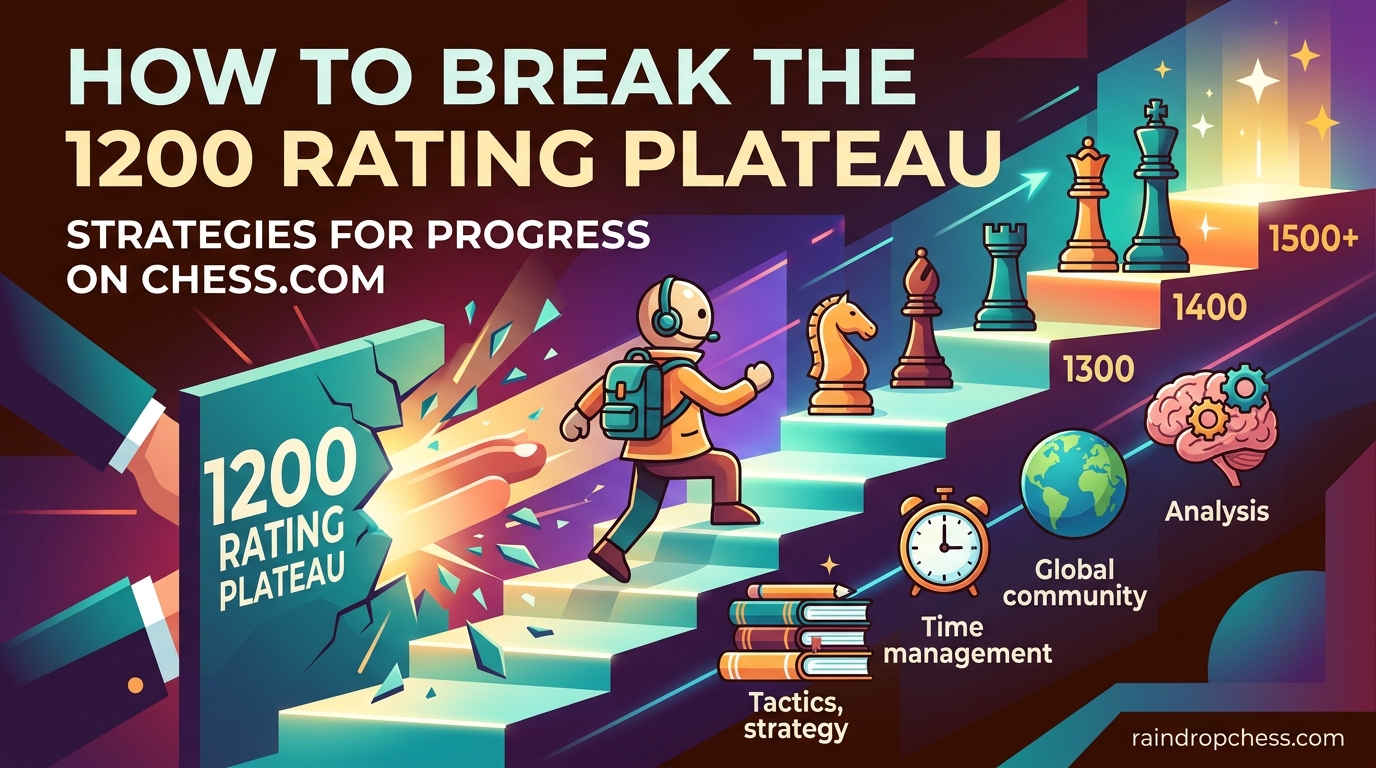
You hit 1200 on Chess.com after a few months of playing. The climb felt steady, even easy. Then something happened. Your rating stopped moving. Weeks turned into months, and you are still hovering between 1150 and 1250. I have been there. Our team has talked to hundreds of players stuck at this exact rating, and the patterns are always the same. The good news is that breaking the 1200 rating plateau on Chess.com is absolutely possible with the right approach. This guide gives you a complete training system built specifically for the 1200 level, using Chess.com features that most players ignore.
By the end of this article, you will have a step-by-step blunder-checking system, a weekly training schedule that fits into a busy life, and specific Chess.com tools to leverage for faster improvement.
Table of Contents
Understanding the 1200 Rating Barrier
A 1200 rating on Chess.com places you in the top 10 to 15 percent of all users on the platform. That might surprise you, but most casual players never break 1000. You have already proven you understand basic tactics, can spot simple forks, and know how to deliver checkmate with queen and king. The 1200 barrier exists because this is where raw talent stops being enough. Players at this level have stopped hanging pieces to one-move threats, but they still miss two-move combinations. They know basic openings but get lost in the middlegame.
The 1200 plateau is actually a sign of progress. You have mastered beginner fundamentals. Now the real work begins. The skills that got you to 1200 will not get you to 1400. You need new tools, and you need to use them consistently.
Why Most Players Get Stuck at 1200
After analyzing forum discussions from hundreds of 1200-rated players, we identified the same five mistakes appearing again and again. These are not complex strategic errors. They are fundamental habits that sabotage every game.
Playing Too Fast
Time trouble destroys more 1200-rated games than any tactical deficiency. You spend 30 seconds on move five, then have two minutes for fifteen critical moves. The result is rushed decisions and missed blunder-checks. Slow down in the opening. You do not need to memorize theory, but you should have a plan for your first eight moves.
Skipping Game Analysis
Playing ten games without analysis teaches you less than playing three games with thorough review. At 1200, every loss contains two or three critical mistakes you can identify and fix. Without analysis, you repeat the same errors for months. Chess.com provides a free game review tool that shows your inaccuracies, mistakes, and blunders. Use it.
Focusing on the Wrong Things
Many 1200 players spend hours watching opening videos and studying complex variations. They lose games because they hang their queen on move 23. At this level, tactics outweigh opening knowledge by a huge margin. You need to see threats, not memorize lines. Study openings just enough to reach a playable middlegame, then focus on not blundering.
No Blunder-Checking Routine
Before you touch a piece, what do you check? For most 1200 players, the answer is nothing. They see a good move and play it immediately. This is why you miss that your knight is pinned, or that your queen is hanging after the capture. A simple pre-move checklist eliminates most one-move blunders.
Inconsistent Training
You play five games on Monday, skip Tuesday through Friday, binge ten games on Saturday, then feel burned out for a week. Improvement requires consistent daily practice, even if it is just 20 minutes. The players who break through 1200 are not necessarily smarter or more talented. They are more consistent.
The Foundation: Tactics Training That Actually Works
Tactics training is not optional at the 1200 level. It is the single highest-leverage activity you can do. The problem is that most players practice tactics incorrectly. They rush through puzzles, guess at moves, and forget patterns immediately. Here is how to train tactics effectively on Chess.com.
Use Chess.com Puzzles Daily
Chess.com offers unlimited puzzles with adaptive difficulty. Start with puzzles rated 200 points below your current puzzle rating. The goal is accuracy, not speed. Spend up to three minutes on each puzzle. If you do not see the solution, try for the full three minutes before giving up. This builds calculation stamina.
Aim for 15 to 25 puzzles per day. This takes 20 to 30 minutes and creates real pattern recognition. Players who do this consistently for three months report seeing tactics in games they would have missed before.
Try Puzzle Rush for Pattern Speed
Puzzle Rush is a Chess.com feature where you solve as many puzzles as possible in three or five minutes. It trains pattern recognition speed, which helps you spot tactics faster in real games. Do one Puzzle Rush session after your regular puzzle training. Do not use Puzzle Rush as your only tactics practice. Speed without accuracy is useless.
Focus on the Big Five Patterns
At 1200, you do not need to know every mating pattern. You need to spot these five instantly: forks, pins, skewers, discovered attacks, and back-rank mates. When you miss a tactic in a game, note which pattern you failed to see. This creates targeted practice. If you keep missing forks, drill fork puzzles until they are automatic.
Game Analysis: Your Secret Weapon
Every game you play contains lessons. Without analysis, you learn nothing. With analysis, every loss becomes a stepping stone. Here is the system we recommend.
Step 1: Review Immediately After
Right after your game ends, open Chess.com’s game review. Do not wait until tomorrow. Your memory of your thought process fades quickly. The game review shows you where you made mistakes, what the best moves were, and alternative lines.
Step 2: Identify the Critical Moment
Every game has one or two moves that decide the result. Find yours. It is usually a blunder, a missed tactic, or a positional error that gave your opponent a lasting advantage. Write down what you should have done differently.
Step 3: Analyze One Game Deeply Per Week
Pick your most instructive loss from the week. Spend 20 minutes analyzing it without an engine. Try to find the best moves yourself. Then check with the engine. This builds calculation skills that puzzles alone cannot develop.
The Blunder-Check System
Most 1200-rated games are decided by one-move blunders, not deep strategic understanding. You can eliminate 80 percent of your blunders with a simple pre-move checklist. Here is the exact routine used by players who successfully broke through this plateau.
Before you touch a piece, ask yourself these questions:
- What is my opponent threatening? Look at their last move and identify any checks, captures, or attacks they just created.
- Is the square I am moving to safe? If you are placing a piece on a new square, verify it cannot be captured.
- Am I leaving anything hanging? Check that your move does not leave a piece or pawn undefended.
- What happens after my move? Imagine your opponent’s most forcing replies. Can they check you? Can they capture something?
- Is there a better move? Spend five seconds looking for tactics. Can you win material or deliver checkmate?
This takes 10 to 15 seconds per move. In a 10-minute game, that is two and a half minutes total. You will spend more time than that recovering from one blunder. Make this automatic, and your rating will climb.
Weekly Training Schedule for Breaking 1200
Consistency beats intensity. Here is a weekly training plan designed for busy schedules. It requires 45 to 60 minutes per day, five days per week.
Monday: Tactics Focus
25 puzzles on Chess.com, focusing on accuracy over speed. Follow with one 5-minute Puzzle Rush. Play two rapid games (10+0) and analyze both immediately.
Tuesday: Game Analysis
Play three rapid games. Spend 30 minutes doing deep analysis of your best loss. Use the Chess.com analysis board to explore alternative lines.
Wednesday: Pattern Training
Work through Chess.com lessons on specific tactics. Focus on one pattern: forks today, pins tomorrow. Complete 15 puzzles on that specific theme. Play two rapid games.
Thursday: Rest or Light Practice
Take a break from playing. Do 10 puzzles and review one previously analyzed game. Look for patterns in your mistakes.
Friday: Match Simulation
Play five rapid games with full focus. Use your blunder-check system on every move. Analyze each game immediately after. Track how many games you won versus lost.
Saturday: Deep Study
Choose one game from the week and analyze it without an engine for 30 minutes. Then check your analysis with Chess.com’s engine. Study one basic endgame: king and pawn versus king, or rook endgames.
Sunday: Rest
No chess. Mental recovery is part of training. Burnout kills more improvement plans than lack of talent.
Time Control Strategy
The time control you choose significantly impacts your improvement rate. At 1200, rapid chess (10 minutes or more) is your best training ground. You have time to think, apply your blunder-check system, and learn from your decisions. Blitz (3 to 5 minutes) is fun but teaches bad habits. You rely on instinct instead of calculation.
Bullet chess (1 minute or less) is actively harmful for improvement at this level. It rewards premoving and pattern recognition without understanding. Avoid bullet entirely until you reach 1600 or higher.
Play 80 percent of your games at 10+0 or 15+10. Use 5+3 for variety. Track your results separately. Many players find their rapid rating climbs while their blitz stays flat. This is normal and expected.
Mindset Shifts for Long-Term Improvement
Rating plateaus test your patience. Here are the mindset shifts that separate players who break through from those who stay stuck.
Focus on Skill, Not Rating
Your rating is a lagging indicator. It reflects your skill from weeks ago, not today. Obsessing over daily rating changes creates anxiety and poor decisions. Track your tactics accuracy, your game analysis completion, and your blunder rate instead. These lead to rating gains.
Expect Setbacks
You will lose games you should win. You will drop 50 rating points in a bad session. This is normal. Plateau breakthroughs are not linear. You might stay flat for a month, then jump 100 points in a week. Trust the process.
Know When to Take a Break
If you lose three games in a row, stop playing. Tilt destroys rating more than any opening. Step away for an hour or a day. Come back when you can think clearly. The players who broke through 1200 report that breaks after losses were crucial to their success.
How to Break the 1200 Rating Plateau on Chess.com
Breaking the 1200 rating plateau on Chess.com requires a systematic approach. Start by implementing the blunder-check system on every move. Add daily tactics training with 15 to 25 puzzles. Analyze every game you play, focusing on the critical moments where the result was decided. Follow the weekly training schedule for at least eight weeks before judging your progress.
Most importantly, remember that 1200 is a respectable rating that puts you ahead of most casual players. The skills you build now will carry you far beyond 1400 and 1600. Be patient, stay consistent, and trust that the work will show in your results.
Frequently Asked Questions
Is 1200 a decent chess rating?
A 1200 rating on Chess.com places you in the top 10 to 15 percent of all users on the platform. It represents a solid intermediate beginner level where you understand basic tactics and can avoid one-move blunders. While there is significant room for improvement, reaching 1200 means you have already surpassed most casual players.
What is the 20-40-40 rule in chess?
The 20-40-40 rule suggests spending 20 percent of your study time on openings, 40 percent on middlegame tactics, and 40 percent on endgames. At the 1200 level, most players should actually spend closer to 60 percent on tactics, 25 percent on endgames, and only 15 percent on openings. Pattern recognition matters far more than memorizing lines.
How long does it take to go from 1200 to 1400 on Chess.com?
With consistent daily practice of 45 to 60 minutes, most players can climb from 1200 to 1400 in two to six months. The timeline depends on your study quality, not just quantity. Players who follow structured training plans and analyze their games consistently tend to improve faster than those who simply play more games.
What should I study at 1200 chess rating?
Focus on these priorities in order: tactics and pattern recognition, blunder prevention techniques, basic endgame fundamentals, and game analysis methods. Openings should be simplified to just a few solid systems. Avoid complex opening theory until you reach 1400 or higher.
Why am I stuck at 1200 chess.com despite playing daily?
Playing without deliberate practice rarely produces improvement. You are likely repeating the same mistakes without identifying them. Focus on analyzing your losses, using the blunder-check system, and training tactics with purpose rather than just playing game after game.
Conclusion
The 1200 rating plateau on Chess.com is frustrating, but it is also a sign that you are ready for the next level. You have mastered the basics. Now you need consistency, a structured approach, and patience. Start with the blunder-check system today. Add the weekly training schedule this week. Track your progress over the next two months. The players who break through are not necessarily more talented. They are more disciplined. You can join them.