

I have spent the last several years working through dozens of annotated game collections, and I can tell you with certainty that studying master games is the single most effective way to improve at chess. When I first picked up a game collection book, my rating jumped 200 points in three months. That experience convinced me that the best chess game collection books are not just reading material — they are structured training tools that build pattern recognition, strategic understanding, and tactical vision all at once.
Game collection books differ from puzzle books and opening manuals. They present complete games played by masters and world champions, with annotations that explain why each move was chosen. You see the full arc of a chess game: the opening ideas, the middlegame plans, the endgame technique. This gives you something no puzzle book can — context. You learn not just how to find the right move, but how to reach positions where the right move exists.
Whether you are rated 800 or 2200, there is a game collection book on this list that will push your understanding forward. Our team has reviewed 12 of the most respected chess game collection books available right now, organized by skill level so you can find exactly what you need. If you are also looking for broader chess learning resources, the Raindrop Chess homepage has additional guides worth exploring.
Table of Contents
Top 3 Picks for Best Chess Game Collection Books


The Mammoth Book of the World’s Greatest…
- 125 annotated games
- Computer-verified analysis
- Kindle and print

Zurich International Chess Tournament 1953
- 210 games
- Greatest tournament book
- Bronstein annotations
Best Chess Game Collection Books in 2026
1. Logical Chess: Move By Move — The Gold Standard for Beginners
Logical Chess: Move By Move: Every Move Explained New Algebraic Edition
256 pages
Every move explained
32 grandmaster games
Batsford Chess series
Pros
- Every single move explained in detail
- Classic openings covered including Ruy Lopez and Queen's Gambit
- Repetition of key ideas reinforces learning
- Readable 30-minute sessions per game
Cons
- Annotations stay at beginner level throughout
- Some analysis does not hold up to modern engines
- Can feel repetitive for experienced players
I started my own chess improvement journey with this book, and I still recommend it as the very first game collection any beginner should own. Irving Chernev takes 33 grandmaster games and explains every single move — not just the important ones, but literally every move on the board. This means you never get lost, never wonder why a pawn was pushed, and never feel like you are missing something.
The genius of this approach is that Chernev repeats important concepts across different games. After seeing the same strategic ideas appear in the Italian Game, the Ruy Lopez, and the Queen’s Gambit, those ideas become permanent fixtures in your chess thinking. I found myself recognizing patterns in my own online games after just a few weeks of studying this book.
Each game takes about 30 minutes to play through, making it easy to fit into a daily study routine. The openings covered — the Italian Game, Ruy Lopez, Colle System, and Queen’s Gambit — are all openings beginners encounter regularly, so the lessons transfer directly to practical play.
The main limitation is that Chernev keeps the analysis at a uniformly beginner level. Once you understand the basics, you will outgrow this book. Some of the analysis also does not survive scrutiny by modern chess engines like Stockfish. But as a starting point, nothing else comes close.
Who should read this book
Players rated under 1400 who want to understand why good moves are good. If you know how the pieces move and can play a full game, but feel lost when trying to figure out what to do in the middlegame, this book was written for you. It is also excellent for coaches looking for material to use with beginner students.
What to watch out for
The book uses algebraic notation, which is the modern standard. However, the analysis is strictly strategic — there is very little on tactics or calculation. You will want a separate tactics book to complement this one. Also, expect to use a physical board or a chess app alongside it, since the diagrams alone are not enough to follow every move.
2. The Most Instructive Games of Chess Ever Played — 62 Strategic Masterpieces
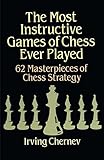
The Most Instructive Games of Chess Ever Played: 62 Masterpieces of Chess Strategy
279 pages
62 masterpieces
Dover Chess series
Strategic focus
Pros
- One clear lesson per game highlighted
- Chernev's witty and accessible prose
- Classic games from Pillsbury to Fischer era
- Conversational commentary style
Cons
- Written in descriptive notation not algebraic
- Reprint quality is mediocre
- No diagrams for every move
- Games are decades old
This is Chernev’s follow-up to Logical Chess, and it takes a different approach. Instead of explaining every move, he focuses on one main instructive lesson per game, with additional mini-lessons woven throughout the commentary. Each game has a memorable title that sticks with you — I still remember “The Pawn That Walked to Queen” years after reading it.
The games span from the Pillsbury era through to Fischer, covering some of the most instructive strategic battles ever played. Chernev’s prose is at its best here — witty, passionate, and genuinely entertaining. I found myself reading this book for pleasure as much as for instruction, which is rare for chess literature.
The major drawback is the descriptive notation. If you learned chess after 1990, you likely learned algebraic notation, and reading descriptive notation (like P-K4 instead of e4) takes getting used to. Some readers find it a dealbreaker; others adapt within a few games. I adapted, but I understand the frustration.
The reprint quality from Dover is also disappointing. Several reviewers mention photocopied pages with poor resolution. The content is phenomenal, but the physical production does not match it. Despite these issues, the instructional value of Chernev’s commentary makes this book worth owning.
Who should read this book
Beginners and intermediate players rated 800-1500 who want to understand strategic chess concepts through classic games. If you enjoyed Logical Chess Move by Move and want more Chernev with slightly deeper analysis, this is the natural next step. It is also a great companion to a tactics training routine.
What to watch out for
Learning descriptive notation takes effort, and there are online conversion tools that can help. The book also lacks modern analysis — some of the games have been re-analyzed by engines with different conclusions. Use this for the strategic ideas, not for the specific variations.
3. Morphy’s Games of Chess — 300 Games from the Romantic Era
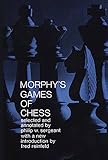
Morphy’s Games of Chess
384 pages
300 Morphy games
Biographical context
Dover Chess
Pros
- Definitive collection of 300 games
- Biographical material alongside annotations
- Simple clear annotations easy to follow
- Direct tactical play teaches attacking chess
Cons
- Uses descriptive notation
- Biographical rather than instructional annotations
- Missing modern diagrams and engine analysis
- Limited middlegame instruction
Paul Morphy is the original chess prodigy, and his games remain some of the most instructive examples of rapid development, open files, and piece coordination. Philip Sergeant collected 300 of Morphy’s games with annotations that blend biographical context with chess commentary. I found reading through these games gave me a much sharper sense of when and how to launch attacks.
The games are organized into categories: tournament games, casual games, and odds games (where Morphy gave up material to weaker opponents). This organization helps you see different facets of Morphy’s play. The tournament games show him at his most serious; the casual games reveal his creativity; the odds games demonstrate pure technique.
Sergeant’s annotations are straightforward and easy to follow, making this book approachable even for players who normally struggle with annotated games. The main teaching point that comes through every game is the importance of rapid development and central control — lessons that never go out of style in chess.
Who should read this book
Beginners and intermediate players rated 800-1600 who want to learn attacking chess from the master of open positions. Morphy’s games are particularly useful for players who struggle to convert advantages in open games. The book is also excellent for anyone interested in chess history.
What to watch out for
The descriptive notation is a barrier, same as with many Dover publications. The annotations are more biographical than instructional — you will learn about the circumstances of each game, but you will not get the deep move-by-move explanation that Chernev provides. Pair this with a more instructional book for best results.
4. Understanding Chess Move by Move — The Modern Successor to Chernev

Understanding Chess Move by Move
240 pages
30 GM games
Themed by Opening, Middlegame, Endgame
Gambit Publications
Pros
- Superior analysis to Chernev's classic
- Modern games from the 1990s more relevant today
- Organized by themes for targeted study
- Clear enough for beginners yet deep enough for advanced players
Cons
- Some variations are too dense to follow without multiple boards
- Games lean tactical rather than strategic
- Not ideal for absolute beginners
- Alternative lines can overwhelm
John Nunn took Chernev’s move-by-move concept and upgraded it with stronger analysis and more modern games. The 30 games in this collection come from the 1990s, meaning the openings, plans, and positions are directly relevant to what you will face in your own games today. When I first read this book, I was struck by how much more practical the games felt compared to the pre-1950 classics.
The organization is particularly well thought out. Games are grouped by Opening Themes, Middlegame Themes (further split into Attacking, Defensive, and Positional), and Endgame Themes. This means you can target specific weaknesses in your play. Struggling with defense? Go straight to the defensive middlegame section. Need endgame help? The endgame chapter has you covered.
Nunn explains the reasoning behind every move, just like Chernev, but his analysis goes deeper and has been checked against modern engines. He is not afraid to point out when the losing player made the critical mistake, and his explanations of positional concepts like pawn structures and piece coordination are first-rate.
Who should read this book
Intermediate players rated 1400-1900 who have already worked through Logical Chess and want the next step. Nunn’s book assumes you understand basic strategic concepts and are ready for deeper, more nuanced explanations. It is also valuable for advanced players who want a well-organized reference collection.
What to watch out for
The variation density can be overwhelming. Some positions have three or four alternative lines branching off the main game, and following all of them requires either a second board or a chess app. I recommend setting up the main game on a board and reading the text without trying to follow every single variation the first time through.
5. Chess: The Art of Logical Thinking — From the First Move to the Last

Chess: The Art of Logical Thinking: From the First Move to the Last
256 pages
30 master games
Move-by-move commentary
Batsford
Pros
- Prose explanations rather than heavy variations
- Games from top GMs including Kasparov and Kramnik
- Covers wide variety of modern openings
- Good for players rated 1200-2000
Cons
- Every-move commentary can feel repetitive for openings
- Only 9 games where Black wins
- Some strategic plans lack depth
- Minor editorial errors
Neil McDonald’s contribution to the move-by-move genre sits comfortably between Chernev’s beginner-friendly approach and Nunn’s deeper analysis. The 30 games feature top grandmasters — Kramnik, Karpov, Kasparov, Anand — playing openings that intermediate players actually use. I appreciated that McDonald covers openings Chernev never touched, like the Sicilian Defense, King’s Indian, and Gruenfeld.
What makes this book special is McDonald’s prose style. Instead of drowning you in variations, he writes in clear, conversational English that explains what is happening on the board and why. This makes the book genuinely enjoyable to read, not just study. I found myself reading games before bed, something I rarely do with denser chess books.
The main weakness is that McDonald comments on every move, including routine opening moves, which can feel tedious after you have seen the same opening idea explained for the fifth time. The imbalance of results (21 White wins, only 9 Black wins) also means you get a skewed perspective. Still, the quality of the games and explanations makes this a solid choice.
Who should read this book
Intermediate players rated 1200-1800 who want a readable game collection without excessive variations. If you find Nunn’s analysis too dense but Chernev too basic, McDonald fills the gap perfectly. It also works well as a second book after completing Logical Chess.
What to watch out for
The opening commentary repeats ideas you already know if you have basic opening knowledge. Skim the first ten moves of each game and focus your attention on the middlegame and endgame phases, where McDonald’s explanations shine. Also, be aware of the minor editorial errors in organization — some cross-references point to wrong game numbers.
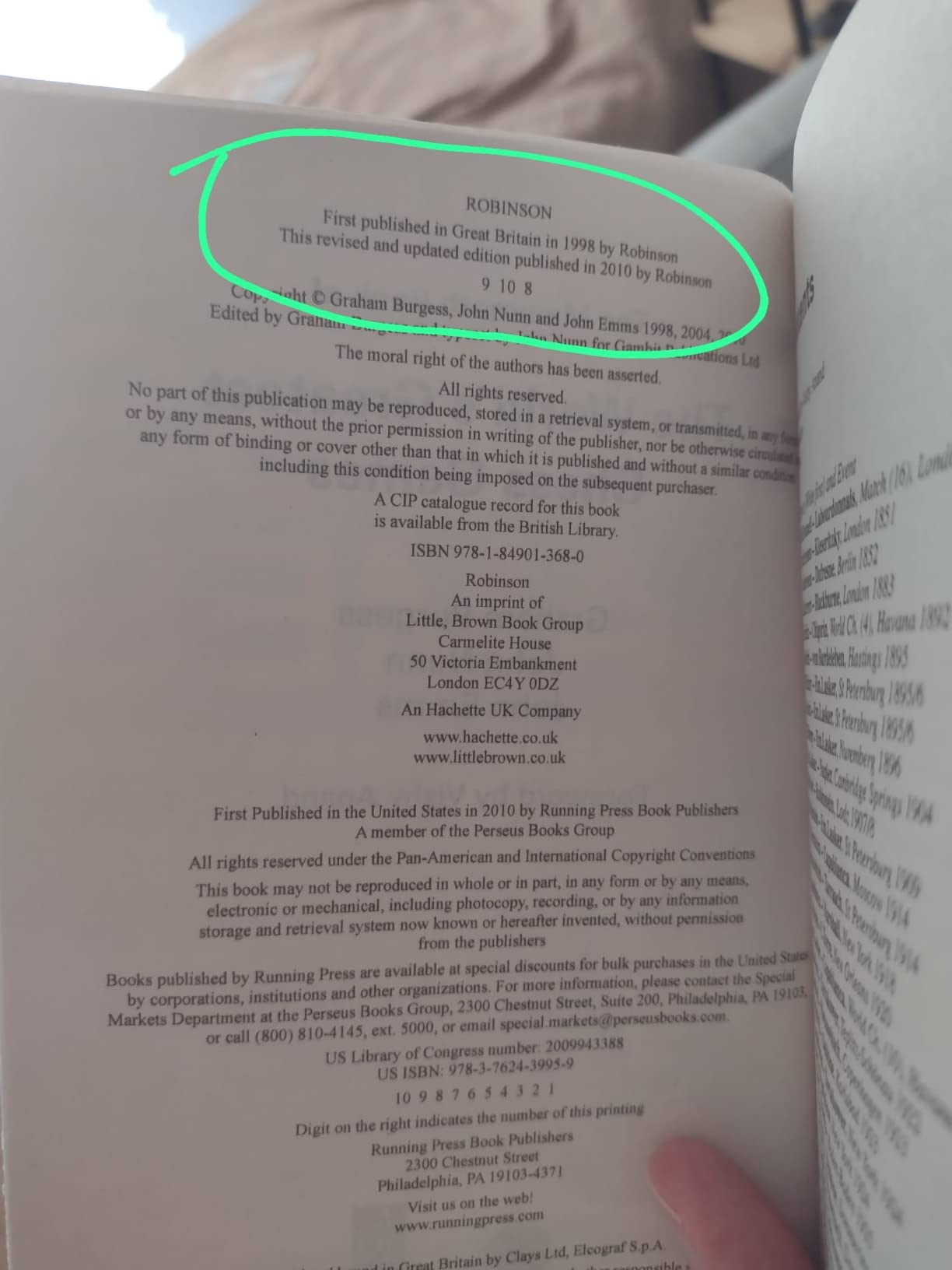
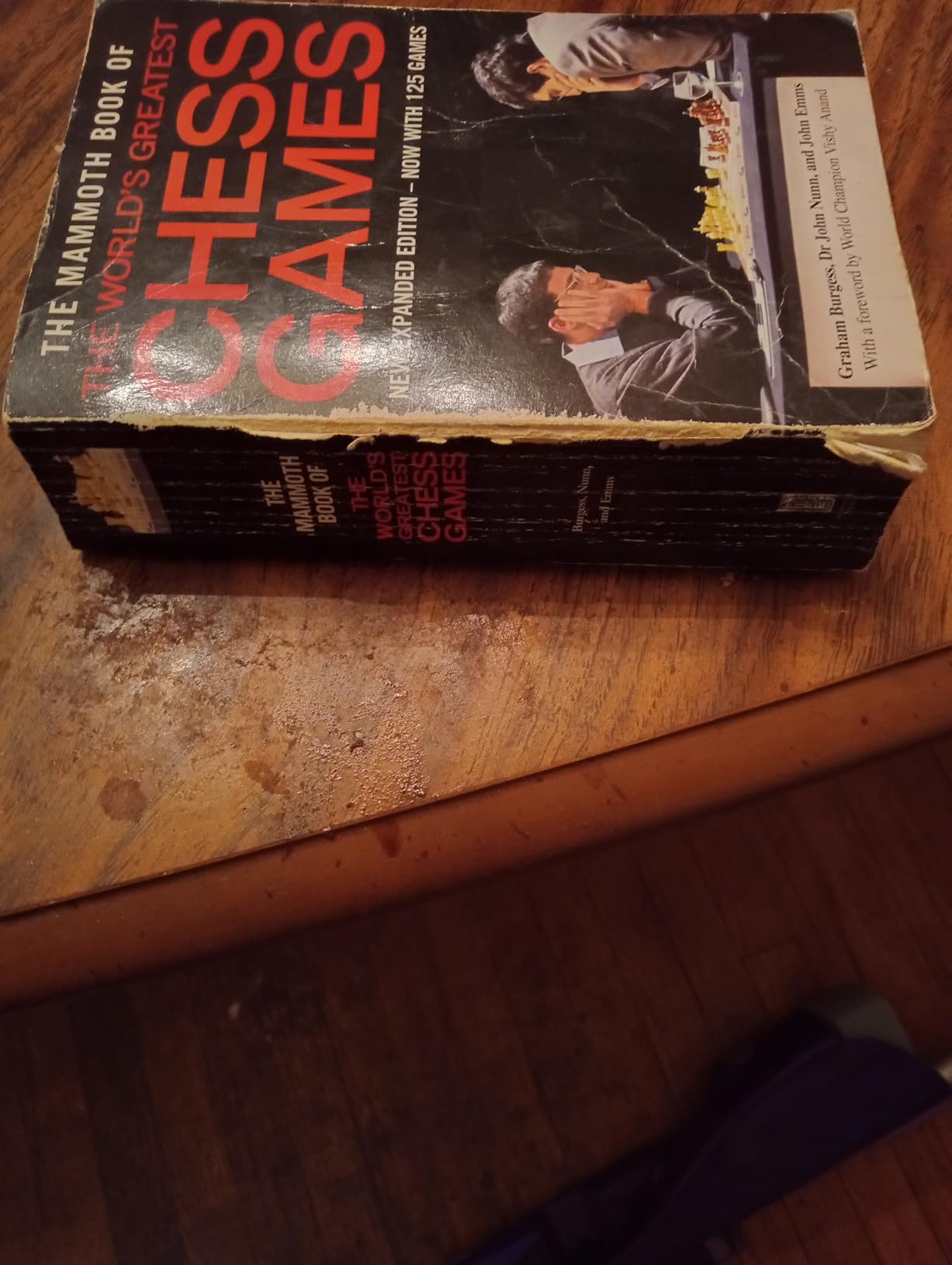
6. The Mammoth Book of the World’s Greatest Chess Games — 125 Verified Masterpieces
The Mammoth Book of the World’s Greatest Chess Games .: New edn (Mammoth Books)
125 annotated games
Modern 2021 edition
Computer-verified analysis
Robinson publisher
Pros
- 125 superbly annotated games with extensive analysis
- Computer analysis used to verify historical annotations
- Player introductions and historical notes included
- Summary lessons at end of each game
Cons
- Kindle version lacks proper navigation index
- Print edition paper quality described as poor
- Some editions may be older than advertised
- Print size is small
If you could only own one game collection book, this would be a strong candidate. The team of Burgess, Nunn, and Emms (later joined by Adams, Anand, and So for the newest edition) selected 125 games through a thorough voting process, then annotated them with deep analysis that includes both the authors’ thoughts and those of other experts. I have worked through about 60 of these games so far, and the quality is consistently high.
What sets this collection apart is the use of modern computer analysis to verify and correct historical annotations. When a 19th-century annotator claimed a move was the only winning continuation, the authors checked it against engines and tell you whether the old analysis holds up. This gives you confidence that what you are learning is accurate.
Each game ends with three summarized lessons, making it easy to review what you learned. The player biographies and historical context add depth — you understand not just what was played, but why and under what circumstances. The Kindle edition at this price point represents extraordinary value for the amount of content you receive.
The main complaints center on production quality. The print edition uses small text on thin paper, and the Kindle version lacks a proper index to navigate between games. These are real issues, but they do not diminish the exceptional quality of the content itself.
Who should read this book
Intermediate to advanced players rated 1400-2200 who want a comprehensive collection spanning chess history. This book works as both a study tool and a reference — you can dip into it for a single game or work through it systematically. The Kindle version is especially good for travel study.
What to watch out for
The annotation depth varies — some games receive extensive analysis while others are more lightly annotated. If you are a beginner, the denser games may overwhelm you. Start with the games that have shorter annotation sections and work your way up. Also, the 2021 edition added 20 new games but the Kindle formatting for these additions can be inconsistent.
7. Capablanca’s Best Chess Endings — 60 Complete Games with Endgame Mastery

Capablanca’s Best Chess Endings: 60 Complete Games
288 pages
60 complete games
Endgame focused
Dover Publications
Pros
- Practical endgame instruction through complete games
- Chernev's entertaining writing style
- Covers wide variety of endgame positions
- Includes indexes for openings and themes
Cons
- Uses long form algebraic notation
- Occasional analysis errors
- Author rarely criticizes Capablanca's mistakes
- Middlegame annotations less thorough
Most endgame books present isolated positions and studies. Chernev takes a different approach here: he gives you 60 complete Capablanca games, focusing on the endgame phase. This means you see how Capablanca reached the endgame, what technical skills he used to convert advantages, and how he handled equal positions. I found this practical approach far more useful than studying abstract endgame theory.
Capablanca is widely considered one of the greatest endgame players in chess history, and watching him technique his way through rook endings, bishop versus knight positions, and queen endings is genuinely instructive. Chernev’s annotations highlight the key moments where small advantages were accumulated or converted.
The book uses long form algebraic notation (writing d2-d4 instead of just d4), which some readers find unnecessarily verbose. There are also occasional analysis errors — both by Chernev and by Capablanca himself. Chernev tends to be too generous in his praise of Capablanca, sometimes overlooking clear mistakes. Despite these issues, the endgame instruction is first-rate.
Who should read this book
Intermediate players rated 1500-2200 who specifically want to improve their endgame play through practical examples. This is not a beginner book — you need solid endgame fundamentals before the lessons here make sense. It is particularly valuable for tournament players looking to convert more drawn endgames into wins.
What to watch out for
Do not expect balanced analysis. Chernev was a huge Capablanca fan, and it shows. You will need to be skeptical of his evaluations and perhaps run the critical positions through your own engine. The long-form notation also takes getting used to if you are accustomed to standard algebraic notation.
8. Zurich International Chess Tournament, 1953 — The Greatest Tournament Book Ever Written
Zurich International Chess Tournament, 1953 (Dover Chess)
384 pages
210 games
1953 Candidates Tournament
Dover Chess
Pros
- Considered the greatest tournament book ever written
- Bronstein's prose makes grandmaster play approachable
- Memorable sayings that stay with you
- Excellent for positional understanding
Cons
- Not ideal for absolute beginners
- Style can be off-putting to some readers
- Small text format
- Limited player profiles
This book has been called the greatest tournament book ever written, and after working through it twice, I understand why. David Bronstein covered the 1953 Zurich Candidates Tournament — a 15-player round robin featuring the strongest players in the world competing for the right to challenge Botvinnik for the World Championship. The result is 210 annotated games that read like a novel.
Bronstein’s approach is unlike any other annotator. Instead of filling pages with variations and computer lines, he uses verbal explanations to describe what is happening on the board. His prose is filled with memorable sayings that have become part of chess culture. Phrases like “the hardest thing in chess is to win a won game” and his descriptions of pawn structures have stuck with me for years.
The games themselves are a masterclass in positional chess. You will see Smyslov’s harmonious piece play, Keres’s attacking brilliance, Bronstein’s own creative approach, and Petrosian’s prophylactic genius. The tournament format means you can follow the narrative arc of the event — who was leading, who collapsed, who surged at the end.
This is not a book for beginners. Bronstein assumes you understand basic positional concepts, and his explanations, while poetic, skip steps that less experienced players need. Players rated below 1200 will find this book frustrating. But for anyone serious about understanding positional chess at a high level, this is essential reading.
Who should read this book
Intermediate to advanced players rated 1600+ who want to understand positional chess through the lens of an elite tournament. Tournament players will particularly benefit from seeing how the world’s best handle different opening systems and middlegame structures under pressure. It is also a must-have for chess history enthusiasts.
What to watch out for
Bronstein’s annotations sometimes hide his own mistakes — he was, after all, annotating his own games too. His prose-heavy style means fewer concrete variations, which some analytical players find unsatisfying. The Dover edition has small text, so consider whether the physical format works for your study setup.
9. My Best Games of Chess, 1908-1937 — Alekhine’s Masterpiece Updated

My Best Games of Chess, 1908-1937, 21st Century Edition
456 pages
Alekhine's complete games 1908-1937
21st Century Edition
Algebraic notation
Pros
- Alekhine's own insightful personal annotations
- Updated to modern algebraic notation
- Includes tournament tables and ECO code indexes
- Bonus downloadable computer analysis
Cons
- Some diagrams have non-standard orientation
- Complex analysis requires patience
- Occasional errors in supplemental material
Alexander Alekhine was one of the most creative attacking players in chess history, and his own annotations reveal a mind that saw combinations others could not imagine. This 21st Century Edition from Russell Enterprises updates the classic with algebraic notation and supplementary material, making it accessible to modern readers while preserving Alekhine’s original commentary.
The book covers Alekhine’s games from 1908 through 1937, spanning his rise to the World Championship and his most creative period. Each game is annotated by Alekhine himself, and his notes are remarkably insightful — he explains not just what he played, but what he was thinking, what alternatives existed, and why his chosen path was strongest. I found his attacking annotations particularly valuable for understanding how to build and execute kingside assaults.
The bonus downloadable computer analysis is a thoughtful addition. It lets you compare Alekhine’s evaluations with modern engine analysis, which is fascinating — sometimes Alekhine’s instincts were validated by the machine, and sometimes the engine found improvements that even the fourth World Champion missed.
Who should read this book
Advanced players rated 1800+ who want to study attacking chess from one of the greatest attackers in history. This is also essential reading for anyone interested in chess history, particularly the period between the World Wars. The depth of analysis rewards repeated study over months or years.
What to watch out for
Alekhine’s annotations can be surprisingly dense for a supposedly autobiographical work. He sometimes skips explanations that seem obvious to him but are not obvious to the reader. Be prepared to spend 45-60 minutes on a single game if you want to follow all the variations. The non-standard diagram orientation (black pieces at bottom in some positions) is also mildly distracting.
10. 500 Master Games of Chess — A Historical Encyclopedia of Master Play

500 Master Games of Chess (Dover Chess)
720 pages
500 master games
Organized by opening
Dover Chess
Pros
- Massive collection of 500 annotated games
- Tartakower's excellent annotations with wit and insight
- Games organized by opening and chronologically
- Shows how openings evolved historically
Cons
- Uses descriptive notation
- Small font size
- Thick book hard to keep open
- Games predate modern era
At 720 pages and 500 games, this is the most comprehensive single-volume game collection on our list. Grandmaster Tartakower and J. du Mont compiled games from the pre-1940 era, annotated them with Tartakower’s trademark wit, and organized them by opening type and chronological order. The result is both a chess instruction book and a historical document.
The chronological organization within each opening is unexpectedly valuable. By reading games in order, you can see how opening theory evolved over decades — how the Italian Game became the Ruy Lopez, how the Queen’s Gambit developed from simple to sophisticated. I found this historical perspective gave me a much deeper understanding of the openings I play.
Tartakower’s annotations deserve special mention. He was not only a strong grandmaster but also one of chess’s great wits. His commentary sparkles with aphorisms and insights that make the games memorable long after you have put the book down. The annotations are lighter than Nunn or Bronstein, focusing on key moments rather than every move, which makes the 500 games manageable.
Who should read this book
Advanced players and chess historians who want a reference library of classic games. This is not a book you read cover to cover — it is one you keep on your shelf and consult when you want to study a particular opening’s history or find examples of a specific strategic theme. The sheer volume of games makes it unmatched as a reference tool.
What to watch out for
The descriptive notation is a significant barrier, and the small font size compounds the difficulty. The book is physically thick and difficult to keep open on a desk while you set up pieces. Consider using a book holder or studying from a digital board alongside it. The games are all pre-1940, so you will not find modern opening lines here.
11. Magnus Carlsen’s Most Instructive Games — Modern Play from the Greatest of All Time
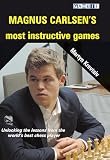
Magnus Carlsen’s Most Instructive Games (Chess World Champions)
176 pages
42 Carlsen games
Thematic chapters
Gambit Publications
Pros
- Excellent detailed annotations of Carlsen games
- Thematic chapters organized by strategic concepts
- Games from 2016-2019 modern and relevant
- Gambit Publications quality
Cons
- Only 42 games in 176 pages
- Relatively new with fewer reviews
- No significant cons noted by reviewers
Most game collection books feature players from the 19th and 20th centuries. This one focuses on Magnus Carlsen, the highest-rated player in chess history, and covers his games from 2016-2019. The modern timeframe means every opening line, every strategic concept, and every tactical pattern is directly relevant to what you will face in your own games in 2026.
The thematic chapter organization is particularly effective for learning. Instead of chronological order, the games are grouped by concepts like counterplay, positional squeeze, and strategic conversion. This means you see multiple examples of the same idea applied in different positions, which accelerates pattern recognition. I found the chapters on Carlsen’s positional technique especially valuable — nobody grinds out small advantages like Carlsen.
Published by Gambit Publications, the production quality is high. The annotations are detailed and in-depth, written for serious players who want to understand not just what Carlsen played, but the reasoning behind his choices. At 176 pages with 42 games, each game receives substantial attention without being overwhelming.
Who should read this book
Intermediate to advanced players rated 1500-2200 who want to study modern chess at the highest level. If you are tired of game collections featuring openings nobody plays anymore, this is the antidote. It is also excellent for players who want to understand Carlsen’s unique style of accumulating and converting small advantages.
What to watch out for
With only 42 games in 176 pages, this is a focused collection rather than a comprehensive reference. The annotation depth is significant, so expect to spend 30-45 minutes per game. Some readers may wish for more games at the expense of annotation depth, but I find the focused approach more effective for learning.
12. Bobby Fischer: My 60 Memorable Games — Collector’s Edition

Bobby Fischer: My 60 Memorable Games Collectors Edition
392 pages
60 Fischer games
Collector's hardcover
Batsford publisher
Pros
- Fischer's original annotations preserved unedited
- Modern algebraic notation
- High quality hardcover collector's edition
- Introduction by GM Andy Soltis
Cons
- Some copies have quality control issues
- Missing the famous Game of the Century
- Kindle layout has problems
- Some faulty analysis in older sections
Fischer’s My 60 Memorable Games has been called the best annotated chess book ever written, and this Collector’s Edition from Batsford presents it in a handsome hardcover format with modern algebraic notation. Fischer annotated all 60 games himself, including losses and draws alongside his victories, which gives the book a rare honesty and self-critical depth.
What makes Fischer’s annotations special is his willingness to reveal his thought process — the doubts, the miscalculations, the moments of uncertainty. Most game collection books present games as if the winner knew what they were doing all along. Fischer shows you the messy reality of competitive chess, where even the eleventh World Champion sometimes winged it. I found this honesty far more instructive than the polished narratives in most game collections.
The games span Fischer’s career from his teenage years through his 1972 World Championship match, covering his most creative and competitive period. You see his development as a player, from brilliant but inconsistent youngster to the dominant force that swept through the 1970-1972 Candidates matches. The hardcover edition includes an introduction by GM Andy Soltis that adds historical context.
Who should read this book
Intermediate to advanced players rated 1400+ who appreciate deep, honest annotations from one of the greatest players ever. This is also a collector’s item — the hardcover edition makes a beautiful gift for any chess enthusiast. Fischer’s annotations reward repeated reading, as you will discover new insights each time through.
What to watch out for
Quality control on this edition has been inconsistent. Some copies do not match the official cloth binding specification, and the Kindle version has layout issues. Check your copy when it arrives. Also note that this edition does not include the famous “Game of the Century” (Fischer vs Byrne, 1956), which some readers expect to find here.
How to Choose the Right Chess Game Collection Book
Picking the right game collection book depends heavily on your current skill level and what you want to improve. I have made the mistake of buying books that were too advanced for me, only to get frustrated and set them aside. Here is what I have learned about matching books to players.
Match the book to your rating range
If you are rated under 1200, start with Logical Chess Move by Move. The every-move-explained format ensures you never get lost, and Chernev’s repetition of key ideas builds a solid strategic foundation. Do not skip ahead to more advanced books — the basics need to be automatic before deeper analysis makes sense.
Players rated 1200-1600 should move to Understanding Chess Move by Move by Nunn or The Art of Logical Thinking by McDonald. Both maintain the move-by-move format but with deeper analysis and modern games. The Mammoth Book of the World’s Greatest Chess Games is also excellent at this level since you can choose which games to study based on difficulty.
Players rated 1600 and above should gravitate toward Bronstein’s Zurich 1953, Alekhine’s My Best Games, and 500 Master Games of Chess. These books assume strong foundational knowledge and reward careful study with advanced insights.
Consider the annotation style
Move-by-move books explain every single move, making them ideal for learning but slower to read. Think Chernev, Nunn, and McDonald. Regular annotated collections explain key moves and skip obvious ones, letting you cover more games but requiring more independent thought. Bronstein and Tartakower fall into this category. Choose based on how much guidance you want.
Some players thrive with heavy variations and deep analysis (Nunn, Alekhine), while others prefer prose explanations that focus on ideas rather than specific lines (Bronstein, McDonald). Neither approach is better — it depends on your learning style. If you enjoy setting up a board and working through variations, choose analysis-heavy books. If you prefer reading chess like narrative, go with prose-focused annotators.
Watch the notation type
Most modern chess books use algebraic notation (e4, Nf3, Bxc6), which is the standard taught today. However, several classic books on this list — Morphy’s Games, The Most Instructive Games of Chess Ever Played, and 500 Master Games of Chess — use descriptive notation (P-K4, N-KB3, BxN). If you are not comfortable with descriptive notation, stick with books that use algebraic. If you are willing to learn it, you unlock some of the greatest chess books ever written.
Think about your study setup
If you study with a physical board, books with diagrams at regular intervals are easier to follow. If you study on a computer or tablet, you can use a chess engine alongside the book to play through moves and check analysis. The Kindle editions of The Mammoth Book and several Gambit publications work well on tablets. For deep study sessions, physical books with a real board remain my preference.
You might also want to check out additional chess learning resources on Raindrop Chess to complement your book study with practical tournament preparation tips.
Frequently Asked Questions
What are the best chess game collection books for beginners?
For beginners, Logical Chess: Move By Move by Irving Chernev is the top recommendation. It explains every single move in 33 grandmaster games, making it impossible to get lost. After finishing Chernev, move on to The Most Instructive Games of Chess Ever Played (also by Chernev) or Understanding Chess Move by Move by John Nunn for the next level of instruction.
What is the best annotated chess games collection?
The best annotated collection depends on your level. For deep, verified analysis, The Mammoth Book of the World’s Greatest Chess Games is the top choice with 125 computer-checked games. For artistic annotation, Bronstein’s Zurich International Chess Tournament 1953 is considered the gold standard. For personal insight, Fischer’s My 60 Memorable Games offers unmatched self-critical depth from the eleventh World Champion himself.
What are the best chess game collection books of all time?
The most universally praised game collection books are: Logical Chess Move by Move (Chernev), Zurich 1953 (Bronstein), My 60 Memorable Games (Fischer), The Mammoth Book of the World’s Greatest Chess Games (Burgess, Nunn, Emms), Understanding Chess Move by Move (Nunn), and My Best Games of Chess 1908-1937 (Alekhine). These six books appear on virtually every recommended reading list from experienced players and coaches.
Should I start with move-by-move books or regular game collections?
Always start with move-by-move books if you are rated below 1500. Books like Logical Chess and Understanding Chess Move by Move ensure you understand every decision point in a game. Once you can follow annotated games without needing every move explained — typically around 1500-1600 rating — you can switch to regular game collections like Bronstein’s Zurich 1953 or the Mammoth Book for broader coverage.
Final Thoughts
Studying annotated master games remains the most effective way to improve at chess, and the best chess game collection books give you access to the thinking of the greatest players in history. For beginners, start with Chernev’s Logical Chess Move by Move — it is the most recommended chess book in the world for good reason. Intermediate players should move to Nunn’s Understanding Chess Move by Move or The Mammoth Book for broader exposure. Advanced players will find lasting value in Bronstein’s Zurich 1953 and Alekhine’s My Best Games.
The key is consistency. Pick one book, set aside 30 minutes a day, and work through every game with a board. I have seen players gain 200-300 rating points from dedicated game collection study alone. Your next breakthrough game might be waiting in one of these books.