
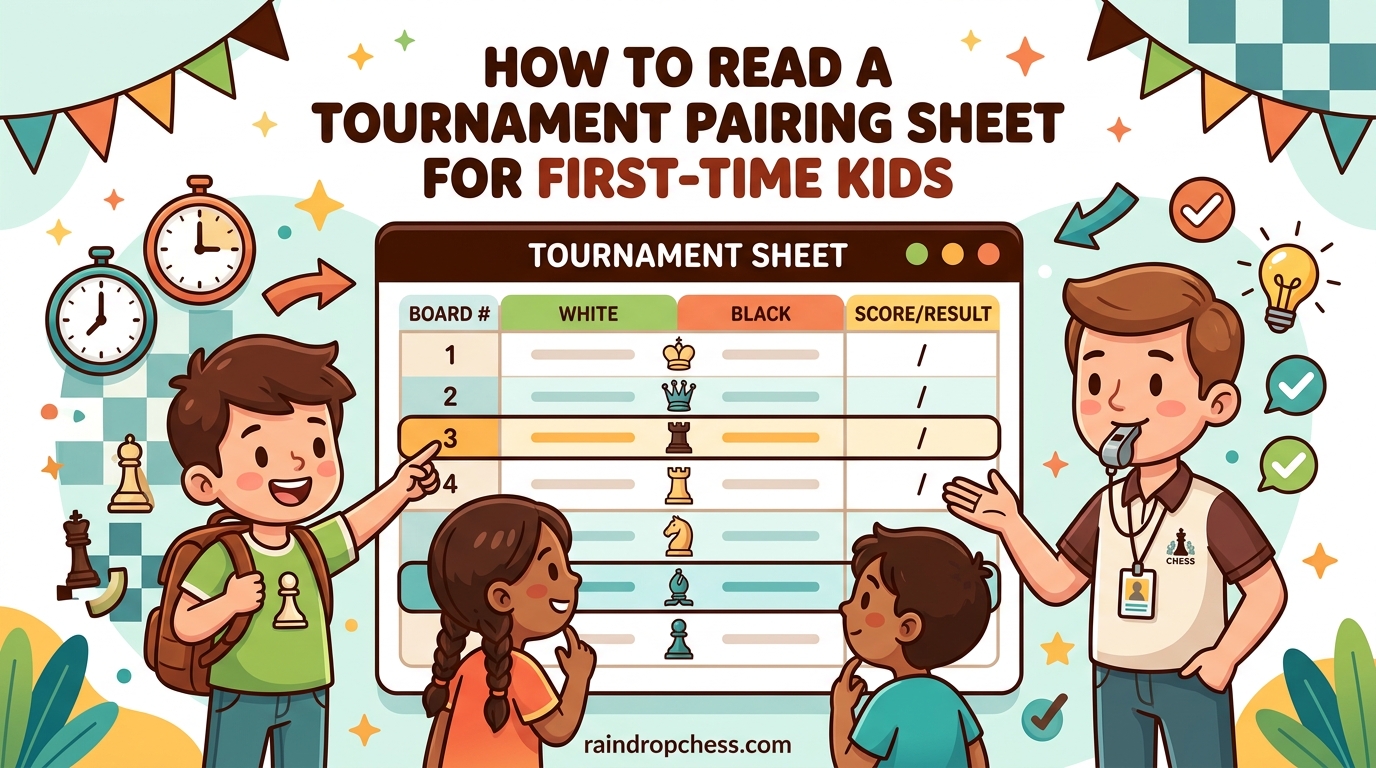
Walking into your first chess tournament feels overwhelming. There are dozens of kids, lots of noise, and somewhere on a wall is a piece of paper that tells your child where to sit and who to play. That paper is called a pairing sheet, and reading it correctly makes the whole experience less scary. This guide breaks down exactly how to read a tournament pairing sheet so you can help your nervous first-time kid feel prepared and confident.
Table of Contents
What is a Tournament Pairing Sheet?
A tournament pairing sheet is a printed or posted list that tells every player three important things: who they play against, which board number they sit at, and what color pieces they will use for that round. Without this sheet, your child would wander the playing hall without knowing where to go or who their opponent is.
The pairing sheet changes every round. After each game finishes, the tournament director creates new pairings for the next round based on who won and who lost. This means the board number and opponent will likely be different in round two compared to round one.
Pairing sheets are usually posted on a wall near the entrance of the playing hall or near the director’s table. Some tournaments now display them on screens. Look for a large formatted list organized either alphabetically by player name or numerically by board number.
Finding Your Name and Game Info
The first thing you and your child need to do is find their name on the pairing sheet. Names are typically listed alphabetically, so scan down the left column until you spot your child’s full name.
Look for Your Name in the Player List
Once you find the name, look across that same row to see the information for the current round. Most pairing sheets show these details in order: Player Name, Board Number, Color, Opponent Name, and sometimes the opponent’s rating. Help your child point to their name so they learn to recognize it themselves for future rounds.
If your child has a common name, check the rating or school listed next to the name to make sure you have the right person. Tournament directors separate players by sections (like K-3, K-6, or Open), so your child should only appear in their appropriate section.
Your Pairing Number Tells Your Game
Some pairing sheets include a pairing number next to each player’s name. This number indicates the order in which players were paired within their score group. Write down the pairing number if your child asks about it, though for most first-timers, simply finding the name and board number is enough to get started.
Understanding Board Numbers
The board number is the most critical piece of information on the pairing sheet. It tells your child exactly where to sit in the playing hall. If your child is listed at Board 14, they walk to board number 14 and wait there for their opponent.
Boards are usually numbered sequentially around the room. In larger tournaments, boards might be grouped by section. Look for signs or posted numbers above each table. If you cannot find the board number, ask a tournament volunteer or the director for help.
Board numbers also help you track your child’s progress throughout the tournament. After each round, check the standings list (often posted near the pairing sheet) to see where your child is placed for the next round.
Color Assignments: White vs Black
On the pairing sheet, you will see either a “W” or a “B” listed near your child’s name. W means your child plays the White pieces, and B means they play the Black pieces. This matters because White always moves first, and in tournament play, White is generally considered a slight advantage.
The tournament director tries to alternate colors as evenly as possible. If your child played White in round one, they will likely play Black in round two. We have seen kids get excited when they learn they are White because it feels special to move first.
Neither color is better for a first-time player. Both sides have equal chances to win. The important thing is for your child to focus on their game rather than worry about whether they are White or Black.
Reading Opponent Information
Next to your child’s name, the pairing sheet shows the opponent’s name. This is who your child will be playing against in that round. The opponent’s rating might also be listed, which gives you an idea of their experience level.
Ratings range widely in beginner tournaments. A child rated 400 is just starting out, while someone rated 1200 has played quite a bit. Matching players of similar ratings helps keep games competitive and fun for everyone.
If your child asks about their opponent before the game, you can share the name and rating. Some kids prefer not to know too much beforehand, and that is fine too. Let your child’s personality guide how much information you share.
How the Swiss System Works
Most youth chess tournaments use the Swiss System to create pairings. This system matches players with similar records against each other. After round one, winners play winners, and players who lost play each other.
In round one, players are paired by rating. The highest-rated player in a section plays against the lowest-rated player in that section. The second-highest plays against the second-lowest, and so on. This ensures that everyone gets a competitive game regardless of skill level.
After round one, the pairing logic shifts. Players with one point (one win) are paired against other one-point players. Players with zero points play other zero-point players. This continues each round, so by the final round, the top scorers face each other for the championship.
Understanding the Swiss System helps nervous kids realize that the tournament tries to make every game fair. Your child will not be matched against a chess master on their first day.
Byes: What Happens When You Do Not Have an Opponent
Sometimes a player receives a bye, which means they do not have an opponent for a round. This happens when there is an odd number of players in a section. The player with a bye receives one point without playing a game.
Byes are typically assigned to the lowest-rated player who does not have an opponent, or sometimes to the player who traveled the farthest. If your child receives a bye, they can rest, watch other games, or take a break outside the playing hall.
A bye is not a penalty. It is a normal part of tournament logistics. Some kids actually enjoy byes because they get extra time to relax before the next round. If your child feels disappointed about not playing, remind them they still earned a point.
Tips to Help Nervous First-Timers Feel Confident
First tournaments are exciting and nerve-wracking at the same time. Here are practical ways to calm those first-tournament jitters.
Walk through the venue together before the tournament starts. Find the pairing sheet location, identify where the boards are numbered, and locate the restrooms and snack area. Familiarity reduces anxiety.
Teach your child to check the pairing sheet independently. This is a real skill they will use every round. Practice finding a name on a list before tournament day so the mechanic feels automatic.
Remind your child that everyone at their first tournament felt the same way. Even the kids who seem confident probably had butterflies too. The tournament director and volunteers are there to help if your child gets confused or lost.
Set realistic expectations. Your child might not win every game, and that is perfectly fine. The goal for a first tournament is to learn, have fun, and gain experience. Celebrate effort and sportsmanship over wins and losses.
Bring a small comfort item like a favorite pen, a snack, or a water bottle. Having something familiar helps ground nervous kids between rounds.
FAQ
What does W/B mean on a chess pairing sheet?
W means your child plays the White pieces and moves first. B means your child plays the Black pieces. Neither color is better, and both offer equal chances to win.
How do I find my child’s game on the pairing sheet?
Look for your child’s name in the left column of the pairing sheet. Scan across that row to find the board number, color, and opponent name. Names are usually listed alphabetically.
What is a bye in a chess tournament?
A bye is when a player does not have an opponent for a round, which happens when there is an odd number of players. The player receives one point without playing.
How does the Swiss System work for pairings?
The Swiss System pairs players with similar records against each other. After round one, winners play winners, and players who lost play each other. This keeps games competitive for all skill levels.
What should I tell my nervous child before their first chess tournament?
Remind them that everyone feels nervous at first. Walk through the venue together, practice finding their name on the pairing sheet, and focus on having fun and learning rather than winning.
How many rounds are in a typical youth chess tournament?
Most youth tournaments have 4 to 6 rounds depending on the number of players. Smaller events with under 20 players typically run 4 rounds, while larger events might have 5 or 6.
Why do board numbers change each round?
Board numbers change each round because the tournament director creates new pairings after every game. Your child is matched against a new opponent in a new location based on their score.
What if my child cannot find their name on the pairing sheet?
Ask a tournament volunteer or the director for help. They can verify which section your child should be in or check if there was a registration issue.
Final Words
Now you know exactly how to read a tournament pairing sheet. The process becomes automatic after the first round or two. Your child will gain confidence each time they locate their name, find their board, and sit down to play. Remember to stay calm yourself, because kids pick up on parental anxiety. If you project confidence about reading the pairing sheet, your child will feel more secure too. Good luck, and enjoy watching your young chess player grow.