
Have you ever felt that standard chess was heading toward a dead end of endless draws? Jose Raul Capablanca, the third world chess champion, certainly did. In the 1920s, he proposed a revolutionary solution: expand the board, add new pieces, and breathe fresh life into the royal game. Capablanca Chess represents one of the most elegant and enduring large-board chess variants ever created.
In this guide, I will walk you through everything you need to know about Capablanca Chess and its sibling variants. You will learn the board setup, how the new pieces move, key strategic differences from standard chess, and where you can play today. Whether you are a curious beginner or a seasoned player seeking new challenges, this comprehensive guide will prepare you to explore the fascinating world of large-board chess.
By the end of this article, you will understand why Capablanca Chess has captivated players for nearly a century and how it solves the “draw death” problem that concerned one of history’s greatest champions.
Table of Contents
What Is Capablanca Chess
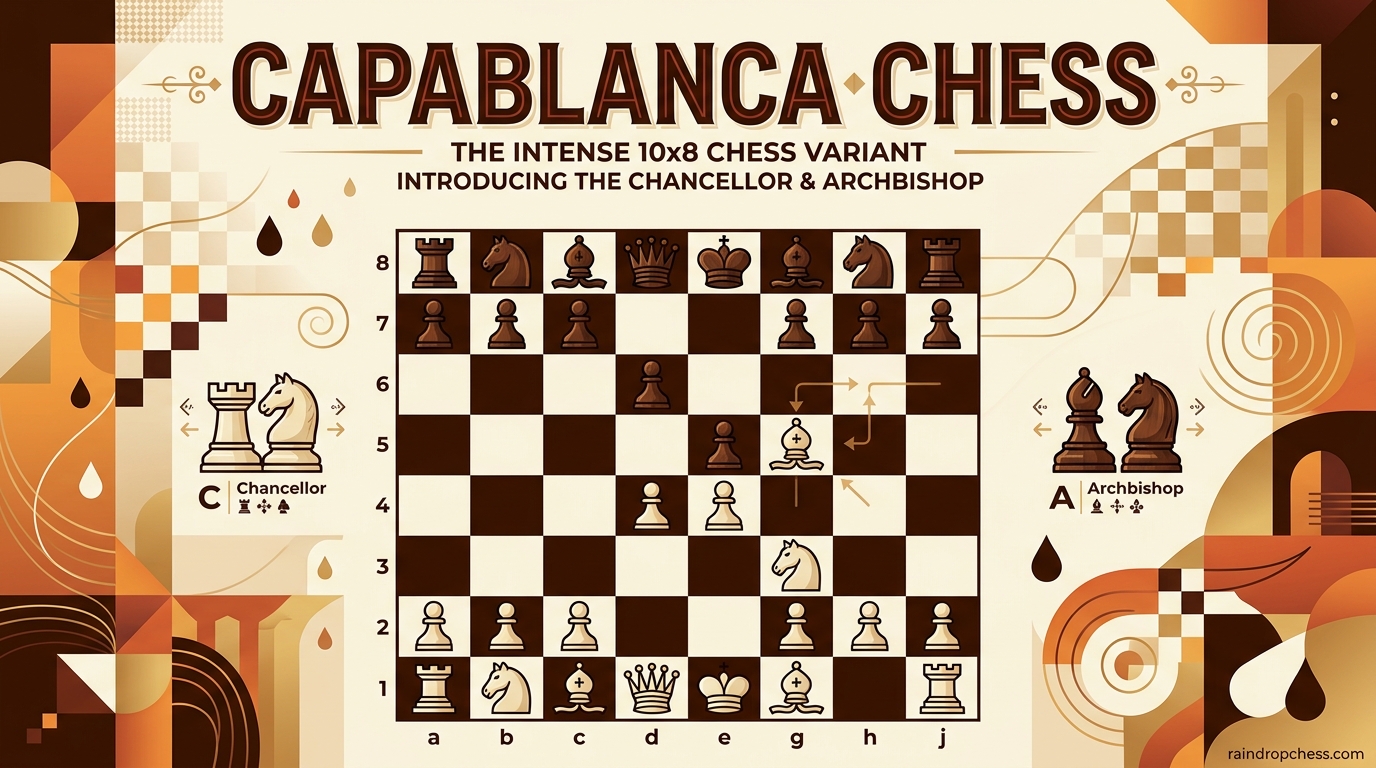
Capablanca Chess is a chess variant created by Cuban world champion Jose Raul Capablanca in the 1920s. The game expands the traditional chess board from 64 squares to 90 squares, arranged in a 10×8 format. Two new pieces join the battle: the Archbishop and the Chancellor. Capablanca designed this variant to prevent what he called the “draw death” of chess, the belief that high-level play was becoming increasingly drawish as opening theory developed.
Capablanca was not merely theorizing. As world champion from 1921 to 1927, he drew more than half of his tournament games against top competition. His positional style was so precise that opponents often found no way to create winning chances. This experience convinced him that chess needed fundamental changes to remain interesting at the highest levels.
Bobby Fischer, the eleventh world champion, expressed profound admiration for Capablanca’s chess understanding. Fischer called Capablanca one of his idols and studied his games extensively. This endorsement from another legendary champion adds significant credibility to Capablanca’s variant and demonstrates its intellectual appeal across generations.
The variant has influenced numerous other chess innovations. Several descendants of Capablanca Chess exist today, each with slightly different rules or board sizes. The core concept of adding compound pieces to a larger board remains one of the most popular approaches to chess variant design.
Board Setup and Dimensions
Capablanca Chess plays on a 10×8 board, meaning ten files wide by eight ranks deep. This creates 90 squares compared to standard chess’s 64. The additional two files accommodate the new pieces while maintaining familiar eight-rank pawn movement and promotion distances.
Initial Piece Placement
The back rank setup differs from standard chess. Working from left to right on White’s side: Rook, Knight, Archbishop, Bishop, Queen, King, Chancellor, Bishop, Knight, Rook. The Chancellor sits between the King and the King’s Bishop, while the Archbishop sits between the Queen’s Knight and Queen’s Bishop.
Black mirrors this arrangement on the opposite side. The symmetry ensures that both players begin with identical attacking and defensive resources. Pawns occupy the second rank on both sides, just as in standard chess.
Why 10×8 Instead of 10×10
Capablanca chose the 10×8 format deliberately. An 8×10 board maintains the same pawn journey from rank 2 to rank 8 for promotion. This preserves the familiar strategic timing of pawn advances while adding lateral space for maneuvering. Some later variants, like Grand Chess, use 10×10 boards, but Capablanca’s original design prioritized compatibility with existing chess intuition.
Some players and designers have experimented with different dimensions. The 10×8 size strikes a balance between increased complexity and playability. Games remain shorter than 10×10 variants while offering significantly more strategic depth than standard chess.
Physical Equipment
Playing Capablanca Chess physically requires special equipment. Standard 8×8 boards cannot accommodate the extra pieces and files. Several manufacturers produce Capablanca Chess sets, typically featuring a 10×8 board with specially designed Archbishop and Chancellor pieces.
The Archbishop is usually represented by a piece combining knight and bishop features, sometimes with a distinctive finial or base. The Chancellor typically combines knight and rook characteristics, often appearing as a rook with a horse head or similar hybrid design. These visual cues help players remember the compound movement abilities of each piece.
The New Pieces: Archbishop and Chancellor
Capablanca Chess introduces two compound pieces that combine the movement abilities of existing chess pieces. Understanding how these pieces work is essential to mastering the variant.
The Archbishop: Knight Plus Bishop
The Archbishop moves as either a knight or a bishop. On any turn, the Archbishop may choose to move like a standard knight in an L-shape (two squares in one direction and one square perpendicular) or slide diagonally like a bishop. This gives the Archbishop tremendous flexibility, combining the bishop’s long-range diagonal power with the knight’s ability to jump over other pieces.
The Archbishop’s value lies in its versatility. It can attack squares of both colors, unlike a bishop which is confined to one color complex. It can switch between close-range tactical jumps and long-range positional pressure. In open positions, the Archbishop dominates diagonals while remaining threats against protected squares via knight moves.
Strategically, the Archbishop excels in complex middlegame positions. Its ability to deliver unexpected forks and pins makes it a dangerous attacking piece. Defensively, it can guard key squares from multiple angles, making it difficult for opponents to create threats.
The Chancellor: Knight Plus Rook
The Chancellor moves as either a knight or a rook. Each turn, the Chancellor may slide horizontally or vertically like a rook any number of squares, or jump in an L-shape like a knight. This combination creates one of the most powerful pieces in chess variant history.
The Chancellor is generally considered slightly stronger than the Archbishop, though opinions vary among experts. The rook movement provides immediate control of open files and ranks, while the knight ability adds tactical surprise. The Chancellor can deliver checkmate patterns that combine rook and knight characteristics in devastating ways.
In practical play, the Chancellor often becomes the centerpiece of attacking formations. Its ability to switch between long-range file pressure and close-range knight attacks makes it unpredictable. Many Capablanca Chess openings prioritize rapid Chancellor development to maximize its influence.
Comparing Piece Values
In standard chess, we traditionally value pieces as follows: pawn (1), knight (3), bishop (3), rook (5), queen (9). In Capablanca Chess, the new pieces complicate this scale. Most estimates place the Archbishop at approximately 8-9 points and the Chancellor at 9-10 points, making them slightly less valuable than the queen (which still moves as bishop plus rook) but significantly stronger than rooks.
This value system affects trading decisions. Sacrificing a rook for an Archbishop or Chancellor is usually disadvantageous. However, minor piece sacrifices to expose these powerful pieces can be sound. Understanding relative piece values takes practice but develops naturally through gameplay experience.
Changed Rules from Standard Chess
While Capablanca Chess preserves most standard chess rules, several important changes accommodate the larger board and new pieces.
Castling Modifications
Kingside castling moves the king three squares toward the rook instead of two. The rook then jumps to the square immediately beside the king. Queenside castling also moves the king three squares toward the rook, with the rook landing adjacent to the king on the opposite side.
This three-square castling reflects the expanded board dimensions. It provides similar king safety and rook activation benefits as standard castling while accounting for the extra files. The king ends up on the g-file after kingside castling and the c-file after queenside castling, positions that offer reasonable protection while keeping the monarch somewhat centralized.
All standard castling restrictions apply: the king cannot castle while in check, through check, or into check. Neither the king nor the involved rook may have moved previously. All squares between king and rook must be empty.
Pawn Promotion Rules
Pawns still promote upon reaching the final rank. However, promotion options expand. When a pawn reaches the eighth rank, it may promote to any piece except a king. This includes the standard queen, rook, bishop, and knight, plus the new Archbishop and Chancellor.
The ability to promote to Archbishop or Chancellor creates fascinating endgame possibilities. Underpromoting to these pieces can be strategically sound when their specific movement patterns offer advantages over a queen. For example, an Archbishop might deliver checkmate patterns that a queen cannot achieve, or a Chancellor might control key escape squares more effectively.
Other Rule Preservations
En passant captures remain identical to standard chess. Pawns may still capture en passant when an opposing pawn advances two squares from its starting position. Stalemate, threefold repetition, and the fifty-move rule all apply as in standard chess.
Checkmate and draw conditions follow standard chess conventions. The game ends when a king is checkmated, when a position is repeated three times with the same player to move, or when fifty moves occur without a pawn advance or capture.
Strategy Differences from Standard Chess
Capablanca Chess requires significant strategic adjustments for players transitioning from standard chess. The larger board and more powerful pieces change fundamental principles.
Opening Principles
Central control remains important but manifests differently. With ten files, controlling the exact center becomes less critical than controlling key central zones. The d, e, and f files form the traditional center, while the c and g files provide expanded influence corridors for the new pieces.
Piece development accelerates in importance. The Chancellor and Archbishop need active squares to justify their presence. Opening systems that rapidly mobilize these pieces tend to score better than slow, solid setups. However, premature piece exposure can be punished just as in standard chess.
King safety requires attention to the modified castling rules. Kingside castling still generally offers safer positions, but the three-square movement leaves the king somewhat more exposed than in standard chess. Some players prefer queenside castling for its surprise value, though it requires careful defensive preparation.
Middlegame Dynamics
The middlegame in Capablanca Chess tends toward complexity. With more pieces and space, tactical combinations proliferate. The compound pieces create threats that combine multiple piece types, making calculation more demanding.
Piece coordination becomes paramount. An Archbishop working with a bishop controls diagonals in ways that create powerful batteries. A Chancellor paired with a rook dominates open files. Finding harmonious piece arrangements separates strong players from beginners.
Attack and defense balance differently than standard chess. Defensive resources increase with more pieces, but so do attacking possibilities. The result is often richer middlegames with more strategic tension.
Endgame Considerations
Endgames in Capablanca Chess feature more pieces than standard chess endgames. The Archbishop and Chancellor retain their value deep into simplified positions. King and Chancellor versus king, for example, delivers checkmate just as king and queen does in standard chess.
However, the additional material makes some endgames harder to win. Converting advantages requires greater precision when facing more defensive resources. The fifty-move rule becomes more relevant as checkmating patterns grow more complex.
Study of basic checkmating patterns with the new pieces accelerates endgame improvement. Learning how Archbishop and Chancellor coordinate with kings and other pieces provides practical dividends during actual games.
Where to Play Capablanca Chess Online
Finding opponents for Capablanca Chess has become easier thanks to dedicated online platforms. Several websites support the variant with varying features and player bases.
PyChess offers one of the most complete Capablanca Chess experiences online. The platform supports the variant natively, providing correct board display, piece movement validation, and rated play against human opponents. The interface clearly shows legal moves for the Archbishop and Chancellor, helping beginners learn the game mechanics.
Chess.com hosts forum discussions about Capablanca Chess and related variants. While the main platform focuses on standard chess and Chess960, the community provides resources for players interested in exploring beyond traditional rules.
Other specialized chess variant sites like BrainKing and Scheming Mind offer turn-based correspondence Capablanca Chess. These platforms accommodate players who prefer longer time controls and deeper analysis. Correspondence play suits Capablanca Chess particularly well given the increased calculation demands of the larger board.
For engine analysis, several strong chess programs support Capablanca Chess through variant modules. Stockfish and other open-source engines can be configured for 10×8 play, allowing players to analyze positions and test opening ideas against computer opponents.
Other Large-Board Chess Variants Worth Exploring
Capablanca Chess belongs to a family of large-board variants that expand chess in various directions. Understanding these alternatives helps players find their preferred style of expanded chess.
Grand Chess
Grand Chess, created by Christian Freeling in 1984, uses a 10×10 board with Capablanca’s pieces plus standard chess armies. The larger board provides even more space for maneuvering. Rooks start on the a and j files, with the back rank filled by the same piece arrangement as Capablanca Chess.
The 10×10 format changes pawn dynamics significantly. Pawns now promote on the tenth rank, requiring two additional advances. This extends the opening phase and creates different strategic rhythms. Grand Chess appeals to players who find Capablanca Chess still somewhat cramped.
Seirawan Chess
Seirawan Chess, developed by Grandmaster Yasser Seirawan, keeps the standard 8×8 board while adding the Capablanca pieces. The Archbishop and Chancellor enter play through drops, similar to shogi. When a player moves a piece from the back rank for the first time, they may place an Archbishop or Chancellor on the vacated square.
This drop mechanism preserves standard chess openings while gradually introducing the new pieces. Seirawan Chess bridges standard and large-board variants, making it accessible to players who prefer the familiar 8×8 dimensions. The piece introduction timing adds strategic depth as players decide when to activate their powerful reserves.
Gothic Chess
Gothic Chess is a specific ruleset for Capablanca Chess with standardized starting positions and tournament procedures. The Gothic Chess community has developed opening theory and competitive structures for the variant. Players seeking organized competition often gravitate toward Gothic Chess as the most established Capablanca variant format.
Omega Chess
Omega Chess expands the board to 10×10 and adds two new pieces: the Champion and the Wizard. The Champion combines wazir (one square orthogonal) and dabbaba (two square orthogonal) movements with knight leaps. The Wizard combines ferz (one square diagonal) and camel (three square diagonal) movements. These exotic pieces create a radically different feel from Capablanca’s more familiar compound pieces.
Terachess
Terachess, played on a massive 16×16 board, represents the extreme end of large-board variants. With 256 squares and expanded armies including additional new pieces, Terachess games unfold over hours or days. The variant appeals to players seeking maximum complexity and minimal opening memorization. Forum discussions mention Terachess as the largest “renowned” variant in terms of board size.
Each variant offers different tradeoffs between complexity and playability. Capablanca Chess strikes a balance that has sustained its popularity for a century, while others push boundaries in different directions.
Frequently Asked Questions
How does Capablanca play chess?
Capablanca Chess is played on a 10×8 board with two additional pieces: the Archbishop (moves as bishop plus knight) and Chancellor (moves as rook plus knight). Castling moves the king three squares, and pawns can promote to either new piece. Otherwise, standard chess rules apply.
What did Bobby Fischer think of Capablanca?
Bobby Fischer deeply admired Jose Raul Capablanca, calling him one of his idols and studying his games extensively. Fischer appreciated Capablanca’s intuitive understanding of chess and positional mastery, which added credibility to Capablanca’s variant among chess enthusiasts.
What was Capablanca’s IQ?
While Capablanca never took a formal IQ test, chess historians and psychologists have estimated his intelligence as exceptionally high based on his intuitive grasp of complex positions and his ability to play simultaneous exhibitions with minimal calculation. His natural talent was legendary even among world champions.
How is Capablanca Chess different from regular chess?
Capablanca Chess differs from regular chess in three main ways: it uses a 10×8 board instead of 8×8, adds the Archbishop and Chancellor pieces, and modifies castling to move the king three squares. These changes increase complexity and reduce drawing chances while preserving chess’s fundamental character.
Where can I play Capablanca Chess online?
You can play Capablanca Chess online at PyChess, which offers native support for the variant with rated play and legal move validation. Other options include correspondence chess sites like BrainKing and Scheming Mind, plus chess forums where you can find opponents for friendly games.
What are the best large board chess variants?
The best large board chess variants include Capablanca Chess (10×8 with Archbishop and Chancellor), Grand Chess (10×10 with expanded armies), Seirawan Chess (8×8 with drops), Gothic Chess (tournament Capablanca Chess), and Omega Chess (10×10 with exotic new pieces). Each offers different strategic flavors for players seeking new challenges.
Conclusion
Capablanca Chess and other large-board variants offer chess players a refreshing escape from opening theory saturation and drawish tendencies. Jose Raul Capablanca’s vision of expanding the game has proven remarkably durable, inspiring variants that continue to challenge and delight players a century later.
The key to enjoying these variants lies in embracing the increased complexity rather than fearing it. The Archbishop and Chancellor reward creative play and deep calculation. The larger boards create space for new strategic ideas while preserving the fundamental chess elements we love.
If you have mastered standard chess and seek fresh territory to explore, Capablanca Chess provides an excellent starting point. Its balance of familiarity and innovation makes it accessible to intermediate players while offering enough depth to challenge grandmasters. Set up a board, learn the piece movements, and discover why one of history’s greatest champions believed chess could be even better than it already was.