
Every parent who knows how to play chess faces the same challenge. You want to share your love of the game with your child, but there’s a problem. Your years of experience mean you’ll win almost every game, often within the first 15 moves.
After a dozen losses, your child starts asking why they should bother playing at all. Chess becomes frustrating instead of fun. You’ve tried letting them win, but children are smart. They know when you’re not playing your best. It feels patronizing, not educational.
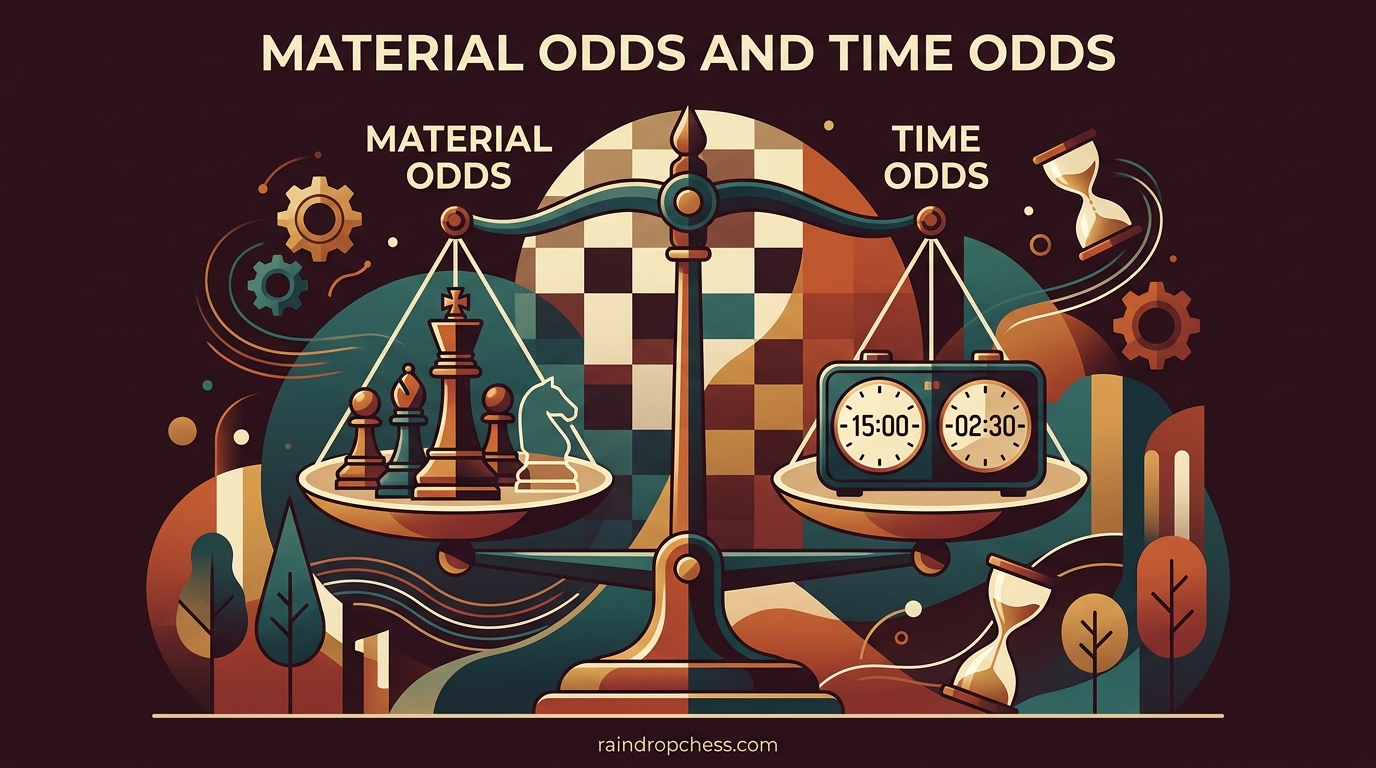
This is where material odds and time odds come in. These two chess handicap methods let you play honestly while giving your child a real chance to win. Material odds mean you start without certain pieces. Time odds give your child more time on the clock. Both methods level the playing field so both players enjoy a competitive, engaging game.
I’ve used both methods extensively when teaching chess to my own children and students. In this guide, I’ll show you exactly how to implement material odds and time odds, which method works best for different situations, and how to gradually reduce handicaps as your child’s skills improve.
For families looking for another approach, check out the Raindrop Chess variant, which balances skill levels through an innovative piece-capture mechanic.
Table of Contents
Understanding Chess Handicaps: Why Level the Playing Field?
The skill gap between an experienced chess player and a beginner child is enormous. An adult who has studied tactics, strategy, and endgames will win 99 out of 100 games against a child who just learned the moves. This isn’t fun for either player.
Many parents resort to throwing games on purpose. You might miss an obvious capture or make a deliberate blunder. But children sense this dishonesty. They know you didn’t really lose. The victory feels hollow, and they learn nothing about actual chess improvement.
Chess handicaps solve this problem differently. Instead of pretending to play worse, you actually play your best. The handicap creates a fair challenge where both players must think hard and play well to win. Your child earns their victories through genuine effort and skill.
This approach builds genuine confidence. When your child wins with material or time odds, they know they outplayed you. They learn chess concepts, improve their pattern recognition, and develop strategic thinking. The games remain competitive and engaging for both players.
Material Odds: What They Are and How They Work
Material odds are the most straightforward chess handicap. Before the game begins, you remove one or more of your pieces from the board. You play with less material than your child, giving them a significant advantage.
This type of handicap has been used for centuries. In the 1800s, strong players would regularly give pawn odds, knight odds, or even rook odds to weaker opponents. It was considered a gentleman’s way to make games interesting. The tradition continues today, especially in parent-child chess.
Material odds work because chess pieces have different values. A queen is worth about nine pawns. A rook is worth five pawns. A knight or bishop is worth three pawns. When you remove one of these powerful pieces from your army, you’re giving your child a substantial material advantage that can compensate for their lack of experience.
The beauty of material odds is their simplicity. Your child can see immediately that you’re playing without a knight or a rook. They understand they have an advantage. This visual clarity helps children accept the handicap without feeling patronized.
Common Material Odds Examples
Pawn odds are the gentlest material handicap. You remove one of your pawns before the game starts. The f-pawn is traditionally removed because its absence creates a permanent weakness in your position. Pawn odds equal roughly a 200-300 rating point difference.
Knight odds mean you play without one of your knights. This is a significant handicap worth about three pawns. Knight odds work well when the skill gap is substantial. Your child gets extra attacking power and more control of the board.
Rook odds are quite severe. You play without one of your rooks, worth about five pawns. This handicap is appropriate when the skill difference is extreme. Your child gains tremendous power in the endgame and extra material to trade.
Queen odds are the most extreme material handicap. You play without your most powerful piece. This handicap is rarely necessary except with absolute beginners. Queen odds give your child overwhelming force.
When to Use Material Odds
Material odds work best in specific situations. They’re ideal for children under 10 who are still learning basic piece movements and simple tactics. The visual clarity of seeing you play without a piece helps young children understand the advantage.
Use material odds when your child is just starting to learn chess but understands all the piece movements. They can make legal moves but haven’t yet studied tactics or strategy. A pawn or knight advantage gives them room to make mistakes and still have winning chances.
Material odds also work well for casual games without a chess clock. If you’re playing over the kitchen table without time pressure, material handicaps create the right balance. Your child can take their time thinking without the stress of a running clock.
However, material odds have limitations. They don’t teach your child about time management, which is a crucial chess skill. They also don’t address the fact that you’ll still think deeper and faster than your child. For these reasons, many parents eventually transition to time odds.
How to Implement Material Odds Step by Step
Implementing material odds is straightforward. Before the game starts, agree with your child which piece you’ll play without. Remove that piece from the board and set it aside. Then begin the game normally.
Here’s the process I recommend. First, assess your child’s skill level honestly. If they just learned the rules, start with queen or rook odds. If they’ve been playing for months and understand basic tactics, try pawn or knight odds.
Second, explain the handicap to your child. Tell them you’re playing without a piece to make the game fair. Show them the piece you’re removing and explain briefly why this helps balance the game. Children appreciate honesty.
Third, play your absolute best. Don’t hold back. The whole point of material odds is that you play seriously. Your child’s advantage comes from the extra material, not from you throwing the game.
Fourth, after the game, review what happened. If your child won, congratulate them on a well-played victory. If they lost, discuss whether the handicap needs adjustment. The goal is close, hard-fought games where either player could win.
Material Odds Guide: Which Pieces to Remove by Skill Level
Choosing the right material handicap takes experimentation. Every child is different, and the skill gap varies widely. Here’s a practical guide to help you start at the right level.
For absolute beginners who just learned the rules, start with queen odds. Your child needs overwhelming material to compensate for their lack of tactical and strategic understanding. Queen odds give them room to make multiple mistakes and still win.
For children who know the rules but blunder frequently, try rook odds. A rook is worth five pawns, which is a substantial advantage. Your child will have extra power in the endgame and more material to trade during the middlegame.
For children who understand basic tactics but miss longer combinations, knight or bishop odds work well. These minor pieces are worth about three pawns. Your child gains attacking chances and extra board control without an overwhelming advantage.
For children who have studied some chess and can calculate a few moves ahead, pawn odds are appropriate. A single pawn might seem small, but in chess, even a one-pawn advantage is significant. Pawn odds create subtle, interesting games.
For children who are improving rapidly and sometimes beat you, try two-pawn odds. Remove your f-pawn and another pawn. This gives your child a small but meaningful edge while keeping the game competitive.
Age-Specific Material Odds Recommendations
Children ages 5-7 typically need extreme material odds. Queen or rook odds are common. At this age, children are still learning piece movements and basic checkmate patterns. They need substantial advantages to compete.
Children ages 8-10 usually do well with knight or bishop odds. They understand tactics better but still miss simple threats. A minor piece advantage gives them winning chances while teaching them about piece value.
Children ages 11-13 often benefit from pawn odds. They’ve likely studied some chess and can calculate. A one-pawn handicap creates interesting, balanced games that teach them about positional play.
Teens 14+ who are serious about chess might only need two-pawn odds or even play even games. At this age, many students study chess seriously and improve rapidly. The handicap should decrease as their skills increase.
Adjusting Material Odds Over Time
The key to successful handicapping is constant adjustment. Your child will improve. What was fair last month might be too easy today. Pay attention to game results and adjust accordingly.
If your child wins 3-4 games in a row with the current handicap, reduce it. Move down one level. If they’re winning with rook odds, try knight odds next. If they’re winning with knight odds, try pawn odds.
Conversely, if they lose 3-4 games in a row, increase the handicap. They need more help to compete fairly. Don’t be afraid to adjust. The goal is close games, not easy wins or crushing defeats.
Track results mentally or in a notebook. Note which handicaps produced the most interesting games. You’ll find the sweet spot where games are competitive and exciting for both players.
Common Material Odds Mistakes to Avoid
Don’t change the handicap mid-game. Once you’ve agreed to play without a knight, play the entire game that way. Changing the handicap during the game confuses the lesson and feels unfair to your child.
Don’t make the handicap too small. Some parents give only pawn odds when their child clearly needs more. This leads to repeated losses and frustration. It’s better to give too much advantage than too little. You can always reduce it later.
Don’t forget to play your best. The whole point of material odds is honest competition. If you’re playing without a knight but still holding back, you’re defeating the purpose. Play seriously and let the material do the work.
Don’t use material odds forever. They’re a teaching tool, not a permanent solution. As your child improves, transition to time odds or even play. The goal is eventually to play fair games without any handicap.
Time Odds: Using the Chess Clock to Balance Games
Time odds are the second major way to handicap chess. Instead of removing pieces, you give your child more time on the chess clock. You might have 5 minutes for the entire game while your child gets 15 minutes. This time advantage lets them think deeper and avoid rushing.
Time odds address a different aspect of the skill gap. Experienced players don’t just know more chess. They also think faster and more efficiently. They see patterns instantly. Children need more time to calculate and evaluate positions.
The chess clock becomes the great equalizer. With extra time, your child can work through complicated variations. They can double-check their calculations. They can avoid blunders that come from rushing. The time advantage compensates for your superior pattern recognition.
Time odds teach a crucial chess skill: time management. Your child learns to budget their time, think efficiently, and handle time pressure. These are essential skills for competitive chess. Material odds don’t teach this lesson nearly as well.
Many chess educators prefer time odds over material odds for this reason. Time handicaps feel more like real chess. Both players start with full armies. The game unfolds normally. Only the time constraints differ.
How Chess Clocks Work
A chess clock has two displays, one for each player. After you make a move, you press your button, which stops your clock and starts your opponent’s. Your time only runs when it’s your turn to move.
If your time runs out, you lose the game immediately. This is called “flagging.” Time pressure creates exciting moments where both players are racing to avoid losing on time.
Modern digital chess clocks offer various time controls. You can set different amounts of time for each player, which is how you create time odds. Most clocks also let you add time increments, where players gain seconds after each move.
Common Time Odds Examples
The 2-to-1 ratio is a good starting point. If you get 10 minutes, your child gets 20 minutes. This gives them a substantial time advantage without making the game absurdly long.
The 3-to-1 ratio works for larger skill gaps. You might play with 5 minutes while your child gets 15 minutes. This gives your child plenty of time to think deeply about every move.
The 5-minute game is a popular time control. You get 5 minutes, your child gets 10 or 15. These games are quick enough to play multiple rounds in one sitting. They’re exciting and teach time management skills.
The 15-minute game allows deeper calculation. You get 10 minutes, your child gets 20. These games feel more like serious chess and teach strategic thinking.
When to Use Time Odds
Time odds work best when your child understands basic chess concepts but thinks slowly. They know tactics and strategy but need time to find the right moves. The extra time lets them compete fairly.
Use time odds with children who are at least 8-10 years old. Younger children struggle with time pressure and may panic when their clock runs down. They benefit more from material odds.
Time odds are ideal when your child is ready to learn time management skills. Competitive chess always uses clocks. Getting your child comfortable with time pressure early prepares them for tournaments and club play.
Time odds also work well when you want games to feel more like real chess. Both players start with all their pieces. The game unfolds naturally. Only the time differs. This feels less artificial than removing pieces.
However, time odds require a chess clock. If you don’t have one, material odds are easier to implement. Also, time odds can stress some children. Not all kids handle time pressure well, especially initially.
How to Implement Time Odds Step by Step
Implementing time odds requires a chess clock and some setup. First, buy a digital chess clock. They’re inexpensive and essential for serious chess practice. Analog clocks work too, but digital clocks are easier to program.
Second, decide on the time ratio. Start with 2-to-1. If you’re not sure, give your child more time rather than less. You can always reduce the advantage later.
Third, program the clock according to its instructions. Most digital clocks have a “time odds” mode that makes this easy. Set your time first, then your child’s time.
Fourth, explain the handicap to your child. Tell them they get extra time to think. Show them how the clock works and what happens when time runs out. Make sure they understand the rules before starting.
Fifth, play your best. Time odds only work when you play seriously. Your child’s advantage comes from having more time to think, not from you holding back.
Sixth, after the game, discuss whether the time felt fair. Did your child have enough time? Did you feel too rushed? Adjust the time ratio for the next game based on this feedback.
Time Odds Guide: Fair Time Controls for Every Age
Finding the right time control takes experimentation. Every child thinks at a different speed. Here are age-based recommendations to help you start.
Children ages 8-10 typically need significant time advantages. Try 5 minutes for you, 15 minutes for your child. This 3-to-1 ratio gives them plenty of time to think without making games excessively long.
Children ages 11-13 often do well with a 2-to-1 ratio. You might play with 10 minutes while your child gets 20. This gives them a meaningful advantage while keeping games at a reasonable length.
Teens 14+ might only need a small time advantage. You could play with 15 minutes while they get 20 or 25. As their calculation speed improves, reduce the time difference.
Time Control Recommendations by Skill Level
For beginners who just learned tactics, use rapid time controls. You get 10 minutes, your child gets 25. This gives them substantial time to calculate combinations and avoid blunders.
For intermediate players who understand strategy, try quicker games. You get 5 minutes, your child gets 15. These blitz games are exciting and teach efficient thinking.
For advanced players who calculate well, use minimal time differences. You might both play with 10 minutes, or give your child just 2-3 extra minutes. At this level, the skill gap is narrowing.
Chess Clock Recommendations
Digital clocks are easiest to program for time odds. Look for models with clear displays and simple buttons. The DGT 1000 and Chronos are popular choices among chess parents.
Analog clocks work but are harder to set for unequal time. You’ll need to manually set different times on each side. Digital clocks are worth the investment for convenience.
Consider clocks with delay or increment features. Delay means time doesn’t start counting down until a few seconds have passed. Increment adds time after each move. These features reduce time pressure and can make games more educational.
Common Time Control Mistakes to Avoid
Don’t give your child too much time. Games that last 45 minutes or more can test a child’s attention span. Keep games under 30 minutes total whenever possible.
Don’t use time odds before your child is ready. Children under 8 often struggle with clocks. Start with material odds, then transition to time odds when they’re older.
Don’t forget to teach time management. Your child needs to learn to budget their time across the game. Show them how to save time for critical moments. Don’t let them burn 10 minutes on one early move.
Don’t make the time difference so large that you’re always flagging. If you lose on time in every game, the handicap is too extreme. You need enough time to play seriously.
Material vs Time Odds: Which Method Should You Choose?
Both material and time odds are effective handicaps. Which one works better depends on your child’s age, skill level, and personality. Many parents use both methods at different stages of their child’s development.
Material odds are simpler and more visual. Young children easily understand that playing without a knight is a disadvantage. They can see their advantage immediately. This clarity helps children accept the handicap.
Time odds feel more like real chess. Both players start with full armies. The game unfolds naturally. Only the time constraints differ. For children who want authentic chess experiences, time odds are preferable.
Material odds work better for very young children. Kids under 8 struggle with time pressure and clocks. They benefit from the concrete advantage of extra pieces. Material odds teach piece value and tactical patterns.
Time odds work better for older children. Kids 10+ are ready to learn time management. They can handle clock pressure and benefit from the lesson. Time odds prepare them for tournament chess.
Consider your child’s personality. Some children feel anxious when they see a clock counting down. Others love the excitement of time pressure. Adapt your approach to what makes chess enjoyable for your child.
Using Both Methods Together
You can combine material and time odds for extreme skill gaps. You might play without a knight AND with less time. This dual handicap creates very fair games when the skill difference is enormous.
However, be careful not to over-handicap. If your child wins too easily, they’re not learning. The goal is close games where both players must play well to win.
As your child improves, reduce the handicap gradually. First eliminate the material odds, keeping only the time advantage. Later, reduce the time difference until you’re playing even games. This gradual transition tracks progress objectively.
How to Introduce Handicaps to Your Child: A Parent’s Guide
Explaining chess handicaps to children requires care. You want them to understand the concept without feeling bad about needing an advantage. Here’s how to introduce handicaps positively.
First, explain that handicaps are normal in chess. Tell them that strong players have used handicaps for hundreds of years. It’s a time-honored tradition that makes games fair and fun.
Second, frame the handicap as a challenge for you. You’re playing at a disadvantage. You have to play your best to overcome it. This makes the game interesting for both players.
Third, emphasize that this lets you play honestly. Tell them you want to play your best, not pretend to play badly. The handicap makes fair competition possible.
Fourth, make it clear that the handicap will change as they improve. This isn’t permanent. As they get better, the advantage will decrease. Eventually, you’ll play even games.
Fifth, keep it positive and fun. Chess should be enjoyable, not stressful. If your child gets upset about the handicap, reconsider whether it’s the right approach. Some children prefer to lose honestly than win with an advantage.
Tracking Progress and Reducing Odds
Keep track of game results. Note how many games your child wins with the current handicap. If they win consistently, it’s time to reduce the advantage.
Celebrate when you reduce the handicap. Frame it as progress. Your child is getting stronger, so they need less help. This positive reinforcement motivates continued improvement.
Eventually, you’ll transition to even play. This is a major milestone. Celebrate it. Your child has become a genuine chess player who can compete fairly.
The Benefits of Fair Chess Play for Child Development
Fair chess play through handicapping offers tremendous developmental benefits. Children learn resilience when they face genuine competition. They build confidence when they earn victories through hard-fought games.
Chess teaches strategic thinking and problem-solving. When games are fair, children must think deeply to win. They develop calculation skills and pattern recognition. These cognitive benefits transfer to academics and life.
Handicapped chess teaches emotional control. Children learn to handle both victory and defeat gracefully. They understand that improvement comes through practice and study. This builds growth mindset and resilience.
Chess strengthens the parent-child bond. When you play fair games, you’re sharing a genuine intellectual challenge. You’re spending quality time together. Many parents treasure these games as their children grow up.
Fair play prepares children for competitive chess. If your child joins a chess club or plays in tournaments, they’ll understand that chess is about honest competition. They won’t expect opponents to go easy on them.
Frequently Asked Questions About Chess Handicaps
What are material odds in chess?
Material odds in chess means the stronger player removes one or more pieces from the board before the game begins. Common examples include pawn odds (removing one pawn), knight odds (removing one knight), rook odds (removing one rook), or queen odds (removing the queen). This gives the weaker player a material advantage to compensate for their lack of experience.
How do time odds work in chess?
Time odds give the weaker player more time on the chess clock. For example, the stronger player might have 10 minutes for the entire game while the weaker player gets 20 minutes. This time advantage lets the less experienced player think deeper and avoid rushing. Time odds teach time management skills while creating fair competition.
How to handicap chess for kids?
Start by assessing your child’s skill level honestly. For young beginners (ages 5-7), use material odds like rook or queen odds. For intermediate players (ages 8-10), try knight or bishop odds. For older children (11+), consider time odds with a 2-to-1 or 3-to-1 time ratio. Adjust the handicap as your child improves, reducing the advantage gradually.
What chess odds should I give?
The right handicap depends on the skill gap. For absolute beginners, start with queen or rook odds. For children who understand basic tactics, try knight or bishop odds. For children who calculate well, use pawn odds or time advantages. The goal is close, competitive games. If your child wins 3-4 games in a row, reduce the handicap.
Is letting kids win at chess bad?
Yes, letting kids win on purpose is counterproductive. Children sense when you’re not playing honestly. Hollow victories don’t build real confidence or skills. Instead, use material or time odds to create fair games where both players compete seriously. Your child earns victories through genuine effort, which builds authentic confidence and teaches real chess.
How to make chess fair for children?
Use chess handicaps like material odds (removing pieces) or time odds (giving more clock time). Both methods let you play your best while giving your child a real advantage. Material odds work better for young children. Time odds suit older kids and teach time management. Adjust the handicap as your child improves, eventually transitioning to even play.
When to reduce chess handicap?
Reduce the handicap when your child wins consistently. If they win 3-4 games in a row with the current advantage, it’s time to decrease it. Move down one level. If they’re winning with rook odds, try knight odds. If winning with knight odds, try pawn odds. Celebrate this progress as a sign of improvement.
Best way to teach chess to kids?
Start with material odds for young children to make games fair and fun. As they improve, transition to time odds to teach time management. Always play your best. The handicap creates fairness, not dishonest play. Review games together, pointing out what both players did well. Celebrate progress and eventually transition to even play when the skill gap narrows.
Conclusion: Making Chess Fun and Fair for Your Family
Material odds and time odds are powerful tools for parents who want to share chess with their children. Both methods create fair competition where both players enjoy challenging, engaging games. Your child builds real skills and authentic confidence while you play your best.
Start with material odds if your child is young. The visual clarity helps them understand the advantage. Transition to time odds as they grow older and more experienced. Time odds teach crucial time management skills that prepare children for competitive chess.
Remember to adjust the handicap as your child improves. The goal is eventually to play even games without any advantage. Track their progress and celebrate when you can reduce the handicap. This objective measurement of improvement motivates continued study.
Most importantly, keep chess fun. If handicaps create stress or resentment, reconsider your approach. Some children prefer to lose honestly than win with an advantage. Adapt to what works for your family.
Chess offers tremendous benefits for child development. Fair play through handicapping ensures your child enjoys those benefits. They learn strategy, build resilience, and develop problem-solving skills. They also strengthen their bond with you through shared intellectual challenge.
For families looking for alternative approaches to fair chess, consider exploring the chess variant for families offered by Raindrop Chess, which creates balance through innovative mechanics rather than traditional handicapping.
Start experimenting with material and time odds today. Your child will appreciate the fair competition, and you’ll enjoy games that are challenging for both players. Chess becomes a shared joy rather than a source of frustration. That’s the greatest gift you can give your child through this ancient game.