
Picture this: you have trained for months, studied openings until they became second nature, and finally earned your spot in a rated tournament. You walk into the playing hall, set up your equipment, and the tournament director approaches your board. They inspect your chess set, pause, and shake their head. Your board does not meet regulations. In 2026, this scenario plays out more often than you might think. Understanding tournament-legal chess board dimensions is not just technical knowledge. It is the difference between playing the game you love and sitting on the sidelines.
Players spend years navigating both USCF and FIDE events, and the confusion around board specifications never ceases to surprise them. Players obsess over openings and endgame technique, yet overlook the very surface they play on. This guide will walk you through every specification, measurement, and requirement you need to know. By the end, you will understand exactly what makes a chess board tournament-legal and how USCF and FIDE standards differ.
Table of Contents
USCF Chess Board Specifications (United States Chess Federation)
The United States Chess Federation sets clear standards for tournament equipment. If you play in USCF-rated events within the United States, these are the specifications your board must meet.
USCF Square Size Requirements
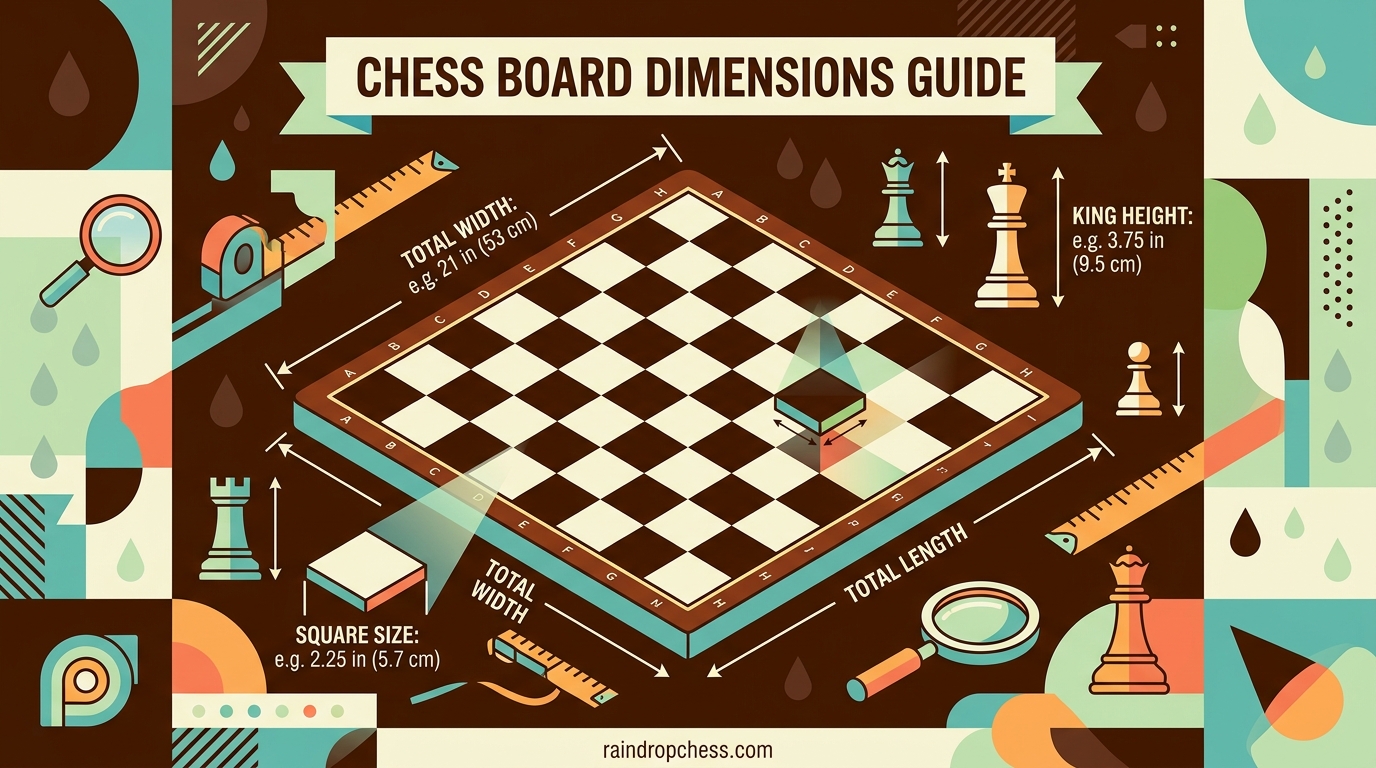
USCF regulations specify that each square on a tournament chess board must measure 2.25 inches. That converts to 5.7 centimeters or 57 millimeters. This measurement applies to the interior of each square, not including any borders or edges around the playing surface.
The federation allows some flexibility in practice. While 2.25 inches is the standard, boards ranging from 2 to 2.5 inches are generally acceptable for most club and scholastic events. However, if you want equipment that passes inspection at any USCF tournament without question, stick to the 2.25-inch specification.
USCF Overall Board Dimensions
A standard USCF tournament board measures between 20 and 22 inches in total width and length. This accommodates the 2.25-inch squares arranged in the standard 8×8 grid, plus a small border around the playing area. The border itself typically ranges from 0.5 to 1.5 inches on each side.
The overall board size matters because it affects piece stability and playing comfort. A board that is too small relative to your pieces creates cramped conditions. One that is too large makes pieces look lost and can affect your visual calculation of squares.
USCF King Height and Piece Ratio
USCF specifications extend beyond the board itself to the relationship between board and pieces. The recommended king height for a 2.25-inch square board is 3.75 to 4.25 inches. This creates a comfortable visual ratio where the king occupies roughly 75% of the square height.
The base diameter of pieces also matters. USCF recommends that the king base should cover 75-80% of the square width. For a 2.25-inch square, that means a king base between 1.7 and 1.8 inches. This prevents pieces from crowding each other while ensuring they sit securely on their squares.
USCF Board Material Flexibility
One area where USCF shows more leniency than FIDE is board material. USCF regulations do not strictly mandate rigid boards. While wooden boards are preferred for serious tournaments, USCF-rated events commonly accept vinyl roll-up boards and silicone mats. These materials offer practical advantages for travel and storage.
That said, higher-level USCF events often prefer or require rigid wooden boards. If you are preparing for state championships, national events, or norm tournaments, investing in a quality wooden board is wise.
FIDE Chess Board Specifications (International Chess Federation)
FIDE, the International Chess Federation, governs chess worldwide and sets the standards for international competitions including the World Championship. Their specifications differ subtly but significantly from USCF standards.
FIDE Square Size Requirements
FIDE regulations specify that tournament chess squares must measure between 50 and 58 millimeters. This range translates to 2 to 2.28 inches, or 5 to 6 centimeters. The most commonly accepted size within FIDE events is 55-58mm, which equals approximately 2.17 to 2.28 inches.
The upper end of this range, 58mm or 2.28 inches, exceeds the standard USCF size. This explains why many players notice FIDE boards feeling slightly roomier. The extra space accommodates the rigorous demands of international competition where players from all backgrounds must feel comfortable.
FIDE Overall Board Dimensions
FIDE requires the total board size to be between 50 and 55 centimeters square. Converting to imperial measurements, that is 19.7 to 21.7 inches. The board must have adequate space around the playing area for captured pieces and clocks.
Border requirements are more specific under FIDE rules. The border around the playing squares must be at least 1 centimeter wide, though wider borders up to 5 centimeters are common and acceptable. The border color must contrast with the outer edge of the board.
FIDE King Height and Piece Specifications
FIDE is stricter about piece proportions than USCF. The recommended king height for FIDE tournament play is 9.5 centimeters, or 3.75 inches. The king base should be approximately 4.5 centimeters, or 1.77 inches.
This creates a specific ratio where the king base covers 75-80% of the square width, similar to USCF recommendations. However, FIDE inspections at major events often verify these measurements precisely. Pieces that deviate significantly may be rejected.
FIDE Strict Material Requirements
Here is where FIDE and USCF diverge most significantly. FIDE mandates rigid boards for all rated events above a certain level. Wood is the preferred material, though other rigid materials like marble or composite may be acceptable if they meet rigidity standards.
The rationale is straightforward. FIDE events often involve high-stakes games where any irregularity affects competitive integrity. A roll-up board that wrinkles or shifts during play could disturb piece placement. Rigid boards eliminate this variable.
For FIDE-rated events, vinyl and silicone boards are generally not permitted unless specifically authorized for a particular tournament. If you plan to compete internationally, invest in a quality wooden board that meets FIDE specifications.
USCF vs FIDE Chess Board Dimensions: Key Differences
Understanding the differences between USCF and FIDE specifications helps you choose equipment that works for your specific needs. Here is a direct comparison of the key measurements.
Square Size Comparison
The most significant difference lies in the square size. USCF specifies 2.25 inches (57mm) while FIDE allows 50-58mm (2 to 2.28 inches). At the upper end, FIDE boards can be 0.125 inches larger per square than USCF standards.
This 0.125-inch difference may seem trivial, but it accumulates across the entire board. On an 8×8 grid, the total difference between a minimum FIDE board and a standard USCF board is a full inch in overall dimensions. That affects how pieces sit, how comfortable the board feels during play, and whether your set passes inspection.
Metric vs Imperial Measurements
USCF specifications use imperial measurements (inches) as the primary standard, reflecting their American jurisdiction. FIDE uses metric measurements (millimeters and centimeters), reflecting their international scope.
If you compete in both USCF and FIDE events, you will need to become comfortable with both systems. A board with 2.25-inch squares meets USCF standards and falls within FIDE acceptable range. However, a board with 58mm squares meets FIDE standards but exceeds USCF preferences.
Rigidity Requirements
USCF allows flexible boards including vinyl roll-ups and silicone mats for many events. FIDE requires rigid boards for rated play. This difference stems from competitive philosophy. FIDE prioritizes absolute uniformity across international events. USCF allows more practical flexibility for club and scholastic play.
Forum discussions reveal this as a major pain point for players. Many American players own quality vinyl boards that serve them well in local USCF events, only to discover these same boards are rejected at FIDE tournaments. If you plan to play internationally, invest in a rigid wooden board early.
Color and Contrast Standards
Both organizations require sufficient contrast between light and dark squares for visibility. FIDE is more specific, recommending that the ratio between light and dark squares fall between 1:1.2 and 1:1.5. USCF guidelines are less precise but emphasize that players must easily distinguish square colors.
Common acceptable color combinations include natural wood tones (walnut and maple), green and buff (official USCF tournament colors), and various shades of brown and cream. Avoid boards with extreme colors like red and black or neon shades that strain the eyes during long games.
Why Tournament Chess Boards Have Specific Size Requirements
New players often wonder why chess federations micromanage board dimensions. The specifications exist for practical reasons that affect competitive play.
Piece Movement and Clearance
Proper square sizing ensures pieces have adequate clearance when moved. If squares are too small, pieces crowd each other and accidental contact becomes likely. If squares are too large, pieces look dwarfed and the board feels sparse.
The 75-80% coverage ratio for king base to square width evolved through decades of tournament play. It represents the sweet spot where pieces sit securely without touching neighboring squares. This matters most during time pressure when quick piece movements are essential.
Visual Perception and Calculation
Board size affects how players visually process the position. Consistent dimensions across tournaments allow players to develop reliable pattern recognition. When every tournament board has similar proportions, your brain builds visual shortcuts for piece relationships and tactical motifs.
Players report that switching between dramatically different board sizes affects their play. A player accustomed to 2.25-inch squares may feel disoriented on a 2.5-inch board, or vice versa. Standardization protects competitive integrity by ensuring consistent playing conditions.
Tournament Hall Logistics
Standardized board sizes simplify tournament organization. Directors can plan table spacing knowing all boards fit within expected dimensions. Broadcasting and livestream setups work reliably when equipment matches specifications. Even the height of pieces relative to camera angles affects spectator experience.
Historical Precedent
Modern chess board standards evolved from the Staunton pattern introduced in 1849. The original Staunton sets established proportions that felt comfortable for competitive play. USCF and FIDE specifications formalized these traditional measurements while allowing minor variations for practical and regional preferences.
Board Materials and Color Requirements for Tournament Play
Material choice affects durability, portability, and tournament legality. Here is what you need to know about different board materials.
Wooden Boards
Solid wood boards remain the gold standard for serious tournament play. Walnut, maple, rosewood, and mahogany are common choices. Wooden boards offer rigidity, stability, and an aesthetic that honors chess tradition.
Look for boards with veneer surfaces over solid wood cores. These resist warping better than solid wood throughout. The squares should be inlaid or painted with durable finish that will not wear off with use.
High-quality wooden boards meeting FIDE specifications typically cost between $75 and $300. USCF-approved wooden boards start around $50. Consider this an investment in your competitive chess career.
Vinyl Roll-Up Boards
Vinyl boards offer unmatched portability and affordability. They roll up for easy transport and unroll flat on any table. USCF accepts vinyl boards for most club and scholastic events.
Choose vinyl boards with algebraic notation (coordinates) along the edges. This helps players record games accurately. Avoid extremely thin vinyl that wrinkles easily or thick vinyl that will not lie flat.
The limitation is FIDE acceptance. While some lower-level FIDE events may permit vinyl boards, anything above amateur level requires rigid boards. If you own only one board and plan to play internationally, skip vinyl and buy wood.
Silicone and Rubber Boards
Silicone boards combine portability with better lie-flat performance than vinyl. They are also easier to clean and more durable. However, they share vinyl FIDE acceptance limitations.
These boards work well for casual play, club meetings, and USCF events that do not specify rigid boards. Many players keep a silicone board for travel and a wooden board for serious tournaments.
Color Contrast Requirements
Both USCF and FIDE require sufficient contrast between light and dark squares. The specific colors matter less than the contrast ratio. Avoid boards where light and dark squares are too similar in tone.
Traditional combinations include:
Natural wood tones (walnut/maple, rosewood/ash)
Green and buff (official USCF tournament colors)
Brown and cream
Black and natural wood
Green and buff became the USCF standard because the colors reduce eye strain during long games. The green is muted, not bright, and the buff (off-white/cream) provides clear contrast without harsh brightness.
Common Chess Board Sizes for Different Playing Environments
Not every chess situation requires tournament specifications. Here is guidance for choosing board sizes based on your playing context.
Home Practice and Casual Play
For home use, any board size that feels comfortable works. Many players prefer smaller boards (18-19 inches overall) for home practice because they fit better on standard tables. Square sizes from 2 to 2.25 inches work well for casual games.
If you are training for tournaments, practice on a board matching your competition specifications. Muscle memory matters. Practicing on a 2-inch square board then competing on 2.25-inch squares creates subtle adjustment challenges.
Club and Scholastic Play
Chess clubs typically use 2.25-inch square boards for consistency with USCF standards. Many clubs invest in vinyl boards for durability and cost, upgrading to wooden boards for special events.
Scholastic tournaments usually follow USCF guidelines strictly. The 2.25-inch standard is universal at school competitions. If you are buying equipment for a school chess program, 2.25-inch vinyl boards offer the best value.
Tournament Hall Play
Serious tournament play demands regulation equipment. For USCF events, bring a 2.25-inch square board, preferably wooden for higher-level competitions. For FIDE events, a 55-58mm rigid wooden board is essential.
Many regular tournament players own two boards: a quality wooden board for rated events and a portable vinyl or silicone board for casual play and analysis. This dual-board approach covers all situations.
Analysis and Study
When studying games or solving positions, board size matters less than piece clarity. Some players prefer magnetic boards for analysis on the go. Others use large demonstration boards for teaching.
Digital boards and tablets have changed analysis habits. Chess apps allow instant position setup and infinite variations. However, physical board study remains valuable for developing board vision and calculation skills.
Frequently Asked Questions
What size chess board is the USCF tournament?
USCF tournament chess boards require 2.25-inch squares (5.7cm or 57mm). The overall board size typically ranges from 20 to 22 inches. While USCF allows some flexibility for club events, serious tournaments expect the 2.25-inch standard. Boards should have adequate contrast between light and dark squares, with green and buff being the official USCF tournament colors.
What size is a FIDE tournament chess board?
FIDE tournament chess boards require squares between 50-58mm (2 to 2.28 inches or 5-6cm). The overall board must measure 50-55cm (19.7-21.7 inches). The most common size in international competition is 55-58mm squares. FIDE strictly requires rigid boards, typically wood, for rated events. Roll-up boards are generally not permitted at FIDE tournaments.
Why are tournament chess boards so big?
Tournament chess boards are sized to ensure adequate piece clearance, consistent visual perception, and comfortable play during long games. The 2.25-inch (USCF) and 55-58mm (FIDE) square sizes allow pieces to sit securely without crowding while maintaining proportions that support accurate pattern recognition. Larger boards also accommodate digital clocks and provide space for captured pieces.
How big should a chess square be?
For tournament play, chess squares should measure 2.25 inches (USCF) or 50-58mm (FIDE). For casual home play, squares between 2 and 2.5 inches work well. The key is matching your board to your pieces: the king base should cover 75-80% of the square width. Avoid squares smaller than 2 inches or larger than 2.5 inches for standard tournament sets.
Conclusion
Tournament-legal chess board dimensions are not arbitrary rules designed to complicate your life. They represent decades of refinement to create optimal playing conditions for competitive chess. Understanding the difference between USCF and FIDE specifications prepares you for any tournament environment.
If you compete exclusively in USCF events within the United States, a 2.25-inch square board serves you well. Vinyl boards work for club play, but invest in wood for serious tournaments. If you plan to play internationally or in FIDE-rated events, acquire a rigid wooden board with 55-58mm squares.
The 0.125-inch difference between USCF and FIDE standards may seem insignificant, but it reflects different competitive philosophies. USCF prioritizes accessibility and practicality. FIDE prioritizes uniformity and rigidity at the highest levels. Both approaches serve their respective competitive communities.
Before your next tournament, verify your equipment against the specifications outlined in this guide. Check your square measurements, confirm your board rigidity meets requirements, and ensure your color contrast is adequate. Tournament-legal chess board dimensions exist to protect the integrity of the game we love. Arrive prepared, and may your pieces always find their squares.