
You have been watching your child play on ChessKid for months. They log in daily, solve puzzles, and crush their opponents. But lately, you have noticed something different. They are winning most games easily. They are asking about features ChessKid does not have. They are curious about playing in tournaments.
This is the exact moment many parents face: the transition from ChessKid to Chess.com. Timing this move matters more than you might think. Move too early, and your child might feel overwhelmed or encounter content that is not age-appropriate. Wait too long, and they could lose interest from lack of challenge.
Our team has worked with dozens of families making this switch. We have studied forum discussions, parent feedback, and platform differences. In this guide, you will learn the 7 clear signs your child is ready to move up from ChessKid to Chess.com. Use these indicators to make a confident decision.
Table of Contents
Signs Your Child Is Ready to Move Up from ChessKid to Chess.com
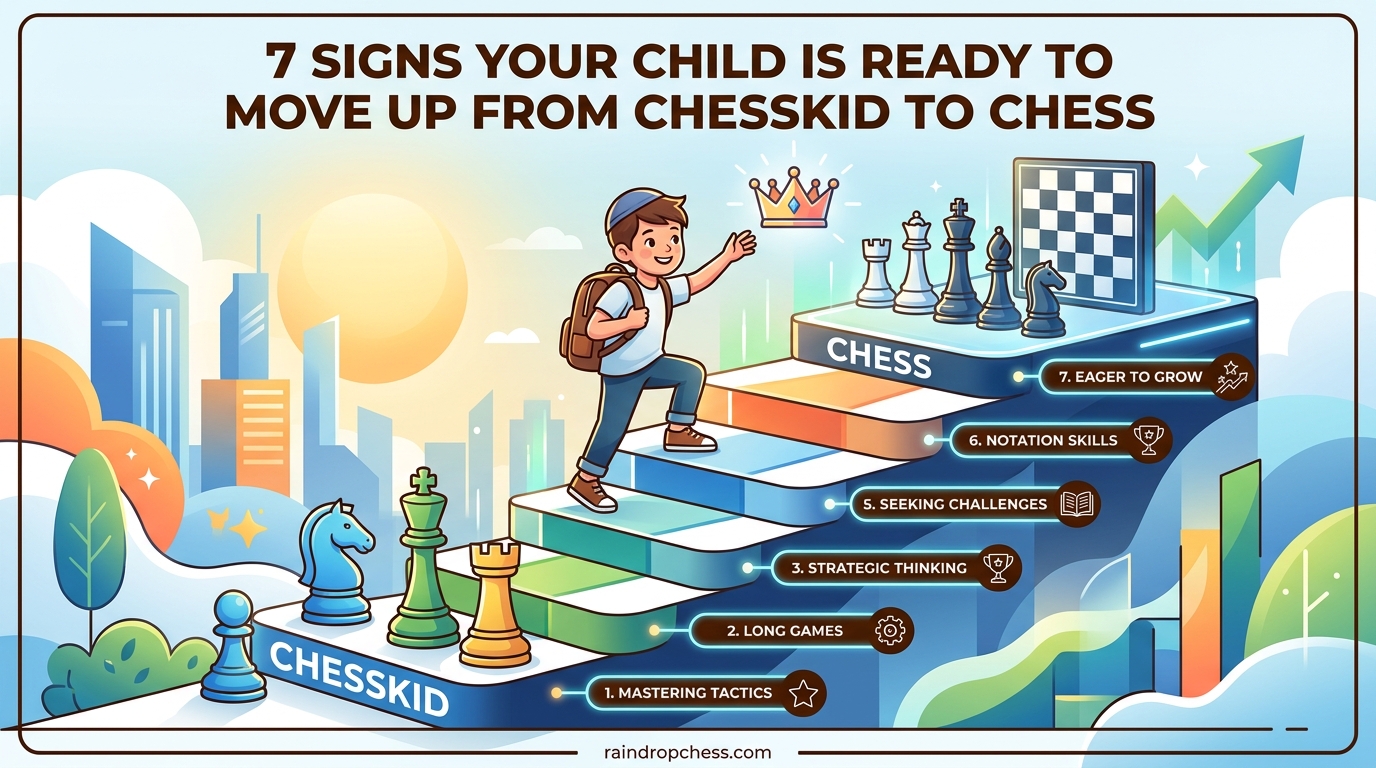
These seven indicators will help you identify the right time for the transition. Most children show 3-4 signs when they are ready. You do not need all seven.
1. Your Child Is 8 Years Old or Older with Emotional Maturity
Age is not just a number when it comes to online chess platforms. ChessKid is designed for ages 5-12, while Chess.com serves players from beginner to grandmaster. The magic number we see most often is age 8.
But age alone is not enough. Your child needs emotional maturity to handle Chess.com’s environment. On ChessKid, every opponent is a child with filtered chat. On Chess.com, they will face adults, teenagers, and competitive players who might not be as forgiving.
Ask yourself these questions: Can my child handle losing without tears? Do they understand that strangers online may not be nice? Can they navigate a more complex interface without frustration? If you answer yes to these, age 8 is a reasonable starting point. Some mature 7-year-olds handle the transition well. Some 10-year-olds are not ready yet.
2. Their ChessKid Rating Has Reached 1200-1500
Rating is one of the most reliable indicators for readiness. When your child hits 1200 on ChessKid, they are approaching the ceiling of the platform’s rating pool. By 1500, they are almost certainly ready for Chess.com.
Here is what the numbers mean in practice. A 1000 ChessKid rating roughly equals an 800 USCF rating or 1000 Chess.com rapid rating. Parents on forums report that once children reach 1300-1500 on ChessKid, finding appropriately matched opponents becomes difficult. The player pool thins out, and your child either waits a long time for games or faces the same opponents repeatedly.
Track their rating over a 30-day period. If they are consistently above 1200 and climbing, the time is right. If they are fluctuating between 900-1100, give ChessKid more time to build their fundamentals.
3. They Have Outgrown ChessKid’s Limited Features
ChessKid excels at teaching basics to young players. It has cartoons, simple lessons, and kid-friendly characters. But those same features become limitations as skill develops.
Watch for these specific requests. Your child asks why they cannot analyze their games with an engine. They want deeper opening preparation tools. They are curious about game databases and master games. They wish they could review their mistakes in detail after each match.
Chess.com offers Stockfish analysis, opening explorers, and extensive game review features. These tools are essential for players moving beyond basic tactics. When your child starts asking about these features, they are telling you they need more.
4. They Crave Stronger Competition
The player pool size difference is massive. ChessKid has thousands of active child players. Chess.com has millions of users worldwide, ranging from beginners to world champions.
When your child wins 70-80% of their games on ChessKid, they are not being challenged. This sounds like a good problem, but it leads to stagnation. Strong opponents force improvement. They expose weaknesses and teach new patterns.
Notice if your child mentions wanting harder games. Do they seem bored after easy wins? Are they seeking opponents who can punish their mistakes? This competitive hunger is a strong sign they are ready for the bigger pond.
5. They Are Serious About Tournament Play
If tournament chess is in your child’s future, Chess.com becomes essential. While ChessKid hosts some events, Chess.com is the hub for serious tournament preparation.
The platform offers daily tournaments, titled arenas, and structured competition that mirrors over-the-board events. Time controls on Chess.com match real tournament formats. The rating system correlates more closely with USCF and FIDE ratings.
Parents on chess forums consistently mention that children preparing for their first rated tournaments benefit enormously from Chess.com’s competitive environment. The pressure, the time management, and the diversity of opponents prepare them for real events.
6. They Can Learn Independently
ChessKid’s parent dashboard lets you monitor everything. You see their games, their friends, and their progress. Chess.com requires more independence.
Your child should show signs of self-directed learning before switching. Do they initiate chess study without prompting? Can they identify their own mistakes and try to fix them? Do they set personal goals for rating improvement?
Chess.com still has parental controls, but the platform assumes more user autonomy. Children who need constant supervision may struggle. Children who enjoy exploring and learning on their own will thrive.
7. They Are Ready for an Adult Interface
The interface difference is stark. ChessKid is colorful, cartoonish, and simplified. Chess.com is professional, dense with information, and designed for serious players.
Some children love the grown-up feel of Chess.com. Others find it overwhelming. Watch how your child reacts when they see you or an older sibling using the platform. Are they curious or intimidated?
ChessKid’s kid mode is fun but limiting. When your child expresses frustration with the “baby” interface or asks to use the “real” chess site, listen to them. They are signaling readiness for the transition.
ChessKid vs Chess.com: A Side-by-Side Comparison
Understanding the key differences helps you make an informed decision. Here is how the two platforms compare on features that matter most for developing players.
| Feature | ChessKid | Chess.com |
|---|---|---|
| Target Age | 5-12 years | All ages |
| Player Pool | Kids only | Mixed (all ages/skill levels) |
| Chat Safety | Filtered, monitored | Configurable (can disable) |
| Game Analysis | Basic review | Stockfish engine analysis |
| Lessons | Cartoon-based, kid-focused | Professional video lessons |
| Parent Dashboard | Comprehensive controls | Limited monitoring |
| Opening Explorer | Not available | Full database |
| Tournament Features | Limited events | Daily tournaments, arenas |
| Cost | Free/premium tiers | Free/premium tiers |
Many families use both platforms simultaneously. ChessKid works well for structured lessons and safe play. Chess.com provides the competitive experience and analysis tools. Your child can maintain a presence on both while gradually shifting more time to Chess.com.
How to Make the Transition Smooth
Switching platforms does not need to happen overnight. A gradual approach reduces stress and lets your child adjust at their own pace.
Start with Chess.com’s kid-friendly settings. Disable chat entirely at first. Use the “kids” or “beginner” rating range when creating games. Enable all safety features in the account settings.
Maintain ChessKid as a backup. Let your child play on ChessKid when they want an easier win or need a confidence boost. Some children use ChessKid for puzzles and lessons while playing rated games on Chess.com.
Expect a rating drop. Chess.com ratings run differently than ChessKid. Your child might start 100-200 points lower. Explain this upfront so they do not feel discouraged. Focus on improvement rather than the absolute number.
Set clear expectations. Chess.com has stronger opponents and faster time controls. Your child will lose more games initially. Frame this as a learning opportunity, not a failure.
Frequently Asked Questions
Is chess.com better than ChessKid?
Chess.com is not better or worse – it serves different purposes. ChessKid is safer and more appropriate for young beginners ages 5-8. Chess.com offers superior features for competitive play and advanced learning. Many families use both platforms, with ChessKid for lessons and Chess.com for serious games. The best platform depends on your child’s age, maturity, and chess goals.
What is a good ChessKid rating?
A rating of 800-1000 on ChessKid indicates solid beginner skills. Ratings of 1200+ show intermediate understanding of tactics and strategy. Once children reach 1400-1500, they often outgrow ChessKid’s player pool and benefit from moving to Chess.com. Remember that ratings are for tracking progress, not defining worth.
When should kids start playing chess?
Children can start learning chess as early as age 4-5 with simplified rules and short games. Most children develop the attention span and logical thinking for structured chess around age 6-7. ChessKid is designed for ages 5-12, while serious competitive play typically starts around age 8-10. Start when your child shows interest, not before.
How do ChessKid and Chess.com ratings compare?
ChessKid ratings tend to run higher than Chess.com ratings for the same skill level. As a rough guide: 1000 ChessKid equals approximately 1000 Chess.com rapid or 800 USCF rating. Expect your child to start 100-200 points lower on Chess.com initially. The rating pools and algorithms differ, so direct comparison is imperfect.
Can my child use both ChessKid and Chess.com?
Yes, many children use both platforms successfully. ChessKid works well for lessons, puzzles, and casual games. Chess.com provides tournament practice and game analysis. Some families use ChessKid through age 10-11 while gradually introducing Chess.com for specific features. There is no rule requiring exclusive use of one platform.
What age is appropriate for Chess.com?
Chess.com recommends users be at least 13 years old, but younger children can use it with parental supervision. Age 8 is a common transition point for mature children. By age 10-11, most children ready for competitive chess benefit from Chess.com’s features. Parental controls and chat restrictions can make the platform safer for younger users.
Conclusion: Trust the Signs
Moving from ChessKid to Chess.com is a milestone in your child’s chess journey. The seven signs we have covered give you a clear framework for timing this transition. Look for the rating threshold, feature requests, competitive drive, and maturity indicators. Most children show multiple signs when they are truly ready.
Remember that every child develops differently. Some 8-year-olds thrive on Chess.com. Some 11-year-olds prefer ChessKid’s safer environment. There is no single right answer. Use these signs as your guide, not as rigid rules.
If your child is showing 3-4 of these signs, it is time to start the conversation. Try Chess.com together with safety settings enabled. See how they respond to the new environment. You might discover they are ready to take the next step in their chess development. Or you might decide to wait a few more months. Either way, you will make an informed decision based on real indicators, not guesswork.