
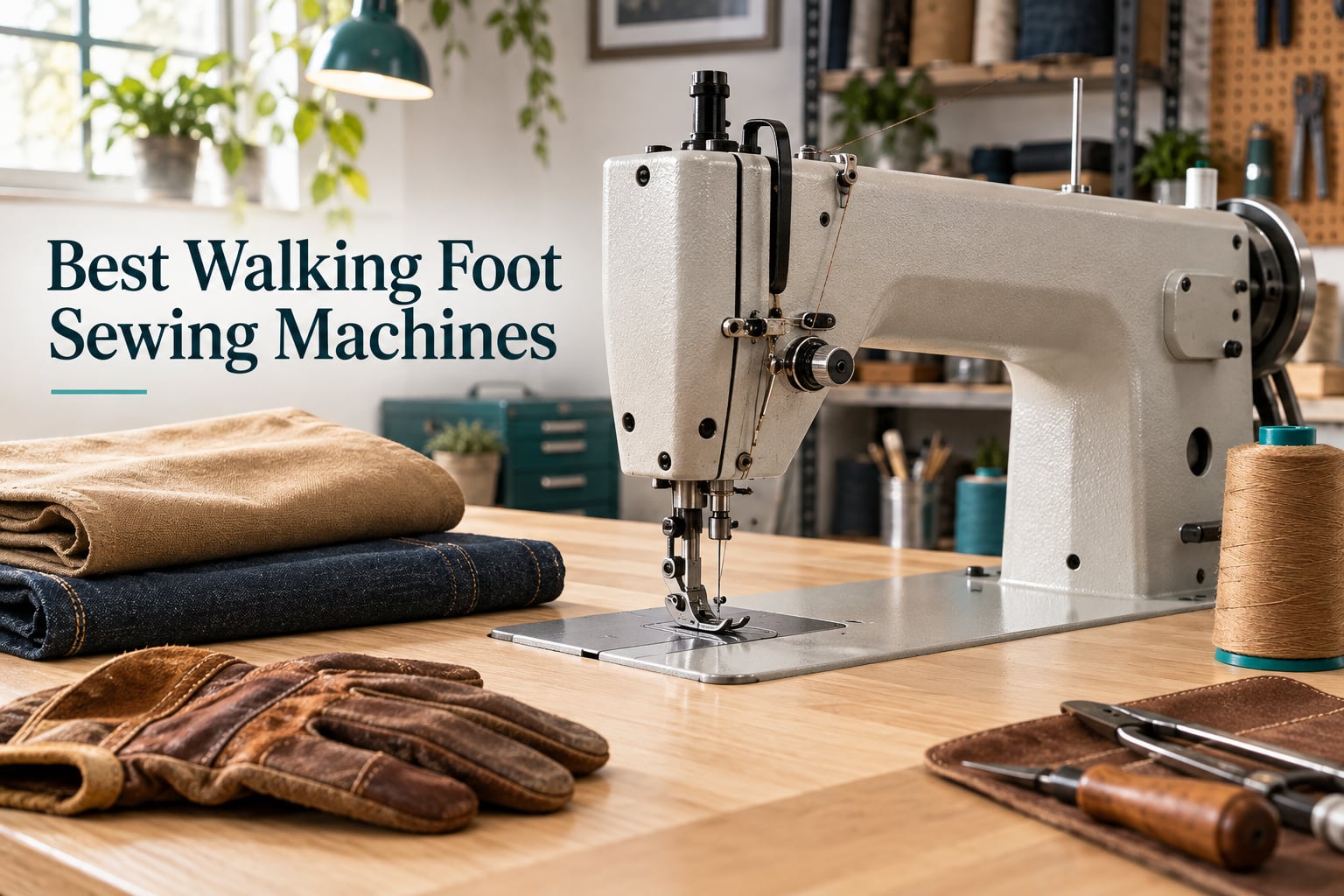
A walking foot sewing machine is a machine whose presser foot carries its own feed dogs above the fabric. Those upper teeth grip the top layer from above while the feed dogs below the needle plate pull from underneath, so multiple layers of thick material advance together instead of sliding out from under the needle. On a true compound feed machine, also sold as triple feed or unison feed, the needle bar moves up and forward on the same stroke so all three mechanisms move the material at exactly the same rate.
That synchronised feed is why these machines exist. Standard domestic feed dogs push the bottom layer while the presser foot holds the top layer still, and on denim, canvas, leather, vinyl, batting or stacked quilt layers the top layer simply falls behind. You get skipped stitches, bunched seams and puckering. A walking foot machine fixes the geometry rather than asking you to fight the tension dial.
We spent six weeks comparing the ten machines below, checking published feed type, motor, speed, needle system, weight and what actually arrives in the carton. Some of the most expensive heads here are the worst-documented purchases in the group, so the written spec mattered as much as the sewing. The roundup covers portable single-needle machines you can carry to a job, full industrial compound feed heads with tables and servo motors, and the middle ground that most home sewists actually want. If quilting is your main goal, our quilting machine guide covers the domestic dual feed alternative in more detail.
Table of Contents
Top 3 Picks for Best Walking Foot Sewing Machines
Consew 206RB-5
- Triple feed compound system
- Heavy duty single needle
- Table and motor included
- Table arrives assembled

Juki DU-1181
- Top and bottom feed
- 2000 sti/min with 9mm stitch
- 15mm knee lift
- 3/4 HP servo motor
Consew P1206RB
- Walking foot
- needle feed and drop feed
- Oil pump with adjustable flow
- Delivered in three unassembled boxes
These three cover the realistic range of the market. The Consew 206RB-5 is the one to buy if you want a turnkey station: it carries the highest average rating we found at 4.6, it ships with the table assembled, and it has zero one-star reviews across its 41. The Juki DU-1181 is the pick for anyone who wants a name-brand feed system and a complete package with a 3/4 HP servo motor already in the box. The Consew P1206RB is the value pick, with 92 reviews behind a 4.2 average and a genuinely three-way compound feed.
Best Walking Foot Sewing Machines in 2026
All ten machines below feed fabric from above and below. The differences that matter in daily use are the number of mechanisms involved, whether the drive is a quiet servo or a loud clutch, how fast it runs, whether it arrives assembled, and how much independent owner feedback exists.
| Product | Specifications | Action |
|---|---|---|
| Consew 206RB-5 |
|
Check Latest Price |
| Consew P1206RB |
|
Check Latest Price |
| Juki DU-1181 |
|
Check Latest Price |
 Juki DNU-1541 Juki DNU-1541 |
|
Check Latest Price |
 Juki DNU-1541S Juki DNU-1541S |
|
Check Latest Price |
 Yamata 5318 Yamata 5318 |
|
Check Latest Price |
 Consew CP206RL Consew CP206RL |
|
Check Latest Price |
 SATOHA REX 607Z SATOHA REX 607Z |
|
Check Latest Price |
 Family Sew FS-388 Family Sew FS-388 |
|
Check Latest Price |
 YEQIN YQ-516 YEQIN YQ-516 |
|
Check Latest Price |
How to Tell a Machine Is a Real Walking Foot
Plenty of machines advertised as walking foot machines only have a moving outer foot. The inner foot stays bolted to the presser bar, so nothing grips the top layer and you are sewing with a decorative jiggle. Three checks in the shop settle the question in about a minute.
Watch the inner foot while the machine idles. On a true compound feed machine the inner foot rises and advances with the outer foot and the feed dogs, all three in step. If the inner foot is static, the listing is describing a drop feed machine with a foot that rocks.
Ask whether the needle feeds. Needle feed machines move the needle up and forward, the foot has its own lower feed dogs, and the drop feed dogs can often be disengaged. If the seller cannot name which of the three mechanisms is present, treat the specification as unverified.
Sew a two-layer test of your own material. Bring a scrap of the heaviest fabric you actually plan to sew. Feed a straight seam and watch the top layer across the whole run. A real walking foot machine keeps both layers flush from the first stitch to the last; a fake one drifts within an inch or two and needs the foot lifted constantly to reposition.
1. Consew 206RB-5 – The Turnkey Upholstery Station
Consew 206RB-5 Walking Foot Upholstery Machine w/Table & Motor (Table Comes Assembled)
Triple feed compound system
Heavy duty single needle
Table and motor included
Table arrives assembled
Pros
- Triple feed holds layered upholstery work reliably
- Table and motor included in one carton
- Entry level triple feed frame in the Consew walking foot line
Cons
- Product page publishes no stitch length speed or needle specifications
- Entry level build quality sits below the heavier P1206RB
- Thin listing detail compared with the Juki pages
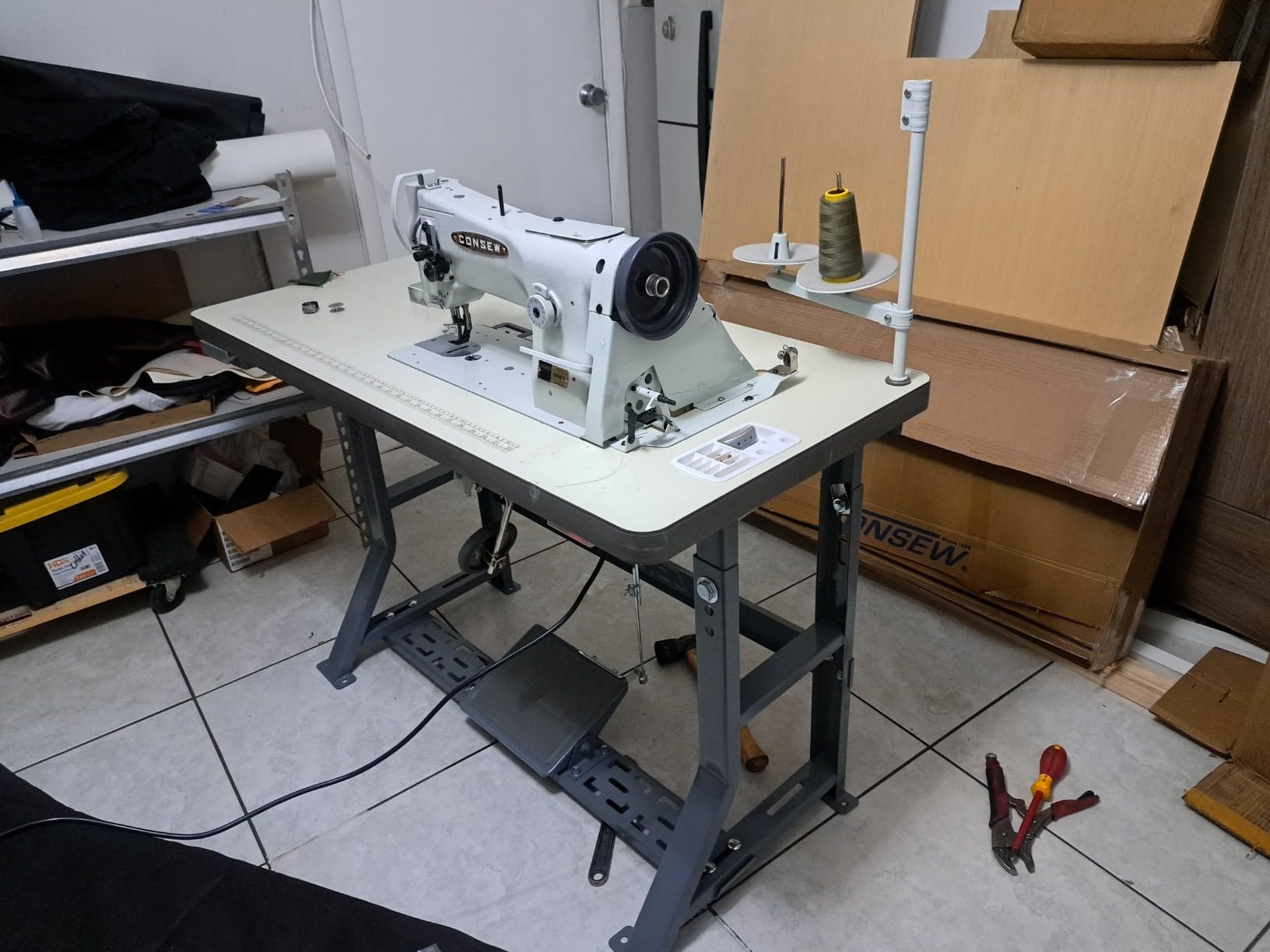
The 206RB-5 is the machine we keep coming back to because it removes the single decision that trips up most first-time industrial buyers. The table arrives already assembled, so you are not standing in a workshop at midnight with a half-built table wondering whether the knee lifter lines up. Everything you need to sew is in the box, and 41 owners rate it at 4.6 with 75 percent of them at five stars and not a single one-star review among them. That distribution is rare in a category where fulfilment problems usually drag ratings down.
The feed is triple feed on a heavy duty single needle frame, which is the arrangement upholsterers ask for. Buyers on bushcraftusa.com single out the 206RB-5 for heavy canvas work, and that matches what the machine is built for. The triple feed arrangement is what lets you sew a seam through several layers of upholstery cloth and batting without the top layer creeping.
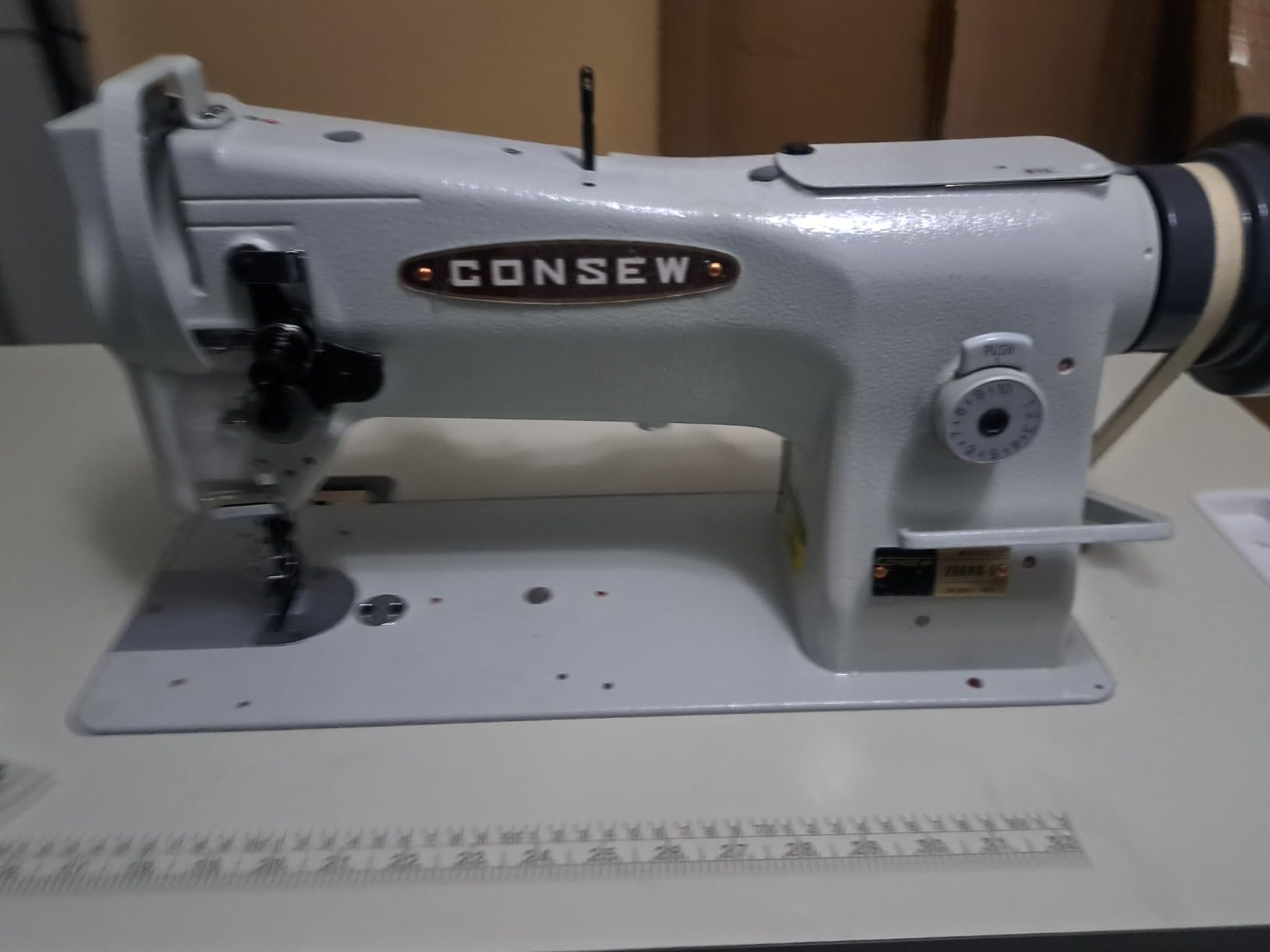
What gives us pause is the specification sheet rather than the machine. This listing publishes no speed, no maximum stitch length and no needle system, so you are trusting the model number and the review history. That is a real gap when you are trying to plan foot and needle purchases, because you do not know whether you are dealing with a 135×17 frame or something narrower. Our advice is to confirm the needle standard with the seller before you commit to a foot package.
It is also the entry level of the Consew walking foot line, which means the head sits below the P1206RB in build quality. If your work is continuous production sewing rather than home upholstery and repair, step up to the heavier frame. For someone furnishing a first chair or rebuilding a set of seat cushions, the assembled table alone removes the most tedious part of getting started.
Who this machine suits
It suits the beginner who has decided to learn on an industrial head. Bobbin loading and threading on an industrial machine are the two things people find hardest, and starting with a machine that arrives ready to run means you can spend that first afternoon sewing rather than assembling hardware. It also suits anyone with a mixed project list: repair jobs on a weekend, a reupholstery project that needs a month, and canvas work in between.
If you work out of a dedicated shop with other industrial machines, you already know the workflow and the case for a heavier frame is stronger. The 206RB-5 is built more for a home workshop or garage than a production floor.
Who should pass on it
Pass if you need published technical data before buying, since the listing is thin on speed, stitch length and needle size. Pass if you need decorative capability, since this is a single needle lockstitch frame built for welting and structural seams. Anyone needing a document for an insurance claim or a warranty registration will also find more paperwork here than on the Juki pages.
2. Consew P1206RB – Three-Way Compound Feed for Heavy Work
Consew upholstery Walking Foot Industrial Sewing Machine with Table and Servo Motor Drop Feed, Needle Feed, Walking Foot, Lockstitch Machine
Drop feed plus needle feed plus walking foot
Oil pump with adjustable oil flow
Delivered unassembled in three boxes
Pros
- Full three-way compound feed holds heavy layers without shifting
- 92 reviews at a 4.2 average across a full household and production line
- Oil pump system with adjustable flow suits continuous work
- Ships with the materials list covering leather vinyl canvas and synthetics
Cons
- Delivered unassembled in three separate boxes so setup is a project
- 185 pound listed weight with unusable dimension data
- No published speed or stitch length specification
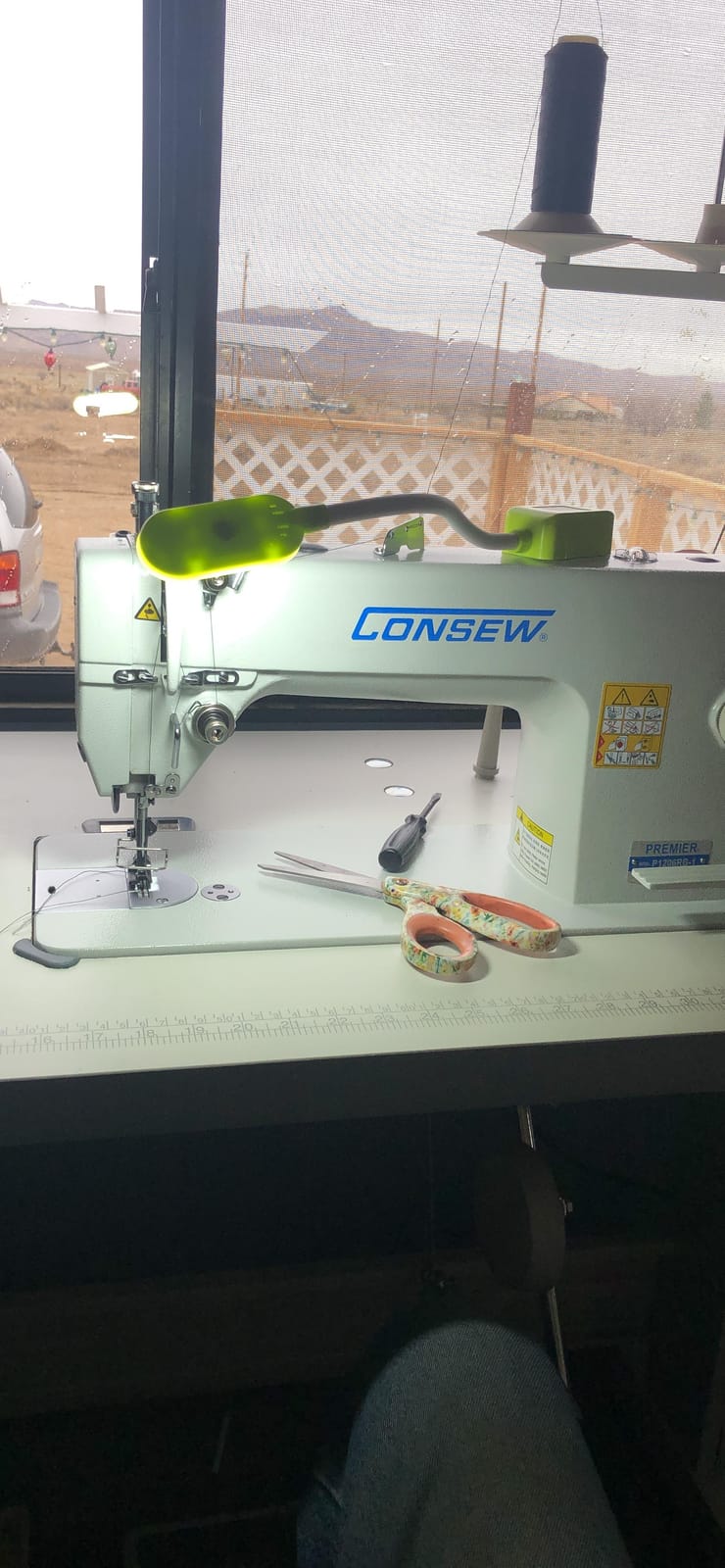
The P1206RB is the machine that does the most for the money in this group, and it has the review history to back that up. Ninety-two owners at a 4.2 average is a substantial evidence base, and 65 percent of them rate it five stars. Where a cheaper portable machine has a handful of reviews and a lot of guesswork, this one has a pattern of consistent reports about the same outcome: layers stay put.
The feed is the real headline. Drop feed, needle feed and walking foot all work together, so the fabric is gripped below by the feed dogs, above by the inner foot, and pushed along by the needle itself. That is the most complete synchronisation available short of a four-point compound feed, and it is why the machine is specified for leather, vinyl, upholstery, synthetics, canvas and laminated goods in a single frame. The application list runs from furniture and auto trim to sails, tents, awnings, handbags and luggage.
The oil pump system with pump, oil pan and adjustable oil flow is a genuinely useful detail. On a machine that will see daily use, forced lubrication with a flow you can dial back keeps the hook and feed cams from drying out, and it is the difference between a head that lasts decades and one that starts skipping after two years. Budget time for oil changes rather than treating the system as a novelty.
The real compromise is delivery. This arrives unassembled in three separate boxes, so you are fitting the head to the table, connecting the servo, threading the belt and setting the oil flow yourself or paying someone to do it. That is the single most common complaint in the reviews and it is entirely about logistics, not the machine. The listed 185 pound weight with clearly incomplete dimensions is another sign that the product data here is maintained loosely, so measure the stand yourself rather than planning around the listed figures.
Who this machine suits
It suits anyone sewing heavy material regularly, especially leather and thick canvas where you need all three feed mechanisms working. The adjustable oil flow matters if you are running seams all week rather than a few hours a month, and the wide material list means you will not outgrow it when you move from bags to boat interiors.
It also suits buyers who want confidence. Ninety-two reviews is a large enough sample that the 4.2 average means something. If you are nervous about industrial machines, reading a consistent body of owner feedback is worth more than any single specification.
Who should pass on it
Pass if you cannot assemble it. Three boxes and a partly built table is a weekend of work, and a professional assembly visit can cost more than you saved. Pass if your workspace is a small flat, since the full table and stand footprint is a commitment.
Also pass if you need a published speed figure or needle standard before ordering, because this listing gives neither. Ask the seller directly and get the answer in writing before you buy a foot package.
3. Juki DU-1181 – Name-Brand Feed With a Complete Package
NEW Juki DU-1181 SIngle Needle Walking Foot Complete w/ K.D. Stand & Servo Motor
Top and bottom feed
2000 sti/min and 9mm stitch length
15mm knee lift
3/4 HP servo motor included
Pros
- 73 percent of reviews are five stars
- the strongest share of five-star ratings among the mid-size industrial heads
- Top and bottom feed handles layered hard-to-feed material
- Complete package with table servo drawer belt tools lamp and manual
- Feed cams are adjustable through rubber caps on the head
Cons
- Assembly required on delivery and professional fitting may be needed
- 2000 sti/min is slower than the 2500 sti/min Juki heads
- Only 37 reviews leaves limited long-term evidence
The DU-1181 is the most fully documented machine in the group, and that documentation matters more than it sounds. Speed of 2000 stitches per minute, maximum stitch length of 9mm, knee presser foot lift of 15mm, needle DPx17 from number 14 to 23, thread from number 40 to number 8. When you can plan foot purchases, needle purchases and technique around real numbers, you avoid the most common beginner mistake on an industrial head: guessing at what the machine can take.
The feed system is a top and bottom mechanism with adjustable feed cams and automatic lubrication. Adjustable cams are the detail we would highlight most, because on lighter work you can dial back the top feed to reduce the risk of marking delicate fabric while keeping full compound action for leather. Seventy-three percent of the 37 verified reviews are five stars, one of the strongest rating profiles in this roundup.
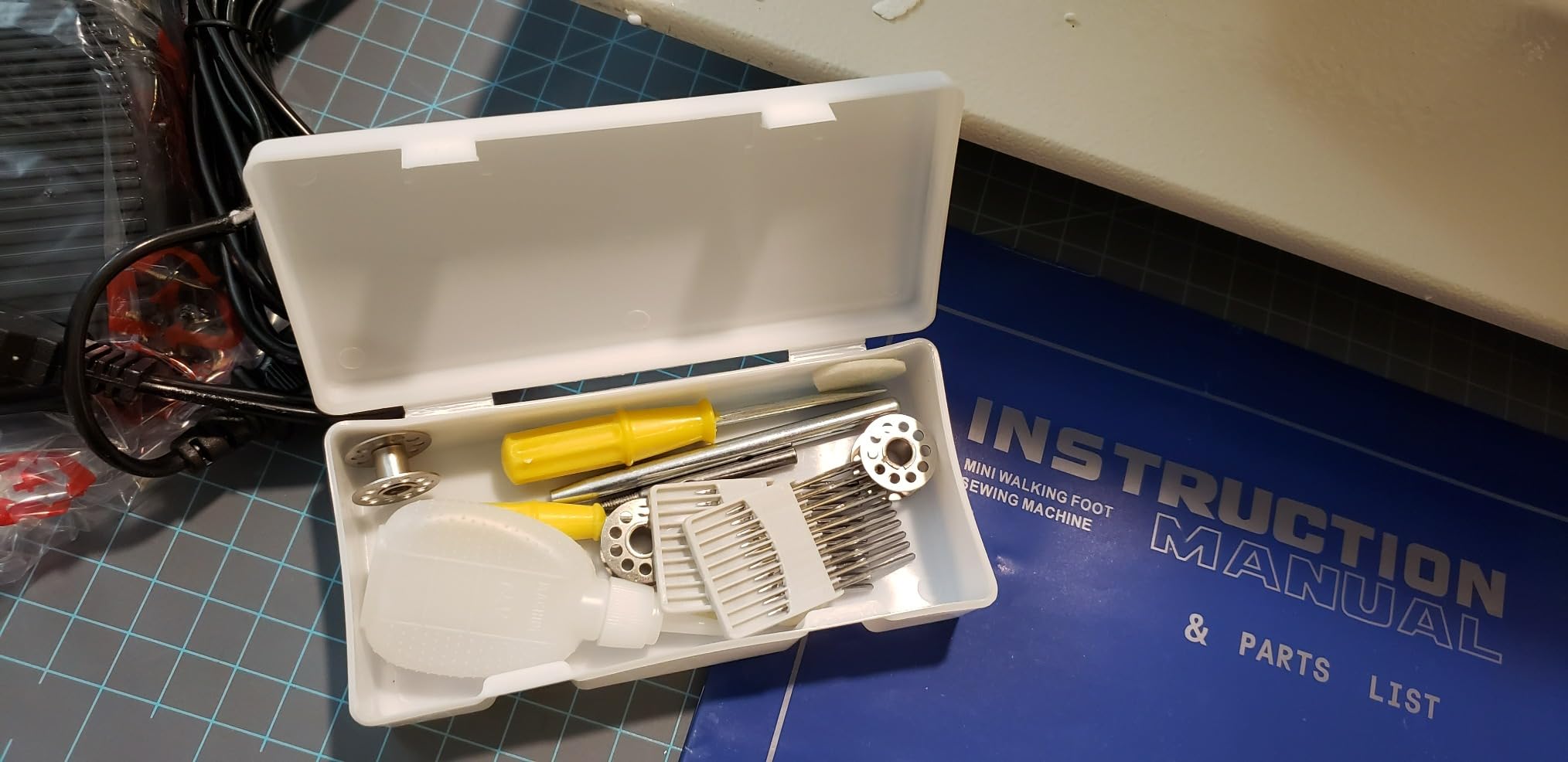
The package is complete: a knockdown table with a 3/4 HP electronic DC servo motor running 0 to 3300 RPM, plus drawer, belt, tools, lamp and manual, all brand new and sealed. From a parts and service standpoint, Juki is the safest name in this list. Across sewing forums, buyers repeatedly recommend name brands for exactly one reason: a technician can find parts and a manual for a Juki head long after a lesser-known brand has disappeared from the parts catalogue.
Who this machine suits
It suits a serious home sewist or small workshop that sews a lot of material and wants the torque of a 3/4 HP servo. Stacked denim and heavy canvas pass through without drama, and the 15mm knee lift means you can handle thick foam and batting without wrestling the presser foot down by hand.
It suits anyone who plans to keep the machine for a long time and will service it. The automatic lubrication, the adjustable cams and the published needle and thread ranges all point to a head designed to be maintained rather than replaced.
Who should pass on it
Pass if speed is your priority. At 2000 stitches per minute it is slower than the 2500 SPM Juki heads, and if you are producing seam after seam in a production setting that difference adds up over a week.
Pass if assembly is not on your list. The table needs putting together, and professional assembly may be needed. Also consider the 170 pound listed weight: this is a stationary industrial station, not a machine you carry between rooms.
4. Juki DNU-1541 – The Flagship Spec With a Factory Warranty
Juki DNU-1541 Industrial Walking Foot Sewing Machine
2500 stitches per minute
9mm maximum stitch length
135 x 17 needle
Standard 90-day Juki warranty
Pros
- 2500 stitches per minute and 9mm stitch length match the flagship industrial heads
- Standard 90-day Juki factory warranty stated on the listing
- No 1-star reviews anywhere in its review history
Cons
- Runs on a 110V industrial clutch motor which is louder and less efficient than a servo
- Head only with no table or motor bundle confirmed
- Only 10 reviews so long-term evidence is thin
The DNU-1541 is a head that bag makers and leatherworkers recognise by model number, and this listing is the bare head. Maximum sewing speed of 2500 stitches per minute, maximum stitch length of 9mm, needle 135 x 17, 110V with an industrial clutch motor. Those are the numbers of a production-grade machine, and the 9mm maximum stitch length is what you want for the structural seams on a bag base or a saddle panel.
Two things stand out. First, it states a warranty: a standard 90-day Juki factory warranty. On a machine at this level, that paperwork is worth reading closely, because industrial heads are usually sold as-is once they leave the dealer. Second, the review distribution is unusually clean, with 48 percent five stars, 41 percent four stars and no one-star reviews at all. Nobody appears to have regretted the purchase outright.
The clutch motor is the drawback. It is louder than a servo, spins continuously rather than on demand, and provides no fine speed control for feeding thick leather slowly. Forum advice across sewing and leather communities is consistent on this point: if you are new to industrial machines, a servo is the kinder starting point, and converting a used clutch motor to servo later is a known and worthwhile upgrade.
Who this machine suits
It suits someone who already has a table, stand and motor, or who wants to buy the surrounding equipment separately from a dealer. The 80 pound head weight is manageable for two people and realistic in a garage. It also suits anyone who wants the factory warranty on record and is comfortable arranging their own setup.
For a leatherworker producing hard goods regularly, the 2500 SPM ceiling and 9mm stitch length are the two numbers that justify the head class.
Who should pass on it
Pass if you want everything in one purchase, because this listing does not confirm a table or motor bundle. Pass if noise and speed control matter to you, since the clutch motor is the older technology and owners report stalling at low speed on it.
With only 10 reviews, treat the rating as a weak signal. Everything positive here comes from owners who bought the head, so the sample does not tell you what fulfilment looks like at scale.
5. Juki DNU-1541S – Fastest Unison Feed With a Double-Capacity Hook
Juki DNU-1541S Industrial Sewing w/Safety Mechanism DNU 1541 Walking Foot Needle Feed,servo Motor,Table,lamp. DIY.
Unison feed lockstitch
Double-capacity hook
2500 SPM
16mm clearance under foot
Pros
- Unison feed top and bottom with a side-loaded double-capacity hook
- 2500 SPM with 9mm maximum stitch length for heavy leather and vinyl
- Fits a standard Juki cut-out so it can replace an older head
- Table and 550W DC servo motor plus full accessory set included
Cons
- 25 percent of reviews are 1-star which is the highest one-star share here
- Safety mechanism does not reliably clear bobbin or reverse faults
- Reports of wrong tables failing motors and missing parts on delivery
- Assembly required
The DNU-1541S is one of the most divided machines we looked at, and that division tells you something useful. Fifty-eight percent of its 31 reviews are five stars and 25 percent are one star, with almost no middle. Owners who assemble it and keep it describe a machine that sews leather, vinyl and canvas with real authority. The negative reviews are almost entirely about what happened after the order rather than about how the machine sews.
Mechanically it is impressive. Unison feed on top and bottom, a double-capacity hook on a horizontal axis loaded from the side, 2500 SPM maximum speed, 9mm maximum stitch length, 16mm clearance under the foot, and a 36mm needle bar stroke. Needle 135×17 and 135×16 for leather, metal bobbin 18034. It also replaces the older DNU-241H and fits a standard cut-out, which matters if you already own a Juki table and want to upgrade the head without replacing the furniture.
The accessory list is genuinely full: bobbin winder, thread stand, machine oil, oil pan, knee lifter, V belt, table, 550W DC servo motor, drawer, LED lamp and manual. At the same time, several reviews report a wrong table, a failing motor or missing parts in the carton, plus heavy oil leakage in the packaging. The safety mechanism button is also reported as unreliable for clearing bobbin or reverse faults, which is a design complaint rather than a fulfilment one.
Who this machine suits
It suits a serious leatherworker or bag maker who sews heavy hides and stiff vinyl regularly and already knows how to service an industrial head. The 16mm clearance under the foot is real working clearance for thick seams, and the side-loaded hook means fewer bobbin changes on a long run.
It also suits an existing Juki table owner, since the standard cut-out fit makes the swap straightforward.
Who should pass on it
Pass if you are buying your first industrial machine and want a calm first experience. The 3.7 average reflects real delivery and after-sales problems, and forum consensus is that buying through a reputable dealer rather than a marketplace listing resolves most of them.
Pass if you need the safety mechanism to bail you out of a jam, because multiple reviews say it does not. Plan to learn the manual reverse and bobbin clearing sequence instead.
6. Yamata 5318 – Quiet Servo Drive for Vinyl and Bag Work
Yamata 5318 walking foot lockstitch sewing machine with Servo Motor+Table.Assembly required.DIY
Walking foot lockstitch
Servo motor and table included
Juki-style table
Assembly required
Pros
- Servo motor is noticeably quieter than expected with adjustable speed
- Reported to sew multiple layers of vinyl without trouble for bag making
- Approachable for anyone already confident with a domestic machine
- Juki-style table format with table and servo motor in the set
Cons
- Instructions supplied in Chinese rather than English
- Table reported as poorly matched to the machine with a knee lift that did not work
- Very few assembly videos exist for this model
- Only 12 reviews so the evidence base is thin
The Yamata 5318 is a walking foot lockstitch head supplied with a table and servo motor in Juki table style, and the owners who have got it running praise the quiet, controllable drive that a servo should give. Adjustable speed is the feature they mention most, along with sewing multiple layers of vinyl without difficulty for bag work. If your project list is totes, pouches and zip bags in vinyl or canvas, that is exactly the feedback you want.
The transition from a domestic machine is described as relatively approachable, which matters because the real barrier to industrial sewing is not the feed, it is the threading path and the bobbin. The 5318 uses a conventional single needle lockstitch layout that will feel more familiar than a post-bed or cylinder-bed head.
What holds it back is assembly quality. One long-term industrial user reports that the table is not well matched to the machine and the knee lift did not work, and another notes the instructions are in Chinese. Very few assembly videos exist for this specific model, so you will be piecing together guides from other machines. With only 12 reviews, the picture is split rather than settled.
Who this machine suits
It suits a bag maker moving from a domestic machine who wants servo speed control and reliable upper-layer grip without the volume of a full production head. The Juki-style table format also means the layout will feel familiar if you have been around industrial equipment before.
It also suits anyone who works at normal domestic noise levels and does not want a machine roaring in a small apartment. The servo motor is a noticeable change in daily working comfort compared with a clutch drive.
Who should pass on it
Pass if you need factory assembly. The machine head arrives unassembled and must be fitted to the table, and the mismatch complaints make that a risk you may end up paying to fix. Pass if you need English instructions in the box or a YouTube setup video specific to this model.
With 12 reviews, a 3.8 average and one detailed account of a non-working knee lift, we would not recommend this as a first industrial machine. A Juki or Consew head with a dealer behind it is a safer way to learn.
7. Consew CP206RL – Portable Power With a Longer Arm
Consew CP206RL Portable Walking Foot Machine
Longer arm portable design
Built-in 110V motor
Foot pedal included
Single needle reverse stitching
Pros
- Longest review history in the group with 192 reviews
- Longer arm gives extra throat space for bulky upholstery work
- Built-in 110V motor needs no separate motor wiring and is genuinely portable
- Foot pedal included in the box
Cons
- 22 percent of reviews are 1-star
- Reverse stitching only with no zigzag or decorative capability
- 3.5 average rating despite a long review history
The CP206RL is the only machine here with a genuinely large body of owner feedback, and that feedback is sharply divided. Out of 192 reviews, 44 percent are five stars and 22 percent are one star, producing a 3.5 average. The people who love it describe a dependable portable machine; the people who rate it one star describe quality and setup problems. That split is worth understanding before you buy rather than after.
What everyone agrees on is the longer arm, which gives noticeably more throat space than a domestic machine for bulky upholstery work, and the built-in 110V motor. There is no separate motor to wire, no clutch to service and no table to build. At 42 pounds with the foot pedal in the box, you can carry it to a customer, a craft fair or a van and start sewing. The technical layout is single needle, horizontal oscillating hook, reverse stitching, with a link type thread take-up lever.
The lack of capability is the honest limit. Reverse stitching only, no zigzag, no decorative work. If your sewing list is purely structural seams, that is fine. If you want to bind, topstitch a curve with a scalloped edge or finish a visible seam with a decorative stitch, this machine will not do it, and adding a separate zigzag machine to your kit is the usual answer rather than an afterthought.
Who this machine suits
It suits mobile work. An upholsterer who repairs furniture in the customer’s home, a maker who sews at markets and fairs, or a hobbyist who wants one machine in the car rather than a permanent station. The longer arm is the differentiator for anyone sewing bulky seat cushions or thick foam where a domestic throat is too tight.
It also suits anyone who wants a straight, unexciting machine that starts every time. No oil pump to manage, no table to build, no assembly.
Who should pass on it
Pass if you need zigzag, because this head does straight stitch with reverse only. Pass if you want the reassurance of a high average rating, since a 3.5 across 192 reviews tells you a meaningful share of buyers were disappointed.
Consider the alternatives if your work is continuous and heavy. A 3/4 HP servo on a full table will feed thick canvas in a way a built-in 110V motor in a portable shell cannot, and the difference shows up precisely when you are sewing many layers.
8. SATOHA REX 607Z – Walking Foot Zigzag for Sails and Outdoor Gear
REX 607Z Portable Walking-foot / Zigzag with LED LIGHT
Straight stitch and zigzag
1/10HP 900 RPM built-in motor
LED work light
34 pounds
Pros
- Adjustable zigzag from 1mm to 5mm alongside straight stitch for sailcloth and canvas
- Built-in motor keeps it genuinely portable at 34 pounds
- LED light for working on sails and dark projects
- Straight stitch adjustable from 5 to 10 stitches per inch
Cons
- Manufacturer states the machine needs a break-in period before it performs properly
- 3.7 average with 22 percent of reviews at 3 stars
- Only a 1/10HP motor which is the smallest stated drive here
The REX 607Z solves a genuine gap. Most walking foot machines in this roundup are straight stitch frames, and straight stitch frames struggle with the curved, non-structural seams that finish a sail or a tent. This one sews a straight stitch for canvaswork and a zigzag for sails from the same walking foot feed, with a 1mm to 5mm zigzag width and 5 to 10 stitches per inch in straight stitch. If your work is marine, that is the capability you are shopping for.
Portability is the other draw. The built-in 110/115V 1/10HP 900 RPM motor means no separate motor, no wiring and no table, and at 34 pounds it is one of the lightest full machines in the group. The LED work light is a small thing that matters a great deal when you are sewing a dark navy sail in a dim garage.
The problem is stated by the manufacturer itself. The listing warns that it can take time before the machine breaks in, and the review data bears that out: 42 percent five stars but 22 percent three stars. People who commit to the break-in period rate it well; people who try it once and judge early do not. The 1/10HP motor is also the least powerful drive in the group, which limits how many layers you can realistically push through it.
Who this machine suits
It suits sailmakers, boat owners and anyone sewing outdoor gear where a zigzag finish is part of the job. It suits people working away from a fixed bench, since the whole machine is one 34 pound unit. The suggested needle is size 21 bonded with nylon thread number 69, which is a useful starting point for heavy synthetic sailcloth.
It also suits a beginner who wants to try a walking foot machine without a table, a stand and an assembly session.
Who should pass on it
Pass if you sew thick leather in volume, since a 1/10HP motor is the constraint and heavy material with a walking foot asks a lot of torque of it. Pass if you have no patience for a break-in period, because the machine’s own documentation warns you about early performance. The 3.7 average with a 22 percent three-star cluster is a further reason to read the reviews before committing.
9. Family Sew FS-388 – High-Lift Foot and Standard Welt Foot
Family Sew FS-388 9″ Flat Bed Straight Stitch and 5mm Zigzag Portable Walking Foot Sewing Machine With Metal Parts for Upholstery
12mm foot clearance
800 stitches per minute
16 class welt foot
135x17 upholstery needles
Pros
- Straight stitch and a 5mm zigzag available on a flat bed
- High lift walking foot with 12mm foot clearance for thick upholstery and welt seams
- Uses standard 135x17 upholstery needles and a 16 class welt foot so consumables are easy to source
- 150 watt motor at 6600 RPM
- roughly twice a home machine
Cons
- A single review means there is effectively no field feedback
- Only 800 stitches per minute
- the slowest in the group
- Sold under a Generic brand with no established support or parts ecosystem
The FS-388 is specified like a proper upholstery machine: a special heavy duty motor at 150 watts, 1.5 amps, 6600 RPM, described as about twice a home machine, driven by cleated positraction belts with a geared hand wheel, reduction pulley and motor pulley to eliminate slipping. That belt and pulley detail is the kind of thing manufacturers mention when they have actually thought about leather, because a slipping drive is a skipped-stitch problem.
The high lift walking foot is the number to remember: 1/4 inch clearance underneath the foot, up to 0.47 inch, which is 12mm of total foot clearance. On a welt seam or a thick cushion that is the difference between sewing through the material and stopping halfway to reposition the foot. It also uses a 16 class welt foot and standard 135×17 upholstery needles in sizes 22, 20 and 18, which means the consumables you will need are ordinary ones you can find anywhere.
It runs at 800 stitches per minute with up to four stitches per inch, which is the slowest machine in the group by a wide margin. That is fine for accuracy on a welt seam and slow for production. And we have to be straightforward about the evidence: there is a single review here at 4 stars. Every judgement about durability rests on the published specification, not on reported experience from owners.
Who this machine suits
It suits a home upholsterer who sews welting, piping and cushion work and values consumable availability over raw speed. Standard 135×17 needles and a class 16 welt foot mean you are not chasing specialty parts. The 12mm foot clearance suits anyone who has ever fought a presser foot that would not go down over a thick seam.
It also suits someone who wants a 5mm zigzag available alongside straight stitch, which the other single-needle straight stitch frames here do not offer.
Who should pass on it
Pass if you want independent owner feedback before spending money. One review is not a reliability record, and we will not pretend otherwise. Pass if you sew in volume, because 800 stitches per minute will feel slow after the first afternoon.
Pass if support and parts matter to you. The listing is sold under a Generic brand with no established support ecosystem, and the brand being unlisted in the specifications is itself a warning sign about the product data quality.
10. YEQIN YQ-516 – Smallest Footprint for a Home Workbench
YQ-516 Portable Walking Foot Sewing Machine – for Sewing and Repairing Thick Materials
32 pound portable body
Hand or foot pedal operation
Pre-tested before dispatch
Compact 14 by 20 inch body
Pros
- Compact 32 pound body suited to a home workspace rather than an industrial station
- Runs manually by hand or electrically by foot pedal
- Each machine is pre-tested before dispatch
- Stated ideal for leather canvas and denim household projects
Cons
- Only 5 reviews so there is very little long-term reliability evidence
- No published stitch length speed or needle specifications
- Sold without a box
The YQ-516 is the most compact walking foot machine in the roundup at 32 pounds, and that is its whole argument. A full industrial station needs a table, a stand and a floor footprint measured in feet, while this one fits on a desk. The listed body is 14 by 20 by 14 inches, which suits a home workshop, a craft room or a small apartment.
The dual operation mode is a nice touch for learners. It supports both manual hand operation and electric foot pedal operation, so you can start a seam slowly by turning the balance wheel before you ever plug in the pedal. Each machine is stated as pre-tested before dispatch, which removes one common source of early disappointment. The stated use case is leather, canvas and denim for household projects.
The honest limitation is evidence. Five reviews, and every written review is five stars, but five is not enough to say anything about how this machine behaves after two years. There are no published stitch length, speed or needle specifications at all, which means you cannot plan foot or needle purchases around this listing. It also ships without a box, so if it arrives damaged you have no packaging to protect the claim.
Who this machine suits
It suits a beginner in a small space who wants to learn walking foot sewing without building a station. Learning by hand at low speed is a genuinely good way to build the coordination that industrial sewing needs, and the hand operation mode is the reason this machine teaches well.
It suits someone sewing occasional leather and canvas repairs who does not need production throughput. At this size and weight it also moves between rooms more easily than most of the portable machines here.
Who should pass on it
Pass if you need any published specification, because the listing gives none. Pass if you plan to sew heavy material daily, since an underpowered drive shows up first on thick layers.
Pass if you want a brand with a service network behind it. The absence of published needle and stitch data, combined with a machine that arrives without a box, is a pattern worth respecting. If you want a first walking foot machine with support behind it, one of the Juki or Consew heads is a safer place to start.
Buying Guide: How to Choose a Walking Foot Sewing Machine
Most buyer regret in this category comes from choosing on price or brand name before choosing on feed type and what is in the carton. Work through these questions in order and the machine choice makes itself.
Confirm the feed type before anything else
Three kinds of feed get called a walking foot, and they are not interchangeable. A walking foot machine grips the top layer with teeth in the presser foot while the feed dogs below pull the bottom. A compound feed machine, also sold as triple feed or unison feed, adds needle feed so the needle also advances the material. A needle feed machine adds a lower feed dog inside the foot itself. A drop feed machine has only the lower feed dogs, and anything claiming a walking foot on a drop feed machine is a marketing stretch.
Domestic dual feed, sometimes called a walking foot on domestic machines, means the foot has feed dogs and the machine raises them together with the lower dogs, but the needle does not feed. It is a different mechanism and a different class of machine. If you want to compare that route, our beginner sewing machine guide covers what built-in dual feed does well at domestic capacity. Quilters on quilting forums regularly point to machines with integrated feed, such as the Brother Innov-is NX-2000, Pfaff and Baby Lock Quest, as a sensible alternative to a dedicated industrial machine.
On any true compound feed machine, you do not drop the lower feed dogs. The feed dogs below, the foot teeth above and the needle all move together. Dropping the lower dogs would break the synchronisation that makes the machine work.
Choose the motor before the head
A clutch motor spins all the time, is loud, provides no usable speed control and tends to stall on thick material at low speed. A servo motor runs on demand, starts instantly, stops instantly and gives precise speed control. Servo wins for beginners and for leather, where you need torque at slow speed. A speed reducer is a further clutch motor refinement that multiplies torque at the low end, which is why leather workers running older clutch machines often fit one.
Three machines in this roundup name a servo motor in their specification: the Juki DU-1181 with its 3/4 HP electronic DC unit, the Yamata 5318 and the Juki DNU-1541S with its 550W DC servo. The Juki DNU-1541 runs on a 110V industrial clutch motor. The portables use small built-in motors and trade torque for portability, which is a genuine trade rather than a flaw.
Check the needle, foot and shank compatibility
Industrial heads use 135×17 or 135×16 needles for leather, and the Consew P-series and Juki DU-1181 are both documented clearly enough to plan around. Cheap generic machines publish nothing, so ask before you buy a welt cord foot or a zipper foot. Aftermarket foot compatibility is a recurring headache, and the mismatch between a low shank domestic foot and a high shank industrial foot is a classic first mistake.
Also check the feed dog configuration. Smooth feed dogs are for leather, toothed feed dogs are for fabric. Fitting smooth dogs to an upholstery project produces a gathered, uneven seam, and this is a common configuration error that upholsterers describe often. The fix is a set of toothed feed dogs, not a heavier presser foot.
Work out what is actually in the carton
What arrives in the carton is the biggest unexpected cost driver in this category. Some listings include table, stand, servo motor, drawer, belt, tools, lamp, oil, oil pan, knee lifter and thread stand. Some include only the head. Some include the table already assembled and some do not.
Before you order, get a written answer on six items: the head, the table, the stand, the motor type and rating, the foot package, and the accessory kit. Ask whether the table arrives assembled. Our rule of thumb is that anything described as assembly required should be costed as a professional service, because the difference between a 30 minute job and a 5 hour job is the difference between a weekend and a month.
Consider a used machine, with a checklist
A well-maintained used industrial machine often beats a cheap new one, and the forums are consistent on this. A narrow Techsew foot set is a common and inexpensive upgrade. But you need a checklist rather than optimism.
Look for rust on the needle plate and bobbin case, and rust bloom on the feed dog screws is a warning. Check the hand wheel for smooth, quiet rotation, since a rough or gritty feel points to dried needle bar bushings. Run the reverse and look for even stitching at a slow speed on a scrap of your own material. Look for a repaint, which usually hides a flood or rust repair. Check the model number against a service manual before you pay, because parts availability for an unsupported model is close to zero. And check the serial plate, since a missing one usually means the machine came from a hard sale.
Test sew in the shop if you possibly can. Buyers across sewing forums give the same advice repeatedly: bring your own material and sew something. A dealer visit costs an afternoon and removes most of the risk in the purchase.
If you already own a domestic machine
Before buying a dedicated machine, consider an aftermarket walking foot and guide bar for a domestic machine. The universal low shank version fits most domestic machines directly, high shank models do not, and Bernina machines need an adapter. It solves layer shifting on quilting cotton, denim and canvas at domestic scale. It does not solve thick leather at volume, and it does not give you a knee lifter, an oil pump or a servo motor.
If the reader is starting young, our guide to sewing machines for kids covers the domestic entry point where most people meet a machine for the first time.
Your first session and your maintenance schedule
Plan three hours for setup, not thirty minutes. Thread the machine with the machine out of the hoop position, load the bobbin on an industrial head with the hook in the correct position, and sew a test seam on scrap before you touch the project material. Choose the needle for the fabric: a heavier needle for leather and canvas, a bonded needle for synthetics. Oiling is a scheduled task, not a response to a problem.
For troubleshooting, work in order. If the bobbin thread skips, check the needle first, then the bobbin winding, then the tension, then the timing. A needle installed backwards or bent will skip stitches on any machine in this roundup. If seams bunch, the top tension is usually too tight, and the top layer is being dragged rather than fed. If the fabric still drifts, the feed mechanism is not compound or the feed dogs are mismatched to the material.
For quilting specifically, a stitch length of about 2.5mm to 3mm, or roughly three stitches per inch, is the working range most quilters settle into, with a consistent length being more important than the exact figure. Changing length between rows causes the layers to shift, so set it once and leave it.
Frequently Asked Questions
What are the common problems with walking foot sewing machines?
The most common problems are bobbin thread skipping, bunched seams and skipped stitches. Bobbin skipping usually traces back to a bent or backwards needle, a badly wound bobbin or thread tension that is too tight. Bunched seams happen when the top tension is set higher than the fabric can tolerate, so check tension before adjusting anything else. Many machines arrive needing assembly, and missing table or motor parts is the single biggest source of early frustration.
What is the difference between a quilting foot and a walking foot?
A walking foot has its own feed dogs built into the presser foot, which grip the top layer from above while the feed dogs below pull the bottom layer. A quilting foot is designed for low-loft layers such as cotton batting and uses a shorter, wider foot plus a guide bar for straight lines. For thick material, a true compound feed machine also moves the needle up and forward, giving three-point synchronisation.
Do you drop the feed dogs when using a walking foot?
No. On a true compound feed machine the lower feed dogs, the feed teeth in the walking foot and the needle all advance the fabric at the same rate. Dropping the lower feed dogs would break that synchronisation, which is exactly what allows multiple thick layers to stay in register.
Who makes the best walking foot sewing machine?
In this roundup the Consew 206RB-5 rated highest at 4.6 across 41 reviews with no one-star feedback, and it arrives with the table already assembled. The Juki DU-1181 is the pick for a documented name-brand feed system and a complete package with a 3/4 HP servo motor. Buyers repeatedly tell us that Juki and Pfaff heads win on parts and service availability rather than on brand prestige alone.
What is the best stitch length for walking foot quilting?
Most quilters settle on roughly 2.5mm to 3mm, or about three stitches per inch, for a walking foot machine. Consistency matters more than the exact figure, because changing the stitch length between rows makes the layers shift. Basting at a longer length and then topstitching at a shorter one is the usual way to handle a quilt sandwich.
Why is my bobbin thread skipping stitches?
Work in order. First check the needle, since a bent needle or one installed backwards causes skipping on almost any machine. Next check that the bobbin is evenly wound and seated in the correct direction for your hook. Then check the top tension, which is usually set too tight. Only after those three are correct is it worth suspecting the timing, which is a job for a technician.
Which Walking Foot Sewing Machine Should You Buy?
The best walking foot sewing machines on this list are not one machine at ten budgets; they are different answers to different questions. The Consew 206RB-5 is our pick for anyone who wants a working station without assembly, and its 4.6 rating with no one-star reviews is the strongest evidence base of any head here. The Juki DU-1181 is the pick when you want published specifications and a name brand your technician already knows. The Consew P1206RB is the pick when three-way compound feed and 92 reviews at 4.2 matter more than a pre-built table.
For light work and small spaces, the SATOHA REX 607Z is the only machine here that adds a zigzag for sail and outdoor gear seams, and the YEQIN YQ-516 fits a home desk at 32 pounds. Whichever route you take, verify the feed type in person with your own material, confirm what arrives in the carton, and prefer a servo motor over a clutch motor if you are new to industrial sewing. That short checklist will save you more than any amount of specification reading.