
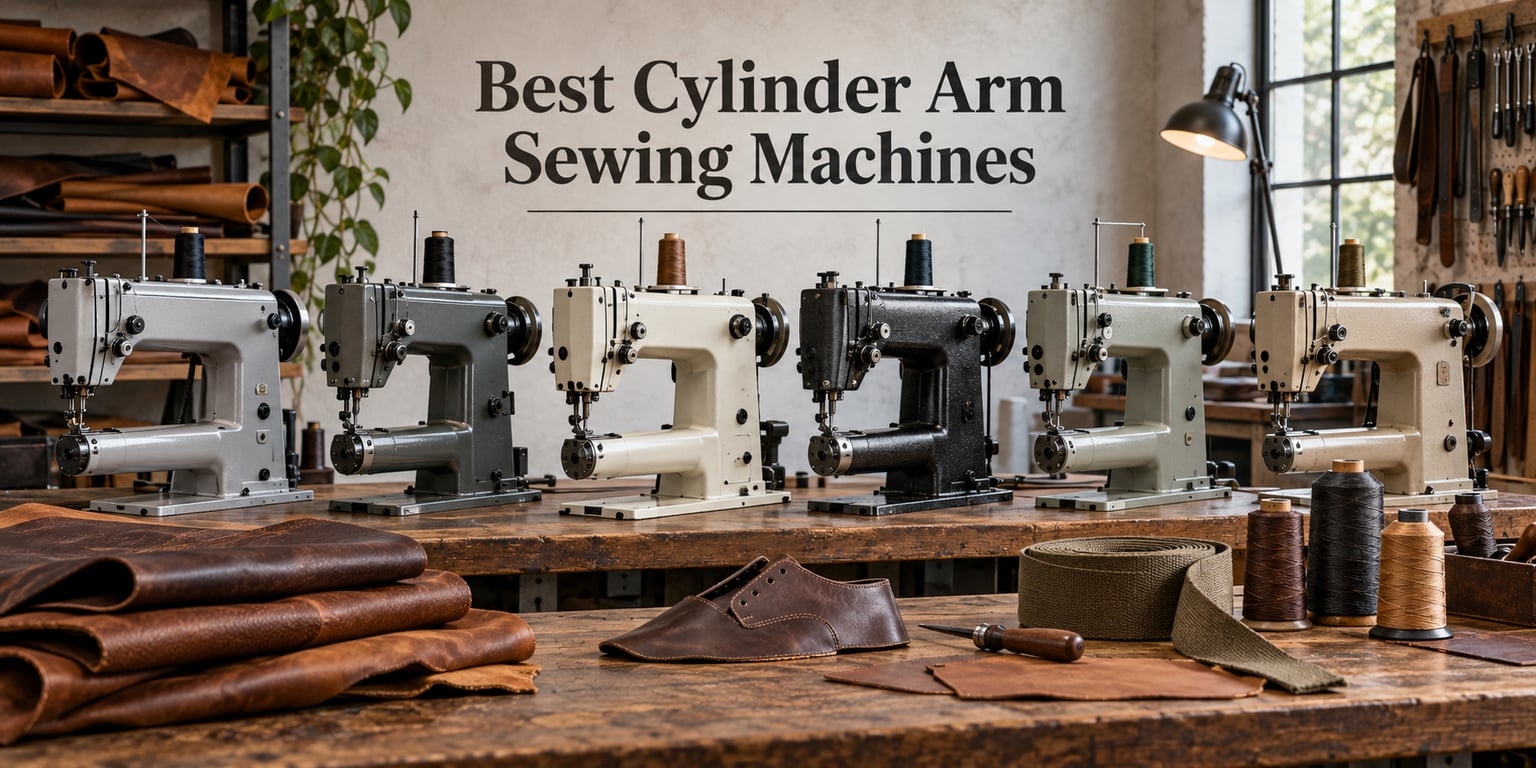
If you have spent any time sewing on tubular work, you already know the frustration: a shoe upper, a hat band, a duffel handle, a lampshade, or a belt loop will not lie flat on a domestic flatbed, and the needle simply cannot reach inside it. That is the whole reason the best cylinder arm sewing machines exist. The arm on these industrial heads is a narrow cylinder instead of a flat plate, so the needle and presser foot drop into the middle of rounded work while the feed system keeps heavy material moving at a steady pace.
We looked hard for the machines on this list. The honest headline is that genuine cylinder arm machines are a genuinely small category, and the listings that exist carry almost no customer feedback to lean on. Five of the six machines below show zero ratings and zero reviews on their listings, so we are not going to pretend we can hand you a five-star consensus. What we did instead was read every spec sheet line by line, sort the machines by what they are actually built to sew, and flag clearly where the performance data simply does not exist yet.
That changes how you should read the picks. These are machines you install once, oil once a week, and keep for a decade, so build specification, feed design and manufacturer traceability matter more than a star average that has not accumulated yet. A machine with a documented 12 inch arm and a large bobbin is a safer bet than an unbranded listing with an inconsistent spec sheet, even though neither has a review count to quote.
Table of Contents
What Is a Cylinder Arm Sewing Machine and What Is It For?
A cylinder arm sewing machine is an industrial lockstitch machine whose bed is not a flat table but a narrow, rounded arm projecting from the body of the head. The needle sits at the end of that arm, which means you can slide a tube, a cone, a shoe or a curved panel right up over it and sew straight down the middle of the work with nothing in the way.
That geometry is the entire reason to buy one. On a flatbed machine you fight the workpiece, turning bulky and rounded pieces constantly to find a workable angle. On a cylinder arm the work stays put and the machine goes to it.
The typical uses cluster into five groups:
Leather small goods – wallets, card holders, belts, knife sheaths, watch straps, where you sew around tight curves and stacked layers.
Bag and luggage work – handles, gussets, straps, piping runs and side seams on backpacks, totes and duffels.
Shoe and boot making – uppers, welts, heels, and repair work on whole boots, which is the classic cylinder arm job.
Hats – the crown and brim of a cap is a cone, and a cylinder arm reaches straight into it.
Upholstery, canvas and webbing – especially closed or tubular items where the underside is inaccessible.
Under the arm, the rest of the machine is a standard industrial single needle lockstitch, usually stitch type 301, which interlocks a single top thread with a single bobbin thread through the middle of the material. A feed system moves the work past the needle, and a servo motor mounted on the table stand supplies the torque. The differences between the six machines below come down to arm length, feed design, presser foot lift, needle count and how much of the table kit arrives in the box.
One warning before we go further. Community leatherworkers raise this constantly: a machine built for binding operations and one built for leather are not the same machine, and a triple-feed head with no usable feed dogs will skate across a hide instead of feeding it. We explain the difference in the feed section below, because it is the single most expensive mistake in this category.
Top 3 Cylinder Arm Sewing Machine Picks for 2026
Yamata LS 1341 Cylinder Arm
- 10 inch cylinder arm
- Walking foot feed
- Table and motor included


All 6 Cylinder Arm Sewing Machines Compared in 2026
| Product | Specifications | Action |
|---|---|---|
| Yamata LS 1341 Cylinder Arm Walking Foot Head |
|
Check Latest Price |
 Consew 29B 12 Inch Cylinder Arm Shoe Repair Machine Consew 29B 12 Inch Cylinder Arm Shoe Repair Machine |
|
Check Latest Price |
 XC-2IPSD1 Double Needle Cylinder Arm Stitcher XC-2IPSD1 Double Needle Cylinder Arm Stitcher |
|
Check Latest Price |
| FY335A Cylinder Arm Complete Table Kit With Servo Motor |
|
Check Latest Price |
| Aijreyie 32 Cm Hand Crank Cylinder Bed Stitcher |
|
Check Latest Price |
 YEQIN 2973 460 mm Long Arm Cylinder Bed Patcher YEQIN 2973 460 mm Long Arm Cylinder Bed Patcher |
|
Check Latest Price |
1. Yamata LS 1341 Cylinder Arm Walking Foot Head – the Best All-Round Choice
Yamata 1341 10″ Cylinder Arm Walking Foot Needle Feed Sewing Machine,Table,Motor
10 inch cylinder arm
Walking foot feed
Metal build
Table and motor included
Pros
- Genuine walking foot feed handles thick leather and canvas
- Recognisable brand with a traceable model number LS 1341
- Arrives as a working package with table and motor
- 10 inch arm suits belts and bags and shoe uppers
Cons
- No customer ratings or reviews on the listing
- One of the larger outlays in the group
- Head and table and motor all need a proper industrial outlet
This is the machine we would put on a bench without hesitating. The Yamata 1341 is a single needle cylinder arm lockstitch with a walking foot feed, which is the configuration that leather, canvas and webbing work all agree on. The walking foot is the point: a feed dog alone struggles to push stacked hide, while a walking foot grips the top of the material and drives it forward with the dog underneath.
The arm measures 10 inches, which is the sweet spot in this group. It will take a shoe upper, a belt, a bag gusset or a rolled strap, and it is not so long that it wobbles when you work near the far end. The build is listed as metal, and the model number LS 1341 is a real, traceable designator rather than a string of random characters, which matters enormously when you need a shuttle hook or a feed dog in two years.
What we like most here is what arrives in the box. The listing includes the table and the motor, so you are not hunting three suppliers for a head, a stand and a drive. That single fact removes most of the setup friction that trips up first-time industrial buyers, and it is why we rate this one ahead of cheaper-looking options.
What we cannot tell you is how it feels after two thousand hours. The listing carries no customer ratings and no reviews, so reliability is unverified by buyers. We are relying on the machine being a conventional industrial design in a well-known brand family, and on the fact that the specification is at least internally consistent. Verify the presser foot lift, stitch length range and thread range with the seller before you commit, because the listing does not publish them.
Who This Machine Is Right For
It suits a maker who already knows what a walking foot is and wants a package that works on arrival. If you are building wallets, belts, small bags, harness pieces or shoe uppers, the 10 inch arm and the walking foot feed cover all of it.
It also suits anyone who values replaceable parts over anonymous engineering. A traceable model number means a parts manual exists somewhere, and that is worth more than a slightly cheaper head with no paperwork behind it.
Where It Falls Short
It carries a large outlay for a first industrial purchase, and that is a real commitment. Buying the costliest option before you know your own material thickness and stitch needs is how people end up with an idle machine and a regret.
It is also an industrial head with an industrial footprint. You need a dedicated table, floor space, a serious outlet and somewhere to oil it every week. This is not a machine for a spare room craft corner.
2. Consew 29B 12 Inch Cylinder Arm Shoe Repair Machine – the Best Cylinder Arm for Boots
Consew 29B Shoe Repair Industrial Sewing Machine, 12″ Cylinder Arm, Large Bobbin
12 inch cylinder arm
Large bobbin
Built for shoe repair
Single needle lockstitch
Pros
- 12 inch arm clears full boots and bulky tubular work
- Large bobbin cuts thread changes on long repair jobs
- Consew is a recognised industrial sewing brand
- Purpose designed rather than adapted
Cons
- No customer ratings or reviews to confirm long term reliability
- Too heavy and industrial for a home or small studio
- Listing does not publish feed type or presser foot lift
If your work is boots, this is the one. The Consew 29B carries a 12 inch cylinder arm, and that extra two inches over the 10 inch Yamata is the difference between reaching the middle of a work boot and reaching a shoe.
The large bobbin is the second thing to look at. On repair work you are frequently sewing through a sole and several layers of welt with heavy thread, and a bigger bobbin means fewer stops to change thread in the middle of a job. That sounds like a small detail until you have done a full day of resoling.
Consew is a name that appears repeatedly in cobbler and repair circles, and the 29B is a purpose-built machine rather than a flatbed head with a cylinder attachment bolted to it. The listing ranks in the Sewing Machines category, which is a small positive signal that it moves units at all.
The gap is documentation. There are no customer ratings or reviews on this listing, and the published specification is thin: a 12 inch arm, a large bobbin, single needle lockstitch construction, and a stated purpose of shoe repair. The feed system and presser foot lift are not published, and those are exactly the two numbers that decide whether a repair machine can handle a thick welt. Ask the seller for both before you order.
Who This Machine Is Right For
It is built for a cobbler, a repair shop, or a maker whose project list is mostly footwear. Repairing and rebuilding shoes and boots is the workload the arm length was designed around, and nothing else on this list serves that job as directly.
It also suits a shop that sews the same thing all day. When your work repeats on a large volume of similar pieces, a large bobbin and a long arm pay back quickly in fewer interruptions.
Where It Falls Short
It is impractical outside a workshop. The 12 inch arm, the industrial frame and the intended use all point at a dedicated floor-standing setup, not a domestic craft space.
Without published feed type you are partly buying on reputation. That is not a dealbreaker, but it is a reason to buy from a seller who will talk you through the specification, and to have a local repair technician lined up before the head arrives.
3. XC-2IPSD1 Double Needle Cylinder Arm Stitcher – the Best for Two-Needle Seams
Heavy Duty Manual Leather Sewing Machine 12 Inch Arm Double Needle High Speed Industrial Stitcher for Shoe Repair Craft Workshop
Double needle
12 inch cylinder arm
Up to 500 SPM
5 to 15 SPI
Pros
- Two needles double your seam output on leather and uppers
- Cast iron frame is unusually rigid for this price class
- Upward feed lets you sew without repositioning work
- Adjustable 5 to 15 stitches per inch
- Two sized needle holes in the plate
Cons
- Unbranded build with no identifiable support network
- One of the larger outlays in the group with no buyer data
- No customer reviews on stitch consistency
This one is different in kind from the rest. Every other machine here sews one needle and one seam. This machine sews two needles at once, which means one pass gives you a twin-needle seam instead of two, and that doubles output on the wide decorative or reinforcing seams you find on bag panels, shoe uppers and leather goods.
The cast iron frame is the detail that stood out to us. For a machine in this class, a cast frame is unusual and it shows up directly in stitch quality, because the frame does not flex under the pressure of heavy material. The feed system feeds upward, which means the material is driven into the foot rather than dragged through it, and you can approach the work from more than one direction without constantly fighting the feed.
The numbers are genuinely usable here. Speed runs up to 500 stitches per minute. Stitch length adjusts from 5 to 15 stitches per inch, which is 5.1 mm down to 1.7 mm in metric terms. The needle plate carries two sized needle holes at each end, so you can fit different needle gauges for leather and for lighter material on the same plate.
What stops us short is the absence of a brand and the absence of reviews. The model number XC-2IPSD1 and the generic manufacturer line mean there is no service network we can point you to, and with zero customer feedback the durability claims are unproven in the wild. The thread tension is also adjusted by a clamp nut rather than a calibrated dial, so expect a short learning curve before your stitch tension stops moving around.
Who This Machine Is Right For
It is for a production shop that wants twin-needle seams and can service its own machine. Anyone stitching bag panels, shoe uppers or wide leather seams twice a day will roughly halve the time on those seams.
It also suits a maker who wants to sew from more than one angle without turning the work constantly. The upward feed and the two-needle plate take some of the awkwardness out of awkward positions.
Where It Falls Short
It carries one of the larger outlays of the six with nothing but a spec sheet behind it. That is a hard combination, and we would not put it first for a first-time buyer.
No identifiable manufacturer also means no obvious parts source. A twin needle head needs matching needles, a twin needle plate and a bobbin case arrangement that a general repair shop may not stock, so plan for a parts supplier before you commit.
4. FY335A Cylinder Arm Complete Table Kit – the Best Value Package
FY335A Cylinder Arm Walking Foot Industrial Sewing Machine – Complete Table Kit with Servo Motor – Leather & Bag Sewing Machine
Walking foot feed
Servo motor kit
Table, legs, LED light
150 lb assembly
Pros
- Complete kit covers head table top legs servo motor and light
- Quiet efficient servo motor rather than a noisy clutch motor
- Walking foot feed for leather canvas bags and upholstery
- Best sales rank among the cylinder arm listings we found
Cons
- Arrives as a knockdown kit so assembly is on you
- No customer reviews to confirm stitch quality
- 150 pound assembly is a two person move
This is the package we would hand to someone who wants a working cylinder arm machine on a bench for the least assembly drama. The FY335A listing includes the machine head, the table top with plastic legs, a servo motor, an LED sewing light, and a drawer with belt and hardware, which is essentially everything an industrial head needs bolted to something.
Once you count all of those pieces against buying a bare head and sourcing a table, a stand, a motor and a light separately, the value case is obvious. This is the one listing on this page where the total cost of the finished machine is not the biggest number in the equation.
The motor is a servo, not a clutch motor, and that matters more than buyers expect. A servo is quieter, draws far less power, starts instantly and gives you smooth speed control without the mechanical wear of a clutch. The walking foot feed covers the main material set: leather, canvas, bag materials and upholstery weight.
It ranks in the top few thousand of the Sewing Machines category, which is the strongest demand signal any listing here has. Even so, there are no customer reviews, so stitch consistency over time is unverified, and the head arrives as a knockdown kit you assemble and align yourself. Budget a weekend for setup, and know that a 150 pound table-and-machine assembly is a two person move rather than a solo lift.
Who This Machine Is Right For
It is for a first-time industrial buyer who wants one purchase that produces a complete working machine. Nothing else on this list removes that many separate sourcing decisions.
It also suits a home shop or small studio that values quiet. The servo motor means you can run it in a shared room without the clutch motor rattle, and the included LED light helps in a corner where the arm casts a shadow on the work.
Where It Falls Short
You are assembling it yourself. A knockdown kit means you set the timing alignment between the needle and the feed yourself, and a misalignment shows up immediately as skipped stitches on thick material. If you have never set up an industrial head, budget for a technician visit.
The plastic legs on the table are also the part of the kit most likely to disappoint. They move and wobble more than a cast or steel stand, and a 150 pound assembly needs to sit still to sew heavy material accurately.
5. Aijreyie 32 Cm Hand Crank Cylinder Bed Stitcher – the Best Budget Entry
Industrial Cylinder Bed Sewing for Shoe Repair,Hand Crank Stitcher with 360° Rotating Presser Foot,500 SPM,32 Cm Arm
Hand crank operation
32 cm arm
360 degree swivel foot
10 mm foot lift
Pros
- No electric motor or outlet needed
- Lowest motorised-work alternative in the group
- 360 degree swivel presser foot simplifies cornering
- 32 cm arm with 10 mm presser foot lift
- Large or small shuttle options
Cons
- Hand cranking is slow and tiring for volume work
- Listing weight data is internally inconsistent
- Generic model number with no traceable parts support
- No customer reviews
Everything about this machine is a deliberate trade. You give up the motor, and with it speed, quiet operation and fatigue, and in exchange you get a machine that needs no power at all. The hand crank means it works in a workshop, a garage, a craft fair tent or anywhere else with no dedicated industrial outlet.
The 360 degree swivel presser foot is the genuinely clever part. It pivots so you can change the direction of the seam without lifting the foot off the work, which is exactly what you want on a shoe upper or a curved panel. The 32 cm arm handles bulky tubular pieces, and the 10 mm presser foot lift gives you room to get thicker material under the foot.
Speed still reaches 500 stitches per minute and stitch length is 5 mm, and the shuttle can be ordered as large or small depending on the thread you use. Net weight is stated at 27 kg with a gross of 30 kg, and the packed dimensions are 590 by 285 by 490 mm.
Two things give us pause. First, the listing states an item weight of 1 kg in one place and 27 kg net in another, and a spec sheet that contradicts itself on the most basic physical fact is a warning sign about the rest of the data. Second, the model number is an untraceable string, so there is no parts source we can point you at. The 27 kg chassis is also genuinely heavy to reposition on your own.
Who This Machine Is Right For
It is for a repair cobbler working in places with no power, or a maker who sews a few items a week rather than a production run. If you only need the machine occasionally, cranking is a small price for total portability.
It also suits someone testing whether they actually want a cylinder arm machine. The outlay is among the lowest here, so it is the least painful way to find out whether sewing inside a tube is the right workflow for you.
Where It Falls Short
Do not buy it for volume. One crank revolution per stitch adds up fast, and a hand-operated head will exhaust you long before a motorised head does on the same job.
The contradictory weight data is the bigger concern. Ask the seller to confirm the actual machine weight, the arm diameter and the shuttle type in writing before you pay, and expect to source any replacement part yourself.
6. YEQIN 2973 460 mm Long Arm Cylinder Bed Patcher – the Longest Reach, and the Weakest Record
YEQIN 2973 Cylinder Long Arm Patcher Sewing Machine Shoe Leather Boots Repair Machine-Long Arm-460mm (Table Stand Motor Not Included)
460 mm long arm
500 SPM
10.5 mm foot lift
Table and motor not included
Pros
- Longest arm in the group at 460 mm
- Reproduction of the classic Singer 29K patching machine
- 10.5 mm presser foot lift for boots and canvas
- Buyer photos show the machine as delivered
Cons
- Lowest rated listing here at 2.3 out of 5 from 5 reviews
- Reports of bent and broken parts on arrival
- Table stand and motor not included
- Replacement parts slow to source
The 2973 is the odd one out twice over. It has by far the longest arm in the group at 460 mm, roughly 18 inches, and it is the only listing here with any customer feedback at all, which turns out to matter a great deal.
On the design side, the reach is the advantage. This is a reproduction of the classic Singer 29K 73 long-arm patching machine, the traditional cobbler’s tool for sewing a full shoe, boot or lampshade in one piece without turning the work. It sews a single needle lockstitch, runs to 500 stitches per minute, lifts the presser foot up to 10.5 mm, and has a 360 degree rotating presser foot for the same directional control as the hand crank model. The sewn table diameter is under 30 mm, which is a tight opening you need to know about before you commit.
On the record side, the five reviews average 2.3 out of 5. Two report bent or broken components on arrival, including a drive wheel handle, pulley, tensioner, bobbin cam, pressure foot and needle. One reports a tight spot with a heavy squeal in the handwheel rotation after oiling, which points at a bearing or alignment problem rather than a one-off. Another buyer reports that two third-party motors lacked the torque to turn the head and burned out, which is a real setup-matching problem rather than a machine fault.
There is one positive report too: a buyer confirms the machine runs once repaired, which tells you the mechanism itself works and the shipping damage is the real issue. The practical read is that you need to inspect the machine on arrival and be prepared for a repair bill.
One more thing that catches people here. The listing excludes the table, the stand and the motor, so the number you see is the head alone and the finished machine costs considerably more once you add the rest. Budget for a motor with genuine torque, because the buyer report about burned out third-party motors is exactly the failure mode you will hit with an undersized drive.
Who This Machine Is Right For
It is right for a cobbler whose work involves whole shoes, boots or lampshades that no other machine here can reach. For 18 inches of reach there is no substitute, and the 29K lineage means repair shops already understand the design.
It also suits a buyer who is comfortable inspecting a machine on arrival and doing basic repair work. Given the reported transit damage, that skill is effectively a requirement rather than a preference.
Where It Falls Short
It has the lowest rating and weakest review record on this page, and we are not going to dress that up. Two of five reviews describe a machine that arrived damaged, and parts were slow to source for at least one buyer who was still waiting on a presser foot.
The excluded table, stand and motor also push the real cost well past the sticker figure. For most buyers the four machines above are the safer purchase, and this one makes sense only when arm length is a hard requirement.
Feed Systems Explained: Drop Feed, Walking Foot and Double Needle
The feed system decides whether a machine feeds your material or just pushes it around, and it is the specification buyers most often get wrong. It is also the one no competitor page here explains properly.
Drop feed means the feed dogs alone move the material, gripping it from underneath. Drop feed is the traditional cobbler and repair configuration because it gives you precise, direct control over stitch placement on leather, which matters when you are placing a welt or a seam by hand-guided positioning. Drop feed is less confident with thick stacked layers because there is nothing holding the top of the material.
Walking foot adds a presser foot with its own feed motion, so the top and the bottom of the material move together. This is the general heavy-duty answer for leather, canvas, webbing and bag materials, and it is the feed documented on two of the six machines here. A walking foot grippier feed reduces the skidding you get on slick leather and thick stack.
Double needle does not change the feed so much as double the output, running two needles to make twin-needle seams in one pass. The XC-2IPSD1 is the only machine on this list built this way.
Now the trap. A machine designed for binding operations moves the material with a triple feed system, where needle, presser foot and feed dog all move in unison, and some of those heads have no usable feed dogs at all. Leatherworkers on forums describe the result plainly: buy a binding machine for leather work and it skates across the hide instead of feeding it. If you are sewing leather, you want feed dogs and a walking foot, not a binding triple feed with the dogs removed.
There is also a machine type mismatch worth naming. A post bed machine is a different shape again, with a vertical post under the arm for stitching shoes and hats where the sole of the shoe sits down onto the post. A cylinder arm gives you a longer, narrower channel to slide a tube over. If you are making whole shoes on a last, a post bed is often the better tool. If you are sewing handles, straps, belts and tubular bags, the cylinder arm wins.
Cylinder Arm vs Post Bed vs Flatbed: Which One Do You Need?
Start from the shape of the work, not from the machine. A domestic flatbed handles flat panels, garments and quilting well and handles nothing tubular at all, so a flatbed is the wrong tool the moment you sew a handle or a boot.
A post bed puts a narrow vertical post under the needle. It is the machine for whole shoes and hats made on a last, and it is a specialist shape you should buy only when shoe or hat construction is your actual output. Sewing Pattern Review members who run cylinder arms with a flat bed attachment option cite that flexibility as their main reason to prefer the cylinder arm: one machine, and a flat bed plate fitted when you need to sew something flat.
A cylinder arm gives you a long narrow channel to slide tubular work over. Choose it for bags, belts, straps, leather goods, hats on a brim, canvas, webbing, repair work and anything rounded or tightly curved.
The quick chooser: if the work is flat, use a flatbed. If the work is a whole shoe or hat on a last, use a post bed. If the work is a tube, a strap, a curve or a bulky item you cannot turn, use a cylinder arm. If you need a cylinder arm but only occasionally sew flat work, check whether the machine accepts a flat bed attachment before you buy. Newcomers still deciding whether sewing is for them usually start with a domestic machine instead, and our roundup of the best beginner sewing kits for adults covers that entry route.
How to Choose a Cylinder Arm Sewing Machine in 2026
Arm length is the first filter. Most leatherwork, belts and bags fit comfortably in a 10 inch arm. Boots and bulky tubular work want 12 inches. Whole shoes, boots and lampshades want a long arm in the 18 inch range, and only the YEQIN 2973 on this list reaches that far. Choose for your largest regular workpiece rather than your typical one, because the machine is built to last and your work will drift larger over time.
Feed type is the second filter. Match it to material thickness and project type. Thin leather and delicate goods that need precise placement favour a drop feed, because you guide the work directly. Thick hide, stacked panels, canvas and webbing favour a walking foot. Wide twin-needle seams favour a double needle head. And do not buy a binding triple feed head expecting it to feed leather, because the binding configuration often has no feed dogs to feed with.
Servo motor and speed control come third. A servo motor starts instantly, runs quietly, uses far less electricity and gives smooth, immediate speed adjustment. A clutch motor is louder, wears mechanically and needs a belt. Leatherworkers also report that a speed reducer is worth adding when you topstitch at low speed on heavy material, because fine control at one stitch at a time is much easier when the machine is not running flat out.
The table, the stand and the true cost of ownership deserve their own conversation, because this is where cylinder arm budgets quietly double. The head is only part of the machine. You also need a table or stand heavy enough to hold it, a motor, a light, a knee lifter or knee pad, and space for the whole assembly to sit still. Then there is freight, which for a 150 pound machine is not a small line, and ongoing servicing, which for an industrial head means oiling on a schedule and a belt change every few hundred hours depending on use. Ask any seller for the all-in figure, not the head price. The FY335A is the one listing here that publishes the whole package.
Thread and needle sizing catch out almost every new buyer. Leather, canvas and heavy webbing need far heavier thread and needles than a domestic machine uses, typically thread in the V69 to V138 range with a Tex 150 bonded polyester, and needles in the #18 to #23 range. A number of sewing forum members running Juki LS-341 and its equivalents warn that the machine wants a minimum of V69, and that V138 is the sensible working choice for most leather. Running thread that is too fine makes the stitch fail under load, and running a needle that is too fine causes skipped stitches on thick material. Check the machine’s published thread and needle range before you buy, and buy a mixed pack of needles in the range you need rather than assuming the standard domestic sizes fit.
Brand reliability and parts support are the last filter, and they are the ones that decide how long the machine lasts. Juki, Consew, Brother, Durkopp Adler, Pfaff and Singer occupy the top tier for build quality and parts availability, and community cordwaining threads regularly recommend the Durkopp Adler 269 with a cylinder arm for heavy leather work. Below that sit well-regarded makers such as Techsew, THOR, Yamata, MoSew and REER, which deliver capability close to the premium tier at a lower outlay. Forum buyers consistently point out that clones can match a Juki head for a fraction of the cost, and a bag maker on leatherworker.net reported a THOR GC1341 with 16 mm presser foot lift, grooved feed dogs, 3 to 9 mm stitch length and a 2000 SPM servo outperforming a Juki 1341 at around half the price. Saddlehunter users likewise describe THOR and Yamata machines as reliable in production with plenty of punching power.
Used machine inspection deserves its own checklist, because a second-hand industrial head can be a bargain or a money pit. Before you commit, ask the seller to run the machine and photograph the handwheel at full rotation, which catches the squealing tight spot one buyer reported. Check that the needle bar returns smoothly and that the presser foot lifts to its full stated height. Look at the feed dogs for polish and flat spots, since worn dogs cause the skipping that ruins leather work. Count the bobbin case and check the shuttle hook for scoring. Ask whether the timing was set recently and whether the machine has been regularly oiled. Confirm that the model number is still searchable for a parts diagram. And run a scrap of the same leather you intend to sew before you pay.
For a first industrial machine, our short version is this: buy a machine with a traceable model number, a documented feed system, and either a published presser foot lift or a seller who will tell you the number. The community view on which machine has the least trouble is consistent: it is not a brand so much as a machine that was sized right for the material, set up correctly, and oiled on schedule.
Frequently Asked Questions
What is the best cylinder arm sewing machine?
For most leather and bag work the best cylinder arm sewing machine is a single needle walking foot model with an arm of 10 to 12 inches and a servo motor, ideally sold with the table, stand and motor included as one package. On this list the FY335A is the strongest all-round package and the Yamata LS 1341 is the strongest head. Walk the arm, not the brand, and match the feed system to your thickest regular material.
What are the typical uses of a cylinder arm sewing machine?
The typical uses are leather small goods such as wallets, belts and sheaths, bag and luggage work including handles, gussets and straps, shoe and boot making and repair, hat crowns and brims, and upholstery, canvas, webbing or any closed tubular item whose underside you cannot reach. If the work is flat, a flatbed is better. If the work is a whole shoe on a last, a post bed is better.
How do I know what type of sewing machine to buy?
Start from the shape of the work. Flat panels and garments mean a flatbed. A whole shoe or hat on a last means a post bed. Tubes, straps, curves and bulky items you cannot turn mean a cylinder arm. Then match the feed: drop feed for precise placement on thin leather, walking foot for thick hide, canvas and webbing, double needle for wide twin-needle seams. Add a servo motor and a speed reducer for fine topstitching.
Which Juki sewing machine is considered the best?
Juki is widely considered the benchmark in this category, with the LS-1341 class cylinder arm head and the LS-341 being the models most often recommended. The practical caveat from forums is that the LS-341 and its equivalents want a minimum of V69 thread, with V138 the sensible working choice for most leather. Buyers should also weigh that THOR, Yamata, MoSew and REER machines deliver comparable capability for a lower outlay.
What is the most trouble-free sewing machine?
The most trouble-free cylinder arm machine is one that was correctly sized for your material, set up by someone who aligned the timing, and oiled on a regular schedule. Across owners, servo motor machines with walking foot feeds and traceable model numbers generate the fewest complaints. Reliability comes more from a matched motor with real torque and correct feed dogs than from the badge on the head, and cheap undersized motors are a known cause of failure on these machines.
Final Verdict: The Cylinder Arm Sewing Machine Worth Your Bench Space
Our pick of the best cylinder arm sewing machines is the Yamata LS 1341, a 10 inch cylinder arm walking foot head that arrives with its table and motor. The walking foot feed is the right default for leather, canvas and webbing, the arm length covers belts, bags and shoe uppers, and the model number is traceable enough that parts will exist when you need them.
Buy the FY335A instead if you would rather have one complete package than assemble the machine yourself, and pick the Consew 29B if boots are your work. Save the double needle machine for a production shop that can service it, and consider the hand crank head only if you genuinely have no power where you work.
Whatever you choose, size the arm to your largest regular workpiece, feed the material with feed dogs rather than binding triple feed, and budget for the table, stand and motor as part of the machine. If you are still comparing flatbed options, our guides to the best sewing machines for beginners and the best sewing machines for kids cover the domestic side, while our quilting machine picks go deeper on flatbed work.