
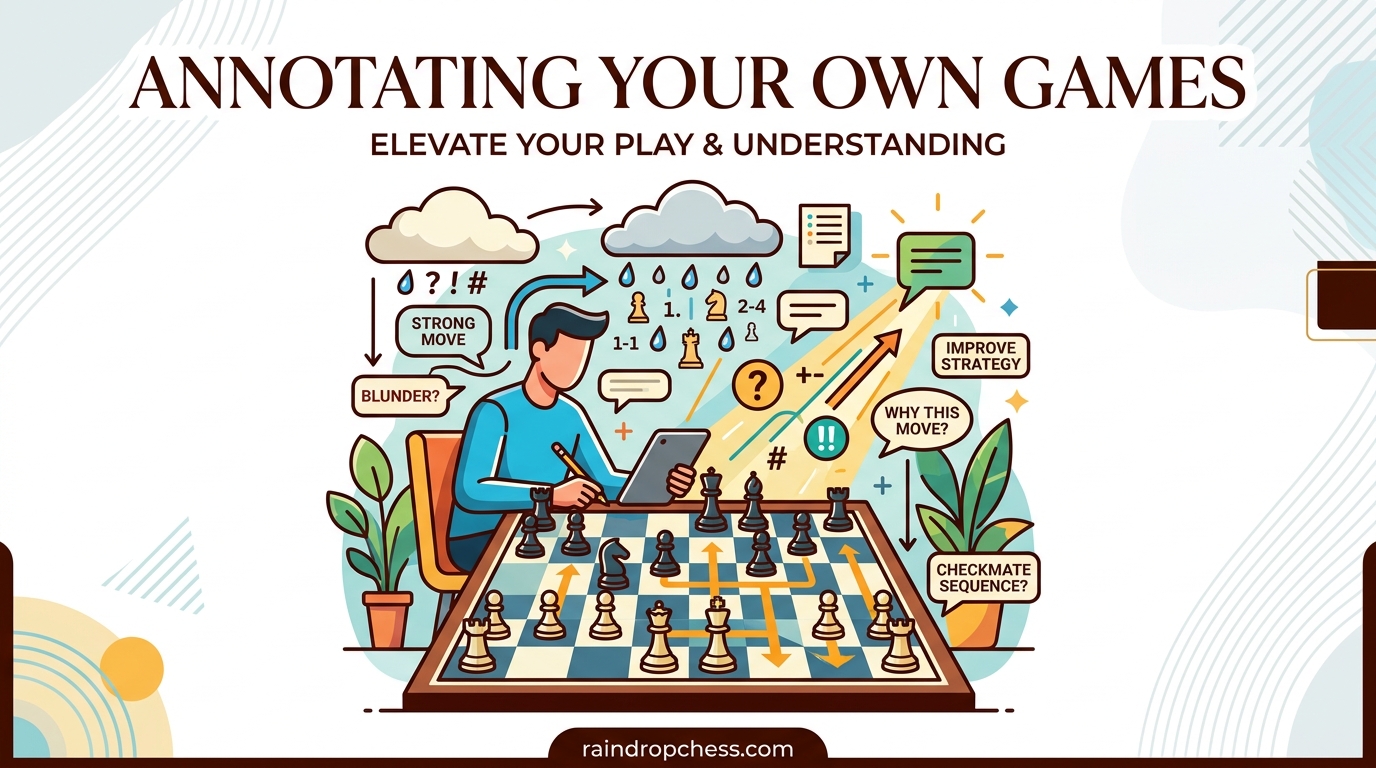
Every chess player who has ever reviewed a game knows the temptation to immediately load it into Stockfish and see where things went wrong. But here is a truth that many improvement players discover too late: annotating chess games without engine assistance first actually produces deeper, more lasting improvements than jumping straight to computer analysis. When you rely on an engine before doing your own thinking, you skip the most valuable part of the learning process.
Self-analysis without an engine forces you to confront your actual thought process, recognize recurring patterns in your decision-making, and take ownership of your mistakes rather than simply accepting that the computer found a better move. This guide provides a complete step-by-step workflow for annotating your own games effectively, whether you are a beginner learning the basics or an intermediate player looking to break through to the next level.
By the end of this article, you will have a repeatable system for game review that builds true chess understanding rather than engine dependency. You will learn exactly what to write down, when to use an engine (and when not to), and how to extract actionable training priorities from every game you play.
Table of Contents
Why Annotate Without an Engine First?
Before diving into the step-by-step process, it is worth understanding why the order matters so much. When you analyze a game with an engine first, you create what psychologists call “confirmation bias” in reverse. You see the computer evaluation and then try to rationalize why your move was wrong, rather than genuinely examining your thought process.
Manual annotation before engine use helps you in several critical ways:
- You retain more: The effort of figuring something out yourself creates stronger memory traces than simply reading an answer.
- You identify patterns: Computers excel at finding individual mistakes, but humans are better at recognizing recurring tendencies in how you think and play.
- You develop evaluation skills: Your ability to assess positions intuitively improves dramatically when you practice without crutches.
- You reduce self-deception: It is easy to convince yourself “I meant that engine move” when you never actually considered it.
Think of it like studying for an exam. You could read the answer key before attempting the problems, or you could struggle with them first and then check your work. The struggle is uncomfortable, but it is where genuine learning happens.
Step 1: Immediate Post-Game Notes (While Memory Is Fresh)
The annotation process actually begins immediately after your game ends, before you even leave the board. This step is often overlooked but provides invaluable information that you cannot recreate later.
What to Record Right Away
As soon as your game concludes, find a quiet spot and answer these questions in writing:
- What was my general plan in the opening? Did I follow established theory or improvise?
- Were there any moments where I felt uncertain but chose a move anyway?
- Did my opponent do anything unexpected that threw off my preparation?
- How did time pressure affect my decisions in each phase?
- What was my emotional state during critical moments (confident, anxious, frustrated)?
Write these notes by hand if possible. The physical act of writing activates different memory pathways than typing and tends to produce more thoughtful reflection. If you play online, use the chat function to send yourself a quick summary before closing the game.
“Game vs. StrongerPlayer (1400 rated). Felt good about my opening preparation until move 15 when I stopped calculating and started hoping. Time trouble at move 30 made me play automatically. I knew my knight was hanging but couldn’t find a way to save it—should have just accepted the loss and simplified.”
Step 2: Rebuild the Game Without Engine
Once you have your immediate notes, it is time to reconstruct the game properly. This means playing through the moves in your mind or on a physical board, noting your candidate moves at important moments.
The Reconstruction Process
Set up the board and play through the game without looking at a screen. For each move, ask yourself:
- What was my candidate move (the one I actually played)?
- What alternatives did I consider, and why did I reject them?
- What did I think my opponent’s response would be?
- Was this move tactical (calculated) or strategic (principle-based)?
Mark moves with basic symbols: ! for moves you still feel good about, ? for moves you suspected were mistakes, and !! for moves you are proud of. Do not overthink these marks—they represent your initial intuition, which is exactly what you want to capture.
If you cannot remember a move, do not check the engine. Instead, work backwards from known positions or try to reconstruct the logical sequence. The struggle to remember is itself valuable analytical work.
Recording Your Analysis
Use algebraic notation to record the game in PGN format. Below is an example of what proper self-annotation looks like:
1. e4 e5 2. Nf3 Nc6 3. Bb5 a6 4. Ba4 Nf6 5. O-O Be7
{My opening preparation was solid here. I remembered the theory up to this point.}
6. Re1 b5 7. Bb3 d6 8. c3 O-O 9. h3 Nb8
{This is where I went wrong. I should have played 9…Na5 followed by c5 to generate counterplay. I was too passive.}
The curly braces {} contain your annotations. This format is standard for PGN and works with virtually every chess platform.
Step 3: Opening Principles Check
With the game reconstructed, you can now evaluate your opening play systematically. The opening phase deserves dedicated attention because establishing good habits early prevents many middlegame problems before they start.
Questions to Ask About Your Opening
Work through these checkpoints for every annotated game:
- Piece development: Did I develop my knights and bishops before moving the same piece twice? Did my opponent develop faster?
- Center control: Did my pawns and pieces control the central squares effectively?
- King safety: Did I castle on time, or did I leave my king exposed while pursuing material gains?
- Pawn structure: Did I create any permanent weaknesses (isolated pawns, doubled pawns, backward pawns)?
- Material balance: Was any piece traded in a way that favored my opponent’s structure?
You do not need to know extensive opening theory for this step. Basic opening principles—the same ones you learned as a beginner—often reveal most of what you need to improve. Ask yourself if you violated any of these principles and, more importantly, why you did so.
Step 4: Middlegame Critical Moments
The middlegame is where most games are decided, and it is also where self-analysis without an engine provides the greatest benefit. Rather than looking for every minor inaccuracy, focus on identifying the critical moments—the points where the game changed decisively.
How to Find Critical Moments
A critical moment is any position where one of the following occurred:
- You had a significant decision to make (3+ plausible moves)
- The evaluation shifted substantially (winning to equal, equal to losing)
- You made a tactical decision that succeeded or failed
- Your opponent made an unexpected move that you had not anticipated
- You entered time pressure and had to make quick decisions
For each critical moment, write out your thought process in detail. What did you calculate? What did you consider but reject? What did you miss? This is the heart of game annotation and the part most likely to produce insights.
Critical Moment at Move 23:
I had three options: Qd2 (protecting my weak pawn), Rae1 (activating my rook), or f4 (opening the position for my bishop). I chose Qd2 because it felt safe. Looking back, I should have calculated Rae1 more carefully. My opponent’s pieces were coordinated and I was passive—I needed to create counterplay rather than just holding what I had.
Tactical vs. Strategic Thinking
At each critical moment, distinguish between tactical mistakes (you saw a combination but miscalculated) and strategic mistakes (you did not have a clear plan and drifted). This distinction matters because each requires different training approaches to fix.
Tactical weaknesses improve through puzzle solving and calculation practice. Strategic weaknesses improve through studying classic games, understanding typical plans in various pawn structures, and learning positional patterns.
Step 5: Endgame Review
Endgames are often neglected in post-game analysis, but they offer some of the clearest learning opportunities because positions become more concrete and the evaluation more certain. Even if your game never reached a simplified position, reviewing basic endgame technique pays dividends in all your games.
Endgame Checklist
Ask these questions for every game, regardless of whether a theoretical endgame was reached:
- Did I convert a winning advantage, or did I allow counterplay that risked my advantage?
- Did I defend accurately when in a worse position, or did I give up too easily?
- Was my king activity appropriate for the position (active when ahead, defensive when behind)?
- Did I understand the theoretical winning/drawing techniques available to me?
- Were my pawn moves purposeful or simply “waiting” moves that accomplished nothing?
If you reached a known endgame pattern (queen vs. rook, rook and pawn vs. rook, etc.), check your play against tablebase evaluation. For other endgames, trust your principles: activate your king, create outside passed pawns when behind, and avoid pawn moves that create weaknesses.
Step 6: Light Engine Verification
Only now, after completing your own analysis, is it appropriate to use an engine for verification. Think of the engine as a tutor who checks your homework, not a teacher who lectures you. The goal is to confirm or challenge your conclusions, not to replace your thinking.
How to Use an Engine Productively
Follow these guidelines for effective engine analysis:
- Set MultiPV to 3 or 4: This shows you multiple plausible moves rather than just the top choice, helping you understand why your move was or was not reasonable.
- Use a low depth initially: Depth 12-15 often provides enough accuracy for learning without showing computer-level precision that humans cannot replicate.
- Check only critical moments: Do not scan the entire game. Focus on positions you identified as important.
- Look for patterns, not just moves: If the engine consistently criticizes your moves in certain types of positions, that reveals a training priority.
The worst way to use an engine is to play through your game at high depth and feel bad about every -0.3 evaluation. Those small inaccuracies are normal and not worth obsessing over. Instead, look for the moments where the engine shows a dramatic shift—those are the turning points that actually decided the game.
Step 7: Extract Patterns and Create a Training Plan
The final step transforms raw game analysis into actionable improvement. Without this step, annotation becomes a historical record rather than a training tool. The goal is to identify recurring problems and create specific exercises to address them.
Pattern Recognition Worksheet
After annotating 5-10 games, patterns will emerge. Use this table to track what you find:
| Pattern Type | Games Found In | Specific Example | Training Priority |
|---|---|---|---|
| Time pressure mistakes | Game 3, Game 7, Game 9 | Move 25+ in each game | High |
| Opening passivity | Game 2, Game 5 | Knight still on starting square at move 10 | Medium |
| Tactical oversights | Game 1, Game 4, Game 8 | Didn’t see Qxf7+ in multiple games | High |
Update this table after each game. Within a month, you will have a clear picture of your biggest weaknesses and can build a targeted training plan around them.
Creating Your Training Plan
Based on your pattern analysis, allocate your study time intentionally:
- If tactics are your weakness: Spend 20-30 minutes daily on puzzle rating slightly above your level.
- If openings are your weakness: Choose one opening to study deeply and play several games with it before changing.
- If time management is your weakness: Use a shot clock for practice games and track when you start feeling pressure.
- If endgame technique is your weakness: Study one endgame pattern per week using chess endgame books or specialized training software.
The key principle is specificity. “I need to improve at chess” produces no results. “I need to stop hanging pieces in the opening when my opponent castles queenside” is actionable and trackable.
Common Mistakes to Avoid
Even with a solid workflow, players make predictable errors that limit their improvement. Here are the most common mistakes to watch for:
Mistake 1: Annotating Without Emotional Distance
It is natural to feel defensive about your own games, especially after a frustrating loss. Annotating while emotional leads to unfair self-criticism (“I am so stupid”) or excessive forgiveness (“That move was fine, the engine is wrong”). Wait until you are calm, or at least acknowledge your emotional state in your notes.
Mistake 2: Inconsistent Annotation Habits
Annotating one game thoroughly and then skipping ten games provides no pattern data. Even a brief annotation (3-5 notes per game) is better than nothing. Schedule regular annotation sessions and treat them as non-negotiable practice time.
Mistake 3: Over-Relying on the Engine
Spending 2 hours with Stockfish after every game is not analysis—it is passive learning. The engine should verify your thinking, not replace it. If you find yourself simply accepting every engine recommendation without understanding, you are wasting your time.
Mistake 4: Ignoring the Psychological Dimension
Chess is a mental game. Your emotional state, confidence level, and mindset affect your decisions as much as your knowledge. Note these factors in your annotations and be honest about how they influenced your play. Improving your mental game is part of improving at chess.
Mistake 5: Not Returning to Old Annotations
A game you annotated six months ago looks different with fresh eyes and improved skill. Schedule periodic reviews of your annotated games to see how your understanding has evolved and to reinforce lessons you may have forgotten.
FAQ: Frequently Asked Questions About Chess Game Annotation
How to Analyse Chess Games Without an Engine?
To analyze chess games without an engine, start by recording your immediate thoughts after the game ends. Then reconstruct the game move-by-move from memory, noting your candidate moves and reasoning at key moments. Use fundamental chess principles rather than computer evaluation to identify mistakes and good decisions. Finally, use a light engine pass only to verify your conclusions rather than to lead your analysis.
What Is a Game Annotator?
A game annotator in chess is someone who analyzes and explains a game, adding comments, evaluations, and variations to help others (or themselves) understand the reasoning behind moves. Annotation can range from simple move notation to extensive commentary explaining the strategic ideas and tactical opportunities in a position. Professional annotators write for publications, while players can annotate their own games for self-improvement.
How Do You Annotate Your Own Chess Games?
To annotate your own chess games, begin by writing down your thoughts immediately after playing while the game is still fresh in your memory. Rebuild the game move-by-move, noting your candidate moves and reasoning at key moments. Mark critical positions with question marks or exclamation points based on your intuition. Identify patterns in your decision-making over multiple games, and create a training plan based on your findings to address recurring weaknesses.
How Often Should I Annotate My Games?
For consistent improvement, annotate every meaningful game you play, whether online or over the board. If you play frequently, prioritize games against stronger opponents, games where you felt something go wrong, or games in tournaments. Even annotating one game per week is more valuable than annotating ten games sporadically. Consistency matters more than volume.
Should Beginners Use Engines at All?
Yes, but strategically. Beginners benefit most from annotating without an engine first to develop their evaluation skills and reinforce fundamental principles. Once you have completed your own analysis, a brief engine check can confirm whether your reasoning was correct. For beginners, using engines to understand why a move is good (not just that it is best) provides the most educational value.
Conclusion
Annotating chess games without engine assistance is not about denying yourself a valuable tool. It is about using that tool more effectively. When you do your own analysis first, you arrive at the engine with specific questions and the context to understand its answers. The engine becomes a confirmation or correction of your thinking rather than a lecture you passively receive.
The workflow presented here—immediate notes, reconstruction, opening check, critical moments, endgame review, light engine verification, and pattern extraction—provides a complete system for getting the maximum learning value from every game you play. The key is consistency. One thoroughly annotated game teaches more than ten games glanced at briefly.
Start this week. Play a game, wait 30 minutes, and then annotate it using these seven steps. You will likely find that you notice things about your play you never saw before. That is not because the engine showed you—it is because you finally took the time to look.
Over time, as you build a library of annotated games and identify your recurring patterns, you will have a roadmap for deliberate practice that no engine can provide. Your improvement will be based on your actual weaknesses, your actual patterns, and your actual growth as a chess player. That is what makes annotating your own games without an engine the most effective self-improvement method in chess.