
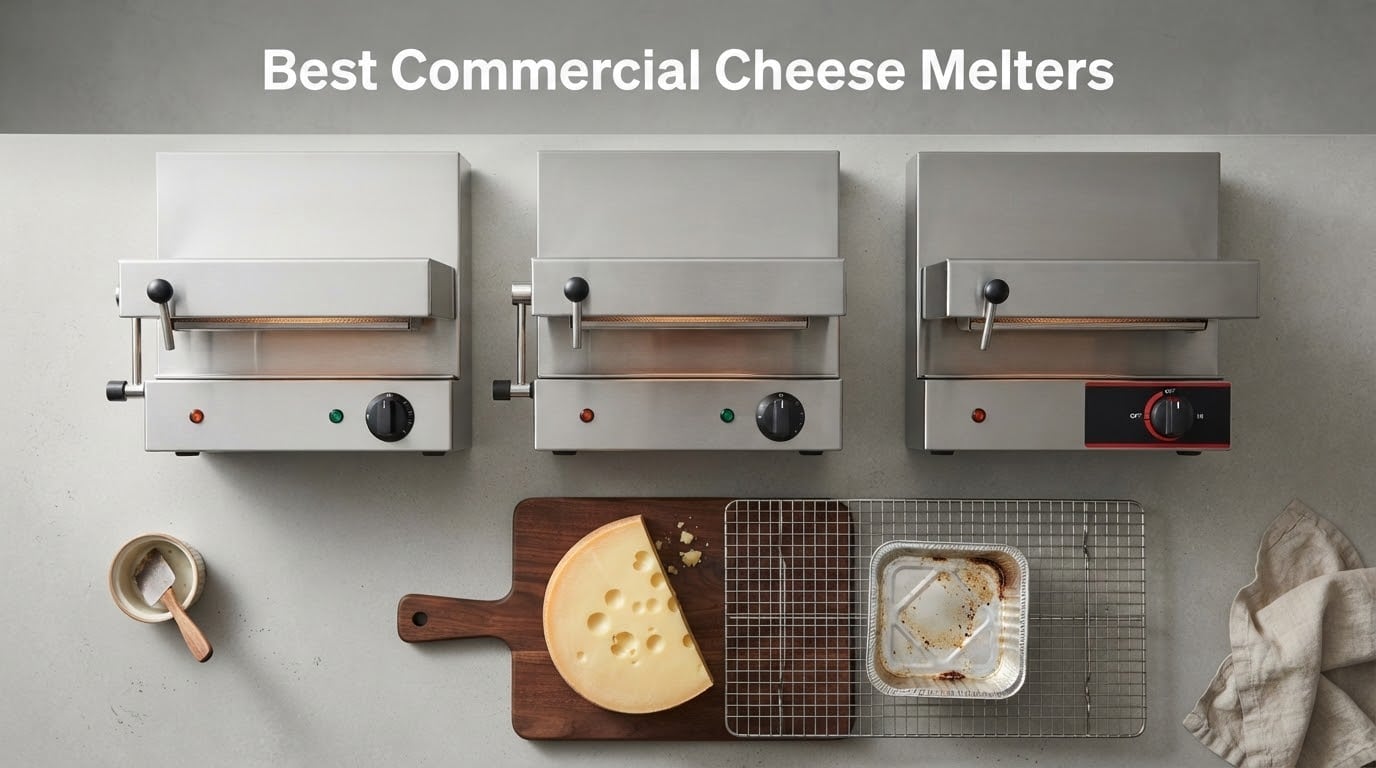
A commercial cheese melter is a countertop or wall-mounted appliance that applies controlled top-down heat to melt and lightly brown cheese on pizza, sandwiches, nachos and other menu items in a few seconds. Pizzerias, cheesesteak shops, delis, grocery hot lines and Mexican restaurants buy them to free up oven capacity, hold a consistent melt at ticket volume and finish food far faster than a full oven can.
That definition hides a wrinkle. The best commercial cheese melters on the market right now fall into two separate families, and only one of them is the overhead infrared cabinet most operators picture when they say melter. Six of the ten models below are overhead melters, also sold as electric salamander broilers, with a heating element above a wire rack. The other four are half-wheel raclette melters, which hold a cheese wheel under a suspended heating bar and let a server scrape melted cheese onto a plate.
Both do the same job of turning solid cheese into a sauce, but they answer completely different menu problems. I compared all ten on wattage, temperature range, rack or arm adjustment, footprint, cleanup and the kind of service each one actually supports, and I flagged the units that stay awkward under real dinner-rush load. If you are outfitting a new line rather than replacing one appliance, our cheese making kit guide covers the small-batch side of the craft.
One note on scope: some searches for this topic are really looking for a commercial cheese grater. A grater shreds solid cheese and is a different appliance with a different price band. Everything below is a melter, meaning an appliance that turns cheese liquid or molten by applying heat.
Table of Contents
Cheese Melter vs. Salamander Broiler: Which One Do You Need?
The difference is heat, not cheese. A cheese melter is a gentler top-down finishing appliance built to melt and warm without searing, while a salamander broiler is the same cabinet format pushed to browning temperatures for steaks and gratin. In practice, most operators buy one appliance and use it for both jobs, and the cabinet-style electric melter is simply a salamander broiler with a thermostat that stops short of a hard sear.
That leaves the naming question. If your line sells cheesesteaks, melt sandwiches and quesadillas, you want an overhead cabinet melter, because you are finishing assembled food on a rack. If your menu is a raclette service where a server scrapes melted cheese from a wheel onto a plate, a half-wheel raclette melter is the correct shape and the overhead cabinet will not do the job at all.
Two more practical differences matter. An overhead melter puts out far more heat, typically 1,200W to 2,000W, and covers a 17 to 18 inch cooking area, so it handles volume. A raclette melter runs 600W to 900W and works on a single wheel, which is deliberate. It is a service format, not a throughput format.
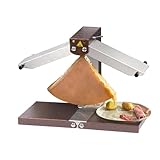
Louis Tellier Raclette Melter
- 900W
- 6 heat settings
- Adjustable elements for 1/6 to 1/3 wheels
- Stainless steel body
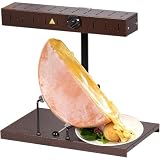
BRON COUCKE Alpage Melter
- 900W with 6 heat settings
- Rack-and-pinion heating ramp
- French-made half wheel

All 10 Commercial Cheese Melters Compared in 2026
The table below lists every model in this roundup with the specs that actually change your purchase decision. Wattage and temperature range set how fast a ticket clears. Grate or arm adjustment sets how much control you have over browning. Footprint and mounting decide whether it fits your line at all.
| Product | Specifications | Action |
|---|---|---|
| Louis Tellier Raclette Melter |
|
Check Latest Price |
| BRON COUCKE Alpage Melter |
|
Check Latest Price |
| LIANDU-US 1500W Melter |
|
Check Latest Price |
 YUEWO Commercial Raclette Melter YUEWO Commercial Raclette Melter |
|
Check Latest Price |
 POPFOODEX Salamander Broiler POPFOODEX Salamander Broiler |
|
Check Latest Price |
 WQV 2000W Salamander Broiler WQV 2000W Salamander Broiler |
|
Check Latest Price |
 BZPFNDKVG 1500W Melter BZPFNDKVG 1500W Melter |
|
Check Latest Price |
 Helivivfy 750W Wheel Melter Helivivfy 750W Wheel Melter |
|
Check Latest Price |
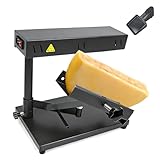 Wait Wit Electric Raclette Melter Wait Wit Electric Raclette Melter |
|
Check Latest Price |
 Adcraft CHM-1200W Cheesemelter Adcraft CHM-1200W Cheesemelter |
|
Check Latest Price |
1. Louis Tellier Raclette Melter: The Best Commercial Cheese Melter Overall
Louis Tellier – Traditional Raclette Melter, 1/4 Wheel, 2-6 People
900W
120V
6 heat settings
17.5 by 8.5 by 11.8 inch
Pros
- Adjustable elements fit 1/6 1/4 and 1/3 wheels
- Stainless steel and coated steel build
- Handles three wheel sizes on one appliance
- Large 799-review base
Cons
- Single-wheel format melts one cheese at a time
- Half-wheel designs need trimming to fit
- 900W draw on a 120V circuit
Out of ten models, this is the one I would put on a line first, and the reason is boring: nobody who owns it seems to regret it. It carries a 4.5 rating across 799 reviews, a review base an order of magnitude larger than anything else in this roundup, and that is the only reliable signal you get about how something holds up after two years of nightly service.
The build is the other reason. It is a French-made half-wheel raclette melter with a stainless steel and coated steel body, and the heating elements are adjustable so the same machine handles a 1/6, 1/4 or 1/3 wheel. That single feature is what separates it from the cheaper fixed-arm models further down this list, where the element height is whatever the factory decided.
Six heat settings and 900W of draw give finer control than the fixed-temperature raclette units, which matters because raclette cheese goes from glossy to burnt quickly once the wheel surface is exposed. Owners report the melt stays consistent through a service without anyone watching it, and a dedicated raclette knife is included in the box.
What to check before you buy a half-wheel melter
Confirm the wheel size you will actually run. This unit covers 1/6, 1/4 and 1/3 wheels, but a full half wheel still needs trimming or careful positioning to sit flat, and that is the single most common complaint in the reviews. If you buy wheels whole and cut them in-house, budget for a few minutes of trim time per changeover rather than assuming a drop-in fit.
Second, count your cheeses. A single-wheel format melts one cheese at a time, so a menu that runs two raclette varieties needs either two machines or a deliberate alternating schedule. Our goat cheese making guide covers the fresh soft cheeses that make an especially good second wheel for a summer menu.
Who should skip it
Skip this if you need throughput. At 900W it melts a wheel section steadily, but it will not keep up with a lunch rush that needs twelve finished plates in ten minutes. Overhead melters later in this list exist for that reason.
Skip it also if you are finishing assembled food on a rack. This machine holds a cheese surface under a bar, and a pizza does not fit the format. For pizza and cheesesteak finishing, read the overhead sections instead.
2. BRON COUCKE Alpage Half-Wheel Melter: Best Raclette Service Design
BRON COUCKE – Commercial Raclette Cheese Melter “Alpage” – Traditional French Raclette for Half Wheel – Commercial and Home Use – Adjustable Heating Rod – 110V – US Cord – Made in France
900W
110V US cord
6 heat settings
Suspended half wheel
Pros
- Rack-and-pinion ramp moves toward the cheese as it melts
- Suspended wheel melts continuously for scraping
- Compact 18.1 by 10.4 by 15.8 inch body
- 4.8 star owner satisfaction
Cons
- Half wheel only so a second variety needs a second machine
- 900W on 120V may need a dedicated line
- French-made parts take longer to source
This is the design I would build a proper raclette service around. It carries a 4.8 owner rating, and the defining feature behind that is the rack-and-pinion heating ramp, a horizontal bar that you crank closer to the cheese as the wheel section shrinks. Everything follows from that: less scorching on the exposed face, faster recovery as the gap narrows, and no need to lift the wheel out and rotate it mid-service.
The wheel also hangs rather than sitting on a plate, so melted cheese keeps draining to the cut face and a server can scrape a clean ribbon onto a plate without chasing pooled grease. Owners describe the operation as hands-off, which is the phrase you want from an appliance that a server has to use while taking an order.
At 900W and 110V it matches the Louis Tellier on draw, which is worth flagging plainly: a 900W load on a 120V circuit can trip a GFCI on a lightly loaded kitchen line. Several reviews mention a dedicated circuit, and it is cheaper to add one during installation than to debug a random trip at 7pm.
Why the ramp matters more than the wattage
Two raclette melters with identical wattage can behave completely differently. On a fixed-element unit the heat gap stays constant, so the cheese browns where it has been sitting and cools where it has not. A ramping bar solves that, and it is why this unit is worth a closer look even with 13 reviews rather than hundreds.
The trade-off is parts. French manufacture since 1947 is a quality signal, and it is also a service risk if a rack-and-pinion component fails and you are not near a distributor. Check lead times before you commit, especially for anything beyond a six-month service life.
Who it suits
A table-service restaurant running a fixed raclette course for six to eight guests, where the wheel is the centerpiece. It is sized for exactly that. A high-volume lunch counter would be better served by an overhead melter working assembled food.
It is also the model I would choose for a customer-facing cheese station, where the wheel sits in view of the guest and the visual of the bar creeping toward the cheese does more work than the spec sheet does.
3. LIANDU-US 1500W Electric Cheese Melter: Best Value Overhead Melter
Commercial Cheese Melter Salamander Broiler, 1500W Electric Cheesemelter Heater Heating Grill, 120-570°F Rapid Heating Countertop Raclette Cheese Melting Oven
1500W
122F to 572F
4-level grill
24 by 12 by 11 inch
Pros
- 1500W preheats fast with even heat spread
- Four rack levels handle mixed portion sizes
- Removable oil pan and wipeable surfaces
- Wall-mount or countertop setup
Cons
- 24 inch footprint takes real counter space
- 1500W may need a dedicated circuit
- 32 reviews is a thin base for durability claims
This is the overhead melter I keep coming back to for small and mid-size kitchens, because at 1,500W it delivers real heat in a 24 inch cabinet with a thermostat that runs from 122F to 572F. That range is the whole argument. The low end holds a plate of nachos without drying them out, the high end browns a cheese edge on a finished pizza.
The 17.7 by 9.65 inch cooking area sits on a four-level adjustable grill, so you can raise a thick cheesesteak toward the element and drop a flat slice of pizza away from it. That rack travel is what lets one appliance handle two very different menu items back to back, and it is the feature I would not give up for a cheaper fixed-height model.
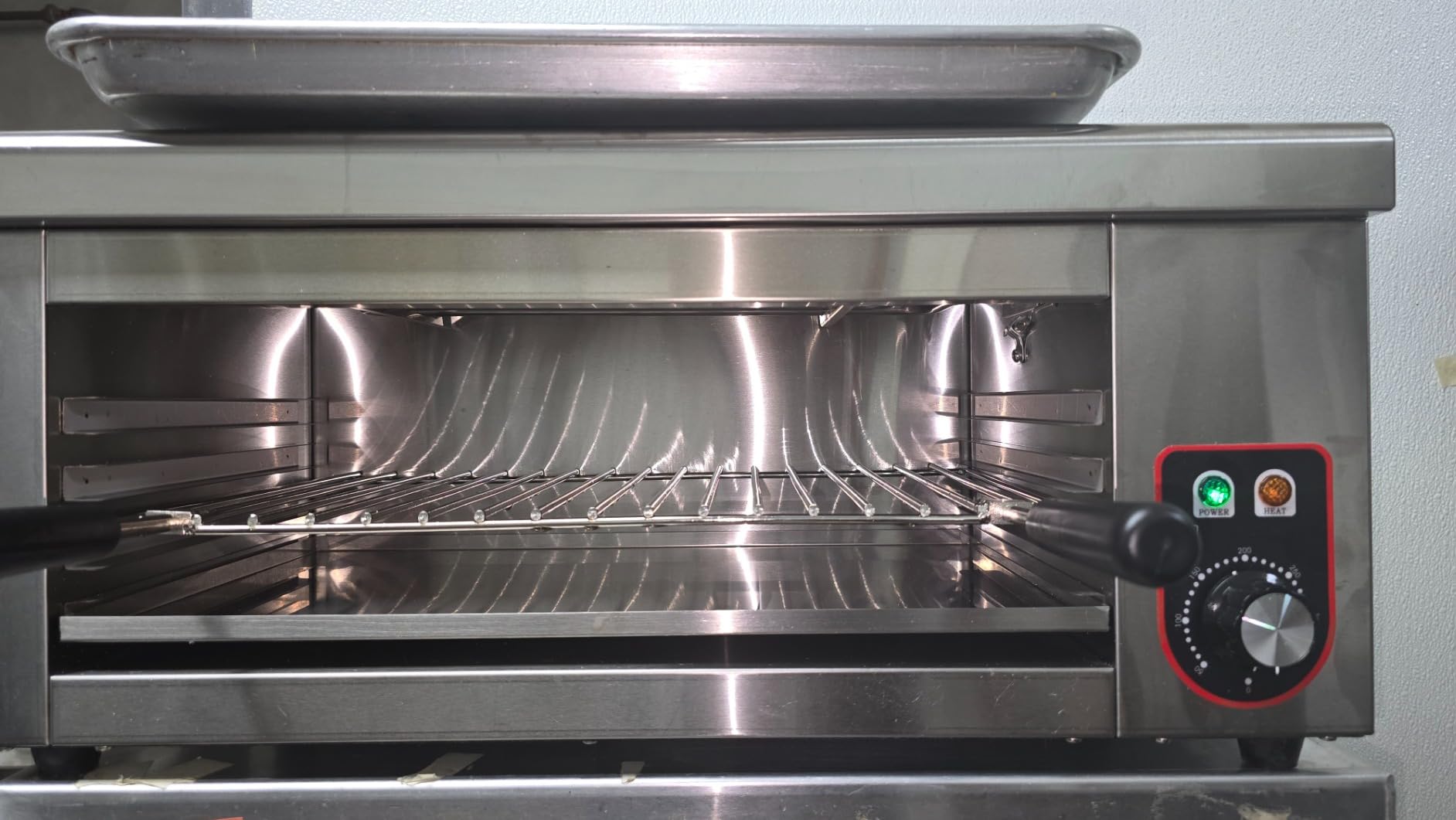
Cleanup is straightforward. The oil pan lifts out at 17.7 by 10.2 inches, the body is thickened food-grade stainless, and the whole unit can go on a wall bracket to free the counter when the rush ends. A pair of heat-resistant gloves and a clip ship in the box.
Check your circuit and your counter before ordering
A 1,500W element is a serious load on a kitchen circuit that already has a microwave, a toaster and a coffee bar on it. Model the load, and if the math is close, run a dedicated line. The same rule applies to any electric melter in this roundup above 1,500W.
Measure the counter too. At 24 inches wide plus 12 deep, this is a footprint that changes a small line. The wall-mount option exists for a reason, and it is the difference between this fitting and not fitting.
Where it falls short
The 4.0 rating across 32 reviews is the honest number, and it points at heat distribution rather than power. Owners like the output and the build, and the recurring gripes are edge-of-grate browning and the speed at which a thin slice browns on the hottest setting. Treat the top of the dial as a finishing range, not a grilling range.
It also carries no certification listing in the data we reviewed, so if your inspector asks for NSF or ETL paperwork, ask the seller before you commit rather than after.
4. YUEWO Commercial Raclette Melter: Best Compact Wheel Melter
YUEWO Raclette Cheese Melter Commercial Electric Raclette Machine Swiss Dish Maker Demi Melting Warmer for Half Nacho Cheese Wheel Sliced Cheese Adjustable Angle
600W
110V
13.4 by 8.6 by 13.4 inch
Swivel tilt holder
Pros
- Swiveling downward-tilting holder simplifies scraping
- Food-grade surfaces wipe clean
- Disassembles for compact storage
- Fits half-round or square cheese
Cons
- Single fixed heat setting with no adjustment
- 600W output means slow recovery on large sections
- Only 30 reviews to judge longevity
If your raclette service needs a footprint smaller than a bread maker, this is the model. At 13.4 by 8.6 by 13.4 inches it is the most compact melter in this roundup, and it disassembles into flat pieces if counter space is the constraint rather than the budget.
The tilting cheese holder is the part that earns its place. Because the holder swivels and tilts downward, a server can tip the melted surface toward the knife and scrape a clean sheet instead of chasing cheese that has run to the far edge. At 600W it melts to a gooey consistency in roughly 40 seconds on a normal section.
It also handles square cheese blocks, not just half rounds, which is more flexible than most competing units and useful for a bar service that works with pre-cut Alpine-style blocks.
The heat control question
This unit has a single temperature setting. There is no knob, no dial and no infinite switch, so your only lever is how long the cheese sits and how thick the section is. For a small service with consistent wheel sizes, that is workable and arguably a feature, because nobody can accidentally leave it on high.
For a kitchen running several cheese varieties of different fat and moisture content, it is a real limitation. Low-fat and aged cheeses need a gentler approach than a fresh soft wheel, and you cannot give them one here.
Where it fits and where it does not
Fit it in a bakery, tasting room or small deli counter where one wheel runs at a time and space is the binding constraint. It handles nacho cheese and a single raclette wheel comfortably.
Do not fit it where volume is the goal. At 600W with no recovery margin, a second section takes noticeably longer to melt than the first, and that delay shows up as a queue at the pass.
5. POPFOODEX 1500W Salamander Broiler: Best for Gratin and Searing
Popfoodex Salamander Broiler, 1500W Electric Cheese Melter w/ 550°F Heating and Stainless Steal Body, Commercial Broiler w/Removable Crumb Tray, Salamander Grill For Pizza, Grill Steaks, Sandwiches
1500W
50F to 550F
17.8 by 15.5 inch grate
4-position rack
Pros
- 8mm element browns strongly and evenly
- Large grate fits larger items when lowered
- Removable stainless crumb tray cuts cleanup time
- Holds a top-seller rank in Commercial Broilers
Cons
- Top-heating only so there is no two-sided cooking
- Only a 1-year warranty
- Side-swing door needs counter depth when open
This is the one to buy if your menu goes past melting into finishing. It reaches 550F, which is a searing range rather than a melting range, and the 8mm stainless element is thick enough to brown a cheese crust rather than just soften it. For a bistro gratin, a steak after sear, or a pizza that needs a blistered edge, that is the right cabinet.
It weighs 11.79 kg, which is not light for a countertop unit, and that is a fair warning about moving it. Plan the position before it arrives rather than after.
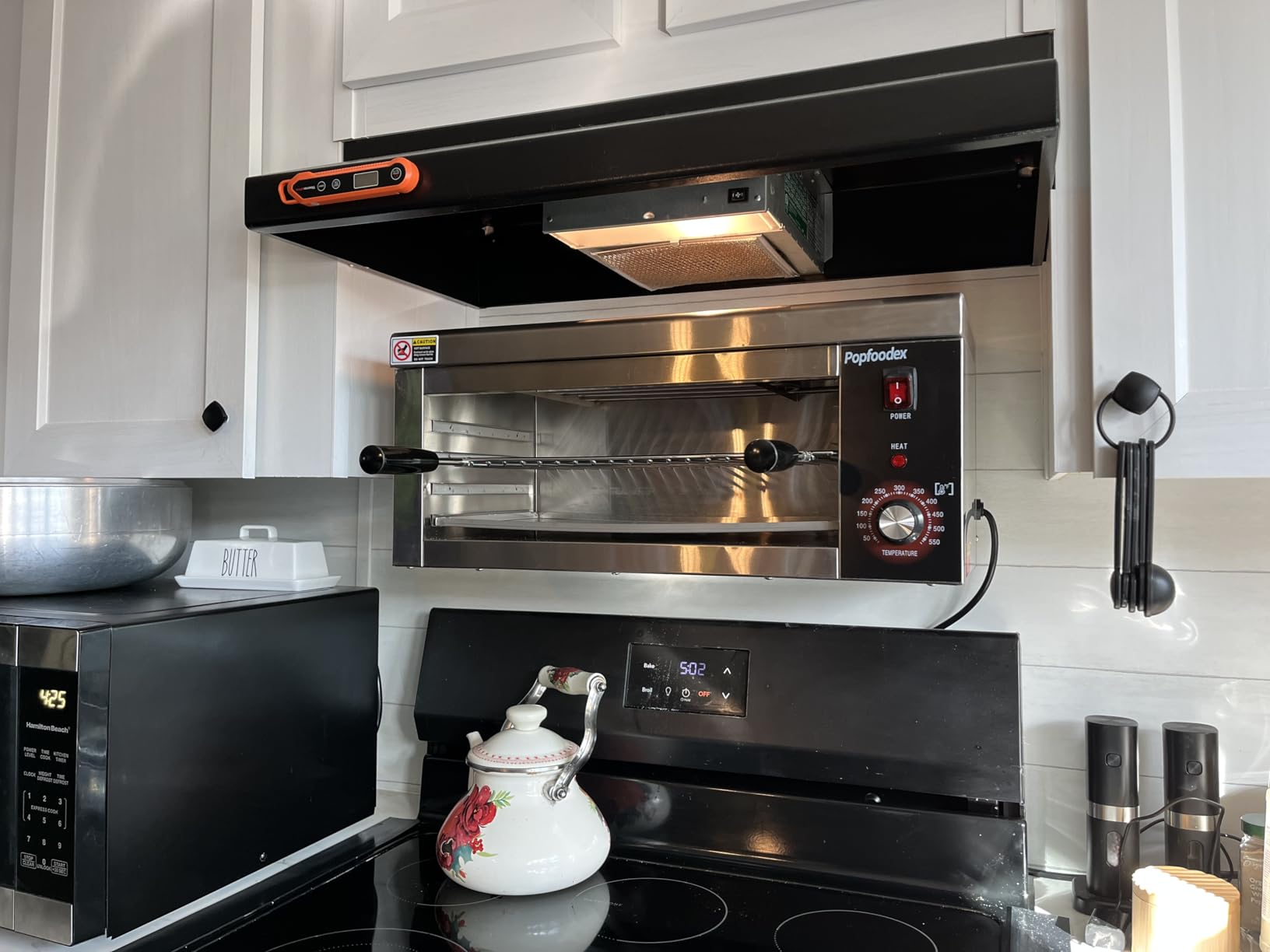
The grate is the differentiator against the other 1,500W models. At 17.8 by 15.5 inches on a four-position rack, it holds a large open-faced item flat, and the rack travel lets you bring the food close when you want crust and drop it away when you only want melt. Measured against a 17.7 by 9.65 inch grate elsewhere in this roundup, the extra width is a real difference for rectangular trays.
Only 0.68 cubic feet of capacity means a long rectangular tray is a better fit than a full hotel pan, and a side-swing door means the whole front swings out, so leave working space in front of the unit when you plan the counter.
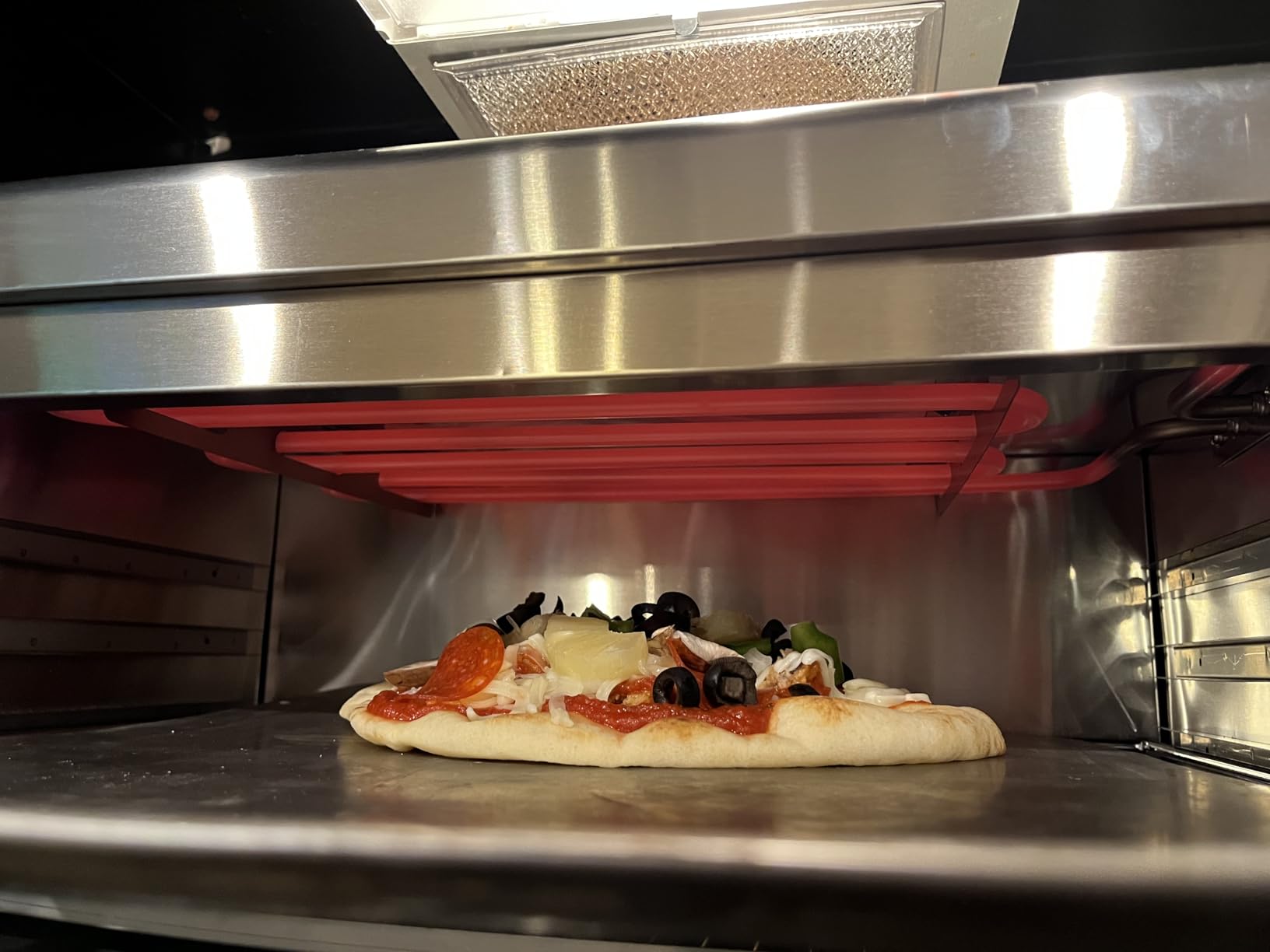
Deciding between 550F capability and melt-only control
If you only ever finish pizza, you will spend most of your day below 400F and this cabinet is over-specified. If you brown gratins, press sandwiches or sear, the top of the range earns its place every service. Decide which of those two kitchens you actually have.
Also weigh the warranty. One year is thin for equipment that sees daily use. A chef forum equipment thread we read noted strong long-term satisfaction with heavier 36 and 60 inch name-brand units, and part of that reliability is bought with a service network that a short warranty does not replace.
The no-bottom-heat limitation
Everything heats from above. That is fine for topping a pizza or finishing a gratin, and it is a problem the moment you want a two-sided sear, a toasted underside or a convection-style finish. Nothing you do with the rack settings will create bottom heat.
Counter depth also matters. A side-swing door needs clearance in front of the unit to open fully, so place it where a server can stand to the side rather than directly in the pass lane.
6. WQV 2000W Salamander Broiler: Highest Electric Output in the Roundup
WQV 2000W Salamander Broiler, Electric Steak Broiler, Raclette Grill Cheese Melter Grill with Removable Plates, Stainless Steel Food Heater for Home Commercial, Wall Mount or Countertop, 50℃-300℃
2000W
122F to 572F
25.2 by 11 by 12.6 inch
Dropdown door
Pros
- Highest wattage here for fast recovery
- Upper-only heat cuts smoke and dust
- Removable plates and lower oil catch tray
- Wall-mount bracket frees counter space
Cons
- 25.2 inch body is the largest footprint here
- Top heat only so there is no two-sided cooking
- Only 10 reviews to judge longevity
At 2,000W this is the strongest electric output in the group, and that number matters for one specific reason: recovery speed. When a cabinet is finishing back to back tickets, wattage is how fast the chamber gets back to temperature after a cold pizza goes in. Higher watts means shorter gaps between plates.
The multiple U-shaped elements are arranged to spread heat across a wider area than a single tube would cover, and the 17.5 by 9.8 inch grill sits on height-adjustable posts with anti-scald handles. Temperature control runs 122F to 572F, giving you the same low-end holding range as the 1,500W units with much more headroom at the top.
Upper-only heating is the quiet benefit here. There is no lower element to drip and smoke, so a cheese that runs off a sandwich does not produce the same amount of airborne grease. In a small room or a food truck, that is worth more than it sounds.
Do the electrical math before anything else
2,000W is the largest load in this roundup and it needs a dedicated circuit on most lines. Do the calculation for your actual service, including any sharing with a microwave or warmer, before you plan the wall mount. This is the model where an electrician visit is likely part of the install.
Confirm the mounting choice too. It works on the counter or on a wall bracket, and the bracket version is how a 25.2 inch wide appliance ends up living in a kitchen that does not have 25.2 inches of free counter.
What the wattage does not solve
More power still means top heat only. It does not give you a bottom element, it does not widen the grate beyond 17.5 inches, and it does not add temperature resolution at the low end. You are buying speed of recovery, not a wider cooking surface.
With 10 reviews, treat the durability picture as unproven. The stainless build and the wall-mount hardware are the right choices for commercial use, but no review base here tells you what the elements look like after three years.
7. BZPFNDKVG 1500W Countertop Cheese Melter: Budget Pick for Small Kitchens
Commercial Cheese Melter Salamander Broiler 1500W Electric Cheesemelter Heater Heating Grill 122-572°F Stainless Steel Countertop Toaster Oven with 4-Level Adjustable Grill & Oil Pan for Home Kitchen
1500W
122F to 572F
24 by 11.8 by 11 inch
25.6 lb
Pros
- 1500W melts and browns in seconds
- Four-level grill handles varied thicknesses
- Oil pan keeps prep areas clean
- Wall-mount or freestanding
- Heat-sink holes and indicator lights
Cons
- Only 3 reviews so durability is unestablished
- No top carry handle so repositioning is awkward
- 25.6 lb unit needs two hands to move
This carries a 5.0 rating, and I want to be straight with you about what that means: it comes from three reviews. The feedback is positive across melting speed, grill adjustment and cleanup, but no review base this small can tell you how an element holds up in year three, so treat the rating as promising rather than proven.
What the machine does is straightforwardly good for the money. 1,500W across multiple U-shaped heat pipes, a four-level grill over a 17.7 by 10.2 inch cooking area, and a 122F to 572F control. That is the same core specification as the LIANDU-US at number three, and it installs either freestanding on anti-slip feet or on a wall bracket.
Heat-sink holes around the body, indicator lights and anti-scald handles are the details that suggest someone thought about a working kitchen rather than a demonstration. The oil pan lifts out for cleaning, and a pair of gloves and a clip are included in the box.
Is this enough for a working line?
For a small café, a deli back room or a concession trailer doing modest volume, yes. One 1,500W element over a 17.7 inch area handles pizza finishing, sandwiches and nachos without trouble, and the four rack levels cover the thickness range you will see.
For a full pizza shop, I would step up one tier. Not because this unit is bad, but because the lack of a documented service history and a carry handle make it a harder unit to move for cleaning or swap during a rush.
Two things to know before ordering
It weighs 25.6 pounds and has no top carry handle, so repositioning means gripping the body. Pick its home before it arrives and leave it there.
It is not listed as prime, and with a 3-review base there is no meaningful warranty signal to lean on. Ask the seller directly about returns and parts, and keep a backup plan for the appliance you already own.
8. Helivivfy 750W Wheel Cheese Melter: Best for Buffet Cheese Stations
Helivivfy Cheese Melter, 750W Electric Commercial Adjustable Temperature Fondue Maker for Half Wheel Swiss Cheese, Restaurant-Grade Melt Dispenser
750W
572F to 752F
Rack height 0-3 cm
Fits 5-12 inch wheels
Pros
- 750W melts hard Swiss and cheddar in about 30 seconds
- Adjustable rack height controls melt and browning
- Distributed heat holes support 8 hours of continuous use
- Doubles as a general food heater
Cons
- Specialized half-wheel design that exceeds what nachos require
- Some users report the upper arm does not hold position
- Weighs 10.83 lb and arrives in a large box
This is the one to consider for a buffet or cheese counter rather than a ticket kitchen. It is built to hold heat for a long service, with distributed heat-dissipation holes rated for up to eight hours of continuous use, and a 750W element that melts hard Swiss and cheddar in roughly 30 seconds. That speed on a hard aged cheese is genuinely useful, because low-moisture cheeses fight a melter more than fresh ones do.
The rack height adjustment of 0 to 3 cm is the control that matters, and an elastic clip fits wheels from 5 to 12 inches. Together they let you set the melt level per cheese rather than per machine, which is exactly what a buffet with two or three varieties needs.
Owners also report it working as a general heater rather than only for cheese, which makes it easier to justify on a line that only needs serious cheese capacity a few hours a week.
Read the reviews about the arm
One verified review flags the upper arm as not holding position firmly, pointing at a design and material issue rather than a user error. That matters on a buffet, where a shifting arm means inconsistent melt height between guests served at different times. Inspect the arm the day it arrives and know your return window.
The other caveat is scale. This is a specialized half-wheel appliance, and if all you need is nacho cheese, you are buying more machine than the job requires. The cheese pressing and aging guide is worth a look if you are building a cheese program where the wheel is a feature, not a side.
Dialing it in
Owners report that this unit needs practice to position cheese and temperature. Start with a freshly cut face, set the rack at its lowest point for hard cheese, and pull the section as soon as the surface glosses. Aged and low-fat cheeses need less dwell time than a fresh wheel, and the difference is larger than most operators expect.
Because it is rated for eight hours of continuous heat, it suits a service that starts early and finishes late. For a two-hour dinner rush, the continuous-use rating is not the deciding factor and a smaller fixed unit would do the same job.
It is also the one model here with a longer continuous-use claim than a dinner service needs, which is worth remembering when you compare it against the fixed-element raclette units at numbers one and two.
9. Wait Wit Electric Raclette Melter: Best for First-Time Raclette Buyers
Electric Raclette Cheese Melter Adjustable Raclette Machine
600W
200C to 400C
16.1 by 14.2 by 6.3 inch
8.27 lb
Pros
- Melt is fast and even with clean scraping
- Height adjustment tunes melt intensity
- Includes four cheese plates
- Assembles and disassembles without tools
Cons
- No user heat control beyond distance from the element
- Entry-level feature set
- Only 3 reviews
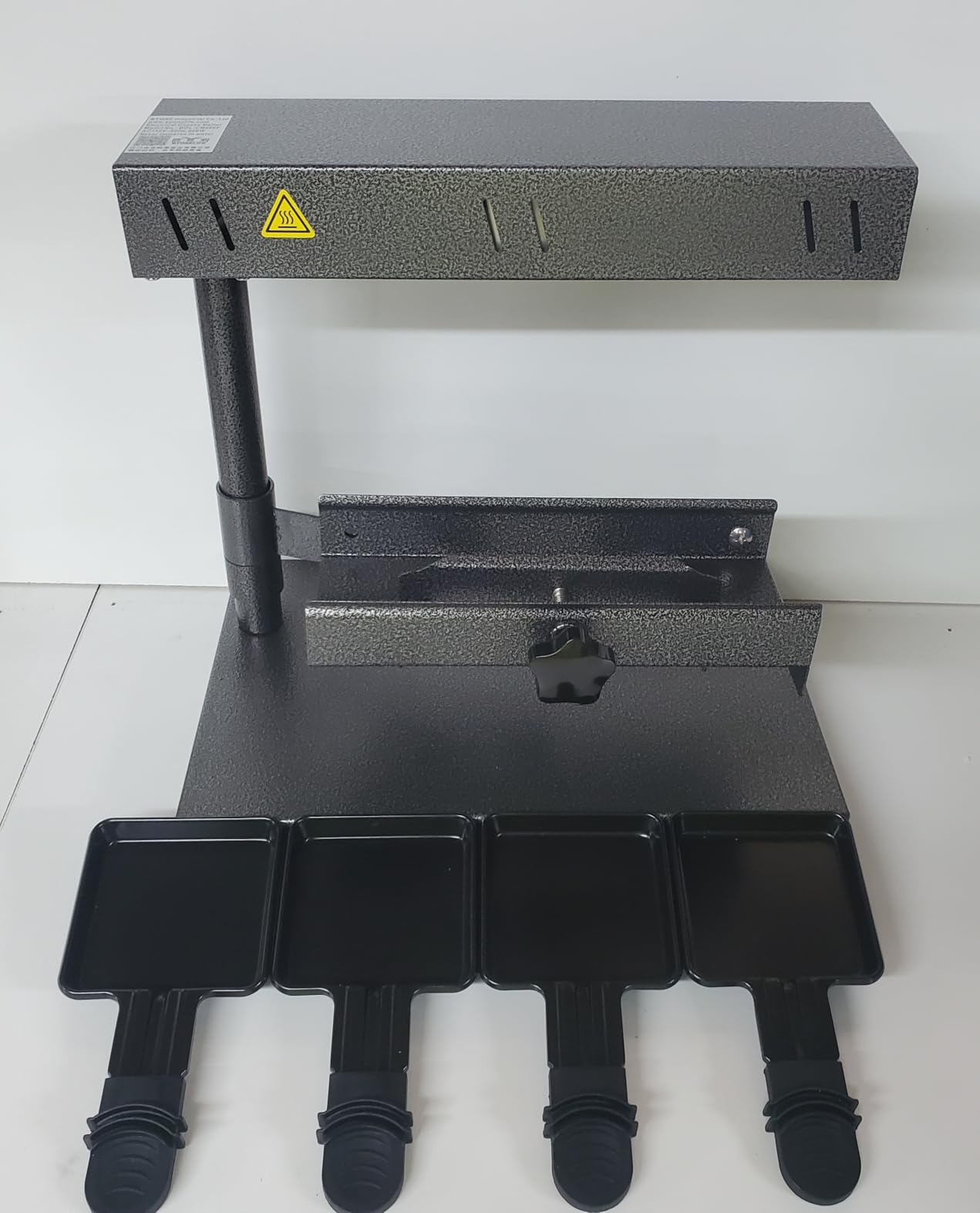
A 4.6 rating from three reviews puts this in the same unproven-but-promising category as the budget overhead unit, and for a different reason it appeals to me: it is the most approachable raclette machine in the group. It ships with four cheese plates, a screwdriver and clear instructions, and it disassembles into compact pieces when the service ends.
Heat control works by distance rather than by thermostat. The 600W element sits on a 304 stainless tube with a ceramic resistor across a 200C to 400C range, and the arm height sets how aggressive the melt is. Owners say the spacing holds roughly a 3 lb block comfortably, which is a useful real-world capacity figure rather than a marketing one.
The rotating, downward-tilting arm is a familiar raclette design and it works: melt comes off the cheese smoothly without sticking to the surface, which is the single thing that decides whether a raclette service is pleasant or a chore.
Understand what you are controlling
There is no thermostat and no heat dial. The only adjustment is how close the arm sits to the cheese, and that couples two variables: melt speed and how much you can hold a rigid frame at a set distance. New operators sometimes find the arm hard to set precisely on a first pass.
Give it one service to learn the feel. Set the arm before the first guest, do not adjust it mid-rush, and the fixed approach becomes an advantage because nobody on the line can change it by accident.
Where it does not stretch
This is an entry-level feature set. If you plan to run a high-volume service or add a second cheese, plan on replacing it within a couple of years rather than treating it as a line-lifetime purchase. For comparison, the Louis Tellier at number one carries a 799-review base at the same wattage class and is built for the long haul.
It does not suit a customer-facing station where the wheel is on display either. It is a working tool, not a presentation piece.
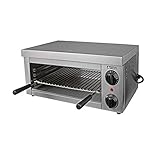
10. Adcraft CHM-1200W Cheesemelter: Compact but Runs Cool
Adcraft CHM-1200W Electric Cheesemelter, 24″, Stainless Steel, 120v , Silver
1200W
24 by 12 by 11 inch
Infinite heat switch
34.6 lb
Pros
- Compact 24 inch stainless body for tight counters
- Insulated chamber retains heat in the melting area
- Infinite switch gives continuous rather than stepped control
Cons
- Multiple reviews report it never reaches browning temperature
- One review reports it dries food rather than warming it
- 3.0 rating is the lowest in this roundup
- 34.6 lb unit is heavy for its size
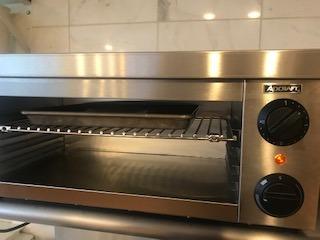
I am including this one because it is a recognizable institutional brand and because the complaints are consistent enough to be useful. The 3.0 rating is the lowest here, and the reason is not build quality but output: multiple verified reviews report the unit never reaches a temperature where it will actually toast or brown anything.
What it does well is space. At 24 by 12 by 11 inches with an insulated melting chamber designed to reduce heat loss, it packs a working melter into a smaller footprint than most 24 inch cabinets, and the infinite switch gives continuous heat control instead of a stepped dial. For a line that only ever needs gentle warming and melting, the chamber retention is a genuine advantage.
It is also heavy at 34.6 pounds for a unit this size, which makes it a two-person install in most kitchens. Plan the delivery path before it arrives.
Some owners use the insulated chamber for holding finished plates during a service rather than melting on the spot, which is a second use for the cabinet if your line already toasts elsewhere.
Set expectations before you buy
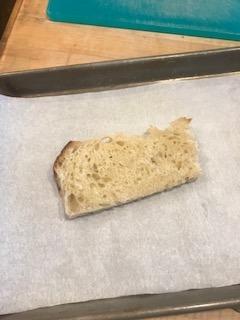
If you buy this, buy it to melt and hold, not to brown. Ask the seller to demonstrate the top setting on a piece of bread if possible, and treat any browning expectation as unverified. One verified review specifically reports that it dries food out rather than warming it, which is a symptom of a thermostat set higher than the element can support.
The 1,200W element in a 24 inch cabinet is the root of the pattern. Compare it against the 1,500W models at numbers three and five in the same width, and the difference in recovery and top-end temperature is what reviews are reacting to.
Who should still consider it
A hot line that is counter-constrained, already has a toast station elsewhere and needs a dedicated gentle-melt cabinet will find the footprint and the insulated chamber genuinely useful. Those buyers are trading top-end temperature for space, which is a fair trade when made deliberately.
For anyone else, the comparison is simple. The 1,500W units in this roundup run materially hotter. Choose this one for the footprint and only for the footprint.
Electric vs. Gas Cheese Melters and the Hood Question
Every model in this roundup is electric, and that is not an accident of the search. It reflects a real constraint that operators talk about openly: many kitchens cannot take a gas melter at all. A reader on r/KitchenConfidential described a grocery deli with no hood, which eliminated every gas option on their list and reduced the decision to electric melter versus consumer toaster oven. That post is worth reading in full, because the reasoning is more useful than any spec sheet.
That operator was running two small toaster ovens successfully for Reuben and French dip service until one failed, and the failure is what forced a proper equipment decision. It is the common pattern in this category. A consumer toaster oven is cheap and works, then it burns out, and now you are buying something anyway.
Does a cheese melter need a hood?
An electric melter produces heat, grease vapour and, in a kitchen, some particulate from food. Whether your local code treats that as requiring mechanical ventilation depends on the equipment’s BTU or kilowatt rating, the way it is mounted and what your inspector applies. There is no single national answer, and the honest guidance is that an electric unit rated in the 1,200W to 2,000W range sits in a different category from a 20,000 to 60,000 BTU gas model that many codes treat as requiring hood coverage.
What you can do is straightforward. Ask your local health department or fire marshal before the purchase, not after. Ask the seller for the electrical specification sheet so the answer is based on the actual rating. And if you install under an existing hood, the question never arises.
When gas is still worth considering
Gas melters exist and are worth it in specific cases: a high-volume pizzeria that runs 400 covers a night, or a line that already has gas infrastructure and a hood. Gas recovery is fast, the heat is unaffected by a dropped electrical supply, and a mounted unit saves counter space permanently.
The trade-off is installation. A gas line, a hood, and in many jurisdictions a permit and a certified installer. For a first-time buyer or a small kitchen, that cost and paperwork usually exceed the operating benefit, which is why the electric path dominates the units above.
Should you buy a conveyor or turbofan oven instead?
Only at real volume. The same forum thread weighed a high-five-figure conveyor oven against a cheese melter plus consumer toaster oven, and the answer depends entirely on covers per hour. A conveyor oven earns its cost by running continuous volume across a whole kitchen. A cheese melter plus a toaster oven covers the same finishing job for a fraction of the capital, at the price of doing the melting in batches.
If your peak demand is under roughly 50 finished cheese items an hour, a melter is the right tool. Above that, and with a hood and gas already in place, run the numbers on a conveyor properly before dismissing it.
How to Choose a Commercial Cheese Melter
Start with the format, because everything else follows from it. A rack-style overhead melter finishes assembled food. A half-wheel raclette melter serves a wheel. If your menu is pizza, cheesesteaks, melt sandwiches and quesadillas, you want an overhead cabinet. If your menu is a plated raclette course, you want a wheel. Buying the wrong shape is the most expensive mistake available in this category, and it is the one mistake where no amount of wattage compensates.
Pick your wattage honestly
For overhead melters, 1,200W is the floor for genuine commercial use and 1,500W is where I would start. Below 1,500W you will hear it in reviews as an inability to brown, which is exactly the complaint pattern on the 3.0-rated unit in this roundup. At 2,000W you are buying recovery speed between tickets, which matters more than raw output in a lunch rush.
Then do the electrical math honestly. A 2,000W element is close to a 20A dedicated load on 120V and can require a 240V or three-phase supply for the biggest cabinets. Share the calculation with an electrician, not with a catalog page.
For raclette melters, 600W to 900W is the normal band and there is no benefit to going higher. These appliances melt one section at a time, and a stronger element does not accelerate a service that is limited by how often you cut a new face.
Match width to real menu volume
Width is the most under-considered spec. An 18 to 19 inch grate covers a single pizza or a small tray and suits a cafe or a sandwich shop finishing ten to twenty items an hour. A 24 inch cabinet handles a full sheet pan, a double stack of sandwiches or two pizzas at once, which is the working size for most pizzerias and deli hot lines. Anything from 36 inches up is a high-volume finishing line meant for continuous ticket pressure.
Map width to the item you actually finish. If your highest-volume item is a 16 inch pizza, a 17 inch grate is not a limitation. If you run a sheet-pan nacho tray, it is.
Look for the boring features
Removable crumb and oil trays are the number one operational concern in this category, and reviews mention them more than any other feature. A tray that lifts out without tools turns a two-minute cleanup into a ten-second one at the end of a service, and that difference compounds across hundreds of services a year.
Rack position adjustment matters next, because it is what lets one appliance handle both a thick cheesesteak and a thin slice of pizza. A thermostat with genuine low-end control is the third item, and it is what stops you from drying out a plate of nachos. Plate-activated or demand-controlled heating is a real energy saver on models that offer it, because it stops heating once the chamber is at temperature instead of cycling a thermostat.
Element material is worth a look too. Incoloy and 304 stainless elements outlast basic steel sheath elements in continuous service, and a thicker element wall resists the pitting that shows up after a year of cheese contact.
Certifications are not optional
NSF, ETL and CSA are not marketing badges. NSF listing is what a health department asks for when it inspects a line, and ETL or CSA listing is the electrical safety listing that tells an inspector the equipment was tested to a recognized standard. Every one of the units in this roundup ships with a wattage and voltage figure in its listing, and that figure is also what your hood question gets answered against.
Ask the seller for the listing documentation before you buy, not after. A unit without it can be a problem the day an inspector walks in, and the seller cannot always supply it retroactively.
Cleaning and used equipment
Daily: pull the crumb or oil tray, empty it, wipe the rack and the interior with a food-safe cleaner, and dry the element housing. Weekly: wipe the heating element housing with a damp cloth once cool, and on gas models have the connection checked. Never spray a cleaner directly into a melter, and never clean an element while it is warm, because thermal shock cracks the tube.
On buying used: operators do ask about it, and it is a reasonable path for a first outfit, but inspect the element and the wiring closely, ask how hard the unit ran, and confirm that parts and certification paperwork still exist. A used unit with a documented service life is a better bet than a cheap new unit with three reviews and no history, which describes two of the models in this roundup.
Budget for more than the appliance
Add the electrical work, the mounting hardware, the shelf or wall bracket, and a replacement element in year three to any comparison you run. An electric melter above 1,500W frequently needs a dedicated circuit, and that install can cost more than a second appliance. Total cost over a ten-year service life tells a different story than the ticket price alone.
Frequently Asked Questions
What is the difference between a cheese melter and a salamander broiler?
A cheese melter is a gentler top-down finishing appliance for melting and warming without searing, while a salamander broiler is the same cabinet format pushed to browning temperatures for steaks and gratin. Most operators use one appliance for both, and a thermostat that stops short of a hard sear is what separates a melter from a broiler.
Do I need a hood or ventilation for a commercial cheese melter?
It depends on the heat rating, mounting and local code. Electric melters in the 1,200W to 2,000W range produce far less airborne grease and heat than the 20,000 to 60,000 BTU gas models that many codes treat as requiring hood coverage. Ask your local health department or fire marshal with the unit’s electrical specification in hand before you buy, not after.
Do I need a cheese melter if I already own a salamander broiler?
Usually not. A salamander broiler with an adjustable rack and a thermostat that reaches around 400F will finish pizza, sandwiches and nachos as well as most dedicated melters. Buy a separate melter only if you need a low-end holding range your broiler cannot hold without drying food out, or if you run a plated raclette service that needs a wheel format.
How long does cheese take to melt under a commercial cheese melter?
A sandwich melt takes roughly 30 to 60 seconds, a pizza takes about 2 to 3 minutes, nachos take 1 to 2 minutes and a quesadilla takes 45 to 90 seconds. Hard aged and low-moisture cheeses take longer than fresh soft wheels, and the single biggest cause of burning is a rack set too close to the element.
What wattage do I need on a commercial cheese melter?
For an overhead cabinet, 1,200W is the floor for real commercial use and 1,500W is the sensible starting point. Below that, owners report an inability to brown, which is the most common complaint on the lowest-rated unit in our roundup. At 2,000W you are buying faster recovery between tickets rather than a higher top temperature.
What size cheese melter do I need for a pizza kitchen?
An 18 to 19 inch grate suits a cafe finishing ten to twenty cheese items an hour. A 24 inch cabinet covers a full sheet pan, two pizzas or a double stack of sandwiches and is the working size for most pizzerias and deli hot lines. Sizes from 36 inches up are high-volume finishing lines built for continuous ticket pressure.
What type of cookware should I use with a cheese melter?
Use flat, heat-tolerant metal pans and perforated pizza pans sized to your grate. Avoid thin plastic, glass bakeware that can thermal shock, and anything that blocks air movement. Parchment on a perforated pan speeds cleanup, and a rimmed pan catches grease that would otherwise drip onto the element housing.
How do I stop cheese burning under a cheese melter?
Lower the rack a position, cut a thinner section of cheese, and pull the food the moment the surface glosses rather than when it browns. Cheese browns from residual heat, so a pie that looks pale leaving the melter will darken on the pass. Working low on the thermostat and closer to the element beats working high and far away.
Which cheeses do not melt well?
Low-fat cheeses, aged cheddar, fresh mozzarella, feta and queso fresco melt poorly because there is too little fat or too much moisture to flow. Compensate with less dwell time rather than more heat, shred rather than slice aged cheese for a faster melt, and add a small amount of moisture or a starch-based roux when the recipe allows it.
How often should I clean a commercial cheese melter?
Empty and wipe the crumb or oil tray and the rack daily, at the end of every service. Once a week, with the unit cool, wipe the element housing with a damp cloth. Never spray cleaner directly into a melter and never clean a warm element, because thermal shock cracks the heating tube and ends the unit’s life.
Can a cheese melter be used for more than cheese?
Yes. The same top-down heat that melts cheese will toast bread, warm tortillas, brown a gratin and finish a seared steak, which is why a lot of lines run one melter for the whole pass. Just remember that every unit in this roundup heats from above, so nothing gets a bottom sear or a toasted underside.
Are commercial cheese melters energy efficient?
Models with plate-activated or demand-controlled heating stop drawing power once the chamber reaches temperature instead of cycling a thermostat, which cuts consumption on models that run all day. A dedicated 1,500W to 2,000W element kept running continuously is a real load on a kitchen, so switching it off between services matters more than the brand name on the housing.
Which Commercial Cheese Melter Should You Buy in 2026?
For a raclette service, the Louis Tellier is the pick: adjustable elements for three wheel sizes, a stainless body and a 799-review base that no other model here can match. Run the BRON COUCKE Alpage instead when the wheel sits in front of the guest, because the rack-and-pinion ramp handles a customer-facing service better than any fixed-arm design in this group.
For finishing pizza, cheesesteaks and sandwiches, start at 1,500W. The LIANDU-US 1500W melter is the value choice, the WQV 2000W unit buys you the fastest recovery in the roundup, and the POPFOODEX is the one to buy if you also brown gratins and sear.
Check your circuit before you order, keep the certificate paperwork with the manual, and pull the crumb tray at the end of every service. Those three habits decide whether a commercial cheese melter still works for you in year five.