
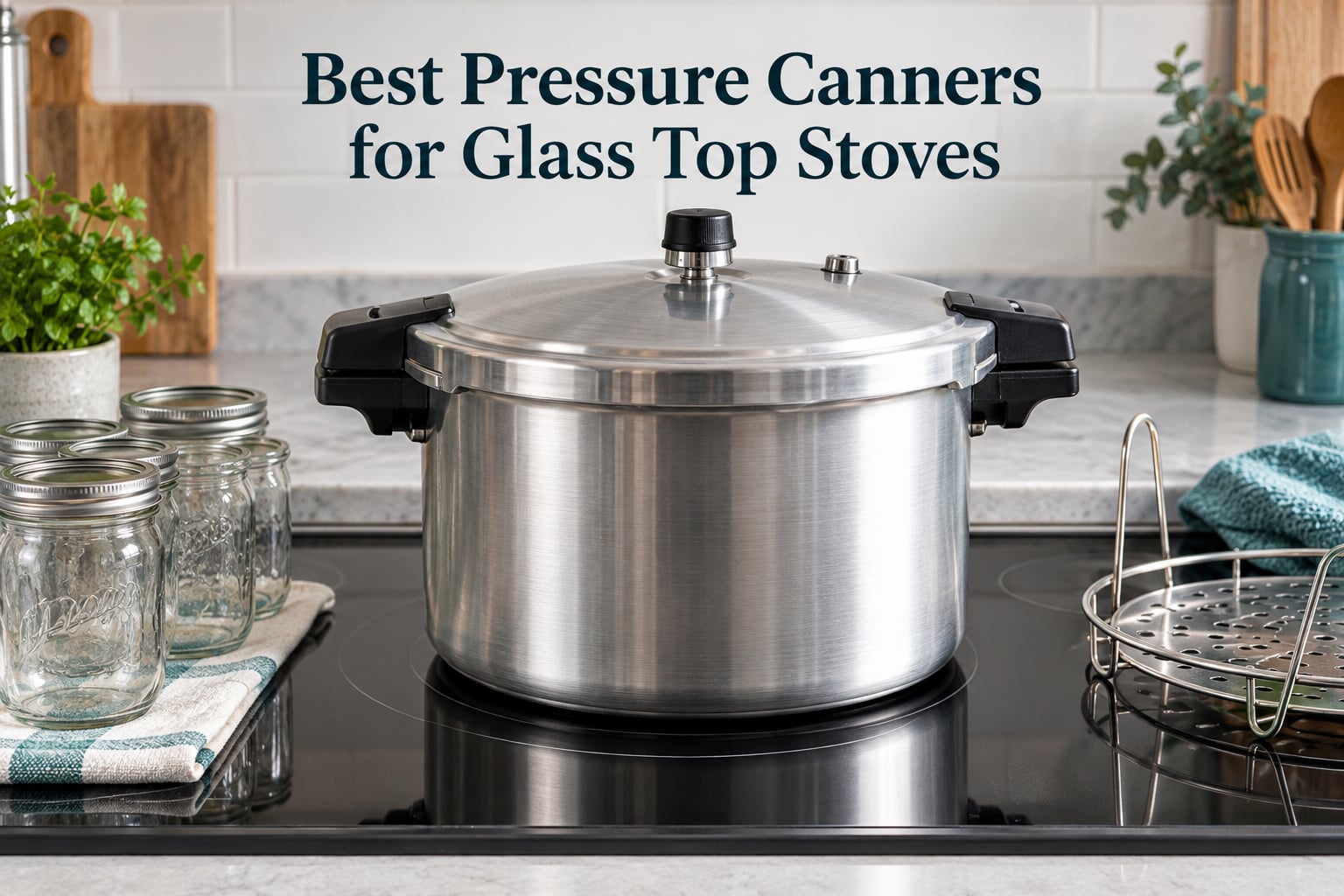
If you have ever stood in the kitchen with a 20 pound canner in both hands, staring at your glass cooktop and your stove manual at the same time, you are not alone. That hesitation is the reason this roundup exists. Almost every question we get about pressure canners for glass top stoves comes down to three numbers, and almost no seller publishes them: how heavy the empty canner is, how wide its base is, and whether the manufacturer actually states the cooktop type it supports.
So we went through all ten canners in this list line by line and pulled the weight, the base material, the gauge type and the stated compatibility straight from the specifications. Some of them came back with an explicit “works on smooth-top ranges” claim. Some did not, and we say so. We also sorted out the gasket-versus-metal question, because that single design decision changes how a canner behaves over a decade of service, and we explained what thermal shock actually is, since that is the thing everyone is afraid of.
The short version before we start: pressure canning on a glass cooktop is not automatically a bad idea, but it is a bad idea if you slide a cold, heavy pot across hot ceramic. Choose a flat-bottomed canner that fits inside your burner ring, check the weight limit in your manual, preheat the empty pot, and lift rather than drag. If you want the short list, head to the top three below. Details follow.
Table of Contents
Top 3 Picks for Glass Top Stoves
Three canners earned the top spots after we weighed their empty weight, base stability and the compatibility language in their documentation. The All American is the only gasket-free design here, the Presto 01781 has the strongest combination of rating and review volume, and the T-fal ships with two racks for double-stacking.

Presto 01781 23-Quart Pressure Canner
- 12 lb empty weight
- Flat heavy-gauge aluminum base
- 26 half-pints or 20 pints per batch
- Dial gauge plus 12-year warranty
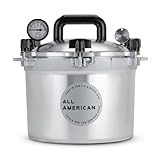
All American 910 10.5qt Canner
- Gasket-free metal-to-metal seal
- 14.8 lb cast aluminum
- 4 quart or 7 pint jars
- Works on flat top stoves
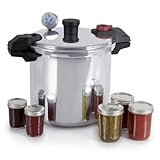
T-fal 22-Quart Pressure Canner
- 22 quart capacity
- 24 half-pints or 18 pints per batch
- Two racks included for double-stacking
- Three PSI settings at 5 10 and 15
Best Pressure Canners for Glass Top Stoves in 2026: Quick Overview
Here is every canner in the roundup with the numbers that decide whether it belongs on a ceramic cooktop. The comparison table ranks them in article order, and each full review follows underneath.
| Product | Specifications | Action |
|---|---|---|
| Presto 01781 23-Quart Pressure Canner |
|
Check Latest Price |
| All American 910 10.5qt Pressure Cooker and Canner |
|
Check Latest Price |
| T-fal 22-Quart Aluminum Pressure Canner |
|
Check Latest Price |
 Presto 01784 23-Quart Induction Pressure Canner Presto 01784 23-Quart Induction Pressure Canner |
|
Check Latest Price |
 WantJoin 10-Quart Stainless Pressure Cooker WantJoin 10-Quart Stainless Pressure Cooker |
|
Check Latest Price |
 IMUSA 16-Quart Jumbo Pressure Cooker IMUSA 16-Quart Jumbo Pressure Cooker |
|
Check Latest Price |
 Granite Ware 20-Quart Pressure Canner Granite Ware 20-Quart Pressure Canner |
|
Check Latest Price |
 Mirro 92116 16-Quart Pressure Cooker and Canner Mirro 92116 16-Quart Pressure Cooker and Canner |
|
Check Latest Price |
 Peterboo 12-Quart Stainless Pressure Cooker Peterboo 12-Quart Stainless Pressure Cooker |
|
Check Latest Price |
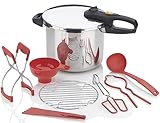 Zavor DUO 8-Piece Pressure Canning Set Zavor DUO 8-Piece Pressure Canning Set |
|
Check Latest Price |
Can You Really Pressure Can on a Glass Cooktop?
Yes, but only under conditions. A glass-ceramic cooktop is a single sheet of glass ceramic bonded to a heating element, and it is engineered to distribute heat across a burner ring rather than tolerate a concentrated hot spot from a heavy pot sitting still. Canners with a wide, flat, heavy-gauge base are the closest match to what the surface was designed for, and several manufacturers in this list state smooth-top compatibility outright.
The failure people fear is thermal shock. Ceramic glass expands as it heats and contracts as it cools, and a sudden change in surface temperature creates stress inside the sheet. A room-temperature cast-aluminum canner body dropped onto a burner that is already at temperature is exactly that sudden change. A cold jar rack or a splash of cold water at the base adds to it. Sliding the pot is the other half of the problem, because dragging a rough or gritty base across ceramic leaves micro-scratches that become stress risers over time.
Weight matters too, though the relationship is not simply heavier equals broken. A heavy canner with a wide flat base spreads its load across a large area, so the pressure on any given square inch stays low. A lighter canner with a small base concentrates the same cookware weight onto a smaller ring. What your stove manual cares about is usually the recommended cookware base diameter and whether heavy canners are restricted, and many of those restrictions come from warranty terms rather than a documented failure mode. Read the manual before you buy.
If your apartment has no suitable burner clearance, or you simply do not want the risk at all, an electric pressure canner removes the question completely. It never touches your cooktop. If you enjoy working with glass equipment in general, our guide to glass carboys covers the same philosophy from the fermentation side.
1. Presto 01781 23-Quart Pressure Canner and Cooker – the Best All-Rounder
Presto 01781 23-Quart Pressure Canner and Cooker
12 lb empty weight
23 quart capacity
26 half-pints or 20 pints
Dial gauge, smooth-top rated
Pros
- Lighter and quieter than cast aluminum competitors
- Works on regular and smooth-top ranges per the manufacturer
- Dial gauge registers the full pressure range for high altitudes
- Canning rack and 76-page guide in the box
Cons
- Loose-fitting regulator weight spins on the vent pipe
- Needs constant supervision and heat adjustment
- Plastic handles wear faster than wood
- Periodic gasket replacement and oiling
The Presto 01781 is the canner I keep coming back to for glass cooktops because it does the one thing a ceramic surface asks for without argument. At 12 pounds empty, it is one of the lighter large canners here, and the heavy-gauge aluminum bottom spreads heat across the burner ring instead of hammering the center. Owners report even heating on smooth-top ranges and no scorch marks.
Batch size is the other strength. It holds 26 half-pints, 20 pints or 7 quarts, which means a full load of pints in one process rather than two runs on a small pot.
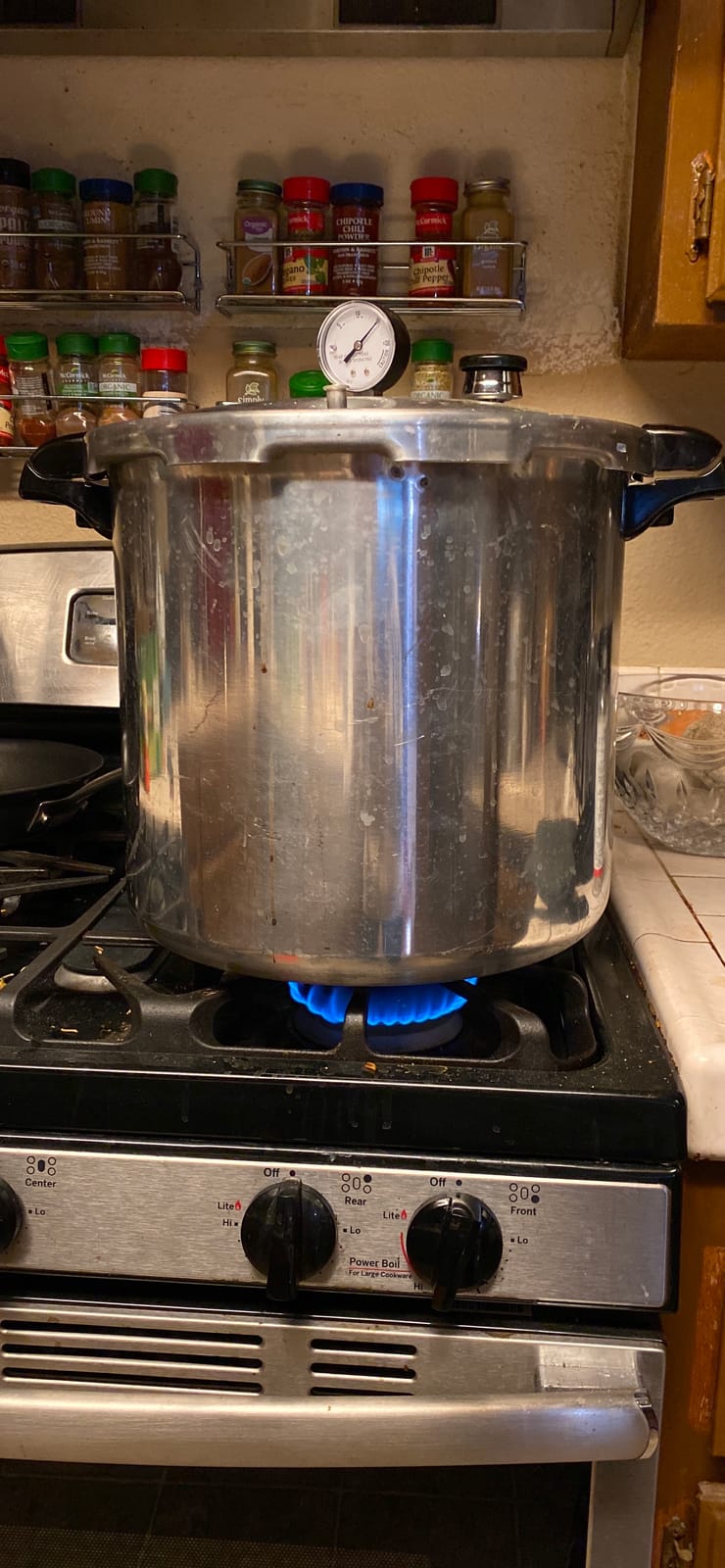
The deluxe dial gauge is genuinely useful rather than decorative. It registers the full range of processing pressures, which matters at altitude, where a weighted regulator alone can leave you guessing.
What we would change is the regulator. The 15 lb weight sits loosely on the vent pipe and the black knob spins freely, so venting steam means lifting the weight off rather than nudging it. Several reviewers also note that the unit needs watching and heat adjustment throughout the process to hold a steady pressure. Neither issue is a safety problem, but both are things you need to plan your kitchen rhythm around.
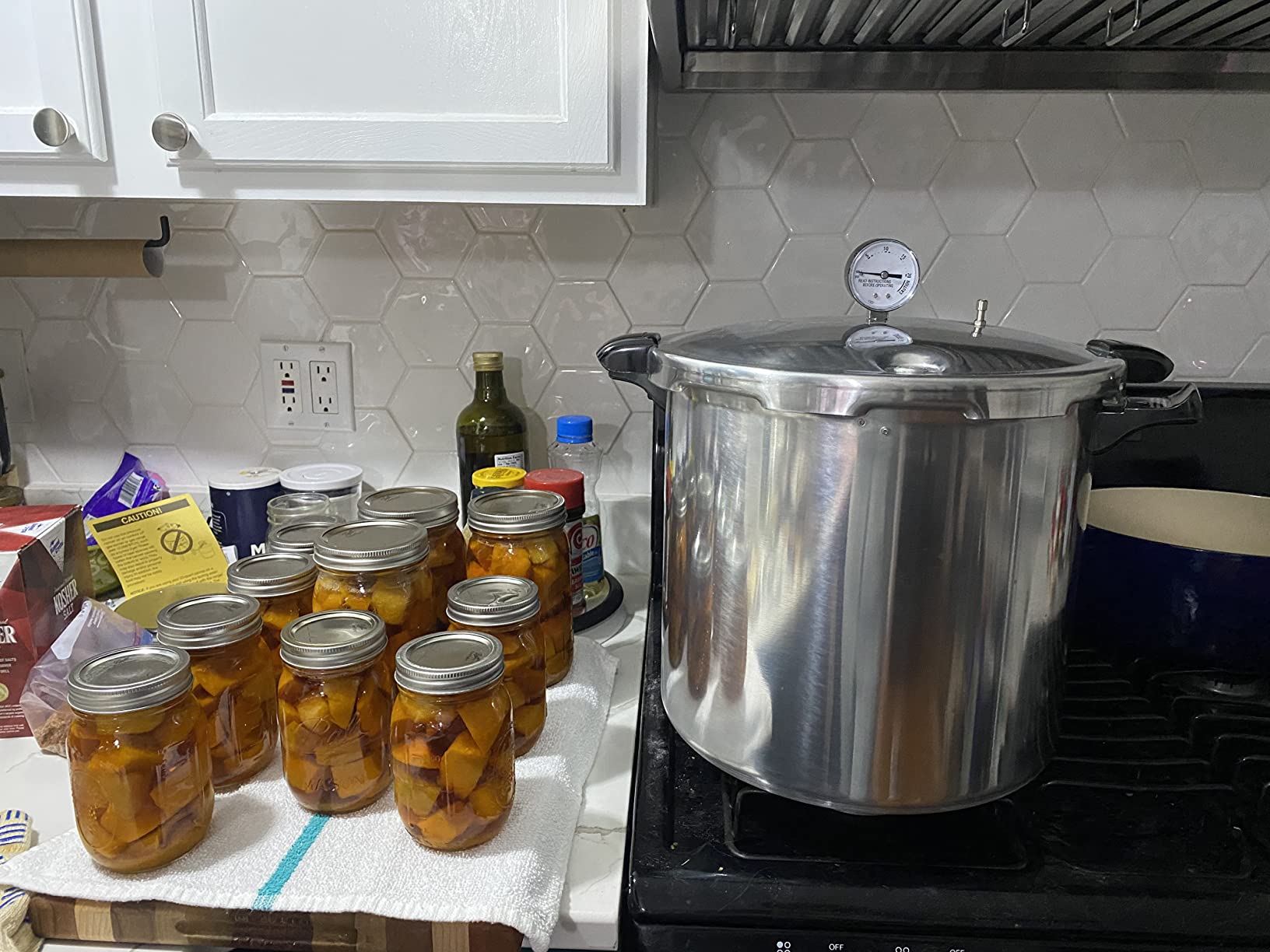
Is the 23-quart size too big for a glass cooktop?
It is large in diameter, so the burner matters more than the weight does. If your largest ring is smaller than the base, no canner of this size belongs on that burner. The 12 pound empty weight is easy on ceramic compared with the cast-aluminum options on this list, and the flat bottom does not rock.
Capacity is the real payoff for anyone preserving a garden rather than a few jars. One process of 20 pints turns a whole afternoon of harvest into a finished shelf.
When should you skip the Presto for something else?
Skip it if you cook a lot of tomato-heavy or vinegar-based food in the same pot, because bare aluminum reacts with acid. It is also not induction-ready, so if your glass surface is actually a portable induction unit, the Presto 01784 below is the version you want.
And if you are squeamish about constant supervision, look for a canner that holds pressure more passively. This one wants a hand on the heat.
2. All American 910 10.5qt Pressure Cooker and Canner – the Gasket-Free Benchmark
All American 1930: 10.5qt Pressure Cooker/Canner (The 910) – Exclusive Metal-to-Metal Sealing System – Easy to Open & Close – Suitable for Gas, Electric, or Flat Top Stoves – Made in the USA
14.8 lb empty weight
10.5 quart capacity
4 quart or 7 pint jars
Metal-to-metal seal, flat top rated
Pros
- No gasket to replace the most failure-prone part is gone
- Cover opens and closes easily with six dog-down wing nuts
- Owners confirm no scorch marks on ceramic or flat tops
- Made in USA cast aluminum with lifetime service and free parts
Cons
- Very heavy empty and genuinely hard to lift loaded
- Long heat-up and cool-down times
- Occasional vapor lock at zero pressure
- Aluminum body reacts with acidic foods
The All American 910 is the design benchmark in this category and the highest rated canner in the roundup at 4.9 across 9767 reviews. The reason is its exclusive machined metal-to-metal sealing system. Pressure clamps form a steam-tight seal with no rubber anywhere in the food path, which means the single component that fails most often on other canners simply does not exist here.
For glass cooktops specifically, the manufacturer lists this model as suitable for gas, electric and flat top stoves, and owners confirm no scorch marks and correct behavior on ceramic surfaces when they lift the pot instead of sliding it.
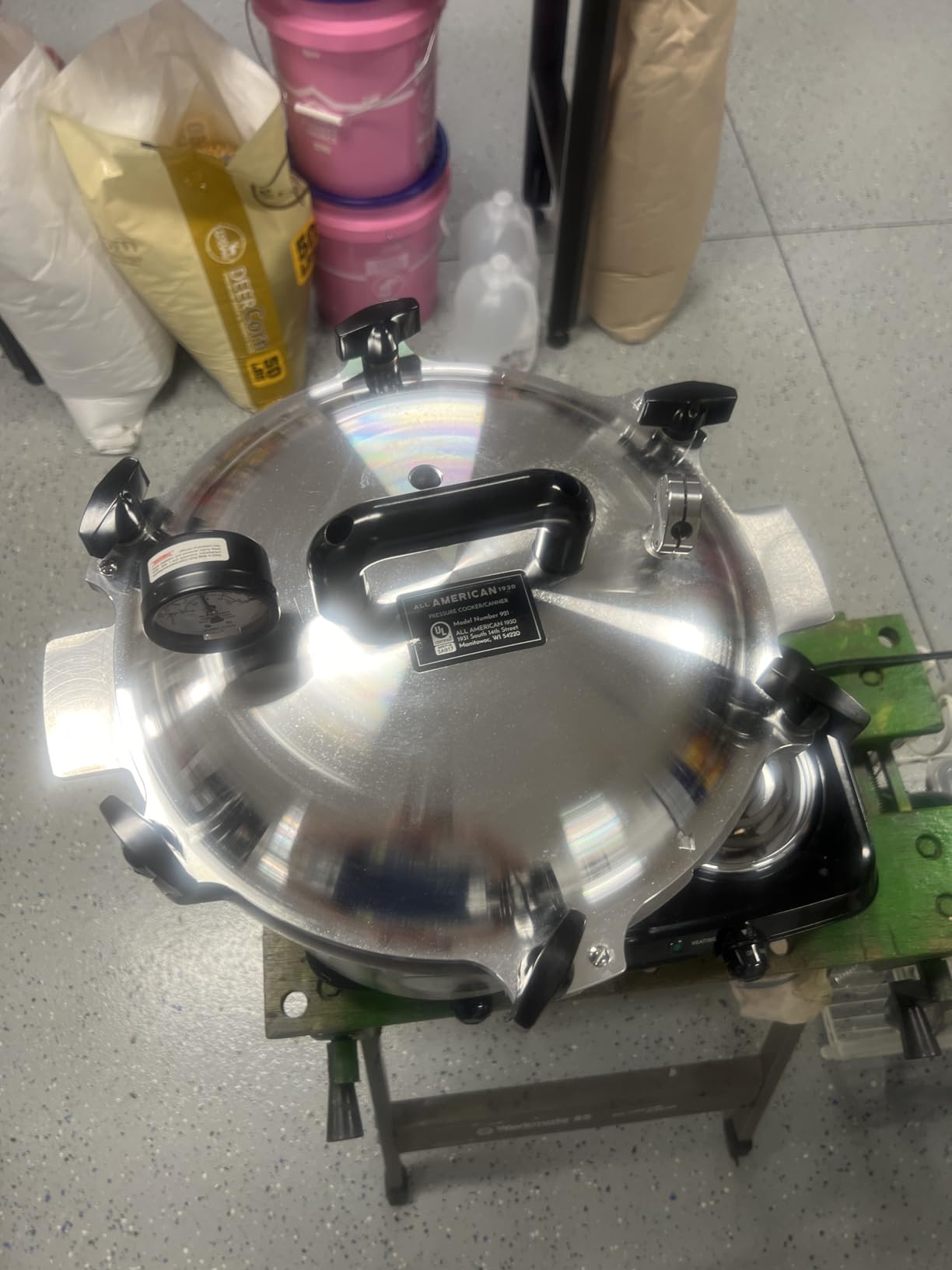
At 10.5 quarts it holds approximately 4 quart jars or 7 pint jars, and the included manual doubles as a full cookbook covering meats, fruit, vegetables and even tin-canning. The weighted regulator gives audible confirmation that the pot is at pressure, which is useful when you are across the room.
The honest drawback is weight. At 14.8 pounds empty, a loaded 910 is a serious lift onto a cooktop, and experienced canners accept that as a fair trade while first-timers get warned to load the pot on the burner rather than carry it full. If your glass surface sits at counter height with no nearby counter space, that matters.
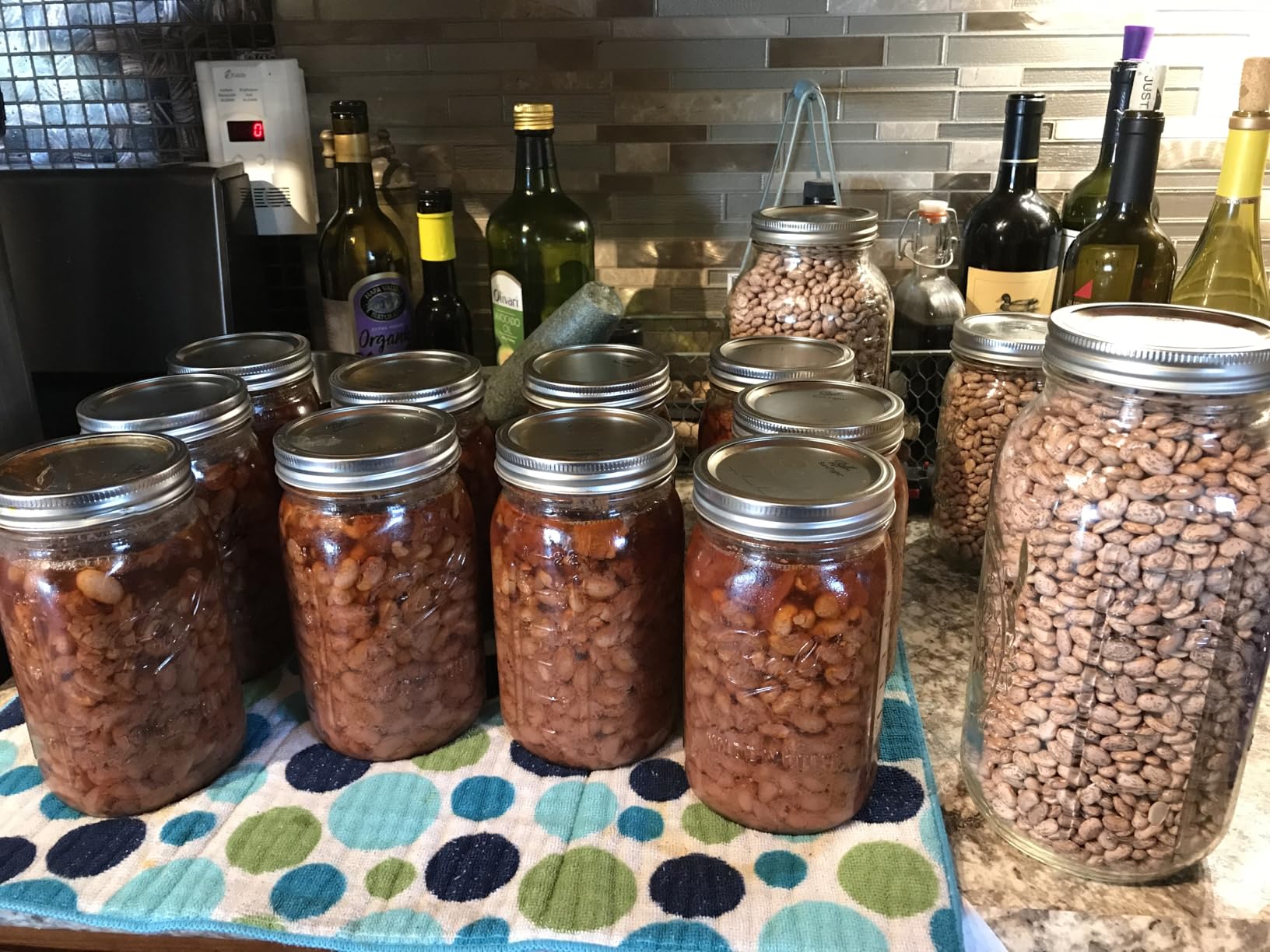
Does the metal-to-metal seal really need zero maintenance?
There is no gasket to replace, which removes the annual replacement and oiling routine entirely. What you do instead is keep the sealing surfaces clean and check the wing nuts, because the seal depends on those clamps sitting evenly.
That simplicity is why long-term owners rate it highly. There is no rubber part to harden, stretch or tear down the line.
Who should avoid the All American 910?
Anyone who lifts the canner rather than loads it in place, and anyone cooking acidic foods in the same vessel. Bare aluminum is not a good match for vinegar-based recipes or large tomato batches.
Also anyone who wants a fast cycle. Compared with lighter aluminum models it takes noticeably longer to heat up and cool down, so plan a longer afternoon.
3. T-fal 22-Quart Aluminum Pressure Canner – the Two-Rack Batch Machine
T-fal 22-Quart Aluminum Pressure Canner, 3 PSI Settings, Home Canning, Includes Racks & Canning Guide, Large Capacity, Pressure & Water Bath Canning for Vegetables, Meats, Seafood & Fruits, Silver
14.8 lb empty weight
22 quart capacity
24 half-pints or 18 pints
Two racks included 5/10/15 PSI
Pros
- Holds 24 half-pints 18 pints 16 wide-mouth pints or 7 quarts per batch
- Two racks let you double-stack jars for a full load
- Three PSI settings with a readable gauge
- Backed by Groupe SEB with a one-year warranty
Cons
- Valve can auto-vent before reaching the marked pressure
- Steam can weep at the handle onto the cooktop surface
- Manual has a broken binding and references an older model
- Gasket needs careful seating to stop small leaks
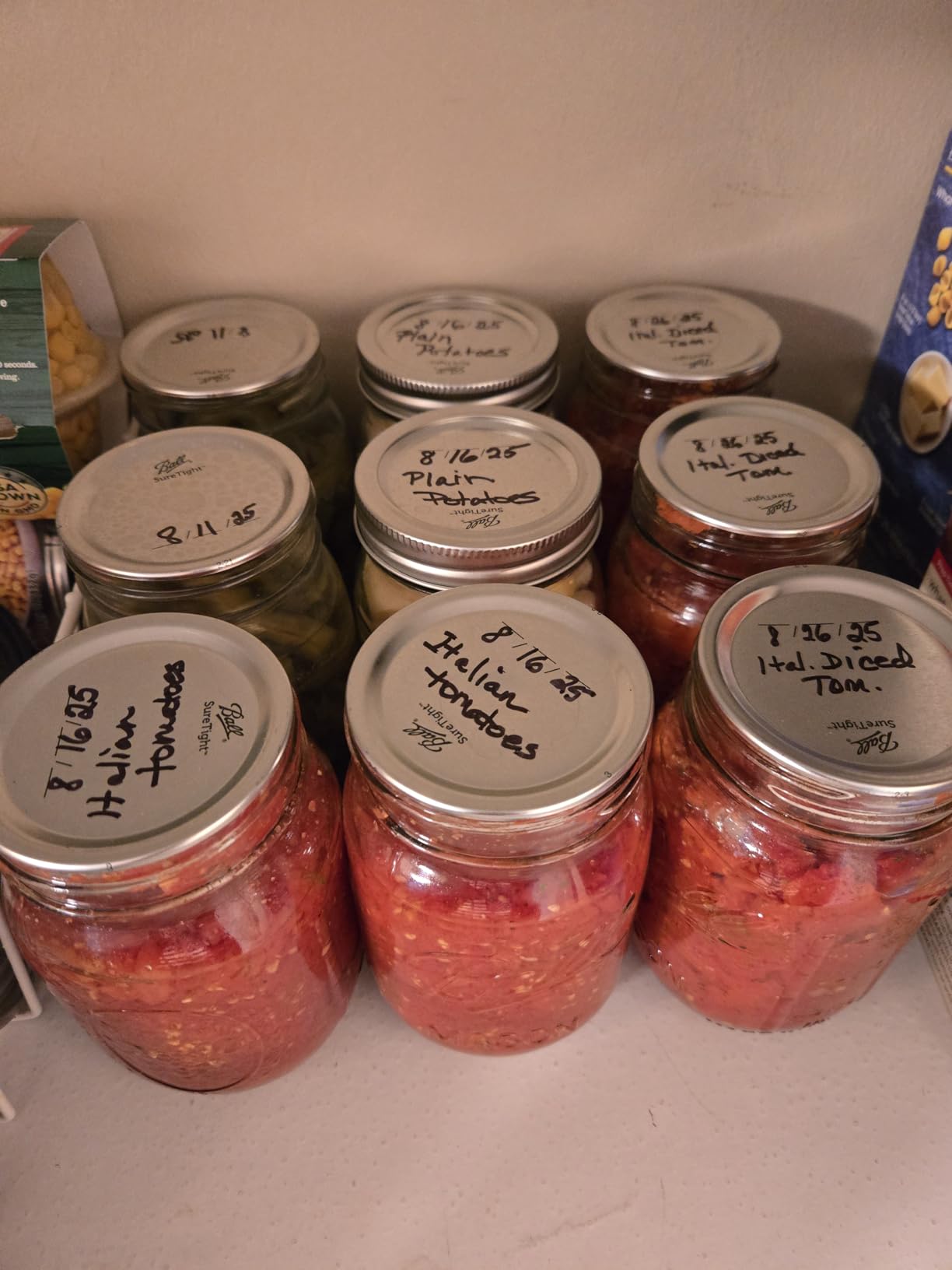
The Presto leads on refinement and the T-fal leads on rack flexibility. At 22 quarts it holds 24 half-pints, 18 pints, 16 wide-mouth pints or 7 quarts, and it comes with two canning racks so you can double-stack jars for a full load in a single process.
That double-rack arrangement is the feature experienced canners look for first, since each Presto 23-quart canner includes a single rack. Two racks let you build a full load in one process instead of running the canner twice for the same harvest.
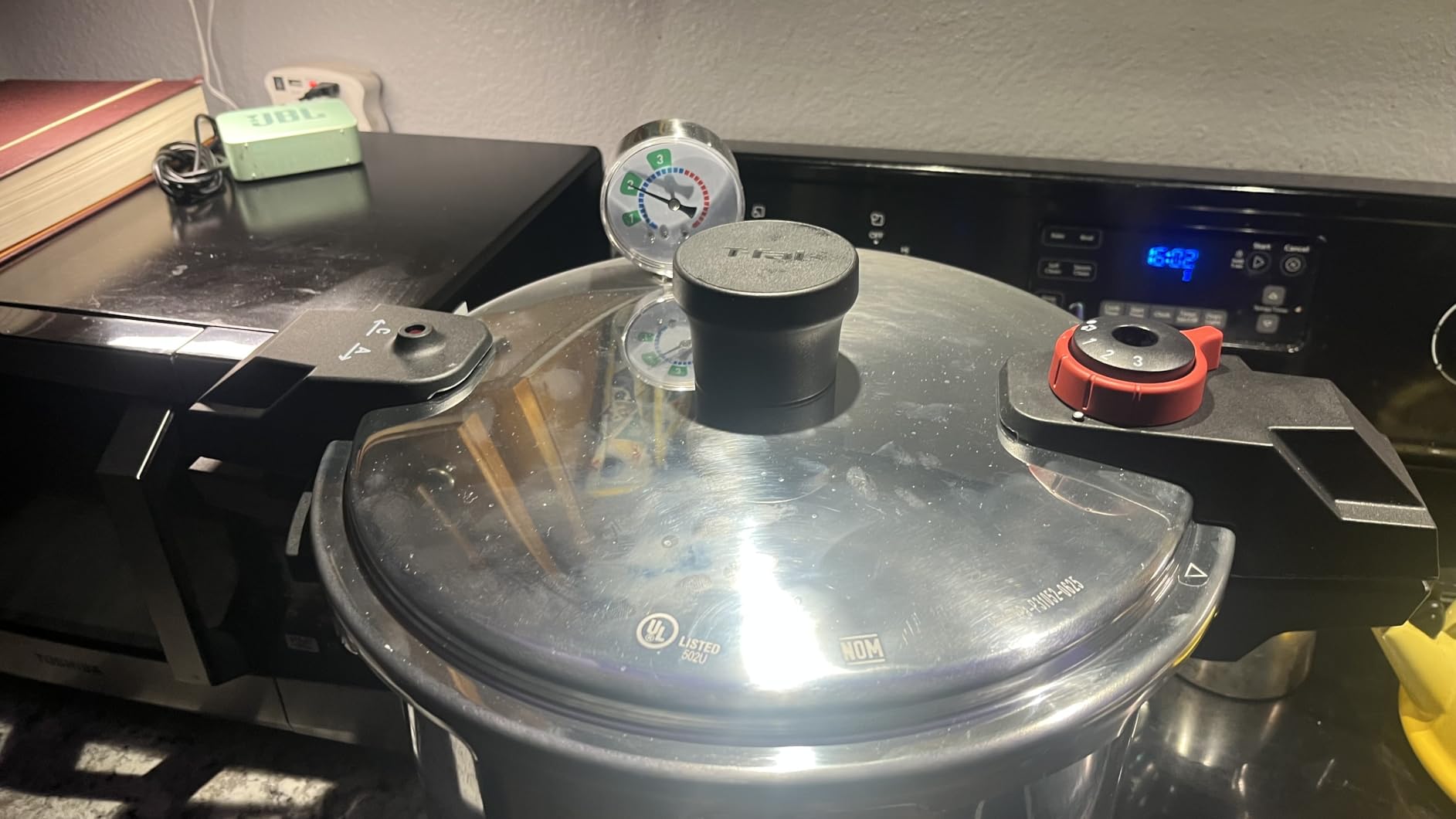
Control is straightforward: three PSI settings at 5, 10 and 15, a readable gauge and a beginner-friendly steam release valve. Many first-time canners report it felt safe and simple to run, and it is backed by Groupe SEB with a one-year warranty.
But it is the one in this roundup with a documented cooktop complaint. A reviewer reports steam leaking around the handle onto the cooktop, scratching an electric glass surface. That makes preheat discipline more important, not less, and it is why we do not hand this one the top spot despite the capacity advantage.
Is the T-fal accurate enough to trust its gauge?
Several buyers report the valve auto-vents before the canner reaches the marked pressure, so the gauge may not match the printed PSI scale. If that is a deal breaker for how you work, a weighted-regulator canner like the Mirro below removes the question entirely.
For most home canners following a tested recipe, the practical effect is a slightly longer process rather than a spoiled batch.
Is 22 quarts worth buying over a smaller canner?
When you have a garden coming in at once. The two-rack setup processes a full load in one run, and the wide flat aluminum base sits predictably on a large burner ring.
Size is the one place where a bigger number is not automatically better. The All American 910 at 10.5 quarts holds roughly 4 quart or 7 pint jars, which suits a household putting up a few dozen jars a season. A garden-scale harvest pushes you toward the 20 to 23 quart Presto and T-fal class.
4. Presto 01784 23-Quart Induction Compatible Pressure Canner – Best if You Own Induction
Presto 01784 23-Quart Induction Compatible Pressure Canner
12.5 lb empty weight
23 quart capacity
7 quarts or 20 pints
Stainless-clad induction base
Pros
- Only Presto canner here that also works on induction
- Cover lock blocks pressure until the lid is closed
- Arrows on the lid and rim make lock alignment obvious
- 12-year limited warranty and lighter than a cast aluminum canner of the same class
Cons
- Comes with a single 15 lb regulator and one rack only
- Lower pressures and a second jar layer need extra parts
- Some buyers find the dial gauge redundant with the weighted regulator
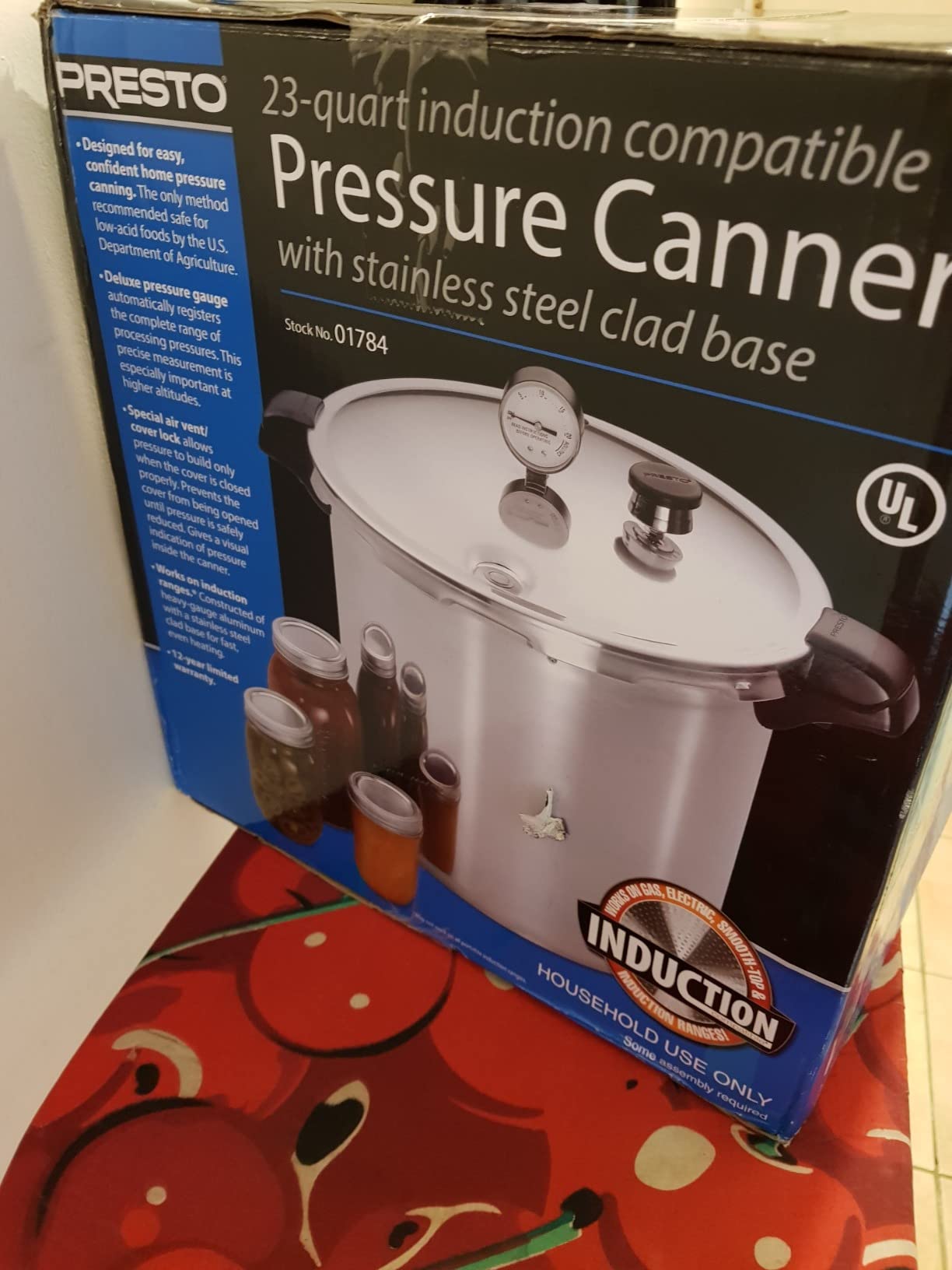
If your cooking surface is induction with a glass top, this is the Presto to buy. The stainless steel-clad base is the only part of the pot that touches the cooktop, which makes it compatible with induction, gas, electric and smooth-top ranges. The same clad base also heats more smoothly on every other surface type, including ceramic glass.
The cover lock is the safety feature we like best. Pressure can only build when the lid is properly closed, and the lid cannot be opened until pressure drops. For a first canner, removing the chance of opening a pressurized pot is worth more than most of the spec sheet.
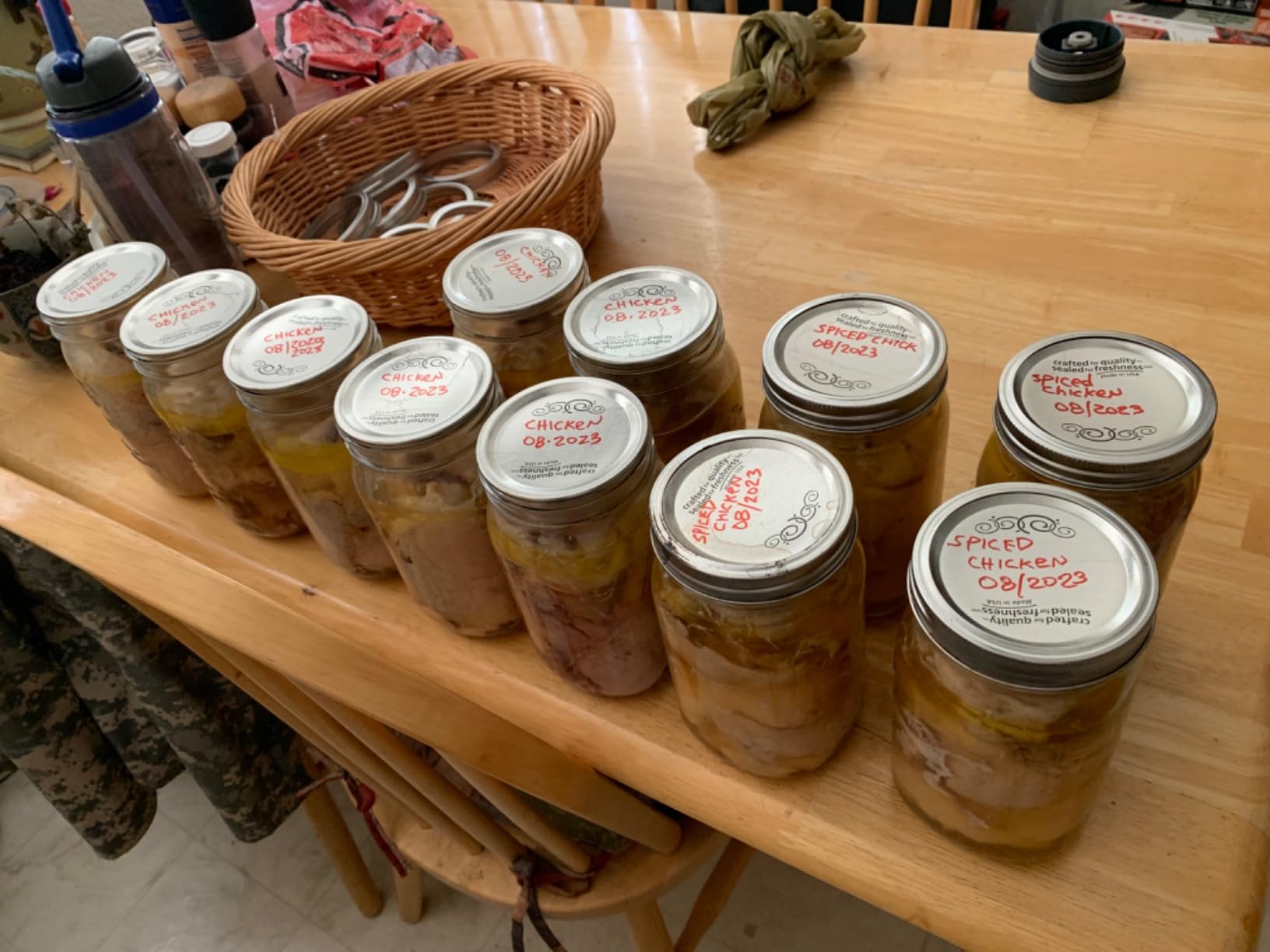
Capacity matches the 01781 at 7 quarts, 20 pints or 26 half-pints, and it can be doubled up with a second canning rack. At 12.5 pounds empty it is solid without being punishing to lift.
One practical catch: it includes a single 15 lb regulator and one rack. Working pressures of 5 and 10 lb and a second layer of jars mean buying the 5/10/15 regulator and an extra rack separately. Owners who add both tend to rate it perfectly.
Do you need both a dial gauge and a weight regulator?
No. The weighted regulator is what actually sets the working pressure, and the dial gauge tells you when you have arrived there. Some experienced canners ignore the dial entirely and go by sound and weight.
The gauge earns its keep mainly at altitude, where the difference between 10 and 15 PSI is harder to hear.
Is the stainless-clad base an upgrade over plain aluminum?
For a glass cooktop, it is a meaningful one. The clad layer spreads heat more evenly and reduces the hot spot directly under the pot, which is exactly the failure mode people worry about on ceramic.
It also means the canner works if you later move to an induction range, which the plain aluminum version does not.
5. WantJoin 10-Quart Stainless Pressure Cooker – the Stainless Induction Option
WantJoin Stainless Steel Pressure Cooker(Non-Aluminum),10 Quart Induction Compatible Pressure Cooker with Spring Valve Safeguard Devices,Compatible with Gas & Induction Cooker
10 lb empty weight
10.56 quart capacity
Fully stainless induction base
Spring valve with auto release
Pros
- All-stainless body with no aluminum touching food
- Indicative spring valve releases automatically if pressure runs high
- Box includes spare seals and spare handle screws
- Flat wide base heats evenly and sears well
Cons
- Sold as a pressure cooker with no canning jar racks included
- No pressure dial at all
- One owner reports a lid that would not close at all
- 10 quart size takes longer to come up to pressure
The WantJoin is not a canner in the USDA sense, and we want to be clear about that. It is an all-stainless, induction-compatible pressure cooker that happens to sit on the same shelf. What it does give you is a wide flat base that heats evenly on a glass cooktop and a body with no aluminum contacting food at all.
The indicative spring valve is a nice touch. The floating lever signals that pressure is building, and the valve releases automatically if pressure gets too high, so the safety case is handled by hardware rather than by your attention.
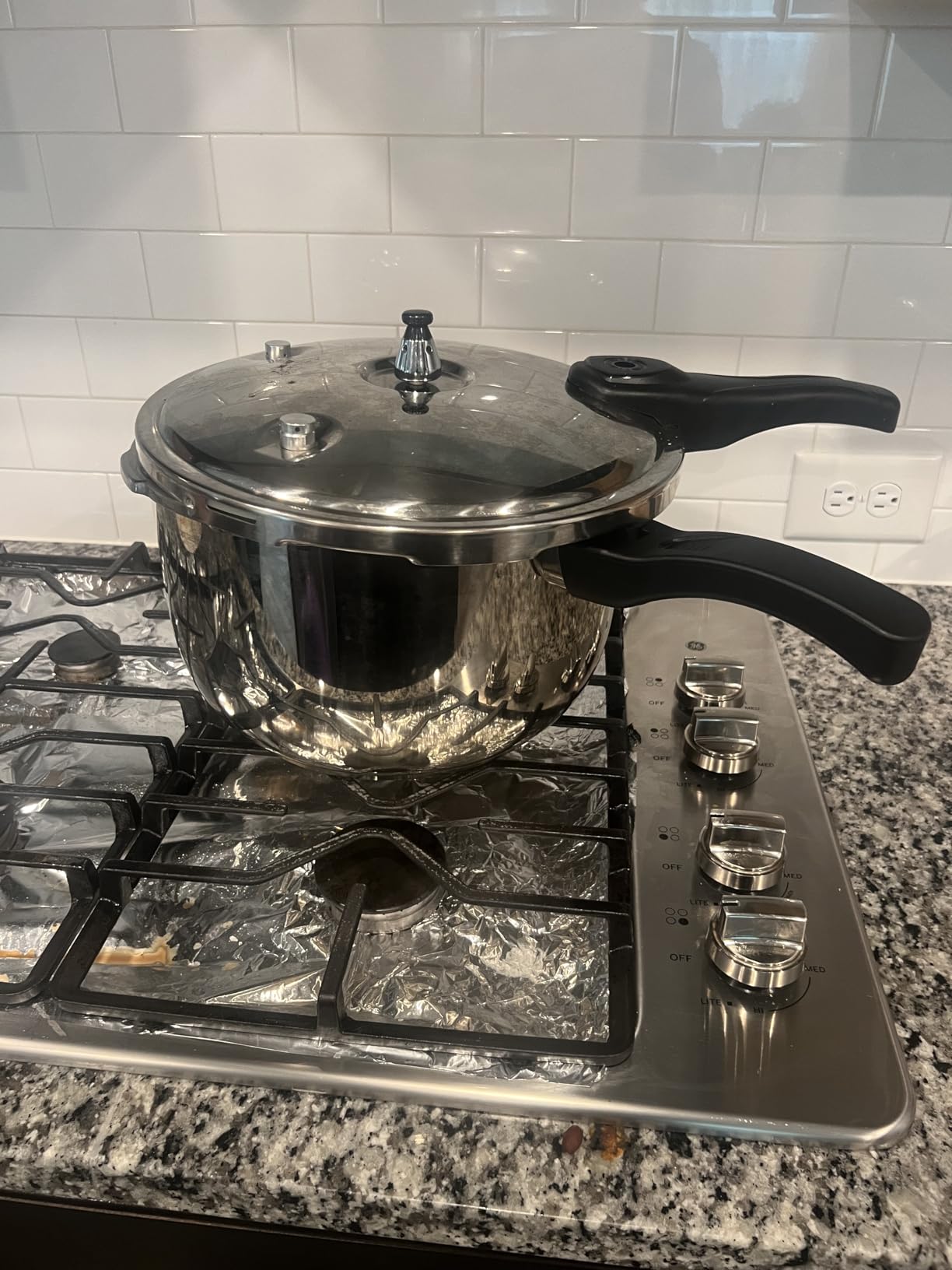
At 10.56 quarts it cuts cooking times roughly in half compared with conventional stovetop methods, and the reinforced bakelite handle stays comfortable through a long cook. Owners specifically appreciate that spare seals and spare handle screws are in the box.
The one serious negative theme across reviews is a lid that will not seat properly, reported by more than one buyer. If you buy this, check the lid closes freely before you commit a batch of low-acid food to it.
Can a pressure cooker be used for canning?
Use it for food you intend to eat, not for shelf storage. Without canning racks, jar capacity documentation and canning-specific process guidance, it is not a tested canning vessel, and low-acid food safety depends on a validated process time.
For high-acid foods like jam or salsa, treat it as a large-batch boiling-water vessel and follow a tested recipe.
Why might you want stainless instead of aluminum?
Stainless does not react with acidic foods, so tomato, vinegar and citrus recipes are safe in the same pot. It also sears properly, which aluminum does not, so it doubles as a searing vessel before the lid goes on.
The trade is weight and even cooking. At 10 pounds empty this is a midweight stainless pot, and the 9.3 pound Peterboo below is the lighter stainless alternative.
6. IMUSA 16-Quart Jumbo Stovetop Pressure Cooker – the 9-Pound Body
IMUSA USA A417-80807 16Qt Jumbo Stovetop Pressure Cooker with Regulator and Side Handles, Silver
9 lb empty weight
16 quart capacity
Flat aluminum base
Weighted regulator, no racks
Pros
- Lightest body in the roundup at 9 pounds
- Flat-bottomed aluminum sits stably on a large burner
- Locking lid regulator and safety valves included
- Doubles as a steamer and everyday stovetop pot
Cons
- No canning racks in the box
- Weighted regulator only with no readable dial
- A wide 16 quart body needs a burner large enough to cover it
At 9 pounds empty, the IMUSA is the lightest body in this roundup, and for a glass cooktop that is a genuine advantage. A heavy pot transfers a shock of cold mass into hot ceramic the moment it lands, and every pound you remove from the lift is a pound less thermal stress.
The flat-bottomed polished aluminum body sits stably and evenly on a glass cooktop’s large burner, with smooth edges and sturdy side handles. The safety set is complete for stovetop work: a locking lid, a pressure regulator and safety valves.
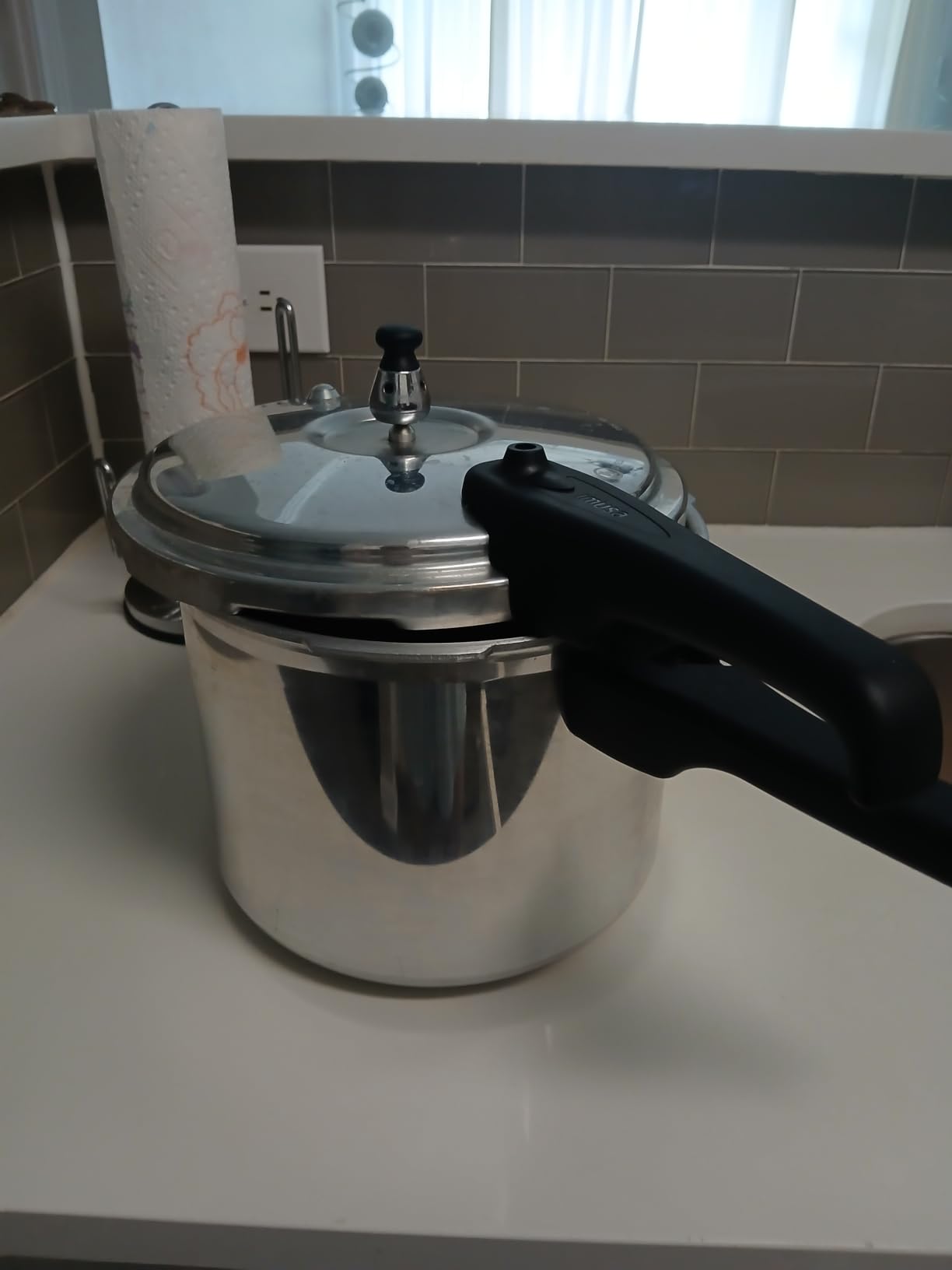
What you get for daily use is a 16-quart pot that also steams and simmers beans, meats and vegetables, which is genuinely more useful than a canning-only vessel in most households.
The limitation is what is not in the box. No canning racks are included, so a real jar batch needs a separately purchased rack, and pressure regulation is weighted-regulator only with no readable dial. If you want a weighted-regulator canner that ships with the racks in the box, the Mirro below is the same idea with the parts filled in.
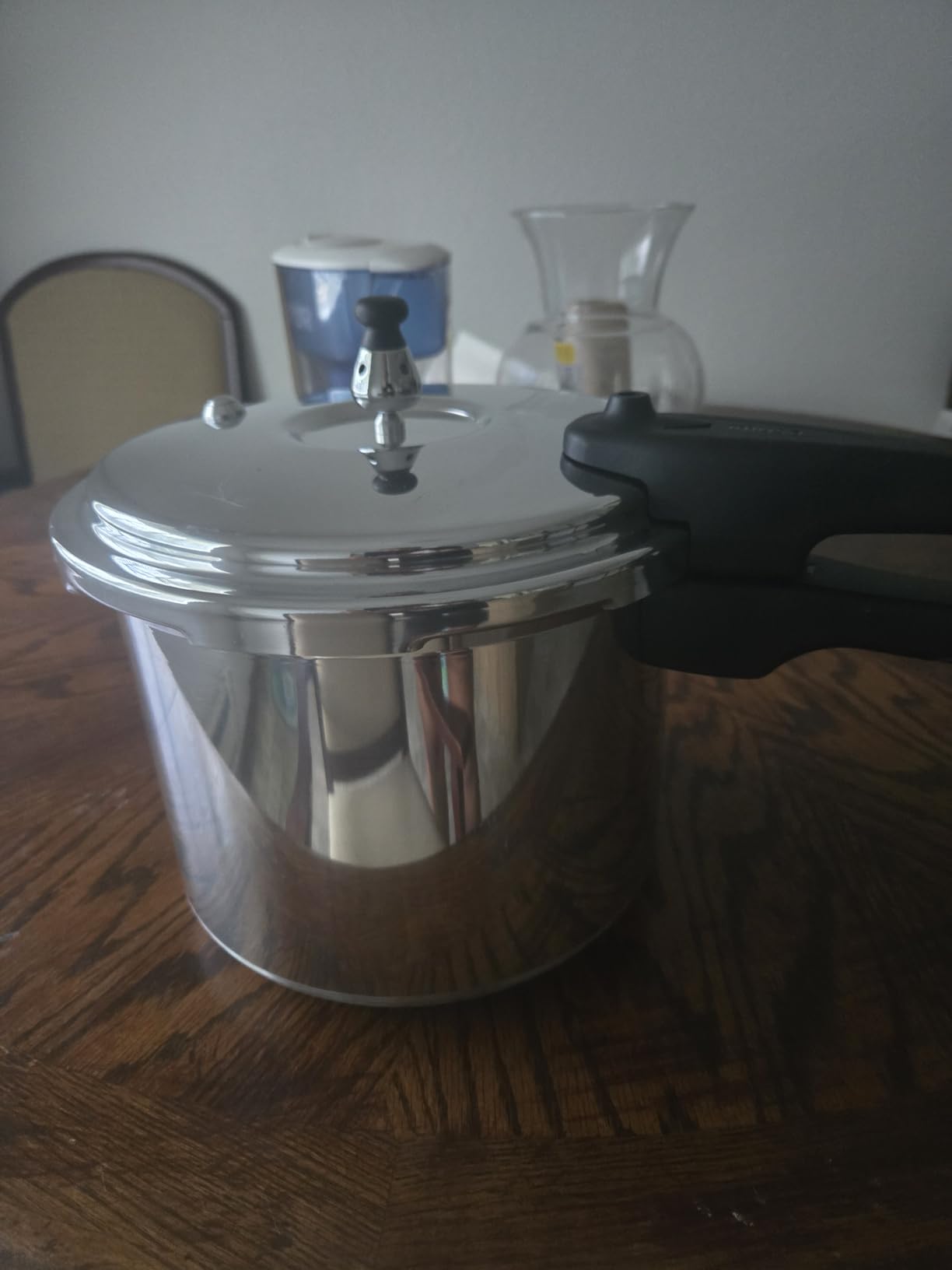
Will a 16-quart pot fit on your burner?
That is the question to answer first. This is a wide pot, and it needs a burner large enough to cover the base for even heating. On a small burner the flame laps the sides instead of heating the bottom evenly, which leads to scorching and a pot that will not hold pressure steadily.
Measure your burner ring before you buy any wide canner, including the T-fal.
Is it worth buying as a canner?
Only if you plan to do real jar batches. Without the rack you cannot process jars properly, so treat this as a large pressure cooker that happens to be canning-capable once you add the missing part.
As a budget everyday pressure cooker with a light body, it is hard to argue with.
7. Granite Ware 20-Quart Pressure Canner – the Anodized Base With a Recessed Center
Granite Ware Pressure Canner/Cooker/Steamer, 20-Quart
10.5 lb empty weight
20 quart capacity
9 inch recessed flat base
Three-piece 5/10/15 PSI regulator
Pros
- Hard-anodized aluminum will not rust stain or react with acid
- 9 inch recessed base fits neatly inside a large burner ring
- Three-piece regulator needs no annual gauge calibration
- Both a canning rack and a steaming rack included
Cons
- No steel in the base so it will not work on induction
- Thin bottom compared with cast aluminum canners
- Included wire rack leaves jars at an angle on a second layer
- Manual has no recipes
The Granite Ware solves two problems at once. Hard-anodized aluminum is the rare canning-grade pot that is genuinely safe for acidic foods, so tomatoes and pickles are not off the table. And the 9 inch flat contact base with a quarter-inch recessed center fits neatly inside a large glass cooktop burner instead of rocking on it, which reviewers call out specifically as a plus for ceramic surfaces.
The three-piece weighted regulator is calibrated at 5, 10 and 15 PSI, so there is no dial to read and no annual gauge calibration to book.
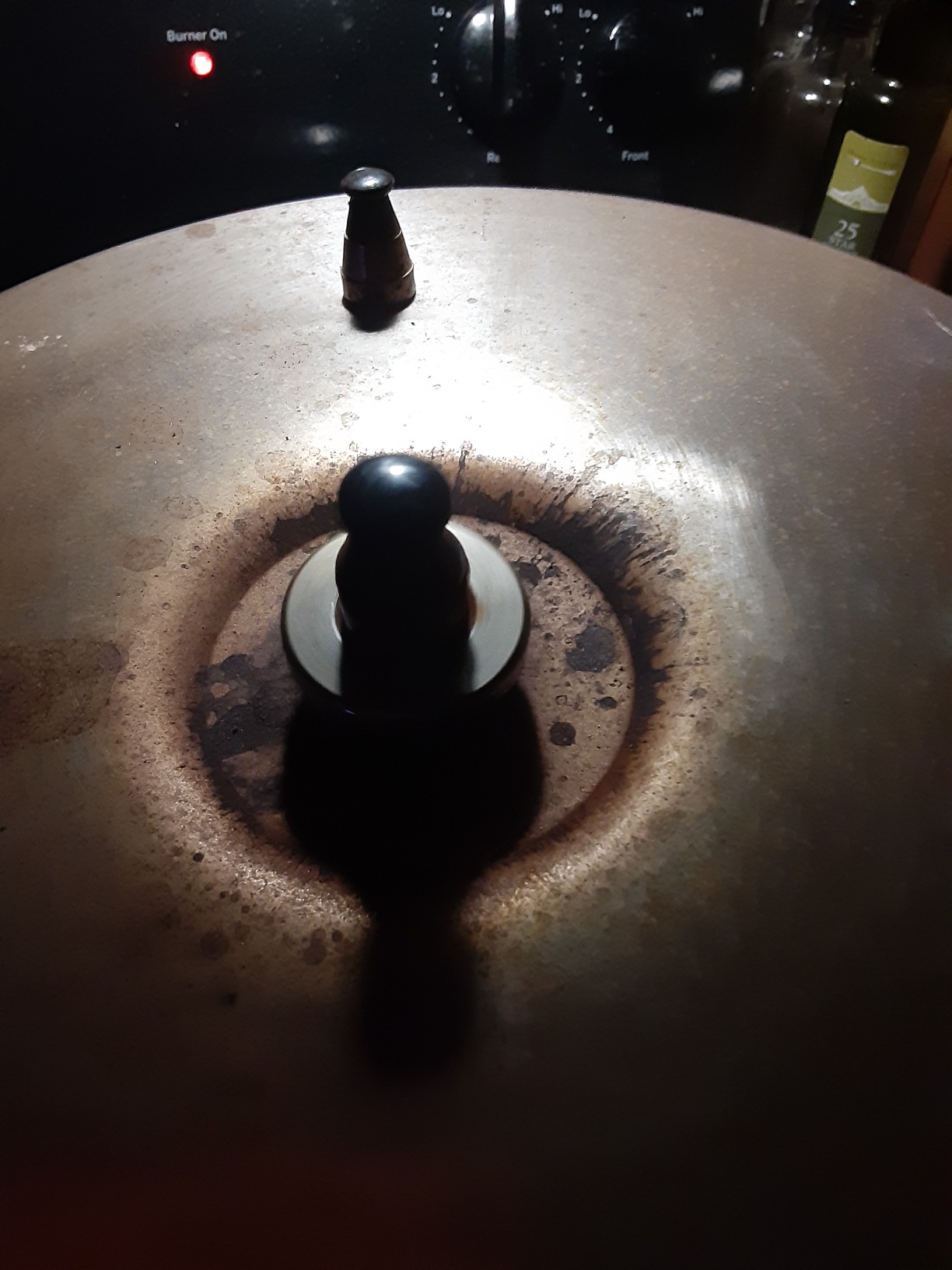
It holds 7 quarts, 8 pints, 24 half-pints across two layers, or 4 half-gallon jars, and the box includes a canning rack and a steaming rack.
The most repeated advice from owners is about the wire rack. It supports one layer properly, and the second layer needs a thicker 10 inch rack bought separately, which roughly doubles your batch. Several owners also flag it as a poor fit for induction, since anodized aluminum has no steel in the base.
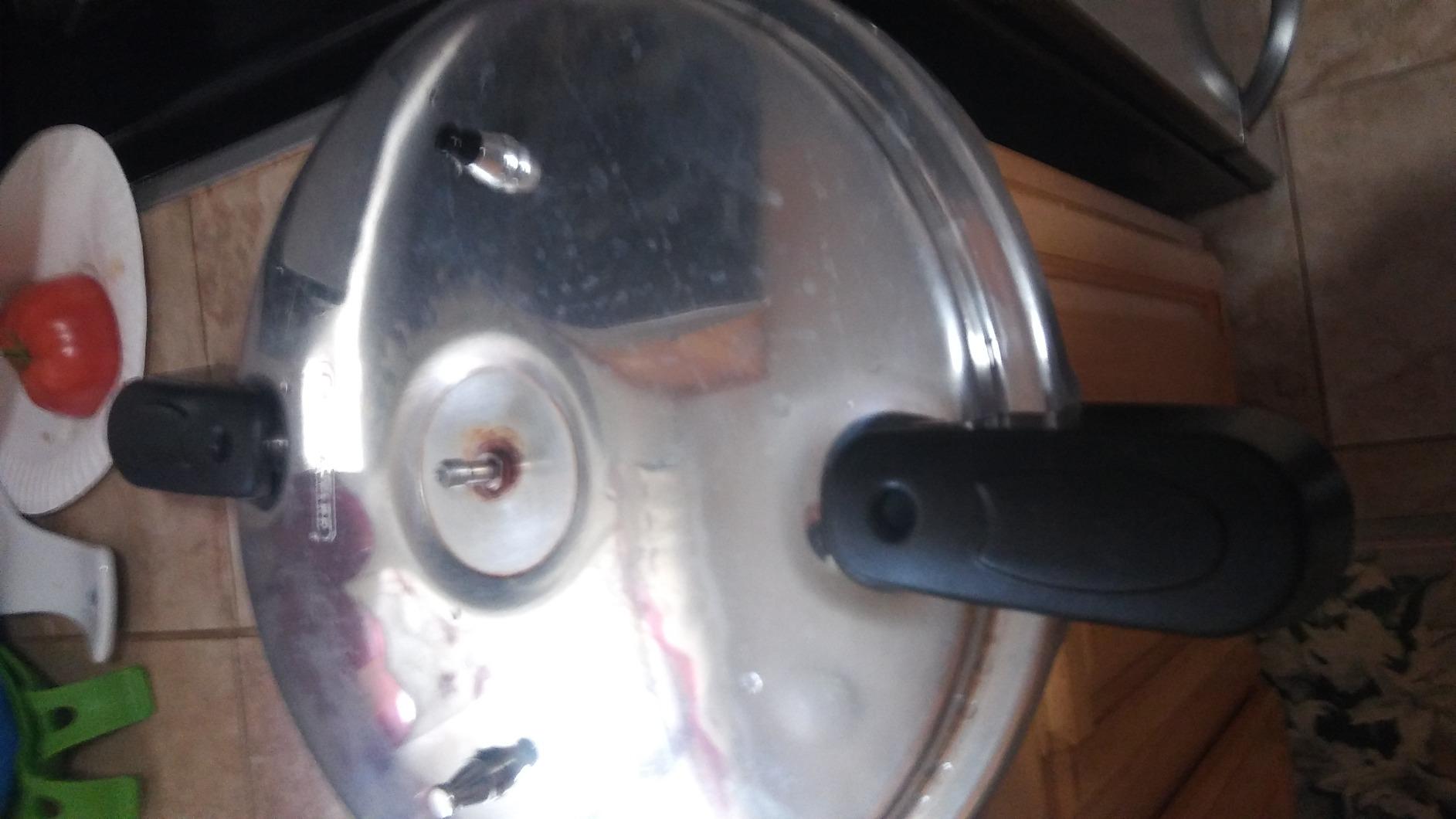
What does the recessed base actually do for a glass cooktop?
It centers the pot on the burner ring and keeps the outer edge clear, so heat reaches the base evenly rather than concentrating in the middle. On a ceramic surface that even distribution is the whole game, and a recessed center is a design choice made with flat cooktops in mind.
It also stops a warped or slightly concave canner base from rocking and tapping.
Is hard-anodized aluminum better than bare aluminum?
For canning, yes. The anodized layer is non-reactive, so acidic foods are safe, and it will not rust or stain. It also scrubs clean easily after a batch of tomatoes or fruit.
The trade is thickness. The bottom is thinner than cast aluminum models, so it responds faster to heat changes and can scorch food if you leave it over high heat as a plain pot.
8. Mirro 92116 16-Quart Pressure Cooker and Canner – the Weighted-Regulator Classic
Mirro 7114000228 92116 Polished Aluminum 5 / 10 / 15-PSI Pressure Cooker / Canner Cookware, 16-Quart, Silver
9.5 lb empty weight
16 quart capacity
16 pint or 5 quart jars
Weighted 5/10/15 PSI regulator
Pros
- Listens for the weight instead of watching a dial
- Quick to heat and holds steady temperature with little adjustment
- Reliable seals with almost no siphoning
- Sure-locking lid with a reusable overpressure plug
Cons
- Regulator must be pushed firmly onto the stem with two pops
- Leaves a rust-colored stain around the steam vent at first
- No stacking rack on the 16 quart version
- 18.6 inches wide so burner and sink space matter
The Mirro is the simplest pressure system in this roundup and the easiest one to learn on. A weighted 5/10/15 PSI regulator means you listen for the jiggle rather than watching a dial, which is exactly what many experienced canners prefer and what a nervous beginner can handle.
It heats quickly and holds a steady temperature with little adjustment, and owners report reliable seals with almost no siphoning. The sure-locking lid, reusable overpressure plug and side gasket pressure release round out a well-thought-out safety set.
Capacity is 16 pint jars or 5 quart jars, and two cooking racks are included to maximize the canning space.
There are two nits we would not skip. The regulator has to be pushed firmly onto the stem until you hear two distinct pops, which feels wrong the first time if you do not know to expect it. And the weight leaves a rust-colored stain around the steam vent from the first use, which is cosmetic but permanent-looking to a new owner.
Is a weighted regulator safer than a dial gauge?
Not inherently safer, just different. A weight regulates pressure mechanically and cannot be misread. A dial tells you the pressure but does not control it, so it depends on you adjusting the heat and reading accurately.
Most experienced canners run both a gauge and a weight, which is why the dual-gauge and dual-weight systems on the Presto 01781 and the T-fal are the ideal.
What should you check before buying this wide a pot?
Burner diameter and sink space. At 18.6 inches wide this is one of the larger canners listed, and it needs a burner that can cover the base. One owner also reports a glass cooktop reaction after the unit was slid across the surface, which is the single behavior to avoid with any ceramic glass.
Lift it into place and you will avoid that entirely.
9. Peterboo 12-Quart Stainless Pressure Cooker – the Induction-Compatible Daily Cooker
Stainless Steel Pressure Cooker 12 quart Peterboo Induction Compatible Thickened Pressure Cooker with Spring Valve Safeguard Devices, Compatible with Gas & Induction Cooker 8-12 people Use
9.3 lb empty weight
12.68 quart capacity
Layered steel induction base
Four-part valve safety system
Pros
- Layered steel base works on induction gas electric coil and ceramic glass
- Four-stage safety system with a pressure window and safety valve
- Three anti-scalding Bakelite handles
- Dishwasher-safe body with a palm brush included
Cons
- Sold as a pressure cooker with no jar racks or canning documentation
- Gasket and pressure-limiting valve must be hand washed
- No pressure gauge
- Needs a full burner underneath for even heating
The Peterboo is a stainless daily pressure cooker that happens to be an excellent fit for a ceramic glass cooktop. The layered steel base distributes heat evenly across induction, gas, electric coil and ceramic glass without scorching, which is the base construction we would want above a surface we are trying not to stress.
The four-part safety system is unusually thorough: an automatic pressure-limiting valve, a self-locking valve with a rising center rod, a separate safety valve and a safety window. It works at 11.6 PSI, which is well above the 10 PSI the USDA recommends for low-acid canning, so the same pot handles both jobs.
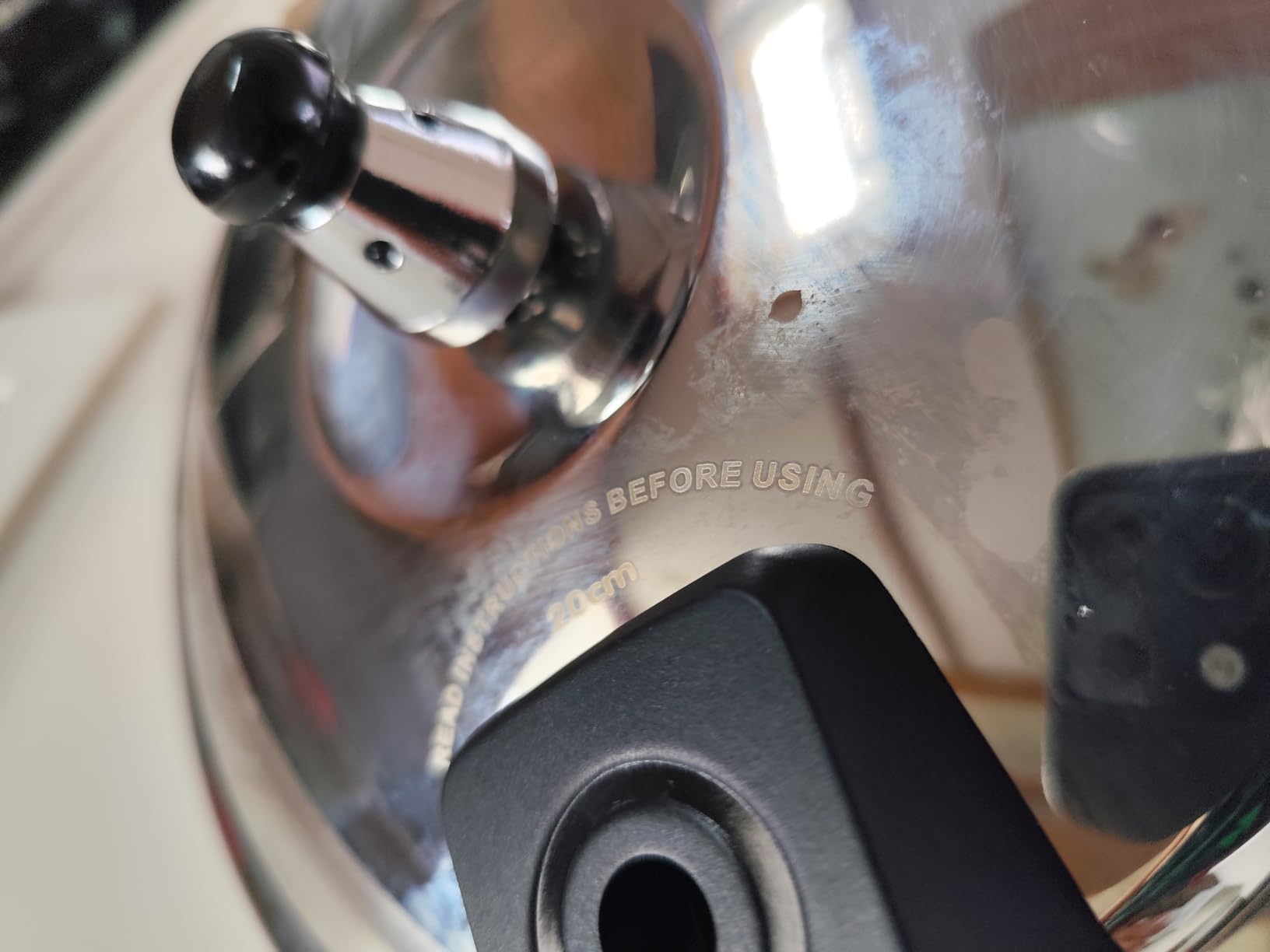
Dishwasher-safe construction is a genuine convenience, with the exception that the gasket and the pressure-limiting valve have to be removed and washed by hand.
What it is not is a canner. There are no jar racks and no canning documentation, and there is no pressure gauge, so pressure level is judged by the valve. If you want a vessel for eating, this does that well.
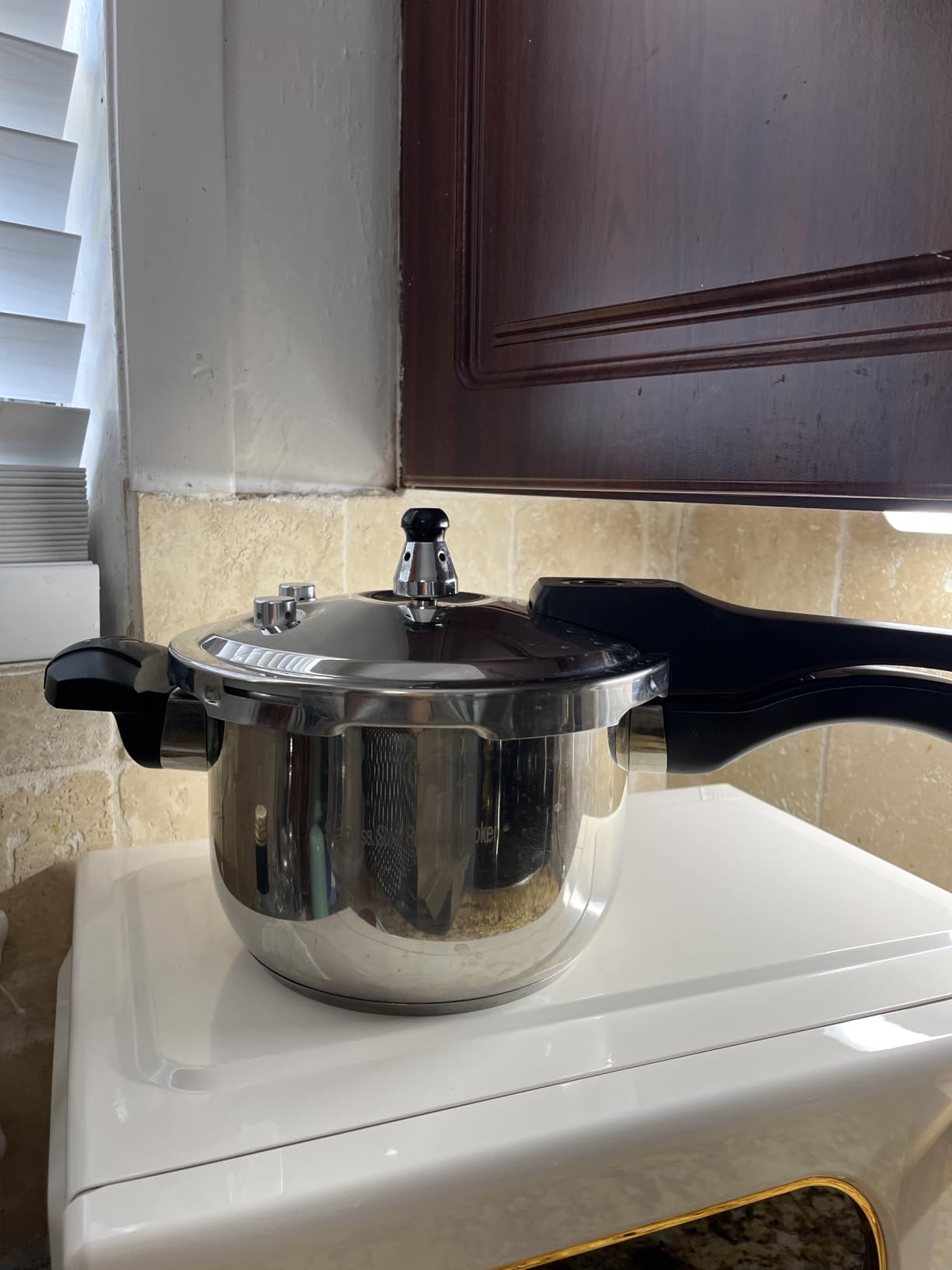
Why would you choose this over a real canner?
If your household pressure cooks several times a week and you preserve only high-acid foods, the stainless body and the complete tool set make more sense. Three anti-scalding handles and a dishwasher-safe body are conveniences a canning-specific pot does not offer.
For low-acid shelf storage, use a tested canner and a tested process time.
Is 12.68 quarts the right size for a family?
It is sized for 8 to 12 people, which covers a large Sunday batch of beans or a whole chicken. Several buyers also note it doubles as a sear-then-pressure vessel, which is a nicer workflow on a flat cooktop than starting cold.
Just confirm your burner is large enough to sit under the whole base.
10. Zavor DUO 8-Piece Pressure Canning Set – the All-in-One Starter Kit
Zavor DUO 8-pc Pressure Canning Set – Pressure Cooker 10 Quart w/Complete Pressure Cooker Canning Kit, including Wide Mouth Canning Funnel, Canning Rack & 5 other Essential Canning Tools
10 lb empty weight
10 quart capacity
Four quart or pint jars per load
Induction-compatible stainless pot
Pros
- Every canning tool in one box with the pot
- Stainless pot works on gas electric ceramic and induction
- Two pressure positions at 15 and 10 PSI
- Beginners report success on a first batch of salsa and jam
Cons
- Only holds four quart or pint jars
- Not compatible with pressure gauges
- Pressure cooker first and canner second at 10 quarts
The Zavor DUO is the answer to the question new canners actually ask, which is what else do I need. The box contains a 10 quart stainless pressure cooker and canner plus a jar lifter, wrench, tongs, a 3-in-1 bubble freer and headspace tool, a wide mouth funnel, a ladle and a canning rack.
The pot is stainless and compatible with gas, electric, ceramic and induction, so it will not be the limiting factor on your cooktop. Two pressure positions cover 15 PSI for canning and tougher foods and 10 PSI for softer items.
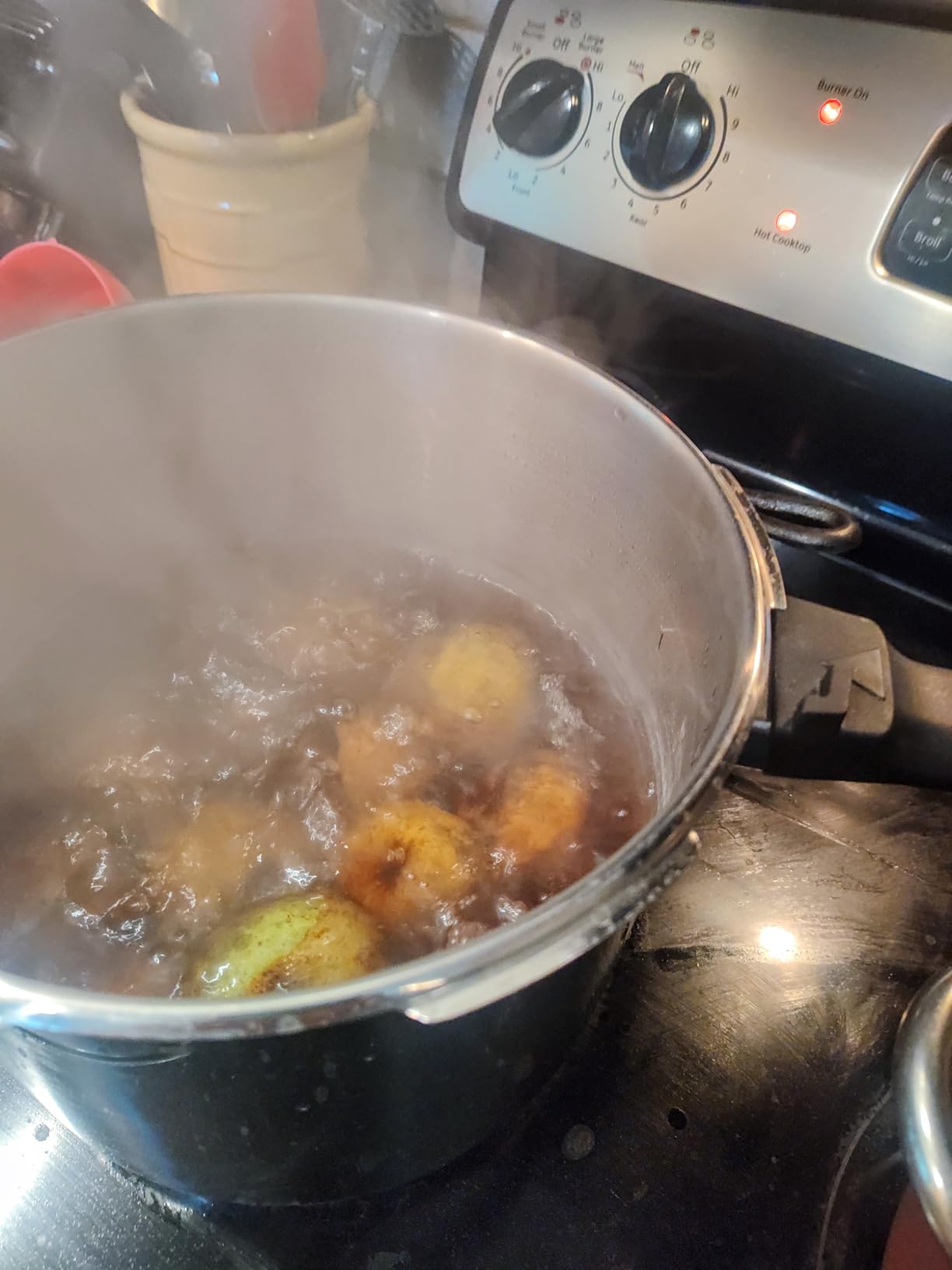
Owners with no canning experience report successfully making a first batch of salsa and jam, which is a real result for a beginner kit.
The capacity is the honest limit. It fits up to four 1-quart Mason or pint jars per load, which several buyers find too small for a meaningful canning season, and it does not accept a pressure gauge, so process times must be read off the weight. At 10 quarts it is a pressure cooker first and a canner second.
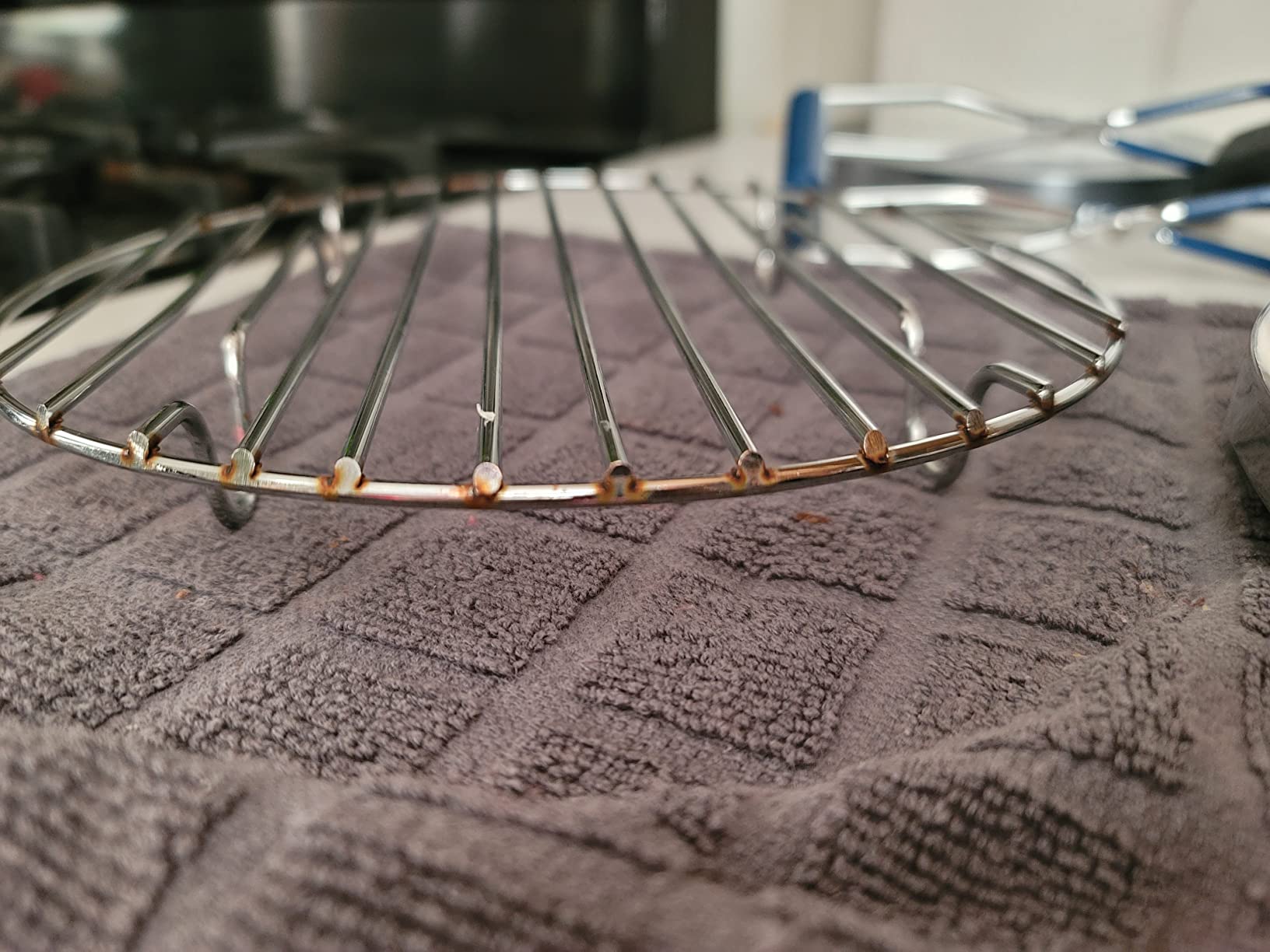
Is a starter kit a good value or a compromise?
It is a good value for your first season. The tools included are the ones you would buy individually anyway, and stainless means no acid reaction risk in the same pot.
It is a compromise if you already preserve in volume, because four jars per load will not keep up with a garden harvest.
Who should buy this instead of a larger canner?
Anyone living in a small kitchen with a modest cooktop, testing whether they enjoy the hobby, or making jam and high-acid batches in small quantities rather than putting up low-acid vegetables.
Buy a full-size canner when you decide to preserve low-acid foods for the shelf.
How to Pressure Can Safely on a Glass Cooktop
This is the routine that keeps a ceramic surface intact. The difference between a careful canner and a cracked cooktop is mostly the following eight steps.
1. Read your stove manual first. Look for the recommended cookware base diameter and any stated weight restrictions. Many restrictions exist for warranty reasons rather than a proven failure mode, but a warranty you void is not worth the savings.
2. Measure your burner ring against the canner base. The base should sit fully inside the ring with no flame or element exposed at the edge. A canner that overhangs the burner is the most common cause of uneven heating on a flat cooktop.
3. Preheat the empty canner. Set the empty pot on the burner for a few minutes before adding anything. This is the single step that most reduces thermal shock, because the base has already expanded before cold jars and cold water go in.
4. Add hot water and a warm rack. Fill with hot rather than cold water, and use a rack that has been rinsed in hot water. Avoid cold liquid hitting the base of a hot pot.
5. Never slide the canner. Lift it into place. If it is already on the burner and needs repositioning, take it off first. Grit dragged across ceramic creates micro-scratches that become stress risers over time.
6. Use a heat diffuser if you are unsure. A diffuser plate or a pair of fire bricks under the canner spreads the load and softens a hot burner, which users on canning forums recommend as cheap insurance.
7. Do not cold-shock the base. When processing is done, let the canner cool naturally and depressurize on its own. Do not run cold water over the base to speed it up, and do not put a cold empty pot back on a warm burner.
8. Let it cool before you lift. Wait for pressure to reach zero, open the vent according to the manual, then carry the pot to the counter. Loaded canners are heavy and full of scalding liquid, so moving them off the burner requires two hands and clear space.
If your kitchen does not have clear counter space next to the cooktop, or the burner is too small, an electric pressure canner solves the problem without any of these steps at all. For people outfitting an older home, clearance planning matters in the same way it does when choosing a freestanding heater that has to sit clear of combustible surfaces.
Pressure Canner Buying Guide: What Actually Matters for Glass Tops
Empty weight and base diameter come first. Every canner in this roundup weighs between 9 and 14.8 pounds empty, and a loaded canner with jars and water can be well past 30 pounds. What matters for ceramic glass is the base diameter relative to your burner ring, because a wide flat base spreads load and heat while a narrow base concentrates both. The 9-pound IMUSA is the lightest body here, and the All American 910 and the T-fal both sit at the 14.8-pound top of the range.
Gasket or no gasket. A gasket canner seals with a rubber ring that needs replacing every year or two and periodic oiling to stay supple. A metal-to-metal seal uses machined clamping surfaces, so there is no consumable part, but the clamping has to be clean and even. The All American is the only gasket-free unit in this roundup. If you will can for a decade, a gasket-free design removes a recurring cost and a recurring failure point.
Dial gauge, weight regulator, or both. A dial gauge measures pressure but does not control it, so you must adjust the heat. A weighted regulator controls pressure mechanically and announces itself with sound and motion. The ideal is both, which is what the Presto 01781 and the T-fal give you. If you will be canning at altitude, prioritize a dial gauge that registers the full pressure range.
Base material for your cooktop type. Flat heavy-gauge aluminum is the traditional choice and works on gas, electric coil and smooth-top. Anodized aluminum adds acid resistance. A stainless-clad base is the one to buy if your cooktop is induction. Fully stainless cookware, like the WantJoin and the Peterboo, doubles as an everyday cooking pot but is not a USDA-tested canning vessel. Electric pressure canners use no cooktop at all, which makes them the right answer for apartments and small kitchens.
Jars per batch, not just quart capacity. Two canners of similar size can differ by a dozen pints per load depending on jar layout. Check the stated jar counts: the Presto 01781 and 01784 both hold 26 half-pints, 20 pints or 7 quarts, while the T-fal holds 24 half-pints, 18 pints or 7 quarts with two racks that allow double-stacking. The Zavor DUO sits at the other end of the list, holding up to four 1-quart jars per load.
Racks in the box matter. A canner without a canning rack is a pressure cooker. The Granite Ware and Mirro both include racks, and the T-fal includes two. The IMUSA, WantJoin and Peterboo do not, and you will be buying racks separately.
Warranty and support. Presto carries a 12-year limited warranty on both 23-quart models, the All American offers lifetime service with free replacement parts and manuals, and the T-fal is covered by Groupe SEB for one year. A long warranty is a reasonable proxy for a company that expects to still be making gaskets and parts in a decade. If you are also upgrading the room around the stove, clearance and ventilation planning in our range hood guide for gas stoves covers the same thinking about heat and clearance around a cooking zone.
Frequently Asked Questions
Do pressure canners work on glass top stoves?
Yes, provided the canner has a flat bottom that fits inside your burner ring and stays within the weight your stove manual permits. Preheat the empty canner before adding jars, lift rather than slide it across the glass, and let it cool naturally instead of cold-shocking the base.
What is the best canner for a glass top stove?
The Presto 01781 23-Quart is the best all-round choice, weighing 12 pounds empty with a flat heavy-gauge aluminum base that the manufacturer rates for regular and smooth-top ranges. The Granite Ware 20-Quart stands out for its 9-inch recessed base, and the All American 910 is the pick if you want a gasket-free seal.
Are pressure canners safe on glass top stoves?
They are safe when the cooktop is designed to support them and you handle them correctly. A wide, flat, heavy-gauge base spreads heat across the burner ring. The risks come from cold-shocking a hot pot, sliding it across the surface, or using a burner too small for the base.
Is there a pressure canner that doesn’t require a gasket?
Yes. The All American 910 uses an exclusive machined metal-to-metal sealing system where clamping wing nuts form a steam-tight seal with no rubber anywhere in the path. That removes the annual gasket replacement and oiling routine that gasket canners need.
Can I use a pressure cooker on my glass top stove?
Yes, for cooking food you plan to eat. Fully stainless induction-compatible cookers such as the WantJoin 10-Quart and the Peterboo 12-Quart have wide flat bases that suit ceramic glass. Do not rely on them for low-acid shelf storage, since they are not USDA-tested canning vessels.
What size pressure canner do I need?
For one or two people, a 10-quart vessel handling four quart jars is workable. A family preserving a garden needs 20 to 23 quarts, such as the Presto 01781 at 26 half-pints or the T-fal 22-quart with two racks for double-stacking. Jars per batch matters more than stated quart capacity.
The Verdict: Best Pressure Canners for Glass Top Stoves
The best pressure canners for glass top stoves in 2026 come down to three picks with very different strengths. The Presto 01781 wins as the all-rounder: 12 pounds empty, a flat heavy-gauge base rated for smooth-top ranges, a dial gauge that handles altitude, and 26 half-pints per load.
The All American 910 takes the seal, with a gasket-free machined system and a manufacturer statement covering flat top stoves, at the cost of real weight. The T-fal 22-quart takes rack flexibility, with two racks for double-stacking in one process. If you need induction, the Presto 01784 is the version to buy.
Whatever you choose, read your stove manual, preheat the empty canner, and lift it into place. That routine matters more than any spec on this list.