
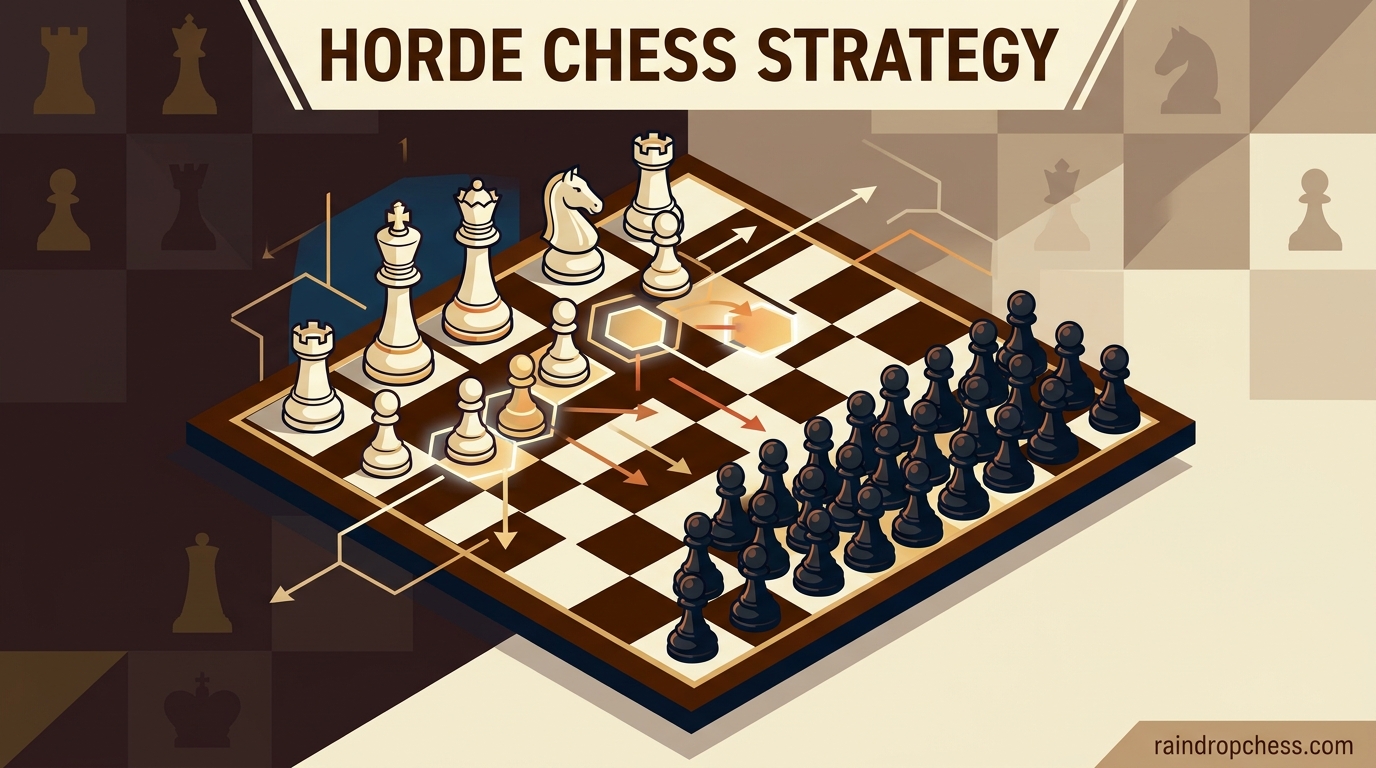
Few chess variants create as much tension as Horde Chess. In this unusual format, one player commands a full army of 16 pieces while the opponent fields a relentless horde of 36 pawns. The imbalance creates a unique strategic puzzle: how do you beat the pawn army with just 16 pieces when the opponent has more soldiers than you can count?
This guide will teach you exactly how to win Horde Chess as the piece player. You’ll learn battle-tested strategies for piece development, king safety, and tactical exploitation of weaknesses in the pawn mass. By the end, you’ll understand why the 16-piece side has a real advantage—and how to convert that advantage into victory.
Table of Contents
What is Horde Chess?
Horde Chess is a chess variant that inverts the traditional material dynamic. Instead of equal armies facing off, one player (white) controls a standard chess set of 16 pieces: one king, one queen, two rooks, two bishops, two knights, and eight pawns. The opposing player (black) commands a staggering 36 pawns, arranged on the first two ranks with the front rank completely filled and the second rank missing only the e-pawn square.
The rules create fascinating asymmetry. White plays standard chess and must checkmate the black king—which does exist and can move—to win. Black, however, has no king and cannot be checkmated. Instead, black wins by either checkmating the white king or forcing stalemate (a situation where white has no legal moves but is not in check). If any black pawn reaches the back rank and promotes to a piece, black gains king-like victory conditions for that piece.
This setup makes the horde surprisingly dangerous. A wall of 36 pawns advances relentlessly, creating tactical threats through sheer numbers. The piece player must survive the initial onslaught while finding tactical and strategic ways to disrupt the pawn mass and create decisive advantages.
Why the Pawn Army Is Dangerous
Before diving into strategies for beating the pawn army, you need to understand exactly what makes this horde so threatening. Underestimating the black position is the most common mistake new Horde Chess players make.
Constant Pressure: Unlike a traditional chess game where both sides develop methodically, the pawn horde creates immediate, unrelenting pressure. Every turn, black pushes multiple pawns forward, reducing your mobility and controlling more of the board. This pressure never lets up unless you actively disrupt it.
Pawn Promotion Threat: The horde’s ultimate weapon is pawn promotion. As pawns reach the far rank, they transform into queens, rooks, bishops, or knights. A single promotion can completely shift the game’s dynamic, giving black piece-like firepower to complement their numerical advantage. Multiple promotions almost always guarantee black victory.
Structural Resilience: The pawn horde can absorb casualties. Trading your pieces for individual pawns is usually a losing proposition because black has so many replacements. Meanwhile, every piece you lose is permanent and weakens your offensive capabilities. The horde regenerates; your army does not.
Board Control: With so many pawns controlling squares, the piece player’s space shrinks dramatically. The white pieces can find themselves boxed in, with limited mobility and few squares for maneuver. Breaking this structure requires careful planning and precise execution.
Core Strategy #1: Develop Your Pieces Early
The single most important principle for the 16-piece side is rapid piece development. In standard chess, you typically aim to develop your pieces within the first 10-15 moves. In Horde Chess, you must do this even faster—ideally within the first 8-10 moves—because the pawn horde starts advancing immediately.
Your knights and bishops must get out quickly to control key squares and prepare for the battles ahead. The knight on g1 (or b1 for black’s equivalent) should jump to f3 or c3 immediately. Meanwhile, your bishops should be eyeing long diagonals that can rake through the pawn mass and create tactical threats.
Controlling the center is especially critical. Squares like d4, e4, d5, and e5 become vital territory. If you can hold these central squares early, you prevent the pawn horde from creating a solid, unified wall. The center is your launchpad for counterattacks and your pathway to the vulnerable areas behind the pawn lines.
Castling early is non-negotiable. Getting your king to safety behind a wall of pawns should happen by move 10 at the absolute latest. Any delay gives the horde an opportunity to generate mating threats or launch a devastating pawn storm that exposes your monarch. When you castle, do so with purpose—ensure your rook connects and controls an open file.
Every tempo matters in Horde Chess. Unlike standard games where you might spend a move on prophylactic measures, here you need every move to either develop a piece, control space, or create threats. Asking “does this move improve my position or my opponent’s?” before every move will help you maintain the initiative you need.
Core Strategy #2: Prioritize King Safety
Your king is the most valuable piece on the board—not because it fights, but because its survival determines your victory condition. In Horde Chess, the white king becomes a precious asset that must be protected at all costs. If the pawn horde manages to trap your king or deliver checkmate, the game is over regardless of how well you’ve played elsewhere.
Castle early and keep your king sheltered. The ideal setup places your king on g1 (or c1 for the queenside equivalent) behind a fortress of pawns. However, be careful about which pawns you move. Advancing the f-pawn or h-pawn too far can create weaknesses that the horde exploits. Sometimes it’s better to leave a pawn unmoved to maintain a solid protective barrier.
Avoid any positions that expose your king to direct attacks. This means not pushing pawns too far ahead of your monarch, not leaving your king on open lines where rooks or bishops can target it, and not saccing important defensive pieces unnecessarily. The horde’s mating attacks often come from seemingly innocuous positions—staying vigilant prevents disaster.
Use your pieces defensively when necessary. A knight stationed on f6 or e5 can intercept pawn advances and absorb threats. Bishops controlling long diagonals can deter pawn storms before they develop. Sometimes the best defensive move is an active one that simultaneously creates counterplay, forcing black to respond to your threats rather than pressing theirs.
Core Strategy #3: Open Lines and Exploit Weaknesses
The pawn horde’s greatest strength is also its weakness: pawns cannot move backward. Every advance creates permanent holes and weaknesses that you can exploit. Your pieces—particularly your rooks, queen, and bishops—can target these structural defects with devastating effect.
Open lines for your heavy pieces by creating channels through the pawn mass. A rook on an open file behind enemy lines becomes a nightmare for the horde player. Every pawn push creates potential weaknesses: isolated pawns, backward pawns, and pawns that have advanced too far from their protective neighbors. Your tactical awareness should constantly scan for these opportunities.
Target poorly protected pawns in the horde. Unlike a coordinated army where pieces defend each other, the pawn mass often has individual soldiers that have advanced too far without support. A knight or bishop can often pick off these stragglers while your other pieces hold off the counterattack. Each pawn you eliminate is permanent progress toward victory.
Coordinate your pieces for maximum effect. A rook and queen working together on an open file can deliver devastating attacks. Knights excel at jumping into the heart of the pawn mass and causing chaos. Bishops can often strike from distance, targeting weak squares that the horde cannot easily defend. Your piece coordination should focus on creating tactical threats that demand responses.
When to Attack vs. When to Defend
One of the most challenging decisions in Horde Chess is knowing when to press the attack and when to consolidate defensively. The answer depends on several factors specific to each position, and mastering this distinction separates intermediate from advanced players.
Attack when you have piece activity and initiative. If your pieces are developed, your king is safe, and you see tactical opportunities, pressing the attack is correct. The horde player is constantly racing against time—their pawns are slowly advancing and will eventually create unstoppable threats. Seize the moment when your pieces are ready and the opponent’s structure has weaknesses.
Defend when the pawn wave is overwhelming. Sometimes black’s position is too solid, their pawns too far advanced, or your pieces too scattered to mount effective counterplay. In these situations, consolidate. Put your king safety first, simplify where possible, and wait for a mistake. Defense in Horde Chess isn’t passive—it’s active regrouping.
Strategic trading helps balance the game. Trading your pieces for the opponent’s pawns reduces the horde’s numerical advantage while maintaining your quality edge. However, avoid trading pieces for pawns that don’t create meaningful improvements. Every exchange should either improve your position, worsen the opponent’s, or both.
Know your breaking point. If the horde has pushed too far and created weaknesses near your king, it’s time to switch to aggressive defense—counterattacking to disrupt the pawn structure. If the position is simply too locked up and black is solid everywhere, pragmatic defense accepting a draw or slow attrition might be your best option.
Common Mistakes to Avoid
Learning what NOT to do in Horde Chess is just as important as knowing the right strategies. These mistakes catch many players and turn winning positions into devastating losses.
Neglecting development for premature attacks: It takes 16 pieces working together to defeat a 36-pawn horde. Sacrificing development to launch early attacks usually ends in failure—the horde simply absorbs the initiative and keeps advancing. Patience and coordinated development beat hasty aggression every time.
Trading pieces for pawns: This is the cardinal sin of Horde Chess strategy. Your pieces have high value relative to individual pawns. When you trade a knight for a pawn, you permanently weaken your army while the horde barely notices the loss. Only take pawns when it genuinely improves your position or prevents a serious threat.
Exposing your king: Every pawn pushed too far forward, every rook left on an open file targeting your monarch, and every moment of king neglect can be fatal against a skilled horde player. The pawn mass can generate surprising mating nets when given opportunity. Prioritize king safety above all else.
Underestimating pawn promotion: Failing to account for the horde’s promotion potential is a common and costly error. A pawn queening on your back rank can instantly transform black from a milling mob into a coordinated army with piece backup. Always be aware of which pawns are approaching promotion and prepare countermeasures.
Creating permanent weaknesses: In standard chess, temporary weaknesses can be repaired. In Horde Chess, the horde’s pawn pushes are irreversible. Every weakness you create—holes in your pawn shield, isolated pieces, exposed squares—becomes a permanent liability that the horde will exploit relentlessly.
Pawn Promotion: The Horde’s Secret Weapon
Perhaps no aspect of Horde Chess defines the variant more than pawn promotion. While the piece player must navigate traditional checkmate patterns, the horde player pursues a completely different victory condition centered on transforming humble pawns into powerful pieces.
As pawns advance down the board, they race toward the back rank. Upon reaching it, a pawn promotes to any piece except a king—typically a queen, but rooks, bishops, and knights each have situational value. One promotion gives black a taste of piece play; multiple promotions usually mean the horde has achieved decisive material advantage.
Preventing promotion should be a priority, but not at any cost. Sometimes the correct response to an advancing pawn is to let it pass and attack its neighbor. Chasing promotion with every piece clutters your position and gives black time to create counter-threats. The ideal approach involves strategic prophylaxis—controlling promotion squares and forcing the horde to waste tempo.
Sometimes sacrificing a piece to stop critical promotion is worth it. If a pawn is one move from queening and stopping it requires a piece, make the trade. A rook or knight for a single pawn promotion is often favorable because you maintain your king’s safety and remove a permanent threat. The calculation depends on the specific position and what else is happening on the board.
FAQ
How do you win Horde Chess as the piece player?
You win Horde Chess as the piece player by developing your pieces quickly, castling early for king safety, and creating open lines to attack weak points in the pawn horde. Focus on piece coordination and targeting isolated or backward pawns rather than trading your pieces for pawns. The key is maintaining initiative while keeping your king protected. Control the center early, exploit any weaknesses the pawn mass creates, and press when opportunities arise.
Who has the advantage in Horde Chess?
The piece player (white) has the theoretical advantage in Horde Chess due to superior piece quality and mobility. A coordinated 16-piece army can defeat a disorganized 36-pawn horde with precise play. However, the advantage is narrow—black’s numerical superiority and promotion potential mean that any mistake can be exploited. At lower levels, black actually wins more often because beginners struggle with the defensive aspects of the piece side.
What is the best opening in Horde Chess for white?
The best opening for white prioritizes rapid piece development and castling. Moves like 1. e4 or 1. d4 control the center, followed by quick knight development to f3 or c3 and bishop development. Castling by move 10 or earlier is crucial. The opening should focus on establishing a foothold in the center before the pawn horde can solidify its structure. Avoid premature pawn advances that create weaknesses.
Can black win in Horde Chess?
Yes, black can and does win in Horde Chess, particularly at amateur levels. Black’s victory conditions are simpler than traditional chess—just deliver checkmate or force stalemate. The horde wins by using its numerical advantage to create constant pressure, advancing pawns to promotion squares, and exploiting any positional mistakes by the piece player. Many experienced Horde Chess players consider black easier to play because the strategy is more straightforward.
Conclusion
Beating the pawn army with just 16 pieces in Horde Chess is a challenging but absolutely achievable goal. The keys to victory are rapid piece development, relentless attention to king safety, and active exploitation of weaknesses in the horde’s pawn structure. Every move should serve one of these purposes: developing your pieces, protecting your king, or creating tactical threats that disrupt the pawn mass.
Remember that the horde’s greatest strength—its numbers—is also its weakness. Pawns cannot retreat, and every advance creates permanent holes in the black position. Your superior piece coordination and mobility allow you to exploit these weaknesses if you maintain the patience and precision the position demands.
Practice is essential for mastering Horde Chess. Play multiple games to develop an intuition for the rhythm of the variant—when to attack, when to defend, and when to trade. Understanding the horde’s perspective makes you a better piece player and vice versa. The unique strategic puzzle Horde Chess presents offers lessons that transfer back to standard chess, particularly in piece coordination, king safety, and exploiting structural weaknesses.
Armed with these strategies and a willingness to learn from each game, you’ll find yourself converting more Horde Chess victories as the piece player. The pawn army is formidable, but with the right approach, your 16 pieces are more than enough to defeat it.