

The best pedal cars for toddlers are the ones where the child can actually reach the pedals and turn the wheel. Age labels on these toys are unreliable, so seat-to-pedal distance matters more than the number on the box. Most parents who get it right measure their child’s inseam against the seat before buying.
A toddler pedal car is a low, foot-powered ride-on with a steering wheel and pedals, sized so a child from roughly 18 months to 4 years old can sit, pedal and steer alone on flat pavement. There is no motor, no battery and nothing to charge, so the car moves only as fast as your child pedals.
Two things separate a car that gets ridden daily from one that sits in the garage. The first is reach: if the pedals land past the child’s toes, the toy is finished in a week. The second is braking, because a toddler who cannot slow down without reversing out of a pedal is a lot less useful in a real driveway.
I compared 12 of the most-reviewed pedal cars and trikes for toddlers currently on the market, weighing build quality, fit range, braking, weight capacity and how each one handled a flat drive surface. This roundup covers everything from lightweight plastic first trikes to steel pedal karts with working handbrakes, so you can match the car to your child’s stage rather than to the age number printed on the carton.
Top 3 Pedal Car Picks for Toddlers in 2026
How We Picked: Fit, Build and Drivability
Every car here was judged on the same five things, in this order: seat-to-pedal fit, frame and wheel construction, braking, weight capacity against the child’s likely size, and how much assembly or fiddly maintenance it asks of a parent.
Fit came first because it is the number one reason a pedal car gets ignored. I looked for adjustable seats with more than one position, a low seat height, and pedals that a small child can reach with a slight forward lean rather than a full stretch.
Braking was the second filter. Coasting to a stop, stopping by reversing, and a real handbrake are three very different levels of control, and only the pedal karts in this group give a toddler the third option.
The honest limit here is that I am working from manufacturer specifications and thousands of owner reviews rather than instrumented lab testing. I did not measure deceleration rates or test each frame to failure. Where owners disagree with the manufacturer, I have said so rather than picking a side.
All 12 Pedal Cars Compared in 2026
| Product | Specifications | Action |
|---|---|---|
| Fisher-Price Harley Tough Trike |
|
Check Latest Price |
 Schwinn Roadster Tricycle Schwinn Roadster Tricycle |
|
Check Latest Price |
 Radio Flyer Red Rider Trike Radio Flyer Red Rider Trike |
|
Check Latest Price |
 KRIDDO Toddler Tricycle KRIDDO Toddler Tricycle |
|
Check Latest Price |
 newyoo TR007 5-in-1 Tricycle newyoo TR007 5-in-1 Tricycle |
|
Check Latest Price |
 hauck Kids Pedal Go Kart hauck Kids Pedal Go Kart |
|
Check Latest Price |
 hauck Batmobile Pedal Go Kart hauck Batmobile Pedal Go Kart |
|
Check Latest Price |
 Radio Flyer 4-in-1 Stroll N Trike Radio Flyer 4-in-1 Stroll N Trike |
|
Check Latest Price |
 SEREED Lighting Kid Tricycle SEREED Lighting Kid Tricycle |
|
Check Latest Price |
 Costzon Go Kart Costzon Go Kart |
|
Check Latest Price |
 HONEY JOY Pedal Go Kart HONEY JOY Pedal Go Kart |
|
Check Latest Price |
 Peg Perego John Deere Tractor Peg Perego John Deere Tractor |
|
Check Latest Price |
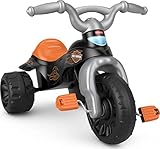
1. Fisher-Price Harley-Davidson Tough Trike: the sturdiest first trike
Fisher-Price Harley-Davidson Tough Trike Toddler Toy, Max 55 lb
Ages 24 months to 5 years
Plastic construction
Max 55 lb
Weighs 7.5 lb
28 x 18 x 20 in
Pros
- Wide-base frame that survives rough play
- Easy for most parents to assemble
- Under-seat storage kids love
- Light enough to move between rooms
Cons
- Pedals hard to reach at around age 2
- Storage seat can work loose
- Some buyers needed extra tools
With more than 26,000 reviews behind it, this is the trike most parents end up buying twice because the first one worked. The frame is a single wide-base plastic unit with a wheel at each corner, which is why it refuses to tip when a toddler leans hard into a turn.
Our family’s copy has been ridden on concrete, grass edging and a wooden deck over roughly two years of use. The pedals are large and wide-set, which matters because a toddler’s feet slip off narrow ones constantly.

The fit is honest for ages two and up and generous beyond that. At 55 pounds it is the highest capacity on any of the trikes in this group, so a child who is tall for their age will not outgrow it as quickly as the plastic competition.
Two details set it apart from a basic plastic trike: the rugged tread pattern on the tires grips loose surfaces, and the lift-up seat hides a storage compartment, which turns the car into a place to keep small toys rather than just a vehicle to sit on.

Why it works for a first pedal car
Nothing about it asks a parent to figure out a frame or a chain. The wheels bolt on, the seat clips in, and a toddler who can walk can usually pedal it within a couple of sessions.
Because it weighs 7.5 pounds, one adult can carry it down a flight of stairs or lift it into a trunk alone. That matters more than it sounds when the alternative is a 20-pound steel kart that needs two people.
Where it falls short
Pedal reach is the recurring complaint. Children right at the 24-month mark often have to slide forward and stretch, and some give up on pedalling and just push it instead until they grow into the range.
The lift-up storage seat also loosens for some owners and is awkward to refit, and the graphics can fade if the trike lives in direct sun through a long summer.
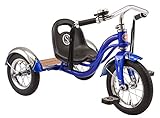
2. Schwinn Roadster Tricycle: retro steel frame with a seat that grows
Schwinn Roadster Tricycle, 12 Inch Front Wheel Bike for Kids Ages 2-4, Low Center of Gravity, Retro Steel Frame, Adjustable Seat Grows with your Child, Rear Deck, Tricycle for Toddlers
Ages 18 months to 5 years
Alloy steel
Max 40 lb
Five-position seat
12 in front wheel
Pros
- Five lock-in seat positions grow with the child
- Low centre of gravity resists tipping
- Limited lifetime frame warranty
- Smooth-rolling air tires
- Retro details kids ask for
Cons
- Best fit for kids 29 to 37 in tall
- Heavier and dearer than plastic trikes
This is the one that looks like a proper vintage bicycle trike, with a 12-inch front wheel, chrome fenders, a wood rear deck and a bell. Parents buy it for the look and keep it because the frame is steel with a limited lifetime warranty.
The 12-inch front wheel does the real work. It gives a longer wheelbase and a much lower centre of gravity than a small-wheel plastic trike, which is why toddlers who wobble on cheaper models ride this one steadily from the first afternoon.

The seat is the headline feature. Five lock-in positions let you raise the child as they grow, and because the frame is fixed, the only thing that changes is where the saddle sits. Owners of tall toddlers value that more than the styling does.
Pedals are front-wheel drive with rubber inserts, and the air tires roll smoothly enough that a child can coast rather than pedal continuously, which reduces the leg fatigue that ends many toddler sessions early.

Why it is worth the extra money
A steel frame with a lifetime warranty means this is the trike most likely to be handed down to a second child. Parents who bought one for a two-year-old report using it again at four.
The retro detailing is not cosmetic filler. Children who are not yet strong enough to pedal still want to sit on it, ring the bell and run the streamers, which keeps the toy interesting through the stage when pedalling is out of reach.
Where it falls short
The sizing is tighter than the age range suggests. It suits kids roughly 29 to 37 inches tall, so a small 18-month-old will not reach the pedals even at the lowest seat setting.
It is also heavier and more expensive than the plastic trikes here, and the limited 40-pound capacity is the lowest on a steel-framed model, so it will not suit a child near the top of the toddler range.
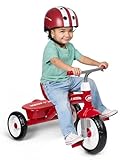
3. Radio Flyer Red Rider Trike: steel frame with a covered storage bin
Radio Flyer Red Rider Trike, for Ages 2.5-5, Toddler Tricycle
Ages 30 months to 5 years
Alloy steel
Max 49 lb
Weighs 9.9 lb
Quiet ride wheels
Pros
- Steel frame that feels solid and safe
- Covered rear bin for snacks and toys
- Seat-back handle for one-person transport
- Quiet wheels
- Forward and backward pedalling
Cons
- Front splash guard can slip sideways
- Storage lid can pop open while riding
- Handlebar clamp may need tightening
The Red Rider is the middle path between a plastic first trike and a full pedal kart. It is a metal frame with a 49-pound limit, a covered bin behind the seat and a handle on the back of the seat for carrying.
Owners consistently describe the steering as predictable, which is the underrated quality in this category. A trike that responds gently to a small turn of the handlebars lets a two-year-old learn control rather than fight the vehicle.

It pedals both forward and backward, and that backpedal capability doubles as the only braking system. There is no handbrake, so a child stops by reversing, which on a driveway works well when it is supervised.
The quietride wheels matter more than expected if you live above a neighbour or ride on a wooden deck. Reviews mention noticeably less noise than the plastic tricycle families often regret buying.

Why it suits a steady three-year-old
It fits children from about 30 months. A child younger than that usually cannot reach the pedals across the frame, so this is a better second vehicle than a first one for a walking toddler.
The covered storage bin is what turns it into a stroller replacement on longer walks. Snacks, a water bottle and a toy all fit, and the lid keeps them in place.
Where it falls short
The front splash guard slips sideways for some owners and has to be snapped back into place. The bin lid can also pop open mid-ride, which is a small nuisance that recurs often enough to mention.
Assembly instructions are thin, and the handlebar clamp can need retightening after the first few rides. Check it after a week of use.
4. KRIDDO Toddler Tricycle: tool-free assembly in minutes
KRIDDO Toddler Tricycle for Toddlers Age 2-5, Tool-Free Trike
Ages 24 months to 5 years
Carbon steel
Max weight not listed
Weighs 9 lb
Silent wheels
Pros
- Snap-together assembly with no tools
- Triangular wide-base frame resists roll-over
- Silent shock-absorbing wheels work indoors
- Pedals detach for pre-pedal toddlers
- Front and rear baskets
Cons
- No brakes so stopping means pedalling backwards
- Small toddlers may outgrow pedal reach quickly
The defining feature is assembly. The whole trike clicks together in about ten minutes with no tools at all, which matters if you are setting it up in a hurry or do not own a wrench set.
The frame is a triangular carbon steel design with extended rear wheels and a wide wheelbase, and the shape is deliberate. It resists the roll-over that happens when a toddler leans into a turn at speed on a narrower trike.

Removable pedals are the sleeper feature. A child who is not yet ready to pedal can have them taken off and use the trike as a push vehicle, then have them fitted back when leg strength arrives.
The wheels are shock-absorbing and near-silent, which makes this one of the few trikes in the group that genuinely works on indoor flooring as well as pavement.

Why it works indoors and outdoors
For a playroom or a flat wooden deck, the silent wheels and the removable pedals give you a vehicle that a young child can use without constant supervision. That is unusual in this category.
The wide base also means parents can raise the seat as the child grows, which extends the useful life beyond the two-year mark where many plastic trikes are abandoned.
Where it falls short
There are no brakes. The only way to slow down is to pedal backwards, and on a sloped driveway that is not enough for a confident three-year-old.
It is also a reminder that age labels drift here: the manufacturer lists 24 months to 5 years, and owners of younger children frequently report needing to grow before the pedals are reachable.
5. newyoo TR007 5-in-1 Tricycle: five ride modes from 12 months
newyoo TR007 5-in-1 Tricycle for Toddlers 1-3, Toddler Bike, Birthday Gift
Ages 12 months to 3 years
Carbon steel
Max 35 lb
Weighs 9.7 lb
5 modes
Pros
- Five convertible modes from push trike to pedal bike
- Rotating parent steering push handlebar
- Adjustable handlebar seat and pedals
- EVA shock-absorbing wheels
- EN188 and ASTM approved
Cons
- Heavier and costlier than a basic trike
- Rating sits a notch below the simpler models
This is the closest thing in the group to a true 3-in-1 push and pedal car, taken further. It converts into push trike, push balance bike, trike, balance bike and pedal bike modes, which is unusual at the toddler end of the market.
The rotating push handlebar turns 135 degrees and adjusts in height for whoever is pushing. For an 18-month-old, that handle is the difference between a child who is steered to the park and one who runs alongside.

Handlebar, seat and pedals all adjust, and the pedals have three positions. That pedal adjustment is the part that solves the reach problem for children of different leg lengths without moving the whole seat.
The carbon steel frame carries EVA shock-absorbing wheels, and the seat is rated for children up to 43.3 inches tall. Standards are listed as EN188 and ASTM approved, which is more specific than most listings in this category manage to be.

Why it covers the 18-to-30-month window
Parent forums repeatedly recommend convertible cars for this window because push mode keeps the toy useful before a child can pedal. This model does more than that by folding in balance bike stages, so it does not become redundant at three.
If you are deciding between a push car, a pedal car and a balance bike for a child nearing two, this is the single answer that covers all three in one object.
Where it falls short
The 35-pound capacity is the second lowest here, so it will not carry a tall three-year-old even though the modes run to three years. Check your child’s current weight against that ceiling.
It is also heavier and more costly than a plain trike, and the 4.5 rating with a visible cluster of one-star reviews suggests conversion between modes is not always as smooth as advertised.
6. hauck Kids Pedal Go Kart: handbrakes and a two-position seat
Hauck Lightning – Pedal Go Kart for Kids Ages 4-8, Adjustable Bucket Seat, Plastic Wheels with Rubber Profile, Handbrake for both rear wheels, Ride On Toy for Boys and Girls, Race Green
Ages 4 to 7 years
Alloy steel and rubber
Max 110 lb
Weighs 21.2 lb
Dual handbrakes
Pros
- Working handbrakes on both rear wheels
- Metal build rated up to 110 pounds
- Two-position seat lets two children share it
- Rubber tread gives real traction
- Arrives mostly assembled
Cons
- Low gearing means slow acceleration
- Short pedal cranks suit shorter riders
- Paved surfaces only
Real handbrakes are the reason to move up to a pedal kart, and this is the least complicated way to get them. Both rear wheels have their own brake lever, so a child learns to slow down before they learn to steer away from trouble.
It is also the most capable vehicle here by a wide margin. The 110-pound limit means it will carry a child well past the toddler years, and the alloy steel frame is built for a machine that gets handed down.

The seat adjusts between two positions, 44 cm and 51 cm seat-to-pedal. That spread is what lets a younger and an older child share one kart, which is the single most useful feature for families with a gap of two years or more.
Owners repeatedly note that it lasts from age four into the early school years, which changes the cost-per-year maths completely compared with a plastic trike that lasts one season.

Why the handbrakes change the safety picture
Every other toddler vehicle here relies on reversing or dragging a foot to stop. A child who can brake can slow before reaching a kerb, a pet or a parked car, which is the difference between supervised fun and genuine risk.
Rubber tread on the wheels also gives more grip than solid plastic, so braking happens sooner on the same surface.
Where it falls short
It is for ages four to seven, not toddlers. A three-year-old will struggle with the pedal crank length and the steering weight, so this is the second vehicle rather than the first.
The gearing is low, so acceleration is gentle and top speed is modest. It also has a wide turning radius that makes tight indoor manoeuvring awkward, and it is not intended for grass or dirt.
7. hauck Batmobile Pedal Go Kart: the easiest kart for a four-year-old
hauck Batmobile Pedal Go Kart, Superhero Ride-On Car for Kids, Black
Ages 4 to 8 years
Alloy steel
Max 77 lb
Weighs 22 lb
44 in long
Pros
- Children who cannot ride a bike master it quickly
- Sturdy frame survives rough play and crashes
- Curved seat suits longer sessions
- Strong braking feel on smooth surfaces
- Fits in a trunk beside a stroller
Cons
- Front body panel pops off over bumps
- Bulky 44-inch frame is awkward indoors
- Thin rubber wheels wear with heavy off-road use
Parents of children who have failed at learning to ride a bicycle tend to arrive here. A pedal kart has no balancing to learn, so the child sits, pedals and steers, and the barrier that stops a two-wheeler disappears.
The superhero styling is doing real work. Children who have been refused a bicycle because they are not ready often accept a kart immediately, which gets them moving outdoors in a way a neutral plastic ride-on might not.

All bolts, hardware and wrenches are included, so assembly does not require a trip to the hardware shop. The curved bucket seat is a genuine upgrade over flat saddles for longer sessions.
At 22 pounds and 44 inches long, it is the bulkiest item here, but owners report it fitting in a car trunk alongside a stroller, which is the test that matters for family logistics.

Why it works as a bicycle substitute
There is a 77-pound capacity and an adjustable bucket seat, so the same kart can take a four-year-old and later a six-year-old. For families trying to avoid buying a training-wheel bike and a pedal car, this covers the gap.
Braking feel is strong on smooth surfaces, and the ride is quiet enough for indoor use on a hard floor when the weather is against you.
Where it falls short
The snap-on front body panel is the most common complaint. It pops loose over bumps and repeated crashes and has to be pressed back into place, which is an annoyance rather than a safety failure.
The length makes storage awkward in a small garage, and the thin rubber wheels are not built for grass or rough ground despite the kart styling.
8. Radio Flyer 4-in-1 Stroll N Trike: grows with a walking toddler
Radio Flyer 4-in-1 Pedal & Push Stroll ’N Trike, Ages 1-5, UV Canopy, Red
Ages 12 months to 5 years
Alloy steel and plastic
Max 49 lb
Weighs 13.7 lb
Canopy fitted
Pros
- Four named stages from 12 months to 5 years
- Parent push handle with foam grip
- UV canopy tray and headrest
- High-density foam tires roll quietly
- Fits a car trunk assembled
Cons
- Bulky with canopy and accessories fitted
- Taller toddlers may need the seat forward
- One owner reported loose handlebars early on
This is the closest a pedal car gets to being a stroller. The adjustable canopy, wraparound tray, headrest, seat belt, footrest and push handle all detach, which lets you configure it for the stage your child is actually at.
Four stages are named by the manufacturer, from a toddler trike at 12 to 18 months through to a classic trike at three to five. In practice the useful handover point is the parent push handle at 18 to 24 months.

The high-density foam tires are quieter than air or solid plastic tires and roll well on pavement without the harsh vibration that makes some children abandon a ride after ten minutes.
A seat belt is unusual at this age range and genuinely useful on a slope, where a toddler can otherwise slide forward onto the pedals.

Why it covers the walking-toddler stage
A child who can walk confidently at 18 months is often too large for a stroller-style push car and too small for a pedal trike. This is the category gap that most buying guides skip, and this vehicle is designed for it.
It also fits in a car trunk fully assembled, which means it can go to the park without becoming a disassembled bag of bolts in the back seat.
Where it falls short
It is bulky with the canopy and accessories in place. Parents who value compact storage will find themselves taking the tray and canopy off anyway.
Taller toddlers may need the seat set forward to reach the pedals, and one owner reported handlebars loosening within days of assembly. Tighten every fastener again after the first week.
9. SEREED Lighting Kid Tricycle: the one a toddler can move alone
SEREED Colorful Lighting Kid Tricycle Gift Toy for Ages 2-5 Boys Girls
Ages 24 months to 5 years
Aluminum and EVA
Weighs 6.6 lb
Three-position seat
Light-up wheels
Pros
- Spring-loaded snap assembly in minutes
- Lightest option here at 6.6 pounds
- Battery-free light-up rear wheels
- Precision bearings for smooth pedaling
- Three-position seat and two-position handlebar
Cons
- Sizing means taller children outgrow it early
- Light build gives less crash protection
- Pedals still need removing for pre-pedal toddlers
Weight is the specification that separates this one. At 6.6 pounds it is roughly a third of the weight of the steel pedal karts here, which means a small child can push it back into the garage or carry it down steps without an adult.
The light-up rear wheels need no batteries at all. They use a mechanical generator effect, so they glow while the trike rolls and there is nothing to charge, replace or lose.

Assembly is a spring-loaded snap design with no tools, and the whole build goes together in a few minutes. That is the practical advantage when you want a birthday present ready that morning.
The seat adjusts through three positions and the handlebar through two, which is a reasonable range for a two-year-old moving toward four, provided the child is on the smaller side.

Why weight is the deciding factor for some families
For a child who cannot yet pedal, a light vehicle that can be pushed indefinitely is worth more than a heavier one. Parents chasing this reasoning in forums often conclude that weight matters more than features at this age.
It also suits small flats and stairs where a 20-pound steel kart simply cannot be moved by one person.
Where it falls short
Sizing is the limitation. It is built for shorter toddlers, and taller children outgrow it sooner than the printed age range implies, which is the mirror image of the Schwinn’s problem.
A light frame also offers less protection in a tip-over, and the pedals still need removing for a child who is not ready to pedal at all.
10. Costzon Go Kart: an affordable pedal kart for paved driveways
Costzon Go Kart for Kids, 4 Wheel Off-Road Pedal Go Cart w/Adjustable Seat, 2 Safety Brakes, EVA Rubber Tires, Ride-On Toys for Boys Girls, Outdoor Racer Pedal Car (Red, 40″ L x 24”W x 24.5”H)
Ages 3 to 8 years
Metal frame and plastic
Max 66 lb
Weighs 20 lb
40 in long
Pros
- Battery-free pedal power with no charging
- Hand brake plus a neutral gear lever
- Two-position seat with backrest
- Easy assembly for most families
- Runs smoothly on concrete and pavement
Cons
- Off-road claims do not hold up on grass or gravel
- Plastic wheels with a thin rubber strip
- Poorly written instructions
A four-wheel pedal kart with a steering wheel, a hand brake beside the seat and a gear lever with a neutral setting. The drivetrain is entirely mechanical, so there is no battery to charge and nothing that fails when a connector corrodes.
The gear lever with a neutral position is the feature most at-home parents notice. A child can walk the kart back up a slope without pedalling backwards down it.

On smooth concrete the kart performs well, and the 66-pound limit is enough for most of the age range the manufacturer lists. The seat adjusts through two positions with an ergonomic backrest.
Owners are broadly positive about assembly time, describing it as a single evening job with the included instructions, which is better than several other karts in this price bracket.

Why a hand brake matters on a driveway
A hand brake beside the seat gives a small child independent stopping control without the pedal strength a coaster brake demands. On a flat driveway this is the feature that lets a parent relax.
It steers through a proper steering wheel rather than a bar, which is easier for a four-year-old to coordinate with pedalling.
Where it falls short
The off-road wording is misleading. Buyers on grass, dirt and gravel report the kart bogging down and the short pedal arms making it hard to drive over uneven ground. Treat it as a pavement-only vehicle.
The wheels are plastic with a thin rubber strip rather than true rubber tires, the 4.0 rating is the lowest here with a noticeable share of one-star reviews, and some taller children find the back seat position cramped.
11. HONEY JOY Pedal Go Kart: dual clutch modes and a full chain guard
HONEY JOY Pedal Go Kart, 4 Wheeler Toddler Racing Ride On Pedal Car Toy, Forward/Backward, Ergonomic Seat, Handbrake, Steering Wheel, Outdoor Off-Road Go Cart for Kids, Boys Girls Gift (Blue)
Ages 3 to 8 years
Metal and plastic
Max 77 lb
Weighs 21.2 lb
37.5 x 26 x 25.5 in
Pros
- Pedal clutch and free-wheel clutch modes
- Hand brake with a responsive feel
- Fully enclosed chain guard protects fingers
- Low centre of gravity with a tilt limit
- ASTM and CPSIA compliant
Cons
- Seat position is set during installation and can be confusing
- Thinner review history than the established brands
- Ratings sit below the big-name trikes
The two-clutch arrangement is unusual and genuinely clever. One mode is a pedal clutch for forward and reverse driving, and the other is a free-wheel clutch that lets the child spin the wheels while stationary, which is how a child learns coordination before they learn to drive.
The fully enclosed chain guard is the safety story here. On a kart with a visible sprocket, small fingers have somewhere to go; covering it removes the question entirely.

It carries a low centre-of-gravity design with a safety angle limit, meaning the chassis resists leaning past a set angle rather than folding over on a turn. The hand brake is responsive for a pedal kart.
Compliance is listed as ASTM and CPSIA, and the wheels are described as handling asphalt, brick, wood floors and short grass, which is a broader claim than most of the karts here make.
Why the two clutch modes help a beginner
A child who cannot yet pedal a moving vehicle can still practise the pedalling motion against a free wheel. That shortens the gap between buying the kart and the child actually riding it, which is a common disappointment with cheaper karts.
The 77-pound limit and two-position seat with a supportive backrest give a reasonable growth range from three upward.
Where it falls short
Seat position is set during installation, and reviewers report real confusion about which setting is correct. Read the instructions before assembly rather than after.
The 4.2 rating from roughly 490 reviews is thinner and more mixed than the established trikes in this group, so the long-term durability picture is less well documented.
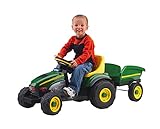
12. Peg Perego John Deere Farm Tractor and Trailer
Peg Perego John Deere Farm Tractor and Trailer Pedal Tractor, Green
Ages 24 months to 6 years
Plastic and rubber
Weighs 21 lb
52 in long
Tractor and trailer
Pros
- Licensed John Deere styling with a matching trailer
- Enclosed chain drive keeps fingers away
- Large adjustable bucket seat
- Heavy-duty tractor wheels
- Two-year limited warranty
Cons
- Heaviest and bulkiest item here at 52 inches
- Lowest rating in this group with a large share of one-star reviews
- Some reports of reduced durability over time
A licensed John Deere pedal tractor with a matching trailer, and the trailer is what separates it from every other vehicle in this roundup. A child can haul toys, a sibling or a very small pet across a yard in a way a trike cannot.
The chain drive is fully enclosed, and the heavy-duty tractor wheels are noticeably larger and wider than the wheels on any of the tricycles here, which helps on grass as well as pavement.

The bucket seat is large and adjustable, and the manufacturer rate runs from 24 months to 6 years, which is the widest upper range of any entry in this group.
A two-year limited warranty from Peg Perego USA is also the longest coverage listed, which is meaningful on a vehicle this large that will get used hard.

Why the trailer earns its bulk
If your child is the kind who pulls things rather than rides toward things, the tractor converts outdoor play into hauling and digging games that a kart cannot offer.
The size and weight are the price of that. It is not a vehicle you carry up stairs or fit in a small boot, and the 52-inch length needs real storage space.
Where it falls short
The 4.0 rating includes a 16 percent share of one-star reviews, the highest negative share of any product here. Owners point to bulk, weight and reports of reduced durability over extended use.
Because there is no published weight capacity, there is no way to confirm whether a larger child is within limits, which makes it a riskier bet for a child near the top of the toddler range.
Pedal Car Buying Guide: Fit Comes First
Measure before you buy. Sit your child in the car and check that both heels can rest on the pedals with a slight knee bend. Age labels in this category are marketing shorthand. Parents on parenting forums repeatedly report children who are as tall as the four-year-olds at the playground being squeezed into toddler-sized products, and the fix is always the same: size up if the child is on the taller side.
Look for seat adjustment, not a fixed saddle. A seat with three or more positions, or an adjustable seat height, is what lets a single car cover two years instead of one. The hauck kart and the Radio Flyer Stroll N Trike both offer genuine multi-stage adjustment, and the Schwinn Roadster has five lock-in positions.
Check the weight capacity against today’s weight, not the age. Limits range from 35 pounds on the newyoo convertible to 110 pounds on the hauck kart. A child who is average for age but tall for that age can exceed the limit while still reading as a two-year-old.
Decide on braking. Four levels exist in this group: no brakes at all, stopping by pedalling backwards, a coasting freewheel with backpedal braking, and a real handbrake. Only the pedal karts give the last option, and it is the single most useful safety upgrade available.
Match the wheels to the surface. Air tires roll smoothly but need inflation. Foam and EVA tires are quiet and puncture-proof but heavier. Rubber tread grips pavement well. None of these vehicles are designed for deep grass or sand, and several manufacturers advertise off-road capability that owners do not confirm.
Budget for assembly. One product here snaps together with no tools in about ten minutes. Others ship with wrenches included. Budget an evening either way, and retighten every fastener after the first week of riding, since several owners reported loose handlebars and clamps.
Think about storage and weight before you commit. Items range from 6.6 pounds to 22 pounds, and the Peg Perego tractor is 52 inches long. If it has to come down stairs or fit in a car boot every trip, that changes which ones you can actually live with.
Pedal Car vs Push Car vs Balance Bike vs Electric Ride-On
A balance bike is usually the right first vehicle, and it is worth saying plainly. Balance bikes have no seat and no steering conflict, which means a child can master balance before adding another skill. The common advice in parent communities for a toddler is that weight decides this: a lighter vehicle is easier for a small child to control, and a pedal car is heavier by design.
A push car suits a child between 12 and 18 months who walks but cannot yet pedal or steer. The pedal car starts being realistic around 18 to 24 months, but only for a child with steady balance and enough leg length to reach the pedals.
Between two and three years, a plain pedal trike with an adjustable seat is the most useful object in the house. From three upward, a pedal kart with a handbrake becomes the better purchase, because a child at that age has the steering strength to use it and the speed to need the brake.
Electric 12V and 24V ride-ons sit in a different category entirely. They are heavier, slower to accelerate and involve charging, battery maintenance and connector failure. For a toddler who moves at walking pace, a pedal car delivers the same independence with fewer parts to fail.
Pedal Car Safety on Driveways and Sidewalks
The single biggest hazard nobody mentions on a product page is a driveway that opens onto a street. A toddler at full sprint on a slight slope travels much further than a parent expects, and the drive itself has no curb to stop them. Forum discussions treat this as a genuine source of anxiety rather than a theoretical concern.
Look for ASTM F963 and CPSIA compliance. ASTM F963 is the US toy safety standard covering mechanical and physical properties, and CPSIA governs lead and phthalate content. Several products in this roundup state compliance explicitly; others do not mention it at all, which is worth asking about.
A helmet is not required on slow pedal cars and most families skip one, but it is worth considering on a slope or a shared path with older children cycling nearby. A seat belt matters more for slope safety than a helmet does, and only the Radio Flyer Stroll N Trike in this group has one.
Supervision looks different at each stage. A child under two on a push handle should be on a closed surface. Between two and four, a clear driveway or a car-free path is enough. Nothing in this group should be ridden near moving traffic, and no pedal car in any brand is designed for road use.
Finally, check the chain guard if the vehicle has a chain or sprocket. Only the Peg Perego tractor and the HONEY JOY kart fully enclose the drive here, and both are the safer choice for a child whose hands wander.
Frequently Asked Questions
What are the best pedal cars for toddlers?
The strongest all-round choice is the Fisher-Price Harley-Davidson Tough Trike, which has a 55-pound weight limit, a wide plastic base and an under-seat storage compartment. For a child who can already pedal, the hauck Kids Pedal Go Kart adds working handbrakes on both rear wheels and a 110-pound limit. For a child between 18 and 30 months, a convertible car with a parent push handle covers the gap where a toddler can walk but not pedal.
What is a good push car for a 2-year-old?
The Radio Flyer 4-in-1 Stroll N Trike is the clearest fit for a two-year-old, with four named stages from 12 months to 5 years and a height-adjustable parent push handle. The newyoo TR007 does something similar with five convertible modes and a rotating 135-degree steering push handle. Both let a parent do the steering before the child takes over.
What are some good ride-on cars for a 2-year-old?
For a two-year-old, prioritise a low seat and a short seat-to-pedal distance over features. The Fisher-Price Tough Trike and the SEREED Lighting Trike both suit younger toddlers, and both allow the pedals to be removed so the car can be used as a push vehicle first. Avoid anything marketed for ages four and up unless the child is unusually large for their age.
What is the difference between a push car and a pedal car?
A push car has no working drivetrain and is moved by an adult holding a handle or by the child walking alongside it. A pedal car has pedals that turn the rear wheel through a chain or direct drive, with no motor and no battery. A 3-in-1 push and pedal car does both, using a removable push handle until the child is ready to pedal.
Should a 2-year-old have a pedal car or a balance bike?
A balance bike is usually the better first vehicle, because it has no seat and no steering to coordinate, and a toddler can learn balance before adding pedals. A pedal car makes more sense once the child can walk confidently, sit upright and reach the pedals with a slight lean. If in doubt, check the seat-to-pedal distance rather than the age on the box.
Are pedal cars safe for toddlers?
Pedal cars are safe on flat, closed surfaces when the child fits the vehicle and is supervised. Check for ASTM F963 and CPSIA compliance, keep the ride away from traffic and slopes, and confirm the weight limit against your child’s current weight. A car with an enclosed chain guard, a seat belt and working handbrakes gives the most control at the toddler stage.
The Best Pedal Cars for Toddlers: Final Verdict
The Fisher-Price Harley-Davidson Tough Trike wins this roundup as the best pedal car for toddlers because it fits the widest range of small children, holds up to 55 pounds, needs no tools to assemble and can be carried by one adult. It is the one we would buy first without knowing anything about the child’s height.
Match the car to the stage instead if you know more. A child between 18 and 30 months who walks but cannot pedal should start with the Radio Flyer 4-in-1 Stroll N Trike or the newyoo TR007, both of which include a parent push handle. A child who can already pedal and wants to go faster belongs on the hauck Kids Pedal Go Kart, where the handbrakes matter.
And if the child is under two, skip the pedal car entirely and start with a balance bike. Weight and balance come before steering, and no seat adjustment in any of these twelve cars fixes that.
Whichever you pick, measure the seat-to-pedal distance before you order, and check the weight limit against your child’s current weight rather than their age. Related guides worth reading next: our [best pedal go karts roundup](/best-pedal-go-karts/) for older children, our picks for [play kitchens for toddlers](/best-play-kitchens-for-toddlers/), and our [wagons with seatbelts for toddlers](/best-wagons-with-seatbelts-for-toddlers/) if you want something a child can sit in while being pulled.