

The best power wheels for 2 year olds are 6V ride-on cars that top out around 1.5 to 2.5 mph, come with a parent remote control, and are rated for ages 1-3. Almost every 12V model you will see on a retail shelf is built for ages 3-8 and runs fast enough that a two-year-old cannot react in time. That mismatch, not the price tag, is what causes most disappointing first rides.
A note on wording before we start: Power Wheels is a trademark that shoppers use as a generic label for any battery-powered kids ride-on. Fisher-Price makes genuine Power Wheels, but most of the cars below come from Radio Flyer, Kid Trax, Kidzone and a handful of other brands. So when you search for power wheels for 2 year olds, you are really shopping the whole ride-on category.
We went through the specs, the owner feedback and the failure reports on ten popular ride-ons to work out which ones genuinely suit a child who has just turned two. The shortlist is not simply the ten highest-rated models. Several of the highest-rated cars on the market are 12V machines rated for ages 3 and up, and putting a two-year-old in one is a bad trade even when the car itself is well made.
Table of Contents
What to Look For in a Ride-On for a 2 Year Old
Four specs decide whether a ride-on works for this age. Everything else on the listing page is decoration by comparison.
Voltage: 6V. A 6V system delivers roughly 1.5 to 2.5 mph in real use. 12V and 24V machines reach 3 to 6 mph or more, which is a running pace, not a walking one, and a two-year-old’s reaction time cannot cover it.
Parental remote: A wireless remote that steers and stops the car from several feet away. Without one, a parent has to walk beside the car for the entire session, which is both exhausting and less safe than it sounds.
Speed: Below 2.5 mph. If the listing says “up to” a number, assume it was measured on flat pavement with a light rider and expect less in real conditions.
Stability: A wide wheelbase, four wheels rather than three, and a low centre of gravity. Two-year-olds shift their weight suddenly and without warning, which is exactly when a narrow ride-on tips.
If your child is not walking steadily yet, hold off. A ride-on needs a child who can sit upright unaided, grip a wheel or joystick with both hands, and understand that pressing the pedal makes the car go. While you wait, LEGO sets and board games for young children keep the same hands busy.
Top 3 Picks for Power Wheels for 2 Year Olds in 2026
Our three favourites cover the three situations parents actually describe: a first ride-on for a cautious two-year-old, indoor play on a hard floor, and a lower-cost outdoor option for a driveway.


Quick Comparison of All 10 Picks in 2026
Every car below appears with its verified voltage, speed, capacity and remote status so you can narrow the field quickly.
| Product | Specifications | Action |
|---|---|---|
| Kidzone 6V Ride-On Bumper Car |
|
Check Latest Price |
| Radio Flyer 6V Bumper Car |
|
Check Latest Price |
| Best Choice Products 6V Quad |
|
Check Latest Price |
 Kid Trax Minnie Mouse 6V Quad Kid Trax Minnie Mouse 6V Quad |
|
Check Latest Price |
 Kid Trax Tow-Mater 6V Quad Kid Trax Tow-Mater 6V Quad |
|
Check Latest Price |
 Hot Wheels 6V Ride-On ATV Hot Wheels 6V Ride-On ATV |
|
Check Latest Price |
 Kid Trax Spider-Man 6V Quad Kid Trax Spider-Man 6V Quad |
|
Check Latest Price |
 Bobike 12V Ride-On Car Bobike 12V Ride-On Car |
|
Check Latest Price |
 Best Choice 12V Ride-On Car Best Choice 12V Ride-On Car |
|
Check Latest Price |
 Best Choice 12V Kids Electric Vehicle Best Choice 12V Kids Electric Vehicle |
|
Check Latest Price |
Can a 2 Year Old Actually Drive One?
Yes, with close supervision, but expect steering by accident rather than by intent. Most two-year-olds can hold a pedal or a joystick and make the car move, and that sense of cause and effect is the real payoff of a first ride-on. What they cannot yet do reliably is plan a turn, judge speed, or notice a step ahead.
The readiness markers are physical rather than numerical: sitting upright without support, steering or pushing with both hands, and showing that pressing something causes something to happen. Most children reach that point between 12 and 18 months, which is why so many of the toddler quads below are labelled 18 months and up.
There is one failure mode worth naming, because it is the moment that ends most disappointing purchases. A child who cannot yet steer will drive in a straight line into a fence, a shrub or a garden bed, then get stuck there needing an adult to push them out. Three-point turns in a full-size ride-on are beyond most two-year-olds. That single fact is why the 360-degree bumper car design has become a common answer for this age, and why one sits at number one on our list.
Why 6V and Not 12V for a 2 Year Old
Voltage is the spec that sets top speed, and speed is what makes a ride-on either a toy or a hazard. A 6V system with a small motor realistically delivers 1.5 to 2.5 mph, which is a fast toddler walk. You can keep up with it on foot without jogging, which means you stay close enough to intervene.
A 12V ride-on typically reaches 3.1 mph and heavier 12V models go faster. That is roughly 4 to 5 mph in the larger units, which is a genuine run. At that speed a two-year-old cannot stop in the distance they can see, and their spatial judgement is still developing. The same reasoning rules out 24V entirely at this age.
Here is the trap. Retail search surfaces for “kids ride on car” are dominated by 12V models because those are the ones with strong review volume and higher basket sizes. When a parent opens a shopping carousel and every result is a 12V car rated three years and up, it is easy to assume the category itself is aimed at two-year-olds. It is not. Three of the ten cars below are 12V, and we include them because some readers will want a car that still works at age four or five, not because we recommend them for a two-year-old.
One more thing to watch: advertised speed claims. Listings frequently say “up to” a figure, which assumes flat pavement, a new battery and a light rider. Owners on parenting forums regularly report measuring a 6V car closer to 2 mph than the 4 mph claimed. That gap is normal, and it is also the safe outcome for this age.
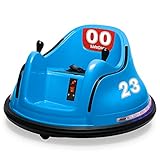
1. Kidzone 6V Ride-On Bumper Car – Best Overall Pick for a 2 Year Old
Kidzone 6V Ride On Bumper Car Kids 1.5-6 Years, Blue
6V
360-degree spin
Remote and manual modes
Ages 1.5-6
66 lb capacity
Pros
- 360-degree spin removes the steering problem
- No assembly just connect the battery
- Remote suits young toddlers
- 66 lb capacity gives real growth headroom
Cons
- Remote has been reported failing after extended use
- Levers can become finicky
- Not built for rough outdoor terrain
This is the car we would put a two-year-old in without hesitating. It is a 6V bumper car rated from 18 months to six years, carries up to 66 lbs, and spins on the spot. That last feature is the whole trick: a child who turns the wrong way simply rotates the car rather than reversing out of trouble with a three-point turn they cannot yet execute.
It weighs 15.4 lbs, which one adult can carry from a garage to a living room, and there is no assembly. You connect the battery and go. For a parent buying a first ride-on for a two-year-old, that combination of low effort and high tolerance for clumsy driving is worth more than any feature on the spec sheet.

The dual mode is genuine rather than a token. The child can drive with the joystick when they are ready, and you can take over with the remote when they are not. That means the same car works for a cautious 18-month-old and a confident four-year-old, which extends the useful life considerably at this age.
One detail worth planning around: the battery is 6V rechargeable, with roughly 1 to 2 hours of run time and about five hours of charging after the first full charge. That first charge runs closer to 18 hours, so plug it in the morning you unbox it, not the morning of the birthday party.

Who it suits
This suits a two-year-old who is enthusiastic but not yet coordinated, and a household with a hard floor or a level patio. The anti-flat tires and low body make it one of the few ride-ons here that works indoors without gouging a floor or tipping into furniture. Parents of children who are already pushing a walker or scooter will get a lot of use out of the manual joystick mode.
Who should skip it
Skip it if your yard is grass, gravel or anything with a slope. Owners report it catching on bumps and uneven surfaces, and it is not built for off-pavement work. If you need a car for a rough driveway, move to a quad with treaded tires. You should also weigh the reported remote and lever failures after extended use; if you are buying for a child who will drive it daily for years, check that replacement parts are available for this model.
2. Radio Flyer 6V Battery Powered Bumper Car – Best for Indoor Play
Radio Flyer 6V Battery Powered Bumper Car, Electric Ride On with Remote, Toddler Ride On Toy for Ages 1.5+ Years
6V
Two speeds: 1 and 2 mph
360-degree spin
Remote included
Ages 1.5-5
43 lb capacity
Pros
- Foam bumper protects walls and furniture
- Remote stores under the seat
- Auto shutoff after 10 minutes idle
- Sound effects can be switched off
Cons
- Spinning motion can feel intense under age 3
- Battery life is modest
- No horn despite repeat requests
Radio Flyer built this one for apartments. The foam bumper ring around the front is the reason: it is designed to bump into a wall or a sofa leg without leaving a mark, which is the only condition under which indoor ride-on play stays peaceful. At 8 lbs it is light enough for one adult to move between rooms on their own.
The two-speed switch is genuinely useful at this age. One mph is a controlled roll for a nervous beginner, and 2 mph is still fast enough to feel like driving. The joystick steering and 360-degree spin follow the same bumper-car logic as our top pick, so a child who cannot yet steer is not blocked by it.

Two details show real thought went into this design. The remote stores under the seat, so it does not vanish between sofa cushions. And an auto shutoff after ten minutes of inactivity protects a battery that owners otherwise report as modest in length.
The sound and light package can be switched off, which matters more than it sounds. A ride-on that plays music at full volume through a living room loses its audience fast, and a parent trying to get a sibling down for a nap is not going to win that battle.

Who it suits
This suits families in flats, townhouses or any home with a hallway or landing where a small ride-on can run at a slow speed. It carries 43 lbs, which covers a two-year-old comfortably with a little room to grow. It also suits anyone who wants a second car for a sibling, since two bumper cars can run in a loop on a hard floor without any risk.
Who should skip it
Skip it if your child is sensitive to spinning. Owners describe the rotation as intense for children under three, and a child who dislikes it will refuse the car rather than grow into it. The 43 lb capacity is also the tightest on this list among the bumper cars, so a child tracking toward that weight will move on sooner. And if a horn matters to you, this model does not have one despite repeated owner requests.
3. Best Choice Products 6V Kids Ride-On Quad – Budget Pick
Best Choice Products 6V Kids Ride On Toy, 4-Wheeler Quad ATV Play Car w/ 1.8MPH Max Speed, Treaded Tires, Rubber Handles, Push-Button Accelerator – Red
6V
1.8 mph
44 lb capacity
Ages 18 months-3 years
Rear wheelie bar
Pros
- Rear wheelie bar prevents backward flips
- Treaded tires handle grass and concrete
- Charging port on the rear
- Rear wheelie bar keeps it level on slopes
Cons
- Handlebars can over-rotate and disconnect steering
- One rear wheel driven so it can get stuck
- No remote control and a 60-day warranty
Most parents first ask whether a two-year-old needs a car with a steering wheel at all. This quad is the answer to that. A two-year-old pushes a button, the car goes, and there is no steering wheel to spin pointlessly while driving into a flowerbed. It runs at 1.8 mph, sits under 27 inches long, and is rated from 18 months to three years.
The standout safety feature is the rear wheelie bar. That small bar stops the quad from flipping backwards when a child leans too far back or drives into a slope, which is a real risk in a low, long vehicle. It is the kind of detail that rarely appears in marketing copy but matters enormously at this age.

The treaded tires and four-wheel suspension handle short-cut grass and concrete, so this works outside on a driveway or a patio rather than being an indoor-only toy. The charging port sits on the rear of the body, so you top up the battery without pulling the seat off and dismantling anything.
Runtime is listed at one to two hours per charge, though owners using it intermittently report getting several days out of a single charge. It weighs 12 lbs and comes in ten colour variants, which is unusually wide for this category.

Who it suits
This suits a child who pushes everything rather than driving anything, and parents who want outdoor play on grass or concrete. It also suits anyone who will supervise continuously from a chair a few feet away, since there is no remote and no way to stop the car from outside it. The 44 lb capacity suits a typical two-year-old with a modest margin.
Who should skip it
Skip it if you need a parent remote. That is the hardest requirement on our list for this age, and this car does not meet it. Also know that only one rear wheel is driven, so on soft ground the quad can bog down and stall. Owners report the handlebars can over-rotate far enough to disconnect the steering column, which ends the ride until it is reassembled. With a 60-day warranty and no remote, this is a seasonal buy rather than a long-term one.
4. Kid Trax Disney Minnie Mouse 6V Quad – Best Value
Kid Trax Toddler Disney Minnie Mouse Quad Ride-On, Kids 18-30 Months, 6V Battery and Charger Included, Max Weight 45 lbs, Hot Pink
6V
1.5 mph
45 lb capacity
Ages 18-30 months
Rubber traction tires
6.2 lbs
Pros
- Light enough for one adult to carry
- Rubber traction tires grip well
- Direct-connect charging is simple
- One year warranty included
Cons
- 1.5 mph feels very slow to some parents
- 45 lb limit is reached quickly
- No remote control
Licensed character themes do a lot of work at this age. A two-year-old does not care about suspension or gearboxes, but does care very much about the pink car with Minnie on it, and that reaction is what gets a child interested in driving at all. This quad pairs the theme with genuinely toddler-appropriate specs.
At 6.2 lbs it is by far the lightest ride-on on this list. One adult can carry it from a car boot to the living room without help, which is a real advantage when you also have a two-year-old to manage. The Power Trax rubber traction strips grip tile, carpet and short grass in a way hard plastic wheels cannot.

Speed is 1.5 mph and the age range is 18 to 30 months, which is the tightest window here. That is a fair reading of who this suits, but it also means the car has a short life in a single child. Buying it at the start of the range rather than the end matters more than usual.
Charging is direct connect, so you attach the lead and leave it. The warranty runs one year with six months on the battery, which is a longer cover than the 60 days offered on the budget quad above, and the reliability record behind Kid Trax is the reason it appears three times here.

Who it suits
This suits a two-year-old who is drawn to characters and needs a car small enough to carry easily. It works well indoors on smooth floors and outdoors on a patio. Parents who are already close to the weight limit should know that the 45 lb ceiling is realistic for a typical two-year-old approaching their third birthday.
Who should skip it
Skip it if your child is a speed-lover. At 1.5 mph this is among the gentlest cars here, and a child who has been on a faster ride-on may treat it as broken. There is no remote control, so it suits only households that supervise at arm’s length. And if you want something that will still work next year, the 18 to 30 month label tells you plainly that it will not.
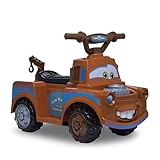
5. Kid Trax Tow-Mater 6V Quad – Most Durable at This Age
Kid Trax Toddler Disney Cars 3 Tow-Mater Electric Quad Ride-On, Kids 1.5-3 Years Old, 6 Volt Battery and Charger Included, Max Weight 45 lbs, Tow-Mater brown
6V
2 mph
45 lb capacity
Ages 1.5-3 years
Rubber traction tires
1 year warranty
Pros
- Owners report it lasting four to six years
- Survives heavy use
- Rubber traction tires give a smooth ride
- Simple push-button operation
Cons
- Some models arrive partly assembled
- Picture-only instructions
- 45 lb limit cuts the usable window short
Durability is the reason this one earns a place. Owners of the Tow-Mater quad report it lasting four to six years and surviving treatment that would end a lighter plastic toy, including rough outdoor play and pool-adjacent mishaps. It is 2 mph, at the fast end of what we would recommend for this age but still inside a controllable range.
The theme comes from Pixar’s Cars 3, and for a two-year-old who is midway through that film, a working vehicle with a character on it is an unusually strong hook. As with the Minnie quad, the character does the persuading before the mechanics do.

The mechanical case is straightforward: 6V rechargeable power, push-button acceleration, direct connect charging, and Power Trax rubber traction tires. Nothing here is clever, and nothing here is likely to break. It weighs 11.2 lbs, sits under 27 inches long, and carries up to 45 lbs.
Be realistic about assembly. Some owners report a car that arrives partly assembled despite what the listing implies, and the instructions are picture-only with no text. Budget twenty minutes and a flat surface with good light before the birthday rather than the morning of.

Who it suits
This suits parents who expect the car to be handed down or sold on. If a car will get driven into fences, rained on outdoors and ridden by more than one child, build quality matters more than any extra feature. It also suits a household where the driveway is the play space and the car will see mud and wet grass.
Who should skip it
Skip it if you need a parent remote, because there is none. Skip it if you want a long useful window, since the 45 lb limit and the 1.5 to 3 year age band mean you have roughly a year of use. And if your child is a Car fan who expects a moving character figure, manage expectations: the theme is painted on, not animated.
6. Hot Wheels 6V Ride-On ATV – Best Growth Headroom Under 6V
Hot Wheels – 6V Kids Ride-On ATV with Rechargeable Battery and Reverse
6V
1.25 to 1.55 mph
55 lb capacity
Ages 2-3
Forward and reverse
Pros
- 55 lb capacity is high for a 6V
- Forward and reverse both work
- Built-in rechargeable battery
- Nine character themes available
Cons
- Slowest of the roundup
- Newer product with limited long-term data
- Sold by Voyager a Sakar brand
Most 6V quads in this roundup cap out at 44 or 45 lbs. This one carries 55, which is the most useful thing about it. A two-year-old uses it comfortably and a three-year-old or four-year-old can still sit in it, which is where parents who fear outgrowing the purchase usually lose their money.
The trade-off is speed. At 1.25 to 1.55 mph it is among the gentlest machines in the roundup, deliberately so. That is exactly the right side of slow for a two-year-old who is still learning cause and effect, but a child who wants to feel speed will not get it here.

Forward and reverse both work from a foot pedal with directional controls, and the battery is built in and rechargeable overnight rather than removable. That removes the single most common failure point on other models, where a connector gets bent or a battery is lost. The body is PP and ABS plastic, and the brand is Hot Wheels.
One transparency note worth stating: the Hot Wheels name is licensed, and the manufacturer is Sakar International under its Voyager brand. Nine character themes are available, including Barbie, Bluey and Paw Patrol variants, so the character on the side is not fixed by the listing you land on.

Who it suits
This suits a parent who wants to buy once. If your child is two today and you are not planning another ride-on purchase for three years, the 55 lb capacity is the reason to choose this over a lighter quad. It also suits anyone who prefers a built-in rechargeable battery and forward-and-reverse capability at a gentle speed.
Who should skip it
Skip it if your child wants a fast ride, since nothing here exceeds 1.55 mph. Skip it if you need a parent remote or a parental speed lockout, because neither is offered. And if you are buying for a long horizon, note the product is newer to the market than the others here, which means less long-term durability data behind it. The age label stops at three years, which understates the capacity but states the intent.
7. Kid Trax Marvel Spider-Man 6V Quad – Best for Superhero Fans
Kid Trax Toddler Marvel’s Spider-Man Premium Toddler Quad Ride-On, Kids 18-30 Months, 6V Battery and Charger Included, Max Weight 44 lbs, Red
6V
44 lb capacity
Ages 18-30 months
Rubber traction tires
Light-up spider emblem
Pros
- Light-up spider emblem gets immediate attention
- Springy web bumpers
- Rubber traction tires
- Direct-connect charging
Cons
- 44 lb limit gives a short window
- No remote control
- Limited speed for an older toddler
This is the same mechanical platform as the other Kid Trax quads in a different suit: 6V rechargeable power, push-button acceleration, rubber traction tires and direct-connect charging. What changes is the light-up spider emblem and the springy web bumpers, which is exactly what a two-year-old in the middle of a Spider-Man phase will notice first.
At 14.3 lbs it is heavier than the Minnie quad and lighter than the Kidzone bumper car. It runs at a low speed in the same 1.5 to 2 mph band, and the 27.9 inch length is compact enough for a living room or a patio.

It carries a one year warranty with six months on the battery, the same cover as the other Kid Trax models. That consistency is part of why Kid Trax appears three times on this list: the drivetrain is proven, the parts are familiar, and the platform is a known quantity rather than a gamble.
Superhero themes are a strong pull at this age and they do last long enough to justify the purchase, which is more than can be said for many licensed designs aimed at older children. If your child names the character without being prompted, this is the version they will want.

Who it suits
This suits a two-year-old with a named superhero obsession and parents who are confident about the age window. It works on smooth indoor floors and short-cut grass, and the rubber traction tires handle both. Because it is mechanically identical to the Tow-Mater quad, the same buying logic applies.
Who should skip it
Skip it if your child has already moved past the character phase, because the premium over a plain quad buys only paint and an emblem. There is no remote control, and the 44 lb capacity combined with an 18 to 30 month label gives you the shortest usable window of any car on this list. If your child is at the upper end of that age band already, this is a car they will outgrow quickly.
8. Bobike 12V Ride-On Car with 2.4G Remote – Best Remote Control Hardware
12V Kids Ride On Car with 2.4G Remote Control,Battery Powered Electric Car Ride On Vehicle Double Doors, Safety Belt,LED Light (SC-Black)
12V
3 km/h (about 1.86 mph)
2.4G remote with emergency stop
15-inch wheels
Pros
- Remote has a dedicated emergency stop
- 2.4G remote resists interference
- Parent and child driving modes
- Side handrails and safety belt
Cons
- Rated for ages 3-8
- Weight capacity is not stated
- Plastic body with fewer long-term reviews
We are including this one as a look at remote hardware rather than as a recommendation for a two-year-old. The listing rates it for ages three to eight, so on paper it does not belong on this list. But the 2.4G remote with a dedicated emergency stop button is one of the best-specified parental controls on any ride-on we examined, and it is worth understanding what that looks like before you shop.
The 2.4 GHz frequency matters because it resists interference from neighbouring devices, so the connection does not drop when another 2.4 GHz gadget is active nearby. The emergency stop is a separate control rather than a consequence of releasing the steering, which means a parent can halt the car without waiting for the child to lift off the pedal.

Speed is listed at 3 km/h, which is about 1.86 mph. That is slower than most 12V cars, and it is the one reason this machine appears here at all. Owners describe it as slow, which for a two-year-old reads as a feature and for a five-year-old reads as a complaint.
The wheels are large and carry side handrails, which give a small child something to hold. Built-in music with a USB port, LED headlights and double doors round out a feature list that is well judged for a three-year-old.

Who it suits
This suits a parent shopping for a child who is nearly three and wants a proper full-size car with excellent remote hardware. It also suits anyone who wants to see what a well-specified remote looks like in person before buying a cheaper 6V car that ships with a basic one.
Who should skip it
Skip it for a two-year-old who is genuinely two, because the age rating is not conservative and the car is a full-size 39 inch vehicle. Weight capacity is not stated on the listing, which makes it hard to verify against your child. And as a longer-term bet, the brand is newer with fewer years of owner data behind it.
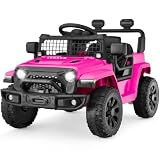
9. Best Choice Products 12V Ride-On Car – Top Pick for Ages 3 and Up
Best Choice Products 12V Kids Ride-On Car with Parent Remote – Bold Pink
12V
3.1 mph
44 lb capacity
Ages 3 and up
Four-wheel suspension
Pros
- Four-wheel suspension over rough ground
- 5-point harness and locking doors
- Remote override with good range
- About two hours of runtime when new
Cons
- 3.1 mph is too fast for a 2 year old
- 44 lb capacity is reached quickly
- Plastic tires limit wet grass traction
This is the car most parents in this age band end up with, and the reason is simple: it is everywhere, it has a huge review base, and it is a competent machine. None of that makes it right for a two-year-old. It is rated three years and up and runs at 3.1 mph, which is running pace.
Where it does excel is build quality for what you pay. The four-wheel suspension handles a driveway or a rough yard better than any 6V quad here, the 5-point harness and locking doors are real safety hardware rather than decoration, and the remote override works at a useful range in open space.

Owners report around two hours of runtime when new, across tile, carpet, grass and pavement, and roughly 25 minutes of assembly. The foot pedal acceleration is simple enough for a young child and the realistic sounds and LED headlights do the work of making it feel like a real car.
The honest negatives are the ones most listings bury. The 44 lb capacity is reached quickly by a growing four-year-old. The tires are hard plastic, so traction drops on mud or wet grass. And owners report that the car’s own controls can override the remote, which undermines the reason the remote exists.

Who it suits
This suits a child who is three or older, particularly on a driveway or a yard with some texture to it. It suits parents who want a full-size car with a proper harness and doors rather than a low quad. Given the volume of owner feedback behind it, it is also a lower-risk purchase than a model with a thin review history.
Who should skip it
Skip it for a two-year-old. 3.1 mph is above the ceiling we would set for this age, and the seat belt is reported not to secure smaller children well. If you are tempted to cap the speed yourself before handing it over, note that owner reports describe the car controls overriding the remote, so the setting may not be the final word.
10. Best Choice Products 12V Kids Electric Vehicle – Best Capacity and Audio
Best Choice Products 12V Kids Electric Vehicle Toy Ride On Car with Parent Remote Control for Toddlers, Seat Harness, 61 lbs Weight Capacity, Locking Doors, Spring Suspension, Bluetooth – Hot Pink
12V
2.8 mph
61 lb capacity
LED headlights
Bluetooth and AUX
Spring suspension
Pros
- 61 lb capacity gives real growth headroom
- Bluetooth and AUX for audio
- LED headlights for dusk
- Reported to handle grass
- pavement and dirt
Cons
- Rated 3 years and up
- Plastic wheels only
- Remote has been reported disconnecting
The largest review base in this roundup, and a 61 lb weight limit that is second only to the Kidzone bumper car. If your real question is which car will not be outgrown next year, this is a strong answer. But it is rated three years and up, runs at 2.8 mph, and weighs 32 lbs, so it is a car for a child who is nearly out of toddlerhood.
The feature set is long. Spring suspension, locking doors, a five-point harness, LED headlights and both Bluetooth and AUX audio. Parents report that it handles grass, pavement and dirt, which makes it a versatile choice among the larger cars on this list.

Assembly runs 25 to 45 minutes and battery life is reported at one and a half to two hours. The wheels are hard plastic, which is a deliberate choice they advertise as never needing deflation, and it does mean the car performs best on smooth surfaces.
Two negatives recur in the reviews and are worth weighing. The remote has been reported to disconnect occasionally, and the car’s own controls can override the remote during use. On a 61 lb capacity car with a 2.8 mph top speed, that combination is more consequential than it would be on a small 6V model.

Who it suits
This suits a household about to skip the toddler stage, or one with two children who will share the car in sequence. It suits a family that wants audio and working lights as much as speed. Its 61 lb capacity is the highest here, which makes it a sensible final ride-on before moving up to a full-size car.
Who should skip it
Skip it for a two-year-old on speed and age rating alone. Also skip it if your yard is uneven or sloped: owners report rollover risk on slopes, and a heavier, faster car amplifies that. The reported remote disconnections are a further reason not to hand this car to a child who needs a parent to intervene instantly.
The Parent Remote: Your Safety Net
Across every forum thread on this subject, the remote control comes up as a hard requirement rather than a nice-to-have. Parents treat it as the difference between sitting in a chair and walking beside a moving vehicle for an hour, and they are right to. If you cannot see what is ahead of the car, you cannot judge whether a two-year-old is about to meet a fence at the wrong angle.
Not all remotes are equal, and this is worth understanding before you buy. There are three levels. A stop-only remote halts the car but does not steer it, which helps in an emergency and does nothing about the child driving into a hedge. A directional remote steers, brakes and reverses, which is what you actually want. A full override remote takes complete control of steering, throttle and direction, and that is the best available.
Two features separate the good ones. An emergency stop button that kills drive independently of the child’s pedal is far better than a remote that works by releasing forward motion. And a 2.4 GHz remote, as found on the Bobike above, resists interference from other wireless devices in a busy house.
If a car you like has no remote at all, you are not stuck. Aftermarket remote control kits exist and can be retrofitted to many ride-ons without one, which converts an otherwise unusable toddler unit into a compliant one. Several experienced owners describe this as the single best modification they made. Fit it through the manufacturer where possible, since the control board inside a ride-on is not universal.
Bumper Car vs Traditional Car vs Quad: Which Form Factor Works at 2
Three body styles dominate this category, and the choice matters more at two than it does at six.
A bumper car is a low, round, single-seat vehicle that spins on the spot and has a soft ring around the front. Steering is a joystick rather than a wheel. For a two-year-old this solves the single biggest problem in ride-on play: there is no bad direction to be in. A child who overshoots simply rotates. That is why both bumper cars on this list sit at the top.
A traditional car mimics a real vehicle with a steering wheel and pedals. It looks more grown-up and reads better as a gift, and it usually has more storage and audio features. But it demands a steering skill most two-year-olds do not have, which is where the three-point-turn frustration begins. Pick this if your child is confidently coordinated, or if the child is nearly four.
A quad is a low, wide four-wheeler with handlebars and a push-button accelerator. It is the most forgiving shape for a beginner because there is nothing to steer badly, and many are built low enough for a child to push themselves along on the floor when the battery runs out. Its weakness is that only some models drive both rear wheels, so a quad with a single drive motor can bog down on soft ground.
Forum consensus leans toward wide wheelbases and low centres of gravity for younger children, because a toddler who suddenly shifts their weight will tip a narrow vehicle and not a wide one. Whatever the body style, look for four wheels, a wheelbase wider than the seat, and a seat that keeps a small child low to the ground.
Battery Life and Charging: The Honest Numbers
Listings claim one to two hours of run time. Expect 45 to 90 minutes in real conditions, and much less on grass with a heavier child. Grass puts a far greater load on a small motor than a smooth driveway does, and that is where most of the lost runtime goes.
Charging is the slow part. Plan on eight to twelve hours for a full charge, and on a longer first charge for a brand new battery. Charge indoors on a hard surface, away from anything flammable, and never leave a charging battery unattended overnight once the unit has aged past its warranty.
The number one complaint across owner communities is not the first year. It is year two. Batteries that performed well when new can drop to a few minutes of run time after roughly a year of use, and owners rarely know whether the fault is the battery, the charger, or ordinary lead-acid decline. The answer is usually the battery.
Three habits make a cheap 6V last longer. Store the car indoors rather than leaving it in sun and rain, because UV exposure makes plastic brittle and corrodes wiring. Do not run the car until the car is barely moving, since lead-acid batteries do not recover well from deep discharge. And clean the terminals twice a year. When runtime drops, replace the battery rather than the whole car; a replacement 6V pack costs a fraction of a new ride-on.
Going Used: What to Check Before You Buy a Ride-On
Experienced owners consistently recommend buying a good used car over a cheap new one. Durability of an established brand beats low cost of an unfamiliar import, and a used car often leaves room in the budget for the remote it is missing.
Check these seven things before you commit. Look for ASTM F963 or an equivalent compliance marking on the body. Confirm the charger is included and test it on the car before buying. Check the battery by asking for a demonstration of a full charge cycle, and treat anything that cannot hold a charge as a battery replacement cost. Look at the tires for flat spots and cracks, and the wheels for wobble. Check that the steering moves smoothly through its full range. Look for sun-bleached or brittle plastic, which means years outdoors. And confirm that the remote, if there is one, pairs with the car rather than being a separate accessory.
Then close the safety gap. If the used car has no parental remote, buy an aftermarket control kit for that model while you are still in the return window. A used ride-on with a working remote is a genuinely good purchase at this age. A used ride-on without one means you walk beside it every session, which is the situation most parents are trying to avoid.
Buying Guide: 8 Criteria to Check Before You Checkout
Run through these eight before you buy, in this order. They will eliminate most unsuitable cars faster than reading reviews will.
Voltage. 6V for a two-year-old, without exception. Anything rated 12V or 24V is built for ages three and above.
Real top speed. Below 2.5 mph. Discount any “up to” figure by roughly a third when the car is loaded and the ground is not perfectly flat.
Parental remote. Full directional control, ideally with an independent emergency stop. This is the most important single feature at this age.
Weight capacity headroom. Buy at least 15 to 20 lbs above your child’s current weight. Most two-year-olds gain 10 to 12 lbs a year, so a 45 lb limit on a 27 lb child buys you about one season.
Wheelbase and stability. Four wheels, a wide stance, and a low seat. Avoid three-wheel designs and narrow-footprint toys at this age.
Tire material. Rubber or EVA foam grips grass and absorbs bumps; hard plastic wheels spin on anything soft and skate across hard floors.
Control simplicity. A single pedal or a single push-button. Avoid dashboards, gear selectors and multi-button panels, which a two-year-old will press instead of steering.
Standards, warranty and parts. Look for ASTM F963 compliance on the listing, a warranty of at least a year, and a replacement battery and charger path that does not require buying the whole toy again.
Two final checks that catch a lot of problems. Confirm the seat is vinyl rather than fabric, since fabric seats do not survive outdoor storage. And confirm the car fits through your doorways and up any steps, because a 39 inch long 12V car will not go everywhere a compact 6V quad does.
Frequently Asked Questions
Can a 2 year old drive a power wheel?
Yes, with close supervision. Most two-year-olds can press a pedal or push a button and make the car move, which is the real developmental payoff. What they cannot yet do reliably is plan a turn or judge speed, so a bumper car with 360-degree rotation suits this age better than a steering-wheel car. Look for 6V power, a speed below 2.5 mph, and a parent remote so an adult can stop the car without reaching it.
Which is better for my child, a 6V or 12V ride-on car?
For a two-year-old, 6V. A 6V system delivers roughly 1.5 to 2.5 mph, which is a fast walking pace an adult can keep up with on foot. A 12V ride-on typically reaches 3.1 mph or more, which is running pace, and those cars are rated for ages three and up. The exception is if you want one car to last until age five, in which case a faster model has a longer useful life but is not appropriate yet.
What is the best voltage for Power Wheels?
6V for children aged 1-3, which covers age two entirely. 12V suits ages 3-8 and reaches 3-6 mph. 24V suits older children and is irrelevant at this age. Power Wheels is a trademark used generically for any kids ride-on, so the voltage spec rather than the brand name is the number that should drive your choice.
Do 2 year olds need a parental remote?
Treat it as a requirement, not an option. A two-year-old cannot judge speed or see what is ahead of the car, so a parent needs to be able to steer and stop it from a distance. Look for full directional control rather than a stop-only remote, ideally with an independent emergency stop button. If a car has no remote, aftermarket control kits can be retrofitted to many models.
What weight limit does a 6V ride-on have?
Most 6V toddler quads are rated between 44 and 45 lbs, while bumper cars run up to about 66 lbs. A typical two-year-old weighs around 25 to 28 lbs, so a 45 lb limit gives roughly one to two years of use before the child is too heavy. Buy at least 15 to 20 lbs above your child’s current weight, and check the listed limit against their weight rather than their age label.
Can ride-on cars go on grass?
Short-cut, flat grass is fine for most 6V models, especially quads with treaded tires or rubber traction strips. Deep grass, slopes and gravel are not. Hard plastic wheels spin on anything soft and skate across hard floors, so tire material matters more than the listing suggests. Expect noticeably shorter run time on grass than the advertised figure, and avoid anything with a reported rollover risk on slopes.
Once your child is riding confidently, the next step up is a 12V car with a proper harness and a working remote, usually around their fourth birthday. You can compare age-appropriate outdoor toys such as kids bikes for 8 year olds for the years after that, and board games for 5 year olds for indoor downtime on days the weather wins.
Conclusion: Our Top Power Wheels for 2 Year Olds in 2026
Our pick for the best power wheels for 2 year olds in 2026 is the Kidzone 6V ride-on bumper car. It is 6V, it spins on the spot, it carries 66 lbs, it needs no assembly, and it includes a remote, which between them remove every failure mode we found in this category. The Radio Flyer bumper car is the pick if you are playing indoors and want a foam bumper that protects your furniture. The Best Choice 6V quad is the pick if you want outdoor play on grass at the lowest outlay.
Whatever you choose, hold three numbers in mind: 6V, under 2.5 mph, and a parent remote. Everything else on the listing is a matter of taste.