
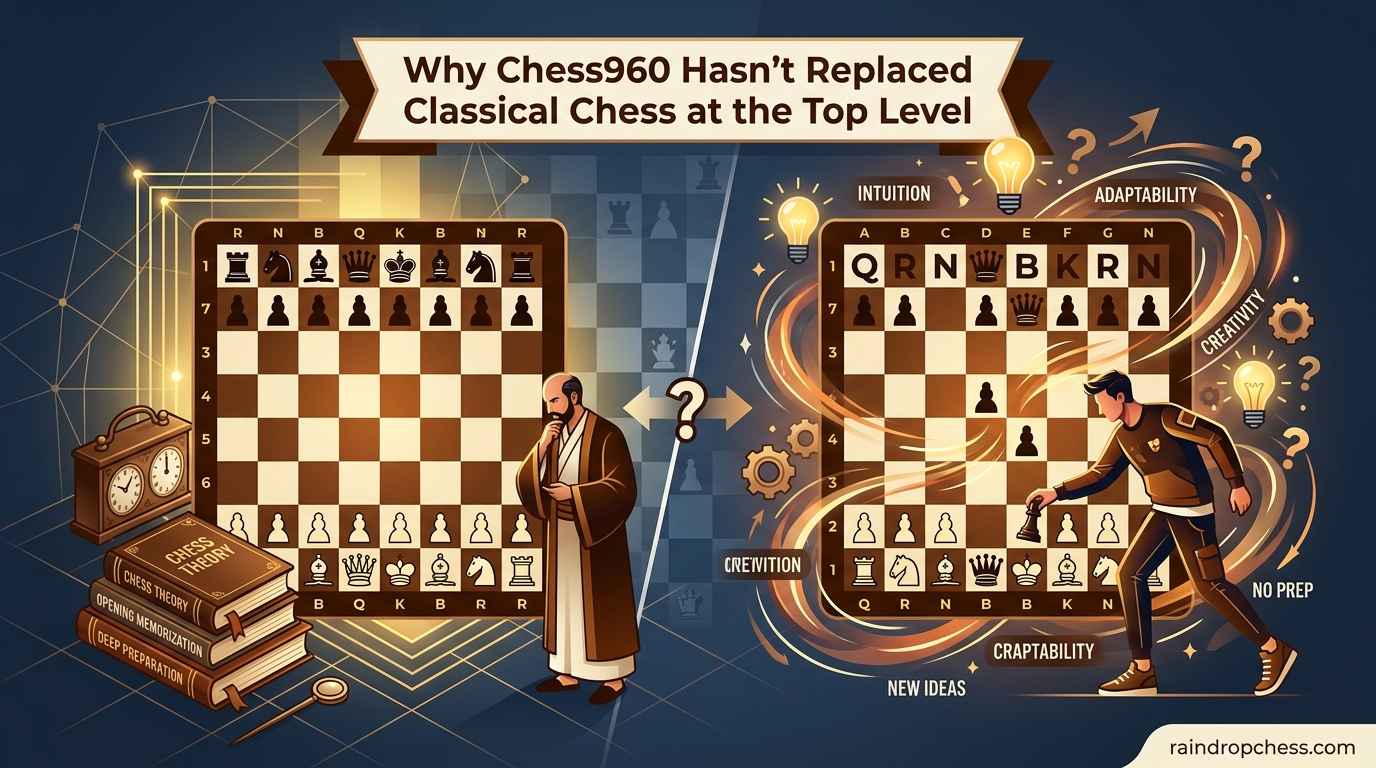
Chess960 hasn’t replaced classical chess at the top level because players, fans, and the entire chess ecosystem remain deeply attached to the traditional starting position. Despite the promise of eliminating computer preparation and reducing draws, the variant faces significant barriers to mainstream adoption that go beyond mere preference.
Bobby Fischer introduced Chess960 (then called Fischer Random) in 1996 as a way to restore “pure chess” where memorization mattered less than raw talent. Nearly three decades later, the variant enjoys pockets of enthusiasm but remains firmly in the shadow of classical chess. Understanding why requires looking at tradition, practical challenges, and what professional players actually want.
In this guide, I will break down the key reasons Chess960 remains a niche format despite its advantages. We will examine everything from historical attachment and opening theory to broadcasting difficulties and fairness concerns that keep classical chess firmly in control.
Table of Contents
The Weight of 150 Years of Tradition
Classical chess as we know it has used the same starting position since the 19th century. This consistency has built an enormous library of recorded games, analysis, and cultural significance that Chess960 simply cannot replicate overnight.
Every major game in chess history shares the same foundation. Morphy’s brilliancies, Capablanca’s endgames, Fischer’s masterpieces, and Carlsen’s grinding wins all started from the identical setup. This continuity creates a shared language that binds the chess community across generations. When I watch a game from 1895 or 2026, the pieces start in the same places and follow the same rules.
Chess960 shatters this continuity. With 960 possible starting positions, each game potentially exists in its own universe. The strategic patterns players have internalized over years may not apply. The familiar reference points vanish. For many, this feels less like evolution and more like starting over.
Why Opening Theory Still Dominates Professional Play
Professional chess players have invested thousands of hours studying opening theory. This represents not just time but identity. Many grandmasters define themselves by their preferred openings. The Najdorf Sicilian, the Ruy Lopez, the Queen’s Gambit – these are more than move sequences. They are chess personalities made concrete.
Chess960 eliminates this entirely. No more prepared lines stretching 25 moves deep. No more surprise novelties stored in databases. For players who have built careers on opening preparation, this feels like removing their primary weapon.
The financial interests extend beyond players. Chess publishers, opening book authors, and content creators have built businesses around classical opening theory. A shift to Chess960 would disrupt an entire industry. Opening books, DVD courses, and video series would lose much of their value. This economic reality creates subtle but real resistance to change.
Forum discussions reveal this tension clearly. Players express genuine psychological discomfort with unfamiliar starting positions. The opening provides structure and confidence. Without it, many feel cast adrift in positions they cannot categorize or understand intuitively.
The Draw Problem and Chess960’s Promise
One of Chess960’s strongest arguments is its potential to reduce the draw epidemic plaguing top-level classical chess. In elite tournaments, draw rates regularly exceed 60 percent, with many games ending in lifeless 20-move exchanges. The problem has grown severe enough that tournament organizers and fans openly worry about the sport’s entertainment value.
Chess960 promises a solution. Without established opening theory, players cannot steer games toward comfortable draws from move one. They must calculate from the start rather than rely on memorized equality. This should produce more decisive results and creative play.
Yet the promise remains partially unfulfilled. While Chess960 does reduce draws compared to classical, the improvement is not dramatic enough to force widespread adoption. Top players still find ways to simplify positions. The fundamental challenge of equally matched opponents finding draws persists regardless of the starting position.
Furthermore, many chess professionals argue that draws are not inherently bad. A hard-fought draw between two grandmasters can demonstrate deep understanding and defensive skill. The problem is quick, uneventful draws agreed over repetition in well-known lines. Chess960 addresses this specific issue but does not eliminate draws entirely.
The Continuity Problem: Why Analysis Doesn’t Transfer
Perhaps Chess960’s most significant practical weakness is the lack of continuity between games. In classical chess, knowledge compounds. A mistake in the Ruy Lopez in one tournament becomes instructive for the next. Players build repertoires that improve over years.
Chess960 fragments this accumulated wisdom. Each starting position is unique. Mistakes in one 960 position rarely apply to another. Players cannot build on previous experience in the same way.
As Tim Krabbé noted in ChessBase, this makes Chess960 feel like “touring an art gallery for the first time” every single game. There are no familiar landmarks. No established patterns to recognize. This constant novelty delights some players but exhausts others.
For professionals who depend on incremental improvement, Chess960 offers a frustrating cycle. Study one position, play it once, then likely never see it again. The investment-to-application ratio feels poor compared to classical chess where deep knowledge of the Najdorf applies to thousands of games.
The Commentary and Spectator Challenge
Chess960 creates significant challenges for broadcasters and commentators. In classical chess, experienced commentators can follow opening theory mentally, anticipating moves and explaining plans based on decades of established patterns. They can reference historical games and strategic concepts that viewers recognize.
Chess960 strips away these reference points. Commentators must calculate everything from scratch alongside the players. Without familiar patterns, explaining positions to audiences becomes more difficult. Casual viewers lose the narrative threads that make chess accessible.
This affects tournament organizers’ decisions. Broadcasts drive sponsorship and viewership. If Chess960 makes commentary harder and audiences smaller, organizers face financial pressure to stick with classical formats that draw larger audiences.
The accessibility gap matters for chess growth. Classical chess offers entry points for new players through recognizable patterns and shared knowledge. Chess960 demands higher baseline understanding from the first move. This raises the barrier to enjoyment for casual fans.
White Advantage Variance: Not All 960 Positions Are Equal
A frequently overlooked Chess960 weakness is the dramatic variance in white advantage across different starting positions. In classical chess, the starting position offers White a modest, well-understood edge of roughly 52-55 percent scoring chances.
Chess960 positions vary wildly. Some configurations give White enormous advantages exceeding 60 percent scoring probability. Others are so balanced that Black practically equalizes from move one. This inconsistency creates fairness problems in tournament settings.
Imagine a knockout tournament where one player randomly receives heavily favorable starting positions while another faces balanced or disadvantageous ones. The outcome reflects luck as much as skill. Classical chess avoids this by guaranteeing identical starting conditions every game.
Players have noted this issue in forums and interviews. The feeling that some games are “lost” or “won” based on the randomized position undermines competitive integrity. While Chess960 eliminates opening preparation, it introduces randomness that can feel equally unfair.
Grandmaster Perspectives: What Top Players Actually Think
World Champion Magnus Carlsen has expressed nuanced views on Chess960. He appreciates the format’s emphasis on calculation over preparation but has not called for replacing classical chess. In interviews, he suggests Chess960 works better as a complement rather than a replacement.
Hikaru Nakamura, one of the strongest 960 players in history, enjoys the format while acknowledging its limitations. His success in Chess960 events demonstrates that skill transfers, but he continues to focus his serious competitive efforts on classical and rapid chess.
Other grandmasters remain openly skeptical. Some view Chess960 as a curiosity rather than serious chess. They argue that the traditional starting position contains optimal piece coordination that randomization disrupts without improving. The artistic dimension of classical chess – the centuries-long exploration of a single position – holds value they are unwilling to abandon.
The consensus among professionals suggests appreciation without commitment. They recognize Chess960’s merits but see classical chess as possessing irreplaceable qualities. This attitude from the players fans follow most closely shapes broader community sentiment.
Impact on Different Player Levels
Chess960 affects amateurs and professionals differently, contributing to its limited adoption. Amateur players often rely on opening knowledge to survive the early game. Memorized lines provide structure against stronger opponents. Chess960 removes this crutch, making games harder for casual players.
Professionals appreciate Chess960’s reduction of computer preparation. In an era where engine analysis dominates opening study, 960 levels the playing field by forcing pure calculation. However, professionals also depend on the continuity and history that classical chess provides.
The result is a format that serves no group’s needs perfectly. Amateurs find it harder than classical. Professionals appreciate aspects but miss the tradition. Tournament organizers worry about viewership. Publishers see no market. Each stakeholder finds reasons to prefer the status quo.
Forum discussions consistently reveal this divide. Amateurs report feeling “disoriented” by 960 positions. Professionals call it “refreshing” but “not serious chess.” These contrasting experiences prevent unified demand for change.
Why Chess960 Hasn’t Replaced Classical Chess at the Top Level
Chess960 faces multiple barriers that together explain its failure to displace classical chess at the highest levels. Historical tradition creates attachment that transcends logic. Opening theory investment represents sunk costs players refuse to abandon. The continuity problem prevents knowledge accumulation. Commentary challenges limit broadcast appeal. Position variance introduces unfairness. And professional players themselves remain unconvinced.
The variant continues to exist in the chess ecosystem as a side event, a curiosity, and an occasional alternative. Major tournaments like the World Chess960 Championship demonstrate ongoing interest. But the absence of calls to replace classical formats reveals the chess community’s fundamental satisfaction with traditional play.
Chess960 may yet grow in popularity. Younger players less attached to tradition might embrace its freshness. Streaming culture could make its unpredictability entertaining. But replacing classical chess entirely would require overcoming forces far stronger than mere preference – the weight of history, economics, and community identity.
Frequently Asked Questions
Is Chess960 replacing chess?
No, Chess960 is not replacing classical chess. While the variant has gained some popularity through events like the World Chess960 Championship, classical chess remains the dominant format for professional play, world championships, and rated tournaments. Most top players continue to focus on classical chess as their primary competitive format.
What are the drawbacks of Chess960?
The main drawbacks include the lack of continuity between games since each position is unique, difficulty for commentators to analyze positions without familiar patterns, variance in white advantage across different 960 positions creating fairness concerns, and the alien feeling of unfamiliar starting positions that disorient both players and viewers.
Is Chess960 harder to learn than standard chess?
Chess960 is not necessarily harder to learn initially since the rules are identical to standard chess after the starting position is set. However, many players find it harder to play well because they cannot rely on memorized opening knowledge. Amateurs who depend on learned theory often struggle more than strong players who calculate well.
Is Magnus quitting classical chess?
No, Magnus Carlsen has not quit classical chess, though he has reduced his participation in certain classical events. He continues to play classical chess and remains the reigning World Champion in that format. Carlsen has expressed interest in Chess960 while maintaining that classical chess holds unique value that 960 cannot replicate.
Why do grandmasters prefer classical chess?
Grandmasters prefer classical chess because they have invested thousands of hours in opening theory that 960 eliminates, appreciate the continuity and accumulated knowledge of traditional chess, find the familiar starting position provides psychological comfort, and view classical chess as holding deeper historical and artistic significance.
Will Chess960 ever become the standard?
Chess960 is unlikely to replace classical chess as the standard format in the foreseeable future. The combination of historical tradition, professional player preferences, commentary challenges, and economic interests in classical chess creates barriers that 960 has not overcome despite being available for nearly three decades.
How does Chess960 affect amateur players?
Amateur players often struggle more with Chess960 than professionals because they typically rely more heavily on memorized opening patterns to survive the early game. Without this crutch, casual players may find themselves in unfamiliar territory immediately. However, some amateurs enjoy the level playing field that eliminates preparation advantages.
Conclusion
Why Chess960 hasn’t replaced classical chess at the top level comes down to a simple truth: the chess world is not looking for a replacement. The variant offers genuine benefits – reduced computer preparation, potentially fewer draws, and fresh creative opportunities. But these advantages clash against 150 years of tradition, professional investment, and community identity that classical chess has built.
The future likely holds coexistence rather than replacement. Chess960 will continue as an alternative format for players seeking variety and organizations wanting something different to broadcast. Classical chess will remain the standard for serious competition, world championships, and rated play.
Both formats have their place. Understanding why Chess960 hasn’t taken over helps us appreciate what makes classical chess enduring – and what might eventually drive change if the problems of draws and computer preparation grow severe enough to overcome tradition.