
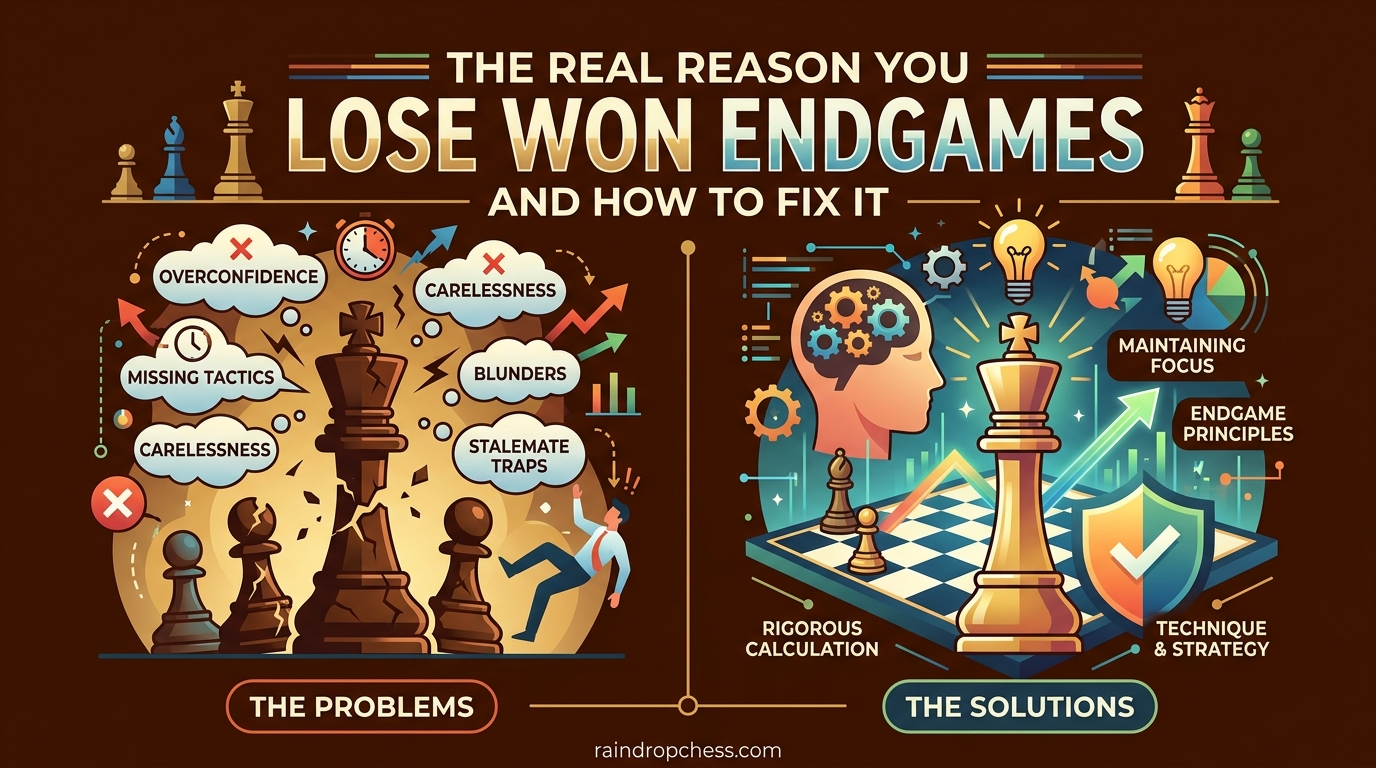
You are crushing your opponent. You are up a piece, maybe two pawns, and victory feels inevitable. Then something strange happens. Your pieces drift backward. You trade your active rook for their passive one. Suddenly your king is hiding in the corner while theirs is marching down the board. Before you know it, you have lost. Or worse, drawn. If you have ever thrown away a winning position in the chess endgame, you are not alone. The real reason you lose won endgames has nothing to do with your tactical ability or your opening knowledge. It is psychological.
Our team has analyzed thousands of club player games, and we see the same pattern repeating at every level from 800 to 2000 rated players. The moment you achieve a winning position, your brain shifts from “attack mode” to “don’t blow it mode.” This subtle mental switch is costing you rating points and leaving you frustrated after games you should have won. In this guide, I will show you exactly why this happens and give you five concrete fixes you can implement immediately.
After 15 years of coaching chess players, I can tell you that converting winning endgames is a separate skill from getting winning positions. The good news is that it is one of the fastest areas to improve. Let us break down the psychology and technique you need to stop losing won endgames.
Table of Contents
The Psychological Trap: Why You Stop Playing to Win
When you reach a winning position, your psychology changes. You stop looking for the best move and start looking for moves that do not lose. This is the fundamental mistake that causes players to lose won endgames. In the middlegame, you are actively seeking advantages. You are calculating tactics, looking for weak squares, and trying to break through. When you get that extra piece or those extra pawns, something shifts in your thinking.
I have seen this pattern hundreds of times in my students’ games. They were playing sharp, creative chess until they won a piece. Then suddenly every move became about safety. Their rooks retreated to the first rank. Their king stopped moving toward the center. They started making passive waiting moves instead of continuing to improve their position. This is why you lose won endgames. You are playing not to lose instead of playing to win.
The fear of blundering becomes stronger than the desire to convert your advantage. Your brain tells you, “Just don’t mess this up.” But chess does not work that way. Passive moves give your opponent chances to create counterplay. Defensive postures invite attacks. The only way to truly secure a win is to keep improving your position until it is mathematically over.
The 5 Mistakes That Cost You Won Endgames
Here are the five specific mistakes I see club players making time and again when they have winning positions in endgames. Each comes with a concrete fix you can apply in your next game.
Mistake 1: You Stop Playing Actively
When ahead, players often move their pieces to “safe” squares and stop looking for improvements. Your active rook suddenly goes to a passive defensive position. Your centralized knight retreats to the edge of the board. You stop looking for tactical shots and only calculate one move deep. This passivity lets your opponent generate counterplay and complicate the position.
The fix is simple but requires discipline. Continue asking yourself the same question you ask in equal positions: “What is my worst placed piece, and how can I improve it?” Keep your pieces on their best squares. Continue looking for tactics and forcing moves. The principle does not change just because you are winning. In fact, being ahead means your active moves are more likely to work since your opponent has fewer resources to counter them.
Mistake 2: You Rush to Trade Everything
This is perhaps the most common endgame mistake. You see a trade and think, “I am ahead, so simplifying should help me win.” But trades often help the defender. Every exchange reduces complexity, and complexity is what gives the stronger side winning chances. When you trade pieces indiscriminately, you might reach a drawn rook endgame when you had a winning minor piece endgame.
Before making any trade, ask yourself: “Does this exchange bring me closer to winning, or does it just remove complications?” Only trade when it improves your position. Trade when you can centralize your remaining pieces. Trade when you activate your king. Trade when you create a passed pawn. Never trade just because you are ahead.
Mistake 3: You Ignore Opponent’s Counterplay
When winning, it is easy to assume your opponent has no resources. You stop calculating their threats deeply. You miss their tactical ideas. This is how winning positions become losing ones in a single move. Your opponent has nothing to lose and will throw everything at your position. They will sacrifice material for activity. They will create passed pawns. They will activate their king.
You must respect every position, even when you are ahead. Calculate your opponent’s threats just as carefully as you would in a complex middlegame. Ask what they would play if it were their turn. Look for their checks, captures, and threats. Winning positions require the same calculation depth as any other position. One oversight can turn a win into a draw or loss.
Mistake 4: You Play Too Fast
Time pressure is a killer in endgames. Many players think, “I am winning, so I can play quickly.” Then they blunder away their advantage with seconds on the clock. Endgames often require precise calculation. You need to count moves in pawn races. You need to calculate opposition in king and pawn endgames. You need to find the exact winning plan.
The fix is to use your time even when winning. The game is not over until checkmate or resignation. In fact, endgames often require more calculation than middlegames because there are fewer distractions and every move matters more. Budget your time carefully. If you have 10 minutes left and 20 moves to make, use 30 seconds per move. Do not rush. The only thing worse than losing a drawn endgame is drawing a won endgame because you played too fast.
Mistake 5: You Lack an Endgame Plan
Random moves rarely convert winning positions. Without a clear plan, you will drift and allow counterplay. Many players enter endgames with no idea what they are trying to accomplish. They move pieces aimlessly, hoping something will work out. This is not how strong players win endgames.
Every endgame position should have a clear plan. The most common winning plans include: activating your king toward the center, creating and pushing a passed pawn, centralizing your pieces, and restricting opponent counterplay. Before making any move, know what you are trying to achieve. If you cannot articulate your plan, stop and find one. Good technique beats hoping every time.
Core Endgame Principles to Win Consistently
Beyond fixing specific mistakes, you need to understand fundamental endgame principles. These concepts will help you convert advantages more consistently across different types of endgames.
King Activation and Centralization
In the middlegame, you hide your king for safety. In the endgame, the king becomes one of your strongest pieces. Activate it early. Move it toward the center where it controls more squares. A centralized king supports your pawns, stops enemy pawns, and helps create mating nets. Many won endgames are simply about getting your king to the right square faster than your opponent.
The general rule is: activate your king as soon as it is safe to do so. This usually happens once queens are off the board and the danger of mating attacks has passed. Do not wait. Every tempi matters. A king on d4 is worth more than a king on g1 in almost every endgame position.
Understanding Opposition and Zugzwang
Opposition is the key concept in king and pawn endgames. When two kings face each other with one square between them, the player who does not have to move has the opposition. This gives them a significant advantage in king and pawn endgames. Understanding when to take opposition and when to avoid it can be the difference between winning and drawing.
Zugzwang occurs when any move a player makes worsens their position. In endgames, you want to create zugzwang positions for your opponent while avoiding them yourself. This often involves triangulation, where you use extra tempi to force your opponent into a worse position. Study these patterns. They appear constantly in practical play.
Passed Pawn Technique
Passed pawns are your path to victory in many endgames. A passed pawn is one with no enemy pawns in front of it on the same file or adjacent files. Create passed pawns by advancing your pawns and trading enemy pawns blocking their path. Once you have a passed pawn, your goal is to promote it.
Remember that passed pawns must be pushed. They only get stronger as they advance. Use your pieces to support the pawn’s advance while restricting your opponent’s counterplay. In rook endgames, the rook belongs behind passed pawns. In minor piece endgames, your king leads the advance. Know these patterns and apply them consistently.
Endgame Time Management: Do Not Blunder with Seconds Left
Time management separates winning players from those who throw away advantages. Here is how to handle the clock in endgames. First, recognize that endgames often require more precise calculation than earlier phases. The margin for error shrinks dramatically. One inaccurate move can let your opponent escape.
Second, budget your remaining time based on the complexity of the position. If you have a simple king and pawn endgame, you may not need much time. If you have a complex rook endgame with pawns on both sides, you will need to calculate carefully. Third, trust your instincts but verify. Even obvious-looking moves deserve a quick check. Ask yourself what could go wrong before committing.
Finally, remember that your opponent is also feeling time pressure. If they are low on time, they are more likely to make mistakes. Keep the position complex. Force them to calculate. Even if you are also short on time, active positions favor the side with the advantage. Do not simplify just because of the clock.
FAQ
Why do I keep losing winning positions in chess?
The main reason players lose winning positions is a psychological shift from active play to passive defense. When you get ahead, you stop looking for the best moves and start trying not to lose. This passivity allows your opponent to create counterplay and complicate the position. Combine this with rushing moves, premature trades, and time pressure, and you have the recipe for throwing away wins.
How is Magnus Carlsen so good at endgames?
Magnus Carlsen excels at endgames because he combines deep technical knowledge with relentless active play. He never stops improving his position, even when far ahead. His ability to activate his king early, calculate precisely, and maintain pressure until the very end makes him the strongest endgame player in the world. He treats every move as important, regardless of the position’s evaluation.
How do you win endgames?
Winning endgames requires several key skills: activate your king toward the center, create and support passed pawns, maintain piece activity rather than becoming passive, avoid premature trades that simplify to draws, and calculate your opponent’s threats even when ahead. You also need specific technique for different material configurations like rook endgames and pawn endgames. Most importantly, keep playing to win rather than playing not to lose.
What is the 40-40-20 rule in chess?
The 40-40-20 rule is a time management guideline suggesting you should spend approximately 40 percent of your time on the opening, 40 percent on the middlegame, and 20 percent on the endgame. However, many strong players recommend adjusting this based on your specific time control and position complexity. In winning endgames, taking your time is crucial to avoid blunders that throw away your advantage.
What causes endgame blunders?
Endgame blunders typically stem from psychological factors rather than lack of knowledge. Players relax when ahead, stop calculating deeply, rush their moves, and make assumptions about the position being simple. Time pressure compounds these issues. The fix is maintaining the same mental discipline in endgames that you use in complex middlegames: calculate carefully, have a clear plan, and respect your opponent’s resources.
The Real Reason You Lose Won Endgames and How to Fix It: Summary
Losing won endgames is not about your chess knowledge. It is about your mindset. The moment you achieve a winning position, your psychology shifts from seeking victory to avoiding defeat. This causes passive play, premature trades, ignored counterplay, rushed moves, and aimless wandering without a plan.
Here is what you need to remember. First, keep playing actively even when ahead. Continue improving your worst piece and calculating tactics. Second, only trade pieces when it improves your position, never just because you are winning. Third, respect your opponent’s resources and calculate their threats. Fourth, use your time in endgames. The win is not secured until checkmate. Fifth, always have a clear plan based on endgame principles like king activation and passed pawn creation.
Study specific endgame techniques for common positions. Learn rook endgames, opposition, and basic checkmates. Practice these patterns until they are automatic. Most importantly, approach every endgame with the same focus and determination you bring to complex middlegames. The players who convert their advantages are not necessarily smarter or more talented. They simply maintain their mental discipline from move one to the final checkmate.
Your next step is simple. Review your last five losses from winning positions. Identify which of these five mistakes you made most often. Focus your training on fixing that one issue. Within a month, you will see your conversion rate improve and your rating climb. Stop losing won endgames. Start converting your advantages into full points.