
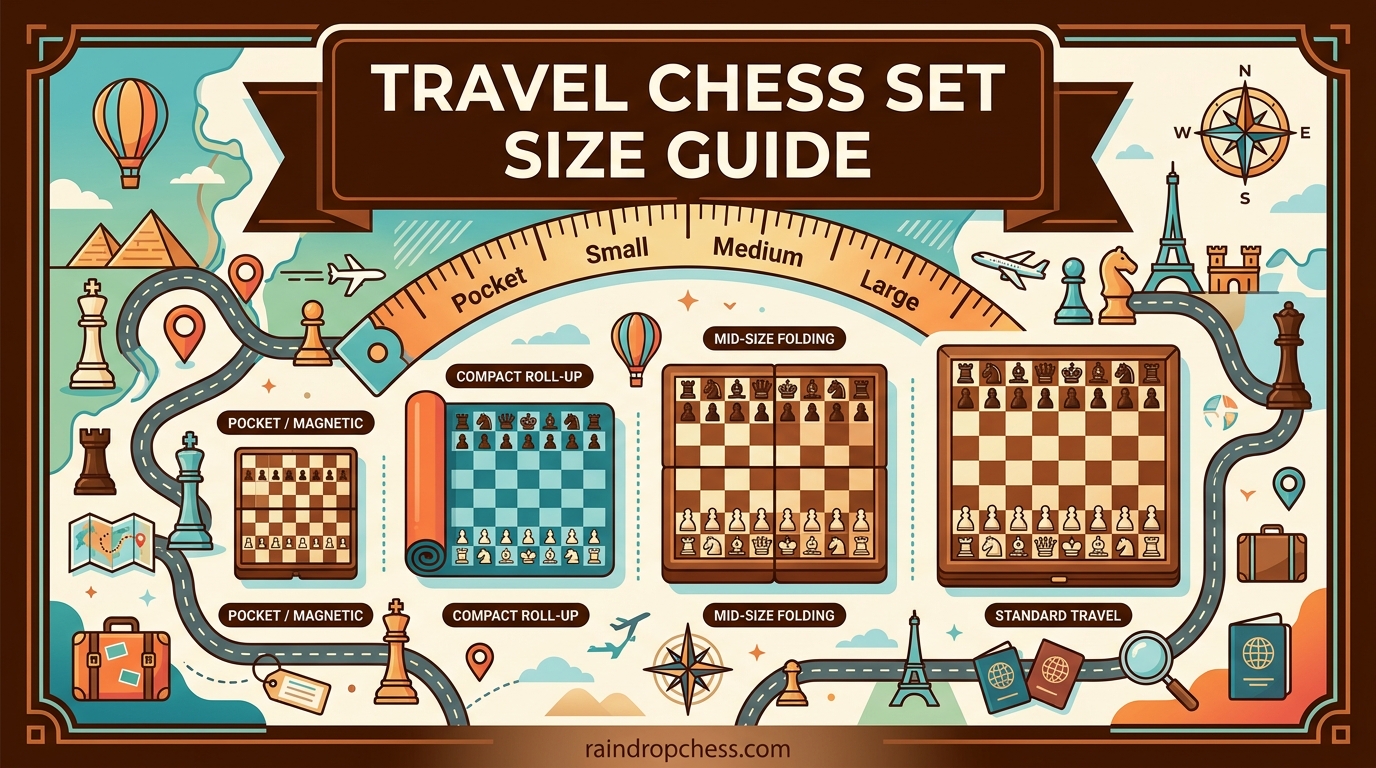
Whether you’re a chess player who travels frequently, someone who enjoys playing at cafés and parks, or a parent looking for a compact set for your child, choosing the right travel chess set size can make or break your playing experience. Too small and pieces become fiddly and hard to see; too large and you lose the portability that makes a travel set worthwhile in the first place. This guide cuts through the confusion and gives you a clear framework — including the often-overlooked 75–78% stability rule — to find the perfect set for your specific needs.
Table of Contents
Understanding Travel Chess Set Sizes
The most common question players ask is: what size board do I actually need? The answer depends entirely on where and how you plan to play. A travel chess set isn’t just a smaller version of a tournament board — it has its own design philosophy centered around portability, durability, and ease of use in non-ideal conditions.
The Relationship Between Board Size and King Height
Chess pieces are proportionally sized to the board squares. In a standard tournament board, king height is typically 3.5 to 3.75 inches, with a base diameter roughly equal to the square size. For travel sets, as the board shrinks, piece size shrinks proportionally — and that’s where readability becomes an issue.
A good rule of thumb is that the king piece should be at least 1.5 inches tall for comfortable play. Any smaller and even players with 20/20 vision will struggle to distinguish piece types, especially in dim lighting or on busy surface patterns. If you find yourself squinting at your pieces, your set is too small for the environment you’re playing in.
What About Those “Is X Inch Board Too Small?” Questions?
You’ve probably seen questions like “Is a 12-inch chess board too small?” or “Is a 14-inch board big enough?” These questions miss the real point. What matters isn’t the total board dimension — it’s the square size and king height relative to your playing surface and hand size.
A 12-inch board with 1.5-inch squares can work well for casual café play. A 14-inch board with 1.75-inch squares is better for extended sessions. But if you’re playing on a standard airplane tray table (about 16 × 11 inches), even a 12-inch board may feel cramped with the lid closed. Context always matters more than the raw number.
The Four Main Travel Chess Size Categories
Travel chess sets generally fall into four size categories. Each serves a different use case, and understanding these categories is the first step to choosing the right one.
Pocket Sets (Board Under 8 Inches)
Pocket sets have boards under 8 inches with squares typically 0.75 to 1 inch. King height is around 1 to 1.5 inches. These sets fit in a jacket pocket or purse and are designed for quick games when a full-sized board simply isn’t an option.
Best for: Airplane tray play, very tight spaces, impulse play situations. Not recommended for extended games due to piece readability challenges.
Considerations: Pieces are small and easy to lose. Magnets are essentially mandatory to prevent pieces from shifting or falling. The magnetic snap is what makes such small boards playable at all.
Cabin Sets (Board 8–12 Inches)
The most popular travel category. Boards in the 8 to 12-inch range offer squares of 1 to 1.5 inches, with king heights of 1.5 to 2 inches. This is the sweet spot for most travelers who want a balance between portability and playability.
Best for: Airplane tray tables with the lid open, café tables, hotel desks, picnic tables. This is the most versatile category.
Considerations: A 9 to 10-inch board with 1.25-inch squares is widely considered the minimum for genuinely enjoyable play. The 6.25 × 6.25-inch board (about 10 inches unfolded) is specifically recommended by House of Staunton as the “perfect size for most players.”
Café Sets (Board 12–16 Inches)
Larger boards in the 12 to 16-inch range offer square sizes of 1.5 to 2 inches with king heights of 2 to 2.5 inches. These sets provide near-standard-sized pieces in a foldable format that still packs away compactly.
Best for: Extended games, players with larger hands, café tables with adequate space, hotel room play where board visibility is a priority.
Considerations: You need a dedicated bag or compartment to carry these. They won’t fit in a laptop bag alongside your other gear. The extra size is worth it if you play often and for long sessions.
Roll-Up Vinyl Sets
These flexible vinyl boards unroll to 12, 15, or even 20 inches with magnetic or weighted pieces that cling to the board surface. No folding required — the board simply rolls up like a yoga mat.
Best for: Road trips, backpacking, situations where you need maximum durability, playing on uneven or outdoor surfaces.
Considerations: Piece stability on roll-up boards is a trade-off. Heavy plastic pieces with strong magnets work best. The vinyl surface can be slippery on smooth tables, and flat piece storage can be tricky when rolling up.
The 75–78% Stability Rule: Your Key Decision Framework
Here’s the most important piece of technical knowledge most buyers never learn: the 75–78% stability rule. Understanding this rule is what separates an educated buyer from someone who simply guesses based on price or appearance.
What the Rule Actually Means
The stability rule states that a properly proportioned travel chess set should have pieces where:
- The king’s base diameter is approximately 75–78% of the square size
- Or equivalently: the king height is approximately 75–78% of the board diagonal proportion relative to standard tournament proportions
In practical terms, this means a board with 1.5-inch squares should have a king with a base diameter of about 1.125 to 1.17 inches, and a height proportional to the square size. Sets that deviate significantly from this ratio will feel “off” — either too cramped on the squares or too wobbly when pieces are moved.
Why This Matters for Stability
When the base-to-square ratio is in the 75–78% range, pieces sit firmly on their squares and are less likely to wobble or topple during play. Below this range and pieces become tippy; above it and they crowd the board, making piece movement difficult.
The rule is adopted from FIDE tournament standards, which specify that a king’s base should cover at least half the square but not more than 85%. The 75–78% “sweet spot” comes from practical testing and is endorsed by the World Chess Federation as a guideline for well-proportioned sets.
How to Apply It When Shopping
When evaluating a travel set, measure the square size and check the king’s base diameter. Divide the base diameter by the square size — the result should be between 0.75 and 0.78. If it is, the set is well-proportioned. If not, expect either crowding or instability during play.
Magnetic vs Non-Magnetic Travel Sets
If you’re buying a travel set intended for use on the go, magnetic pieces are strongly recommended. But not all magnetic travel sets are created equal — the strength of the magnets matters enormously.
Understanding Magnetic Strength
Magnet strength is measured in gauss (G) or more precisely in pull strength (measured in ounces or grams). For travel chess sets:
- Under 400 gauss: Very weak — pieces will slide on any tilt and fall off on a steep angle. Common in very cheap sets.
- 400–600 gauss: Adequate for flat surfaces. Pieces hold on gentle tilts but will shift on lap or slightly angled surfaces.
- 600–900 gauss: Good quality. Pieces hold firmly on most surfaces including slight tilts. This is the sweet spot for most travelers.
- 900+ gauss: Premium. Pieces hold on significant tilts — useful for airplane tray tables that are rarely perfectly flat.
How to Test Magnet Strength Before You Buy
When you receive a set, run these three quick tests:
- Flat surface test: Place the board on a perfectly flat table and hold the board level. The pieces should stay put with no tendency to drift.
- Tilt test: Slowly tilt the board to about 15 degrees. Good magnets (600+ gauss) should hold pieces in place. If pieces slide immediately, the magnets are too weak.
- Shake test: With pieces placed, give the board a gentle side-to-side shake. Pieces should not walk across the squares or fall off. If they do, the set is poorly designed regardless of magnet strength — the piece weight relative to magnet strength is off.
Felted Bases: The Unsung Hero
Many travelers overlook felted piece bases, but they make a significant difference. Felt bottoms absorb moisture, protect the board surface, and reduce the “click” of pieces on the board. More importantly, felt adds a tiny bit of grip that supplements weak magnets. If your set doesn’t have felted bases, you can apply self-adhesive felt pads yourself — a five-minute mod that dramatically improves the playing experience.
Board Size Recommendations by Use Case
Here’s a practical breakdown of recommended sizes for specific scenarios:
Airplane Tray Table
Tray tables average about 16 × 11 inches but have a hinge that reduces effective space. A board in the 9–10 inch range (about 6.25 × 6.25 inches per half-board) works best. The board should fold with the hinge running through the middle to create a flat playing surface. Look for sets with strong magnets (800+ gauss) because tray tables are almost never perfectly flat.
Café or Restaurant Table
Standard café tables are typically 24 inches in diameter. You have plenty of room. A 12–14 inch board with 1.5–1.75 inch squares is ideal. Magnet strength matters less here since tables are flat. Focus instead on piece size and board aesthetic.
TSA Regulations for Magnetic Sets on Airplanes
There’s ongoing confusion about whether magnetic chess sets are allowed through airport security. Magnetic chess pieces ARE allowed in both carry-on and checked baggage. The TSA’s restriction applies to large magnets that could interfere with aircraft instruments — a travel chess set’s small magnets pose no risk. However, some security officers may inspect the set closely. Pack your set in an easily accessible location to avoid delays.
Hotel Room
Hotel desks and nightstands vary widely, but most provide ample space. A 14–16 inch board or even a full-sized folding set works well here. Magnet strength is less critical since surfaces are flat. Prioritize piece quality and board aesthetics over raw portability.
Commuter Bag or Laptop Case
If you carry a chess set alongside a laptop, you have limited space. A 9–10 inch folding set is the practical maximum. The board should fit in your bag’s laptop sleeve or a dedicated zippered compartment. Weight matters here — look for sets under 1 pound total.
Kids and Beginners
Children and chess beginners benefit from larger pieces they can handle easily. A 12–15 inch board with 1.5–2 inch squares is ideal. Bigger pieces are easier to grip, move, and see — which keeps younger players engaged. Strong magnets are important too, since kids are more likely to bump the board.
Material Comparison: Wood, Plastic, and Vinyl
Travel chess sets come in three main materials, each with distinct trade-offs:
Wooden Sets
Pros: Beautiful appearance, pleasant tactile feel, good weight that aids stability, prestigious look.
Cons: Heavier, more expensive, more susceptible to moisture and temperature changes, less durable for rough travel.
Best for: Hotel room play, serious players who prioritize aesthetics, occasional travelers.
Plastic Sets
Pros: Lightweight, durable, moisture-resistant, affordable, bright colors aid piece identification.
Cons: Can feel cheap, lighter weight may need stronger magnets, less prestigious appearance.
Best for: Frequent travelers, airline play, families with kids, outdoor use.
Vinyl Roll-Up Sets
Pros: Most compact when packed, excellent durability, handles uneven surfaces well, very affordable.
Cons: No hinged folding — rolls up instead, pieces can shift on smooth surfaces, less prestigious.
Best for: Backpacking, road trips, outdoor play, maximum portability priority.
Visibility in Different Lighting Conditions
One of the most underappreciated factors in choosing a travel set is how it performs in different lighting. A set that looks perfect in bright sunlight may be nearly unplayable in a dim restaurant.
Low-Light Play
If you frequently play in dimly lit venues — rooftop bars, evening café sessions, hotel rooms with poor overhead lighting — prioritize these features:
- High-contrast color schemes: White pieces with bright cream/off-white squares and black pieces with deep black or very dark green squares. Avoid muted or brown tones.
- Light-colored board squares: Light cream or white squares reflect available light and make piece positions easier to see.
- Larger king pieces: At least 2 inches tall for low-light play, since larger pieces cast shadows that help distinguish them.
- Avoid metallic finishes in dim light: Gold and silver pieces look identical under low incandescent lighting.
Outdoor and Bright Light
In direct sunlight or very bright conditions, glare becomes the enemy. Choose sets with matte finishes and avoid glossy boards that create reflections. Neutral cream-and-black boards with a matte finish work best in bright outdoor environments.
Care and Maintenance Tips
With proper care, a quality travel set will last for years of adventures:
- Store pieces in a dedicated compartment to prevent loss — a single rook can render a set nearly unusable.
- Keep the board flat when possible. Extended storage in a cramped bag can cause wooden boards to warp.
- Clean magnetic pieces and board squares periodically to remove debris that can reduce magnet effectiveness.
- Avoid leaving a vinyl roll-up set in a very hot car — the vinyl can soften and become tacky.
- For magnetic sets, periodically check that magnet discs haven’t detached from pieces (a common failure point in cheaper sets).
Frequently Asked Questions
What is the best size travel chess set?
For most travelers, a 9 to 12-inch folding magnetic board strikes the ideal balance between portability and playability. This size fits on most café tables and airplane tray tables, and the 1.25 to 1.5 inch squares provide good piece readability for players of all skill levels.
Is a 12-inch chess board too small?
A 12-inch board with 1.5-inch squares is not too small for casual play — many experienced players use this size regularly. It works well on café tables and when you need a genuinely portable set. However, for extended games or players with larger hands, a 14 to 16-inch board with 1.75 to 2-inch squares will feel more comfortable.
Is a 14-inch chess board too small?
No — a 14-inch board is actually considered an excellent size for travel, offering 1.75-inch squares that are near tournament proportions. This is the largest size that still folds into a compact, portable form factor. If you can accommodate the extra size, a 14-inch board provides a noticeably more comfortable playing experience than smaller alternatives.
Magnetic vs folding travel chess sets — which is better?
Magnetic sets are better for travel use because the magnets prevent pieces from shifting and falling when the board tilts or gets bumped. Folding sets without magnets work fine on flat, stable surfaces but are impractical for most travel situations. Look for magnetic sets with at least 600 gauss magnet strength for reliable performance on slightly uneven surfaces.
What size travel chess set should I buy for my child?
For children, choose a 12 to 15-inch board with at least 1.5-inch squares. Larger pieces are easier for small hands to grip and move, and they make piece identification simpler for beginners. Strong magnets are especially important for kids since they’re more likely to accidentally bump the board. Vinyl roll-up sets are also excellent for families because they’re durable and easy to clean.
How do I test magnet strength on a travel chess set?
Run three quick tests: place the board flat and watch for piece drift (none should occur), tilt the board to about 15 degrees (pieces should hold), and give the board a gentle side-to-side shake (pieces shouldn’t walk or fall). If pieces fail any of these tests, the magnet strength is insufficient for travel use. Look for sets rated at 600 gauss or higher.
What is the 75-78% stability rule in chess?
The 75-78% stability rule states that a well-proportioned chess piece should have a base diameter that is approximately 75-78% of the square size. For example, on a 1.5-inch square, the king’s base should be about 1.125 to 1.17 inches in diameter. Sets that follow this ratio provide the best balance between piece stability and ease of movement — pieces sit firmly on their squares without feeling cramped.
Conclusion: Finding Your Perfect Travel Chess Set Size
The “best” travel chess set size ultimately comes down to your specific use case, but here’s a quick summary to guide your decision:
- Maximum portability: Pocket set under 8 inches — accepts the trade-offs in playability
- Best all-around: Cabin set 9–12 inches — the sweet spot for most travelers
- Extended play priority: Café set 12–16 inches — near-tournament proportions in a portable format
- Outdoor and road trips: Roll-up vinyl — most durable and flexible option
Whatever size you choose, remember the 75–78% stability rule as your quality benchmark: a well-proportioned set with a king base diameter that’s 75–78% of the square size will always play better than a poorly proportioned one, regardless of brand or price.
Pair that rule with magnet strength of at least 600 gauss, appropriate square sizes for your primary playing environment, and a material that fits your durability and aesthetic preferences — and you’ll have a travel chess set that serves you well for years of games on the road.