
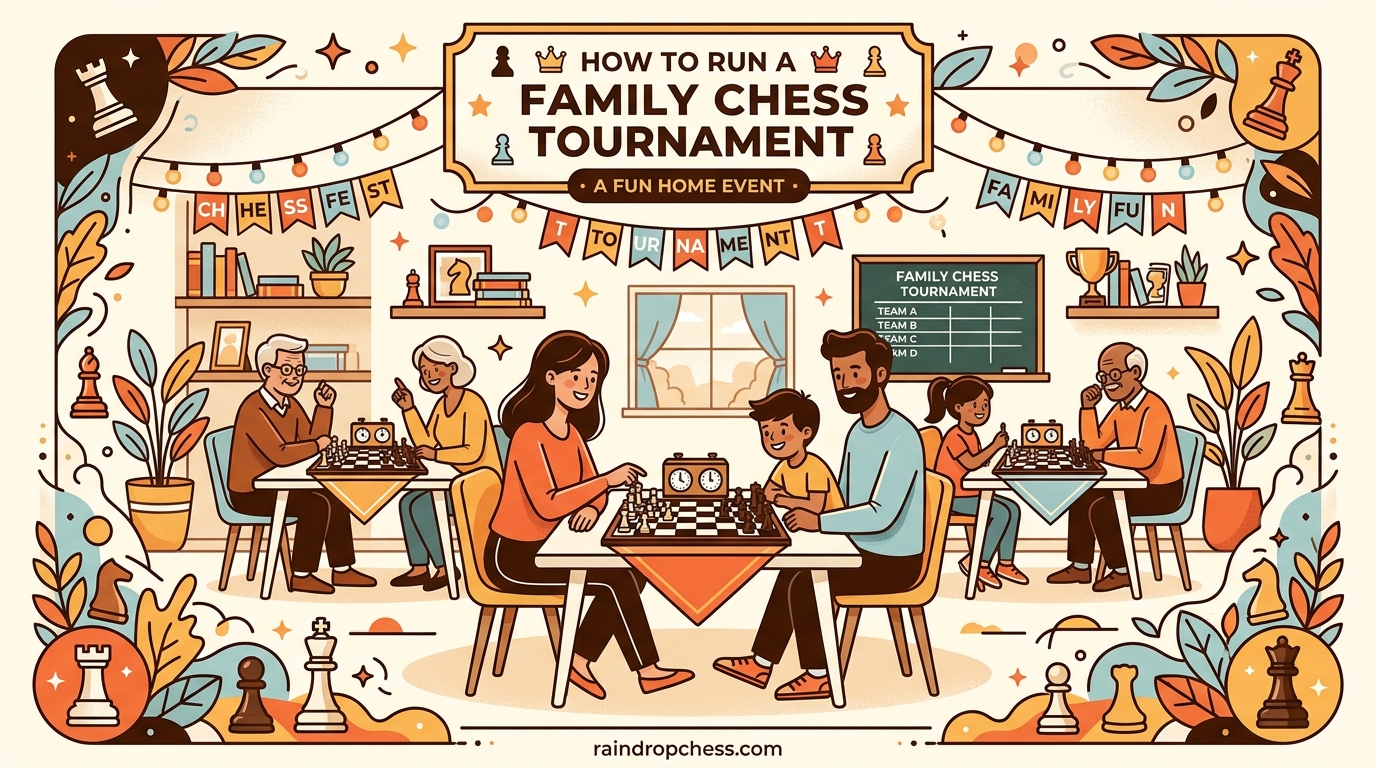
Running a family chess tournament at home is one of the best ways to turn a regular evening into a memorable event. Whether you are looking to settle the age-old sibling rivalry or simply want to introduce chess to your kids in a fun, competitive setting, a structured tournament brings out the best in everyone. I have organized dozens of these tournaments in my own home, and I can tell you that nothing beats watching the whole family gathered around the chessboard, cheering each other on.
The beauty of a family chess tournament is that it works for any skill level. You do not need to be a grandmaster to participate or enjoy it. With just four players, you have the perfect number for a balanced, engaging bracket that keeps everyone involved without dragging on too long.
In this guide, I will show you exactly how to run a family chess tournament with a 4-player bracket that actually stays fun from start to finish. You will learn the equipment you need, how to set up the bracket, which tournament formats work best for families, and my tested strategies for keeping everyone engaged no matter their age or skill level.
Table of Contents
What You Need for Your Family Chess Tournament
Before the first move is made, you will want to gather a few essentials. The good news is that you probably already have most of what you need for a home chess tournament.
Chess sets: You will need at least two complete chess sets for a 4-player tournament. This allows both semifinal matches to happen simultaneously, cutting your tournament time in half. If you only have one set, your tournament will take longer but will still work fine.
Chess clocks: These are optional but highly recommended, especially if you want to keep games moving and prevent the dreaded “think for 10 minutes about a single pawn move” scenario. For family chess night, I recommend starting with 15 minutes per player per game. You can find affordable digital chess clocks online, or use a smartphone app as a free alternative.
Score sheets: Keep track of results with simple score sheets. A piece of paper with columns for player names, game results, and points works perfectly. I like to keep a master sheet visible so everyone can see the standings at a glance.
Writing utensils: Have pens or pencils ready for recording moves and results.
Tournament bracket: You can draw this on paper, print a template from online, or simply use a whiteboard to track the pairings. For a 4-player bracket, you do not need anything fancy.
Space: You will need two tables or surfaces if running simultaneous games, plus comfortable seating for all players and any spectators.
Optional but nice to have: Snacks and drinks keep energy levels up, especially for younger players. Consider having small prizes or certificates ready for the winners, or just plan to celebrate with a family treat at the end.
How to Set Up a 4-Player Bracket (Step-by-Step)
Setting up a 4-player bracket is straightforward once you understand the structure. With four players, a single-elimination tournament requires exactly three games total: two semifinal matches and one final. If you want to determine a third-place winner, you will play one additional game between the semifinal losers.
Step 1: Assign Player Positions
Write down the names of your four players. If you have a clear skill hierarchy in your family, you might want to seed the bracket to prevent the two strongest players from meeting in the first round. Put the strongest player in position 1, the second strongest in position 4, the third strongest in position 2, and the fourth strongest in position 3.
Step 2: Create the Semifinal Pairings
Match player 1 against player 4, and player 2 against player 3. These are your two semifinal games. If you have two chess sets available, these games can happen at the same time. Otherwise, play them sequentially.
Step 3: Winners Advance to the Final
The winners of each semifinal match face each other in the final. This determines your first and second place finishers.
Step 4: Optional Third-Place Match
If you want to keep everyone engaged until the end, have the two players who lost in the semifinals play each other for third place. This works particularly well with kids who might otherwise lose interest after being eliminated.
The Bracket Visual
Imagine your bracket like this:
Semifinal 1: Player 1 vs Player 4
Semifinal 2: Player 2 vs Player 3
Final: Winner of SF1 vs Winner of SF2
Third Place: Loser of SF1 vs Loser of SF2
That is it. Three or four games, clear progression, and a champion crowned at the end. A single-elimination 4-player bracket typically takes 1 to 2 hours to complete, depending on your time controls.
Tournament Format Options for 4 Players
While single elimination is the most common format for a 4-player tournament, it is not your only option. Depending on your family’s preferences and available time, consider these alternatives:
Single Elimination
The classic tournament format. Lose once and you are out. This keeps things moving quickly and creates high stakes for each game. Best for: Families who want a quick tournament or have younger players with shorter attention spans.
Pros: Fast, simple to understand, builds excitement.
Cons: Half your players only play one game, disappointing for early losers.
Round Robin
Each player faces every other player once. With four players, that means three rounds total, with each player playing three games. The player with the most points at the end wins.
Pros: Everyone plays multiple games, fairer results, more chess practice.
Cons: Takes longer (typically 2 to 3 hours), requires more games to be played.
Double Elimination
Players move to a losers bracket after their first loss. The winner of the losers bracket faces the undefeated player in the final. With four players, this extends your tournament to five or six games but gives everyone at least two matches.
Pros: No one is eliminated after one game, comeback stories possible.
Cons: More complex to track, longer duration.
Quads Format
This format, common in chess clubs, puts exactly four players in a group where everyone plays everyone else. It is essentially a round robin for four players, and it is the standard “quad” tournament structure you will find in organized chess.
Pros: Designed specifically for four players, fair and balanced.
Cons: Same time commitment as round robin.
For most family chess nights, I recommend starting with single elimination or the quads format. They provide the right balance of engagement and time commitment.
Setting Rules and Scoring System
Clear rules prevent arguments and keep your family chess tournament running smoothly. You do not need the FIDE rulebook, just simple guidelines everyone understands.
Time Control
Set a time limit per player. For family chess night, I have found these work well:
For beginners or young children: 10 minutes per player with no increment.
For intermediate players: 15 minutes per player, or 10 minutes with a 5-second increment per move.
For experienced players: 20 minutes per player, or 15 minutes with a 3-second increment.
The increment adds time to the clock after each move, preventing players from running out of time in complex endgames.
Draw Rules
Decide in advance how draws are handled. In a family tournament, I recommend allowing draws by agreement at any time. If the game reaches a clearly drawn position (like king versus king), declare it a draw. For stalemate, insufficient material, or threefold repetition, the game is automatically drawn.
Some families prefer to prohibit draws to ensure a decisive result. This is fine too, just make sure everyone knows before starting.
Scoring System
Use standard chess scoring:
Win: 1 point
Draw: 0.5 points
Loss: 0 points
In single elimination, you do not need to track points, just who advances. In round robin or quads, add up points at the end to determine the winner.
Tiebreaks
If players finish with the same score, use these tiebreak methods in order:
1. Head-to-head result (who won when they played each other)
2. Sonneborn-Berger score (sum of defeated opponents’ scores plus half of drawn opponents’ scores)
3. Total number of wins
4. Playoff game (sudden death, 5 minutes each)
For family tournaments, I usually stop at head-to-head or just play a quick tiebreaker game. Keep it simple.
Keeping It Fun: Tips for Mixed Skill Levels
The biggest challenge in a family chess tournament is keeping everyone engaged when skill levels vary widely. Here are strategies I have tested over many family chess nights.
Handicap Systems
If one player dominates every game, consider handicaps to level the playing field. The stronger player starts without a queen, or with reduced time, or must reach checkmate in a specific number of moves. Adjust the handicap until games become competitive and fun for everyone.
Teaching Moments
Encourage stronger players to explain their thinking after games, especially when playing against beginners. This turns losses into learning opportunities. I have seen my kids improve dramatically just from these post-game discussions.
Keep Games Moving
Use chess clocks and enforce time controls strictly. Nothing kills the energy of family chess night like one player taking 15 minutes to decide on a bishop move. Set the expectation that games should flow.
Take Breaks
Between rounds, step away from the boards. Grab a snack, stretch, or play a quick different game. This prevents mental fatigue, especially for younger players.
Prizes and Recognition
Everyone should leave feeling accomplished. Consider multiple categories: overall winner, most improved player, best sportsmanship, best opening, most creative move. Small prizes, certificates, or even just sincere recognition keeps morale high.
One family I know gives out a rotating trophy that the winner keeps until the next tournament. It has become a beloved tradition.
Include Remote Players
If family members cannot be physically present, set up a board on a video call. It takes a bit more coordination, but having a grandparent or traveling parent join remotely adds a special element to the tournament.
Frequently Asked Questions
What is the 40-40-20 rule in chess?
The 40-40-20 rule is a training guideline suggesting you spend 40% of your study time on tactics, 40% on endgames, and 20% on openings. While not directly related to tournament organization, this balanced approach helps players improve their overall game. For family tournaments, focus on having fun rather than strict training ratios.
How to set up a 4 team tournament?
For a 4-player or 4-team tournament, use a single-elimination bracket. Pair player 1 vs player 4 and player 2 vs player 3 in semifinals. Winners face each other in the final. This requires just 3 games total, or 4 if you play a third-place match. Draw the bracket on paper or use an online bracket generator to track progress.
How do you structure a chess tournament?
Structure your tournament by first choosing a format: single elimination for speed, round robin for fairness, or double elimination for second chances. Set clear time controls (10-20 minutes per player works for families). Establish rules about draws and tiebreaks. Create a schedule showing when each round starts. Track results on a visible score sheet, and advance winners according to your bracket.
How do you play quads in chess tournaments?
Quads is a tournament format designed for exactly four players. Each player faces the other three players once in a round-robin style. After three rounds, the player with the highest score wins. Quads are popular in chess clubs because they create competitive groups of similar skill levels. For family tournaments, quads ensure everyone plays multiple games regardless of early results.
How many games are in a 4 player chess bracket?
A single-elimination 4-player bracket requires 3 games: 2 semifinals and 1 final. If you include a third-place match, it becomes 4 games total. A round-robin or quads format for 4 players requires 6 games total (each of the 4 players plays 3 games).
Ready to Start Your Tournament?
You now have everything you need to run a family chess tournament that will create lasting memories. Remember, the goal is not perfection but connection. A family chess tournament at home brings everyone together around the board, teaches valuable lessons about winning and losing gracefully, and most importantly, provides hours of genuine fun.
Start simple with a single-elimination 4-player bracket, gather your equipment, set your basic rules, and let the games begin. As you run more tournaments, you will discover what works best for your family. Maybe you will develop traditions, create a family championship trophy, or find your own unique ways to keep everyone engaged.
The most important move is the first one. Set up that board, call the family together, and start your tournament 2026.