
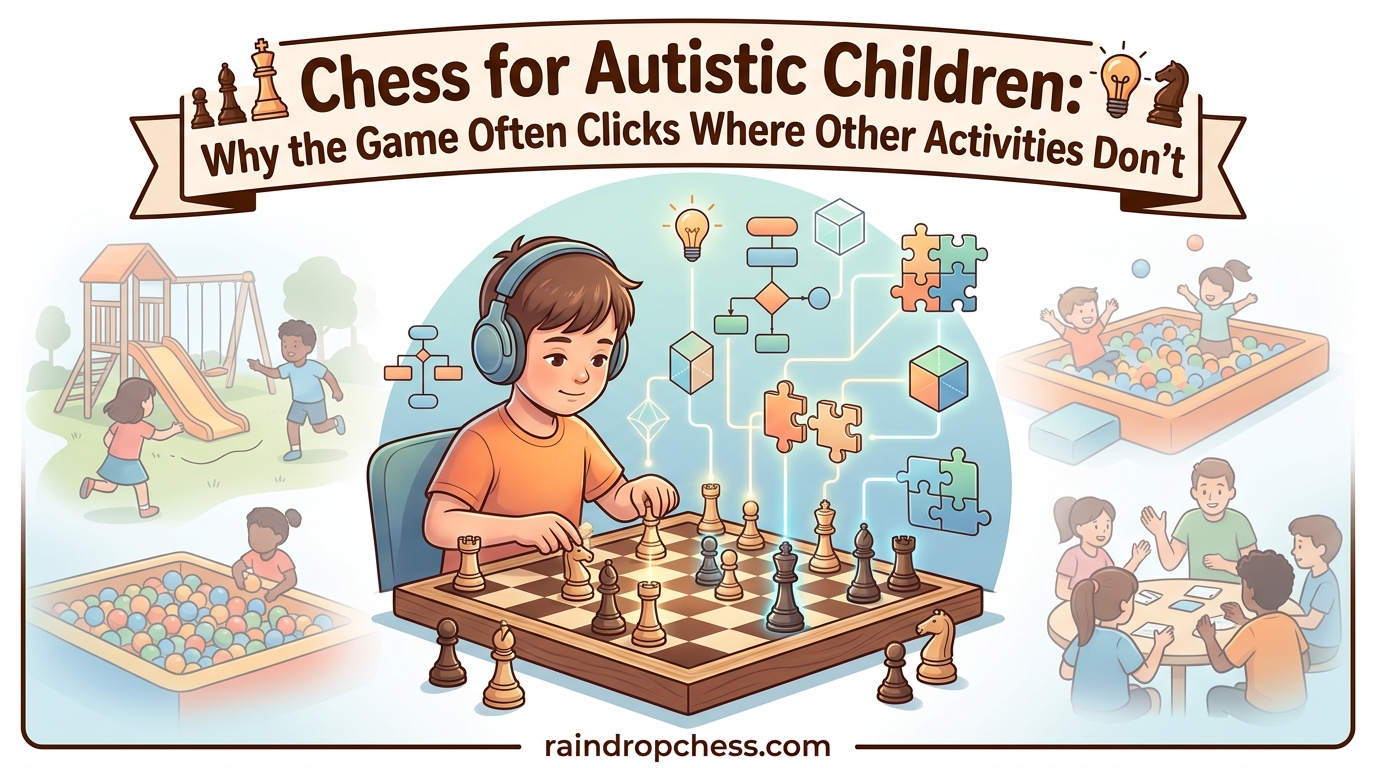
If you’ve ever watched an autistic child become completely absorbed in a chess game while struggling to engage with team sports or social activities, you’re not alone. Parents and educators have repeatedly observed something remarkable: chess often “clicks” for autistic children in ways that other activities simply do not. This article explores why that connection exists and how it might help your child.
Finding the right activity for an autistic child can feel like an endless search. Team sports bring social pressures. Arts and crafts can overwhelm with sensory input. Even playdates often collapse under the weight of unpredictable social dynamics. But chess offers something different. It offers a structured, predictable world where the rules never change, social interaction is optional and silent, and success depends on thinking rather than physical ability.
Over the past several years, researchers and educators have begun documenting why chess resonates so strongly with autistic children. The evidence is compelling, and the stories from parents are even more so. Whether your child has already shown interest in chess or you’re searching for an activity that might finally click, understanding this connection could change everything.
Table of Contents
Why Chess Works for Autistic Children
Chess works for autistic children because it addresses several core challenges that are common across the autism spectrum. Rather than forcing children into situations that trigger anxiety or sensory overload, chess creates an environment where autistic thinking styles become advantages rather than obstacles.
The Power of Predictable Rules
Chess rules never change. A knight always moves in an L-shape. A pawn always advances forward and captures diagonally. This predictability is incredibly reassuring for autistic children, who often struggle with the ambiguity and rule-changing nature of social interactions and many recreational activities.
In team sports, rules can vary by league or team. Social games involve constant negotiation about what is acceptable. But chess offers complete consistency. The board layout, piece movements, and win conditions remain constant across every game, in every country, with every opponent. For autistic children who find unpredictability stressful, this stability is deeply calming.
Parents in autism support communities frequently describe this phenomenon. Their children may struggle to follow rules in other contexts but become chess experts quickly. The reason is simple: chess does not require reading social cues or navigating emotional dynamics. It requires only understanding and applying a fixed set of rules.
Sensory-Friendly by Design
Chess creates almost no sensory demands. Unlike soccer games in crowded stadiums or birthday parties in loud arcades, chess matches typically happen in relative quiet. There are no sudden loud noises, no required physical contact with other children, and no overwhelming crowds.
This matters enormously for autistic children who experience sensory sensitivity. Many recreational activities bombard children with sensory input that neurotypical children handle easily but autistic children find debilitating. A chess tournament, by contrast, typically involves sitting at a table, moving wooden pieces, and thinking. The sensory environment is controlled and manageable.
The FIDE Infinite Chess Project, which brings chess programs to autistic children worldwide, specifically highlights this aspect. Their program coordinators note that autistic children can participate fully in chess without the sensory accommodations that would be required for many other activities.
Silent Social Interaction
Chess allows children to play alongside each other without forced conversation or social performance. Two children can compete intensely across a chessboard while maintaining complete silence. This is revolutionary for autistic children who find small talk exhausting or nonsensical.
Social interaction in chess happens through the game itself. When your opponent makes a move, that IS the communication. There is no need for verbal sparring, no obligation to make eye contact, no requirement to smile or perform emotional responses on command. The social interaction is pure and focused, mediated entirely through logical movement on the board.
Many autistic children who struggle to connect with peers through conversation connect easily through chess. The game provides a shared activity and a shared language. It creates common ground without demanding the social flexibility that other interactions require.
Logical Consequences
Every move in chess has a clear cause-and-effect relationship. Make a bad move, and your position worsens. Make a good move, and you gain advantage. This logical transparency is exactly what autistic children often need from their environment.
In social situations, consequences are often ambiguous. A child might upset a peer without understanding why. A comment meant as neutral might land as harsh. The social world frequently lacks the clear connection between action and result that autistic children find reassuring. But chess is ruthlessly logical. If you hang your queen, you lose your queen. If you don’t protect your king, you get checkmated. The cause is always visible, and the effect is always clear.
This transparency helps autistic children learn from mistakes without the emotional confusion that often accompanies social errors. When you lose a chess game, you know exactly why. You can study the game, find the exact moment things went wrong, and improve. This makes failure constructive rather than demoralizing.
Key Benefits of Chess for Autistic Children
The benefits of chess for autistic children extend far beyond simply having an enjoyable activity. Research and parent reports consistently show improvements across multiple areas of development and daily functioning.
Improved Concentration and Focus
Chess requires sustained attention. A single game can last an hour or longer, and throughout that time, children must concentrate deeply on the position on the board. This practice in focused attention carries over into other areas of life.
Studies on chess and executive function have shown that regular chess players develop stronger working memory and attention control. For autistic children who often struggle with concentration, this structured practice provides therapeutic benefits. The concentration demanded by chess is demanding but not overwhelming, because the activity is inherently engaging for children with pattern-recognition strengths.
Parents frequently report that children who begin chess practice show improved focus in school. The same attention muscles used during chess study are strengthened and become available for classroom use. This transfer of skills is one of the most valuable aspects of chess as an activity for autistic children.
Emotional Regulation Through Safe Failure
Every chess game involves losing. Even strong players lose roughly half their games. But losing in chess carries no real-world consequences beyond the game itself. This makes chess an ideal environment for learning to cope with failure.
Autistic children often struggle with the emotional intensity of losing or being wrong. In chess, losing is expected, analyzed, and used as a learning tool. The emotional distance from failure that chess provides allows children to process loss constructively rather than collapsing into frustration or shutdown.
Over time, regular chess play teaches children that losing is not catastrophic. It is simply part of the learning process. This emotional resilience generalizes beyond the chessboard into school, social situations, and family life. Children learn that mistakes are information, not verdicts.
Building Self-Esteem Through Achievement
Chess skill is measurable and tangible. You can track your rating, count your wins, and see your progression in concrete terms. For autistic children who often struggle with the ambiguous social feedback that neurotypical children navigate easily, this clear achievement system is deeply satisfying.
When an autistic child improves at chess, they know it. The rating goes up. They beat opponents they couldn’t beat before. They solve puzzles they couldn’t solve last month. This unambiguous progress builds genuine self-confidence that is not dependent on social performance or physical ability.
Many parents report that success in chess transforms their child’s self-image. A child who has struggled academically or socially suddenly sees themselves as someone who is good at something real. This confidence boost ripples outward, improving performance and attitude across domains.
Perspective-Taking and Theory of Mind
To play chess well, you must understand what your opponent is thinking. You must anticipate their plans, recognize their threats, and see the board from their perspective. This practice in perspective-taking directly exercises theory of mind, which is the ability to understand that others have thoughts, feelings, and intentions different from your own.
Theory of mind is an area of difficulty for many autistic children. Chess provides structured practice in this skill without the social demands of direct interaction. Children can practice understanding another person’s thinking while focusing entirely on the logical game rather than the social performance.
Research from chess psychology programs suggests that regular chess practice can improve theory of mind functioning. The repeated exercise of imagining the opponent’s position, plans, and possible responses strengthens this cognitive muscle in a way that direct social practice often cannot.
Patience and Impulse Control
Chess forces children to think before acting. In an era of instant gratification and rapid-fire communication, chess demands patience. You must wait for your turn. You must consider multiple moves ahead. You must resist the urge to move quickly and instead deliberate carefully.
For autistic children who struggle with impulsivity, this structured delay is therapeutic. Chess rewards patience and punishes impulsivity through the game’s own logic. The natural consequences of rushing are losing pieces and losing games. Children internalize the value of careful thought through direct experience.
Executive function, which includes impulse control and planning, shows measurable improvement in children who play chess regularly. This improvement generalizes to academic performance, following instructions, and completing multi-step tasks.
Connection to Special Interests
Many autistic children develop intense special interests that consume their attention and bring them joy. Chess can become exactly this kind of interest for children who connect with it, providing a deep well of engagement and enthusiasm.
Parents often worry about chess obsession in autistic children. But channeling intense focus into a constructive activity is far better than watching that focus dissolve into unproductive worry or anxiety. A child who can spend hours studying chess openings is building cognitive skills, not just passing time.
The concept of hyperfocus, often framed negatively in discussions of autism, becomes a significant advantage in chess. A child who can concentrate deeply on complex positions has an edge over opponents who cannot maintain that focus. What looks like a problem in other contexts becomes a genuine strength at the chessboard.
Why Other Activities Often Fail for Autistic Children
Understanding why chess succeeds requires understanding why other activities often fail. This is where the unique angle of this article lies, and it is crucial context for parents who have watched activity after activity fall flat.
Team Sports and Social Pressure
Team sports demand constant social interaction alongside physical performance. Children must communicate with teammates, read social cues from coaches, navigate complex peer relationships, and perform under observation. For autistic children who struggle with social communication, these demands create persistent anxiety.
Beyond the social demands, team sports require physical coordination that has nothing to do with cognitive ability. An autistic child who is brilliant in abstract thinking may struggle with the motor demands of soccer or basketball. The physical nature of team sports creates barriers that have nothing to do with the child’s actual strengths.
The competitive intensity of youth sports adds another layer of stress. Children are watched, evaluated, and compared to peers constantly. For autistic children who find evaluation threatening, this constant observation can make team sports actively harmful to self-esteem rather than beneficial.
Sensory Overload in Many Settings
Birthday parties, amusement parks, school cafeterias, and sports arenas all share characteristics that are deeply challenging for autistic children with sensory sensitivities. These environments are loud, crowded, visually overwhelming, and unpredictable. Children cannot control the sensory input they receive.
The sensory environment of a typical recreational activity is designed for neurotypical comfort, not autistic accommodation. Bright fluorescent lights, echoing sound from hard surfaces, crowds of people moving in unpredictable patterns, and strong smells from food courts combine to create sensory overwhelm that makes participation impossible for many autistic children.
Chess tournaments, by contrast, are typically held in relatively quiet rooms with controlled lighting. Children sit at tables with ample personal space. The sensory environment is one that autistic children can not just tolerate but genuinely enjoy. This difference in sensory demands explains much of why chess succeeds where other activities fail.
Unpredictability Creates Anxiety
Most recreational activities for children involve significant unpredictability. The rules might change from game to game. Activities rotate so children never know what to expect. Social dynamics shift without warning. For autistic children who find ambiguity stressful, these activities create persistent low-grade anxiety that makes participation unrewarding.
Chess offers complete predictability. The rules are fixed. The pieces move in known ways. The objective is clear. There is no ambiguity about how to succeed or what constitutes winning. This predictability is not a limitation of chess but a feature that makes the game accessible to children who cannot handle unpredictable environments.
When every other activity in a child’s life involves some level of unpredictability, chess provides a haven of certainty. This safety is invaluable for autistic children’s emotional wellbeing and explains why many children become deeply attached to the game.
Getting Started with Chess for Autistic Children
If you want to introduce chess to an autistic child, the approach matters. Here are practical recommendations based on what works for parents and educators.
Age-Appropriate Starting Points
Children can begin learning chess as young as age five or six, depending on their developmental stage. The key is not age but readiness to understand rules and demonstrate patience. Some children are ready at five; others not until eight or nine.
Start with the basics: how pieces move and the goal of checkmating the opponent king. Do not introduce strategies or tactics initially. Build a foundation of understanding first. Games can be short initially, even just a few moves, as attention permits.
There is no rush. The goal is positive association with chess, not rapid skill development. Let the child set the pace. Some children will want to play every day; others will prefer once-weekly games. Follow the child’s lead.
Teaching Approaches That Work
Autistic children often learn best when information is presented systematically and logically. Chess is naturally suited to this teaching style. Start with one piece type, practice its movement until it is mastered, then introduce the next piece.
Puzzles are often more engaging than full games for beginners. Chess puzzles present a single position and ask for one solution. This structure allows children to experience success quickly and build confidence gradually. Many children prefer puzzles to full games initially.
Online chess platforms offer advantages for autistic children. They eliminate the social pressure of playing in person, allow players to take time without feeling rushed, and provide immediate feedback. Chess.com and Lichess both offer puzzle sections and can be valuable teaching tools.
Online vs In-Person Chess
Online chess works well for many autistic children who feel anxious about in-person interaction. Playing online removes sensory concerns about the physical environment and allows complete focus on the game itself. There are no opponents visible, no social performance required, just the board and the thinking.
In-person chess offers its own benefits, including face-to-face interaction practice and the experience of navigating a tournament environment. Many children benefit from eventually playing in person after establishing comfort with the game online.
Consider the individual child’s needs. Some children will prefer online exclusively for months or years. Others will want to play in person from the start. There is no single right approach. Follow the child’s comfort level and expand gradually.
Frequently Asked Questions
Do autistic people struggle with chess?
What age can autistic children start learning chess?
Most children can begin learning chess between ages five and eight, depending on their developmental readiness. The key indicators are ability to understand simple rules and willingness to engage in focused activity for 10-15 minutes at a time.
How does chess help autism?
Chess helps autistic children in multiple ways: it provides structured predictability that reduces anxiety, offers safe practice in perspective-taking, builds concentration and working memory, creates a safe environment for learning to cope with failure, and allows silent social interaction without demanding conversational performance.
Why does my autistic child fixate on chess?
Chess fixation often reflects the game activating a special interest or hyperfocus, which are common autistic traits. Rather than worrying about the fixation, consider channeling it constructively. Intense focus on chess builds real skills and provides genuine enjoyment, which is healthy for autistic children.
Can chess be used as therapy for autistic children?
Chess is not a formal therapy but functions therapeutically for many autistic children. It provides structured cognitive exercise, emotional regulation practice, and social skill development in a low-pressure environment. Some therapists incorporate chess into treatment plans, and programs like FIDE Infinite Chess use chess specifically to support autistic children.
Conclusion
Chess for autistic children works because it aligns perfectly with autistic cognitive strengths. The predictable rules, logical consequences, silent social interaction, and sensory-friendly environment address exactly the challenges that make other activities difficult. What looks like a simple board game is actually a carefully designed intervention that builds cognitive skills, emotional resilience, and social understanding.
If your autistic child struggles to find activities that click, consider introducing chess with low expectations and no pressure. Let them explore the game at their own pace. You may find that what begins as tentative exploration becomes a lifelong passion that builds skills you never expected to develop.
Every autistic child deserves activities that honor their thinking style rather than demanding they pretend to be someone else. Chess offers this possibility. It is a game where being precisely who you are is not just acceptable but advantageous. In a world that often asks autistic children to perform neurotypical behavior, chess offers something radical: acceptance of exactly who they are.