
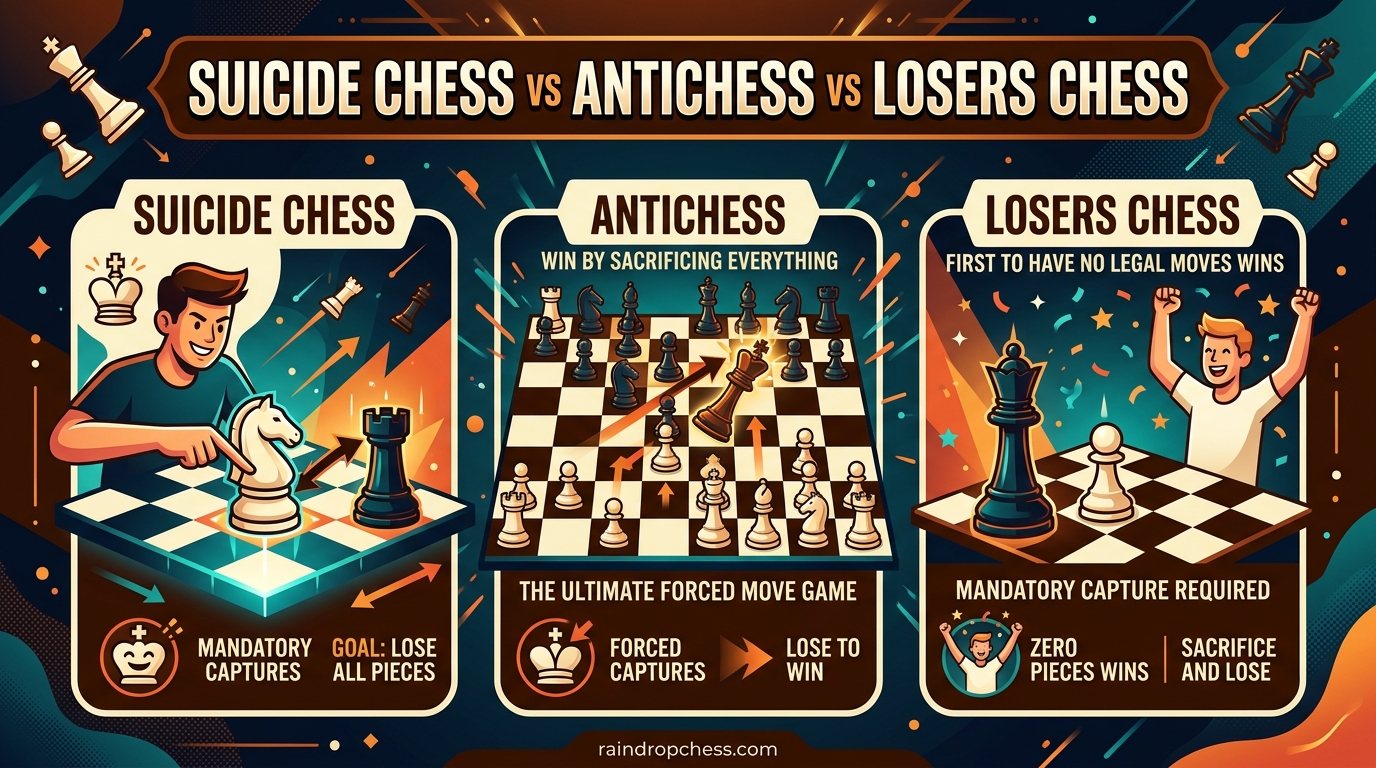
Suicide chess, antichess, and losers chess are three names for the exact same chess variant where your goal is to lose all your pieces or be stalemated. If you have stumbled across these different names and wondered whether they are different games, you are not alone. I spent years thinking they were separate variants until I dug into the history and rules.
In this guide, I will clear up the terminology confusion once and for all. You will learn why three names exist, how the rules work regardless of what you call it, and where to play online. By the end, you will understand exactly what makes this variant so addictive and why players keep coming back despite its counter-intuitive nature.
Table of Contents
Suicide Chess vs Antichess vs Losers Chess: What Is the Difference?
There is no difference. Suicide chess, antichess, and losers chess are the same variant with the same core rules. The names simply reflect different communities and time periods adopting the game.
Think of it like “soccer” versus “football.” Same game, different names depending on where you are and who you are talking to. The confusion persists because major chess platforms use different terminology, and regional preferences have developed over decades.
Why Are There Three Names for the Same Game?
Understanding the origins of each name helps explain why the confusion exists and why it is likely to continue.
Suicide Chess: The Descriptive Name
The name “suicide chess” emerged from the self-destructive objective. You are essentially trying to commit piece suicide by giving away all your material. This name became popular in casual play and online communities during the early 2000s because it immediately describes what makes the variant weird and fun.
On many chess servers and in informal settings, “suicide chess” remains the most common name. It is intuitive for beginners because you literally try to kill off your own army.
Antichess: The Formal Tournament Name
“Antichess” became the preferred term in competitive and tournament settings. The International Antichess Federation adopted this name, and it stuck. The term emphasizes that nearly everything is opposite to standard chess: you lose material instead of preserving it, there is no check or checkmate, and the king has no special status.
When you see tournament announcements or formal discussions about the variant, they almost always use “antichess.” This is the name you will find on Lichess and in competitive play.
Losers Chess: The Traditional Variant Name
“Losers chess” (sometimes written as “loser’s chess” or “losing chess”) is the traditional name found in chess variant encyclopedias and historical texts. David Pritchard’s Encyclopedia of Chess Variants, the definitive reference work, uses “losing chess” as the primary entry. This name emphasizes the win condition: you win by losing.
Academic sources and Wikipedia typically default to “losing chess” for this reason, though they acknowledge the other names.
Other Names You Might Encounter
The variant has collected several other names over its long history. “Giveaway chess” is popular on Chess.com and in some American chess clubs. “Take-me chess” dates back to the 1870s and describes the compulsory capture mechanic. “Killer chess” and “reverse chess” also appear occasionally, though less frequently than the big three.
How Suicide Chess Works: The Core Rules
Whether you call it suicide chess, antichess, or losers chess, the rules work the same way. The objective flips everything you know about chess upside down.
The Objective: Lose Everything
You win by losing all your pieces or by being stalemated. The first player to have no pieces left on the board wins immediately. If you cannot move and have no legal captures available, you win by stalemate.
This creates bizarre scenarios where having more material is actually a disadvantage. A player with just a king against an opponent’s full army is in a winning position because they have fewer pieces to lose.
Compulsory Capture: You Must Take
If you can capture an opponent’s piece, you must capture. This is the most important rule and the one that shapes all strategy. When multiple captures are available, you may choose which one to take. The compulsory capture rule means you often have to make moves that would be blunders in standard chess.
The forced capture mechanic creates chains of exchanges that skilled players can calculate many moves ahead. A single sacrifice can force your opponent to capture in a way that opens up more captures for you.
The King Is Just Another Piece
In suicide chess, the king has no royal power. There is no check, no checkmate, and the king can be captured like any other piece. This removes the protective instinct you have developed from standard chess. Your king is just another target to give away.
Castling is not allowed in most implementations because the king has no special status. Pawns can promote to any piece, including kings, in some rule sets.
What Stays the Same
Pieces move identically to standard chess. Pawns move forward, capture diagonally, and promote on the eighth rank. Knights, bishops, rooks, and queens all have their normal movement patterns. The board and starting position are unchanged.
The familiar framework makes the variant accessible to anyone who knows chess basics. You do not need to learn new piece movements or board layouts.
Platform Differences: Lichess vs Chess.com vs Others
While the core rules are consistent, different platforms implement subtle variations that can affect gameplay. Knowing these differences matters if you switch between sites.
Lichess Antichess Rules
Lichess uses the most widely accepted tournament rules. Stalemate is a win for the player who cannot move. Castling is prohibited. Pawns can promote to kings. These rules align with the International Antichess Federation standards and are considered the “official” competitive rules.
Lichess also offers rated antichess games and runs official World Championship events. Their implementation is the standard for serious play.
Chess.com Giveaway Rules
Chess.com calls the variant “giveaway” and offers two rule sets. Their standard giveaway follows the same rules as Lichess antichess. However, they also offer a variation where stalemate is a draw rather than a win.
Make sure you check which rule set is active when playing on Chess.com. The stalemate difference significantly changes endgame calculations.
Free Internet Chess Server (FICS)
FICS, one of the oldest chess servers, implements what they call “losing chess” with the standard tournament rules. Their version allows pawn promotion to kings and treats stalemate as a win. Many long-time variant players learned on FICS and prefer their implementation.
Stalemate Variations Explained
The biggest rule difference between platforms involves stalemate. Under standard rules, if you cannot move, you win immediately because you have successfully eliminated your ability to make moves. Some casual implementations treat stalemate as a draw, which changes strategy significantly.
Always confirm the stalemate rule before playing a serious game on a new platform.
Suicide Chess Strategy for Beginners
The strategy in suicide chess is completely opposite to standard chess. Everything you have learned about material advantage, king safety, and positional play needs to be flipped.
Has Antichess Been Solved?
Yes, antichess has been weakly solved. In 2016, computer scientist Mark Watkins proved that White wins with the opening move 1.e3. This means that with perfect play, White can force a win every time from the starting position.
However, the solution does not extend to finding perfect play for every position. The game tree is too large for complete solving. For practical purposes, human players still have plenty of room for creativity and error.
The Winning First Move
If you want to play the objectively best move, open with 1.e3. This move leads to a forced win for White under perfect play. The move opens lines for the queen and bishop while creating early capture opportunities.
Most other opening moves lose for White against perfect play. Moves like 1.e4, 1.d4, and 1.Nf3 are known losing openings that give Black a forced win. This is the opposite of standard chess, where those moves are perfectly fine.
Counter-Intuitive Thinking
Suicide chess rewards material disadvantage. Having fewer pieces means fewer pieces to lose. When you capture an opponent’s piece, you are often helping them by giving them something to take in return.
Look for moves that force your opponent to capture your pieces. Sacrifices that would be catastrophic in standard chess become powerful weapons here. A piece that cannot be captured is actually a problem because you have to find another way to get rid of it.
Opening Traps to Avoid
Many standard chess openings lose immediately in suicide chess. The Italian Game opening sequence (1.e4 e5 2.Nf3 Nc6 3.Bc4) loses for White. The Queen’s Gambit (1.d4 d5 2.c4) loses for White. Any opening that develops pieces toward the center without considering forced captures can backfire.
Study the losing opening database to avoid these traps. Even strong standard chess players sometimes lose in 10 moves because they play familiar openings that are suicide chess blunders.
Frequently Asked Questions
Is suicide chess the same as antichess?
Yes, suicide chess and antichess are the same variant with identical core rules. Suicide chess is the casual name describing the objective of losing all your pieces. Antichess is the tournament name used by the International Antichess Federation and on platforms like Lichess.
Has antichess been solved?
Antichess has been weakly solved. Computer analysis by Mark Watkins in 2016 proved that White wins with the opening move 1.e3 under perfect play. However, complete analysis of all positions remains impossible due to the enormous game tree.
Can the king be captured in suicide chess?
Yes, the king can be captured in suicide chess. The king has no special status and functions like any other piece. There is no check or checkmate, and capturing the king is often a strong move that helps you lose material faster.
Where can I play suicide chess online?
You can play suicide chess on Lichess (called antichess), Chess.com (called giveaway), and the Free Internet Chess Server (called losing chess). All three platforms offer rated games and matchmaking. Lichess has the largest active community for this variant.
Is castling allowed in antichess?
No, castling is not allowed in antichess on most platforms including Lichess and Chess.com. Because the king has no royal power and can be captured, the special move serves no protective purpose and is prohibited.
Does stalemate win in suicide chess?
Yes, stalemate wins in suicide chess under standard tournament rules. If you have no legal moves available, you win immediately. Some casual implementations treat stalemate as a draw, so always confirm the rules before playing on a new platform.
Conclusion
Suicide chess vs antichess vs losers chess comes down to this: they are the same game with three different names. Whether you are playing suicide chess on a casual server, antichess in a Lichess tournament, or giveaway on Chess.com, the core experience is identical. The compulsory capture rule, the king’s lack of royal power, and the counter-intuitive objective make this variant a refreshing break from standard chess.
If you have never tried it, head to Lichess and start an antichess game. Remember that 1.e3 is your best first move, and do not be surprised when sacrificing your queen wins the game. The learning curve is steep, but the satisfaction of mastering such a different way of thinking about chess makes it worthwhile.