
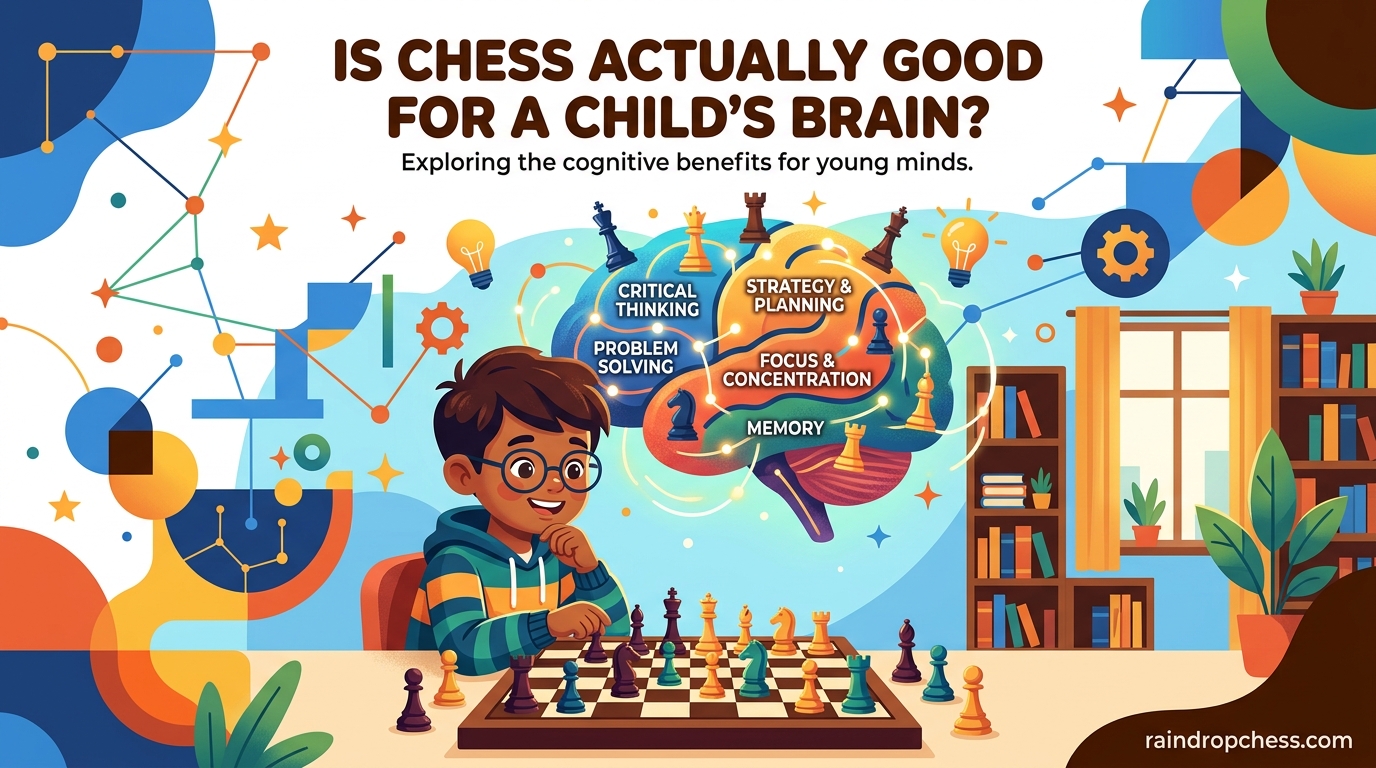
As a parent watching your child stare intently at a chessboard, calculating moves three steps ahead, you’ve likely wondered: is this actually building their brain, or just teaching them a game? The answer isn’t as simple as the headlines claim. Research shows chess benefits for children’s brains are real, but they’re more nuanced than the “chess makes you smarter” marketing suggests.
After analyzing dozens of studies and talking with researchers, educators, and parents, I’ve found that chess genuinely develops specific cognitive skills – executive functioning, working memory, pattern recognition, and impulse control. However, the evidence that these chess skills automatically transfer to making your child “smarter” in general is mixed. Let’s look at what the research actually shows, separated from the hype.
Table of Contents
Chess Benefits for Children Brain: Executive Function Development
Executive functioning – the brain’s command system for planning, focusing, and executing tasks – is where chess shows the strongest benefits for children. When children play chess, they’re constantly exercising these exact skills: planning several moves ahead, holding multiple possibilities in working memory, inhibiting impulsive moves, and adapting when opponents disrupt their strategy.
Brain imaging studies provide compelling evidence. Research using fMRI scans shows that chess activates the prefrontal cortex – the same brain region responsible for executive functions. During complex chess positions, children’s brains light up in areas associated with working memory, problem-solving, and cognitive control. This isn’t just theoretical; one study found that just 120 hours of chess instruction over a school year significantly improved executive function scores compared to control groups.
The key mechanism here is sustained cognitive engagement. Unlike fast-paced digital games that provide instant gratification, chess requires children to hold focus through extended calculation, resist the impulse to make quick moves, and manage frustration when plans don’t work. These are precisely the executive function skills that predict academic success and life achievement. The research suggests that regular chess play strengthens these neural pathways through the same principle that physical exercise strengthens muscles – repetitive challenge and adaptation.
Cognitive Benefits and IQ: What the Studies Actually Show
The claim that chess increases IQ in children is one of the most debated topics in the research. The famous Venezuela study from the 1980s showed students receiving chess instruction for 4.5 months gained IQ points, but this research has significant limitations. The sample size was small, and there was clear selection bias – children who volunteered for chess programs may have already had cognitive advantages.
More recent meta-analyses paint a more nuanced picture. Chess reliably improves specific cognitive abilities: pattern recognition, spatial reasoning, working memory, and calculation skills. These improvements are measurable and significant. However, the holy grail of “transfer effects” – whether chess skills automatically improve performance in completely unrelated domains – shows mixed results. Some studies find better math achievement, while others show no significant difference in general academic performance beyond the direct cognitive skills being trained.
What does this mean for parents? Chess will almost certainly improve your child’s ability to recognize patterns, think spatially, hold multiple pieces of information in mind simultaneously, and calculate through complex scenarios. These are genuinely valuable cognitive skills. Whether this translates to a higher IQ score or better grades across all subjects depends on factors like how consistently they play, the quality of instruction, and whether they consciously apply these thinking patterns beyond the chessboard. The cognitive benefits are real, but they’re not magic.
Academic Performance: Math, Reading, and Classroom Focus
When researchers examine chess’s impact on academic performance, math achievement shows the most consistent positive correlation. The connection makes intuitive sense – both chess and math require abstract thinking, pattern recognition, logical progression, and holding multiple steps in working memory. Several studies have found that students who receive regular chess instruction show improved math scores compared to control groups, with effects persisting even after controlling for initial ability.
The research on reading skills and verbal abilities is less consistent. Some studies show modest improvements in reading comprehension, possibly because chess trains the same working memory and analytical skills used in understanding complex texts. Other research finds no significant difference. The variability may come down to teaching quality – chess instructors who explicitly connect strategic thinking to reading comprehension see better transfer effects than those who focus purely on chess tactics.
Classroom behavior and attention present another clear benefit area. Teachers consistently report that students who play chess regularly demonstrate better focus, longer attention spans, and improved ability to follow multi-step instructions. This aligns with what we know about executive function development – chess trains the mental muscles that help children stay engaged with challenging tasks and resist distraction. For children who struggle with classroom attention, chess can be a valuable complementary tool alongside other educational supports.
Chess Benefits for Children with ADHD and Attention Challenges
For parents of children with ADHD or attention difficulties, chess research offers promising but realistic findings. Multiple studies over 10-12 week periods show that structured chess instruction can improve attention span, impulse control, and working memory in children diagnosed with ADHD. The game’s inherent requirement to think before acting, combined with immediate natural consequences for impulsive moves, creates an ideal training ground for self-regulation.
The mechanism appears to be twofold. First, chess provides structured cognitive engagement that strengthens the same prefrontal cortex circuits involved in attention control. Second, the game offers a safe environment to practice impulse control – a child learns that rushing a move usually leads to problems, while patience and calculation yield better outcomes. Over time, this pattern recognition can transfer to other situations requiring sustained attention.
However, chess should be viewed as a complementary approach rather than a standalone treatment. The research shows best results when chess is combined with other evidence-based ADHD interventions, not used as a replacement. For parents exploring chess as an ADHD support strategy, the key is consistency and patience – benefits emerge gradually over weeks and months of regular play, not from occasional games. Start with shorter sessions (15-20 minutes) and gradually increase duration as your child’s attention capacity grows.
The Research Reality: When Chess Benefits Don’t Transfer
Here’s what most chess-benefits articles won’t tell you: a significant body of research finds limited evidence that chess skills automatically transfer to unrelated domains. The “transfer problem” has plagued cognitive training research for decades – just because you get better at a specific mental task doesn’t mean you’ll be better at completely different mental tasks. Studies examining whether chess improves general intelligence, creativity outside of chess contexts, or academic subjects unrelated to math show inconsistent results.
The selection bias problem also complicates the research picture. Children who voluntarily join chess clubs often come from more privileged backgrounds, have more supportive home environments, and may already have cognitive advantages. When studies control for these factors, some of chess’s apparent advantages diminish. This doesn’t mean chess has no benefits – but it does mean we should be skeptical of claims that chess alone creates dramatic cognitive transformation.
Another crucial distinction often overlooked: casual play versus structured instruction. Research consistently shows that children receiving systematic chess lessons with trained instructors show greater cognitive benefits than children who play chess recreationally without guidance. The difference matters – simply having a chessboard available isn’t enough. Quality instruction that teaches thinking processes, not just moves and tactics, appears to be key for cognitive development. For parents, this means investing in lessons or coaching yields better brain-building results than leaving children to figure chess out on their own.
Age-Appropriate Introduction: When Should Children Learn Chess?
The research on optimal age for starting chess shows developmental readiness matters more than chronological age. Most cognitive benefits emerge when children have developed sufficient working memory and attentional capacity – typically around ages 6-8. Before this age, children can learn basic piece movements, but the strategic thinking that drives cognitive development remains limited. That said, early exposure (ages 4-5) can build familiarity and enjoyment that supports more serious study later.
Readiness signs include: ability to follow rules consistently, capacity to focus for 15-20 minutes, interest in strategy games, and basic counting skills. Children showing these traits typically benefit more from chess instruction than those pushed into the game before they’re developmentally prepared. The key is matching chess complexity to your child’s cognitive level – starting with simplified games, shorter sessions, and focusing on fun rather than technical mastery.
For maximum cognitive benefit, research suggests introducing chess between ages 7-11, when the brain’s prefrontal cortex is undergoing rapid development and executive functions are forming. This window aligns with what neuroscientists know about sensitive periods for cognitive training. However, starting later (ages 12-15) still yields benefits – adolescents show significant improvements in strategic thinking and problem-solving from chess instruction, even if they miss the early childhood window.
Practical Guidance for Parents: Maximizing the Cognitive Benefits
Based on the research, here’s how to actually help your child get the brain benefits from chess: aim for 2-3 sessions per week minimum, with each session lasting 20-30 minutes depending on age. Consistency matters more than marathon sessions. Find quality instruction – whether through school programs, chess clubs, or online platforms that focus on thinking processes rather than just memorizing openings. Play together when possible, asking questions like “What are you planning?” and “What happens if I do this?” to make strategic thinking explicit.
Connect chess skills to real-world situations. When your child faces a problem at school, ask them to think through it the way they’d analyze a chess position – identifying options, considering consequences, planning ahead. This explicit connection-making is where transfer effects are most likely to happen. Balance challenge and frustration – chess should be difficult enough to build cognitive muscles but not so hard that your child wants to quit. Most cognitive benefits disappear if children quit chess after a few months, so keeping it engaging matters more than pushing intensity.
Finally, have realistic expectations. Chess will likely improve your child’s focus, planning skills, pattern recognition, and comfort with strategic thinking. These are genuinely valuable. But it won’t magically transform them into a genius or guarantee academic success across all subjects. The children who benefit most are those who enjoy chess enough to stick with it, receive quality instruction, and consciously apply the thinking habits they learn beyond the board.
FAQ
Does chess increase IQ in children?
Research shows mixed results. The famous Venezuela study found IQ increases after 4.5 months of chess instruction, but this study had small sample size and selection bias issues. More recent research finds chess reliably improves specific cognitive skills like pattern recognition, working memory, and spatial reasoning, but evidence that these skills transfer to general intelligence increases is inconsistent. Chess likely develops cognitive abilities that IQ tests measure, but whether it raises IQ scores depends on factors like instruction quality, consistency of play, and initial ability level.
Is chess good for an ADHD child?
Yes, research shows chess can help children with ADHD improve attention span, impulse control, and working memory. Multiple studies over 10-12 weeks found that structured chess instruction strengthened the same prefrontal cortex circuits involved in attention control. Chess provides a natural environment for practicing impulse control because rushing moves leads to poor outcomes while patience yields better results. However, chess should be viewed as a complementary approach alongside other evidence-based ADHD treatments, not a standalone replacement. Benefits emerge gradually from consistent play over weeks and months.
What age should children learn chess?
Most cognitive benefits emerge when children have sufficient working memory and attentional capacity, typically around ages 6-8. Before this age, children can learn basic piece movements but strategic thinking remains limited. Research suggests the optimal window for cognitive benefit is ages 7-11, when the prefrontal cortex is rapidly developing. Readiness signs include ability to follow rules consistently, focus for 15-20 minutes, interest in strategy games, and basic counting skills. Starting later (ages 12-15) still yields significant benefits in strategic thinking and problem-solving.
Does chess make children smarter?
Chess makes children smarter in specific ways – it reliably improves executive functioning, pattern recognition, working memory, spatial reasoning, and strategic thinking skills. Brain imaging studies show chess activates the prefrontal cortex and strengthens neural pathways used for planning and problem-solving. However, research on whether these skills transfer to improved general intelligence or academic performance outside of math shows mixed results. Chess develops valuable cognitive abilities, but it’s not a magic solution for overall intelligence. The children who benefit most are those who receive quality instruction and play consistently over time.
Conclusion
So is chess actually good for a child’s brain? The research says yes – with important caveats. Chess genuinely strengthens executive functioning, working memory, pattern recognition, and impulse control. Brain imaging studies confirm it activates the neural circuits responsible for planning, focus, and strategic thinking. For children with ADHD or attention challenges, structured chess play can meaningfully improve concentration and self-regulation. And the math achievement benefits are well-documented across multiple studies.
But chess isn’t a miracle cure. The cognitive benefits are real but specific – they don’t automatically transfer to making your child smarter across all domains. Quality instruction matters more than casual play. Consistent engagement over time matters more than intensive short-term bursts. And children who enjoy the game enough to stick with it benefit far more than those pushed into chess before they’re ready.
For parents considering chess as a cognitive development tool, the research-backed approach is clear: start when your child shows developmental readiness (usually ages 6-8), find quality instruction that emphasizes thinking processes over tactics, aim for consistent practice 2-3 times weekly, and connect the strategic thinking skills learned in chess to real-world problem-solving. Chess benefits for children’s brains are real and measurable – but they emerge from the right combination of quality instruction, consistent practice, and developmental readiness, not from simply having a chessboard in the house.