
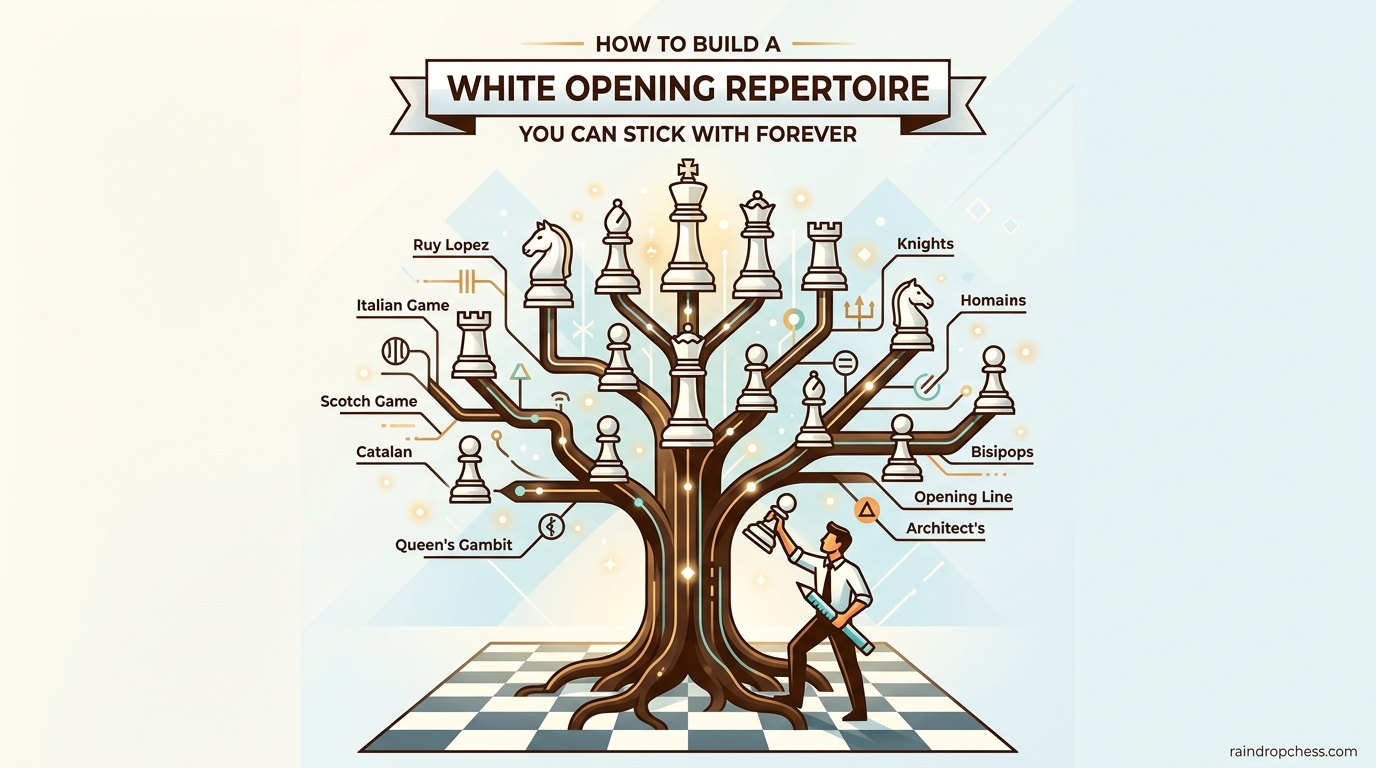
You have probably been there. You spend weeks memorizing lines from a Chessable course. You drill the moves until your fingers know them by heart. Then your opponent plays something slightly off-book on move six, and suddenly every plan you memorized evaporates.
This happens to chess players constantly. They build a white opening repertoire the wrong way, one move at a time, without any real understanding of why they are making those moves. The result is a fragile knowledge that falls apart the moment something unexpected happens.
In this guide, I will show you how to build a white opening repertoire that actually sticks. We will cover everything from choosing openings that match your style to using spaced repetition the right way. By the end, you will have a clear roadmap for creating a repertoire you can rely on for years, not just weeks.
Table of Contents
Why You Need a Repertoire That Actually Sticks
Most chess players approach opening preparation like they are studying for a test. They memorize move sequences. They look for tricks and traps. They try to learn as many lines as possible.
The problem is that chess is not a multiple choice exam. Your opponent does not follow the script. When they play something you have not seen before, all that memorization becomes useless if you do not understand the underlying logic.
I have watched countless players hit a wall around 1400 or 1500 Elo not because they lack talent, but because their opening knowledge is built on sand. They know moves but not plans. They remember positions but not structures. When the game goes off the beaten path, they are lost.
A solid white opening repertoire solves this problem. It gives you positions you understand deeply, plans you can execute even when your opponent deviates, and a framework for handling anything they throw at you. Instead of hoping your opponent follows the script, you build knowledge that works in any scenario.
Understanding What a Chess Opening Repertoire Actually Is
A chess opening repertoire is not just a collection of openings you happen to know. It is a deliberately chosen set of responses you play consistently as White, designed to reach middlegame positions where you understand the plans and your opponent does not.
The key word is “system.” A true repertoire has coherence. Your 1.e4 lines should work together. Your 1.d4 responses should share common strategic themes. This coherence is what allows you to play confidently even when your opponent tries to surprise you.
Think of it this way. Grandmasters do not memorize every possible position. They understand pawn structures and piece placement so well that they can navigate unknown positions using the same principles they use for their prepared lines. That is the goal of a real white opening repertoire.
What Is the 40-40-20 Rule in Chess?
You may have heard players mention the 40-40-20 rule. This is not an official law of chess. It is a rough guideline about where games are decided.
The idea is that roughly 40 percent of games are decided by opening mistakes, another 40 percent by middlegame errors, and 20 percent by endgame technique. Some people dispute these exact numbers, but the underlying point matters for repertoire building.
If 40 percent of your games are lost in the opening, then getting a solid white opening repertoire is not optional. It is essential if you want to improve your results. But here is the catch. That 40 percent is not about knowing more lines than your opponent. It is about avoiding positions where you are already lost before the middlegame begins.
Choosing Openings That Match Your Playing Style
Before you pick a single move, you need to understand yourself. Your playing style dramatically affects which openings will feel natural and which will constantly put you in uncomfortable positions.
Are you a tactical player who loves complications, sacrifices, and sharp play? Or are you a positional player who prefers clean structures, piece maneuvering, and gradual advantages?
Most players have a dominant tendency, though the best players can shift between styles depending on the position. When you are building your white opening repertoire, pick openings that align with your natural inclinations. You will play them better, study them more enjoyably, and stick with them longer.
If you love sharp positions and concrete calculation, 1.e4 openings like the Ruy Lopez, the Sicilian, or the King’s Gambit might suit you. If you prefer clean positions and long-term planning, 1.d4 systems like the Queen’s Gambit Declined, the Catalan, or the London System will feel more natural.
The worst thing you can do is choose openings based on what someone else says is “objectively best” without considering how they match your style. The best opening for your repertoire is the one you actually enjoy playing and can stick with for years.
White’s Main Options: Your First Move Choices
As White, you have four main first moves that form the foundation of most serious repertoires. Each has distinct character and leads to different types of positions.
The 1.e4 First Move
The king pawn opening has been the most popular choice at all levels for over a century. 1.e4 immediately fights for central control and opens lines for your queen and bishop. It leads to more tactical, double-edged positions on average.
Against 1.e4, Black has several major responses. The Sicilian Defense is the most combative, often leading to sharp play where both sides have chances. The French Defense is more solid but creates an awkward pawn structure for Black. The Caro-Kann is positionally sound but can be passive. The Open Game repertoire (1.e4 e5) leads to classical chess with the Ruy Lopez, Italian Game, and Scotch.
If you play 1.e4, you are signing up for more concrete, tactical battles. Your opponent will have fewer safe positions to hide behind.
The 1.d4 First Move
The queen pawn opening is White’s most solid choice. 1.d4 also claims central space and leads to more positional, strategic battles on average. The pawn structure tends to be more stable, and piece maneuvering matters more than acute tactics.
Against 1.d4, Black has several major defenses. The Queen’s Gambit Declined is the most classical response, fighting for the center with solid piece development. The Nimzo-Indian and King’s Indian Defense are more ambitious, challenging White’s center directly. The Slav Defense provides a solid alternative to the QGD.
If you play 1.d4, you are building toward middlegame positions where understanding plans matters more than memorizing variations. This suits players who prefer strategic complexity to tactical chaos.
The 1.c4 First Move
The English Opening is a flexible first move that often transposes into other systems. It avoids many of Black’s most prepared responses and can lead to very different positions depending on how Black replies.
Many players who struggle with 1.d4 find 1.c4 more comfortable. It is a “slow” opening that prioritizes flexibility and long-term positioning over immediate central confrontation.
The English is particularly good if you want to avoid massive theory. While it has plenty of lines, many positions arise from different move orders, and your understanding of general principles carries further than in more tactical systems.
The 1.Nf3 First Move
The Reti Opening is the most transpositional of White’s main choices. By developing a knight first rather than pushing a pawn, you keep your options open and can head toward many different structures.
1.Nf3 often leads to closed or semi-closed positions where piece placement matters enormously. It is a favorite of players who want to avoid theory and rely on understanding.
This move works particularly well if you want one setup that can handle anything Black plays. You can develop harmoniously without committing to a specific pawn structure early, then steer toward positions you understand well.
The Key Principle: Learn Plans, Not Just Moves
Here is where most players go wrong. They treat opening preparation like brute force memorization. They learn move sequences without understanding why those moves are played.
The result is fragile knowledge that fails the moment anything unexpected happens. Your opponent plays a move you have not studied, and suddenly you are thinking for the first time in the game, already on the back foot.
The solution is to study openings the way grandmasters do. For every position in your repertoire, ask yourself these questions. What is the pawn structure and what are its implications? Which side has the better bishop and why? What are the typical plans for both sides? What does the position want to become in 10 moves if nothing dramatic happens?
When you understand plans, you do not need to know every possible move. You can evaluate new positions using the same principles that govern your prepared lines. Your knowledge generalizes instead of being locked to specific move orders.
This is what I mean by a white opening repertoire you can stick with forever. It is not a collection of memorized lines. It is a deep understanding of positions and plans that serves you regardless of what your opponent plays.
How Deep Should You Study? Rating-Based Guidelines
One of the most common questions I see is “how deep should my repertoire be?” The answer depends heavily on your current rating and what your goals are. Here are practical guidelines based on how much coverage you actually need.
Under 1200 Elo
At this level, your priority is mastering opening principles, not memorizing lines. You need to understand why we develop pieces before moving them, why we fight for the center, and why we connect our rooks. A basic repertoire of main line openings with understanding of their main plans is all you need. Focus your study time on tactics and fundamental endgame technique. Those will improve your results far more than deep opening knowledge.
1200 to 1700 Elo
This is where a real white opening repertoire starts to matter. You should know your main lines through move 10 to 12 with good understanding of the plans involved. You also need to handle the most common deviations, particularly the ones your opponents actually play at your level. Avoid the trap of learning too many sidelines. Go deep on your main lines before expanding sideways.
1700 to 2000 Elo
At this level, you need reliable responses to all of Black’s main systems plus most of the serious second-line choices. Your main lines should go 15 to 18 moves deep with understanding of plans, structures, and typical piece placement. You should also start using transpositions strategically to reduce your study workload. One move order trick can let you reach familiar positions through different paths.
2000 and Above
Above 2000 Elo, your repertoire needs to handle everything Black throws at you with high reliability. That means comprehensive coverage of main lines and serious sidelines. You need engine analysis to verify your understanding and identify subtle improvements. Most importantly, you need to maintain what you know through regular drilling using spaced repetition. At this level, maintenance is as important as expansion.
Transpositions and Move Order Flexibility
One of the smartest things you can do for your white opening repertoire is embrace transpositions. A transposition occurs when you reach the same position through different move orders.
For example, if you sometimes play 1.d4 followed by 2.c4, and other times play 1.c4 followed by 2.d4, you might reach identical positions. By knowing these connections, you can reduce how much you actually need to study.
When you choose a system with flexible move orders, you can often avoid committing to a specific structure until you have more information about Black’s setup. This is why many players prefer the English or the Reti. They keep options open longer than rigid systems do.
The practical benefit is enormous. Instead of preparing separate lines against each of Black’s responses, you can often steer toward positions you already understand well regardless of how your opponent started.
Use transpositions deliberately to make your repertoire more efficient. The goal is not to know every possible move. It is to reach comfortable positions as often as possible while minimizing your study workload.
Tools and Methods for Building Your Repertoire
You do not need expensive tools to build a solid white opening repertoire, but using the right methods makes a huge difference. Here is what actually works.
Spaced repetition software is the backbone of modern opening preparation. Chessable is the most popular option, using algorithms like FSRS to optimize your review schedule. When you learn a line on Chessable, the software tracks how well you remember it and schedules reviews at the optimal interval. This turns opening knowledge into long-term memory instead of short-term cramming.
Lichess Studies are another powerful tool. You can create a study with all your lines, annotate them with your own analysis, and review them anytime. The collaborative features let you share with training partners or coaches. Lichess also tracks which positions you have reviewed recently.
For verification and deeper analysis, use a chess engine. Stockfish or similar engines help you confirm that your understanding is correct and identify any lines you might have missed. Engines are particularly useful for checking move orders and transpositions.
PGN files remain the universal format for storing opening lines. Export your repertoires from whatever tool you use and keep backups. Losing months of preparation to a software crash is devastating and entirely preventable.
Common Mistakes to Avoid
Building a white opening repertoire goes wrong in predictable ways. Learning from these mistakes will save you years of frustration.
The first mistake is trying to learn too many openings at once. I see players bounce between the Sicilian, the King’s Indian, the Catalan, and the English, never mastering any of them. They spread their study time across everything and end up knowing a little about a lot but not enough about any single line. Pick one first move and master it before expanding.
The second mistake is switching openings when ratings stall. Rating plateaus are normal. They usually happen because you have reached the limit of what your current knowledge supports, not because your opening is wrong. Before changing, analyze whether your issues are actually opening-related or if they stem from middlegame or endgame play.
The third mistake is focusing exclusively on opening memorization while neglecting middlegame skills. Opening knowledge is just the beginning. Even a perfect repertoire only gets you to move 15 or 20. After that, your results depend entirely on the rest of your chess skills. Improving those skills is what actually raises your rating long-term.
How to Patch Gaps in Your Repertoire
No repertoire is ever complete. You will discover gaps the first time an opponent plays something you have never studied. How you handle these discoveries matters enormously.
After every game where you felt lost in the opening, analyze whether the problem was a genuine gap or a misunderstanding. A gap means you had no prepared response. A misunderstanding means you knew the line but played it incorrectly.
Fix misunderstandings immediately by reviewing the correct moves and understanding why your plan failed. Fix gaps by adding the new line to your repertoire, but prioritize based on how often you encounter it. If you see this response once a year, a brief note is enough. If you see it monthly, it needs proper preparation.
The key is to patch without rebuilding. Your repertoire is not a house you need to remodel every time you find a problem. It is a living document you update as needed. Add what is necessary, review occasionally, and keep moving forward.
Conclusion
Building a white opening repertoire you can stick with forever is not about memorizing the most lines or finding the objectively best openings. It is about creating a coherent system that matches your style, understanding it deeply enough to navigate variations, and maintaining it with regular review.
The players who succeed with their repertoires long-term are the ones who picked openings they genuinely enjoy playing, learned plans instead of just moves, and stayed patient through rating plateaus instead of abandoning their work at the first sign of trouble.
Start today. Pick one first move. Choose one main line. Study it deeply enough that you understand why every move is played. Build from there. In a year, you will have a repertoire that serves you reliably. In five years, you will have knowledge that feels like a natural extension of how you think about chess. That is what a white opening repertoire built to last actually looks like.
FAQ
What is the strongest opening move for white?
There is no single “strongest” opening move in chess. 1.e4, 1.d4, 1.c4, and 1.Nf3 are all used by grandmasters at the highest levels. The best choice depends on your style. 1.e4 leads to sharper, more tactical play. 1.d4 is more positional and strategic. 1.c4 and 1.Nf3 offer flexibility and transpositional possibilities. Pick the move that matches how you want to play, not what someone claims is objectively best.
How to build an opening repertoire?
Start by choosing openings that match your style. Learn plans and structures, not just move sequences. Build depth gradually, starting with 1-2 main lines. Add responses to common deviations as you encounter them. Use spaced repetition software to maintain what you learn. Review games regularly to identify gaps, then patch them without rebuilding your entire system.
What is the 40-40-20 rule in chess?
The 40-40-20 rule is a rough guideline suggesting that about 40 percent of games are decided by opening mistakes, 40 percent by middlegame errors, and 20 percent by endgame technique. While the exact percentages are debated, the principle matters for repertoire building. It means avoiding opening disasters is essential, not optional. Your goal is positions where you are equal or better by move 15, not hoping your memorization carries you further.
How many positions should a working repertoire contain at 1500 ELO?
At 1500 Elo, aim for thorough knowledge of your main lines through moves 10-12, plus handling the most common deviations your opponents actually play. This typically means knowing 3-5 main responses for Black against your first move, with 2-3 common deviations each. You do not need comprehensive coverage of rare sidelines yet. Focus on depth in your main lines before worrying about width.
Should I switch openings if my online rating stalls for several months?
Probably not. Rating plateaus at your current knowledge level are normal. Before switching, analyze whether your issues are actually opening-related. Are you losing in the opening, or are you reaching equal or better positions and then losing in the middlegame? If it is the latter, improving your middlegame play will raise your rating far more than changing openings. Stick with your repertoire and focus on the parts of your game that actually need work.
Do I need to cover every rare sideline or can I leave gaps in my repertoire?
Leave gaps strategically. You do not need to prepare for every obscure line your opponent might try. If a sideline is rarely played, a basic understanding of the main ideas is enough. Focus your deep preparation on lines you actually encounter regularly. Use your game history to identify which gaps matter most. A rare sideline you have never faced does not need the same attention as a deviation you see every week.
How much study time per day does a maintained repertoire require?
For maintenance only, 15-30 minutes daily using spaced repetition is usually enough to retain a well-built repertoire. If you are actively expanding your repertoire while maintaining existing knowledge, budget 30-60 minutes daily. The exact time depends on how large your repertoire is and how deeply you want to know each line. Consistency matters more than duration. Daily short sessions outperform weekly long cramming sessions.