
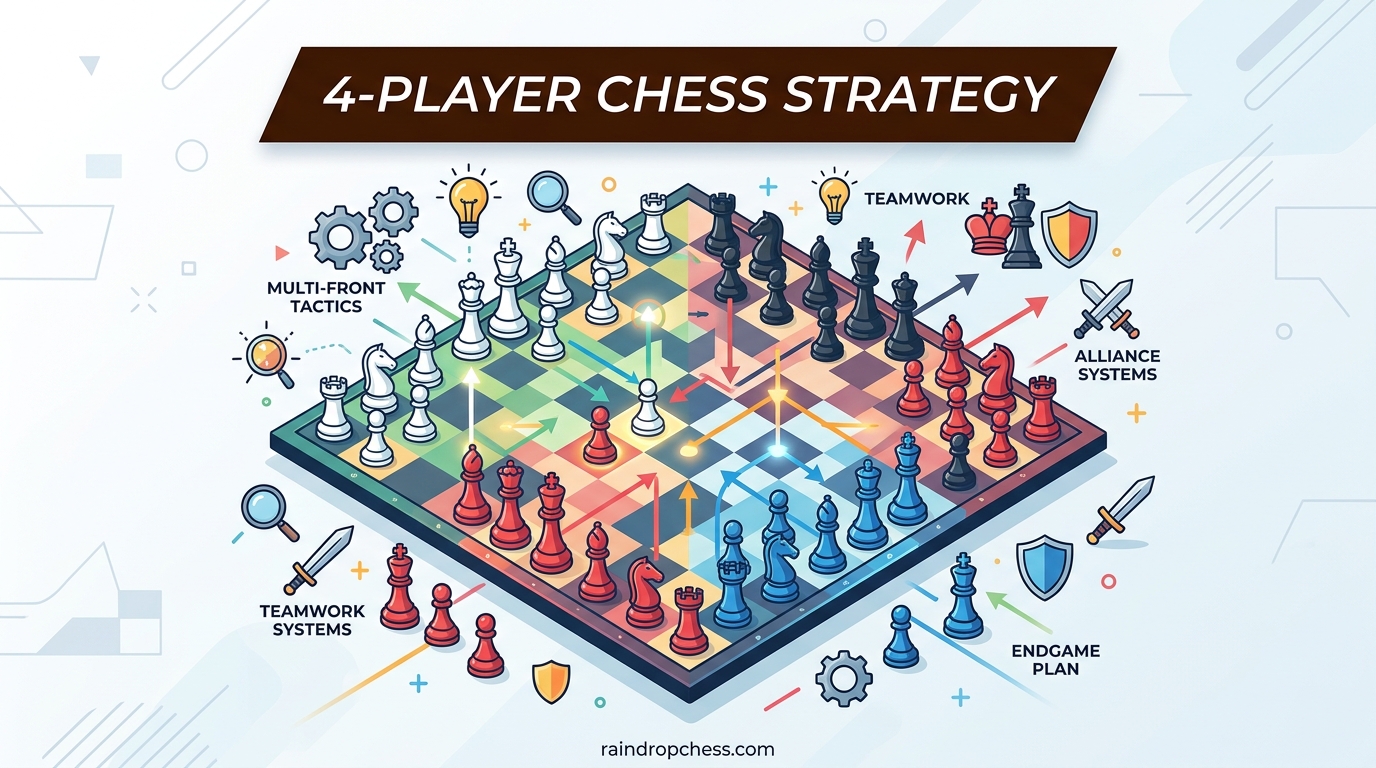
2026 Four-player chess transforms the royal game into a battlefield of shifting allegiances. While classical chess is a solo duel, multiplayer variants introduce something dangerously close to politics: temporary alliances that can suddenly collapse into betrayal. Understanding when to cooperate, when to strike, and when to turn on your supposed ally separates the novices from the masters in four-player chess. This guide breaks down the core strategic principles that govern alliances in this chaotic, compelling variant.
Table of Contents
The Unique Dynamics of Four-Player Chess Alliances
Unlike two-player chess, where your enemy is always clear, four-player chess creates a web of potential relationships. Any player can become an ally, a target, or a betrayer within the span of a few moves. This fluidity makes alliances both powerful and treacherous. The player who masters alliance dynamics does not just play chess—they play the political game that surrounds it.
In four-player chess, survival often depends on reading the board state and the intentions of other players. Aggressive alliances can form to eliminate a dominant threat, only to dissolve once that threat is removed. Sometimes a player will feed you advantages, expecting loyalty later—or planning their betrayal when your guard is down. The best four-player chess players are those who can navigate this social layer without losing sight of checkmate threats.
The core principles of alliance strategy in four-player chess rest on two fundamental rules: the Rule of Two Attackers and the Rule of the Opposite. These guidelines help you make decisions about when to attack, when to defend, and when to pivot your allegiances. Let us examine each in detail.
Rule of Two Attackers: The Power of Combined Forces
The Rule of Two Attackers states that no single player should attempt to eliminate another player alone. In four-player chess, the attacking force must come from at least two directions to be effective. This principle exists because defending against a coordinated assault from multiple players is nearly impossible, while attacking alongside an ally spreads the risk and maximizes the chance of success.
When you identify a target—typically the player in the strongest position—you need allies. Going it alone against a well-defended position invites disaster. The targeted player can focus all their defensive resources on your single assault, while you expose yourself to counterattacks from uninvolved players who see an opportunity. Two attackers create a dilemma: the defender must choose which assault to address, leaving the other breach unguarded.
The practical application of this rule requires reading the board and player intentions. Look for players who share your concern about the dominant position. Approach them subtly—sometimes through in-game actions rather than explicit communication. Move your pieces toward a common target while keeping enough defensive cover to avoid becoming the next victim. The alliance forms organically through shared purpose rather than explicit negotiation in most cases.
Consider a scenario where you hold a strong position with a powerful attacking force. A second player begins positioning pieces near your opponent across the board. Rather than viewing this as a threat, recognize it as an opportunity. Align your attacks to pressure the same target. Neither of you needs to announce the alliance—the coordinated assault speaks for itself. The target player will struggle to defend against two fronts simultaneously, and their defeat benefits you both.
Rule of the Opposite: Creating Strategic Dilemmas
The Rule of the Opposite governs how to position yourself when two other players form an alliance against a common target. It states that you should position yourself on the opposite side of the board from your potential ally when attacking a shared target. This creates a crossfire situation where the target cannot defend both directions simultaneously, and it prevents accidental self-destruction when the assault concludes.
When two players attack from opposite sides of the board, the target faces a classic pincer movement. Defending against your ally means leaving themselves exposed to you, and vice versa. The target must choose which assault to survive, and the other will inevitably break through. This geometry makes coordinated attacks devastating when executed correctly and helps you avoid the awkward situation where your ally accidentally captures your pieces or blocks your winning attack.
The Rule of the Opposite also governs post-alliance positioning. When an alliance forms to eliminate a dominant player, the remaining players must immediately begin thinking about their relationship. The player who contributed more to the elimination should expect higher reward—but the Rules also set expectations for what happens after. Position yourself to be closest to the eliminated player’s territory, ready to claim the greatest share of their lost position.
Imagine a situation where three players surround a fourth. The target defends heroically but cannot withstand attacks from three directions. When they fall, chaos often follows—the three victors now face each other with varying levels of advantage from the fallen player. Applying the Rule of the Opposite, you position yourself to receive the largest benefit while staying prepared to defend against former allies who may now view you as the biggest threat.
Betrayal Timing: When to Turn on Your Ally
Betrayal in four-player chess is not a question of if but when. The key question is not whether to betray your ally but rather what timing maximizes your advantage. Early betrayal catches your ally off guard but may leave you exposed to other players. Late betrayal risks your ally turning first, leaving you in a weakened position. The optimal timing depends on several factors.
Reading the Board State
The most reliable indicator for betrayal timing is board state. Watch for moments when your ally commits heavily to an attack, exposing their pieces. Their defensive structure weakens during the assault, making a sudden betrayal both effective and difficult to counter. Alternatively, observe when your ally approaches a dominant position that will make them unbeatable once the current target falls. Betraying before they consolidate that advantage prevents them from becoming the new powerhouse.
Counting the Remaining Players
In four-player chess, the transition from four to three players changes the strategic landscape significantly. When your ally elimination would leave you in a strong position relative to the remaining opponent, betrayal becomes attractive. Calculate your expected position after the betrayal. If you will control more than half the remaining board advantage, strike. If not, wait for a better opportunity or a different trigger event.
The Three-Player Transition
When four-player chess reduces to three players, the dynamics shift dramatically. Alliances become much more explicit and fragile. The player in the weakest position often becomes the target of an alliance between the two stronger players. If you are that weakest player, you must recognize the danger quickly and either find a way to break the alliance or position yourself as the less attractive target. If you are one of the stronger players, watch for signs that your ally plans to eliminate you once the third player falls.
The Element of Surprise
Surprise matters in betrayal timing. If your ally expects betrayal, they will have prepared defenses. The ideal betrayal moment comes when your ally believes the alliance is secure and has let their guard down. This often occurs immediately after a successful joint elimination, when the victory celebration distracts from defensive positioning. Experienced players refer to this as “the victory blindspot”—a moment of lowered vigilance that skilled betrayers exploit.
When to Form Alliances
Forming alliances requires reading both the board state and player psychology. The right moment to ally is when the strategic conditions favor cooperation and when you can identify a target whose elimination benefits you. Rushing into alliances without clear purpose creates dependency and exposure that experienced players exploit.
Against the Dominant Player
The most reliable alliance trigger is the presence of a dominant player who threatens to win if not stopped. When one player accumulates significant material advantage or positional strength, other players have a shared interest in containing that threat. The alliance forms naturally as players recognize the common danger. No negotiation is necessary—the board state communicates the threat clearly.
In practice, watch for the player who has captured multiple pieces from different opponents, who controls central real estate, or who threatens checkmate on multiple fronts simultaneously. This player has become the alpha, and the remaining players share an interest in their elimination. Your alliance should form around this shared interest, with each participant contributing enough to ensure success without overcommitting to the point where you cannot pivot if circumstances change.
Mutual Benefit Scenarios
Beyond anti-alpha alliances, consider forming partnerships where both participants benefit directly. If your pieces naturally complement another player’s style—if you excel at long-range attacks while they control the center—a temporary partnership can capture significant territory from a third player whose position lies between you. This alliance dissolves once the territorial division concludes, leaving both players stronger for the next phase.
The key is ensuring the benefit flows evenly. If an alliance benefits one player dramatically while leaving the other only marginally improved, the disadvantaged player has incentive to dissolve the partnership before the advantaged player becomes unstoppable. Structure alliances around rough parity in expected gain, and build in exit opportunities that allow graceful dissolution when the partnership’s purpose concludes.
Defensive Alliances
Not all alliances are offensive. Defensive alliances form when a player faces elimination and offers partnership terms to would-be attackers. If you are the target, offering partial compensation—some material, positional advantage, or future cooperation—to a potential eliminator can buy survival. If you are one of the potential attackers, evaluating whether the target’s offer exceeds the value of their elimination helps determine whether to accept the partnership or press forward.
Defensive alliances are inherently unstable. The player who survives through defensive alliance often emerges weakened, a target for future elimination. However, survival itself has value, particularly when the alternative is immediate defeat. Use defensive alliances as temporary measures that buy time to rebuild strength, not as long-term strategies. The goal is to emerge from the defensive alliance in a position to form stronger offensive partnerships later.
When to Break Alliances
Breaking alliances—sometimes called backstabbing—represents one of the most psychologically challenging aspects of four-player chess. The decision requires balancing the immediate gain from betrayal against the long-term cost to your reputation and strategic position. Breaking alliances too often marks you as unreliable; never breaking them leaves you dependent on others’ goodwill.
The Power Imbalance Signal
The primary signal that an alliance should break is power imbalance. If your ally has grown significantly stronger through the alliance—whether through material gain, positional advantage, or eliminated opponents—and now threatens to become dominant, the alliance’s purpose has been achieved in a way that disadvantages you. The betrayal should come before this imbalance solidifies into an unbeatable position.
Track the accumulated advantage during an alliance. If your ally has gained twice as much as you from your joint activities, the partnership has become lopsided. They now possess resources to eliminate you at will, while you remain dependent on continued cooperation for protection. This is the optimal betrayal window: your ally feels secure but has not yet consolidated their advantage into an unstoppable position.
Alternative Target Availability
Sometimes breaking an alliance makes sense not because your current ally has become dangerous but because a better target has emerged. If a third player has accumulated significant advantage while you and your ally were focused elsewhere, turning on your ally to address this new threat may be strategically superior. The key is ensuring the new target represents a larger potential gain than betraying your current partner.
This scenario requires careful evaluation. Betraying your ally to pursue a new target is only advantageous if the new target exceeds your ally’s value AND if you can defeat the new target with your current resources. If betraying your ally leaves you too weakened to address the new threat, you have simply created a different problem. Weigh the expected gains from each path before committing to betrayal.
The Third Player Threshold
When the game transitions to three players, the alliance structure must evolve. Alliances of two against one are inherently unstable because the minority player faces elimination. If you are part of a two-player alliance as the game reaches three players, evaluate whether your ally will turn on you first. Sometimes preemptive betrayal—attacking your ally before they can attack you—represents the optimal survival strategy.
The third player threshold is particularly dangerous for the player in the weakest position among the three. They become the obvious alliance target and must either find ways to make themselves invaluable to one of the stronger players or accept that elimination is imminent. Stronger players should watch for signs that their partner is preparing a preemptive strike—the weakest player often attacks first to avoid being caught in a two-versus-one alliance.
Reputation Management
Every betrayal affects your reputation with remaining players, present and future. Betraying too readily marks you as untrustworthy; other players will refuse alliances or demand unfavorable terms. Betraying too rarely leaves you exploited by partners who take advantage of your reliability. The optimal balance requires selective betrayal that serves strategic goals while preserving enough trustworthiness for future partnerships.
Experienced players track betrayal patterns. If you have not betrayed anyone in recent games, your reputation for reliability is high, and partners will offer better terms. If you have betrayed frequently, expect suspicion and reduced partnership opportunities. Manage your reputation deliberately, betraying strategically when the gain justifies the cost to your trustworthiness and appearing reliable when reputation rebuilding serves long-term interests.
Advanced Alliance Tactics
Beyond the fundamental rules, several advanced tactics can improve your alliance outcomes. These strategies require practice to execute effectively but provide significant advantages when mastered.
The False Alliance
A false alliance involves appearing to cooperate with a player while actually positioning for their elimination. You move pieces toward the same target, share in the attack, and let your partner believe the partnership is genuine. When they commit their pieces to the assault, leaving their position exposed, you turn and eliminate them instead. This tactic requires patience and precise timing but can yield enormous advantages.
The Buffer Alliance
The buffer alliance targets a fourth player who sits between you and your actual objective. You ally with the buffer to eliminate them, split their territory, and then immediately turn on your ally to control the entire former buffer zone. This tactic works when geography makes direct conflict with your ultimate target impractical and the buffer must be removed regardless. The buffer alliance provides cover for your true intentions.
The Chain Alliance
Chain alliances involve a sequence of partnerships where each alliance targets the previous partner’s replacement. You ally with Player A to eliminate Player B. You then ally with Player C to eliminate Player A. You ally with Player D to eliminate Player C, and so on until victory. This tactic requires careful management of trust and timing but can systematically eliminate competition while maintaining the appearance of reliability.
Common Alliance Mistakes to Avoid
Even players who understand alliance theory often make predictable mistakes. Recognizing these errors helps you avoid them and exploit them in others.
Overcommitting to a single ally. Placing too many pieces in support of one partner leaves you vulnerable when that partnership dissolves. Always maintain escape routes and defensive options even within seemingly secure alliances. The player who commits all resources to one partnership has no pivots when circumstances change.
Ignoring board state during negotiations. Players sometimes become so focused on social dynamics that they ignore objective board evaluation. An alliance may feel politically sound while being strategically disastrous. Evaluate every alliance on its strategic merits independent of social considerations.
Failing to track alliance ages. Alliances have lifecycles. New alliances feel tentative and fragile. Mature alliances develop routine and expectations. Old alliances begin degrading as circumstances change and trust erodes. Knowing where your alliances fall in this lifecycle helps predict when they will dissolve and whether you should be the one to dissolve them.
Taking too long to betray. When betrayal is necessary, delay increases danger. Your ally may recognize your hesitation as weakness or may betray you first. If you have decided to betray, do so decisively and without warning. Half-hearted betrayal attempts leave both parties damaged but your ally retains initiative.
Frequently Asked Questions About Four-Player Chess Alliances
The complexity of alliance dynamics generates many questions. Here are answers to the most common concerns players raise about four-player chess partnerships.
Is betraying your ally in four-player chess considered poor sportsmanship?
Not within the game’s established norms. Four-player chess explicitly incorporates betrayal as a legitimate strategic option. The variant’s design acknowledges that alliances are temporary by nature, and players who fail to recognize this find themselves eliminated through loyalty to partners who had no such loyalty in return. Experienced players expect betrayal and plan for it accordingly. Refusing to betray on principle puts you at a significant disadvantage against players who treat alliances as what they are: temporary cooperative arrangements.
How can I tell if my ally is about to betray me?
Watch for behavioral and positional signals. Behaviorally, your ally may become less communicative, stop offering pieces or positions, and begin positioning pieces defensively rather than offensively. Positionally, they may be accumulating pieces without attacking, leaving themselves with strong defensive options. If your ally begins improving their position relative to yours without clear strategic purpose, they are likely preparing a betrayal. Prepare your own countermeasures immediately.
Should I always attack the player who is winning?
Not always. The dominant player is the obvious target, but obvious targets often have prepared defenses. Sometimes targeting a secondary threat or even an ally yields better results. Evaluate the expected value of each target, including the costs of the attack, the likelihood of success, and the post-victory position. The player in second place who is rising rapidly often makes a better target than the dominant player who has already peaked.
What is the best way to form an alliance?
The best alliances form implicitly through coordinated action rather than explicit negotiation. Move pieces toward a common target while allowing your potential partner to do the same. If they follow your lead, the alliance exists without ever requiring a conversation about it. Explicit negotiations can backfire by revealing your intentions to other players or by creating commitments that limit your flexibility. Let the board communicate your intentions.
How many alliances should I form during a game?
This depends on the game length and player dynamics. In a typical four-player chess game, expect to form two to four distinct alliances of varying duration. Some alliances last only a few moves, targeting an immediate threat. Others persist through multiple elimination phases. The number matters less than the quality. One well-timed alliance that eliminates a major threat and leaves you in a strong position outperforms several poorly executed partnerships that waste resources.
When should I refuse to ally even when approached?
Refuse alliance proposals when the proposing player is in a weaker position than you and their elimination would leave you stronger, when the proposed target is not actually threatening, or when the terms being offered underserve your interests. Alliances should improve your strategic position. If an alliance would leave you at a disadvantage relative to your potential partner, decline. Your reputation for selectivity often proves more valuable than one questionable partnership.
Conclusion: Mastering the Art of Alliance
Four-player chess alliances combine strategic calculation with psychological awareness. The Rule of Two Attackers ensures that eliminations succeed by requiring coordinated assault from multiple directions. The Rule of the Opposite governs positioning for maximum effectiveness and minimum collateral damage. Together, these principles provide a framework for making alliance decisions that may otherwise seem chaotic.
Betrayal timing separates skilled players from novices. The best betrayals come when your ally has committed resources to a shared goal but has not yet consolidated the resulting advantage. They exploit the victory blindspot when trust reaches its peak. Failing to time betrayal correctly—either too early or too late—leaves you in a worse position than maintaining the alliance would have provided.
Understanding when to form and break alliances requires evaluating multiple factors simultaneously: board state, power distribution, player psychology, and reputation effects. The players who excel at four-player chess develop an intuition for these dynamics that guides their decisions without requiring explicit calculation. They read the signals other players emit through their piece movements and alliance behaviors, anticipating betrayals before they occur and positioning to benefit from the inevitable disruptions.
Ultimately, four-player chess alliances are about managing relationships in service of survival. The player who treats alliances as pure transactions—evaluating each move purely on immediate gain—misses the reputational dimensions that shape long-term success. The player who prioritizes loyalty above all else gets exploited by partners who recognize and act on their reliability. Balance is key: be trustworthy enough to attract partnerships, unpredictable enough to prevent exploitation, and strategic enough to know when each approach serves your interests.
Practice these principles in your next four-player chess game. Start by applying the Rule of Two Attackers to every elimination you attempt. Watch for opportunities to position according to the Rule of the Opposite. Develop your sense of betrayal timing through deliberate practice, and manage your reputation deliberately rather than by accident. The mastery of alliance dynamics will elevate your four-player chess game from competent to exceptional.
Remember: in four-player chess, your allies today may be your enemies tomorrow, and your enemies today may be your allies tomorrow. The only constant is the board, and the only certainty is change. Play accordingly.