
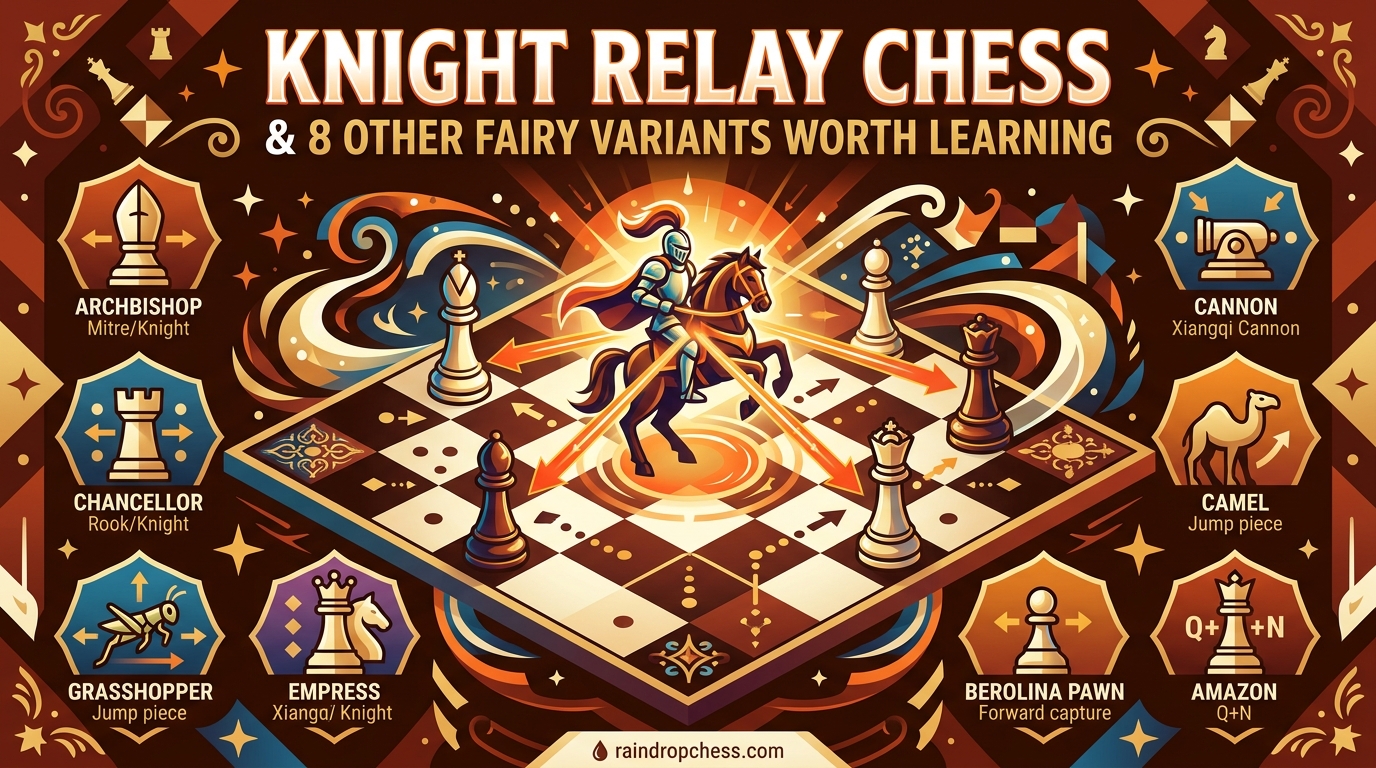
Chess has evolved far beyond the standard 64-square board we all know. For centuries, players and composers have experimented with new pieces, modified rules, and creative variations that challenge our understanding of the game. These experimental forms are called fairy chess variants, and they offer a refreshing alternative to traditional chess.
Knight Relay Chess stands out as one of the most engaging and accessible fairy variants you can learn. In this guide, I’ll explain what Knight Relay Chess is, how it works, and introduce you to eight other fairy chess variants that are worth your time in 2026. Whether you’re looking to improve your standard chess skills or simply want to explore something new, these variants will expand your chess horizons.
Table of Contents
What Is Knight Relay Chess?
Knight Relay Chess is a fairy chess variant where any piece (except kings and knights) that is protected by a friendly knight gains the ability to move like a knight in addition to its normal movement. This simple rule change creates remarkable tactical complexity and strategic depth.
Here’s how it works: if your queen is positioned on a square that a knight could move to, and you have a knight protecting that square, your queen can suddenly make knight moves. The same applies to bishops, rooks, and pawns. This creates unexpected tactical possibilities and forces you to think about piece coordination in entirely new ways.
The relay mechanic means that knights become the most valuable pieces on the board, not for their own movement but for what they enable other pieces to do. A well-positioned knight network can turn your pawns into formidable attacking pieces or allow your queen to deliver checkmate from unexpected angles.
What makes Knight Relay Chess particularly worth learning is how it transforms familiar patterns. The opening principles you’ve learned still apply, but the tactical landscape shifts dramatically. You’ll discover new mating patterns, unusual piece sacrifices, and creative attacking ideas that will sharpen your overall chess vision.
Complexity: Medium (3/5)
Time to learn basics: 15-20 minutes
Best for: Players who enjoy tactical puzzles and dynamic piece coordination
Understanding Fairy Chess Variants
Fairy chess variants encompass any chess game that modifies the standard rules, pieces, or board. The term “fairy” comes from the whimsical and experimental nature of these variations, which have been developed by chess enthusiasts, composers, and players for centuries.
These variants fall into several categories: some introduce new pieces with unique movement abilities, others change the board size or shape, and many modify fundamental rules like how pieces capture or promote. What they all share is the spirit of creative exploration and the desire to discover new strategic possibilities within the chess framework.
The history of fairy chess dates back to medieval times, with variants like Courier Chess emerging in 12th-century Germany. In the modern era, organized fairy chess composition began in the early 20th century, leading to thousands of documented variants and pieces. Today, thanks to online platforms, these experimental games are more accessible than ever before.
Learning fairy variants isn’t just about novelty. These games teach you to think flexibly, recognize patterns beyond standard chess, and appreciate the underlying mechanics that make chess so rich. Many players find that exploring variants actually improves their standard chess by breaking rigid thinking patterns and developing tactical creativity.
8 Fairy Variants Worth Learning in 2026
Courier Chess
Courier Chess is one of the oldest documented chess variants, originating in medieval Germany around the 12th century. Played on a larger 12×8 board, it introduces several additional pieces including the courier (a strengthened bishop), the sage, and the fool. These extra pieces create more complex tactical and strategic possibilities.
The larger board means games tend to be longer and more positional. You’ll need to develop pieces across a wider front and coordinate attacks from a greater distance. The courier piece moves like a bishop but can also jump over one piece, combining long-range power with tactical flexibility.
What makes Courier Chess fascinating is its historical significance. Playing it connects you to chess enthusiasts from nearly a thousand years ago, showing how the game has evolved. The variant rewards careful planning and piece coordination, making it an excellent choice for players who enjoy strategic depth.
Complexity: Medium-High (4/5)
Time to learn basics: 30-40 minutes
Best for: History enthusiasts and players who enjoy positional play
Chancellor Chess
Chancellor Chess adds one new piece to the standard setup: the chancellor, which combines the movement of a rook and a knight. This powerful piece can move like a rook or make knight moves, making it arguably stronger than a queen in many positions. Each side starts with a chancellor in place of one knight.
The addition of the chancellor dramatically changes opening theory and tactical patterns. You’ll discover new attacking lines, unexpected defensive resources, and novel checkmating patterns. The chancellor’s ability to switch between long-range and short-range movement makes it incredibly versatile and dangerous.
I find Chancellor Chess particularly appealing because it feels like a natural extension of standard chess. The board and other pieces remain familiar, so you can focus on understanding how the chancellor changes the dynamics. The variant rewards tactical calculation and creative piece coordination.
Complexity: Low-Medium (2.5/5)
Time to learn basics: 15-20 minutes
Best for: Players who want powerful new tactical tools
Grand Chess
Grand Chess expands the board to 10×10 squares and introduces two new pieces: the marshal (rook+knight combination) and the cardinal (bishop+knight combination). These compound pieces add tremendous tactical firepower while the larger board creates more maneuvering space and deeper strategic considerations.
The extra pieces and squares mean Grand Chess games are richer and more complex than standard chess. You’ll need to develop all your pieces effectively across a wider front, and the endgames feature new checkmating patterns with the compound pieces. The variant particularly rewards players who enjoy complex positional maneuvering.
What I appreciate about Grand Chess is how the additional space allows for more nuanced piece development. There’s room for sophisticated plans that would be cramped on a standard board. The marshal and cardinal create fascinating tactical possibilities that will sharpen your calculation skills.
Complexity: Medium (3/5)
Time to learn basics: 25-30 minutes
Best for: Players who enjoy complex positional play
Seirawan Chess
Seirawan Chess, developed by Grandmaster Yasser Seirawan, adds one new piece to each side: the hawk, which moves like a knight+bishop combination. The unique twist is that the hawk doesn’t enter the game immediately—it’s placed next to the board on your first rank, and you can bring it into play by moving the piece that started on that square.
This “drop-in” mechanic creates fascinating strategic decisions about when and where to introduce your hawk. Early deployment can catch opponents unprepared, while waiting until later might allow for more powerful coordinated attacks. The variant maintains the familiar chess structure while adding this one compelling new dimension.
Seirawan Chess has gained significant popularity in recent years, with online platforms supporting it and organized tournaments taking place. I recommend it as an excellent entry point into fairy variants because it feels like standard chess with one exciting new option rather than a completely different game.
Complexity: Low-Medium (2/5)
Time to learn basics: 10-15 minutes
Best for: Beginners to fairy chess and standard chess enthusiasts
Capablanca Chess
Capablanca Chess, named after former world champion José Raúl Capablanca who advocated for it, expands the board to 10×8 and introduces two new pieces: the archbishop (bishop+knight) and the chancellor (rook+knight). Capablanca believed that standard chess had been played out and that these additions would revive the game’s creative possibilities.
The wider board accommodates the extra pieces without cramping the position. Games tend to be more dynamic and tactical, with the compound pieces creating complex attacking possibilities. The variant has been extensively analyzed and has a rich theoretical tradition dating back to the early 20th century.
What makes Capablanca Chess particularly compelling is its pedigree. Capablanca’s endorsement carries weight, and many strong players have explored this variant over the decades. The combination of historical significance and genuine strategic depth makes it a rewarding variant to study and play.
Complexity: Medium (3/5)
Time to learn basics: 20-25 minutes
Best for: Players interested in chess history and strategic depth
Omega Chess
Omega Chess modifies the standard board by adding two special squares to each side (called “wizard squares”) and introduces two new pieces: the wizard and the champion. The wizard moves like a king+knight combination, while the champion can move like a rook or make a two-square diagonal jump.
The unique board shape and new pieces create tactical patterns found in no other variant. The wizard squares add an extra dimension to piece placement and control, while the new pieces offer creative attacking and defensive possibilities. Games tend to be sharp and tactical from the opening.
I find Omega Chess particularly interesting because it forces you to reconsider basic chess principles. The board extensions change what constitutes good piece development, and the new pieces create unfamiliar tactical motifs. It’s an excellent choice for players who enjoy solving novel tactical puzzles.
Complexity: Medium (3/5)
Time to learn basics: 25-30 minutes
Best for: Tactical players who enjoy novel patterns
Gothic Chess
Gothic Chess adds three new pieces to the standard setup on a slightly expanded board: the chancellor (rook+knight), the archbishop (bishop+knight), and the amazon (queen+knight). The amazon is particularly powerful, combining all queen movements with knight jumps, making it the strongest piece in any chess variant.
The presence of three powerful compound pieces makes Gothic Chess extremely tactical and complex. Games feature spectacular combinations and unexpected blows, with the amazon often serving as the decisive attacking piece. The variant rewards accurate calculation and tactical creativity.
Gothic Chess represents one of the most dramatic departures from standard chess while still maintaining recognizable patterns. The amazon’s power creates entirely new checkmating patterns, and the coordination between compound pieces produces unique strategic considerations. It’s ideal for players who want maximum tactical complexity.
Complexity: Medium-High (4/5)
Time to learn basics: 30-35 minutes
Best for: Experienced players seeking maximum tactical depth
Chess960 (Fischer Random)
Chess960, also known as Fischer Random Chess, randomizes the starting position of the pieces on the back rank while maintaining standard chess rules. There are 960 possible starting positions, hence the name. The game was championed by former world champion Bobby Fischer, who believed it would reward creativity over memorization.
What makes Chess960 unique among fairy variants is that it doesn’t change any rules or pieces—only the starting position. This means all your tactical and strategic knowledge remains applicable, but you can’t rely on memorized opening lines. Each game requires fresh thinking from the very first move.
Chess960 has gained significant acceptance in the chess world, with official tournaments and even a world championship. Many top players use it as a training tool to improve their chess understanding. I recommend it as the most accessible fairy variant for standard chess players looking to try something different.
Complexity: Low (1.5/5)
Time to learn basics: 5-10 minutes
Best for: All players, especially those who want to avoid opening theory
Why Learn Fairy Chess Variants?
Exploring fairy chess variants offers numerous benefits that extend beyond the variants themselves. Many players find that time spent with alternative chess forms improves their standard chess game in unexpected ways. Here are the key advantages:
Enhanced Pattern Recognition: Fairy variants expose you to new piece movements, board configurations, and tactical patterns. This expands your pattern recognition abilities, making you more alert to tactical possibilities in standard chess. You’ll start seeing connections that other players miss.
Tactical Creativity: When pieces move differently or the board changes shape, you’re forced to think creatively about tactics. This mental flexibility carries over to standard chess, where you’ll find yourself considering unusual sacrifices and creative attacking ideas more readily.
Deeper Strategic Understanding: Fairy variants reveal the underlying principles of chess by showing what happens when you change the parameters. You’ll gain a deeper appreciation for why standard chess works the way it does, which improves your strategic decision-making.
Fresh Mental Challenge: Even the most dedicated chess players can feel burned out by standard chess. Fairy variants provide a refreshing change of pace while still exercising your chess muscles. This can renew your enthusiasm for the game and prevent plateauing.
Historical Perspective: Many fairy variants have rich historical traditions. Learning them connects you to centuries of chess experimentation and helps you understand how the modern game evolved. This historical appreciation enriches your relationship with chess.
Community Benefits: The fairy chess community is passionate and welcoming. Engaging with variants opens doors to new playing opportunities, discussions, and friendships. You’ll discover a whole side of chess culture that many players never experience.
Getting Started with Fairy Chess
Starting your journey into fairy chess variants doesn’t have to be overwhelming. I recommend a progressive approach that builds confidence and understanding gradually. Begin with simpler variants before tackling more complex ones, and don’t feel pressured to learn everything at once.
Recommended Learning Progression:
1. Start with Chess960—it’s the easiest to learn and requires no new piece movements
2. Try Seirawan Chess next, as it adds just one new piece to a familiar setup
3. Explore Knight Relay Chess to experience mechanic changes rather than new pieces
4. Progress to Chancellor or Capablanca Chess for compound piece experience
5. Tackle more complex variants like Grand Chess or Gothic Chess as your comfort grows
Where to Play Online:
Several online platforms support fairy chess variants in 2026. ChessVariants.com offers the widest selection, with play against both human opponents and computer AI. Lichess.org includes Chess960 and some other variants in their variant section. ICC (Internet Chess Club) and Chess.com occasionally feature variant tournaments, particularly for Chess960. For correspondence play, Game Courier allows you to explore virtually any documented variant.
Finding Opponents:
The fairy chess community may be smaller than standard chess, but dedicated players are enthusiastic about welcoming newcomers. Join forums and communities dedicated to chess variants, participate in online tournaments, and don’t hesitate to challenge friends to learn a variant with you. Many players find that learning a variant together with someone else is more enjoyable than learning alone.
Practice Tips:
Start each variant by playing against a computer opponent to familiarize yourself with the new patterns without pressure. Read the rules carefully and play through example games if available. Focus on understanding how the variant changes fundamental chess principles rather than memorizing specific lines. Most importantly, have fun with the learning process—fairy chess should be an enjoyable exploration, not a chore.
FAQ
What are fairy chess pieces?
Fairy chess pieces are non-standard chess pieces created for chess variants. They include compound pieces that combine movements of standard pieces (like the chancellor combining rook and knight), entirely new movement patterns (like the camel, which moves in an extended L-shape), or modified versions of standard pieces. These pieces are what distinguish fairy chess variants from standard chess and create new tactical and strategic possibilities.
How do fairy chess variants differ from standard chess?
Fairy chess variants differ from standard chess in several ways. Some introduce new pieces with unique movements, others modify the board size or shape, and many change fundamental rules about how pieces move, capture, or promote. For example, Knight Relay Chess changes how pieces move based on knight proximity, while Chess960 randomizes starting positions. Despite these differences, most fairy variants retain core chess concepts like checkmate and piece capture.
Which fairy chess variants are best for beginners?
For beginners to fairy chess, I recommend starting with Chess960 (Fischer Random) because it uses standard pieces and rules with only randomized starting positions. Seirawan Chess is another excellent choice, adding just one new piece while keeping everything else familiar. Knight Relay Chess is relatively accessible since it doesn’t introduce new pieces but changes how existing pieces interact. These variants provide gentle introductions to fairy chess concepts without overwhelming complexity.
Where can I play fairy chess variants online?
Several online platforms support fairy chess variants in 2026. ChessVariants.com offers the most comprehensive selection with play against humans or AI. Lichess.org includes Chess960 and some other variants. The Internet Chess Club (ICC) and Chess.com occasionally feature variant tournaments. For correspondence play, Game Courier supports virtually any documented variant. These platforms make it easy to find opponents and explore different variants regardless of your location.
What is Knight Relay Chess?
Knight Relay Chess is a fairy chess variant where any piece (except kings and knights) protected by a friendly knight gains the ability to move like a knight in addition to its normal movement. This creates unique tactical possibilities as pieces can suddenly make knight moves when supported by knights. The variant transforms standard chess patterns and rewards creative piece coordination, making knights the most valuable pieces for their relay abilities rather than their own movement.
Conclusion
Knight Relay Chess and the eight other fairy variants covered in this guide represent just a small sampling of the creative experimentation that has enriched chess throughout its history. Each variant offers unique strategic challenges, tactical patterns, and insights that will deepen your understanding of chess as a whole.
Whether you start with the accessible Chess960, dive into the tactical complexity of Knight Relay Chess, or explore the historical richness of Courier Chess, you’ll discover that fairy variants are more than just curiosities—they’re legitimate chess games that reward study and practice. The skills you develop exploring these variants will carry over to your standard chess, making you a more creative and flexible player.
I encourage you to pick one variant that resonates with you and give it a serious try. Find an online platform, learn the rules, and play a few games. You might just discover a new passion within chess that keeps you engaged and improving for years to come. The world of fairy chess is waiting—explore it in 2026.