
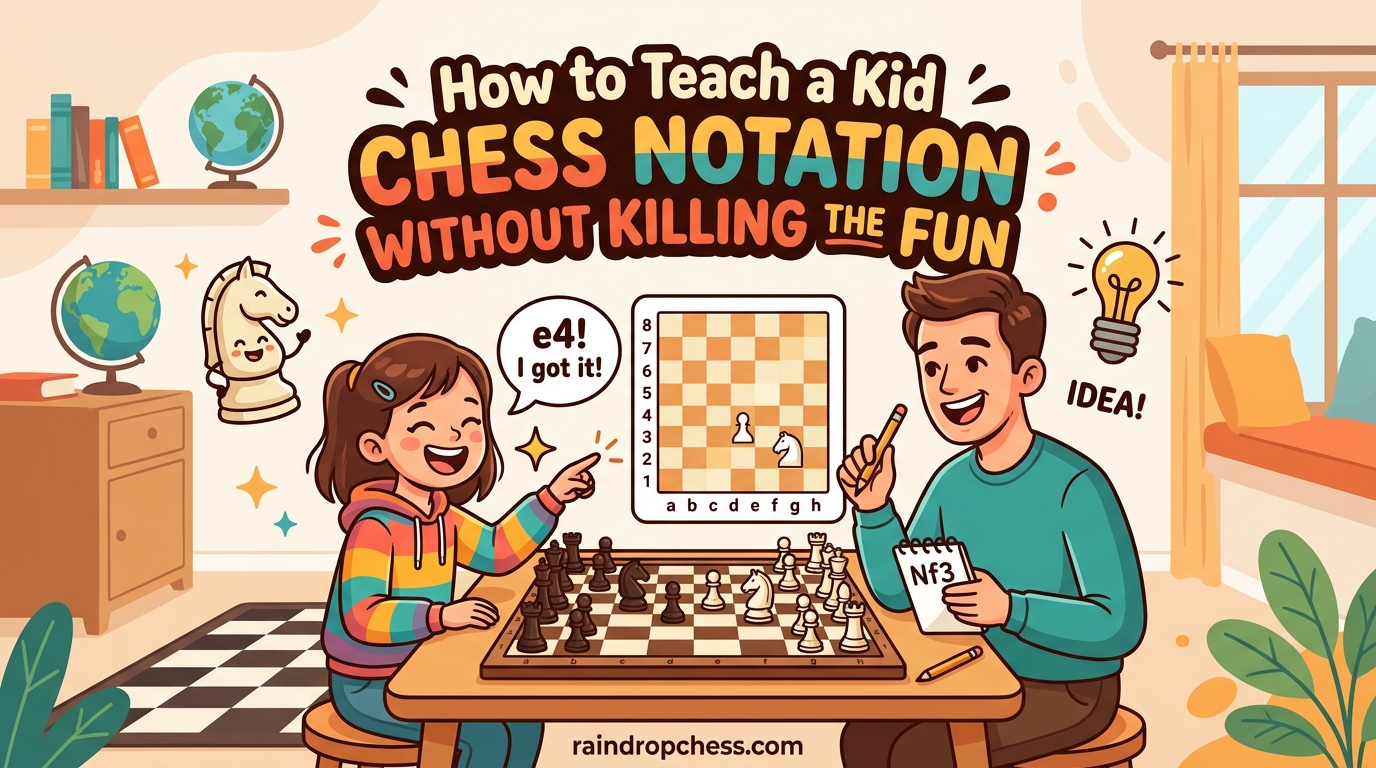
Your child just learned how the knight moves. They are finally enjoying chess games that last more than four moves. Then someone mentions notation, and their face drops.
I have been there. My own son, at age seven, called notation “chess homework that ruins everything.” After three months of trial and error, we found a way to make it click. Now he records moves voluntarily because it feels like a game, not a chore.
This guide will show you how to teach kid chess notation while keeping the joy alive. You will learn what actually works for different ages, why fine motor skills matter more than most parents realize, and fun games that turn reluctant learners into enthusiastic scribes.
Table of Contents
How to Teach a Kid Chess Notation Without Killing the Fun
The secret is treating notation as a puzzle-solving activity rather than paperwork. Kids love codes, treasure hunts, and detective work. Algebraic notation is all three.
Start by explaining that every square has a secret name. The files run from a to h like the alphabet. The ranks go from 1 to 8 like counting. When you say “e4,” you are speaking a special chess language that players around the world understand.
Pieces get single-letter abbreviations. King is K, Queen is Q, Rook is R, Bishop is B, and Knight is N. Pawns are special because they do not get a letter at all. When a pawn moves to e4, you just write “e4.” This simplicity makes pawns the perfect starting point for young learners.
Captures add excitement. You write “x” between the piece and the square. So Nxe4 means your knight captured something on e4. Check uses a “+” symbol. Checkmate gets the grand “#” symbol. These special marks make notation feel like scoring points in a video game.
What Is Chess Notation and Why Should Kids Care
Chess notation is simply a written record of every move made in a game. Think of it like keeping score in baseball or writing down clues in a mystery novel.
Before algebraic notation became standard, players used descriptive notation with confusing phrases like “Knight to King’s Bishop 3.” The modern system using coordinates is actually simpler for kids to grasp than you might expect.
Recording games matters because it unlocks three superpowers. First, your child can replay their games later to find mistakes and brilliant moves. Second, they can study famous games played by champions. Third, they can communicate with coaches and other players anywhere in the world using the same written language.
One parent in a chess forum shared that their nine-year-old went from hating notation to loving it once they realized they could recreate their tournament games at home. That is the hook that works.
Understanding the Chessboard Coordinate System
The chessboard has 64 squares arranged in a perfect 8 by 8 grid. Each square has a unique address.
Files are the vertical columns running from white’s left to right. They are labeled a through h. Ranks are the horizontal rows numbered 1 through 8, starting from white’s side.
This means a1 is the square at the bottom left corner from white’s perspective. H8 is the top right corner. The center squares are d4, d5, e4, and e5.
Here is the trick that helps kids remember: the board is like a city map. Streets run one way, avenues run the other. You meet friends at the corner of A Street and 1st Avenue. Chess works the same way.
I recommend spending one entire week just on square identification before touching actual notation. Play games where your child calls out square names. Hide pieces and have them give coordinates to find them. Make it automatic before adding complexity.
The Piece Abbreviations Every Child Should Memorize
Algebraic notation uses single uppercase letters for each piece. This is actually the easy part.
K stands for King. Q stands for Queen. R stands for Rook. B stands for Bishop. N stands for Knight.
Notice something important? Knight gets N instead of K because King already claimed that letter. This confuses some kids initially, so emphasize that N means “horse” in their mind.
Pawns have no letter. When a pawn moves, you simply write the destination square. Pawns capture diagonally, so you include their file of origin when recording captures. Exd5 means the pawn on the e-file captured something on d5.
Most children memorize these letters within two practice sessions. The challenge is applying them quickly during actual games.
Special Moves and Their Notation Symbols
Chess has four special moves that use unique notation. Understanding these makes your child feel like an insider.
Castling kingside is written 0-0. Castling queenside is 0-0-0. Those are zeros, not letter O’s. Many kids find this the most fun part of notation because the symbols look like little faces.
En passant captures add “e.p.” after the move. Pawn promotion uses an equals sign. E8=Q means a pawn moved to e8 and became a Queen. You can also write E8=R, E8=B, or E8=N for other promotions.
Check gets a “+” after the move. Checkmate gets a “#” symbol. These marks add drama and make the notation sheet feel like a story with exciting moments.
Why Chess Notation Builds Better Players
Recording moves does more than satisfy tournament rules. It transforms how children think about chess.
When kids write down moves, they develop pattern recognition. They start seeing that certain positions lead to certain outcomes. One father reported that his daughter spotted a three-move checkmate pattern after reviewing just five of her recorded games.
Notation also improves visualization skills. Children learn to picture the board in their mind without looking at pieces. This is the foundation of advanced chess calculation.
The 40-40-20 rule applies here. Tournament players spend about 40 percent of their time on opening moves, 40 percent on middlegame tactics, and 20 percent on endgame technique. Notation helps with all three phases by creating a record to study.
What Is a Good Age to Teach Chess Notation
Most chess coaches agree that ages 6 to 8 are ideal for introducing notation. However, readiness depends more on developmental skills than calendar age.
A five-year-old with strong fine motor control and genuine interest can start learning square names. A nine-year-old who struggles with writing might need adapted approaches. Judge the individual, not the age.
Here is a practical timeline. Ages 5 to 6 focus on square identification games. Ages 7 to 8 introduce basic notation with plenty of patience. Ages 9 to 12 can handle full tournament notation with coaching support.
One Reddit parent shared that their kindergarten child had poor fine motor skills and hated traditional notation. They switched to a custom sheet with circles to check for piece type and capture status. Problem solved.
Age-Appropriate Approaches for Teaching Notation
Young children learn differently than older kids. Your approach should match their developmental stage.
For ages 5 to 6, stick to verbal square naming. Play games where you move a piece and your child calls out the destination square. Use magnetic boards or apps where they can tap squares instead of writing. Fine motor skills are still developing at this age.
For ages 7 to 8, introduce simplified notation sheets with large boxes. Let them record just their own moves at first, then add opponent moves later. Focus on accuracy over speed.
For ages 9 to 12, use standard tournament notation sheets. They can handle the full system including captures, checks, and special moves. Challenge them to notate entire games without help.
Addressing Fine Motor Skill Challenges
This is the hidden barrier many parents miss. Writing small letters and numbers in tiny boxes requires hand strength and coordination that develops at different rates.
If your child struggles physically with notation, consider adaptations. Use larger notation sheets with bigger boxes. Allow digital recording apps for practice. Let them say moves aloud while you write them down, then switch roles.
Some families create custom notation sheets with visual checkboxes. Circle for piece type, fill in square letter and number, mark an X for captures. This reduces writing while maintaining the learning benefits.
One chess parent on a forum suggested using dry-erase boards for practice. Kids write moves, erase them, and try again without paper waste or permanence anxiety.
Fun Games to Practice Chess Notation
These activities turn notation from a chore into play.
Treasure Hunt Notation: Hide a small prize under a chess piece. Your child notates their moves as they search. When they find it, you read their notation aloud to verify the path. Then hide another prize and switch roles.
Famous Game Replay: Find a short brilliant game online. Read the moves aloud while your child sets up the position. They see notation bringing a real game to life. The Opera Game by Morphy works perfectly.
Notation Detective: Show your child a position and a notation sheet with one move missing. They must figure out what happened. This builds analytical skills while keeping notation central.
Chess Notation Bingo: Create bingo cards with common moves like “pawn captures,” “knight checks,” or “castles.” During a practice game, kids mark their cards when those moves happen. First to get bingo wins a small prize.
Speed Notation Challenge: Set a timer for five minutes. See how many moves your child can accurately notate from a game you play together. Track their personal best and celebrate improvements.
How to Handle a Child Who Hates Notating
Reluctance usually comes from three sources. The task feels too hard, too boring, or too disconnected from the fun of playing.
First, check the difficulty level. If fine motor skills are the issue, try the adapted sheets mentioned earlier. If understanding is the problem, slow down and spend more time on square identification.
Second, connect notation to something they care about. If your child loves puzzles, frame it as code-breaking. If they are competitive, show how tournament players use notation to prepare for rematches. If they enjoy stories, explain that they are writing the history of their game.
Third, reduce the pressure. Let them notate just special moves at first, like captures or checks. Gradually increase the requirement as confidence builds. One father reported success by letting his son choose which games to notate rather than demanding every single one.
Common Mistakes Parents Make
Watch out for these traps that turn enthusiastic kids into notation resisters.
Forcing notation too early: A five-year-old who just learned piece movements is not ready for written recording. Pushing too soon creates negative associations that last years.
Making it feel like homework: Chess should remain a game. If notation becomes associated with school stress, children resist. Keep the tone playful.
Skipping the why: Kids need to understand the purpose. Explain that notation lets them review their brilliant wins and learn from tough losses. Show them a famous player’s scoresheet.
Inconsistent practice: Notating once a month never builds fluency. Aim for weekly notation practice, even if just for ten minutes during a fun activity.
Expecting perfection: Messy notation sheets are fine. Missed moves are fine. The goal is participation, not calligraphy. One mother shared that her daughter’s early sheets were barely legible, but six months later she was notating tournament games with confidence.
Daily Practice Activities That Work
Consistency beats intensity. Ten minutes of fun practice beats an hour of forced drilling.
Move of the Day: Each day, show your child one interesting chess position. They notate the best move and explain why. This builds analysis skills without overwhelming them.
Capture Counting: During practice games, have your child record only captures. This reduces writing volume while maintaining engagement with the notation system.
Notation Journal: Keep a special notebook for recording memorable positions. Your child draws the position and writes the key move. Over time, this becomes a treasured collection.
Family Chess Notation Nights: Once a week, play a family game where everyone notates. Compare sheets afterward and laugh about differences. This normalizes notation as just part of playing.
Preparing for Tournament Play
Most chess tournaments require notation once children reach a certain rating or age level. Requirements vary by organization, so check your local rules.
US Chess Federation tournaments typically require notation for players in third grade and above, or any rated section. Some tournaments waive the requirement for younger or lower-rated players.
Before a first tournament, have your child complete at least five full notation sheets at home. Time pressure changes everything. Practice writing quickly while maintaining legibility.
Teach your child to ask for help. Tournament directors understand that young players make mistakes. A quick question about how to notate en passant is better than incorrect recording.
Pack extra pencils and an eraser. Tournament nerves plus equipment problems create unnecessary stress. One parent always brings three pencils because they have seen too many broken leads at critical moments.
Building a Notation Habit That Lasts
The goal is making notation automatic, not optional.
Start with a thirty-day challenge. Notate one game every day for a month. Use fun activities from this guide, not boring drills. By day thirty, the habit should feel natural.
Create positive associations. After every notated game, spend five minutes reviewing one interesting moment together. This makes the notation feel worthwhile.
Let your child teach someone else. Have them explain notation to a younger sibling or friend. Teaching reinforces learning and builds confidence.
Celebrate milestones. First complete game notated independently deserves recognition. First tournament with perfect notation deserves a special reward. These markers keep motivation high.
Frequently Asked Questions
How to learn chess notation easily?
Start with square identification games before writing anything. Play treasure hunts where your child calls out coordinates. Introduce piece abbreviations gradually. Practice with just your child’s moves first, then add opponent moves later. Use fun activities rather than drills.
What is the 40-40-20 rule in chess?
The 40-40-20 rule suggests dividing study time into 40 percent opening preparation, 40 percent middlegame tactics, and 20 percent endgame technique. Notation helps with all three phases by creating game records to study.
How to teach chess in a fun way?
Frame notation as code-breaking or detective work. Use games like treasure hunts, notation bingo, and famous game replays. Connect notation to your child’s interests. Keep practice sessions short and playful. Celebrate progress rather than demanding perfection.
What is a good age to teach a kid chess?
Ages 6 to 8 are ideal for introducing notation, but readiness varies by child. Focus on square identification at ages 5 to 6. Introduce basic notation at ages 7 to 8. Full tournament notation works for most children ages 9 to 12. Consider fine motor skills and interest level, not just age.
How to make chess notation fun for reluctant learners?
Use adapted notation sheets with checkboxes if fine motor skills are challenging. Connect notation to puzzles, competitions, or stories your child enjoys. Reduce pressure by notating only special moves at first. Let them choose which games to record. Keep sessions short and celebrate participation.
Can a 5-year-old learn chess notation?
Most 5-year-olds should focus on verbal square naming and piece movements rather than written notation. Fine motor skills are still developing at this age. Start with coordinate games and save writing notation for age 6 or 7 unless your child shows strong interest and ability.
Conclusion
Learning how to teach kid chess notation without killing the fun is about patience, creativity, and respecting your child’s pace.
Remember the core principles. Start with square coordinates before touching notation. Match the approach to your child’s age and fine motor abilities. Use games and activities rather than drills. Connect notation to purposes your child cares about.
Most importantly, keep the joy of chess alive. A child who hates notation will resist learning. A child who sees notation as a fun code to crack will become a stronger player and lifelong chess enthusiast.
Pick one activity from this guide and try it this week. Notice what engages your child and what falls flat. Adjust and try again. You have got this.