
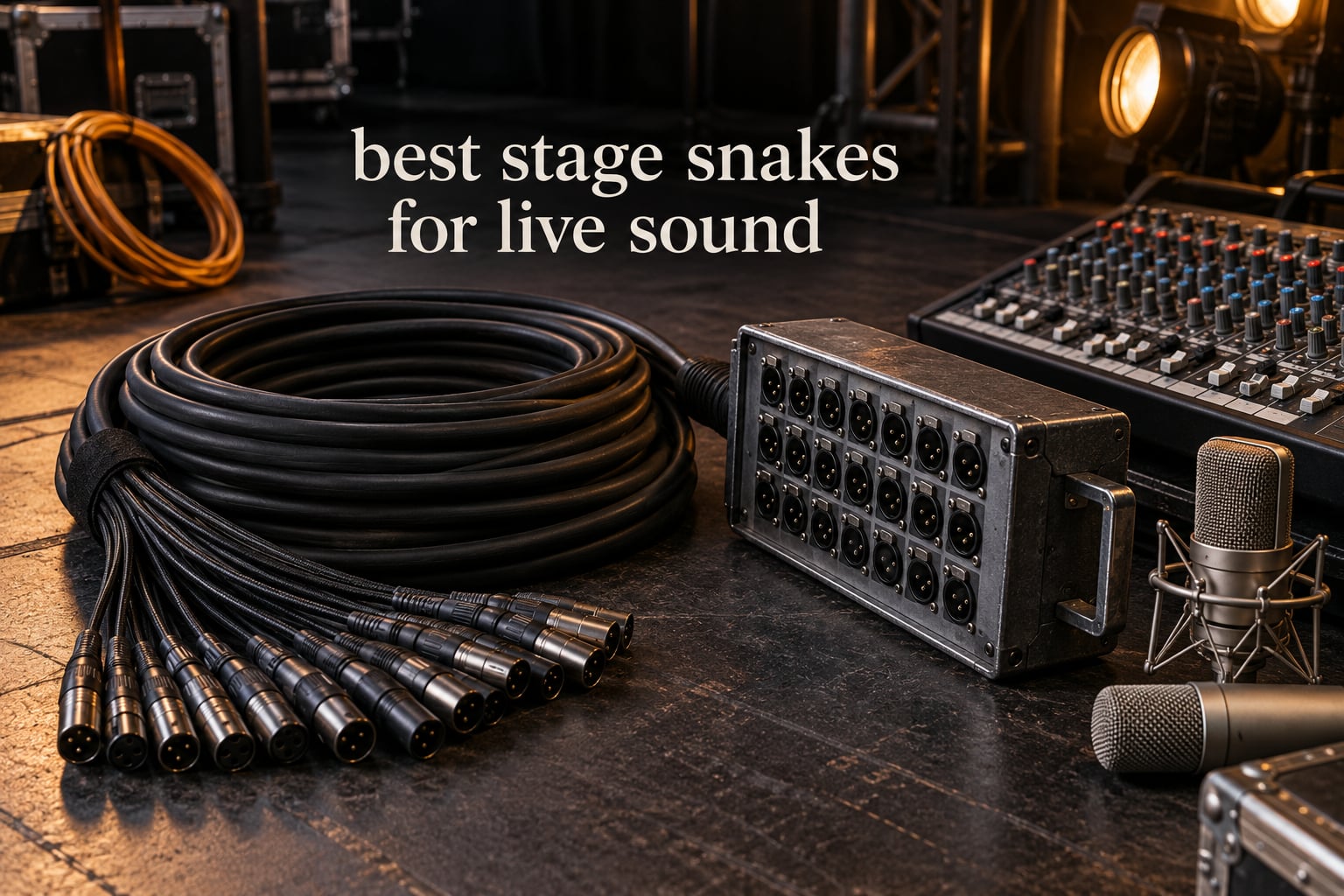
Snakes are the plumbing of live sound. One loom replaces sixteen individual mic cables, and once you have run a show without a spaghetti pile on your downstage edge, going back is hard. But the category is crowded with near-identical listings that all claim to be the same thing, and picking the wrong channel count or connector layout is the single most common regret we hear from working engineers.
We spent several weeks comparing ten of the most widely used stage snakes for live sound, checking their published specs against what owners actually say after a season of load-ins. We looked hard at sends, returns, cable length, gauge, connector types and the physical build of each stage box, because those are the details that decide whether a snake survives a tour. If you are still choosing a console, our audio mixer roundup covers the other half of the signal chain.
This guide covers everything from four-pound fan-outs for a coffee-house rig to a 24-line analog snake and two digital stage boxes. We also explain channel and return sizing, cable gauge, the balanced-versus-unbalanced trap that wrecks more rigs than any single cable, and the failure modes that show up a year into service. Updated for 2026, and correct as of the last time we handled these cables.
Table of Contents
What Is a Stage Snake?
A stage snake is a bundled multi-channel cable that carries balanced audio between the stage and the front-of-house console. Sources plug into a multi-input stage box on stage, the far end presents male XLRs that feed the console, and a smaller set of return channels runs monitor or in-ear mixes back toward the performers.
Each channel inside the loom is an independently shielded twisted pair sharing one outer jacket. That is the whole trick: eight to twenty-four individually shielded runs in the space of one cable, with the fan-out labelled so you can patch in the dark.
Most engineers first meet snakes the same way. A band plugs mics and DI boxes directly into the console, walks cables across the stage lip to front of house, and spends the first soundcheck untangling the mess. Once the channels exceed about eight, or the run crosses a room where people walk, the snake becomes the obvious answer. Our guides on microphone cables for live sound and stage monitors for live bands cover the rest of that chain.
Top 3 Stage Snakes for Live Sound in 2026
These three cover the widest range of real working situations: an all-round analog box with returns, a featherweight send-only fan-out, and a heavy-duty long run with colour coding. Everything else in the list earns its place by doing one of those jobs at a different size or price point.

Seismic Audio SACB-16x4x25
- 16 XLR sends plus 4 returns
- Low-profile circuit board stage box
- 25 ft of steel construction

Hosa Little Bro SH-8X0-25
- 8 XLR sends in a 4.3 lb body
- 25 ft and UL listed
- Limited lifetime warranty

Seismic Audio SAEM-16x8x50
- 16 sends and 8 returns over 50 ft
- Individually shielded 22 AWG pairs
- Color-coded numbered fan-out
Best Stage Snakes for Live Sound: Quick Comparison in 2026
All ten options in the table below carry balanced XLR signal. The differences that actually matter are sends, returns, length and what the box is built from. Read the returns column first, because that is where people under-buy.
| Product | Specifications | Action |
|---|---|---|
| Seismic Audio SACB-16x4x25 16×4 25 ft |
|
Check Latest Price |
| Hosa Little Bro SH-8X0-25 |
|
Check Latest Price |
| Seismic Audio SAEM-16x8x50 |
|
Check Latest Price |
 KIRLIN MT-815-5M 8-Channel KIRLIN MT-815-5M 8-Channel |
|
Check Latest Price |
 Seismic Audio SAXQ-16x8x50 Seismic Audio SAXQ-16x8x50 |
|
Check Latest Price |
 PRORECK PR-SC25 8-Channel PRORECK PR-SC25 8-Channel |
|
Check Latest Price |
 Behringer S16 Digital Snake Behringer S16 Digital Snake |
|
Check Latest Price |
 Behringer SD16 Digital Stage Box Behringer SD16 Digital Stage Box |
|
Check Latest Price |
 Rockville SX1650 16-Channel Rockville SX1650 16-Channel |
|
Check Latest Price |
 Harmony Audio HA-SB2450 24-Channel Harmony Audio HA-SB2450 24-Channel |
|
Check Latest Price |
1. Seismic Audio SACB-16x4x25 – Best All-Round 16×4 Snake with a Low-Profile Box
Seismic Audio SACB-16x4x25 16-Channel XLR Low Profile Circuit Board Snake Cable, 25-Feet
16 XLR sends and 4 XLR returns
25 ft run
Steel low-profile box
12 lb
Pros
- Low-profile circuit board stage box keeps the fan-out compact
- 16 sends plus 4 returns give 20 usable lines
- Steel outer construction at 12 lb
- 4.7 average across more than 1600 reviews
Cons
- Circuit board connectors are not field-serviceable
- Only a 25 ft run in this configuration
This is the snake we keep coming back to. The SACB-16x4x25 carries sixteen XLR male sends and four XLR female returns over twenty-five feet, which is a genuinely useful mix: enough sends for a full band, and four returns for a wedge mix plus a couple of IEM feeds. At 4.7 stars across more than sixteen hundred reviews, it also has the largest reviewed base in this group, which tells you something about how it holds up over years.
The stage box is the reason people choose it. The circuit board connector design keeps the box low profile, so it sits flat and out of the way on a crowded stage rather than standing up like a wall of XLRs. The steel outer shell and a listed weight of twelve pounds make it feel like permanent infrastructure rather than a cable accessory.
Owners consistently point to the compact footprint and the multi-channel fan-out as the main draws. Patch time at load-in drops noticeably when the box fits under a keyboard stand instead of needing a stand of its own.
What to check before you buy
Confirm your stage-to-console distance fits twenty-five feet. That is generous for a club with the console at the back wall and tight for an outdoor stage where the FOH position is further out. If your run is longer, the fifty-foot options later in this list are the safer pick.
Also check what arrives at the far end. The four returns terminate in XLR females on this configuration, so if your console or monitor distribution takes 1/4 inch TRS, you will need adapters or a different box.
Where it falls short
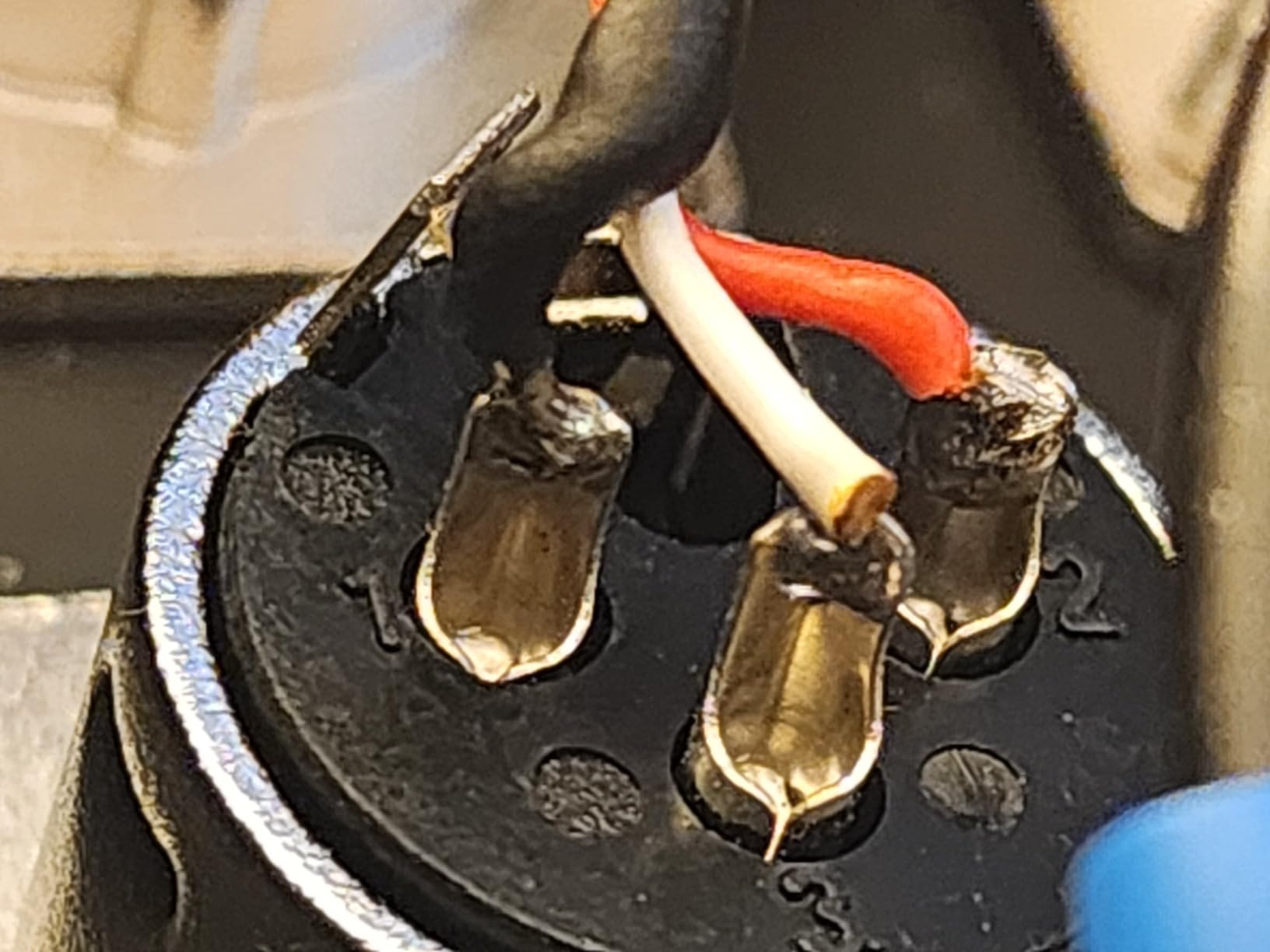
Circuit board connectors are the trade-off for that low profile. They are not field-serviceable the way panel-mount XLRs on a conventional stage box are, so when one connector develops an intermittent fault, the fix is not a screwdriver and a spare connector. On a long tour schedule that matters more than the footprint does.
2. Hosa Little Bro SH-8X0-25 – Best Lightweight 8-Channel Send Snake
Hosa Little BRO SH 8X0 25-25 Feet
8 XLR sends with no returns
25 ft run
4.3 lb
UL listed
Pros
- Only 4.3 lb for a full 8-channel snake
- Compact box routes easily on small stages
- UL listed with a limited lifetime warranty
- 4.7 average across 544 reviews
Cons
- Send-only box with no return lines
- 25 ft is short for large stages
Hosa is the name most working engineers mention first when they talk about snake brands, and this Little Bro model is the reason. It is an eight-channel fan-out over twenty-five feet, XLR female on the box end to XLR male at the fan-out, weighing four and a half pounds in total. That is light enough that one person carries it with a backpack on a load-in.
The rating tells the durability story better than the marketing does. Four point seven stars across five hundred and forty-four reviews, with eighty-three percent of those scoring five stars, is the kind of long-tail consistency you only see on a product people stop worrying about. The limited lifetime warranty from Hosa backs that up, and the box is UL specified.
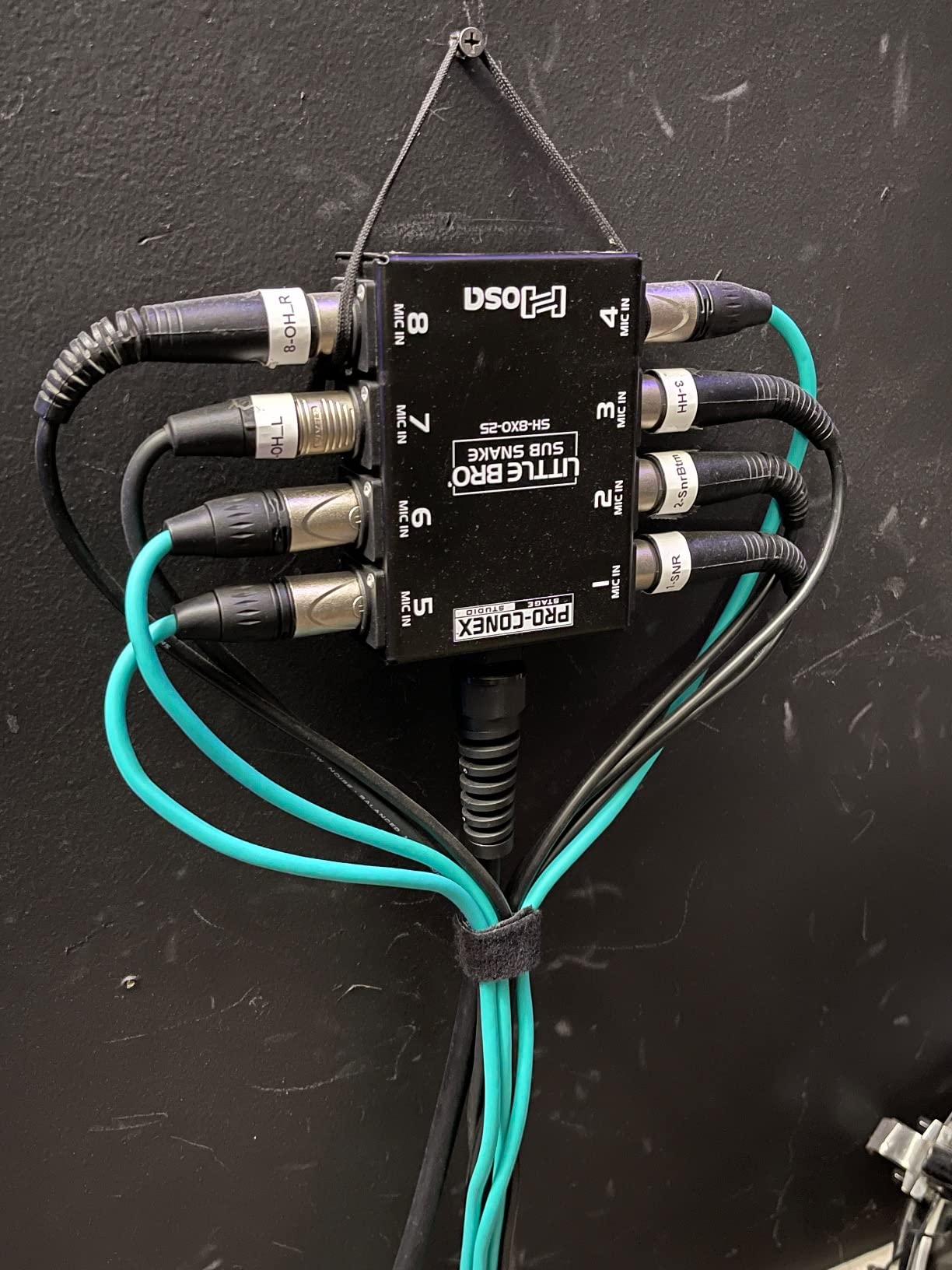
Owners highlight the low weight and the compact ProConex box as the reasons they keep buying it. The fan-out is small enough to route behind a drum riser or tuck under a riser lip without a stand.
Is eight channels enough for your rig?
Eight sends covers a small club band without surprises: two or three mics, a DI for bass, guitar and keys, and a couple of spare lines. The moment you add a horn section, a lapel mic for a preacher, or four wedges, you are past what this box can carry.
Also plan the return path. This configuration has no returns on the stage box, so monitor feeds come back over separate XLR runs. That is fine at a small venue where the console sits near the stage, and annoying everywhere else.
Where it falls short
Twenty-five feet is a short run. Larger stages and outdoor events routinely push past that, and once you are daisy-chaining extensions you lose the neat single-cable advantage. The send-only layout is the bigger limitation for anyone running monitors or in-ear mixes.
3. Seismic Audio SAEM-16x8x50 – Best 16×8 Heavy-Duty Snake with Color-Coded Fan-Out
Seismic Audio – 16 Channel XLR Snake Cable 50′ Long – 16 Sends and 8 XLR Returns – Color Coded, Numerically Well Labeled – Heavy Duty 50 feet Long
16 sends and 8 returns
50 ft run
22 AWG shielded pairs
Steel box, 27 lb
Pros
- Panel-mount XLR connectors that can be serviced
- Color-coded and numbered fan-out speeds up patching
- Individually shielded 22 AWG pairs
- Flexible jacket that resists taking a permanent set
Cons
- Printed channel numbers sit close to the neighbouring input
- Push-release buttons described as low quality
- 27 lb is heavy for a stair carry
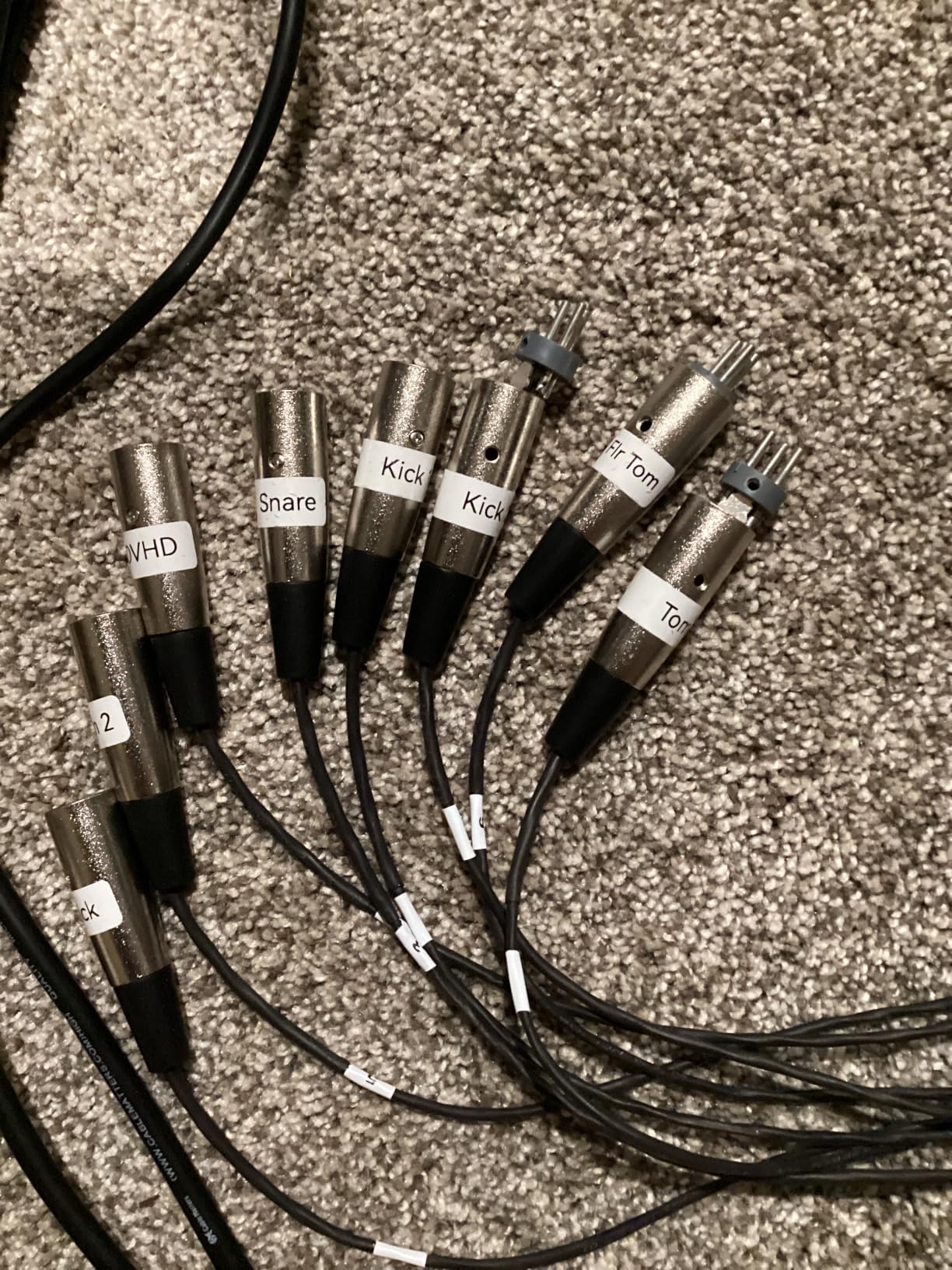
This is the one we would put on a touring rig. Sixteen XLR male sends, eight XLR female returns, fifty feet of loom, and a steel stage box with a handle. At 4.6 stars across five hundred and twenty-one reviews with eighty-two percent five-star scores, the review history is deep enough to trust over a season of shows.
The cable spec is the headline: 100 percent individually shielded pairs on 22 gauge conductors. Individually shielded matters because it is what keeps one channel from printing into its neighbour when you push the gain up on a hot vocal. Reviewers report no measurable crosstalk or attenuation on analog lines.
The colour-coded, numerically labelled fan-out is the feature owners mention most. In a dark stage or a rushed changeover, matching the coloured sleeve to the printed box number removes a whole category of patch error. The jacket also resists taking a permanent set when coiled, which is the number-one complaint about braided and cloth-wrapped cables.
Why panel-mount connectors are worth the extra weight
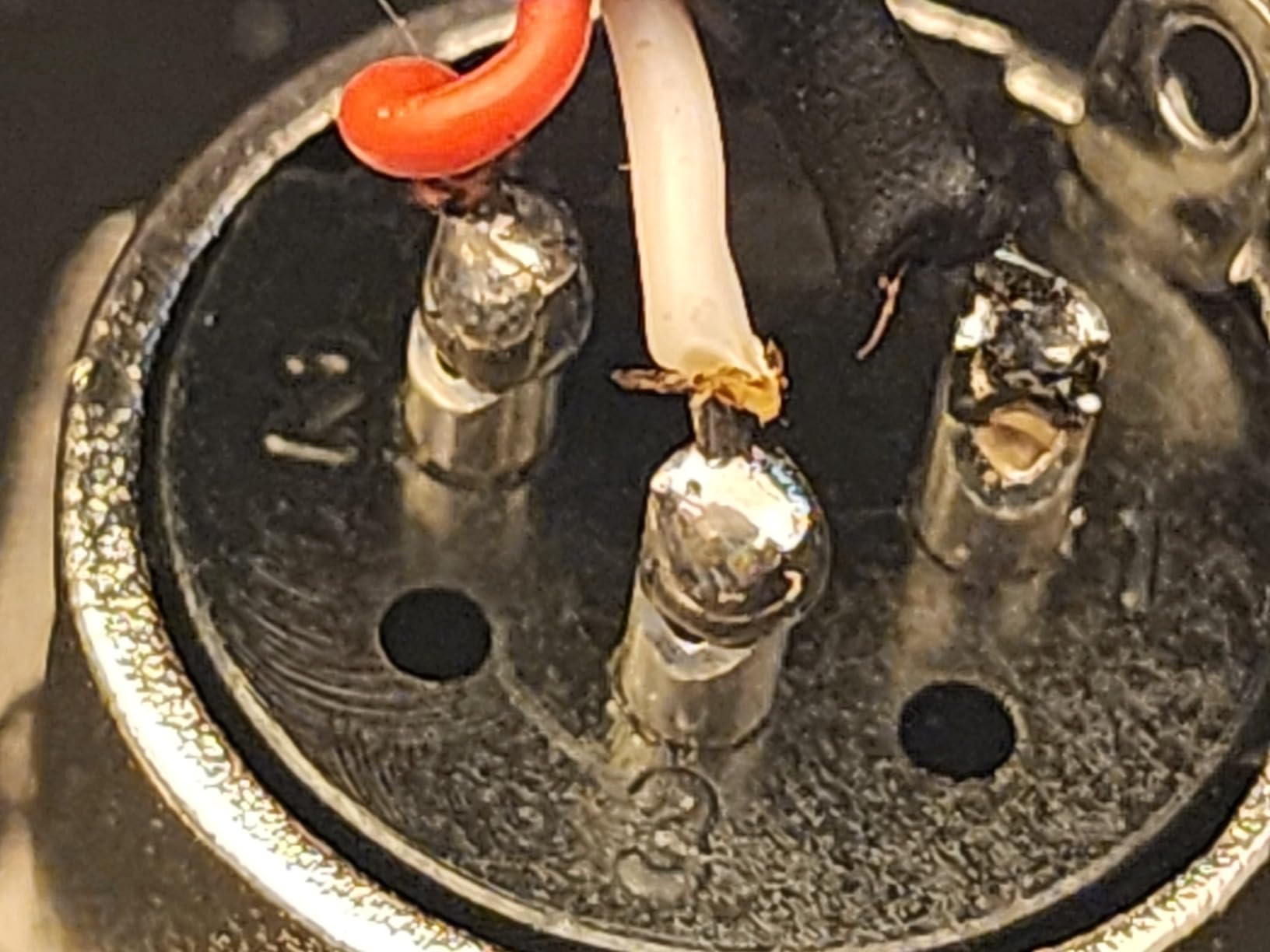
Panel-mount XLRs on the steel box reduce mechanical stress on the internal wiring and, more usefully, they can be serviced. When a connector starts intermittent, a panel-mount jack can be replaced on the bench. Bonded or circuit board connectors cannot, and that difference shows up in year three.
The trade is weight. At twenty-seven pounds this is a serious object to carry up a stairs or across a load-in with a cart. If your load-in is flat and the venue has a lift, you will not notice. If you are carrying it yourself into a basement club, you will.
Where it falls short
Some buyers report that the painted channel numbers on the box sit closer to the adjacent input than their true channel. It is a labelling quibble rather than a fault, but in a dark patch it is the kind of detail that costs you thirty seconds every show. The push-release buttons on the box are also described as low quality, and can stick under load.
One long-term owner reported loose inputs after roughly two and a half years of use. That is worth knowing if you are shopping for a decade-long install rather than a seasonal hire.
4. KIRLIN MT-815-5M – Best Quiet 8-Channel Snake for Short Runs
KIRLIN Cable MT-815-5M 5-Meter 8-Channel Multi-Track Snake Cable XLR Male to XLR Female
8 XLR channels, sends only
5 meter run
Copper conductors, PVC jacket
4 lb
Pros
- Field-serviceable connectors with solid strain relief
- Quiet signal path with no audible distortion
- Jacket coils well without strong coil memory
- Large easy-to-read channel numbers
- 4.8 average across 279 reviews
Cons
- Build feels adequate rather than premium
- Arrives tightly coiled and can keep a curl
- Heavier than comparable short snakes by about a pound
- No return channels
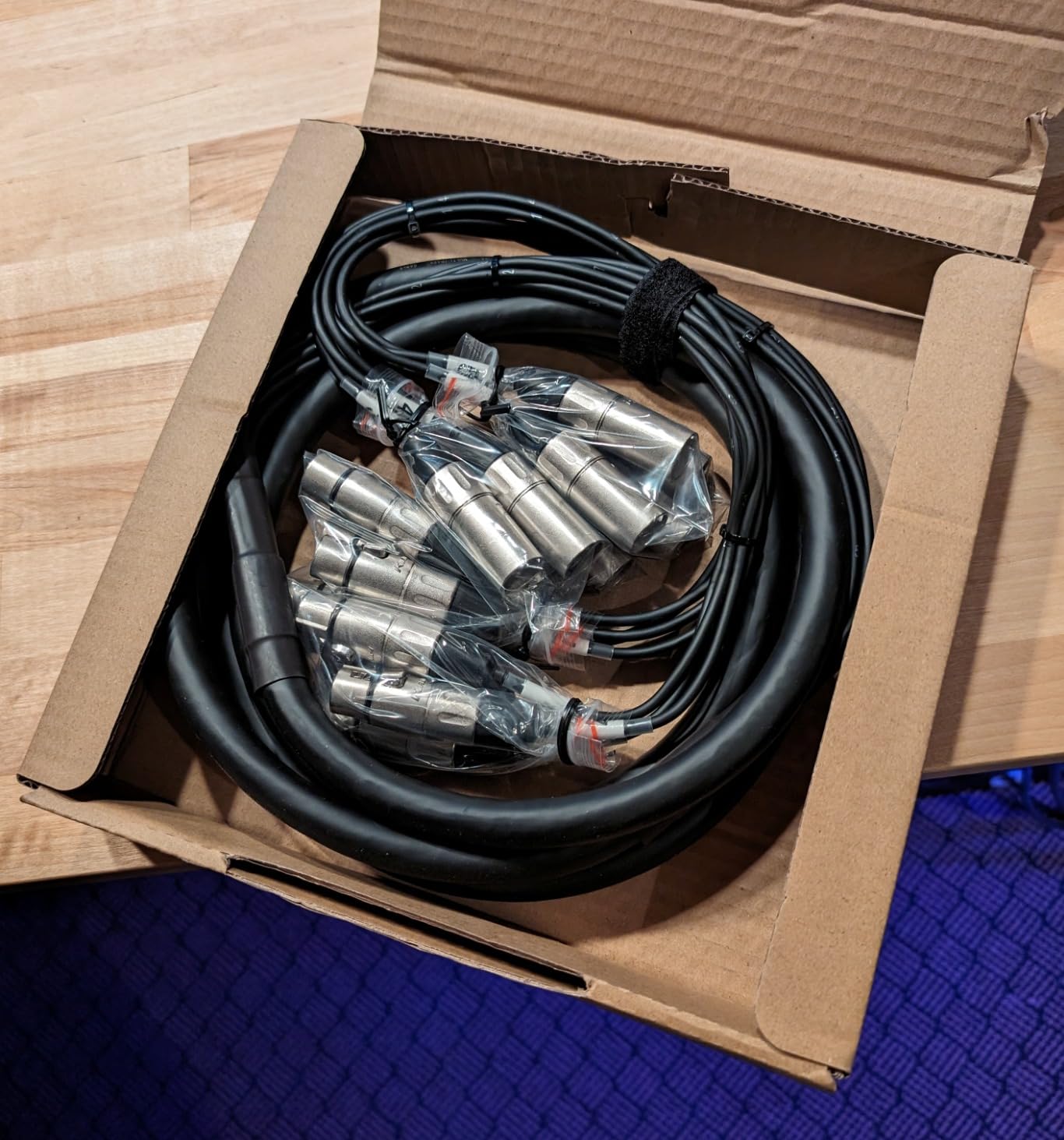
The KIRLIN MT-815-5M is the sleeper of this list. It rates 4.8 across two hundred and seventy-nine reviews with eighty-five percent five-star scores, which is the second-highest average in the group, and it does so with eight XLR channels over five metres of copper conductors in a PVC jacket.
What reviewers confirm repeatedly is that the signal path is quiet. No audible distortion across any of the eight channels, which for a budget snake is the thing that actually has to be right. The connectors are metal-housined, field-serviceable, and come with solid strain relief, and each channel sleeve is numbered and colour coded.
The jacket is genuinely flexible. Owners note that it coils well and does not hold a strong coil memory, which sounds minor until you are unrolling a snake at nine in the morning in a car park.
When five metres is the right answer
Five metres is roughly sixteen feet, and that covers the majority of small-room work: a rehearsal room, a function room, a studio live room, or a bar where the console is close to the performers. It is also a good sub-snake or patch run for studio work.
Because the channel sleeves are numbered and colour coded, you can use it as a trunk or as a stage box interchangeably. For a send-heavy rig with monitor feeds handled separately, it is a clean fit.
Where it falls short
The build is adequate rather than premium, and some owners are cautious about heavy touring use. It is also about a pound heavier than comparable short snakes. The cable arrives tightly coiled and can retain a curl after first deployment, which needs a day or two to relax.
There are no return channels at all in this configuration, so monitor and IEM feeds need their own cable.
5. Seismic Audio SAXQ-16x8x50 – Best Snake with Both XLR and 1/4 Inch Returns
Seismic Audio – SAXQ-16x8x50 – 16 Channel 50′ XLR Snake Cable with XLR and 1/4″ Returns on the Box
16 sends and 8 returns
50 ft run
Returns as XLR and 1/4 inch TRS
28.5 lb
Pros
- Dual-format returns need no adapters
- 16 sends and 8 returns cover most stage layouts
- Steel box aimed at touring and harsh environments
- 22 AWG shielded conductors
Cons
- Heaviest option here at 28.5 lb
- Parallel TRS returns can mismatch long unbalanced runs
This is the connector-flexibility pick. The SAXQ-16x8x50 gives you sixteen XLR sends and eight returns, and each return is paralleled with a 1/4 inch TRS on the stage box end. If your monitor system takes TRS and your console takes XLR, you patch natively on both sides without a bag of adapters.
That dual-format box is the whole reason to choose this over the straight XLR 16×8. Sixteen sends and eight returns over fifty feet covers most band and church stage layouts, and the twenty-two gauge conductors sit in line with what we consider the pro standard for analog snakes.
At 4.6 stars across two hundred and forty-seven reviews it sits solidly in the group. Its five-star share is lower than the other Seismic models here, and that is the one number to watch if you are deciding between the two fifty-foot boxes.
Deciding between the two 50-foot Seismic boxes
If your returns terminate in XLR, the straight XLR box is the cleaner choice: fewer connection points, less to fail, and the higher five-star share in its review history.
If your monitor or IEM distribution takes TRS, this box removes a whole category of adaptation. Adapters at the end of eight long runs are exactly the kind of thing that loosens during a show and gets left on the floor at load-out.
Where it falls short
At twenty-eight and a half pounds it is the heaviest option in this group, and that is a genuine load-in consideration for anyone moving stairs or stairs-only venues.
The parallel TRS returns need a word of caution. Using a balanced XLR snake’s paralleled quarter-inch outputs for long or unbalanced runs can create impedance mismatches. Keep those TRS outputs on short, properly balanced monitor paths and you will be fine.
6. PRORECK PR-SC25 – Best Low-Cost Circuit Board Snake
PRORECK 8-Channel Low Profile XLR Send Circuit Board Snake Cables, XLR Splitter Cable for Live, Recording, Stage, Studio, 25 Feet Long
8 channels, sends only
25 ft run
Circuit board connectors
RoHS compliant
Pros
- Lowest cost multi-channel snake in this set
- Circuit board connectors keep the noise floor low
- Matching numbers on fan-out and box
- Feeds analog or digital consoles without converters
Cons
- Send-only box with no returns
- Circuit board connectors are not field-serviceable
The PRORECK PR-SC25 is the cheapest way into the format, and the ratings suggest it is not a compromise where it counts. Four point seven stars across one hundred and twenty-three reviews with eighty-four percent five-star scores puts it level with products costing several times more.
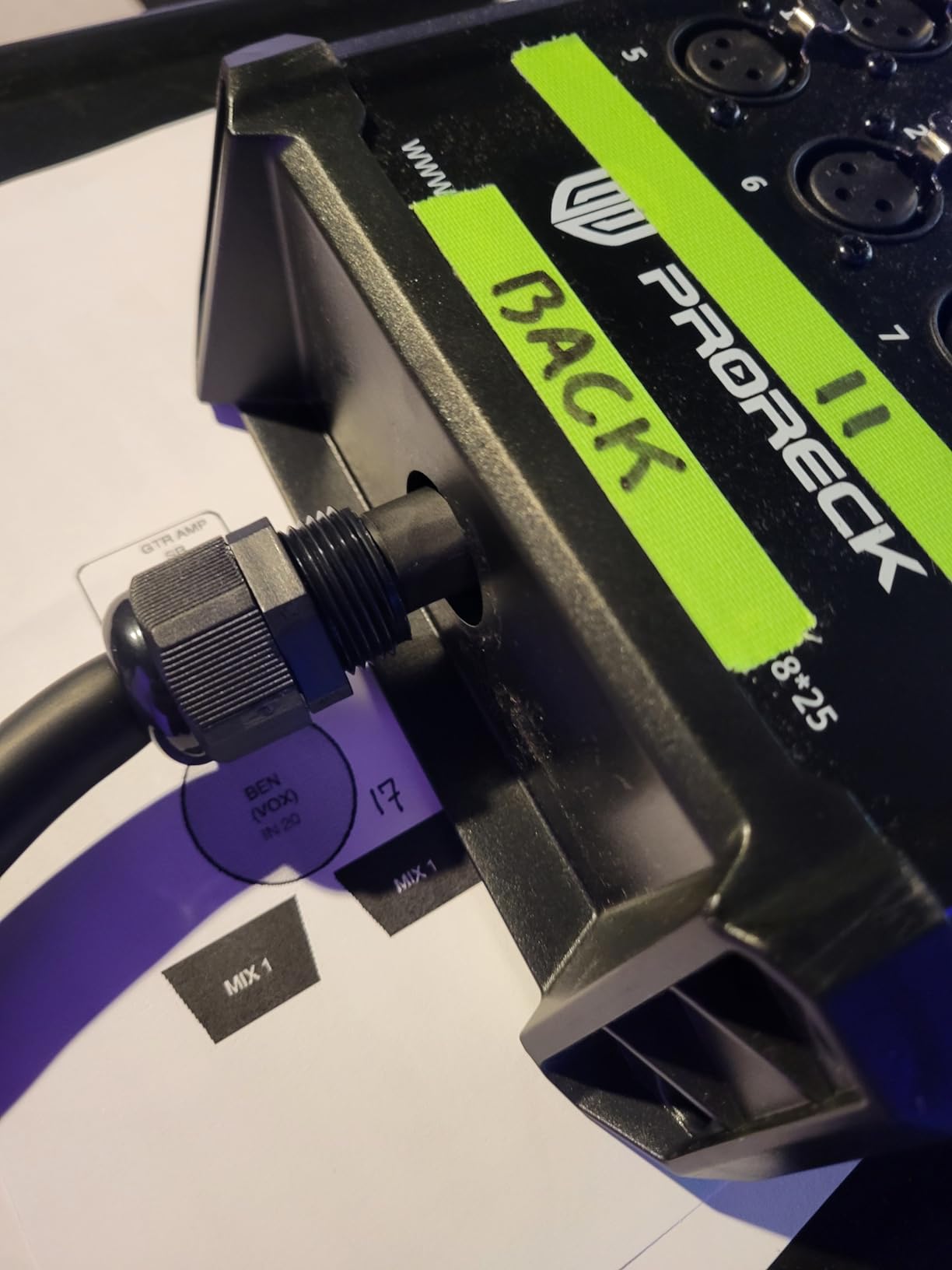
The circuit board connector design is doing the work here. Reviewers focus on its low noise floor as the reason it punches above its class, and the corresponding numbers printed on both the fan-out and the box make channel identification fast. It feeds analog or digital consoles directly without converters.
Eight channels, female XLR on the box end, male XLR on the fan-out, twenty-five feet. RoHS compliant, and the box and cable are both included.
Is a budget snake acceptable for regular gigs?
For rehearsal rooms, church mid-week services, and cover bands that move small amounts of gear, yes. The signal quality is not the weak point; reviewers consistently report a clean path. What you give up is serviceability and returns.
If your rig is permanent or touring hard, spend up on a panel-mount box. The failure mode on a bonded connector is a technician visit, not a five-minute swap.
Where it falls short
This configuration is send-only. There are no return lines, so monitor feeds need separate cable no matter how the rest of your rig is set up.
The circuit board connectors carry the same non-serviceable drawback as other low-profile designs in this list. It is a fine trade for a fixed location, and an awkward one for anything that travels.
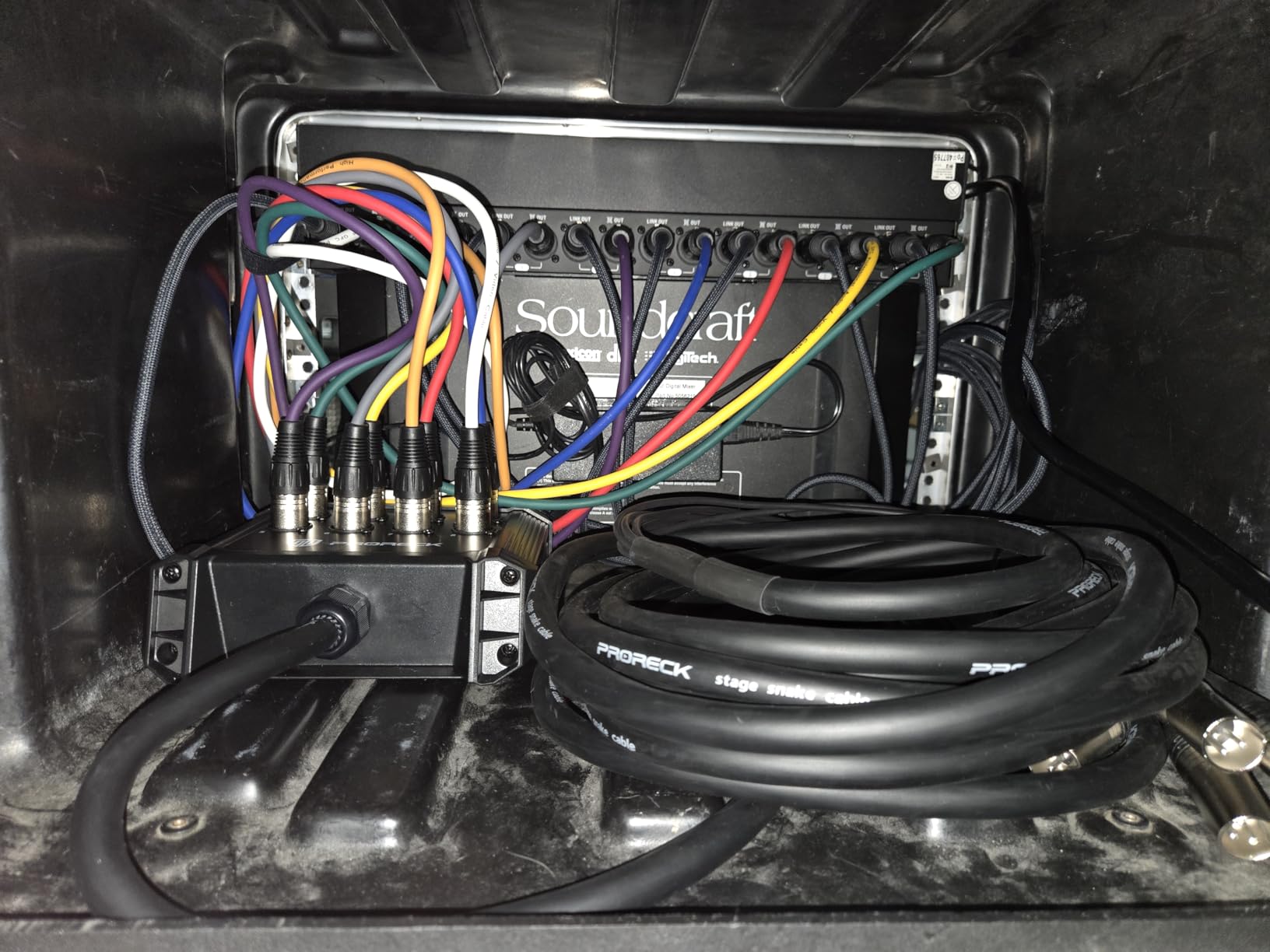
7. Behringer S16 – Best Digital Snake for X32 Rigs
Behringer S16 16-Channel Digital Snake Black
16 remote MIDAS preamps
8 XLR outputs
AES50 SuperMAC ports
10.36 lb
Pros
- One Cat5e cable replaces a full analog fan
- Remote preamps reduce stage-side gain problems
- SuperMAC AES50 keeps latency inaudible
- Works with standard shielded Cat5e
- 4.8 average with 90 percent five-star
Cons
- Learning curve the first time you pair it
- Locked to the X32 ecosystem
- One owner reported phantom power failing within a month
The S16 is not a snake in the analog sense. It is a digital stage box: sixteen MIDAS-designed fully programmable mic preamps on the stage end, eight servo-balanced XLR outputs, and AES50 network ports using KLARK TEKNIK SuperMAC for low jitter and low latency. One shielded Cat5e run carries all sixteen channels and control back to the console.
Users overwhelmingly frame it as a workflow upgrade. Load-in and tear-down times drop because a single cable replaces a full analog fan, and having remote-controlled preamps at the stage end largely removes ground loop problems because gain staging happens digitally at the console. It also carries a ULTRANET hub for Behringer P16 personal monitoring.
Four point eight stars across one hundred and eight reviews, with ninety percent scoring five, makes this the strongest five-star share in the group.
How to know when a digital snake is justified
The case for digital is strongest when you have more than sixteen analog channels to move, when load-in time is billed, or when you want stage-side preamps you can trim from the console without sending an engineer to the stage.
It needs an X32-family console to talk to, and standard shielded Cat5e with plain RJ45 terminations. No EtherCON cabling required, which is where a lot of digital stage box plans get derailed.
Where it falls short
It is a learning curve the first time you get the S16 talking to an X32, and it is not a general-purpose stage box. There is a real ecosystem lock-in here that analog snakes never have.
One owner reported phantom power failing on the unit within a month, though it was repaired under warranty. Worth noting if you run condensed condenser mics across the whole input count.
8. Behringer SD16 – Best Digital Stage Box for Church and Touring
Behringer SD16 I/O Stage Box with 16 Remote-Controllable Midas Preamps, 8 Outputs, AES50 Networking and ULTRANET Personal Monitoring Hub
16 remote MIDAS preamps
8 XLR outputs
AES50 SuperMac
3.2 kg
Pros
- All 16 channels plus control on one shielded run
- Remote preamp control per input
- Easy to strip down and remount for transport
- AES50 connection reported as stable
Cons
- Plastic connector shrouds can harden with long use
- One reviewer received a unit that did not work
- Same X32 ecosystem lock-in as the S16
The SD16 is the sibling unit to the S16, and the differences are mostly physical. It measures 15.35 by 8.45 by 7.75 inches at 3.2 kilograms, so it is a touch smaller and noticeably lighter than the S16 at 10.36 pounds. The core is the same: sixteen remote-controllable Midas-designed mic pres, AES50 networking over SuperMac, eight outputs, and a ULTRANET hub for Powerplay P16 personal monitoring.
Owners in church and touring contexts praise the single-cable run, the remote preamp control and how easily the unit strips down and remounts for transport. The single shielded Cat6A RJ45 run carrying all sixteen channels plus control is the part that changes a load-in day.
Four point seven stars across one hundred and one reviews with eighty-three percent five-star scores is a solid profile, if a thinner one than the analog boxes here.
S16 or SD16?
Both deliver sixteen remote preamps, eight outputs and AES50. Treat the choice as a physical one: the SD16 is lighter and smaller, which matters in a permanent install or a rack room. The S16 carries more connectivity in its published spec, including digital control for TURBOSOUND speaker systems.
Neither is general-purpose. If your console is not an X32 family unit, neither of these belongs on your shortlist.
Where it falls short
The plastic connector shrouds are reported to harden and degrade with long-term use. That is the main durability criticism across the review history, and it is exactly the part you touch every show.
One reviewer received a unit that arrived not working, and advises turning the box off when it is not in use to avoid overheating. Heat build-up on a permanently powered stage box is worth taking seriously in a hot room.
9. Rockville SX1650 – Best Value 16-Channel Double-Shielded Snake
Rockville SX1650 16 Channel 50 Foot XLR Snake Cable, 100% OFC
12 sends and 4 returns
50 ft run
Oxygen-free copper, double shield
15 lb
Pros
- Double foil and braid shielding
- Steel box with a carry handle
- Labeled and numbered ports
- 12 sends and 4 returns suit a mid-size band
Cons
- Lowest rating here with 9 percent one-star reviews
- Only 4 returns against 12 sends
- 25 AWG is lighter than the 22 AWG snakes here
The Rockville SX1650 is a sixteen-line snake over fifty feet: twelve XLR male sends and four XLR female returns, with a heavy-duty steel stage box and a carry handle. The conductors are 100 percent oxygen-free copper with double shielding, foil plus braid, and the ports are labelled and numbered.
On paper the shielding spec is the best in this roundup. Two layers of shielding is more than a single foil screen, and reviewers credit the copper conductors and shielding for a clean signal.
Here is the honest caveat. This is the lowest-rated option in the group at 4.3 across sixty-five reviews, with sixty-seven percent five-star and nine percent one-star. That is the widest spread of any product here, and it means the spec sheet and the real-world experience diverge more than they do elsewhere.
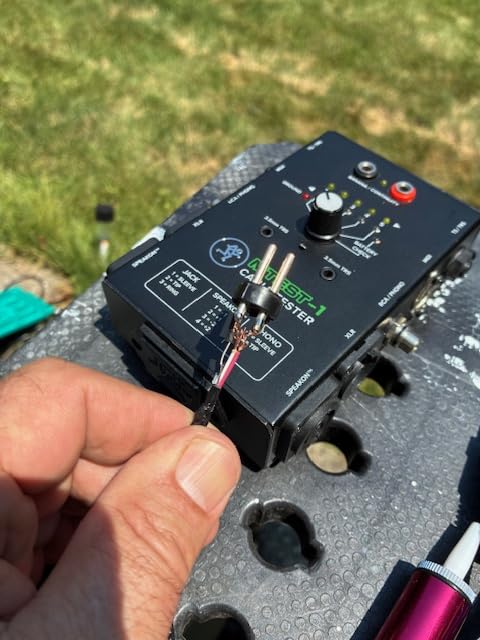
When double shielding earns its place
Doubled shielding matters in electrically noisy environments: stages with old dimmer racks, venues sharing power with lighting and video, and setups where the snake runs near mains cables. If you are in a well-behaved room with clean power, a single foil screen is plenty.
The 50-foot length and the carry handle are both practical wins for a mid-size band, and twelve sends plus four returns is a workable layout for a typical five-piece.
Where it falls short
Four returns against twelve sends is thin for foldback-heavy work. If you are running wedges plus IEM mixes, you will end up carrying a second return path.
The 25 AWG conductors are lighter than the 22 AWG used by the Seismic options in this list, and the nine percent one-star share suggests more variability in long-term build consistency. Buy it for a fixed room rather than a touring calendar.
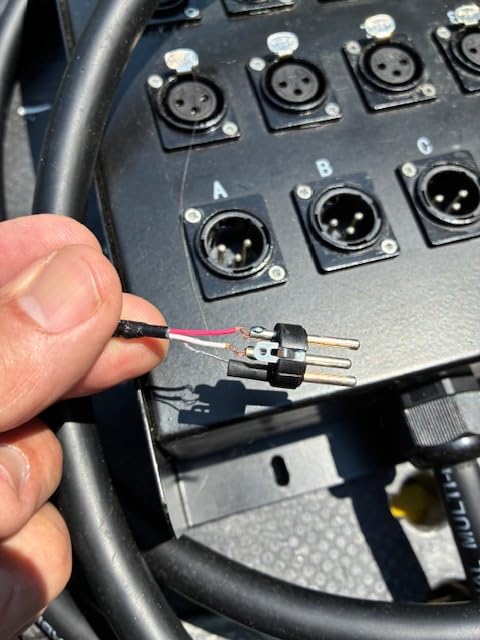
10. Harmony Audio HA-SB2450 – Best High-Channel-Count 24-Line Snake
Harmony Audio XLR Snake Cable 24 Channel 50 ft Stage Box – 20 Send 4 Return
20 sends and 4 returns
50 ft run
22 AWG shielded
Nylon braided jacket
27.7 lb
Pros
- Highest rating here at 4.9 with 97 percent five-star
- 24 lines in a single run
- Numbered inputs and lettered A/B/C/D returns
- 22 AWG shielded on a nylon braided jacket
Cons
- Only 4 returns for 20 sends
- Heaviest at 27.7 lb
- Smallest review base at 33
The Harmony Audio HA-SB2450 carries twenty-four channels over fifty feet, which is twenty XLR male sends and four XLR female returns. It is the largest analog channel count in this roundup, which makes it the natural answer for big stages, orchestras, and studio sub-snake work.
It also carries the highest rating here at 4.9, with ninety-seven percent five-star scores across thirty-three reviews. Read that number with the review count attached. Thirty-three reviews is the smallest sample in the group, so the rating carries far less statistical weight than the 4.7 across sixteen hundred that the Seismic 16×4 does.
The labelling scheme is genuinely thoughtful. Inputs are numbered and returns are lettered A, B, C and D, so a patching error between a send and a return is less likely in a dark room. The cable is 22 AWG, fully shielded, in a nylon-braided outer jacket.
Where 24 channels actually pays off
Twenty sends covers a full worship band with a rhythm section, a horn line, multiple vocal mics and still leaves room for choir or orchestra pickups. In studio work the same loom becomes a sub snake feeding a patch bay.
The braided jacket is a real consideration. Braided and cloth-wrapped cables are widely considered too inflexible for live work compared with typical rubber jackets, and this one at 27.7 pounds is the heaviest unit in the group. Flexibility over a long haul is a genuine tradeoff.
Where it falls short
Four returns against twenty sends is the concern. Foldback-heavy setups will need a second box or a separate return cable, which defeats some of the point of a single run.
And the small review base is the honest limitation. A 4.9 from thirty-three owners is encouraging, not conclusive. If you need certainty, pick a snake with hundreds of reviews behind it.
Stage Box vs. Cable-Only Snake: Which One Do You Need?
A stage box is a metal enclosure with many panel-mounted inputs. A cable-only snake is the same channels without the box, usually as a fan-out pigtail that plugs directly into a console or a wall of live inputs. They solve the same problem; one just gives you somewhere to plug in.
Choose a stage box when the console lives away from the stage. Mics and DI boxes plug into the box, one loom runs to front of house, and the fan-out lands near the console inputs. Everything stays on stage except one cable.
Choose a cable-only snake when you already have a patch bay or a console with plenty of unused live inputs, or when you are moving between rooms and want the smallest thing that works. The KIRLIN in this list is the clearest example of that format.
A note on connectors: a stage box usually presents female XLR inputs on stage and male XLRs at the far end, because the cable is designed to run box to console with no adapters. Check what your console end actually accepts before buying, because that mismatch is the most common expensive surprise in this category.
How Many Channels and Returns Do You Need?
Count your inputs before you count anything else. Every mic, every DI output, every playback source and every instrument feed needs a send. Then count the return paths separately, because that is where people get it wrong.
- Solo or duo act: 4 to 6 sends, 2 to 4 returns. A keyboard or an acoustic player rarely needs more than a couple of monitor lines.
- Three to five piece band: 8 to 12 sends, 4 returns. This covers drums, bass, guitar, keys, vocals and a spare or two, with enough returns for wedges plus a small IEM feed.
- Full band with horns or a worship team: 12 to 16 sends, 6 to 8 returns. Six or more wedges is where the 16×8 boxes earn their extra cost.
- Church with choir, band and spoken word: 16 to 24 sends, 8 returns minimum. Add a second box rather than dropping return lines.
- Theater or corporate stage: 24 sends, 8 to 16 returns. Here the argument for a digital stage box gets much stronger.
- Studio sub-snake: Match your patch bay exactly. Return count is usually irrelevant; send count is everything.
Two rules make sizing easier. First, add two spare sends beyond your real count, because you will add a mic at soundcheck and you would rather not be the one splicing it in. Second, if you run IEM systems, count returns per mix rather than per performer, then add two spare returns.
A common error is buying sixteen sends and two returns. The result is an expensive cable that cannot carry your monitor mixes, so wedges end up on separate runs anyway and the snake never earned its place.
How to Choose a Stage Snake
Match the connector layout to your console
Decide what terminates at each end before you choose a brand. XLR female inputs on the stage box and XLR male at the far end is the standard analog arrangement. If your monitor distribution takes 1/4 inch TRS returns, look for a box that provides both, such as the Seismic SAXQ in this list, or plan for adapters.
Combo inputs on the stage box are worth paying for when a band plugs instruments straight into the snake. Otherwise a separate DI box per source is the cleaner route, and it is where you can add padding and impedance correction.
Cable gauge and shielding: 24 AWG is the pro standard
The ideal gauge for a stage snake is 24 AWG shielded twisted pair with a foil shield and drain wire. That is the pro-audio norm, and the 22 AWG used by the Seismic and Harmony models here sits slightly heavier than that baseline. Eighteen and sixteen AWG are only justified for unusually long runs or high source impedances.
The reason each pair is independently shielded is crosstalk. A shared screen across all channels lets one hot vocal print into the next channel’s input. Individually shielded pairs, as specified for the Seismic 16×8, prevent that.
Does cable quality actually change the sound?
Less than branding suggests. In a balanced run with properly shielded pairs, a decent 24 AWG snake is effectively transparent over a hundred feet. Conductor quality and shielding matter; the logo on the jacket does not. What genuinely changes the sound is going into an unbalanced input, which is a connector decision rather than a cable decision.
Returns sizing for wedges and in-ear monitors
Size returns by mix, not by band member. Four wedges plus two IEM mixes needs six returns. Four returns is fine for a small club band running two wedges and one stereo IEM send, and painful the moment the monitor engineer asks for a fifth line.
Length: how far a snake can safely run
Over a hundred feet on balanced XLR lines, losses are generally small. The more common problems at distance are mechanical rather than electrical: strain at the connectors and interference from power or lighting cables run alongside the loom.
Choose length by measuring the actual route, including where the FOH position sits and where the cable has to cross the stage lip. Guessing short and adding an extension is how you end up with a snake and a second snake.
Build quality: jacket, strain relief and connector type
Look at three things: whether the connectors are panel-mount and serviceable, whether the jacket is rubber rather than braided or cloth-wrapped, and whether the strain relief at both ends is real. Heavy steel boxes survive a touring van; lightweight plastic boxes survive a rehearsal room.
Custom builds for unusual I/O
Mass-market snakes rarely ship with combo inputs plus TRS returns in the same box. When your I/O is genuinely non-standard, custom builders such as Radial Custom Shop, Clark Wire and Cable, Conquest USA and Link USA will build to spec for more money than a catalogue snake. Most engineers regard that cost as fair when nothing off the shelf fits.
Analog vs. Digital Snakes: When to Make the Jump
An analog snake moves audio as electrical signal on copper. Every input is a physical channel, and every gain decision is made at the console or at the stage. A digital stage box converts at the stage end and sends data over a single network cable.
Where digital wins is setup time and control. One Cat5e or Cat6A run replaces a fan of analog cables, load-in shortens, and the remote-controllable MIDAS preamps in the Behringer S16 and SD16 let you set gain from the console instead of walking to the stage. It also removes a lot of analog ground loop problems, because the signal is converted once.
Where analog wins is cost and independence. An analog snake connects to almost anything: any console, any interface, any preamp rack, now or in five years. Digital stage boxes here are tied to a console family, which is a real cost when the console gets upgraded.
Distance is worth mentioning. Digital solves the long-run problem rather elegantly, because one network cable is easier to route, terminate and test than twenty balanced pairs. If your stage is more than a hundred feet from the console, a digital box changes the conversation.
Our rule: stay analog below about sixteen channels with a short run, and consider digital when channels grow, load-in time is billed, or the FOH position is far from the stage. Do not buy digital for a coffee-house rig with eight inputs; you will spend the difference on the console instead.
Stage Snake Problems and How to Prevent Them
Straightened XLR pins are the most predictable failure. It happens from tight coiling, kinking around door frames, and wrapping the loom too small after a show. Coil in loose loops, and never wrap the fan-out end around the loom itself.
Jacket abrasion is the second. Rubber jackets resist taking a permanent set, while braided and cloth-wrapped cables stiffen and crack. On stage, keep the run off the edge of the deck where heels and dollies catch it, and put a tape patch on any spot that scuffs.
Hum and RF pickup are the third, and they are usually a routing problem rather than a cable problem. Never run the snake alongside mains or power cables, keep distance from dimmer outputs, and cross power at right angles rather than parallel. Experienced engineers will tell you the same thing forum after forum: snakes are balanced, and everything going into it needs to be balanced.
Unbalanced misuse is the fourth and the most common. Running a guitar-level TS signal over twenty-five to thirty feet degrades the signal and invites RF from power cables, stage-light dimmers and nearby radio. The fix is not a longer cable; it is a DI box into a mic pre.
Under-specified length causes the fifth. A run that is too short gets extended with a coupler or an extension lead, and every extension is another failure point and another source of noise.
Finally, insufficient returns push people back to loose cables. If your box cannot carry the monitor mixes, the tidy single-cable plan quietly dissolves. Size returns first, then buy the box.
Frequently Asked Questions
What is a stage snake and do I need one?
A stage snake is a bundled multi-channel cable that carries balanced audio from the stage to the front-of-house console, with a multi-input stage box on one end and a fan-out on the other. You need one once you pass roughly eight inputs, once the run to the console crosses a room people walk through, or any time setup and tear-down time starts costing you.
What is the ideal gauge for a snake cable?
24 AWG shielded twisted pair with a foil shield and drain wire is the pro-audio standard for stage snakes. Heavier 22 AWG is a step up, and 18 or 16 AWG is only worth it for very long runs or high-impedance sources. Each pair should be individually shielded to keep channels from printing into one another.
What are common problems with snake cables?
The usual failures are straightened XLR pins from tight coiling, cracked or stiffening jackets, hum and RF pickup from running alongside mains and dimmers, unbalanced instrument-level signals run too far, and a run that is too short for the venue. Coiling loosely, routing away from power, and using a DI box for instrument-level sources prevents most of them.
How many channels and returns do I need on a stage snake?
Count every mic, DI and playback source as a send, then add two spare sends. A three to five piece band usually needs 8 to 12 sends and 4 returns; a full band with horns or a worship team usually needs 12 to 16 sends and 6 to 8 returns. Size returns by monitor mix rather than by band member.
What is the difference between an analog and digital snake?
An analog snake carries electrical audio on copper, one balanced pair per channel, and connects to almost any console. A digital stage box converts at the stage end and sends everything over one network cable, which shortens load-in and gives you remote-controlled preamps, but ties you to a particular console family.
Can I run guitars directly into a stage snake?
Not ideally. Instrument-level unbalanced signal degrades over distance and picks up RF noise from power cables and dimmers. Use a DI box at the stage and feed the snake a balanced mic-level line instead, and add a reamp box at the amp end when you are sending a line-level output to a guitar amplifier.
Final Verdict by Use Case
For most working engineers, the Seismic Audio SACB-16x4x25 is the best stage snake for live sound in 2026 because it pairs sixteen balanced sends with four real returns in a box that fits under a stand, and it has more than sixteen hundred reviews behind it. If you need eight channels and want to forget about it, the Hosa Little Bro is the lighter, cheaper answer.
Match the layout to the job: the Seismic SAXQ when your monitors take TRS, the Rockville SX1650 for double shielding in a noisy room, and the Harmony Audio HA-SB2450 when twenty-four lines in one run matter more than four returns. Go digital with the Behringer S16 or SD16 only when the console is an X32 and the run or the channel count justifies it.
Whichever you choose, count your returns before you buy, keep the snake away from mains cables, and buy a panel-mount box if anything in your rig travels.