

A sealed grow tent runs out of carbon dioxide long before it runs out of water. Outdoor air sits at roughly 400 ppm, and once you seal a tent, your plants, your soil and your own breathing pull that number down fast. Growers who measure before they start supplementing usually find a tent sitting well under ambient, not over it.
That is why a CO2 monitor for grow tent work is not a luxury accessory. It tells you three things at once: whether your plants have enough CO2 to photosynthesize efficiently, whether your injection point is wasting gas, and whether the air your tent is holding has climbed high enough to be uncomfortable to work in. Our team compared ten current units on sensor chemistry, accuracy, control outputs and what they actually do inside a hot, humid tent.
We also broke the list into plain categories. If you want a meter that just reports numbers, the Temtop and Newentor units do it for very little. If you want the tent to hold a setpoint on its own, you need a controller, and the Autopilot APC8200 is the one we would install first. Updated for 2026, with placement rules and target ppm tiers explained below.
Getting the lighting right matters just as much as the air. If your tent is still dialing in intensity, start with our full spectrum grow light picks for seedlings before you spend on gas. In a compact setup, our aeroponic tower garden guide covers the other half of the controlled environment puzzle.
Table of Contents
Top 3 CO2 Monitors for Grow Tents

Autopilot APC8200 Controller
- Controller with remote 15 ft NDIR probe
- Adjustable ppm deadband and set point
- Photocell day/night scheduling
- Trend chart at minute/hour/day/week scales

Autopilot APCEM2 Data Logger
- 2-channel low drift NDIR sensor
- Records CO2/RH/temperature over 24 hour or 7 day windows
- Audible high and low CO2 alarm
- Hangs or stands with included strap and screws

Temtop C1 NDIR Monitor
- Swiss engineered NDIR sensor
- Reads CO2 temperature and humidity together
- 70 day battery with USB power option
- Silent mode for dark cycles
Our top three cover the three decisions most growers actually face. The APC8200 runs the whole system for you. The APCEM2 watches and records without controlling anything. The Temtop C1 tells you where you stand for very little money, and the manufacturer lists grow tents among its intended uses.
All 10 CO2 Monitors for Grow Tents at a Glance
| Product | Specifications | Action |
|---|---|---|
| Autopilot APC8200 CO2 Monitor and Controller |
|
Check Latest Price |
| Autopilot APCEM2 Desktop Monitor and Data Logger |
|
Check Latest Price |
| Temtop C1 CO2 Temperature Humidity Monitor |
|
Check Latest Price |
 Newentor C1 CO2 Monitor Newentor C1 CO2 Monitor |
|
Check Latest Price |
 GoveeLife Smart Air Quality Monitor H5140 GoveeLife Smart Air Quality Monitor H5140 |
|
Check Latest Price |
 SwitchBot Meter Pro CO2 Monitor SwitchBot Meter Pro CO2 Monitor |
|
Check Latest Price |
 TEKCOPLUS COTK-57 Portable CO2 Meter TEKCOPLUS COTK-57 Portable CO2 Meter |
|
Check Latest Price |
 DANOPLUS KB0297 CO2 Controller DANOPLUS KB0297 CO2 Controller |
|
Check Latest Price |
 Inkbird ICC-500T Controller with S01 Sensor Inkbird ICC-500T Controller with S01 Sensor |
|
Check Latest Price |
 TEKCOPLUS TK297PLUS CO2 Controller TEKCOPLUS TK297PLUS CO2 Controller |
|
Check Latest Price |
1. Autopilot APC8200 CO2 Monitor and Controller – the one that actually holds a setpoint
Autopilot CO2 Monitor & Controller w/15′ Remote Sensor
Low drift NDIR sensor
Remote 15 ft probe with photocell
Adjustable deadband and set point
7.4 x 9.6 x 3.4 in
Pros
- Holds a programmable ppm set point instead of just reporting
- Remote probe places the sensor at canopy level with the display outside the tent
- Photocell input so CO2 only runs while the lights are on
- Trend chart records per minute/hour/day/week with adjustable zoom
- Works out of the box on default programming with auto-calibration
Cons
- No app or WiFi for remote monitoring
- Display has no backlight
- Needs regulator flow tuning before it stops overshooting
Our first pick is the Autopilot APC8200, and the reason is simple: it is the only unit in this group that closes the loop. The 2-channel low-drift NDIR sensor feeds a controller with a fully programmable ppm deadband and set point, so the box opens a solenoid, runs a generator or triggers a bag valve when readings drop and shuts it when they climb.
The remote probe is what earns its place in a tent. A 15 foot data cable with an integrated photocell lets the sensor sit deep in the canopy while the display hangs at eye level outside, which is exactly where you want it when you are adjusting a regulator at midnight. The photocell is a genuine cost saver on a bag-based setup because the tent only gets CO2 while the lights are running.

Growers on THCFarmer report running a Titan Atlas 2 with a Titan regulator for five years without problems, and that same community treats the Autopilot line as the other durable option. One grower there described an Autopilot monitor surviving a drop down a flight of stairs, and another recommends keeping a second meter purely as a cross-reference in case the first one dies quietly.
The trend chart is more useful than it sounds. Readings recorded per minute, per hour, per day and per week with adjustable zoom make it easy to see whether your injection point is short-cycling, which is the usual reason a set point never holds in practice.

What the APC8200 does that a plain meter cannot
A monitor tells you 1,150 ppm when the tent is starved. A controller turns that number into a solenoid click. If you are running a tank, a generator or timed bags, the difference is the difference between topping up CO2 and metering it.
Set the deadband wide enough that the relay is not cycling every few seconds, then tune the regulator down until the controller settles instead of sawtoothing. Growers who skip that tuning step are the ones who conclude the controller overshoots.
Where this unit is the wrong choice
There is no phone app, so you cannot check the tent from the couch or get an alert while you are away. If remote visibility matters to you, one of the app-connected meters further down this list is a better fit for a monitor-only setup.
It is also a controller, not a complete system. You still need a regulator or generator, and a second tent needs a second probe and a second controller unless you run them in parallel. Budget for the rest of the hardware before you commit.
2. Autopilot APCEM2 Desktop Monitor and Data Logger – best for watching what the tent does overnight
Autopilot Desktop CO2 Monitor & Data Logger
Low drift NDIR sensor
CO2 humidity and temperature
24 hour or 7 day memory chart
15.84 ounces
Pros
- Records min/hour/day/week trends for CO2 humidity and temperature on the device itself
- Reads three metrics at once so VPD and CO2 drift can be compared
- Audible alarm for both low and high CO2
- Includes strap and screws plus two Micro USB cables and an AC adapter
- Operates from 32 to 122 degrees F at 0-95% RH noncondensing
Cons
- Battery pack for the hook-and-loop mounting option is not included
- Memory-based charting rather than live app monitoring
- Desktop form factor needs a shelf or hang point inside the tent
The APCEM2 is the sibling of our top pick without the control side. It watches CO2, relative humidity and temperature on a clear LED screen and stores the history in an internal digital memory chart you can review later over an adjustable 24 hour or 7 day window.
That memory is the reason to pick it over a cheaper screen-only meter. Growers who cannot sit and watch the graph will miss a slow leak, a fan schedule clash or a bag that died overnight, and the APCEM2 shows variable min, hour, day and week readings for CO2, humidity and temperature side by side.

In a tent, having humidity and CO2 on one display is more useful than it first appears. When CO2 falls right as temperature climbs, the cause is usually intake airflow or a light schedule change, not your gas delivery, and seeing both numbers on the same screen makes that pattern obvious.
The audible alarm covers both directions. A high reading alarm is a genuine safety feature once you are supplementing in a small tent, and the low alarm is how you notice the tent has quietly run out of gas while you sleep.

What to check before you buy it
This is a logger, not a remote monitor, so you have to physically read the chart. If your setup is in a basement or a room you only enter twice a day, that is still workable. If you want push notifications, it is not.
Two small planning notes. The hook-and-loop mounting option on the back expects an external battery pack that is not included, and the included green power supply works with a standard smartphone charger, so USB power is easy to add.
How we would use it in a tent
Hang it at canopy height on a wall away from the tent seam and away from any injection tube. Set it to the 7 day window, leave it alone through a full grow phase, and read the trend once a week. That weekly read is usually enough to catch a failing sensor or a leaking bag before it costs you a full flowering block.
3. Temtop C1 NDIR Monitor – the budget pick that skips the cheap sensor trap
Temtop CO2 Monitor Indoor air Quality Monitor Portable CO2 Meter, CO2, Temperature, Humidity Home, Office or School
Swiss NDIR sensor
Accurate within 400-2500 ppm
Reads CO2 temp and humidity
Battery or USB power
Pros
- Swiss engineered NDIR sensor with accuracy of +/-40 ppm plus 5% of reading from 400-2500 ppm
- 1 ppm resolution and 5 second refresh
- The most reviewed unit in this group with a strong four-star share
- Covers 400-5000 ppm CO2 which spans the entire useful grow range
- Audio alerts and screen illumination can both be switched off for dark cycles
- Manufacturer lists grow tents and nurseries among intended uses
Cons
- No relay or controller output
- Best used plugged in since battery mode slows the refresh rate
- Does not detect carbon monoxide which some buyers confuse with CO2
Most cheap CO2 meters use a MOS or eCO2 sensor and drift badly. The Temtop C1 does not. It uses a Swiss engineered NDIR sensor rated at +/-40 ppm plus 5% of reading inside the 400-2500 ppm band, which is precisely the band a grow tent lives in.
It also reads temperature from -10C to 60C and humidity from 0 to 99% RH, so one device covers the three numbers you actually track. Growers on r/microgrowery are blunt about the sensor chemistry here: get NDIR, because the MOS reads are not reliable and the price difference is small.

The refresh rate is 5 seconds with 1 ppm resolution. That is slower than the 1 second devices in this roundup, and it does not matter for enrichment, because plants and gas do not change fast enough in a tent to need a faster update.
One feature is worth more than it looks: both the buzzer and the display backlight can be disabled. If your tent is beside a bedroom, a bright screen glowing at 3am is the most common reason growers abandon a monitor they otherwise like.

When this is enough and when it is not
It is enough if you are supplementing with bags, because you can check the reading, add gas, check again and adjust by hand. It is not enough if you are running a tank and a solenoid, because there is no output to switch anything.
Run it plugged in. The 70 day standby battery is a nice emergency reserve, but the maker advises keeping it powered for continuous real-time monitoring, and the refresh cadence drops when it is on battery.
How to get an accurate read out of it
Take it outside for a few minutes first so it sees fresh air near 400 ppm, then bring it into the tent and let it settle for 15 minutes. The 1 ppm resolution makes it easy to read stable rather than transitional numbers, which matters when you are deciding whether to add a second bag.
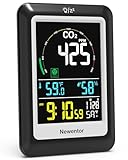
4. Newentor C1 CO2 Monitor – best for a straightforward read-only check
Newentor CO2 Monitor, Indoor Air Quality Meters, Carbon Dioxide Detector
Sensirion photoacoustic sensor
CO2 temp and humidity
5000 ppm model
4.8 ounces
Pros
- Uses Swiss Sensirion PASens photoacoustic technology for a real sensing element rather than a MOS approximation
- Customizable CO2 alert levels with audible alarm and snooze
- Display changes colour once you pass your chosen threshold
- Explicitly marketed for grow tents and greenhouses
- Runs on 3 AAA batteries as backup when mains power is lost
Cons
- Reading updates roughly every 6 seconds when plugged in
- Proprietary round barrel power connector instead of USB-C
- Touch screen can show temporary white lines and the kickstand is unstable on wire shelving
The Newentor C1 is the plainest tool in the list and that is its appeal. It uses Swiss Sensirion PASens photoacoustic technology, gives you CO2, temperature and humidity at the same time, and lets you set your own alert level with an audible alarm and snooze.
The display colour change past your threshold is a small touch that gets used more than you would expect. In a dark tent at night you can tell from across the room whether the reading is safe without walking over to it.

Owner reports in this category are unusually consistent. Buyers say the readings line up with more expensive meters, and one customer service story describes a humidity-damaged unit being replaced without argument, which matters in an environment where condensation is constant.
Battery backup is genuinely useful here. Three AAA cells keep the alarm alive if the extension run gets knocked, so you still get a high reading warning during a power cut.

What you trade away for the simplicity
The 6 second refresh interval is the biggest compromise. It is fine for spot checks and poor for watching a gas valve cycle, so if you plan to sit and watch levels move, pick a faster device.
Plan around the power connector too. It is a proprietary round barrel plug rather than USB-C, so a spare cable is not something you can grab at any shop when the one in the box frays.
Where we would hang it
Canopy height on a wall, away from the seam and away from the injection point. If you also care about tent humidity, our large tent and canopy guide covers airflow setup that pairs well with a CO2 monitor in a larger space.
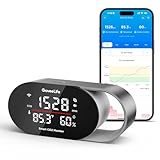
5. GoveeLife Smart Air Quality Monitor H5140 – best for logging without sitting in the tent
GoveeLife Smart Air Quality Monitor CO2 Detector H5140, Display & Alarm
SCD4x photoacoustic NDIR sensor
Altitude compensation
CO2 temp humidity and clock
AC powered
Pros
- SCD4x photoacoustic NDIR sensor rated at +/-40 ppm plus 5% with a 5 second refresh
- Built-in pressure compensation for altitude which matters in high-elevation grows
- Up to two years of history in the app with CSV export
- Buzzer plus app notifications and email reports at your thresholds
- Display brightness and light bar can be scheduled for dark cycles
Cons
- Needs a nearby outlet
- so relocating it requires a power bank
- CO2 only with no particulate sensing
- No Apple HomeKit integration
The GoveeLife H5140 is the pick if you cannot be in the tent when the interesting things happen. It logs to an app, keeps up to two years of history, and pushes notifications and email reports when a threshold is crossed, which is the closest thing in this roundup to a real-time CO2 feed.
The sensor is a photoacoustic NDIR SCD4x with +/-40 ppm plus 5% accuracy, a 5 second refresh and built-in pressure compensation for altitude. That last spec is not marketing filler. If you are above 1,000 meters, an uncompensated meter can read low enough to make you chase a problem you do not have.

Reviewers report that its readings line up against other meters, and several mention using it to watch CO2 climb in a closed room, which is the fastest way to confirm whether your tent is actually sealing. You can also calibrate it in the app against outdoor air if you want a fresh-air baseline.
Display management is better than most. The screen and the tri-color light bar are programmable on an app day/night schedule, so the glow does not become a light leak in your dark cycle.

What decides it for a grow tent
It runs on AC power with no batteries to swap, which suits a permanent install but means you need an outlet near the tent. A power bank works if the only outlet is on the wrong side of the room.
It measures CO2 only. There is no particulate sensor, and it cannot link to an air purifier because purifiers do not remove CO2, so if you are chasing a mixed air quality problem this is the wrong tool.
How we would pair it
Use it as your early warning system and keep a second, cheaper NDIR meter in the tent as a cross-check. Growers on THCFarmer run a second monitor purely for reference, and having one logged remotely plus one read in person is the cheapest accuracy insurance in this category.
6. SwitchBot Meter Pro CO2 Monitor – best for moving the sensor around
SwitchBot CO2 Detector, Air Quality Monitor Indoor, CO2 Monitor for CO2/TEMP/Humidity, Portable Carbon Dioxide Detector for Home/Car/Office/Greenhouse
Swiss NDIR sensor
400-9000 ppm range
92mm screen
3.62 x 3.62 x 0.98 in
Pros
- Swiss made NDIR sensor measuring every second at +/-50 ppm accuracy across 400-9000 ppm
- Large 92mm screen shows CO2 temperature humidity time date and comfort level together
- Three alert routes including sound plus on-screen alert and app notifications
- Built-in battery of up to 12 months with wall-mount holes and an adjustable bracket
- Only 154g so you can carry it between tents to compare readings
Cons
- App notifications need the separate SwitchBot Hub
- Monitor only with no control outputs
- Battery operation can reduce the update frequency versus USB power
The SwitchBot Meter Pro is the most portable unit here, and portability turns out to matter more than expected. At 154g with a 12 month battery, you can take it from tent to tent and get a comparative picture in a way a fixed install never allows.
The Swiss NDIR sensor measures every second across a 400-9000 ppm range at +/-50 ppm, and the 92mm screen shows CO2, temperature, humidity, time, date and a comfort level all at once. That combination display is the fastest way to spot a ventilation problem at a glance.

Alerts come three ways: an audible buzzer, an on-screen alert and app notifications. The last one needs the separate SwitchBot Hub, which is worth knowing before you build remote monitoring into your plan.
Measured against a fixed controller this is a different job. It never switches anything, so your gas flow is manual. For a bag setup where you add a bag when the number drops, that is a perfectly workable loop.

Where the wide range helps
A 400 to 9000 ppm span covers everything from a starved tent to a genuine safety concern, so the same device works as a growth monitor and as an early warning during a fault with your ventilation.
The upper band is where the reading matters. Growers who work a room with the door closed have reported readings in the 2,500 to 3,250 ppm range on a similar class of meter, dropping to roughly 1,300 to 1,900 ppm once air was allowed to move.
When to keep it plugged in
Run it on USB when you want continuous second-by-second updates. On battery it lasts about a year, which is ideal for spot checks across several tents, but the update cadence slows down.
For multi-site work, this is the unit that scales. It also pairs naturally with compact setups like our hydroponic grow system picks, where you may want to check air quality in a sealed closet setup without hardwiring anything.
7. TEKCOPLUS COTK-57 Portable CO2 Meter – best for wide-range and thermal readings
CO2 Meter Portable CO2 Detector Digital CO2 Monitor with Alarm Function Carbon Dioxide Temperature and Humidity Meter, NDIR CO2 Sensor Indoor Air Quality Monitor for Home Office Grow Room
0-9999 ppm NDIR meter
Accurate 0-2000 ppm
Dew point and wet bulb
Backlit LCD alarm
Pros
- Huge 0-9999 ppm range for both grow readings and high-level safety checks
- Accuracy of +/-50 ppm or 5% of reading from 0-2000 ppm which covers the grow band
- Dew point and wet bulb alongside CO2 temperature and humidity
- Large backlit LCD shows all values at the same time
- User-set audible and visual alarm threshold
Cons
- Monitor only with no relay output
- Accuracy widens to +/-10% of reading between 2000 and 9999 ppm
- Battery powered with no data logging or trend chart
The COTK-57 is the one to buy if your concern extends past plant growth into personal safety. Its 0 to 9999 ppm range covers both a normal grow tent and the numbers you do not want to see in a poorly ventilated room, and the dew point and wet bulb readings help you see condensation forming on your sensor.
Within 0 to 2000 ppm, where grow tents actually sit, accuracy is +/-50 ppm or 5% of reading. Above 2000 ppm the spec widens to 10% of reading, so treat the upper numbers as a safety flag rather than a precise measurement.

The dew point reading is the sleeper feature in a tent. When the dew point approaches your tent temperature, condensation starts forming, and a fogged or wet sensor is the most common reason a grower throws a perfectly good meter away.
Reviewers point to the wide range, the backlit display and the threshold alarm as the reasons to buy, and equally to the fact that it only reports levels. Everything beyond 2000 ppm is a warning, not a control surface.
When this is the right tool
Keep one outside the grow area if you store cylinders indoors. Growers on THCFarmer describe CO2 tank safety as a genuine reason to monitor beyond the tent itself, and a meter that reads up to 9999 ppm is more use for that than a 5000 ppm unit.
Inside the canopy, it works as a secondary reference. Two meters in the same tent, one growth band and one safety band, is a reasonable setup if you want a cheap check on whether the controller probe is lying.
What to watch
There is no data logging or trend chart, so every reading is a moment-in-time snapshot. If your tent is stratified, a single handheld reading taken at the wrong height can be badly misleading, which is why we recommend it alongside a fixed monitor rather than instead of one.
8. DANOPLUS KB0297 CO2 Controller – best for running a fan as well as gas
CO2 Controller, 0-5000PPM Carbon Dioxide Controller with Human/Plant Mode, 15ft NDIR Probe, LCD Trend Display, Audible Alarm, Day&Night Relay, CO2 Monitor for Greenhouse, Grow Rooms
0-5000 ppm NDIR sensor
15 ft probe with photocell
Plant and human modes
10A socket
Pros
- Two automation modes
- plant mode adds gas when levels drop and human mode pulls ventilation when levels rise
- 2-channel low-drift NDIR sensor accurate to +/-50 ppm or 5% over 0-5000 ppm with 1 second updates
- 15 ft probe with a built-in photocell that pauses generation overnight
- LCD trend display across 5 time scales with max/min records
- 10A US piggyback socket so you can skip an extra relay box
Cons
- Photocell night pause is fixed behavior rather than a selectable schedule
- No app or wireless monitoring
- Controller only with no separate temperature or humidity sensors
The DANOPLUS KB0297 is unusual in a good way: it has two modes. Plant mode starts your CO2 source when levels fall below target, and human mode turns on ventilation when levels rise, which is the response you want if you are working in the tent while gas is being released.
That dual behavior is why it earns a place. Most controllers only add. A unit that also removes is the closest thing in this list to a safe unattended setup, and in a small tent where you work with the door open, human mode is worth more than another 50 ppm of precision.

The probe is 15 feet with a built-in photocell that pauses CO2 generation at night to save gas, and the sensor is a 2-channel low-drift NDIR element reading every second across 0 to 5000 ppm at +/-50 ppm or 5%.
It also solves a small hardware problem. The 10A US piggyback socket means you can plug a generator or fan directly into the controller instead of buying a separate relay box and wiring it up.

What the two modes change in practice
Plant mode alone is a dosing loop. Adding human mode turns the same box into a two-sided system, where high readings trigger extraction instead of just sounding an alarm you might sleep through.
Use it with the probe in the canopy and the body outside. The LCD shows a trend across 5 time scales with max and min records, so a night of bad readings is visible in the morning.
Where the design annoys people
The photocell night pause is fixed behavior, not a menu setting. If you run lights on a split cycle or supplement during dark hours for a photoperiod-sensitive grow, that behavior works against you.
There is no app, so the display must be read where it hangs, and there are no temperature or humidity sensors on the body. Pair it with a separate three-metric meter such as the Temtop or Newentor if you want CO2 and VPD in one screen.
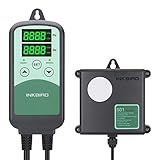
9. Inkbird ICC-500T with S01 sensor – best for simple dual-outlet control
Inkbird ICC-500T CO2 Controller CO2 Meter Carbon Dioxide Controller for Grow Room and CO2 Generator, with CO2 Sensor for Home Grower (CO2 Controller + S01 Sensor)
Controller with S01 sensor
Programmable ppm range
Shows measured and target CO2
Pros
- Two switched outlets so you can plug a CO2 regulator or generator into WORK1 and an exhaust fan into WORK2
- Programmable to hold CO2 within a desired ppm range with calibration and alarm support
- Display shows measured CO2 and target CO2 in ppm at the same time
- Plug and play operation with no wiring
- CE and FCC certified with an S01 sensor made for home growing and HVAC
Cons
- No app connectivity
- remote monitoring or data logging
- Controller only
- so a tank
- regulator and mounting hardware are separate purchases
- Mixed owner reports on long term sensor reliability
The Inkbird ICC-500T is the least fiddly controller here. Two switched outlets on the back, one for your CO2 source and one for an exhaust fan, and a digital display that shows measured CO2 next to your target so you can see at a glance how far off the setpoint is.
It runs plug and play. Once you set the ppm range, the controller switches devices on and off as readings cross your limits, with calibration and alarm support built in. There is no wiring to run and no menu to learn.

Growers like the straightforward pairing of source plus fan, which is the same dual-role idea the DANOPLUS approaches with its piggyback socket, just with a different hardware layout and no separate probe cable.
Owners also note that support replaced a unit when needed and that the S01 sensor is described as suitable for home growing and HVAC equipment, both of which matter more than they sound in a damp tent.

What you have to buy separately
Think of this as the switching brain, not the gas system. A CO2 tank or cylinder, a regulator with a solenoid, and mounting hardware for the sensor are all separate purchases, and the mounting piece is the one most first-time growers forget.
If you are bag-based rather than tank-based, this controller does less for you. Bags emit continuously and cannot be switched, so a controller has nothing to switch on the CO2 side.
Reliability to keep in mind
Reviews are mixed on sensor longevity after extended use, so treat it as a device you may replace once in a while. If the sensor fails silently, a second meter in the tent is the only way to know.
For growers running several tents, this is where the honest answer is that you need one controller per tent or a multi-channel unit, which is exactly the gap growers complain about in multi-site setups.
10. TEKCOPLUS TK297PLUS CO2 Controller – best for scheduling enrichment to the light cycle
CO2 Controller Carbon Dioxide Controller Air Quality Monitor CO2 Meter with Day and Night Control Relay Function, NDIR Sensor Probe Cable, CO2 Detector for Plant, Grow Room, Green House, Garden, Home
NDIR sensor on 4.5m probe
Photo sensor night shutoff
Plant and human modes
Trend chart
Pros
- 4.5m sensing probe lets the display sit outside the tent while the sensor stays deep in the canopy
- Built-in photo sensor shuts off CO2 enrichment during darkness so gas is not wasted
- Programmable target and zone values with dedicated human and plant modes
- Large backlit LCD with a CO2 chart across minute hour day and week scales
- Owners report simple installation and easy programming
Cons
- Several owners report the unit or sensor failing or freezing its reading after months
- Unresponsive seller support in at least one reported failure
- A few reports of inaccurate readings
- Not recommended by some owners for permanent unattended monitoring
The TK297PLUS takes the canopy-placement idea seriously. A 4.5m, or 14.7 foot, probe cable means the main display can live outside the tent while the sensor sits inside the plant canopy, and the built-in photo sensor shuts off enrichment whenever the tent is dark.
That night shutoff is the practical feature. Bags and generators run 24 hours a day unless something tells them not to, and tying dosing to the light cycle is the simplest way to stop paying to add CO2 that plants cannot use. Growers on THCFarmer make the same point from the gas side: schedule a tank release to lights-on, because bags have no schedule of their own.
Programming is straightforward. You set target and zone values, pick plant or human mode, and the backlit LCD charts readings across minute, hour, day and week time scales with adjustable zoom.
Durability is the deciding factor here
This is the one product in the roundup with a consistent durability complaint. Several owners report the unit or the sensor failing, or freezing on a fixed reading, after roughly a year of service, and at least one report describes unresponsive seller support after a failure.
There are also a few reports of readings that were not accurate and owner advice against permanent unattended monitoring. If your tent depends on this box to shut gas off when nobody is home, weigh that carefully against a controller with a stronger track record.
Who it still suits
If your tent is attended, your runs are seasonal, and you like a canopy-depth probe with a daylight schedule, the feature set is genuinely good for the money. Just plan to check the display in person rather than trusting it to run for months untouched.
What CO2 Level Should You Target in a Grow Tent
Outdoor air is about 400 ppm. That is the number your tent is competing against, and a sealed tent frequently sits below it because plants are removing CO2 to photosynthesize and there is no fresh intake replacing it. A grower on THCFarmer measured ambient at 650 ppm in a heavily insulated basement while another logged 375 ppm outdoors, and that gap is why you measure your own baseline instead of assuming.
The target depends on how much light you are delivering, because CO2 only pays off when the plants have the photons to use it. More light means more carbon gets fixed, and holding a high setpoint under weak lighting mostly wastes gas.
Target ppm tiers by light intensity
Use these as starting points and adjust for what your meter shows at canopy height after the tent has been closed for an hour:
- 400 to 500 ppm – ambient parity. The right goal for a low-light setup, a seedling stage, or a leaky tent where enrichment will not hold.
- 800 to 1000 ppm – the sensible working target for most indoor tents. Meaningful photosynthesis gain without complicated control.
- 1200 to 1300 ppm – where you should be with high-intensity lighting and a properly sealed tent. This is the common default setpoint on controllers like the APC8200.
- 1500 ppm – the ceiling for most setups. Gains flatten, cost per day climbs, and control becomes harder to keep stable.
One useful rule ties it together: match your CO2 setpoint to your light level, and never supplement in a tent that is leaking. If the number will not hold for 10 minutes after you stop dosing, the problem is airflow, not the sensor.
NDIR vs MOS Sensor Chemistry
Buy NDIR. This is the single most important spec on any CO2 monitor for grow tent shopping, and it is the one most cheap listings bury. An NDIR sensor, or non-dispersive infrared, measures how much infrared light CO2 absorbs and converts that into ppm. A MOS or eCO2 sensor estimates CO2 from a change in a metal-oxide resistance, and that estimate drifts with humidity, temperature and time.
The practical difference in a tent: NDIR holds a stable reading over months, which is what you need when you are dosing gas by the number. MOS units wander, so you end up chasing a target that keeps moving, or worse, trusting a reading that is off by several hundred ppm.
Two of the cheapest devices in this roundup use photoacoustic detection, which is a close relative of NDIR and is used by both the Newentor and the GoveeLife. Both are fine choices, and both beat a MOS sensor at the same price. The one product group we would not buy for a grow tent is any listing that never names the sensor type.
One more spec worth reading carefully: accuracy. A claim of +/-40 ppm plus 5% of reading is a good, realistic figure. A bare claim of “+/- 400 ppm” is not a measurement spec, it is a placeholder, and it tells you nothing about the useful band.
Where to Put Your CO2 Monitor in a Tent
CO2 is denser than air, so it settles, and that single fact is the source of most placement mistakes. Get the position wrong and you are reading the floor puddle rather than the air your plants are breathing, and you will either over-dose or conclude enrichment does not work.
- Measure outdoor air first. Take the monitor outside for a few minutes before it goes in the tent, so you know your fresh-air baseline.
- Hang the sensor at canopy height, in the breathing zone of the plants, not at the top of the tent and not on the floor.
- Keep it 12 to 18 inches above the lowest point if you also want to know whether CO2 is pooling underneath the canopy.
- Place it away from the injection tube and at the opposite end of the tent from where gas enters. Growers on THCFarmer describe running the tube to the back of an oscillating fan with the sensor at the far end, which is the arrangement that produces a representative reading.
- Aim small upward-facing fans from the floor. Since CO2 settles, upward airflow mixes the heavy low layer into the canopy instead of leaving it under the leaves.
- Keep the display outside the tent where possible, with only the probe inside, so you can read it at eye level without opening the door and changing the air you are measuring.
Watch for condensation. A sensor fogging over in a hot, humid tent will read oddly, and the dew point reading on the TEKCOPLUS COTK-57 is a good early warning that you need more airflow across the probe.
Monitor Only vs Monitor With Controller
A monitor reports. A controller reports and acts, switching a solenoid, a generator or a ventilation fan as readings cross limits. That is the whole difference, and it decides what you are actually able to do with the number.
If you use bags, you need a monitor. Bags emit continuously and cannot be switched, so your only control is your own hands and how many bags you open. If you run a tank with a solenoid, or a generator, you need a controller, because hand-dosing a tent every 20 minutes is not realistic. If you work in a small tent where levels climb while you are inside it, a controller with a ventilation mode such as the DANOPLUS adds a safety layer a plain meter cannot.
For the rest of the system, remember that a controller is not gas. Every controller in this roundup still needs a regulator with a solenoid, or a generator, and in most cases a cylinder or a set of bags. Buy the controller second, after you know what is feeding it.
On calibration, expect to check outdoor baseline every few months. Sensors live in hot, humid, CO2-rich air and drift slowly. If your reading has not moved in 30 minutes, compare it against a second meter before you start adjusting gas delivery.
When CO2 Enrichment Is Not Worth It
Plenty of growers should not buy gas yet, and the honest answer saves more money than any monitor does. If your tent leaks, supplementation will not hold and you are just venting money. If you are running low light, the plants cannot use the extra carbon and the setpoint should stay near ambient. And for seedlings and clones, the growth rate is driven by root development and light, not CO2.
Uninsulated rooms and tents that open a window or run a fan on a timer are the classic cases where enrichment fails. So are tents with a leaky door seal, where the monitor will show you exactly how much you are losing, which is a valid reason to buy a meter even if you never add gas.
A cheap meter is still worth it as a diagnostic in those situations. Knowing that your tent sits at 420 ppm tells you enrichment could pay; knowing it reads 380 ppm after an hour of closure tells you your tent is starved and your intake is doing nothing. Either way you have bought information, not a bill.
CO2 Safety in a Sealed Tent
CO2 is not toxic to plants at any level you would sensibly target, but it is a real hazard for you. Outdoor air is around 400 ppm. Sustained exposure above 2,000 ppm starts to cause noticeable symptoms, and above 5,000 ppm, which is 0.5% of the air, it becomes a genuine health risk.
Ventilate before you work in the tent, not after. Keep the exhaust running whenever gas is being released, and do not sleep in a room with an active CO2 source. Nobody should ever have to enter a tent to find out whether the level is safe.
Storage is the quieter risk. Cylinders in a closed room can raise the ambient level with no one noticing, and a monitor reading into the thousands is a warning about the room, not about your plants. A meter with a high range such as the TEKCOPLUS COTK-57 is genuinely useful for a storage space where a 5000 ppm ceiling would clip.
One last note on meters: none of the units in this roundup detect carbon monoxide. CO and CO2 are different gases, and a device that does one does not do the other. For combustion equipment, buy a dedicated CO alarm.
Frequently Asked Questions
What is the best CO2 monitor for a grow tent?
The Autopilot APC8200 is the best overall CO2 monitor for a grow tent because it is a controller as well as a monitor, with a 2-channel low drift NDIR sensor, a remote probe on a 15 foot cable with a photocell, and a programmable ppm deadband and set point. If you only need to read levels and dose by hand, the Temtop C1 gives you a Swiss NDIR sensor with +/-40 ppm plus 5% accuracy for far less.
What is the ideal CO2 level for a grow tent?
Target roughly 400 to 500 ppm to match outdoor air, 800 to 1000 ppm for a typical indoor tent, 1200 to 1300 ppm under high intensity lighting in a properly sealed tent, and 1500 ppm as a practical ceiling. CO2 only pays off when you have the light to use it, so match your setpoint to your light intensity and never enrich a leaking tent.
What is the best CO2 system for a grow tent?
A complete system is a monitor or controller, a regulator with a solenoid or a generator, and the gas itself. In practice that means a controller like the Autopilot APC8200, Inkbird ICC-500T or DANOPLUS KB0297 paired with a solenoid regulator, with the sensor probe placed at canopy level and the exhaust running whenever gas is released.
At what level does CO2 become toxic to plants?
CO2 is not toxic to plants at any level you would sensibly target, and growers routinely run 1200 to 1500 ppm for faster photosynthesis and heavier yields. The real limits are economic, since gains flatten above roughly 1500 ppm while gas cost keeps climbing. Above 2,000 ppm people begin to notice symptoms and above 5,000 ppm it is a genuine health hazard.
What is the typical ppm range for a CO2 meter?
Outdoor air is about 400 ppm and a sealed grow tent often sits at or below that, so a grow-range meter should cover roughly 400 to 5000 ppm. Grow-focused models such as the Temtop C1 quote 400 to 5000 ppm, while general air quality meters reach 9000 ppm and safety-focused meters go to 9999 ppm for detecting dangerous levels in a room.
Final Verdict
The Autopilot APC8200 is our pick for the best CO2 monitor for grow tent work, because it is the only unit here that both measures with a proper low-drift NDIR sensor and holds a setpoint through a remote canopy-level probe. Install it with the display outside, the probe inside, and a regulator you have already tuned.
If you are supplementing with bags, the Temtop C1 is the smart first purchase and the Autopilot APCEM2 is the upgrade that adds history. For the app-connected and portable routes, the GoveeLife H5140 and the SwitchBot Meter Pro cover remote logging and multi-tent spot checks.
Before you buy any gas, run one cheap NDIR meter for a week and log your ambient and tent readings. If the tent sits near 400 ppm with the door closed, you have room to work. If it drifts far below that, fixing your airflow will pay back faster than any monitor. Both answers cost nothing to find, and they tell you which of these ten you actually need.