
When your child starts getting serious about chess, one of the first equipment questions that comes up is whether to buy a digital chess clock vs analog. As a parent or coach, you want to make the right investment that will serve your young player through tournaments, club games, and practice sessions. This decision becomes even more confusing when you see experienced players using different types of clocks and hear conflicting advice about what’s appropriate for scholastic players.
The truth is, both analog and digital chess clocks have their place in a young player’s development, but understanding the differences, advantages, and specific use cases will help you make an informed decision. In this guide, we’ll break down everything you need to know about choosing between digital and analog chess clocks for scholastic players, including age-appropriate recommendations, tournament requirements, budget considerations, and when it makes sense to transition from one type to another.
Table of Contents
Digital Chess Clock vs Analog: Understanding the Basics
Before diving into which type is better for scholastic players, it’s important to understand what we mean by analog and digital chess clocks and how they fundamentally differ in operation and features.
What Are Analog Chess Clocks?
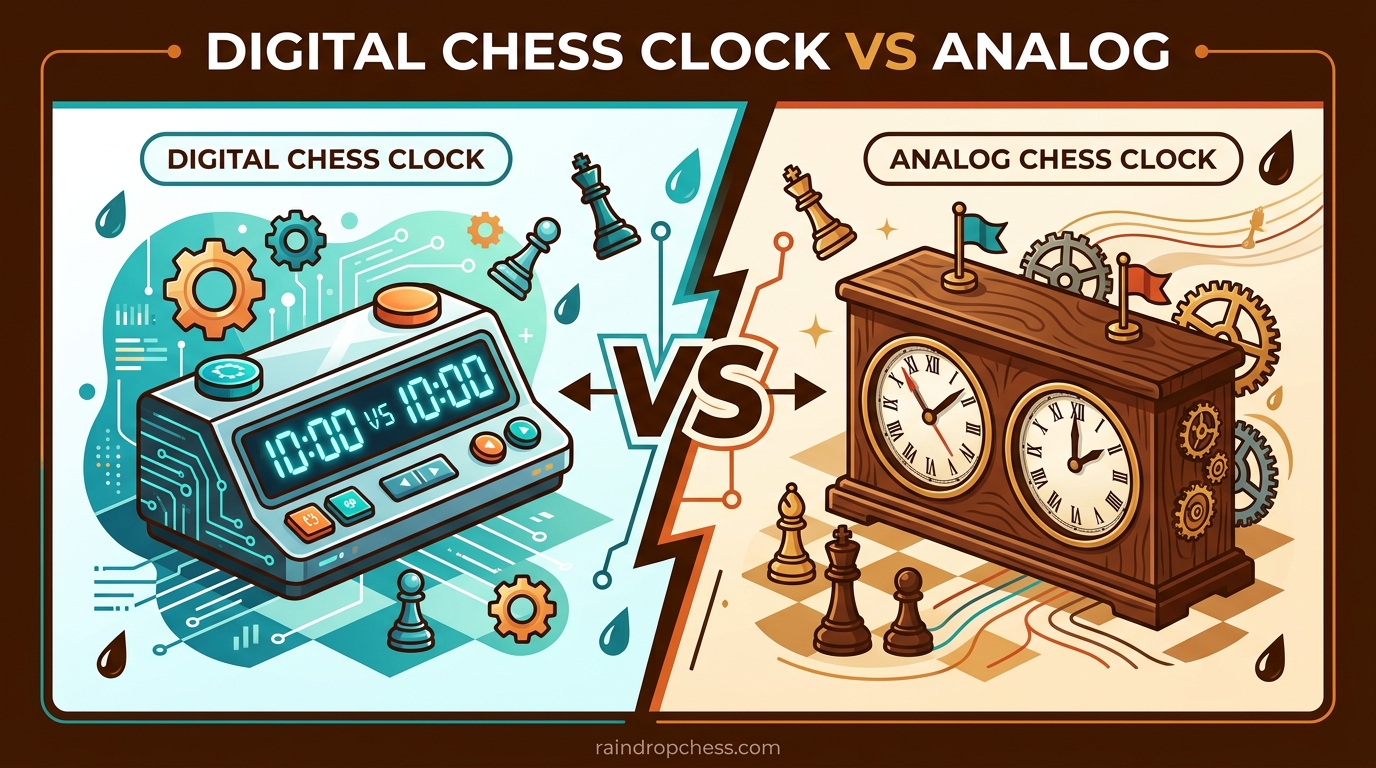
Analog chess clocks, also called mechanical clocks, are the traditional style that has been used in chess for over a century. They feature two clock faces side by side, each with its own wind-up mechanism and a physical flag that falls when time expires. Players press a button on their side to stop their clock and start their opponent’s clock, creating that distinctive clicking sound that many associate with competitive chess.
These clocks work through a mechanical spring mechanism that you wind up, similar to old-fashioned alarm clocks. The visible flag is a small marker that sits at the 12 o’clock position and begins to fall as time winds down, eventually dropping completely when the minute hand passes the 6 o’clock mark (typically indicating the last few minutes of play). This visual indicator has been part of chess strategy for generations, as players can see at a glance when their opponent is getting short on time.
What Are Digital Chess Clocks?
Digital chess clocks use electronic displays (typically LCD or LED) to show time numerically for each player. Instead of mechanical movements and falling flags, they rely on battery power and computerized timing systems. Modern digital clocks can be programmed for virtually any time control, including complex increment and delay modes that are standard in tournament play today.
These clocks typically feature preset time controls, large displays that are easy to read from across the board, and additional features like move counters, time display on both sides, and various timing modes that analog clocks simply cannot handle. When a player runs out of time, digital clocks usually emit a beep or visual signal instead of a falling flag.
Key Differences Between Digital and Analog Clocks
Understanding the practical differences between these two types of clocks will help you recognize which situations call for one over the other, especially when it comes to scholastic chess players.
Time Control Capabilities
The most significant difference between digital and analog clocks is their ability to handle modern time controls. Digital clocks can be programmed for any time control, including:
- Fisher Increment: Adds a fixed amount of time to a player’s clock after each move (commonly used in modern tournaments)
- Bronstein Delay: Delays the start of a player’s time count for a set period after each move
- Simple Delay: Similar to Bronstein but with different implementation
- Multiple Time Controls: Can switch from one time control to another during a game (common in longer tournament games)
Analog clocks, by contrast, are limited to simple time controls without increment or delay. They can handle basic time controls like “Game in 30 minutes” or “Game in 90 minutes,” but cannot implement the sophisticated timing modes that have become standard in tournament chess since the 1990s. This limitation is why you rarely see analog clocks in serious tournament play anymore.
Precision and Accuracy
Digital clocks are significantly more precise than analog clocks, especially at faster time controls. In blitz or rapid games where every second counts, digital clocks measure time to the exact second, while analog clocks can have slight variations due to mechanical imperfections and human error in reading the exact position of the hands.
This precision matters most in games with very fast time controls (such as Game in 5 minutes or faster) where a one-second difference can change the outcome. For scholastic players just starting out, this difference is less critical, but as players improve and move toward tournament play, the precision of digital clocks becomes increasingly important.
Ease of Use for Young Players
For very young players (ages 5-7), analog clocks can sometimes be easier to understand conceptually because they can see the time “winding down” visually. The moving hands and falling flag provide an intuitive sense of time passing that digital numbers don’t always convey to children who are still learning to tell time.
However, digital clocks have advantages too:
- Large Displays: Easy to read from across the board
- No Winding Required: Always ready to use (as long as batteries are fresh)
- Clear Indicators: No confusion about whose turn it is or who is low on time
- Less Physical Force Needed: Some young children struggle to press analog clock buttons firmly enough
Durability and Maintenance
Analog clocks are mechanical devices that can last for decades with proper care. They don’t require batteries and are less susceptible to electronic failure. However, they do need regular winding and can be affected by dust, humidity, and mechanical wear over time. The physical buttons and mechanisms can also jam if not maintained properly.
Digital clocks run on batteries and contain electronic components that can eventually fail, but they have no moving parts (other than buttons) and are generally very durable. The main maintenance concern is keeping fresh batteries available and protecting the display from damage. Most quality digital clocks are built to withstand the rigors of tournament use and frequent transport.
Cost Considerations
Price is often a significant factor for parents and coaches buying equipment for multiple players or school programs:
- Analog Clocks: Generally less expensive, with basic models starting around $15-25
- Digital Clocks: Range from $30-60 for quality tournament-approved models
While analog clocks are initially cheaper, the cost difference has narrowed in recent years as digital clock technology has become more widespread. When considering long-term value, it’s worth noting that a good digital clock will serve a player through their entire chess career, while an analog clock may eventually need to be replaced as players advance to tournaments that require digital timing capabilities.
Understanding Chess Clock Features
To make the best choice for a scholastic player, it’s helpful to understand some key chess clock terminology and features that you’ll encounter as your child progresses in chess.
What Is Increment in Chess Clocks?
Increment (often called “Fisher increment” after Grandmaster Bobby Fischer, who popularized it) adds a fixed amount of time to a player’s clock after each move. For example, in a “Game in 30 minutes with 5-second increment” format, each player starts with 30 minutes on their clock, and after each move, 5 seconds are added to their remaining time.
This format rewards players who move quickly and helps prevent time trouble at the end of games. It’s become the standard for most tournament chess because it creates more exciting games and reduces the likelihood that players will lose simply by running out of time in complex positions. Digital clocks handle increment seamlessly, while analog clocks cannot implement it at all.
What Is Delay in Chess Clocks?
Delay is another timing method that differs slightly from increment. With delay (commonly Bronstein delay), a player’s clock doesn’t start counting down immediately after they press their clock. Instead, there’s a delay period (typically 5-10 seconds) before their time begins decreasing. Any unused delay time is lost, unlike increment where unused time carries over.
Delay serves a similar purpose to increment but with slightly different strategic implications. Both formats are designed to give players a minimum amount of thinking time per move, and both require digital clocks to implement properly.
Tournament Requirements
Most scholastic tournaments today require or strongly prefer digital clocks, especially for divisions with players rated above 1200 or for games with time controls that include increment or delay. Tournament directors typically have a limited supply of clocks available, so players are expected to bring their own equipment.
FIDE (the international chess federation) and most national chess organizations have approved specific digital clock models for tournament use. These approved clocks meet strict standards for accuracy, reliability, and fairness. While analog clocks may still be allowed in some lower-level tournaments, their use is becoming increasingly rare as digital clocks have become more affordable and widely available.
Digital Chess Clock vs Analog: Which Is Better for Scholastic Players?
Now that we understand the differences between clock types, let’s address the specific question of which type of clock is better for scholastic players at different ages and skill levels.
For Young Beginners (Ages 5-7)
For the youngest players who are just learning to play chess and tell time, analog clocks have some advantages:
- Visual Learning: The moving hands help children understand the concept of time passing
- Physical Connection: The falling flag provides a clear, dramatic signal that time has expired
- Simplicity: No confusing buttons or programming to navigate
- Sensory Experience: The clicking sound reinforces the turn-taking rhythm of chess
That said, many young players adapt easily to digital clocks, and some actually prefer them because they’re easier to read quickly. If your child is already comfortable with digital displays (from tablets, phones, etc.), a digital clock with simple presets may work just as well.
For Developing Players (Ages 8-10)
This is the age range where many scholastic players start participating in tournaments and more serious club play. For these players, digital clocks begin to make more sense because:
- Tournament Preparation: Getting used to the type of clock they’ll encounter in tournaments
- Time Control Complexity: Games may start using increment or delay time controls
- Reading Speed: Digital displays can be read at a glance without interpreting hand positions
- Future-Proofing: A digital clock purchased now will serve them through their entire chess development
However, if your child is playing primarily in casual settings, school clubs that don’t use increment, or practicing at home, an analog clock is still perfectly adequate and may even be preferable for its simplicity and lower cost.
For Competitive Scholastic Players (Ages 11+)
Once players reach this age and are competing regularly in tournaments, digital clocks become essentially mandatory:
- Tournament Standards: Most tournaments require digital clocks for this age group
- Advanced Time Controls: Competitive games almost always use increment or delay
- Training Accuracy: Practicing with the same equipment used in competition
- College and Beyond: Building equipment for a lifetime of chess play
Players in this age group who are serious about chess will be at a significant disadvantage using an analog clock, as they won’t be familiar with the timing methods used in their tournaments and won’t have developed the time management skills that come with practicing with increment/delay.
Recommendations for Scholastic Players by Age and Skill Level
Based on the considerations above, here are specific recommendations for choosing between digital and analog chess clocks for scholastic players:
Age 5-7: Casual/Home Play
Recommendation: Analog clock is acceptable, digital clock is fine too
At this age, the type of clock matters less than simply having a clock and using it regularly. If budget is a concern, an inexpensive analog clock will work fine. If you plan to have the clock grow with your child, a basic digital clock with simple presets is a good investment.
Age 5-7: Early Tournament Play
Recommendation: Simple digital clock with presets
If your young child is already playing in tournaments, get them accustomed to digital clocks early. Look for models with large displays and simple programming that you can set up for them before games.
Age 8-10: School Club and Casual Tournaments
Recommendation: Mid-range digital clock with increment/delay capability
This is the ideal age to transition to digital if your child hasn’t already. A mid-range digital clock will serve them through several years of development and will be compatible with most time controls they’ll encounter.
Age 8-10: Regular Tournament Players
Recommendation: Tournament-approved digital clock with all standard features
For players competing regularly, invest in a quality digital clock that meets tournament standards. This ensures they’re practicing with the same equipment they’ll use in competition.
Age 11+: All Players
Recommendation: Tournament-approved digital clock
At this age, digital is essentially mandatory for any player participating in tournaments. Even if your child only plays occasionally, having a proper digital clock means they’re always prepared for whatever time controls they encounter.
Budget Considerations for Parents and Coaches
When buying chess equipment for young players, cost is often a significant factor. Here are some strategies for getting the most value from your chess clock purchase:
Buying for Individual Players
For a single child’s chess development, consider the total cost of ownership:
- Analog Clock: Lower initial cost ($15-25), but may need replacement in 2-3 years as player advances
- Digital Clock: Higher initial cost ($35-60), but will last indefinitely and grow with the player
Over the long term, investing in a quality digital clock often makes more financial sense, especially if your child shows sustained interest in chess.
Buying for School Programs and Clubs
For coaches and organizers buying multiple clocks:
- Initial Investment: Digital clocks cost 2-3x more than analog per unit
- Long-Term Value: Digital clocks don’t become obsolete as players advance
- Tournament Hosting: Digital clocks enable your program to host sanctioned tournaments
- Standardization: All players using the same equipment simplifies instruction
Many school programs start with a mix of analog and digital clocks, then gradually transition to all-digital as budgets allow and as players advance to levels where digital becomes necessary.
Cost-Saving Tips
- Buy Used: Chess clubs and tournament organizers often sell used digital clocks at significant discounts
- Group Purchases: Coordinate with other parents to buy in bulk from suppliers
- Club Equipment: See if your chess club has equipment loan programs for members
- Tournament Prizes: Many tournaments give digital clocks as prizes – these are excellent opportunities to acquire quality equipment
Common Mistakes to Avoid
When choosing and using chess clocks for scholastic players, being aware of these common pitfalls will help you make better decisions:
Training with Analog, Competing with Digital
One of the most common mistakes is players practicing with analog clocks at home but then competing in tournaments with digital clocks. This creates several problems:
- No Increment Practice: Players don’t develop time management skills with increment timing
- Reading Confusion: Players may struggle to read digital displays quickly during games
- Button Differences: The timing and feel of pressing different clock buttons can affect play
The best practice is to always use the same type of clock for training that you’ll use in competition. If tournaments use digital clocks (which they almost always do), practice with digital clocks.
Buying Clocks Without Tournament Approval
Not all digital clocks are approved for tournament play. Before making a purchase, check that the model is on the approved list for your national chess federation or the organization that sanctions the tournaments your child will play in. Using an unapproved clock can lead to complications and disqualification in tournament settings.
Choosing Based on Nostalgia Rather than Function
Some parents who grew up with analog clocks have emotional attachments to them and may prefer to buy analog for their children out of nostalgia. While analog clocks have their place, modern tournament chess has moved decisively toward digital for practical reasons. Giving your child the equipment they’ll actually use in competition is more important than preserving tradition.
Making the Transition from Analog to Digital
For players who started with analog clocks, transitioning to digital doesn’t have to be difficult. Here are some tips for making the switch smoothly:
Gradual Introduction
Start by using the digital clock for some practice games while keeping the analog clock available. Let your child get comfortable with the new display and button feel without pressure. Use simple time controls at first (like Game in 10 or 15 minutes) before introducing increment and delay modes.
Learn Together
If you’re not familiar with digital chess clocks yourself, learn alongside your child. Read the manual together, experiment with different time controls, and practice setting up the clock before tournaments. This learning process can be a bonding experience and shows your child that it’s okay to be new to something.
Focus on Time Management Skills
Use the transition to digital as an opportunity to teach better time management. Digital clocks make it easier to see exactly how much time remains, which helps players develop more efficient thinking habits. Practice games with shorter time controls to build these skills incrementally.
Conclusion: Digital Chess Clock vs Analog for Scholastic Players
Choosing between a digital chess clock vs analog for your scholastic player doesn’t have to be complicated. For the youngest players in casual settings, analog clocks are still perfectly adequate and can even be beneficial for learning the basics of time management. However, as players develop and begin competing in tournaments, digital clocks become not just preferable but essentially necessary.
The key considerations are your child’s age, skill level, and competitive ambitions. A 5-year-old playing chess at home will do fine with an analog clock, but an 11-year-old playing in scholastic tournaments needs a quality digital clock that meets tournament standards. When in doubt, choosing digital is almost always the better long-term investment, as it will grow with your child and won’t need to be replaced as they advance in their chess journey.
Remember that the most important thing is not which type of clock you choose, but that your child has a clock and uses it regularly. Consistent practice with proper time management will benefit their chess development far more than any specific piece of equipment. Whether you start with analog and transition to digital, or begin with digital from the start, what matters most is supporting your young player’s growth and enjoyment of the game.
Frequently Asked Questions
What are the disadvantages of digital clocks?
Digital clocks require batteries that can run down at inconvenient times, they may be more complex for very young children to operate, and they lack the nostalgic feel and visual appeal of analog clocks. Some players also find digital displays less intuitive than analog clock faces for seeing time passing at a glance.
Which chess clock should I buy?
For most scholastic players aged 8 and older who play in tournaments, buy a tournament-approved digital clock with increment and delay capability. For younger players or those only playing casually at home, an analog clock is acceptable, but a basic digital clock is also a good choice that will grow with them.
Are chess clocks analog or digital?
Chess clocks come in both analog and digital varieties. Analog clocks are traditional mechanical clocks with moving hands and falling flags, while digital clocks use electronic displays and computerized timing systems. Modern tournament chess overwhelmingly uses digital clocks due to their ability to handle complex time controls like increment and delay.
What is increment in chess clocks?
Increment adds a fixed amount of time to a player’s clock after each move. For example, in a “Game in 30 with 5-second increment” format, each player starts with 30 minutes and gains 5 additional seconds after each move. This helps prevent players from losing on time in complex positions and rewards efficient move-making. Increment requires a digital clock to implement properly.