
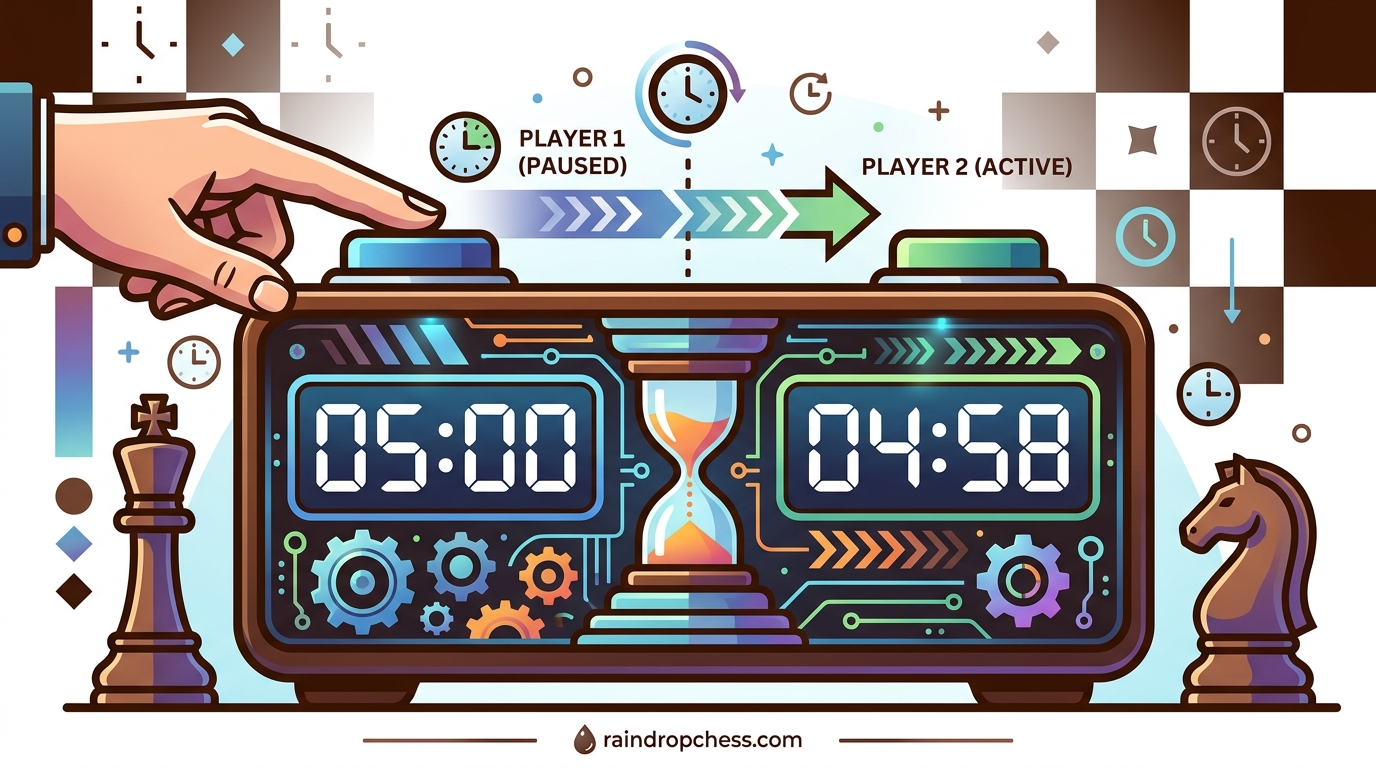
Understanding how a chess clock works is essential for any serious player. Whether you are preparing for your first tournament or transitioning from casual play to rated games, the timing system you use fundamentally changes your strategy. In this guide, I will explain how a chess clock works, breaking down the three most common timing systems: Fischer increment, Bronstein delay, and Simple delay. By the end, you will know exactly how each system affects your time and which one suits your playing style.
Chess clocks were invented to prevent games from dragging on indefinitely. The basic mechanism is simple: two timers sit side by side, and when you press your clock button, your timer stops and your opponent’s starts. But modern digital chess clocks added something revolutionary: the ability to give players extra time per move. This innovation changed tournament chess forever.
Table of Contents
How Chess Clocks Work
At its core, a chess clock is a dual timer with two displays and two buttons. When the game begins, Black’s clock is running. After Black makes the first move and presses their button, White’s clock starts. Each time a player completes a move and presses their clock, their timer stops and the opponent’s begins. This back-and-forth continues until someone runs out of time or the game ends.
Traditional time controls used “sudden death,” meaning each player had a fixed amount of time with no additions. If you had 60 minutes and used 60 minutes and 1 second, you lost on time. This system punished fast play and created anxiety around move 40 when players entered “time trouble.” The invention of delay and increment systems solved these problems.
Modern digital chess clocks can be programmed with three different time-adding mechanisms. Understanding how a chess clock works means understanding these three systems: Fischer increment adds time before your move, Bronstein delay adds time after your move, and Simple delay pauses the countdown during a set period. Each produces different strategic outcomes.
Fischer Increment: The Time-Building System
Fischer increment, named after Bobby Fischer who patented the concept in 1988, adds time to your clock before you make your move. If you are playing 5+3 (5 minutes starting time plus 3 seconds increment), you receive 3 seconds added to your clock immediately when your opponent presses their button. You now have those extra 3 seconds available for your current move.
The key characteristic of Fischer increment is that your clock can grow. If you consistently make moves in under 3 seconds, your total time actually increases. A blitz game starting at 3+2 can see both players finish with more time than they started. This rewards fast, intuitive play and allows aggressive time management strategies. You can spend 30 seconds on a critical move knowing you will gain back 2 seconds on each of the next 10 moves.
FIDE, the international chess federation, exclusively uses Fischer increment in official tournaments. The most common time control is 90+30 (90 minutes plus 30 seconds per move) for classical games. The 30-second increment ensures players always have thinking time and eliminates the frantic scramble of time trouble. Online platforms like Lichess and Chess.com also default to Fischer increment for most time controls.
Bronstein Delay: The Time-Guarantee System
Bronstein delay, invented by Grandmaster David Bronstein in the 1970s, works differently. Instead of adding time immediately, the system tracks how long you take to move. If you complete your move within the delay period, your clock jumps back by that amount. With a 10-second Bronstein delay, if you move in 5 seconds, your clock shows no change. If you move in 12 seconds, your clock only loses 2 seconds.
The critical difference is that Bronstein delay cannot increase your time beyond the starting amount. Your clock never grows; it only loses time slower. If you have 5 minutes with 10-second Bronstein delay, your clock will always show 5 minutes or less. Even if you make every move instantly, you gain nothing. This makes Bronstein delay feel fundamentally different from Fischer increment during play.
Many players prefer Bronstein delay because it feels more honest. You cannot hoard time by playing quickly in the opening. Your starting time is your maximum, and the delay simply prevents you from losing that time too quickly. Some tournament organizers prefer it because games have a predictable maximum duration. A 60-minute game with 10-second Bronstein delay will finish within 70 minutes, while a Fischer game could theoretically last hours if both players move instantly.
Simple Delay: The Countdown Pause System
Simple delay, sometimes called US delay, is the third system and the one that causes the most confusion. When your clock starts, the countdown pauses for the delay period. With 10-second simple delay, your clock shows “10” in the delay field and only begins counting down your main time after those 10 seconds expire. If you move within 10 seconds, your main time remains untouched.
Here is what many chess players do not realize: mathematically, Simple delay and Bronstein delay are identical. Over the course of a game, both systems give you exactly the same amount of thinking time. The difference is purely psychological and how the clock displays your remaining time. In Bronstein, you see your main time ticking down immediately, then jumping back if you move quickly. In Simple delay, you see the delay counting down first, then your main time begins.
The US Chess Federation (USCF) prefers Simple delay for rated games. When a player has only 5 seconds remaining with 10-second delay, the Bronstein clock might show “5” while the Simple delay clock shows “10” (delay) + “5” (main time). This display difference matters when you are in time trouble. With Simple delay, you always know exactly how much delay you have remaining.
Fischer vs Bronstein vs Simple Delay: Side-by-Side Comparison
Understanding the differences between these three systems is easier with a direct comparison. Here is how each system handles a 10-second delay/increment:
| System | When Time is Added | Can Time Grow? | Used By |
|---|---|---|---|
| Fischer Increment | Before your move starts | Yes | FIDE, Online platforms |
| Bronstein Delay | After your move completes | No | Some European tournaments |
| Simple Delay | Clock pauses during delay | No | USCF, Some American tournaments |
The strategic implications are significant. Fischer rewards speed; Bronstein and Simple delay punish slowness without rewarding haste. FIDE chose Fischer for world championships because it eliminates the possibility of losing on time in a winning position due to one slow move. The increment ensures you always have at least those seconds to make each move.
USCF chose Simple delay because it feels more transparent. Players can see exactly how much delay remains. With Bronstein, a player might think they have 30 seconds when they actually have 30 seconds of main time plus 10 seconds of delay. The Simple delay display separates these clearly. Both systems, however, prevent the “flag fall” that made sudden death so nerve-wracking.
Practical Examples: What Each System Feels Like
Let me walk through a concrete example to show how these systems differ in practice. Imagine you are playing a rapid game with 15 minutes starting time and 10-second delay/increment. You are in a complex position and need to calculate a forcing line.
With Fischer increment: You spend 2 minutes analyzing. Your clock shows 13:00 when you move. After pressing the button, you see 13:10. The increment was added immediately. You used 2 minutes but gained 10 seconds back. Your net loss was 1 minute 50 seconds. If you had moved faster, you could have gained time.
With Bronstein delay: You spend 2 minutes analyzing. Your clock counts down from 15:00 to 13:00, then jumps back to 13:10 when you press the button (since you used more than 10 seconds). The final result is the same: 13:10. But during those 2 minutes, you watched your clock tick down without the psychological comfort of knowing time would be added back.
With Simple delay: Your clock shows a separate 10-second countdown. You spend 2 minutes analyzing. The delay field counts down from 10 to 0 in the first 10 seconds, then your main time counts down from 15:00 to 13:00. When you move, nothing changes because you exceeded the delay. You end at 13:00 with a fresh 10-second delay for the next move.
Which System Should You Choose?
If you play FIDE-rated tournaments or online chess, you will use Fischer increment. Learning to build time through fast moves is a valuable skill. In a 5+3 blitz game, experienced players often finish with 6 or 7 minutes by making opening moves instantly. This time cushion allows deep calculation in the middlegame without time pressure.
If you play USCF tournaments in the United States, you will encounter Simple delay. The feeling is similar to Bronstein but with clearer display. Many American players prefer it because the delay is visually separate from main time. You always know exactly how much “free” thinking time remains.
Bronstein delay is less common but still used in some European tournaments and casual play. It offers the same protection as Simple delay with a different psychological feel. Some players find Bronstein less stressful because the clock behaves more like a traditional countdown.
My recommendation: learn Fischer increment first since it dominates competitive chess worldwide. Once comfortable, understanding Bronstein and Simple delay takes minutes. The core skill is time management, and all three systems reward the same fundamental discipline: thinking on your opponent’s time, moving quickly when the position is familiar, and saving time for critical moments.
Frequently Asked Questions
What is the Bronstein delay in chess?
Bronstein delay is a timing system where time is added back to your clock after you complete a move, but only up to the delay amount. If you have 10-second Bronstein delay and move in 5 seconds, your clock stays the same. If you move in 15 seconds, you lose 5 seconds from your main time. The key feature is that your time cannot grow beyond the starting amount, unlike Fischer increment.
What does delay mean on a chess clock?
Delay on a chess clock means a set number of seconds that either pauses the countdown (Simple delay) or gets added back after your move (Bronstein delay). During the delay period, you effectively have free time that protects your main clock. Standard delay values are 3, 5, or 10 seconds per move.
What is the 40-40-20 rule in chess?
The 40-40-20 rule refers to a traditional tournament time control format where players must make 40 moves in 40 minutes, followed by 20 minutes for the remainder of the game. This is a sudden death format without increment or delay. It has been largely replaced by Fischer increment time controls in modern tournaments.
Is there really any difference between Bronstein and Simple Delay?
Mathematically, no. Over a complete game, Bronstein and Simple Delay give exactly the same amount of thinking time. The difference is purely in how the clock displays the time and when the delay is applied. Bronstein adds time after the move; Simple Delay pauses the countdown during the delay period. The final result for any sequence of moves is identical.
Which timing system is best for beginners?
Fischer increment is generally best for beginners because it is the most forgiving. The ability to gain time by moving quickly means beginners are less likely to lose on time in winning positions. Online platforms default to Fischer for good reason. Once comfortable with increment, learning delay systems is straightforward.
Does delay apply on the first move?
No, delay and increment typically do not apply on the first move of the game. The delay or increment begins when your clock starts running, which for White is after Black makes the first move and presses the clock. Some digital clocks can be configured differently, but standard tournament rules delay the increment until after move one.
Conclusion
Understanding how a chess clock works means understanding Fischer increment, Bronstein delay, and Simple delay. Each system protects your time differently: Fischer rewards speed with time bonuses, while Bronstein and Simple delay prevent time loss without encouraging rushing. FIDE tournaments use Fischer increment exclusively. USCF tournaments prefer Simple delay. Mathematically, Bronstein and Simple delay are identical, just displayed differently.
The best way to learn is to play. Set up a 10+5 Fischer game on Lichess, then try the same position with Bronstein delay. Feel how the clock behaves differently even when the moves are the same. Understanding these timing systems is not just about avoiding time trouble. It is about using your time as a strategic resource, knowing when to think deeply and when to trust your instincts. That is the true mastery of how a chess clock works.