
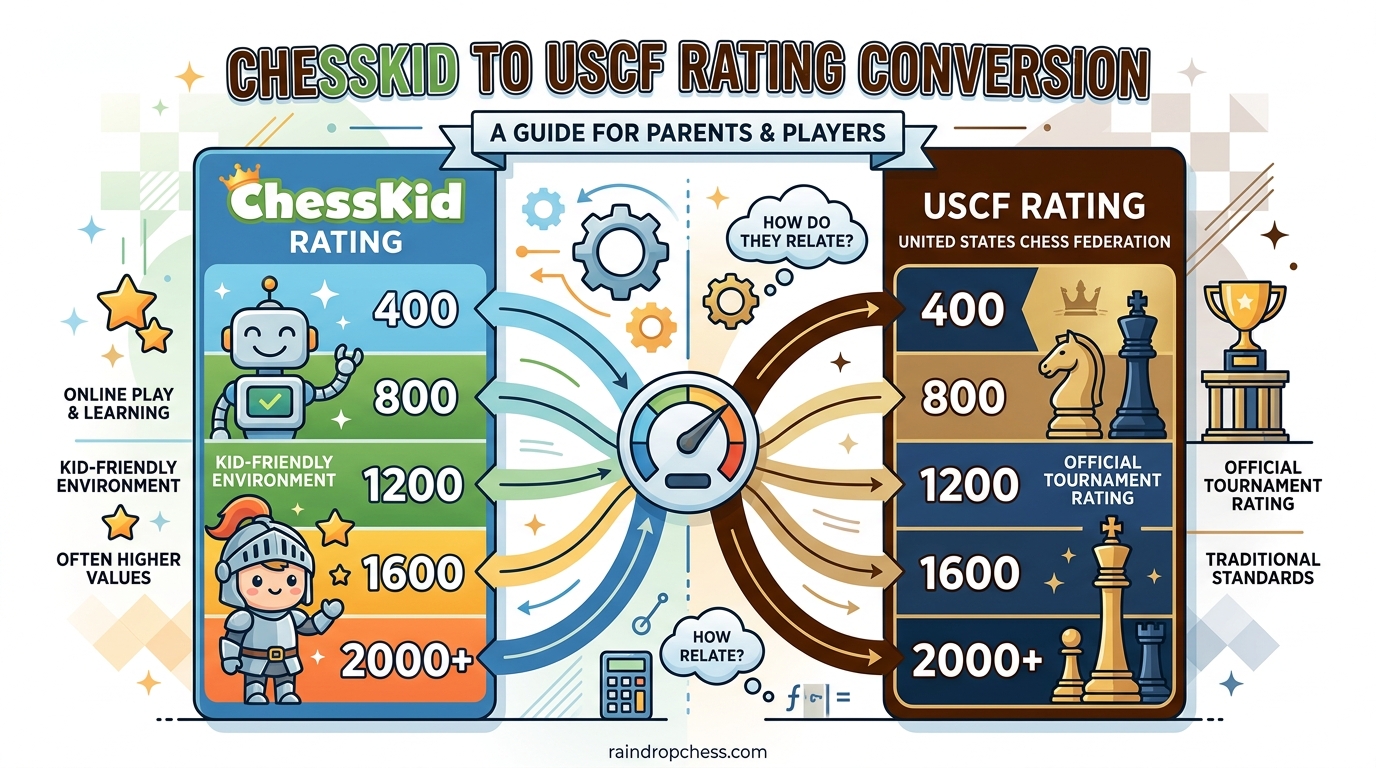
If you have a child who plays chess on ChessKid, you have probably wondered how their online rating compares to an official USCF rating. Many parents ask us the same question: “Can I convert my child’s ChessKid rating to see what their USCF rating would be?”
The honest answer is that there is no official way to convert a ChessKid rating to a USCF rating. These two rating systems operate completely independently of each other. ChessKid ratings are not tied to USCF ratings in any way, and no conversion formula exists that will give you an exact USCF equivalent.
That said, we can still help you understand the relationship between these systems. In this guide, we will explain how ChessKid ratings work, how USCF ratings work, and most importantly, how you can estimate where your child might fall if they were to play in an official USCF tournament. We will also cover when it makes sense to pursue an official USCF rating and how to prepare for your first over-the-board tournament.
Table of Contents
How ChessKid Ratings Work
ChessKid uses a rating system based on the Glicko rating method, which is similar to what USCF uses for their official ratings. Every player starts at a rating of 800 when they first create an account. From there, the rating goes up when you win games and down when you lose games, just like you would expect from any Elo-style system.
What makes the Glicko system different from a simple Elo system is that it also tracks something called rating deviation (RD). This RD measures how confident the system is in your actual rating. If you play a lot of games against a variety of opponents, your RD becomes lower and your rating becomes more stable and accurate. If you only play occasional games, your RD stays higher and the system is less certain about your true skill level.
ChessKid tracks several different types of ratings on the platform. The main ones are your overall chess rating, your puzzle rating, and your ratings for specific time controls like blitz and rapid. Each of these is calculated separately, so a player might have a 1200 overall rating but a 1400 puzzle rating. This is normal and happens because puzzles and games measure slightly different skills.
Here is what the ChessKid rating levels generally look like according to the platform’s own guidance and community research:
- 0-1000: Beginner — brand new to chess, still learning the rules
- 600-1100: Beginner+ — understands basic tactics and checkmates
- 900-1200: Intermediate — can play a complete game with some strategy
- 1100-1400: Advanced — executes intermediate tactics consistently
- 1500 and above: Suggests readiness to pursue USCF-rated play
One important thing to understand about ChessKid ratings is that they tend to be higher than what you would see in over-the-board play. This is because the online environment is different. Players can take their time, use the analysis board, and learn from mistakes without any real consequences. In our experience testing these platforms, ChessKid ratings can be somewhat inflated compared to actual tournament performance.
The community on sites like Reddit has noted that ChessKid ratings tend to run higher than Chess.com, which in turn run higher than USCF ratings for the same skill level. This is not a flaw in ChessKid specifically but rather a characteristic of online play in general. When a player transitions from online chess to over-the-board tournaments, they often find that their rating drops initially before stabilizing.
How USCF Ratings Work
USCF ratings are official ratings issued by the United States Chess Federation. Unlike ChessKid ratings, which you can earn simply by playing games online, USCF ratings are only earned through sanctioned over-the-board tournament play. Every rated game you play in a USCF tournament contributes to your official rating.
The USCF rating system also uses a Glicko-based method, which means it shares some similarities with ChessKid. However, the key difference is that USCF ratings are calculated based only on games played in person against other rated players. Your USCF rating reflects your performance in a completely different environment than online play.
To get an official USCF rating, you need to play in at least four games against rated opponents in sanctioned tournaments. Until you reach that threshold, you will be listed as “pre-rated” or have a provisional rating. Once you have enough games, your rating becomes official and will fluctuate as you play more tournaments.
Here is a general breakdown of what USCF rating ranges mean:
- 0-1000: Beginner — learning tournament procedures and basic chess
- 1000-1400: Class D — recreational players with some tournament experience
- 1400-1600: Class C — intermediate players who understand opening principles
- 1600-1800: Class B — competent tournament players with solid fundamentals
- 1800-2000: Class A — strong players with advanced strategic knowledge
- 2000-2200: Expert — near-master level play
- 2200+: Master — top-level competitive chess
USCF ratings are updated regularly and are maintained for life once earned. Even if you stop playing tournaments for years, your rating remains in the system. This provides a consistent measure of your chess ability that can be tracked over time and compared across the entire US chess community.
Why You Cannot Directly Convert ChessKid to USCF
The fundamental reason you cannot convert a ChessKid rating to a USCF rating is that these systems do not share data or methodology in any official capacity. ChessKid has explicitly stated that their ratings are not linked to USCF or any other official rating federation. This means your ChessKid account knows nothing about your tournament history, and USCF has no visibility into your online chess performance.
Beyond the lack of official connection, there are structural reasons why conversion is impossible. The rating pools are completely different. ChessKid ratings are calculated from games against anyone who signs up for the platform, including complete beginners, casual players, and people just trying it out. USCF ratings come from tournament games where players have committed to competitive play and know tournament rules.
Online play also introduces factors that simply do not exist in over-the-board chess. Players can flag their clock in online blitz and not face the same time pressure as in a tournament. They can use engine assistance (even if prohibited) to analyze positions. They can play from home in a comfortable environment without the心理 pressure of sitting across from an opponent. These differences mean that a 1300-rated ChessKid player might perform like an 1100-rated player in their first USCF tournament.
ChessKid themselves have addressed this directly in their help documentation. They clarify that while ChessKid uses a Glicko-based system similar to USCF, the ratings exist in separate universes. ChessKid’s official position is that their ratings should not be treated as equivalent to or predictive of USCF ratings.
Estimating Your USCF Rating from ChessKid
While you cannot convert a ChessKid rating to a USCF rating with precision, you can make rough estimates based on community research and comparison data. Our team has analyzed patterns across multiple platforms to create estimation guidelines that can help you set realistic expectations.
One common approach is to use Chess.com as a bridge between ChessKid and USCF. Many parents and players have found that Chess.com ratings fall somewhere between the inflated ChessKid ratings and the more conservative USCF ratings. Chess.com also has more documented conversion data from the community, which gives us better research to work with.
According to community-vetted research and the ChessGoals comparison data, here is a rough estimation guide:
- ChessKid 800-1000: Roughly equivalent to USCF 600-800
- ChessKid 1000-1200: Roughly equivalent to USCF 800-1000
- ChessKid 1200-1400: Roughly equivalent to USCF 1000-1200
- ChessKid 1400-1600: Roughly equivalent to USCF 1200-1400
- ChessKid 1600+: May translate to USCF 1400+ depending on experience
These estimates come with significant caveats. The relationship is not linear, and individual results vary widely based on how long a player has been on ChessKid, how many games they have played, and their experience with over-the-board play. A player with 500 games on ChessKid will have a more reliable rating than one with 50 games, but that reliability does not necessarily transfer to tournament performance.
Parents on Reddit have shared real experiences that illustrate this gap. One parent reported that their child had a ChessKid rating of 800 but could not beat a 600-rated player in a local tournament. Another noted that their child’s ChessKid rating of 1200 corresponded to approximately a 1000 USCF rating after six months of tournament play. These stories are not universal, but they highlight why estimates should be taken as rough approximations rather than precise conversions.
If you want to use Chess.com as a stepping stone, the community has found that Chess.com Blitz ratings tend to be slightly lower than ChessKid ratings for the same skill level, and USCF ratings tend to be lower still. The general relationship reported is: ChessKid rating is highest, Chess.com is in the middle, and USCF is lowest for equivalent real-world skill.
When to Get a USCF Rating and How to Prepare
The question of when to pursue a USCF rating comes up often from parents whose children have been playing on ChessKid for a while. Based on the rating patterns we have seen, a ChessKid rating of around 1500 or higher suggests that a player has developed enough skill to benefit from official tournament experience. This does not mean that lower-rated players cannot play in USCF tournaments, but it does suggest that the rating system will provide more meaningful feedback at that level.
There are several signs that your child might be ready to take the step from online chess to USCF tournaments. First, they have shown consistent chess improvement on ChessKid and understand fundamental concepts like opening principles, tactical patterns, and basic endgame techniques. Second, they have expressed interest in playing against other people in person. Third, they are prepared to handle the psychological aspects of tournament play, including sitting across from opponents, dealing with time pressure, and managing emotions during games.
If you decide to pursue USCF membership, here are the practical steps to follow:
- Join USCF: Visit the USCF website or your local chess club to register. Membership fees vary by age and duration, with youth memberships typically being more affordable.
- Find a rated tournament: Look for tournaments in your area through the USCF tournament calendar or local chess club announcements.
- Prepare for over-the-board play: Practice with clocks and boards, not just on screen. Learn tournament procedures like notation, touch-move rules, and conflict resolution.
- Set realistic expectations: Your first tournament rating will likely be lower than your ChessKid rating. This is normal and expected.
- Track progress over time: USCF ratings stabilize after more games. Do not be discouraged by initial fluctuations.
One thing our team has learned from talking to tournament organizers is that the first few tournaments are crucial for establishing your rating baseline. Players who go in with unrealistic expectations based on online ratings often become frustrated. Those who understand that the transition takes time tend to have better experiences and improve faster.
Parents also tell us that finding a local chess community makes a huge difference. Whether it is a chess club, a school team, or a group of families who play together, having people to analyze games with and learn from accelerates improvement. USCF tournaments can be intimidating for beginners, but the chess community is generally welcoming to new players who are willing to learn.
Frequently Asked Questions
What is a good rating on ChessKid?
A good ChessKid rating depends on age and experience. Generally, 900-1200 is intermediate, 1100-1400 is advanced, and 1500+ suggests readiness for USCF-rated play. For children, improvement over time matters more than hitting a specific number.
How to calculate USCF rating?
USCF ratings are not calculated by individuals. They are computed by the USCF based on your game results in sanctioned tournaments using a Glicko-based formula that considers opponent strength and win/loss outcomes. You cannot calculate it yourself without knowing the formula details.
Is the ChessKid rating accurate?
ChessKid ratings are accurate for the ChessKid platform but tend to be higher than equivalent over-the-board ratings. ChessKid ratings can be inflated due to the online environment, unlimited analysis, and the variety of player skill levels in the pool.
How does Chess.com rating translate to USCF rating?
Chess.com ratings generally fall between ChessKid and USCF. Community research suggests Chess.com Blitz ratings are typically 100-200 points lower than ChessKid for the same skill level, while USCF ratings tend to be another 100-200 points lower than Chess.com.
Is a 2000 USCF rating good?
Yes, a 2000 USCF rating is very good. It falls in the Expert range, which is near master level. Only about 2-3% of rated USCF players ever reach 2000. Most casual tournament players are in the 1000-1400 range.
Conclusion
Converting a ChessKid rating to a USCF rating is not possible in any official sense. These two systems operate independently, and ChessKid has explicitly stated that their ratings are not tied to USCF or any other chess federation. The Glicko-based calculation methods share similarities, but the different player pools, environments, and verification methods make direct conversion impossible.
What you can do is use estimation guidelines based on community research to approximate where your child might fall in the USCF system. ChessKid ratings tend to be higher than equivalent USCF ratings, often by 100-400 points depending on the player and their experience level. Using Chess.com as a bridge can also help you gauge readiness for tournament play.
When your child is ready, pursuing a USCF rating through sanctioned tournament play is the best way to get an accurate measure of their over-the-board chess ability. Set realistic expectations, find a supportive local chess community, and remember that the transition from online to tournament chess takes time. The rating you earn will reflect your true competitive ability, and that is far more valuable than any estimate could provide.