
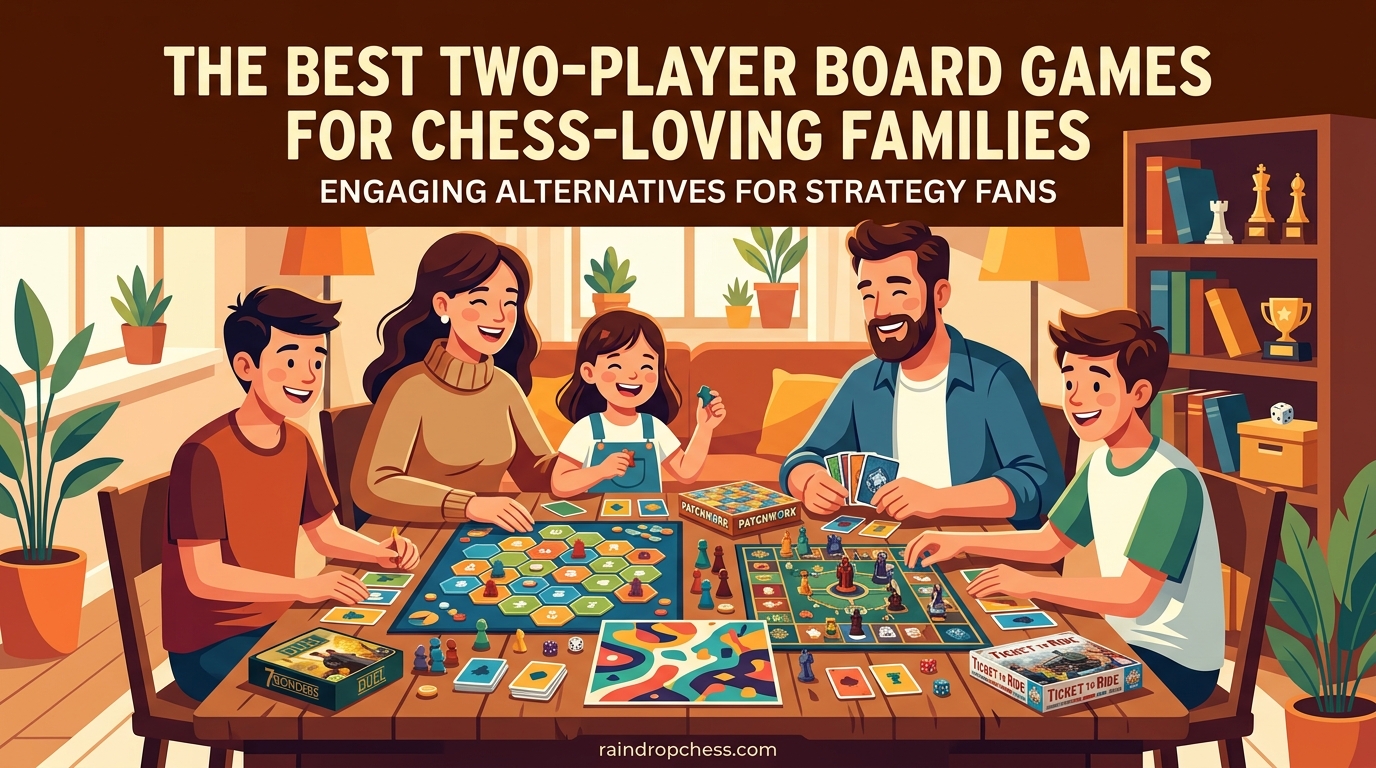
If your family loves chess, you’re already familiar with the joy of deep strategic thinking, the satisfaction of outmaneuvering an opponent, and the mental workout that comes from hours of calculated decision-making. But what happens when you want to explore beyond the 64 squares? Fortunately, the world of abstract strategy games offers plenty of options that chess-loving families will find immediately familiar and endlessly engaging.
Why Chess-Loving Families Need More Than Just Chess
Chess is the quintessential abstract strategy game, offering perfect information gameplay where every move matters and every decision carries weight. For families who have spent years cultivating their chess skills, the game becomes more than just a hobby—it develops critical thinking, spatial awareness, pattern recognition, and the ability to think several moves ahead. These are precisely the skills that transfer beautifully to other board games, particularly other abstract strategy titles that share chess’s emphasis on mental calculation and tactical positioning.
The beauty of exploring other two-player board games lies in discovering how your chess-trained mind approaches these new challenges. A chess player’s board vision naturally translates to games involving spatial planning. Their understanding of offensive and defensive strategy applies to any competitive abstract game. Their calculation skills provide an immediate advantage when learning new rule sets. Most importantly, these games offer fresh environments to exercise the strategic thinking muscles your family has already developed through countless chess matches.
This guide explores five exceptional abstract strategy games that chess-loving families consistently report enjoying. Each game offers unique strategic depth while remaining accessible enough for family game nights. Whether you’re looking for a quick 15-minute duel or an hour-long battle of wits, these recommendations span different mechanics and complexity levels while sharing one essential trait: they all reward the same type of deep thinking that makes chess so compelling.
Blokus: Mastering Spatial Territory Control
Age: 7+ years
Play Time: 20-30 minutes
Blokus is a geometric masterpiece that rewards the same spatial awareness chess players develop over years of practice. The objective is simple but deceptively complex: place as many of your colored pieces on the board as possible while blocking your opponents from expanding their territory. Each piece must touch at least one corner of your previously placed pieces, never sharing an edge, creating a constantly evolving puzzle of expansion and containment.
What makes Blokus particularly appealing to chess enthusiasts is its emphasis on board vision—the ability to see how pieces interact across the entire board, not just in your immediate vicinity. Chess players naturally excel at this kind of global thinking, understanding how a move in one area affects positions across the entire board state. In Blokus, this translates to recognizing when to expand aggressively versus when to consolidate defensive positions, and identifying the critical control points that determine who dominates the board’s center versus its edges.
The game develops spatial reasoning that directly supports chess improvement. Players must visualize how their 21 tetromino, tromino, and domino pieces will fit together while simultaneously blocking opponent placements. This creates the same kind of multi-positional calculation chess demands, where you’re always weighing offensive opportunities against defensive necessities. Families report that children who play Blokus show improved board awareness in chess, particularly in understanding how pieces interact across distance.
Strategy tip: In Blokus, the corners and edges of the board become precious commodities as the game progresses. Chess players understand the value of edge and corner squares—Blokus teaches the same lesson in a purely spatial context. Experienced players often sacrifice immediate point opportunities to establish “corner strongholds” that restrict opponent movement while providing launch points for late-game expansion.
Qwirkle: Pattern Recognition and Point Maximization
Age: 6+ years
Play Time: 30-45 minutes
Qwirkle brings combinatorial complexity to the family gaming table in a way that feels immediately intuitive to chess players. The game uses tiles featuring six colors and six shapes, and players score points by creating lines that either share all the same color or all the same shape—but never both simultaneously. This simple rule creates remarkable strategic depth where every placement affects multiple potential scoring lines.
Chess players excel at Qwirkle because the game rewards the same systematic thinking they apply to opening theory and endgame technique. Just as a chess master sees common patterns that guide their decision-making, Qwirkle players develop intuitive understanding of tile distributions and line-building opportunities. The calculation required to maximize points while limiting opponent options mirrors chess thinking, where every move creates and destroys possibilities across the board.
The point maximization aspect of Qwirkle teaches “calculation depth”—understanding not just your immediate score but how your current move sets up future scoring opportunities. Chess players naturally think this way, considering not just the immediate advantage of a move but how it positions them for the next 3, 4, or 5 moves. This forward-thinking mentality provides significant advantage in Qwirkle, where chain reactions of 20+ points are possible with careful tile placement.
Strategy tip: Watch for the “empty handed” moment—when you’ve played your last tile and must draw from the bag. Experienced Qwirkle players manage their hand like a chess player manages their pawn structure, sometimes sacrificing immediate points to maintain a flexible position that sets up larger combinations later in the game.
Othello: The Art of Reversal and Position Control
Age: 8+ years
Play Time: 30-60 minutes
Othello (also known as Reversi) shares more DNA with chess than almost any other popular board game. It’s a perfect information game with simple rules but enormous strategic complexity, played on an 8×8 board with black and white discs. The objective is to finish with more of your color showing when the board is full, which requires constant positional awareness and the ability to think several moves ahead about piece conversions.
What makes Othello particularly satisfying for chess players is its emphasis on position over material. While having more pieces on the board matters, true mastery comes from understanding stable positions—the squares and regions that, once secured, cannot be flipped regardless of opponent efforts. Chess players understand this distinction instinctively, knowing that a knight outpost or passed pawn matters more than their raw material count in certain positions.
The edge and corner control concepts transfer directly from chess to Othello. Corners in Othello are immovable fortresses—once secured, they cannot be flipped and often determine the course of the entire game. This mirrors chess understanding perfectly: corner squares offer the same defensive impregnability and strategic significance. Chess players quickly learn to recognize these critical positions in Othello, giving them an intuitive advantage over opponents who haven’t developed positional instincts through chess study.
Strategy tip: Chess players should focus on Othello’s concept of “frontier discs”—pieces on the boundary between your color and opponent’s color. Managing these carefully determines whether you create stable, unassailable positions or hand your opponent easy conversion opportunities. The same defensive thinking that protects king safety in chess applies directly to protecting your stable positions in Othello.
Santorini: Building Empires with Strategic Depth
Age: 8+ years
Play Time: 20-30 minutes
Santorini represents modern abstract strategy at its finest, offering layered tactical decisions wrapped in beautifully simple rules. The game recreates the Greek island’s iconic white buildings, with players competing to build the tallest hotel while preventing opponents from doing the same. What begins as straightforward building mechanics becomes deeply strategic when players add God cards that grant special powers, creating thousands of unique game combinations.
Chess players are drawn to Santorini because it offers similar multi-move planning complexity. In chess, a single move often sets up a combination that unfolds over several turns. Santorini rewards the same type of long-term thinking, where your turn-one building decision might determine whether you execute a winning combination on turn eight. The game’s temporal dimension—the 10-turn limit before the game ends and tallest building wins—creates urgency that sharpens tactical decisions.
The God card mechanism introduces variable powers that require rapid strategic adaptation—similar to how chess openings require understanding both general principles and specific move orders. A chess player accustomed to studying opening theory will enjoy the puzzle of finding optimal God card synergies and counter-strategies against opponent powers. This adds a layer of meta-gaming that chess enthusiasts find intellectually satisfying.
Strategy tip: Santorini teaches the critical skill of “action denial”—making moves that limit opponent options rather than directly advancing your own position. Chess players understand this intimately from positions where a seemingly passive move actually restricts opponent piece activity. In Santorini, controlling building heights to deny opponents dome-building opportunities often matters more than pursuing your own building plan.
Onitama: Chess-Lite with Eastern Elegance
Age: 8+ years
Play Time: 15-20 minutes
Onitama serves as perhaps the perfect “chess transition game”—maintaining the direct confrontation, piece-capture, and winning-condition simplicity of chess while introducing fresh mechanics that make it immediately distinct. Set in a stylized feudal Japan, Onitama uses a 5×5 board, two pawns per player, one master piece, and a deck of movement cards that change each turn, creating dynamic tactical challenges that reward adaptive thinking.
Chess players appreciate Onitama because the fundamental tension between offense and defense remains intact. Your master piece must be protected at all costs—losing it means instant defeat—while simultaneously maneuvering to capture your opponent’s master. The movement card system adds an extra layer of calculation: you must consider not just where you can move this turn but which cards you’ll have available next turn, creating the same multi-move planning chess demands.
The 15-20 minute playtime makes Onitama ideal for families wanting quick strategic duels. Unlike chess games that can stretch hours, Onitama provides satisfying tactical battles that fit easily into busy schedules while still exercising the same strategic muscles. Parents who want to challenge their chess prodigy children will find Onitama offers appropriate difficulty without requiring the same time investment chess demands.
Strategy tip: In Onitama, the center squares matter enormously—controlling the middle of the board provides maximum mobility options regardless of your movement cards. Chess players understand centralization principles intuitively and should apply them aggressively in Onitama. Additionally, watch your opponent’s card discard carefully; the movement pattern they just used is the one you’ll have available, allowing for powerful anticipation tactics.
How Chess Skills Transfer: A Skill Progression Guide
One of the most fascinating aspects of exploring these games as a chess-loving family is recognizing how your existing skills apply across different rule sets. Here’s how core chess abilities translate to each game:
Skills That Transfer Across Games
Spatial Awareness
This chess-developed skill provides immediate advantage in Blokus (geometric piece placement), Othello (board region control), and Santorini (building height management). Chess players automatically see how pieces interact across distances and understand the value of controlling key spatial positions.
Calculation Depth
The chess habit of thinking several moves ahead serves players well in Santorini (multi-turn building combos), Onitama (anticipating card cycles), and Qwirkle (chain reaction setups). This mental muscle, developed through countless chess puzzles and games, provides measurable advantage when learning these rule systems.
Positional Understanding
Chess players’ intuitive sense of piece activity, stability, and position quality translates directly to Othello (stable disc identification), Blokus (territory corner control), and Santorini (building advantage positions). This strategic intuition often develops faster than opponents who lack chess background.
Defensive Thinking
The chess emphasis on protecting key assets (your king, important pieces, critical squares) prepares players for the defensive requirements in all these games. Onitama demands constant king protection, Santorini requires guarding building advantages, and Othello rewards defensive stability maintenance.
This skill transfer isn’t just theoretical—families who play these games together report noticeable improvement in their chess performance, particularly in the specific skill areas each game develops. Consider rotating through these games to systematically develop different strategic capabilities while enjoying diverse gaming experiences.
Frequently Asked Questions
What is the best 2 player board game for chess lovers?
Games like Santorini and Onitama closely mirror chess mechanics with their direct confrontation style and emphasis on tactical positioning. Blokus and Othello offer excellent spatial and positional challenges that chess players naturally excel at due to their developed board vision. The “best” ultimately depends on whether you prefer chess-like piece movement (Onitama), building mechanics (Santorini), territory control (Blokus), or positional reversal (Othello).
Are these games good for teaching children strategy?
All five games mentioned have age recommendations starting at 6-8 years and offer excellent cognitive development benefits. They teach spatial awareness, critical thinking, forward planning, and pattern recognition—skills that transfer directly to academic performance and, importantly, to chess improvement. The varying complexity levels allow families to start with simpler games like Qwirkle and progress to more demanding ones like Santorini as children’s strategic thinking develops.
How do these games compare to chess in complexity?
These games are generally easier to learn than chess while still providing deep strategic gameplay. Chess requires memorizing complex opening theory and understanding intricate endgame technique. These abstract strategy games have simpler rules that families can explain in minutes, yet offer enough strategic depth to reward years of play. They serve as excellent “bridge games” for families looking to explore abstract strategy beyond chess while developing skills that support future chess growth.
Can playing these games actually improve chess skills?
Yes, research and family experience consistently show cross-skill development between abstract strategy games. Blokus improves spatial awareness critical for piece coordination in chess. Othello sharpens positional thinking about edge and corner control. Santorini enhances multi-move planning and combination recognition. Qwirkle develops pattern recognition useful for chess tactics. Onitama maintains the direct confrontation tactical sharpness chess demands. Playing these games provides mental workout variety while reinforcing strategic thinking habits.
What should families consider when choosing between these games?
Consider play time (Onitama for quick 15-minute games, Qwirkle for longer 45-minute sessions), player count (only Othello and Onitama are strictly two-player, while the others support 3-4 players for larger family game nights), and complexity level (Qwirkle and Blokus are more accessible for younger children, while Santorini with God cards offers more experienced strategy gamers additional depth to explore).
Expand Your Family’s Strategic Horizons
The world of abstract strategy games offers chess-loving families endless opportunities to exercise their strategic thinking muscles in fresh, engaging contexts. Whether your family prefers the spatial puzzle of Blokus, the pattern recognition challenge of Qwirkle, the positional depth of Othello, the building mechanics of Santorini, or the elegant simplicity of Onitama, each game provides unique intellectual rewards while reinforcing skills that support chess improvement.
What makes these games particularly valuable for families is their ability to grow with your skills. A ten-year-old might initially enjoy Qwirkle’s accessible rules while developing combinatorial thinking, then progress to Santorini’s multi-layered tactical decisions as their strategic sophistication increases. Parents can enjoy these games alongside children at appropriate difficulty levels, making them excellent options for family bonding through intellectual challenge rather than just entertainment.
The chess-trained mind finds fertile ground in these games, immediately recognizing transferable principles while discovering new strategic landscapes to explore. Best of all, the mental workout you receive from these games directly supports continued chess improvement, creating a positive cycle of strategic development that keeps family game nights fresh and intellectually stimulating year after year.