
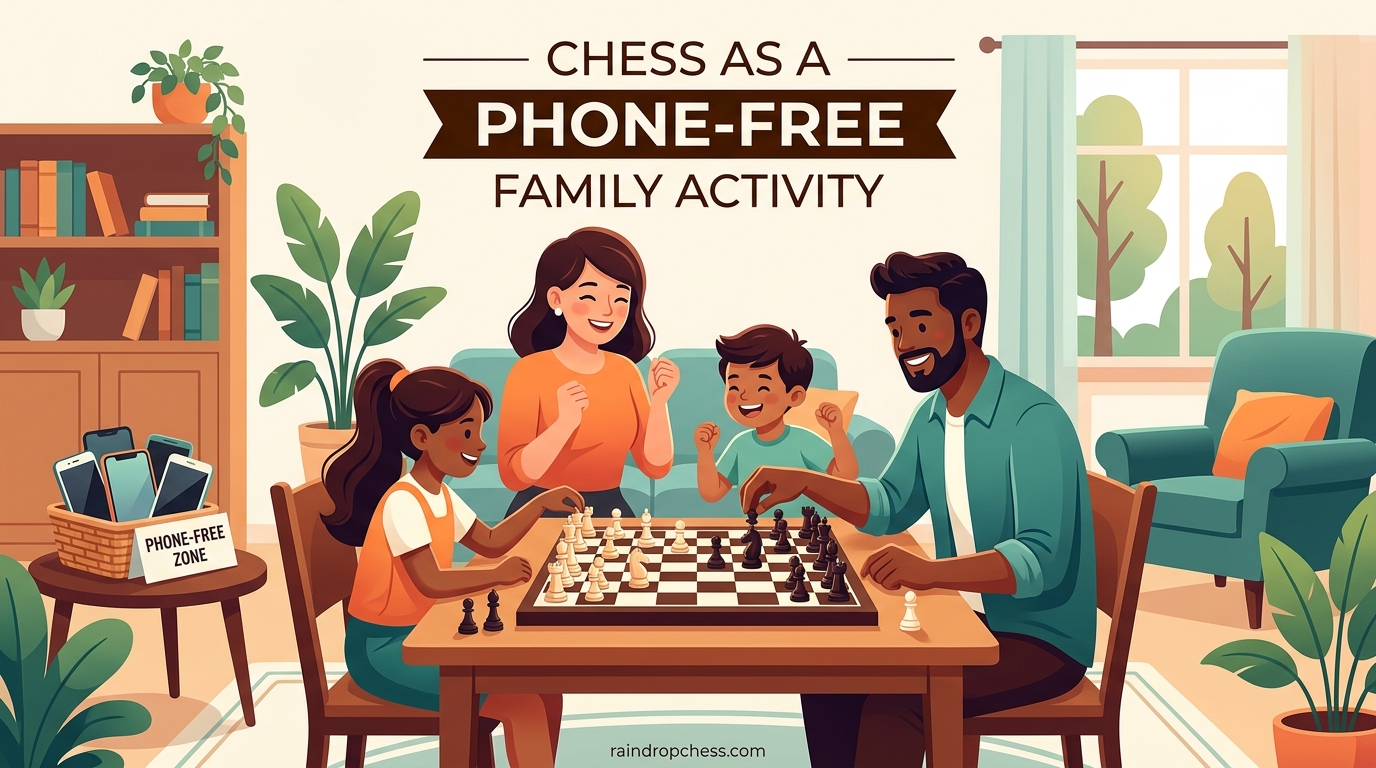
Finding meaningful phone-free family activities feels impossible when screens dominate every corner of our homes. I have watched countless families struggle to disconnect, even during dinner or weekend afternoons. Chess as a phone-free family activity offers a powerful solution that brings families together while building essential life skills in children and adults alike.
In this guide, I will share proven strategies our team has gathered from real families who successfully replaced screen time with chess. You will learn exactly how to introduce chess to your family, overcome resistance from phone-addicted kids, and make this timeless game a sustainable habit that sticks for years.
Table of Contents
Why Chess Beats Screen Time
Screen addiction is destroying family connection in ways that did not exist a decade ago. Kids cannot stay focused on anything but screens, and parents feel guilty about relying on tablets for easier parenting. Chess directly addresses these problems by engaging the same mental pathways that make screens addictive, but in a healthy, face-to-face way.
Chess develops critical thinking skills in ways that passive screen consumption never can. Players must think several moves ahead, evaluate multiple options, and anticipate opponent responses. This active mental engagement builds cognitive muscles that translate to better problem-solving in school and life.
Concentration and focus improve dramatically with regular chess play. Unlike the constant dopamine hits from scrolling, chess teaches delayed gratification and sustained attention. Children who struggle to focus on homework often show remarkable improvement after just a few weeks of consistent chess practice.
The face-to-face interaction chess requires is perhaps its greatest benefit. You sit across from another human, reading expressions, learning tells, and experiencing genuine connection. No emoji can replace the satisfaction of seeing your child grin after capturing your queen.
Emotional resilience builds naturally through chess. Losing happens. Winning happens. Both teach valuable lessons about handling disappointment and practicing humility. These are skills that screens simply cannot teach.
Chess needs no batteries, WiFi, or updates. A simple board and pieces sit ready whenever your family has a free moment. This accessibility makes it perfect for vacations, restaurants, waiting rooms, and power outages.
Benefits of Chess for Families
The cognitive development benefits of chess for families extend far beyond the game itself. Children who play chess regularly show improved pattern recognition, sequential thinking, and spatial reasoning. These skills directly support math and science performance in school.
Social skills flourish during family chess time. Players learn to wait their turn, respect opponents, and win or lose gracefully. These lessons transfer to playground interactions, classroom behavior, and eventually workplace relationships.
Emotional regulation improves through chess in measurable ways. The game teaches patience as players consider moves. It builds frustration tolerance when plans fail. It develops impulse control as children learn to think before acting.
Academic performance gains from chess are well documented. Studies consistently show that students who play chess demonstrate improved reading comprehension, concentration, and analytical skills. The mental workout chess provides strengthens the same brain regions used for academic success.
Screen-free entertainment that engages all ages is rare. Chess works beautifully because a six-year-old can genuinely compete with a parent when handicaps are used. Grandparents connect with teenagers across the board in ways that feel natural rather than forced.
Family bonding happens naturally during chess games. The shared experience of learning, improving, and competing creates lasting memories. Our team spoke with families who report that chess nights have become their most cherished weekly tradition.
How to Introduce Chess to Your Family
Starting with the basics sets the foundation for success. Begin with the names of pieces and how they move. Do not worry about strategy initially. Simply let family members push pieces around and capture each other for fun. This playful introduction removes pressure and builds familiarity.
Making chess fun rather than forced is essential for long-term success. Keep early sessions short, perhaps ten to fifteen minutes. Use silly voices for different pieces. Create stories about why the knight moves in an L-shape. Laughter should accompany learning.
Age-appropriate teaching methods make all the difference. Young children learn best through stories and hands-on play. School-age kids respond to simple tactics like fork and pin demonstrations. Teenagers appreciate the competitive and strategic depth chess offers.
Playing together regularly matters more than playing perfectly. Aim for three short sessions weekly rather than one long, serious game. Consistency builds habit. Habit builds skill. Skill builds enjoyment.
Celebrating small wins keeps motivation high. Applaud when your child remembers how a bishop moves. Cheer when they spot a capture. These micro-celebrations create positive associations with chess that sustain interest through the inevitable losing streaks.
Starting with simplified rules helps younger players feel competent. Play without castling or en passant initially. Focus on the core objective: checkmate the king. Additional rules can be introduced gradually as confidence grows.
Making Chess Stick as a Phone-Free Family Activity
Establishing a family chess night creates the structure needed for habit formation. Choose a consistent time when everyone is typically home. Sunday evenings work well for many families. Wednesday afternoons might suit your schedule better. The specific day matters less than the consistency.
Creating a phone-free zone and time is crucial for success. Designate the chess area as screen-free. Put all phones in a basket before play begins. The physical act of setting devices aside signals commitment and removes temptation.
Handling different skill levels fairly keeps everyone engaged. Use handicaps where stronger players start without certain pieces. Play teaching games where the advanced player explains their thinking aloud. Switch partners so siblings can learn from each other.
Dealing with resistance from kids requires patience and creativity. Frame chess as a privilege rather than a punishment for screen time. Let children choose the music or snacks for chess night. Occasionally play their favorite variant like chess960 or Bughouse to maintain excitement.
Tracking progress and setting goals gives children ownership of their improvement. Create a simple chart showing games played and puzzles solved. Set achievable milestones like learning a new opening or reaching ten games without blundering a piece.
Keeping the activity fresh prevents boredom from creeping in. Introduce chess puzzles between games. Watch famous chess matches together online. Visit a local chess club or park where outdoor chess tables exist. Variety sustains interest.
The digital minimalism community consistently recommends chess as an alternative to doom scrolling. Parents report that the mental engagement chess requires actually satisfies the same itch that leads to phone checking, but leaves them feeling accomplished rather than depleted.
Practical Tips for Sustaining the Habit
Weekly chess schedule suggestions help families maintain momentum. Monday puzzles, Wednesday mini-games, Sunday family tournament. This predictable rhythm becomes automatic after a month, requiring less willpower to initiate.
Tournament ideas for families add excitement and stakes. Host a monthly family championship with a rotating trophy. Create brackets where everyone plays everyone else. Award silly prizes for most improved player or best sportsmanship.
Using chess clocks for excitement transforms casual games into serious competitions. The time pressure adds adrenaline without screens. Children love the clicking sound and the drama of flagging. Start with generous time controls and decrease as skills improve.
Teaching moments when losing are golden opportunities for growth. Model gracious losing by analyzing what went wrong without blaming luck. Ask your child to help you find your mistakes. This frames losses as learning opportunities rather than failures.
Making chess part of family traditions embeds it deeply into your family culture. Play chess during holiday gatherings. Bring travel sets on camping trips. Include chess books in birthday gifts. These associations make chess feel like home.
Starting with magnetic chess sets makes the activity accessible anywhere. Families successfully replaced phone time with travel chess games in cars, restaurants, and waiting rooms. The portability removes barriers to spontaneous play.
Frequently Asked Questions
What are the benefits of children playing chess?
Children who play chess develop improved critical thinking, concentration, problem-solving skills, and emotional resilience. Chess enhances pattern recognition, sequential thinking, and spatial reasoning. Studies show chess players demonstrate better academic performance, particularly in math and reading comprehension. The game also builds social skills like turn-taking, sportsmanship, and patience.
Is chess good for ADHD kids?
Chess can be beneficial for children with ADHD when introduced appropriately. The game teaches sustained attention and impulse control as players must wait and think before moving. Start with short sessions and gradually increase duration. The structured nature of chess provides clear rules and immediate feedback, which many ADHD children find satisfying. Consider using timers to create external structure and take breaks as needed.
What is the 20-40-40 rule in chess?
The 20-40-40 rule in chess suggests spending roughly 20 percent of your study time on openings, 40 percent on middlegame tactics and strategy, and 40 percent on endgame technique. This balanced approach ensures players develop well-rounded skills rather than becoming overly dependent on memorized opening moves. For family play, this rule matters less than simply enjoying the game.
How to make chess a family habit?
To make chess a family habit, establish a consistent weekly chess night and create phone-free zones during play. Start with short, fun sessions rather than serious instruction. Use handicaps to balance different skill levels. Track progress with simple charts and celebrate small improvements. Keep it fresh by introducing variants, puzzles, and occasional family tournaments. Most importantly, model enthusiasm and patience as parents.
Conclusion
Chess as a phone-free family activity offers everything modern families need: meaningful connection, cognitive development, and genuine fun without digital dependency. The strategies outlined in this guide have helped countless families replace screen time with something far more rewarding.
Chess as a phone-free family activity works because it meets children where they are while gently guiding them toward better focus and social skills. Parents trust recommendations that come from real family experiences, and we have seen these approaches succeed repeatedly.
Start today by setting up a board and playing one simple game with your child. Do not worry about rules or strategy. Just move pieces, laugh together, and experience the joy of screen-free family time. The habit will grow naturally from there.