
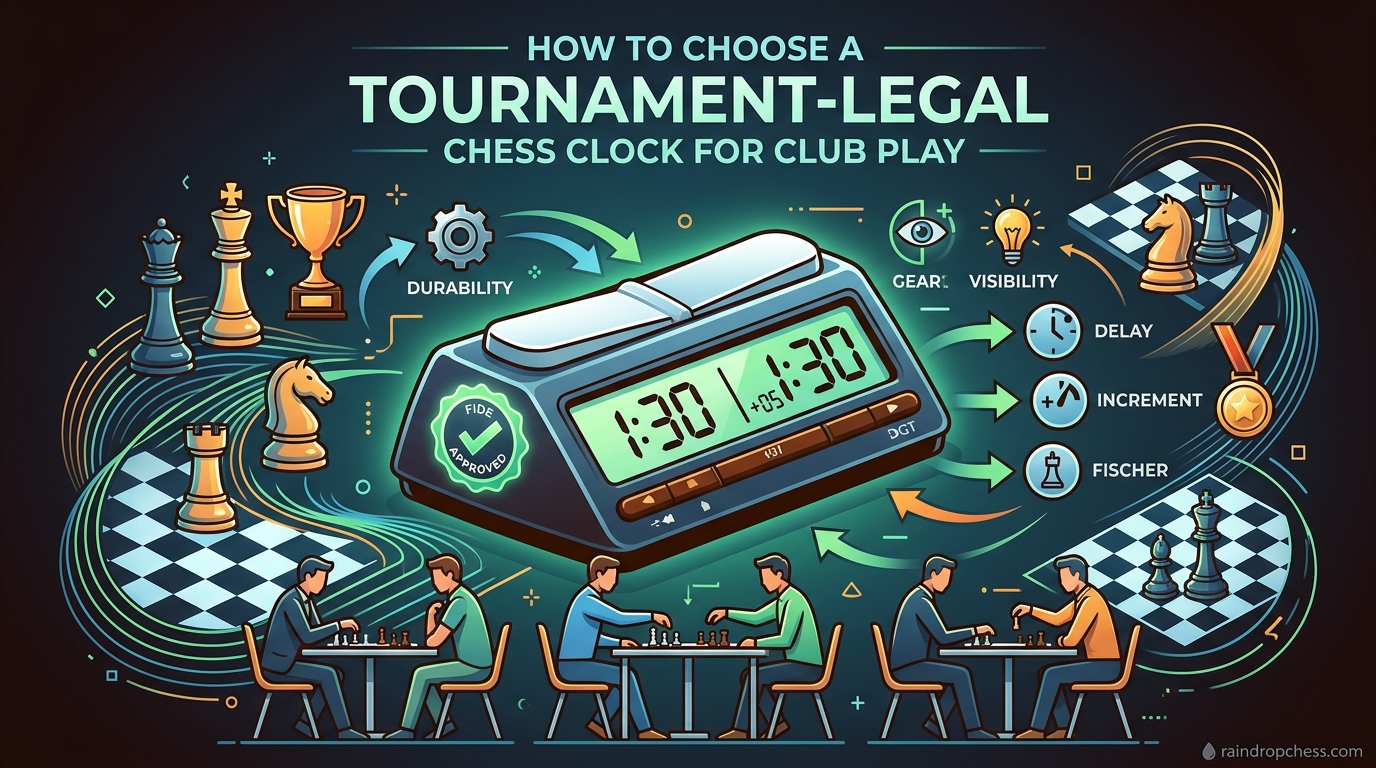
Choosing the right tournament-legal chess clock for club play can feel overwhelming, especially when you’re staring at shelves of different models with varying features and prices. I’ve spent years playing in club tournaments and helping fellow players select equipment that meets official standards without breaking the bank. The truth is, most club players only need a clock that handles basic time controls reliably and has approval from the governing bodies that matter for their events.
In this guide, I’ll walk you through exactly what makes a chess clock tournament-legal, which features actually matter for club play, and how to avoid common mistakes that lead to buying equipment you can’t use in rated games. Whether you’re a tournament director outfitting an entire club or an individual player preparing for your first rated event, understanding these requirements will save you time, money, and frustration.
Table of Contents
Understanding Tournament-Legal Requirements
A tournament-legal chess clock meets specific requirements set by chess governing bodies like FIDE (international play) and USCF (United States Chess Federation). These requirements aren’t arbitrary—they ensure fair play, accurate timekeeping, and compatibility with modern tournament time controls. The most critical requirement is support for delay or increment timing, which has become standard in virtually all tournaments since the early 2000s.
FIDE approval means the clock has been certified for use in FIDE-rated events. Most major manufacturers submit their clocks for testing, and approval lists are maintained on both the FIDE and USCF websites. For club play, USCF approval is typically what matters most, though many clocks carry both certifications. The key difference is that FIDE has stricter requirements about certain features, particularly regarding move counters and display visibility.
Why does approval matter for club play? Even if your club runs casual events, using approved equipment prepares players for tournament conditions and prevents disputes. I’ve seen too many clubs purchase cheap clocks online only to discover they don’t support the delay settings needed for rated games. A clock might keep time perfectly but still be unusable if it can’t handle the specific time control formats your tournament requires.
Verifying approval is straightforward—check the manufacturer’s website for certification mentions or search the USCF’s approved equipment list. Be cautious of clocks that claim “tournament-style” or “tournament-ready” without specifying approval from a recognized governing body. These marketing terms don’t guarantee the clock will work in rated events.
Analog vs Digital Chess Clocks
Analog chess clocks were the standard for decades. These wind-up mechanical clocks use traditional faces with moving hands and simple rocker switches on top to control which timer is running. They’re durable, require no batteries, and have a certain nostalgic appeal. However, analog clocks have a critical limitation for modern tournament play: they cannot implement delay or increment timing. This means they’re essentially obsolete for any serious competitive chess in 2026.
Digital chess clocks have replaced analog models almost entirely in tournament settings. These battery-powered devices use digital displays to show remaining time precisely, and they support advanced timing methods like delay (where time doesn’t start counting down immediately after your opponent moves) and increment (where bonus time is added after each move). Digital clocks also offer preset time controls, move counters, and various user-programmable settings that make them versatile for different tournament formats.
The transition to digital wasn’t just about features—it was about fairness. Analog clocks could run at slightly different speeds depending on how recently they were wound, their mechanical condition, and even temperature. Digital clocks eliminate these variables, ensuring every second is counted exactly the same way. For club play, this consistency matters, especially when games are decided by time forfeits in complex positions.
That said, some clubs still keep analog clocks around for casual games or teaching purposes. They’re fine for unrated play, blitz without increment, or introducing beginners to chess clocks. But if you’re serious about tournament chess or running rated events at your club, digital is the only practical choice in 2026. The price difference has narrowed considerably, and the functionality gap is too significant to ignore.
Essential Features to Look For
When evaluating digital chess clocks for tournament play, certain features are non-negotiable while others are nice additions depending on your specific needs. I’ve tested dozens of models over the years, and here’s what actually matters based on real tournament experience rather than marketing hype.
Delay vs Increment Capability: This is the most critical feature. Delay timing means a specific amount of time (typically 5 seconds) passes before your clock starts counting down after your opponent moves. Increment timing adds bonus time to your clock after each move. Most modern tournaments use one or both methods, and your clock must support them. Look for clocks that handle both US-style delay (common in American tournaments) and FIDE-style increment (standard internationally).
Button Style and Size: In time pressure, every fraction of a second counts. Large, easy-to-press buttons are essential for blitz games and complex time scrambles. I prefer clocks with rocker-style buttons or large rectangular buttons that offer good tactile feedback. Avoid tiny buttons that require precise finger placement—when you’re down to 10 seconds and calculating complex variations, you don’t want to miss your button press and lose on time. Forum discussions consistently emphasize button quality as a deciding factor for serious players.
Display Readability: Large, clear displays prevent time trouble mistakes. Look for clocks with high-contrast digits that remain visible from different angles and lighting conditions. Some premium models feature backlighting, which can be helpful in dim tournament halls. The display should show remaining time clearly for both players, with indicators for whose turn it is and whether delay/increment is active.
Programming Ease: Some clocks are notoriously difficult to program, with confusing menus and tiny buttons for navigation. This becomes a real problem when you’re setting up multiple boards before a tournament round starts. Look for clocks with intuitive interfaces, clearly labeled buttons, and quick-set features for common time controls. I’ve spent 20 minutes fumbling with a complicated clock before a round while players waited—an experience you want to avoid.
Move Counter: While not essential for most club tournaments, a move counter is valuable for events that use time controls with multiple phases (such as 40 moves in 90 minutes, then additional time). Many digital clocks include this feature, but some budget models omit it. If your club hosts serious tournaments with complex time controls, this feature becomes important.
Battery Life and Power Options: Most digital clocks run on AA or AAA batteries, which typically last for hundreds of hours of play. Some higher-end models offer AC adapter options, which can be useful for club settings where clocks see heavy use. Consider how often you’ll use the clock and whether battery replacement costs matter for your budget.
Making Your Selection
Now that you understand what features matter, how do you choose the right clock for your specific situation? The answer depends on your budget, how often you’ll use the clock, and what types of events you’re running or participating in. Let me break this down by common scenarios.
Budget-Conscious Buyers: If you’re spending under $50, focus on essential features—delay/increment support, decent buttons, and clear programming. You’ll sacrifice some build quality and may miss premium features like move counters or extensive presets, but reliable options exist in this range. Many clubs successfully use these clocks for regular play and smaller tournaments. Just verify tournament approval before purchasing, as some ultra-budget models cut corners on certification.
Serious Tournament Players: If you compete regularly and want equipment that will last years, consider investing in a premium model from established brands like DGT or Chronos. These clocks offer superior build quality, extensive preset libraries, and features like move counters and multiple timing methods. The initial cost is higher, but these clocks withstand years of tournament use and hold their value if you decide to sell later. Most tournament directors prefer these brands because they’re familiar with their operation and trust their reliability.
Club Directors: When outfitting an entire club, balance cost with consistency. Having identical clocks across all boards simplifies setup and reduces confusion. Many clubs choose a mid-range model that offers good durability without the premium price tag. Consider your typical events—if you mostly run standard time controls, you don’t need clocks with 50 programmable settings. Focus on ease of use, button reliability, and quick setup between rounds.
Common Mistakes to Avoid: Don’t buy a clock without confirming it supports your required time controls. I’ve seen players purchase clocks online only to discover they can’t implement the delay settings needed for their tournaments. Don’t prioritize fancy features over basic usability—a clock with 100 presets but tiny, hard-to-press buttons will frustrate you in time trouble. Finally, don’t assume expensive means better—some premium clocks sacrifice usability for features you’ll never use.
Frequently Asked Questions
What is the best chess clock for tournaments?
The best chess clock for tournaments depends on your budget and needs, but DGT models are widely considered the tournament standard. DGT clocks offer reliable performance, intuitive programming, and full FIDE/USCF approval. For serious players, the DGT 3000 or DGT North American are excellent choices. Budget-conscious players often find good options from Wholesale Advanced or LEAP, though these may lack some premium features.
What chess clocks are FIDE approved?
FIDE-approved chess clocks include most models from major manufacturers like DGT, Chronos, and ZGF-Pro. The FIDE website maintains an official list of approved equipment. Generally, any digital clock from these reputable brands that supports delay and increment timing will be FIDE-approved for international play. Always verify approval on the official list if you’re competing in FIDE-rated events, as requirements can change.
How to choose a chess clock?
Choose a chess clock by first confirming it’s approved for your type of play (FIDE or USCF). Then prioritize essential features: delay/increment support, large easy-to-press buttons, clear display, and straightforward programming. Consider your budget and how often you’ll use the clock. For occasional play, a reliable budget model works well. For frequent tournament play, invest in a durable brand like DGT or Chronos that will last years.
Do I really need a digital clock for tournaments?
Yes, you need a digital clock for virtually all modern tournaments because they require delay or increment timing that analog clocks cannot provide. While some very small local events might still allow analog clocks, any rated tournament under USCF or FIDE rules will require a digital clock with these features. Digital clocks also provide more accurate timekeeping and support the complex time controls used in contemporary tournament chess.
Are analog clocks still allowed in tournaments?
Analog clocks are generally not allowed in modern tournaments because they cannot implement delay or increment timing, which are standard requirements. Some extremely casual or unrated events might permit analog clocks, but any USCF or FIDE-rated tournament will require a digital clock. If you’re serious about tournament chess, an analog clock is essentially obsolete for competitive play in 2026, though it may still be useful for casual games or teaching beginners.
Conclusion
Choosing the right tournament-legal chess clock for club play doesn’t have to be complicated. Focus on the essentials: FIDE or USCF approval, delay and increment capability, buttons you can press confidently in time pressure, and a display you can read easily. Avoid getting distracted by features you’ll never use, and don’t assume more expensive always means better for your needs.
Whether you’re outfitting an entire club or buying your first personal clock, the investment in a quality tournament-legal chess clock pays off in reliability and peace of mind. You’ll be prepared for rated events, avoid disputes, and develop good habits for tournament play. The right clock becomes a trusted partner in your chess journey, quietly doing its job while you focus on what really matters—making good moves and enjoying the game.