
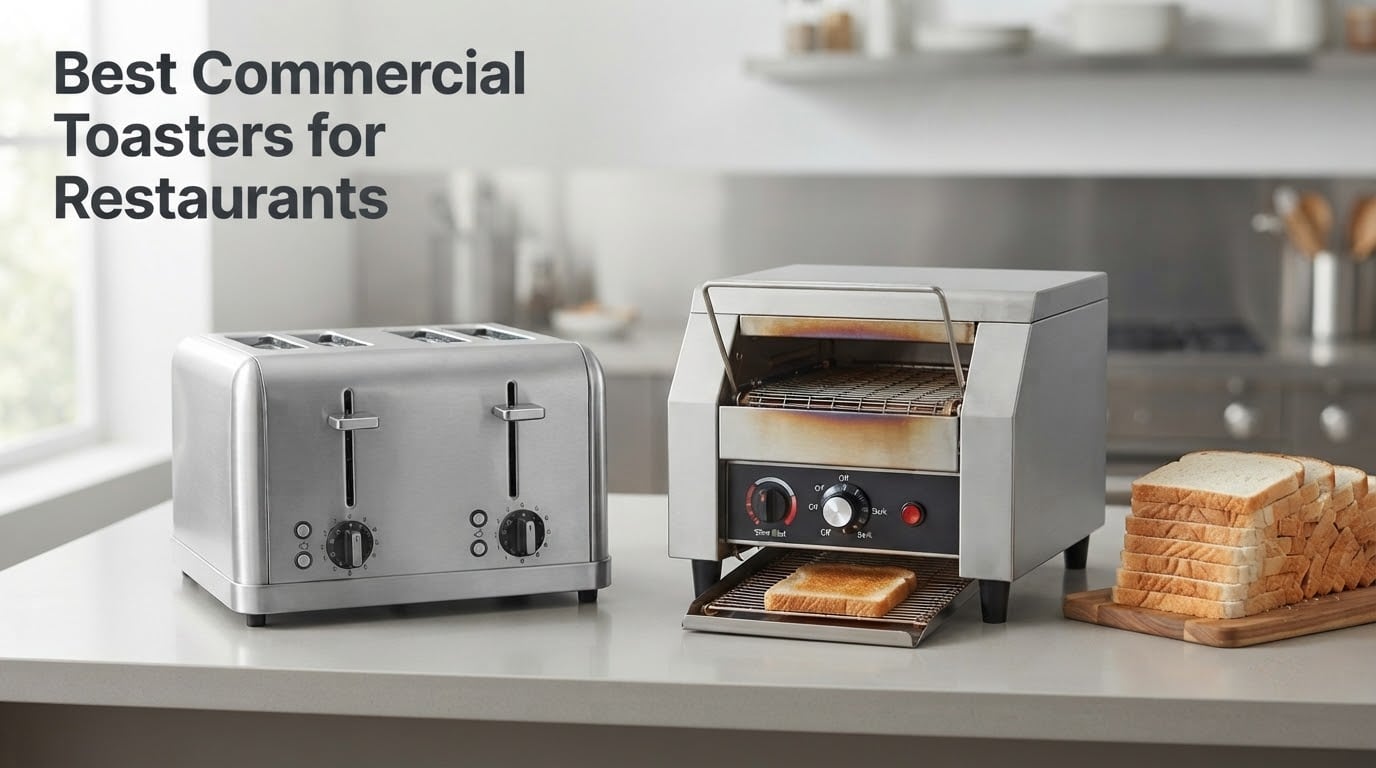
Most restaurant toasters fail for the same boring reason: the wrong form factor, the wrong voltage, or a throughput number that looked fine on a spec sheet and fell apart at 7:45 on a Saturday. I have spent the last two months working through the listings, spec sheets and buyer questions for the best commercial toasters for restaurants, and the short version is that almost every bad purchase in this category traces back to a decision made before anyone checked the electrical requirement.
A commercial toaster is not a bigger kitchen appliance. It is a foodservice machine with a duty rating, a listed wattage, a NEMA plug configuration and a throughput figure measured in slices per hour. It has to produce finished slices at the rate your breakfast rush demands, survive a health-department inspection, and still be serviceable five years from now. Residential toasters fail on all three counts: the heating elements burn out, the warranty is void the moment a paying customer uses the machine, and there is no crumb tray you can put through a dishmachine.
This roundup covers ten machines across the two form factors that actually work in food service: the pop-up slot toaster, where bread drops into live elements and pops back up on a timer, and the conveyor toaster, where bread rides a variable-speed belt through a longer heated chamber so you can load slices continuously. I did not include toaster ovens, which compete for the same counter space but behave very differently under a rush. We also looked hard at certification, footprint and cleaning, because that is where the operating costs hide.
Last updated for 2026. Every rating and review count below is copied straight from the retailer listing, and every specification comes from the manufacturer data, not from my paraphrase.
Top 3 Commercial Toaster Picks for 2026

Waring WCT708 4-Slot Pop-Up
- 4 extra-wide slots
- 225 slices per hour
- Electronic browning control
- Removable crumb tray
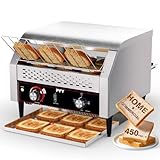
PYY 450-01 Conveyor Toaster
- 450 slices per hour
- Switchable front and rear discharge
- 7 belt speed settings

The Waring WCT708 wins the overall slot because it has the deepest review base in the group and a 225 slices per hour rating that holds up under normal breakfast pressure. The PYY 450-01 is the throughput pick at 450 slices per hour with switchable discharge ends. The Proctor Silex 24855 is the one to buy when an inspector, not a guest, is the person you have to convince.
Best Commercial Toasters for Restaurants in 2026: Quick Overview
The table below lists all ten machines in the order we recommend them, with the spec that drove the ranking next to each name.
| Product | Specifications | Action |
|---|---|---|
| Waring WCT708 4-Slot Pop-Up |
|
Check Latest Price |
| PYY 450-01 Conveyor Toaster |
|
Check Latest Price |
| Proctor Silex 24855 |
|
Check Latest Price |
 Hiteemer BI007129 Conveyor Hiteemer BI007129 Conveyor |
|
Check Latest Price |
 Dyna-Living BI006192TOP Dyna-Living BI006192TOP |
|
Check Latest Price |
 PYYDSL 6-Slot Toaster PYYDSL 6-Slot Toaster |
|
Check Latest Price |
 Tanxinxin 4-Slice Pop-Up Tanxinxin 4-Slice Pop-Up |
|
Check Latest Price |
 HTTSICHI SZ-TT-300 Conveyor HTTSICHI SZ-TT-300 Conveyor |
|
Check Latest Price |
 Vollrath CT2-120350 Vollrath CT2-120350 |
|
Check Latest Price |
 ARPITUYN 6-Slice Toaster ARPITUYN 6-Slice Toaster |
|
Check Latest Price |
1. Waring WCT708 4-Slot Pop-Up Toaster for the Standard Breakfast Line
Waring 4-Slot Toaster with with Defrost Function
4 slots at 1-3/8 inch
225 slices per hour
120V 1800W
7.5 pound countertop unit
Pros
- Wins the overall slot on the deepest review base in the group
- Extra-wide 1-3/8 inch slots take bagels and thick bread
- Self-centering racks keep slices even
- Removable crumb tray
- Limited 1-year warranty
Cons
- Light-duty build unsuited to a full hotel buffet rush
- Narrow 4.5 inch square footprint packs few machines onto one line
- Electronic controls cost more than analog commercial dials
The Waring WCT708 is the one I keep coming back to, and the reason is not the spec sheet, it is the volume of people who have run it. Two hundred and twelve ratings is far more feedback than anything else in this roundup, and the 4.0 average holds up when you know that roughly a sixth of the reviews are one-star complaints about capacity rather than quality.
In practice it toasts up to 225 slices per hour across four extra-wide 1-3/8 inch slots. That slot width matters more than buyers expect: it takes a split bagel or a thick slice of country bread without a fight, which is the single most common reason a restaurant ends up discarding toast. The four self-centering racks do the unglamorous work of keeping bread centered so it browns evenly edge to edge.
Browning is electronic with six settings, which is a step above the old analog dial and the reason it can hold a consistent color through a 90-minute rush. Defrost is built in, so frozen bagels do not need a separate station. At 1800W on 120 volts it plugs into a standard countertop circuit, and at 7.5 pounds it is easy to reposition when you reconfigure the line.
The brushed stainless body is the version that survives, and the removable crumb tray is the version your health-department checklist cares about. The tray pulls out and goes straight into a dishmachine, so a two-minute close-down task at the end of service becomes trivial.
What to check before you commit counter space
Look at the footprint before anything else. At 4.5 inches deep and 4.5 inches wide, this unit is narrow, which is a genuine advantage on a tight line but also means you will need two or three of them instead of one to hit the same throughput. Run the math on how many slices per hour your peak window actually needs, because one of these is not a hotel buffet solution.
Second, confirm your 120-volt circuit can carry 1800 watts. Most restaurant circuits can, but a crowded countertop with a waffle iron and a coffee grinder on the same receptacle is a different story.
Where it falls short
This is a light-duty machine wearing a commercial badge, and the 16% one-star share in the reviews is mostly volume frustration. A full-service restaurant doing 200 covers an hour will outgrow it faster than the spec sheet suggests.
The tall narrow body, listed at 16 inches high, is also awkward under a low shelf or in a pass-through cabinet. Measure the vertical clearance, not just the floor space.
2. PYY 450-01 Conveyor Toaster for Continuous High-Volume Service
PYY Commercial Conveyor Toaster 450pcs/h – Commercial Toaster for Toast, Bun, Bagel, Bread, Heavy Duty Stainless Steel Toaster Oven for Restaurant, Bakery, Buffet Use
450 slices per hour
7 belt speed settings
1800W 100V
Switchable discharge ends
Pros
- 450 slices per hour
- Switchable front and rear discharge fits different layouts
- Fully removable crumb tray speeds cleaning
- Food-grade chain mesh belt
- Responsive support and available parts
Cons
- Slowest belt setting takes about three minutes for a bagel
- Main switch stops the belt but not the heating elements
- Toast level drifts during long service and needs readjusting
A conveyor changes the shape of breakfast service. Instead of a timer cycle, you load a row of bread and it comes out the far side, so a single operator can feed a buffet line without standing over a lever. The PYY 450-01 is rated at 450 slices per hour and carries 181 ratings, which makes it the best-evidenced conveyor in the group.
The feature I would not give up is the switchable front and rear discharge chute. Most kitchens want bread to come out the back toward the pass, but a self-service or grab-and-go counter needs it out the front. Being able to flip the chute without owning two machines is a small design decision that saves real counter space.
Seven belt speed settings combined with independent heating control give you a wide browning range, and the food-grade chain mesh belt is the right choice over a smooth belt because crumbs fall through instead of baking onto the surface. The four non-slip rubber feet matter more than they sound like on a machine weighing close to 42 pounds.
At 1800 watts and 100 volts this is a standard-plug machine, which removes the single biggest installation headache in the category. No electrician, no dedicated 208-volt line, no breaker calculation.
The honest weakness is the slowest belt setting. One owner reports a bagel taking roughly three minutes at that speed, which means thicker items can need a second pass, and a bagel that goes round twice is a bagel nobody orders twice. Set the belt faster and learn to read the color instead of the clock.
There is also a control quirk worth knowing before you buy. The main power switch stops the conveyor belt but does not cut power to the heating elements, so the unit stays warm and keeps drawing current until it is unplugged at the breaker. Plan your shutdown procedure around that, and tell the closing staff.
Reviewers also report toast level drifting over a long service and needing periodic readjustment, plus a few reports of units arriving in used or refurbished condition. Inspect the belt and the chamber on arrival and before you sign the delivery paperwork.
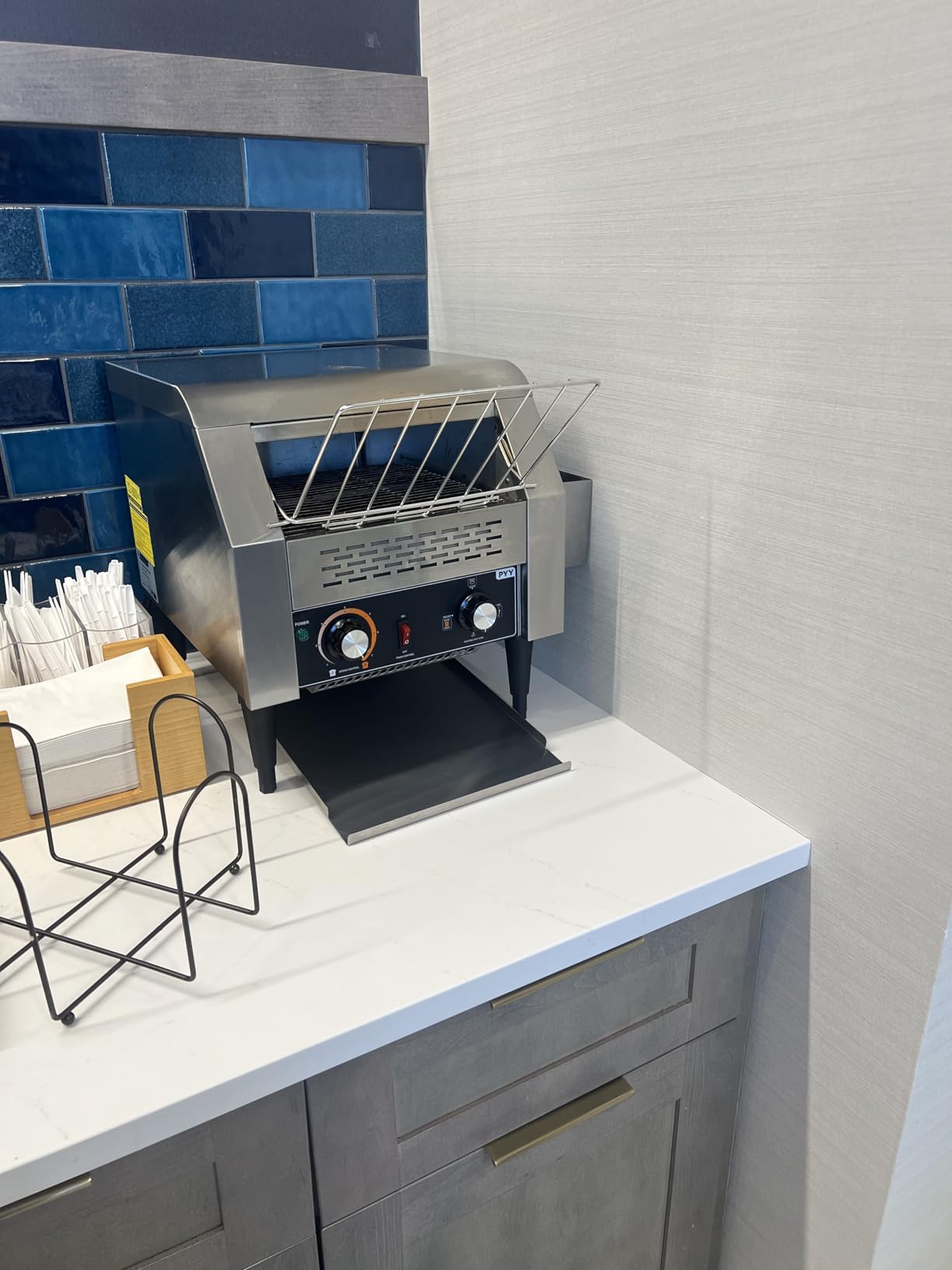
How it handles a hotel breakfast buffet
At 450 slices per hour, this covers a hotel breakfast buffet serving a few hundred covers with room to spare, and it stays ahead of a grab-and-go counter because the operator never waits on a cycle. Load the chute and step away to plate eggs while the belt does the work.
At 17.3 inches wide by 14.6 inches deep and 20 inches tall, it needs a real counter footprint. If your pass is shallow, measure twice.
When a conveyor is the wrong answer
If you are serving fewer than roughly 60 covers an hour, a conveyor is overkill. The slot toaster costs less to run, easier to staff during a slow shift and takes up less space. Conveyors earn their footprint when the line has to stack up during a rush.
Second, if your menu is mostly thick artisan bread or large bagels, test one first. This belt is tuned for standard bread thickness, not for a four-inch sourdough loaf.
3. Proctor Silex 24855 for Kitchens That Need NSF Approval
Proctor Silex Commercial 4 Slot Toaster with Crumb Tray, Longer-Life Heating Elements, Stainless-Steel Construction, NSF Certified, 24855
NSF approved for hotel and restaurant use
4 slots at 1-3/8 inch
120V 1750W
6.1 pound body
Pros
- NSF approved for commercial hotel and restaurant kitchens
- Extra-wide slots handle bagels waffles and artisan bread
- Two front-access crumb trays for fast cleaning
- Fingerprint and rust resistant steel body
- Toast boost and self-centering guides
Cons
- Only 10 ratings so long-term durability data is thin
- Analog controls are less precise than digital units
- Adjustable browning runs up to 450F in coarse steps
If a health department, a group buyer or a client corporate spec requires NSF approval, this is the machine in the roundup that carries it. Proctor Silex Commercial, made by Hamilton Beach Commercial, lists model 24855 as approved for hotel and restaurant use, and that single line of paperwork can be the deciding factor on an institutional bid.
Everything else about it is sensible. Four extra-wide 1-3/8 inch slots fit bagels, waffles and artisan bread, bread centering guides keep slices positioned, and the toast boost function handles a thicker cut without guesswork. Two crumb trays slide out from the front, which is a meaningful upgrade over a single rear tray because staff will actually use the one they can reach.
It is one of the most compact units here at 6.1 pounds and roughly 12.25 by 12.38 inches. That matters in a small cafe or a concession stand where counter space is measured in inches rather than feet, and where two of these are feasible in a spot that fits one large conveyor.
The heating elements are described as longer-life, and the controls adjust up to 450 degrees Fahrenheit. On a 1750-watt 120-volt draw it shares a normal countertop circuit with a coffee grinder without drama.
When NSF listing is worth paying for
NSF listing matters in three situations: institutional and contract feeding, any kitchen where a compliance audit is a real possibility, and group accounts that mandate listed equipment. In a small independent cafe serving sandwich bread, it is nice to have and not decisive.
Confirm the listing on the unit itself rather than trusting the listing page, and keep the model number handy, because that is what an inspector will ask for.
What the reviews cannot tell you
With 10 ratings and a 4.3 average, the sample is genuinely small, and 84% of those reviews are five-star. That is encouraging, but it is not a long service history in the field.
Buyers who did review it zero in on the NSF certification, the wide slots and the dual crumb trays. Nobody reported a failure. Plan for the thin data and buy it for the paperwork and the cleaning design, not because the reviews prove longevity.
4. Hiteemer BI007129 for Bun and Breakfast Sandwich Programs
Hiteemer Commercial Toaster, 300 Pcs/Hr Toasters for Restaurant Bun 1900W
300 slices per hour
7 baking levels
3 modes
304 stainless body
1900W 110V
Pros
- Three dedicated modes for BREAD BUNS and STBY
- 7 baking levels on a single control knob
- Food-grade 304 stainless body rated for daily commercial use
- Front or rear discharge adapts to the counter layout
- Removable crumb tray and heat-dissipating vents
Cons
- Needs a 10-12 minute preheat before service
- Lighter colors require a faster belt speed that takes practice
- Only 7 ratings on record
The Hiteemer BI007129 is built around a specific problem: a breakfast sandwich program where the bun and the bread need different treatment. The three modes, BREAD, BUNS and STBY, are separate from the seven browning levels, so a staffer can dial a soft bun and a crisp slice of wheat without relearning the machine between them.
At roughly 300 slices per hour with a 1900-watt draw, it sits in the middle of the conveyor group. That makes it a good fit for a full-service restaurant where a 450-per-hour machine is overbuilt and a 225-per-hour pop-up is a bottleneck during the 8 to 10 rush.
The 304 stainless body is the better grade of steel for a machine that sees water and heat daily. Front or rear discharge handles the counter layout question, and the removable crumb tray plus ventilation holes handle cleaning and cooling, which matters because a sealed hot chamber in a small kitchen is a heat problem before it is a toasting problem.
It runs on 110 volts, so again there is no electrical work at install. The body measures about 8.1 inches wide by 12.3 inches deep and stands 11.4 inches, which is a modest footprint for the output.
How to live with the 10-12 minute preheat
Build the preheat into your opening routine rather than trying to shorten it. If breakfast service starts at 6:30, the unit goes on at 6:15 and sits in STBY until the first ticket. The standby mode is designed for exactly that window.
Because it runs at 110 volts on 1900 watts, do not put it on a receptacle shared with a high-draw appliance. A dedicated outlet removes the most common cause of a browning complaint.
When to pick something else
The evidence base here is small: 7 ratings with a 4.7 average. Owners report the machine performs as specified with no critical feedback, which is a good sign, but it is not a large sample.
If your operation needs more than 300 slices an hour, step up. The gap between 300 and 450 slices per hour is the difference between a comfortable rush and a visible queue.
5. Dyna-Living BI006192TOP for Deli Production at 300 Slices per Hour
Dyna-Living Commercial Toaster 300 PCS/H Conveyor Toaster for Restaurant
300 slices per hour
7 heating levels
3 modes
1900W 110V
37.2 pound body
Pros
- Single-sided or double-sided baking for open-face subs
- Seven heating levels across BREAD BUNS and STBY modes
- Food-grade thickened stainless with a 304 stainless chain
- Front and rear output chute options
Cons
- 1900W draw may need a dedicated circuit in a busy kitchen
- Only 7 ratings on record
- Longer 20.5 inch depth needs more counter space than a typical 300-slice conveyor
The Dyna-Living BI006192TOP carries a 4.8 average across 7 ratings, with 79% of those at five stars. Deli operators report that it does what it claims and cuts production time, and the single most substantive caution in the reviews is electrical rather than mechanical.
On features it is closely matched to the Hiteemer above: 300 slices per hour, seven heating levels, and the BREAD, BUNS and STBY mode set. The addition that matters in a deli is single-sided or double-sided baking, which lets you open-face a sub roll without waiting for a second pass.
Construction is food-grade thickened stainless with a 304 stainless chain, and the pull-out crumb tray combined with the air vents keeps the chamber serviceable. At 37.2 pounds it has real mass, which is reassuring on a machine that runs all morning on a vibrating belt.
Measure the depth carefully. At 20.5 inches deep by 10.4 inches wide and 15.4 inches tall, this conveyor is deep, and that depth is the price of the larger chamber.
The circuit question comes first here
At 1900 watts, this unit will pull close to the limit of a lightly loaded 20-amp circuit. The review consensus is to give it a dedicated outlet, and we agree, because a toaster that browns inconsistently under load gets blamed for a fault it does not have.
Run it on 110 volts as supplied. This is not a 208 or 240-volt machine, and you do not need a panel change.
What to watch in the first month
Double-sided baking on a conveyor takes practice to time. Run a test batch at your typical belt speed and adjust from the color of the output rather than from a timer, and write the setting down for the closing staff.
The thin review base is worth factoring in. Seven ratings is enough to show the machine works as specified and not enough to forecast a decade of service life, so buy it on the stainless and chain build rather than on the rating.
6. PYYDSL 6-Slot Toaster for Countertop Batch Toasting
PYY Professional 6-Slice Commercial Toaster – 1800W Stainless Steel Heavy Duty Toaster, 6 Browning Levels, 1.1″ Wide Slots, Removable Crumb Tray for Bread Waffles (Commercial & Home Use)
6 slots up to 300 slices per hour
Two control zones
6 browning levels each
1800W 110V
Pros
- Six slots in one body for batch sandwich toasting
- Two independent control zones let staff run different browning at once
- Anti-jam function reduces stuck or burnt slices
- High-lift lever handles small items like English muffins
- Stainless body stays cool to the touch
Cons
- Narrower slots exclude oversized bagels and thick artisan bread
- Only 5 ratings on record and all are five-star
- Listed dimensions need verifying before buying
The PYYDSL is the value answer to a specific problem: a kitchen that needs to toast four slices at a time instead of two, without moving up to a conveyor. Six slots at up to 300 slices per hour is real throughput in a countertop body, and the two independent control zones let one pair of slots run dark while the other runs light.
That dual-zone feature is more useful than it sounds. A breakfast line that toasts wheat for one customer and a plain bagel for the next does not have to stop and reset the dial, which is where throughput quietly leaks in most kitchens.
The anti-jam function prevents bread sticking in a slot and burning, and the high-lift lever raises the carriage for small items like English muffins, which otherwise sit too low to retrieve. Removable stainless crumb trays handle the close-down clean. At 1800 watts on 110 volts it is a standard-plug machine.
All five reviews are five-star, describing consistent daily use, a stainless body that stays cool, quiet operation without loud popping, and quick heat-up. That is a clean record from a small sample.
Check the slot width twice before ordering
This is the one real caveat. The listing copy references both 1.1 inch slot width and 1.57 inch extra-wide slots, which is a genuine contradiction in the product data. If your program includes bagels, Texas toast or thick-cut bread, measure a slice and confirm the fit before you commit.
The second caveat is the listed dimension, which reads 6 inches deep by 0.5 inches wide by 5 inches high and does not describe a six-slot toaster. Ask the seller for the shipping dimensions rather than trusting that line.
Where a six-slot unit fits on the line
A cafe doing light breakfast service, a small deli finishing sandwiches, or a hotel grab-and-go counter that needs more than four slots in a compact footprint. It is a step up in capacity without a step up in electrical requirements.
It is not the right machine for a conveyor-scale rush, and it is not the right machine if your customers bring in four-inch sourdough loaves.
Our picks on [commercial deep fryers for restaurants](https://www.raindropchess.com/best-commercial-deep-fryers-for-restaurants/) follow the same buy rule: check the rated output against peak service before you look at anything else on the spec sheet.
7. Tanxinxin 4-Slice Pop-Up for Small Counters and Muffin Programs
Tanxinxin 1800W Commercial Grade 4-Slice Pop Up Toaster -industrial Toasters 6-Browning Settings with Removable Crumb Tray for Bagel Bread English Muffins, Waffles
4 self-centering slots
Up to 225 slices per hour
6 browning settings
120V 1800W
Pros
- Four self-centering 1-1/4 inch slots handle bagels and Texas toast
- Separate controls for each pair of slots
- Anti-jam function and high-lift for small items
- Owners report it holds up after a year of use
- Compact listed size for tight counters
Cons
- Only 3 ratings on record which is a very small evidence base
- Stainless body is a lower grade than the NSF-listed units here
- No manufacturer certification is listed for commercial duty
The Tanxinxin is a straightforward four-slice pop-up aimed at operators with modest counter space. Four self-centering slots in two controlled pairs, six browning settings, a manual ejector lever and a rated 225 slices per hour put it in the same performance band as the Waring at a fraction of the review history.
Owners report even toasting with no burnt or under-done slices, wide slots that easily take bagels and thick bread, and durability after a year of daily use. The anti-jam function and high-lift feature handle the small-item problems that make a four-slot machine frustrating in practice.
The listed size is 12 by 10.5 by 7.76 inches, a normal footprint for a four-slot machine and easy to place next to a coffee urn.
It runs on 120 volts at 1800 watts, so it drops into an existing countertop circuit without any electrical work.
All three reviews are five-star, which tells you the machine performs but tells you very little about how it holds up over five years of two-shift service.
When this is the correct buy
A small cafe, a bakery finishing bagels, or a breakfast cart where 225 slices per hour is genuinely enough. If you are running a single location with modest covers, this does the job at the lowest complexity.
The high-lift carriage is worth calling out for English muffins and small buns, which sit too low in a standard carriage to retrieve cleanly. Staff notice that within a week.
What the missing certification means for you
There is no NSF or ETL listing shown for this unit, and the stainless body is a lower grade than the certified machines in this roundup. If you serve a hotel group, a school system or any client with a compliance requirement, this is not a qualifying machine.
For an independent cafe with no institutional contracts, the practical question is parts and service support. Confirm that the seller will supply replacement heating elements before you install it.
8. HTTSICHI SZ-TT-300 for Three-Slice Batch Loading
HTTSICHI Commercial Conveyor Toaster w/ 2 Slice Wide Slot, 300 Slice/hour Commercial Toaster w/ 10.1’’ Wide and 3‘’ Opening, Industrial Kitchen Cooking bagel w/Stainless Steel and Heavy Duty
10.1 inch wide chute
3 inch product opening
300 slices per hour
UL certified 110V 1770W
Pros
- Wide 10.1 inch opening takes three slices at once
- 3 inch tall opening fits bagels Texas toast and English muffins
- Only two knobs to learn with seven color settings
- Energy-saving standby mode shortens preheat between rushes
- UL certified with a handled crumb tray
Cons
- Its 21 by 12 by 22 inch body is bulky
- Only 3 ratings on record
- Thickened heating tubes rather than replaceable elements
The HTTSICHI SZ-TT-300 solves a problem most conveyors cannot: it toasts up to three standard slices side by side across a 10.1 inch wide opening, with a 3 inch tall product opening for bagels, Texas toast and English muffins. For a hotel buffet or a self-service pass where customers grab their own toast, that width removes the bottleneck of one slice at a time.
Operation is deliberately simple. Two knobs: one for chain speed and browning, one for the heater, with BREAD, BUNS and STBY modes across seven color settings. An operator can be trained in about two minutes, which matters when the person on the toaster station changes weekly.
The standby mode is a real operating saving. It cuts preheat time between services, so a lunch-only counter or a late-rising hotel breakfast does not leave the chamber drawing full power all morning. UL certification for US use, a handled crumb tray and side bread-clip shelves round out a well-specified machine.
At 300 slices per hour and 1770 watts on 110 volts, the electrical picture is straightforward. The counter footprint is not: 21 inches deep by 12 inches wide and 22 inches tall is the largest body in this roundup.
Measuring for a 22-inch tall machine
Before anything else, measure the vertical space. At 22 inches tall, this will not go under a standard shelf, and it will not sit inside a typical pass-through cabinet. It needs a designed station, not a spare corner of the counter.
Plan the 21-inch depth too. If your counter runs against a wall with a 24-inch backsplash, you have very little room, and this machine will not fit without moving something else.
What to check on the heating elements
The heating tubes are described as thickened rather than field-replaceable, which is the one longevity question we would raise with the seller. In a machine rated for near-continuous service, a failed element ends the unit until it is repaired.
With only 3 ratings, split between four and five stars with no critical remarks, the case rests on the UL certification and the published throughput. That is a reasonable basis, just a thin one.
9. Vollrath CT2-120350 for Operations That Want Warranty Backup
Vollrath CT2-120350 Horizontal Conveyor Toaster, Stainless Steel, 120V, 10.5″ Wide Conveyor, 350 Slices/Hour Capacity, Variable-Speed Control, Quartz Heating, 1.5″ Product Opening
350 slices per hour
Variable-speed conveyor
Quartz heating
120V 1600W
1 year parts and labor
Pros
- Documented 1-year commercial parts and labor warranty
- Quartz elements with forced convection recover heat fast during a rush
- Variable-speed conveyor gives precise browning control
- Uniform heat distribution for consistent color
- Established foodservice manufacturer with a real parts channel
Cons
- 1.5 inch product opening will not take thick bread or large bagels
- Only 3 ratings on record
The Vollrath CT2-120350 states a commercial warranty in writing: one year parts and labor for commercial end users, with residential installation explicitly excluded. That statement changes the calculation on a machine you plan to run for a decade, because parts availability and a service relationship matter more than any single spec.
Mechanical specs are the strongest here: quartz elements with forced convection, rated at 350 slices per hour, with variable-speed conveyor control for browning. Quartz elements recover heat quickly, which is the difference between a machine that holds temperature through a rush and one that drifts lighter as the morning goes on.
Reviews highlight uniform heat distribution and consistent browning, with a 4.6 average across 3 ratings and no negative remarks. At 1600 watts and 120 volts it shares a standard circuit, and the body is stainless and aluminized steel with a side-swing stainless door for belt access.
Be clear-eyed about one limitation: the product opening is 1.5 inches. That handles standard sandwich bread and standard bagels, and it will not handle thick-cut country bread or a large artisan bagel.
When the warranty justifies the step up
If you are a multi-location operation, a contract caterer, or a hotel group with an established service relationship, a written parts and labor warranty is worth real money. It converts a catastrophic single-point failure into a service visit.
For a single small cafe, the same money buys a more capable machine elsewhere, and the warranty matters less because you can swap to a spare.
Confirm the opening before you commit
At 1.5 inches, this opening is tight for thick items. If your program includes bagels or thick bread, measure a slice and test it. This machine toasts beautifully within its envelope and simply cannot take a large item.
Verify the 10.5 inch conveyor width against your counter and confirm the mounting height, because a horizontal conveyor sits differently on the line than a vertical one.
10. ARPITUYN 6-Slice Toaster for the Lightest Commercial Duty
ARPITUYN 6 Slice Toaster, 1680W 110V Commercial Stainless Steel Toaster with Wide Slot, Electric Baking Machine Bread Making Tool with Timing Function for Home Bakery Restaurant
6 slots with 4/6 slice selector
1-5 minute timer
1680W 110V
15 pound body
Pros
- One-piece molded body with no welding marks
- Five-minute timer range for fine browning control
- 6 slots let staff toast two clubs at once
- 4 or 6 slice selector avoids toasting more than needed
Cons
- Uses 201 stainless rather than 304 or commercial grade steel
- Timer control is less precise than a browning dial
- Only 3 ratings on record
The ARPITUYN is the value pick and a deliberately modest machine, and we include it because plenty of small operations genuinely do not need a conveyor. Six slots at 1680 watts on 110 volts, with a quantity selector for four or six slices, is a reasonable working toaster for a cafe doing light food service.
The quantity selector is the quietly useful feature. Toasting six slices when a customer ordered four wastes the elements and extends the cycle, and a one-touch selector stops staff from loading the full chamber every time.
The one-piece molded body has no welding marks, which is a construction detail worth noting: welded seams are where food service equipment corrodes first, and a molded body has nowhere to crack. A club operator reviewing it noted that it makes two clubs or three sandwiches at once, which is exactly the use case it suits.
All three reviews are five-star, with value as the consistent theme. Treat that as a small sample rather than a durability record.
Where this tier of machine makes sense
A small cafe, an office catering kitchen, a bakery finishing slices for sandwiches, or a first location testing whether breakfast service is worth scaling. Six slots and 1680 watts cover a modest cover count without a dedicated circuit.
If you later find you need 300 slices an hour, you will outgrow it, and that is fine. It is a reasonable first machine rather than a mistake.
Where the lower-cost steel shows up
The body is 201 stainless rather than the 304 or commercial grade steel used on the higher-spec machines. It will do fine in a dry cafe, and it will corrode faster in a steamy kitchen or a dish area where it gets splashed daily.
The timer-based control is also the deciding weakness. A 1 to 5 minute timer is workable, but a dial with numbered browning levels is faster to set and easier to keep consistent across staff changes.
How to Choose a Commercial Toaster Without Overbuying
Every recommendation above came out of five decisions: form factor, throughput, slot width, electrical requirement and certification. Work through them in that order and the model choice takes about five minutes.
Slot, pop-up or conveyor: which form factor fits your service
Slot and pop-up toasters are the same machine described two ways. Bread drops into live heating elements, a spring-loaded carriage lowers it, and a timer pops it back up. They are the default in restaurant settings for good reason, as forum discussion on the topic puts it, with conveyor belt units as the large-scale exception.
Conveyors move bread on a variable-speed belt through a longer heated chamber. You load continuously rather than waiting on a cycle, which is why they win at high volume and why they lose on footprint and on running cost at low volume.
A pop-up toaster is the right answer up to roughly 100 slices per hour, and a conveyor earns its place above roughly 250 slices per hour. Between those numbers, look at counter space and at how much electrical work you want to avoid.
Form factor also decides who can run the machine. A pop-up needs an attentive operator pressing a lever. A conveyor loads and keeps moving, which is why it suits a buffet line or a grab-and-go counter staffed by someone already doing three other jobs.
Sizing to breakfast volume with slices-per-hour math
Work out your peak number of covers, then multiply by two slices per cover, then divide by the length of your peak window in hours. That gives the slices per hour your station must sustain.
A 100-cover breakfast served over a one-hour peak needs about 200 slices per hour as a floor, and you want headroom because demand is not evenly spread. Aim for a machine rated 25 to 30% above your calculated peak. A 225 slices per hour pop-up handles roughly 110 covers in an hour, and a 450-slice conveyor handles roughly 220.
The same calculation shapes your [commercial refrigerator choices](https://www.raindropchess.com/best-commercial-refrigerators-for-restaurants/), since cold storage and hot holding both change how fast a line can clear a table.
The 120V vs 208V and 240V trap to check before you buy
This is the mistake that costs buyers the most, and it comes up repeatedly in forums. The top-ranking discussion on the topic is not about which brand is best, it is about the fact that most used commercial toasters are 220-volt machines while plenty of kitchens only have 120-volt circuits available.
The check is simple and takes thirty seconds. Read the nameplate voltage, read the NEMA plug configuration, and read the circuit you actually have. A 120-volt machine with a NEMA 5-15P plugs into a standard receptacle. A 208 or 240-volt unit needs a NEMA 6-20P and a dedicated circuit, which means an electrician and possibly a panel change.
Every machine in this roundup runs on 110 or 120 volts, so you can plug in and go. Before you buy a used unit, verify the voltage on the machine in front of you, not the voltage in the listing.
What NSF and ETL listing actually mean
NSF listing is a sanitation standard. It says the equipment is cleanable to food safety standards, which matters for institutional kitchens, contract feeding and any buyer with a compliance requirement. The Proctor Silex 24855 in this roundup carries it.
ETL or cETLus listing is an electrical safety standard from a testing laboratory, and UL certification serves the same purpose. HTTSICHI SZ-TT-300 is UL certified. These listings are about shock and fire risk rather than sanitation, and they are the ones your insurance carrier may ask about.
Neither listing is a durability rating. They tell you the machine is safe and cleanable, not that it will last.
Light, medium and heavy duty: the filter retailers use
Light duty suits a cafe, coffee shop or bakery doing modest breakfast service, and it describes a machine that runs a few cycles an hour. Medium duty covers a full-service restaurant with steady but not extreme demand. Heavy duty is for continuous service, hotel buffets and quick-service breakfast.
Total cost of ownership follows the same split. Light-duty machines with non-replaceable elements get replaced sooner. Heavy-duty machines with steel internals, replaceable heating plates and a real parts channel keep working, which is why a machine at the top of this list can cost less per slice over its life than one at the bottom.
Slot width: standard 1 1/2 inch vs wide 1 3/4 inch and beyond
No, toasters do not all have the same size slots. Standard slot toasters use roughly 1-1/2 inch openings, wide-slot commercial models run 1-3/8 inch to 1-3/4 inch, and conveyor machines are described by a product opening height instead. In this roundup, slot widths run from 1-1/4 inch on the Tanxinxin to 1-3/8 inch on the Waring and the Proctor Silex, and conveyor openings run from 1.5 inch on the Vollrath to 3 inch on the HTTSICHI.
Measure your bread before you buy. A machine that cannot take a split bagel will generate discarded toast all morning, and that waste costs more than the gap between two slot models.
Cleaning, footprint and the five checks before you accept delivery
Crumb trays decide your close-down routine. Look for a tray that pulls out from the front, because a rear tray at the back of a hot line gets skipped. Confirm it is dishwasher safe, and check how long a full clean takes on the machine you are actually buying.
Run five checks before you sign the delivery paperwork. Confirm the voltage and plug on the nameplate. Confirm the dimensions clear your counter and your cabinet above it. Run a full cycle and check browning on both sides. Pull the crumb tray and check it slides freely. Power it off and confirm it shuts down cleanly, which matters most on conveyors.
One last operational point that buyers skip: noise. A conveyor in a small cafe is a permanent hum, and a pop-up toaster that pops loudly under a stainless hood next to a counter is harder to live with than it looks on a spec sheet.
Frequently Asked Questions
What toasters do restaurants use?
Full-service restaurants use slot or pop-up commercial toasters for everyday breakfast service, and they step up to conveyor units only when peak demand exceeds roughly 250 slices per hour. Hotels, cafeterias and quick-service breakfast counters run conveyors almost exclusively because the belt loads continuously instead of waiting on a timer cycle. The deciding factor is never brand name, it is throughput matched to peak covers, slot width matched to the bread you serve, and a voltage match to your circuit.
What is the best commercial conveyor toaster?
For most operations the PYY 450-01 is the strongest all-round choice, rated at 450 slices per hour with switchable front and rear discharge, seven belt speeds and a fully removable crumb tray. Operators wanting a documented commercial warranty should look at the Vollrath CT2-120350, which carries one year of parts and labor coverage. For very wide batch loading, the HTTSICHI SZ-TT-300 takes three slices at once across a 10.1 inch opening.
Who makes the highest quality toaster?
Vollrath is the pick for build quality and documented warranty support, with a one-year commercial parts and labor warranty and quartz elements built for continuous service. Waring Commercial has the deepest field history in slot toasters and the largest review base in this roundup at 212 ratings. Proctor Silex Commercial, made by Hamilton Beach Commercial, is the choice when NSF sanitation approval is a requirement. Quality here is less about one brand than about steel internals and replaceable parts.
Which brand of toaster is considered the best?
Waring Commercial, Hatco, Star, Cadco, Toastmaster, Avantco and Galaxy all appear regularly in restaurant equipment catalogs, and each fills a different slot. Waring dominates general-purpose slot toasters, Hatco and Cadco are strong on pop-up and hot holding, and Star is known for conveyor systems. In this roundup we reviewed ten machines and the Waring WCT708 earned the top slot on the strength of its review base and even toasting.
Do all toasters have the same size slots?
No. Standard slot toasters run roughly 1-1/2 inch openings, wide-slot commercial models run 1-3/8 inch to 1-3/4 inch, and conveyor machines are described by a product opening height rather than a slot width. Within this roundup, slot widths run from 1-1/4 inch on the Tanxinxin to 1-3/8 inch on the Waring WCT708 and Proctor Silex 24855. Conveyor openings range from a 1.5 inch product opening on the Vollrath to a 3 inch opening on the HTTSICHI SZ-TT-300.
Our Final Verdict on the Best Commercial Toasters for Restaurants
The Waring WCT708 is the best commercial toaster for most restaurants, because 212 ratings of real service beat a better spec sheet with seven reviews behind it. For a hotel buffet or high-volume breakfast counter, the PYY 450-01 at 450 slices per hour is the machine to beat, and for a kitchen where compliance decides the purchase, the NSF-approved Proctor Silex 24855 is the safe answer.
Check the voltage before anything else, size the machine to your peak covers rather than your average, and measure the slot width against a slice of your actual bread. Those three checks prevent nearly every bad toaster purchase we have seen. Explore our other equipment picks, including our [best commercial refrigerators for restaurants](https://www.raindropchess.com/best-commercial-refrigerators-for-restaurants/) and [commercial deep fryers](https://www.raindropchess.com/best-commercial-deep-fryers-for-restaurants/) guides, to finish building out the line.