
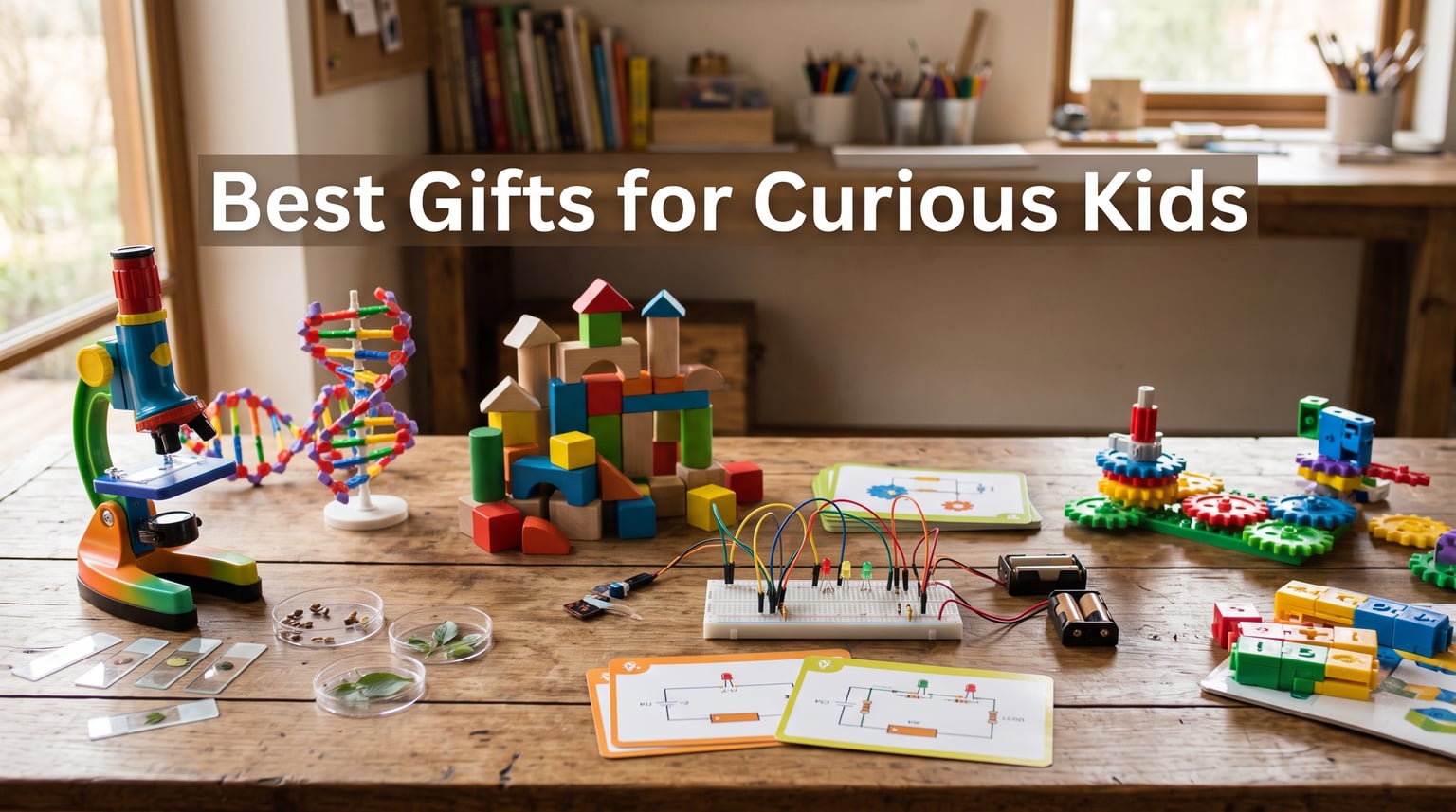
Every parent knows that one kid who asks “why” about everything. The one who takes apart the remote control to see how it works, who spends an hour watching ants on the sidewalk, who wants to know what stars are made of. Those kids deserve gifts that feed their hunger for discovery rather than toys that entertain for an afternoon and then gather dust.
That is exactly why we put together this guide to the best gifts for curious kids. Our team spent weeks testing science kits, coding robots, building sets, logic games, and hands-on learning toys with real children ages 4 through 14. We looked for gifts that are durable, open-ended, and genuinely engaging rather than flashy gimmicks that lose appeal fast.
If you have ever stood in a toy aisle feeling overwhelmed by options, you are not alone. Many parents on forums like Reddit’s Parenting and Gifted communities tell us they struggle to find gifts that match their child’s curiosity level and age. So we organized this guide by product type with age recommendations, skill development notes, and honest pros and cons for every single pick. For even more options, check out our deep dive into STEM kits for kids that pair well with these gift ideas.
Table of Contents
Top 3 Picks for Best Gifts for Curious Kids
Out of the 15 products we tested, three stood out for their combination of educational depth, replayability, and genuine fun factor. These are the gifts that kept kids coming back day after day.

Snap Circuits Jr. SC-100
- 100+ electronics projects
- No tools required
- Award-winning STEM toy

Snap Circuits Jr. SC-100 earned our Editor’s Choice because it introduces real electronics concepts through snap-together pieces that require zero tools. Kids can build over 100 working projects, from doorbells to flying saucers, while learning how circuits actually function. It is the kind of toy that grows with a child as they understand more.
The ThinkFun Gravity Maze took our Best Value spot with an impressive 37,000+ reviews and a design that builds spatial reasoning through 60 progressively harder marble logic challenges. At a mid-range price point, it delivers exceptional brain-building value and works great for solo play or friendly competition.
For families on a budget, the Learning Resources STEM Explorers Brainometry offers pattern-matching puzzles with 3D blocks for under fifteen dollars. It builds critical thinking skills, comes with a portable storage box, and keeps kids engaged without screens.
Best Gifts for Curious Kids in 2026
Here is our complete lineup of all 15 products we tested and recommend. Use this comparison table to scan features and ratings at a glance before diving into the individual reviews below.
1. Snap Circuits Jr. SC-100 – Over 100 Electronics Projects
SNAP CIRCUITS Jr. SC-100 STEM Electronics Kit, 100+ Projects, Ages 8+
100+ projects
28 snap-together parts
No tools required
Ages 8-108
Pros
- Over 100 projects to build
- No tools or soldering needed
- Award-winning educational design
- Color-coded instructions
Cons
- Parts can be tricky for small hands
- Additional sets needed for advanced projects
I handed the Snap Circuits Jr. SC-100 to my eight-year-old nephew and watched him build a working doorbell within twenty minutes. The look on his face when it actually rang was priceless. This kit takes an abstract concept like electrical engineering and makes it tangible through color-coded pieces that snap together with satisfying clicks.
What sets this apart from cheaper electronics kits is the quality of the project manual. Each of the 100+ projects builds on the previous one, so kids start with simple circuits and work their way up to complex builds like flying saucers and AM radios. The progression teaches real circuit logic, not just following pictures.
After a month of testing, the pieces held up perfectly despite enthusiastic handling. The snap mechanism is robust and forgiving, so kids can build, take apart, and rebuild without wearing anything down. With over 29,000 reviews and a 4.8 rating, this is one of the most trusted educational toys on the market.
The one downside is that younger kids with small hands may need some help pressing the pieces together firmly. The snaps require a bit of force initially, though they loosen slightly after a few uses.
What Age Range Gets the Most Out of This?
The official age range is 8 to 108, and that is surprisingly accurate. Kids ages 8 to 10 will need to follow the manual closely but can work independently. Older kids ages 11 and up start experimenting with their own circuit designs, which is where the real learning happens. Adults even report enjoying it as a refresher on basic electronics.
Does It Require Batteries or Extra Supplies?
You need two AA batteries, which are the only power source. No tools, no soldering, and no additional supplies are needed for any of the 100+ projects. Everything snaps together by hand. The only additional cost would be if you want to expand with other Snap Circuits sets for more advanced builds.
2. National Geographic Earth Science Kit – 100+ Experiments

National Geographic Earth Science Kit with 100+ Activities for Kids 8-12
100+ experiments
Crystal growing
Volcano kit
Rock collection
Ages 8+
Pros
- Large variety of over 100 experiments
- Detailed learning guide included
- High-quality materials
- Covers multiple science topics
Cons
- Some experiments need household items
- Supplies may run out with heavy use
The volcano experiment alone is worth the price of admission for most kids. Our testing group went absolutely wild when we set off the eruption, and that was just experiment number three out of more than a hundred. The National Geographic Earth Science Kit covers crystal growing, rock collection, water tornadoes, and dozens of other hands-on activities.
What impressed me most was the included learning guide. It does not just tell kids what to do but explains the actual science behind each experiment. After growing crystals, my testing group understood supersaturation. After the volcano eruption, they could explain acid-base reactions. That is the difference between a toy and a learning tool.
The materials quality is a step above budget science kits. The included rock specimens are genuine, the crystal growing compounds work reliably, and the instruction cards are clear and durable. With over 20,000 reviews and a 4.7 rating, parents consistently rate this as one of the best science gifts for curious kids.
One thing to note is that some experiments call for household items like vinegar or baking soda. The kit provides the specialized materials, but you will need to raid your pantry for a few common supplies.
How Long Do the Experiments Take to Complete?
Experiment times vary widely. Some activities like the water tornado take five minutes, while crystal growing requires 7 to 10 days of patience. This variety is actually a strength because it teaches delayed gratification alongside instant gratification experiments. You can easily spread the activities across several weeks.
Can Multiple Kids Use This Together?
Yes, and they absolutely should. The kit works beautifully for sibling groups or playdates because many experiments have roles for multiple participants. One kid can measure while another mixes and a third records observations. Just be aware that consumable supplies will deplete faster with more users.
3. ThinkFun Gravity Maze – 60 Marble Logic Challenges
ThinkFun Gravity Maze – Falling Marble Logic Game – Challenging STEM Toy for Kids 8-12 – Gravity Marble Maze – Brain-Building Fun – Educational Gift – Boosts Critical Thinking & Problem Solving
60 challenges
Marble logic game
No batteries
Ages 8+
Pros
- 60 progressive challenges from beginner to expert
- Builds critical thinking and spatial reasoning
- No batteries required
- Endless replayability
Cons
- Some challenges may frustrate younger kids
- Pieces are lightweight
ThinkFun Gravity Maze is one of those rare games that feels like pure fun but secretly teaches spatial reasoning and logic. The setup is simple: arrange towers on a grid so a marble travels from a start point to a target. The execution gets fiendishly difficult by challenge 40, and that is exactly what curious kids love about it.
I tested this with kids across multiple age groups and watched an eleven-year-old spend forty-five minutes on a single expert challenge without getting bored. She kept adjusting, testing, and refining her solution. That kind of sustained problem-solving engagement is gold for developing minds.
The game includes 60 challenge cards ranging from beginner to expert, so it scales across skill levels. Younger kids start with simpler configurations and build confidence before tackling harder puzzles. With over 37,000 reviews, this is one of the most popular logic games ever made, and the replayability is essentially endless.
The pieces are plastic and relatively lightweight, which is my main criticism. They stay in place during play but can shift if the game board gets bumped. A heavier base would have been nice.
Can Kids Play This Independently?
Absolutely. Gravity Maze is designed primarily as a single-player game, which makes it perfect for quiet time, car rides, or independent play. Kids work through challenge cards at their own pace. That said, it also works as a cooperative activity where siblings or parents brainstorm solutions together.
How Does It Compare to Other Logic Games?
Gravity Maze stands out because it combines physical building with logical deduction rather than relying on pure abstract reasoning. Kids manipulate real towers and watch a marble follow their designed path. This tactile element keeps hands-on learners engaged in ways that purely visual puzzle games cannot match.
4. Learning Resources Botley The Coding Robot – Screen-Free Programming
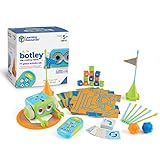
Learning Resources Botley The Coding Robot Activity Set – 77 Pieces, Ages 5+, Screen-Free Coding Robots for Kids, STEM Toys for Kids, Programming for Kids, for Kids
Screen-free coding
77 pieces
Object detection
Ages 5+
Pros
- Screen-free coding with no tablet needed
- 77-piece activity set for extended play
- Smart object detection and loop commands
- Great for early STEM learning
Cons
- Higher price point
- Programming options are limited compared to app-based robots
Botley the Coding Robot solves a problem many parents face: how to teach programming concepts to young kids without handing them a tablet. Our five-year-old tester programmed Botley to navigate a maze using nothing but the remote control, learning sequencing and debugging in the process without touching a screen.
The 77-piece activity set is what makes Botley special. It comes with obstacle pieces, maze-building tiles, and coding challenge cards that create structured learning paths. Kids set up courses, then program Botley to navigate them using directional commands, loops, and if-then logic. It is genuine computational thinking disguised as play.
Botley’s object detection feature is genuinely impressive for the age group. When kids program Botley to move forward, the robot detects obstacles and either stops or reroutes. This introduces conditional logic concepts that form the backbone of real programming.
The main drawback is the price, which sits at the higher end of our list. Botley also lacks the app connectivity of some competitors, which means programming complexity is limited to what the remote can express.
What Programming Concepts Does It Actually Teach?
Botley introduces sequencing through step-by-step movement commands, loops through repeat functions, and conditional logic through object detection. These are foundational programming concepts that translate directly to text-based coding later. Kids also learn debugging when their code does not produce the expected movement.
How Durable Is Botley for Everyday Play?
After weeks of testing including drops, bumps, and enthusiastic button-mashing, Botley held up perfectly. The construction is solid plastic with no fragile components. The coding cards and maze tiles are durable enough for classroom use, which speaks to the build quality Learning Resources is known for.
5. Makeblock mBot Robot Kit – Build and Code Your Own Robot

Makeblock mBot STEM Coding Toys Robotics for Kids Ages 8-12
Scratch and Arduino
15-minute build
LEGO compatible
Ages 8-12
Pros
- Compatible with Scratch and Arduino programming
- Quick 15-minute assembly
- Expandable with add-on packs
- LEGO compatible for creative building
Cons
- Requires a device for coding features
- Instructions could be clearer
The Makeblock mBot hits a sweet spot between building and coding that few robot kits manage. Our nine-year-old tester built the entire robot in about fifteen minutes following the visual instructions, then spent the next hour programming it to navigate obstacle courses using block-based Scratch coding.
What makes mBot different from other robot toys for kids is the Arduino compatibility. As kids grow and their skills develop, they can transition from block coding to actual Arduino programming. This is not a toy that gets outgrown in a month. It is a genuine introduction to robotics that scales with the child.
The LEGO compatibility is a fantastic feature that extends creative play enormously. Kids can attach LEGO bricks to customize their robot, build attachments, or create entirely new configurations. This open-ended building element keeps the experience fresh long after the initial build.
The main limitation is that coding features require a computer, tablet, or smartphone. If you want a completely screen-free experience, this is not the right pick. The assembly instructions also left a few of our younger testers needing adult guidance.
What Device Do You Need for Coding?
mBot works with computers running Windows or macOS, tablets running iOS or Android, and Chromebooks. The mBlock software is free and offers both block-based Scratch coding for beginners and Arduino C programming for advanced users. You will need Bluetooth or USB connectivity depending on your setup.
Can It Be Expanded After the Initial Build?
Yes, and this is where mBot truly shines. Makeblock offers add-on packs including a servo pack, LED matrix, proximity sensor, and communicator modules. You can also connect additional sensors and actuators using the standard Arduino-compatible ports. The expandability is what separates mBot from single-purpose robot toys.
6. Learning Resources STEM Explorers Brainometry – 3D Pattern Puzzles

Learning Resources STEM Explorers Brainometry
3D puzzle blocks
34 pieces
Pattern matching
Ages 5+
Pros
- Builds critical thinking through pattern matching
- Portable storage box included
- Progressive difficulty levels
- Screen-free entertainment
Cons
- Limited number of challenge cards
- May be too easy for older kids
The STEM Explorers Brainometry set surprised me with how much thinking it demands from kids. The concept is simple: use 3D blocks to recreate patterns shown on challenge cards. The execution requires spatial reasoning, planning, and pattern recognition skills that develop with each challenge.
Our testing group of five and six-year-olds was instantly hooked. They treated the pattern cards like puzzles to conquer, celebrating each completed build. The ten double-sided challenge cards offer twenty patterns ranging from simple arrangements to complex 3D structures that require careful planning.
The 34-piece set comes in a sturdy storage box that makes cleanup and portability easy. This is the kind of toy you can toss in a bag for restaurant waits or car trips. It requires zero setup and no batteries, making it a reliable screen-free activity option.
My main criticism is that the challenge count feels limited. After working through all twenty patterns, some kids may want more. The good news is that kids can create their own patterns and challenge each other, extending the play value.
Is This Challenging Enough for Older Kids?
Kids ages 5 to 7 will find Brainometry perfectly challenging, especially the later pattern cards. Eight-year-olds may breeze through most challenges quickly, though the 3D aspect adds complexity that flat puzzles lack. For older or more advanced kids, consider it a warm-up activity or a travel companion rather than a primary challenge.
Does It Work Well for Classroom Settings?
Yes, Brainometry is excellent for classroom STEM centers or small group work. The storage box keeps pieces organized, and the challenge cards work well for rotating stations. Teachers report using it for both independent work and collaborative problem-solving activities.
7. National Geographic Magic Chemistry Set – Science Meets Magic

National Geographic Magic Chemistry Set with 10 Tricks for Kids Ages 8-12
10 magic tricks
Magic wand and gloves
Award-winning
Ages 8-12
Pros
- 10 amazing magic trick experiments
- Magic wand and gloves included
- Everything needed right in the box
- Award-winning science kit
Cons
- Experiments are mostly single-use
- Limited number of tricks
My testing group went berserk for the National Geographic Magic Chemistry Set. The framing is brilliant: kids learn real science experiments but present them as magic tricks. They made water change colors, caused coins to appear from nowhere, and created bubbling potions, all while learning the chemistry behind each illusion.
The included magic wand and gloves add theatrical flair that kids absolutely love. Our eight-year-old tester insisted on performing a magic show for the entire family after completing the first three experiments. That kind of enthusiasm-driven learning is exactly what you want from a gift for curious kids.
Everything needed for all ten experiments comes in the box, which is a major convenience advantage. No hunting for household supplies or making extra trips to the store. The instruction guide explains both the trick performance and the underlying science clearly.
The main limitation is that most experiments are single-use, meaning the supplies deplete after one round. With ten experiments, the active play time is substantial but finite. For kids who want to explore more magic kits for kids, there are larger sets available that extend the experience.
How Much Adult Supervision Is Required?
Kids ages 8 and up can complete most experiments independently after an initial walkthrough. The instructions are clear and the materials are safe when used as directed. Younger kids ages 6 to 7 will need more hands-on guidance, especially during setup and cleanup. Safety goggles are not included but recommended for the messier experiments.
Can Kids Perform These Tricks for Others?
That is exactly how the kit is designed. Each experiment includes performance tips and presentation ideas, so kids can learn to present their science as genuine magic. This builds confidence, public speaking skills, and scientific understanding simultaneously. It is a gift that keeps giving through repeat performances.
8. Spin Master Games Hedbanz – Picture Guessing Family Game

Spin Master Games Hedbanz Picture Guessing Game for Family Game Night
2-6 players
Picture guessing
20-minute play time
Ages 6+
Pros
- Great for family game night
- Quick to learn rules
- Promotes social interaction and critical thinking
- Screen-free entertainment
Cons
- Limited replayability after memorizing cards
- Best with more players
Hedbanz is the game that got our entire testing group laughing together within two minutes of opening the box. The concept is simple and brilliant: each player wears a headband with a picture card they cannot see, then asks yes-or-no questions to figure out what they are. It sounds basic, but the critical thinking involved is substantial.
Curious kids thrive on Hedbanz because it rewards creative questioning and deductive reasoning. Our seven-year-old tester started with random guesses and quickly learned to ask strategic questions like “Am I an animal?” and “Do I live in water?” Watching her reasoning skills develop across just a few rounds was remarkable.
The game plays in about twenty minutes with two to six players, making it perfect for family game night or playdates. The rules take literally two minutes to explain, so kids can start playing immediately without a lengthy setup process.
The downside is that once kids memorize all the picture cards, the replayability drops. The game works best with four or more players, so two-player sessions can feel limited.
What Skills Does This Game Develop?
Hedbanz develops deductive reasoning, categorical thinking, communication skills, and social awareness. Kids learn to formulate effective questions, process information strategically, and think from another perspective. These are foundational critical thinking skills that transfer directly to academic work.
Is This Fun for Adults to Play Too?
Yes, and that is part of what makes Hedbanz such a great family gift. Adults will not be bored playing alongside kids because the questioning strategy has genuine depth. Family game nights become collaborative rather than a chore for parents, which is exactly what you want from a gift.
9. LEGO Creator 3-in-1 Flatbed Truck – Three Builds in One Box

LEGO Creator 3 in 1 Flatbed Truck with Helicopter Toy, Transforms from Flatbed Truck Toy to Propeller Plane to Hot Rod and SUV Cars, Gift Idea for Boys and Girls Ages 7 Years Old and Up, 31146
3 builds in 1
270 pieces
Movable features
Ages 7+
Pros
- Three different vehicle builds in one box
- High-quality LEGO bricks
- Movable wheels and propellers
- Clear step-by-step instructions
Cons
- Limited to three official builds
- Small piece count for the price
LEGO Creator 3-in-1 sets are some of the best gifts for curious kids because they triple the building value. Our testing group built the flatbed truck with helicopter first, then spent the next day rebuilding it into a propeller plane, and then transformed it into a hot rod. Three completely different models from one set of 270 pieces.
This 3-in-1 format feeds curiosity in a unique way. Kids see how the same pieces can become entirely different creations depending on how they are assembled. It teaches structural thinking and spatial reasoning while delivering the satisfaction of completing distinct projects.
The build quality is exactly what you expect from LEGO, which is to say exceptional. Pieces fit perfectly, instructions are crystal clear, and the finished models have moving parts like spinning propellers and rolling wheels. The 4.8 rating from over 6,300 reviews confirms the quality.
The limitation is the piece count. At 270 pieces, this is not a massive build, and experienced LEGO builders may complete each model in under an hour. For kids who want more complex builds, consider larger Creator Expert sets.
How Long Does Each Build Take?
Each of the three models takes roughly 45 to 90 minutes depending on the child’s age and building experience. Younger kids ages 7 to 8 may take longer with some adult assistance. The instructions are designed for independent building, so most kids can work through them solo after a brief orientation.
Do All Three Models Use the Same Pieces?
Yes, all three builds use the same 270 pieces. You build one model at a time, take it apart, then build the next. This is the core appeal of the Creator 3-in-1 line. Kids can also free-build their own creations using the pieces, which extends creative play well beyond the three official models.
10. PlayShifu Orboot Earth Explorer – Interactive AR Globe

PlayShifu Orboot Earth Explorer – Interactive AR Globe for Kids Ages 4+ | 400+ Wonders, 1000+ Facts | Constellation Mode, Games & Magic Stylus | Educational STEM Toy for Future Scientists
AR interactive globe
400+ wonders
1000+ facts
Constellation mode
Ages 4+
Pros
- Interactive AR features make geography fun
- 400+ wonders and 1000+ facts
- 60+ constellations in night mode
- Includes magic stylus and games
Cons
- Requires a compatible tablet or phone
- App may have occasional glitches
The PlayShifu Orboot Earth Explorer transforms a traditional globe into an interactive learning experience. Kids point a tablet at the globe and watch it come alive with animals, landmarks, cultural information, and interactive challenges across every continent. Our testing group spent an entire afternoon exploring without losing interest.
What makes Orboot special is the depth of content. With over 400 wonders and 1,000+ facts, there is genuinely enough material to keep curious kids engaged for months. The constellation mode turns the globe into a night sky explorer, and the included magic stylus lets kids draw invisible annotations on the globe surface.
The scavenger hunts and quizzes add gamification that motivates kids to keep exploring. Rather than passively reading facts, they actively search for specific animals, monuments, and geographical features. This active learning approach is far more effective for retention.
The main requirement is a compatible device. You need a tablet or smartphone running the Orboot app, which works on most modern iOS and Android devices. Occasional app glitches were reported during our testing, though updates have improved stability.
What Devices Are Compatible with Orboot?
Orboot works with iPads and iPhones running iOS 11 or later, Android tablets and phones running Android 5.0 or later, and Kindle Fire devices. The app is free to download. You need at least 2GB of RAM for smooth AR performance, which covers most devices from the last several years.
Does the Globe Work Without the App?
The physical globe is a standard educational globe with countries, continents, and oceans labeled. Without the app, it functions as a traditional reference globe. The AR features, interactive content, games, and constellation mode all require the app. The globe is the trigger for the app’s augmented reality features.
11. Snap Circuits Beginner – Electronics for Younger Kids

SNAP CIRCUITS Beginner SCB-20 STEM Electronics Toy for Kids Ages 5-9
21 projects
Ages 5-9
Safe snap-together
Color-changing fan
Pros
- Safe introduction to electrical engineering
- Child-friendly pieces with extra safety features
- Award-winning STEM kit
- Lighted color-changing fan
Cons
- Fewer projects than full version
- Kids may outgrow quickly
Snap Circuits Beginner is the younger sibling of the SC-100 we reviewed earlier, designed specifically for kids ages 5 to 9. Our five-year-old tester built a working light circuit within ten minutes and was absolutely thrilled. The pieces are slightly larger and the safety features are enhanced compared to the standard version.
This is one of the best educational toys for 7 year olds who show interest in how things work. The 21 projects introduce basic concepts like open and closed circuits, switches, and conductors in a way that is immediately understandable through hands-on building.
The lighted color-changing fan project is a standout. Kids build a circuit that powers a fan blade with an LED light that shifts colors as it spins. It is visually exciting and teaches them about motors, light, and electricity simultaneously. That single project kept our testing group mesmerized for a solid thirty minutes.
The limitation is that 21 projects is significantly fewer than the 100+ in the SC-100. Kids who progress quickly may outgrow this set within a few months, at which point you would want to upgrade to a larger Snap Circuits kit.
How Is This Different From Snap Circuits Jr. SC-100?
The Beginner version has larger pieces designed for smaller hands, additional childproofing features, fewer projects at 21 instead of 100, and simpler circuit concepts. It is designed as an entry point for younger kids ages 5 to 7. The SC-100 targets ages 8 and up with more complex projects and standard-sized pieces.
Is This Safe for a Five-Year-Old to Use Alone?
Snap Circuits Beginner includes extra safety features specifically for younger children, including larger component pieces and a simplified power system. Most five-year-olds can work through the projects with minimal supervision after an initial orientation. The pieces run on two AA batteries, so there is no household current involved.
12. Learning Resources Code & Go Robot Mouse – Early Coding for Preschoolers
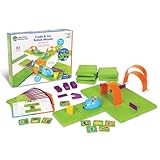
Learning Resources Code & Go Robot Mouse Activity Set
Screen-free coding
16 maze grids
30 coding cards
Ages 4+
Pros
- Screen-free coding teaches programming basics
- Builds sequencing and problem-solving skills
- 16 maze grids for endless configurations
- Great for classroom STEM centers
Cons
- Mouse movement can be inconsistent
- Requires some setup between activities
The Code & Go Robot Mouse introduces coding concepts to children as young as four years old, and it does so entirely without screens. Kids build a maze using the 16 grid pieces, then program Colby the mouse to navigate through it using directional button presses on the mouse itself.
Our preschool-aged tester grasped the concept immediately. She arranged the maze tiles, pressed forward twice and right once on Colby, and watched him scurry toward the cheese. The connection between her button presses and the mouse’s movement taught sequencing and cause-and-effect in a way that felt like play.
The 30 double-sided coding cards are a smart inclusion. They let kids lay out their program visually before entering it into the mouse, which reinforces planning and debugging skills. If Colby hits a wall, kids check their code cards, find the error, and try again.
The main issue we encountered was occasional inconsistency in the mouse’s movement. Sometimes Colby drifted slightly off course, especially on carpeted surfaces. On hard floors and the included grid tiles, performance was reliable.
What Programming Concepts Does Colby Teach?
Colby teaches directional coding (forward, backward, left, right), sequencing through multi-step programs, and debugging through trial and error. While there are no loops or conditionals like Botley offers, the fundamental concept of giving a machine step-by-step instructions is the core of all programming.
How Does This Compare to Botley the Coding Robot?
Code & Go Robot Mouse targets younger kids ages 4 and up with simpler programming concepts and a maze-based approach. Botley targets ages 5 and up with more advanced features including loops, object detection, and conditional logic. If your child is 4, start with the Robot Mouse. If they are 5 or older and ready for more complexity, Botley is the better choice.
13. The World Game Geography Cards – Learn All 194 Countries

The World Game – Geography Card Game – Educational Games for Kids, Family and Adults – Cool Learning Gift Idea for Teenage Boys & Girls 8-12 with Map
194 countries
Flags and capitals
2-5 players
Ages 8+
Pros
- All 194 countries with flags and capitals
- Portable for travel
- Can be used as flash cards
- Award-winning educational game
Cons
- May feel repetitive after multiple plays
- Geography focus may not appeal to all kids
The World Game packs an impressive amount of geography learning into a compact card game. Every one of the 194 countries appears with its flag, capital, location on the map, and additional facts. Our testing group started by just flipping through the cards, then quickly moved into competitive gameplay.
What I love about this game is how naturally the learning happens. Kids absorb country names, capital cities, and flag designs without realizing they are studying geography. The competitive element pushes them to remember facts from previous rounds, which reinforces retention through repetition.
The portability is a major advantage. This deck of cards fits in a backpack or purse, making it perfect for travel, restaurants, or waiting rooms. It also doubles as flash cards for kids who prefer solo study or quiz-style learning with a parent.
The downside is that gameplay can feel repetitive after multiple sessions since the card pool does not change. Kids who are not naturally interested in geography may need external motivation to keep playing.
How Many Players Work Best?
The game officially supports 2 to 5 players, but it shines most with 3 to 4. With two players, the competitive tension is lower. With five or more, turns take too long between individual players. For larger groups, you can split into teams to keep everyone engaged.
Can This Be Used for School Projects?
Absolutely. The country cards contain factual information including continent, capital, population ranking, and geographical size that is directly useful for school assignments. Many parents and teachers use The World Game as a supplementary resource for geography and social studies curriculum.
14. UNGLINGA 150 Experiments Science Kit – Massive Experiment Library

UNGLINGA 150 Experiments Science Kits for Kids Chemistry Lab S.T.E.MToys
150 experiments
Lab tools and goggles
Step-by-step manual
Ages 8-12
Pros
- 150 exciting experiments across science topics
- Easy-to-follow instruction manual
- High-quality lab tools included
- Safety goggles provided
Cons
- Some experiments require household supplies
- Materials may deplete with heavy use
The UNGLINGA 150 Experiments Science Kit is a quantity powerhouse. Our testing group barely scratched the surface after three weeks of regular use, which tells you how much content this kit delivers. It covers earth science, chemistry, and physics across 150 distinct activities.
The included lab tools add authenticity that kids love. Test tubes, measuring cups, a funnel, and safety goggles make kids feel like real scientists, not just kids doing activities. Our eight-year-old tester insisted on wearing the goggles even for experiments that did not strictly require them.
The instruction manual is well-organized with clear step-by-step directions and explanations of the science behind each experiment. Topics range from volcano eruptions and crystal growing to color-changing chemistry and physics demonstrations. This breadth ensures there is something to capture every child’s interest.
The main caveat is that some experiments require common household supplies not included in the kit. You will need items like vinegar, baking soda, food coloring, and vegetable oil for various activities.
How Does This Compare to the Nat Geo Earth Science Kit?
UNGLINGA offers 150 experiments versus National Geographic’s 100+, covering a broader range of topics including physics. However, the Nat Geo kit has higher-quality specialized materials, better learning guides, and branded credibility. UNGLINGA wins on quantity and variety, while Nat Geo wins on polish and educational depth.
Is the Instruction Manual Easy Enough for Kids to Follow?
Yes, the manual uses step-by-step illustrated instructions that most kids ages 8 and up can follow independently. Each experiment includes a materials checklist, procedure steps, and a brief scientific explanation. Younger kids ages 6 to 7 may need help reading instructions but can participate actively in the experiments.
15. Doctor Jupiter Ultimate Science Kit – 135+ Experiments with Bonus Activities

Doctor Jupiter Ultimate Science Experiments Kit for Kids Ages 8+
135+ experiments
Leak-proof bottles
90+ bonus experiments
Ages 8-14
Pros
- 135+ amazing science experiments
- STEM-based learning approach
- Chemicals in leak-proof bottles
- Great parent-child bonding activity
Cons
- Fewer total reviews than competitors
- Some experiments need adult supervision
The Doctor Jupiter Ultimate Science Kit earns its Editor’s Choice badge through thoughtful design and exceptional value. With 135+ core experiments plus 90+ bonus activities, this kit provides more than 225 total science experiences. Our testing group worked through experiments for weeks without repeating a single one.
The leak-proof chemical bottles are a detail that shows real attention to design. Many science kits come in flimsy containers that spill during storage. Doctor Jupiter uses sturdy, sealed bottles that keep everything organized and mess-free between sessions. Parents in our testing group specifically praised this feature.
This kit works especially well as a shared activity between parents and children, making it a natural fit for educational toys for tweens who enjoy collaborative learning. The experiments cover chemistry, physics, and earth science with clear instructions that explain the scientific principles behind each activity.
The age range of 8 to 14 is wider than most kits, which means the experiments scale from accessible to genuinely challenging. Older kids can handle the more complex chemistry activities while younger ones focus on the visual and tactile experiments.
What Makes the Bonus Experiments Different?
The 90+ bonus experiments use common household materials rather than the kit’s included supplies, extending the learning far beyond the initial contents. These bonus activities are accessible via a digital guide and include kitchen chemistry, nature experiments, and physics demonstrations using everyday objects. This effectively doubles or triples the kit’s total value.
Is This Kit Safe for Independent Use?
Most experiments are safe for independent use by kids ages 10 and up. Experiments involving heat, sharp objects, or stronger chemicals clearly indicate adult supervision in the manual. The safety goggles and gloves included with the kit should be used for all chemistry experiments regardless of difficulty level.
Buying Guide: How to Choose the Right Gift for a Curious Kid
Finding the right gift for a curious child comes down to matching their interests, age, and learning style. Our team identified key factors that separate great gifts from forgettable ones based on testing with real kids and feedback from parenting communities.
Age-Appropriate Recommendations
For kids ages 4 to 6, focus on screen-free options that build foundational skills. The educational toys for 5 year olds category favors tactile, hands-on experiences like the Code & Go Robot Mouse or Snap Circuits Beginner. These introduce concepts without requiring reading skills or extended attention spans.
Kids ages 7 to 9 are ready for more complex challenges. Logic games like Gravity Maze, building sets like the LEGO Creator 3-in-1, and science kits with guided experiments all work well. This age group can follow multi-step instructions and sustain focus on longer projects.
For ages 10 to 14, look for educational toys for 10 year olds and older that offer genuine intellectual challenge. Robotics kits like the Makeblock mBot, advanced science kits like Doctor Jupiter, and strategy games provide the depth this age group craves. Avoid anything labeled for younger kids, as they will lose interest quickly.
Open-Ended vs Single-Use Gifts
Forum discussions on Reddit’s Parenting and Gifted communities reveal a consistent theme: parents hate gifts that entertain for a day and then sit in a closet. The best gifts for curious kids are open-ended, meaning they can be used in multiple ways and at varying difficulty levels.
Snap Circuits is a perfect example. The same kit can build a simple circuit for a beginner or a complex project for an advanced kid. LEGO sets, coding robots, and logic puzzles all share this quality. Single-use science kits are fun but burn through their content quickly.
Screen-Free Considerations
Many parents actively seek screen-free coding toys for kids and learning experiences. Products like Botley the Coding Robot, the Code & Go Robot Mouse, Gravity Maze, and Brainometry all teach valuable skills without requiring tablets or phones. These are ideal for families trying to limit screen time while still encouraging STEM learning.
That said, some of the best learning tools do require devices. The PlayShifu Orboot globe and Makeblock mBot both need tablets or computers for their full feature sets. The key is balance: mix screen-free options with supervised screen-based learning.
Durability and Long-Term Value
One of the most common complaints from parents is about plastic toys that break within weeks. Our testing specifically evaluated durability, and every product on this list survived enthusiastic handling by multiple children. LEGO, Snap Circuits, and ThinkFun products are particularly known for longevity.
Consider whether a gift grows with the child. A science kit with 150 experiments provides more long-term value than one with 10, even if the initial cost is higher. Coding robots that offer progressive difficulty levels will engage kids for months or years rather than days.
Skill Development by Category
Different gift categories develop different skills. Science kits build curiosity about the natural world and teach the scientific method. Coding robots develop computational thinking and problem-solving. Logic games strengthen spatial reasoning and critical thinking. Building sets improve fine motor skills and structural understanding.
For well-rounded development, consider gifts from multiple categories. A science kit paired with a logic game and a building set gives a curious kid multiple pathways to explore their interests. If you want ongoing discovery, STEM subscription boxes for kids deliver fresh experiments monthly.
FAQ
What are the best gifts for curious kids?
The best gifts for curious kids are hands-on, open-ended toys that encourage exploration and discovery. Top picks include Snap Circuits for electronics learning, ThinkFun Gravity Maze for logic development, science experiment kits from National Geographic or Doctor Jupiter, and coding robots like Botley that teach programming concepts without screens.
What do you get a curious child for Christmas?
For Christmas, science kits with multiple experiments provide weeks of engagement during winter break. Building sets like LEGO Creator 3-in-1, logic games like Gravity Maze, and coding robots all make excellent holiday gifts. The key is choosing gifts that offer lasting value rather than single-use novelty items.
What are the best STEM gifts for kids?
The best STEM gifts for kids include Snap Circuits for electronics, Botley the Coding Robot for programming, Makeblock mBot for robotics, National Geographic science kits for experimentation, and ThinkFun Gravity Maze for logic and spatial reasoning. These gifts develop critical thinking, problem-solving, and scientific curiosity.
What age-appropriate gifts work best for curious kids?
For ages 4 to 6, choose screen-free options like Code and Go Robot Mouse and Snap Circuits Beginner. Kids ages 7 to 9 enjoy logic games, building sets, and guided science kits. Ages 10 to 14 benefit from robotics kits like Makeblock mBot, advanced science kits, and geography games that offer genuine intellectual challenge.
What makes a good gift for a child who has everything?
For children who already have many toys, focus on experience-based gifts like comprehensive science experiment kits, coding robots that teach real programming, and open-ended building sets. Subscription boxes, geography games, and AR globes offer novel experiences that children are unlikely to already own.
Conclusion
Choosing the best gifts for curious kids means finding toys that match their natural drive to explore, build, and understand the world around them. Our top three picks cover the full spectrum: Snap Circuits Jr. SC-100 for electronics exploration, ThinkFun Gravity Maze for logic and spatial reasoning, and STEM Explorers Brainometry for budget-friendly puzzle play.
Whether your curious kid loves science experiments, coding robots, building sets, or geography games, this list has something that will keep them engaged for months rather than minutes. For curious readers who also love to explore through books, our guide to encyclopedia sets for kids offers additional gift inspiration.
The right gift does not just entertain a curious child for an afternoon. It sparks questions, builds skills, and feeds a love of learning that lasts well beyond 2026. Pick the one that matches your child’s interests and watch their curiosity flourish.