
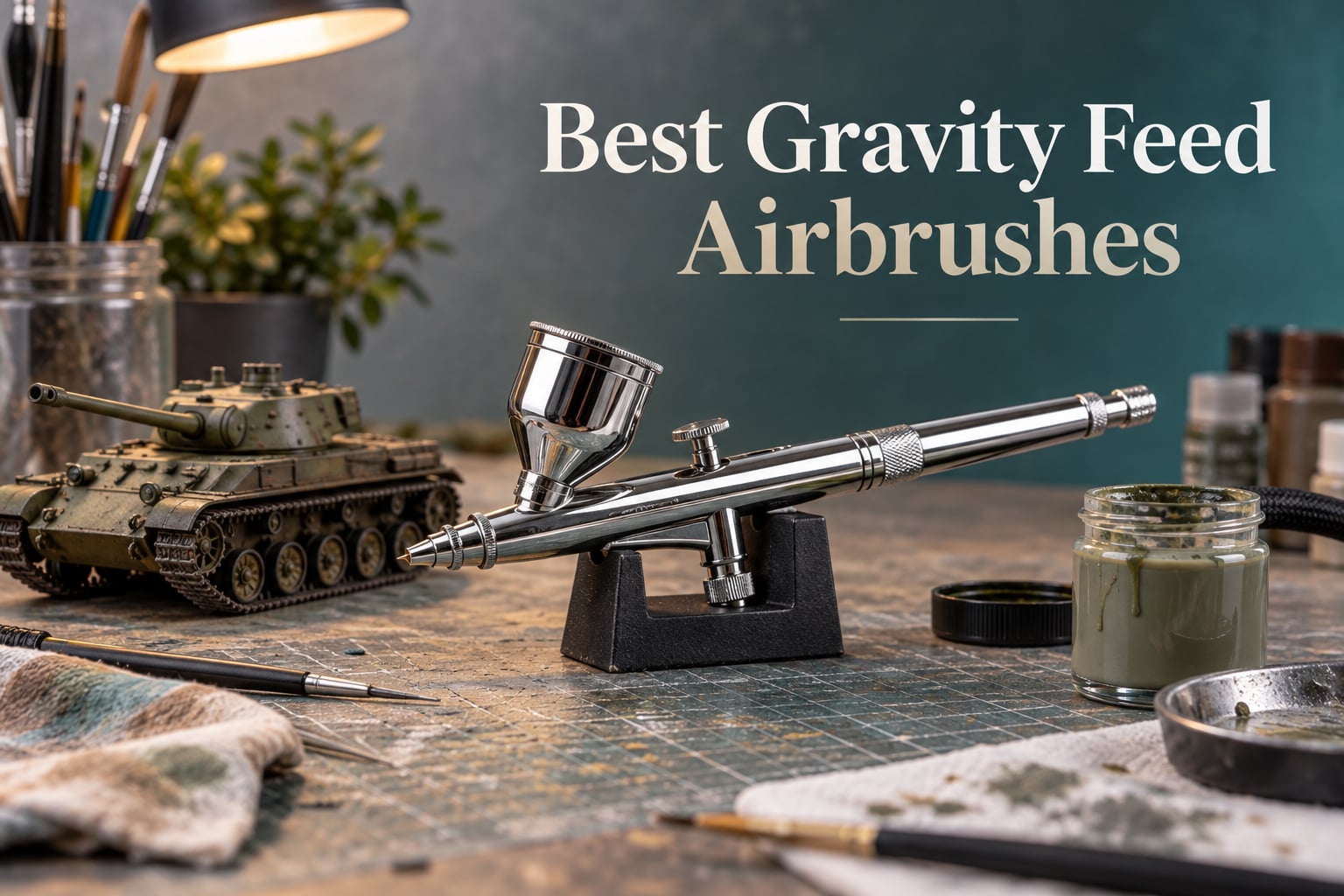
Gravity feed wins for almost every hobby painter, because paint falls into the nozzle from a cup on top of the body instead of being sucked up from a bottle below it. That design primes with less paint, flushes between colours in seconds, and works at lower air pressure, which makes it the standard choice for scale models, miniatures, canvas and illustration. Siphon feed still makes sense for large flat areas where you want a big reservoir and minimal refills.
This roundup covers the 12 best gravity feed airbrushes we could get hands on, from entry kits that include a compressor to precision brushes built for fine detail. We compared them on trigger feel, atomization consistency, how fast they disassemble for cleaning, and how they behaved with acrylics, enamels and thinned primers over roughly six weeks of work.
One thing we noticed early: the gap between a well-made brush and a cheap one is less about the headline specs and more about needle seating and how willingly the gun comes apart afterward. The best gravity fed charcoal smokers guide we published covers a completely different hobby, but the same rule applies there. Buy the tool that is easy to service, not the one with the longest feature list.
Table of Contents
Top 3 Picks for the Best Gravity Feed Airbrushes
All 12 Gravity Feed Airbrushes at a Glance
Every gun below is dual-action and gravity feed. The differences that matter day to day are needle size, cup capacity, and how the airbrush comes apart for cleaning.
| Product | Specifications | Action |
|---|---|---|
| Master Airbrush G233 Pro Kit |
|
Check Latest Price |
| TIMBERTECH Kit with Compressor |
|
Check Latest Price |
 Iwata NEO CN Iwata NEO CN |
|
Check Latest Price |
 Gaahleri GHAD-39 Gaahleri GHAD-39 |
|
Check Latest Price |
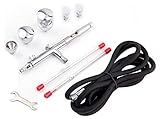 Fengda BD-183K Fengda BD-183K |
|
Check Latest Price |
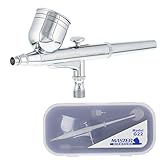 Master Airbrush G22 Master Airbrush G22 |
|
Check Latest Price |
 Badger 105 Patriot Badger 105 Patriot |
|
Check Latest Price |
 GotHobby 0.3mm Kit GotHobby 0.3mm Kit |
|
Check Latest Price |
 Iwata Eclipse HP-CS Iwata Eclipse HP-CS |
|
Check Latest Price |
 Iwata Revolution CR Iwata Revolution CR |
|
Check Latest Price |
 NEOECO SJ83 NEOECO SJ83 |
|
Check Latest Price |
 Harder and Steenbeck Ultra 2024 Harder and Steenbeck Ultra 2024 |
|
Check Latest Price |
1. Master Airbrush G233 Pro Kit – Best Overall Gravity Feed Airbrush
Master Airbrush G233 Performance Pro Airbrush Kit with 3 Nozzle Sets
Dual-action gravity feed
0.2 0.3 and 0.5mm sets
1/3 oz cup
Quick disconnect
Pros
- Three needle sizes in one kit
- Smooth dual-action trigger
- Solid metal body
- Cutaway handle flushes air passages
- Quick disconnect with flow valve
Cons
- Small cup needs frequent refills
- Some actuator slop
- Non-detachable cup with a hard-to-clean groove
- Gaskets and nozzle head wear quickly
This is the gun we kept reaching for. The G233 Pro ships with 0.2mm, 0.3mm and 0.5mm needle, fluid tip and air cap sets, so one purchase covers freestyle lines, basecoating and background work. Over six weeks it handled thinned acrylics, enamel and a heavy-bodied primer without a single clog.
The trigger is where the money goes on this brush. Paint flow ramps in gradually instead of jumping to full output, which gave us far more control on panel lines and rivet detail than cheaper kits manage. The included quick disconnect with a built-in flow control valve is a genuinely useful addition at this tier.
The cutaway handle is an underrated feature. You can flush air passages straight through the body without a full teardown, which matters when you are switching colours several times in a session. The 1/3 oz cup holds enough for a small model or a short canvas panel.
Where it falls short is the cup itself. It does not detach, and the deeper groove around the needle seat is the one part of the body that takes real effort to scrub. Several owners also report replacing gaskets or a cracked nozzle head after extended use, so treat the small parts as consumables.
Who this airbrush suits
This is the right first serious brush for anyone moving past the kit that came in a beginner bundle. Three needle sizes mean you are not locked into one paint type, and the progressive trigger makes line work learnable rather than frustrating.
It also works as a second gun. Plenty of painters keep one brush for dark basecoats and primer and a finer one for detail, and this fits either role without occupying the premium slot in the budget.
Who should skip it
Skip it if you are flooding large surfaces in one pass. A 1/3 oz cup with a fixed body means frequent refills, and the 0.5mm set is the largest tip available here. For murals or big fabric panels, a larger reservoir brush is a better fit.
It is also not the choice for hair-trigger fine detail. If you want the sharpest possible line at low pressure, the thinner needle sets on the Iwata and Harder and Steenbeck brushes below will serve you better.
2. TIMBERTECH Airbrush Kit with Compressor – Best All-in-One Starter Setup
TIMBERTECH Airbrush Kit with Compressor, Multi-purpose Airbrush Compressor Set, Dual Action Gravity Feed Airbrush with Air Hose for Hobby, Body Tattoo, Model Painting, Automotive Graphic, Make-up
Oil-free piston compressor
Dual-action 0.3mm gun
0.2/0.5mm spare tips
20-23 L/min
Pros
- Compressor and airbrush in one box
- Quiet around 50 dB
- Plug-and-play setup
- Spare nozzles included
- Even airflow for model work
Cons
- Bundled airbrush is the weaker half
- Compressor can walk on a table
- Some first-use valve failures
- Warms up after 30 minutes
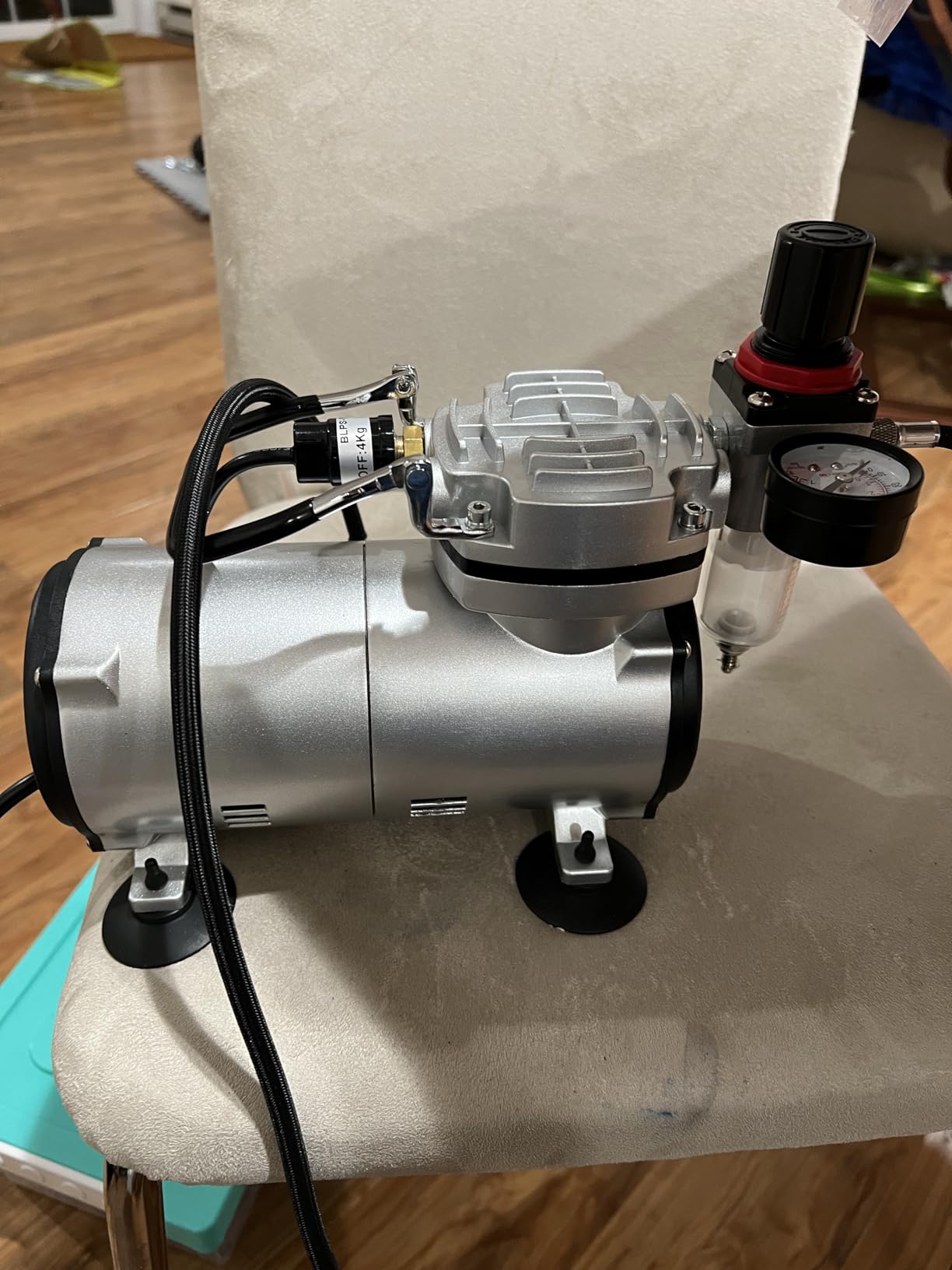
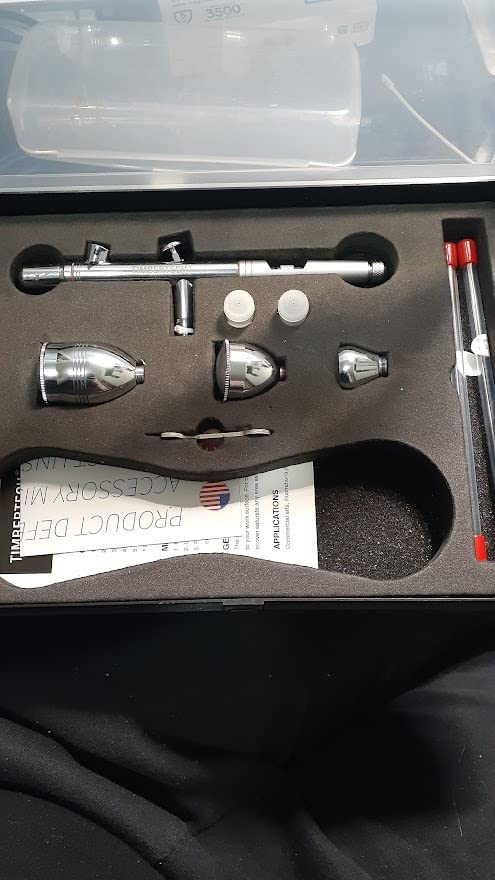
Most beginners do not need two shopping trips. This set pairs a dual-action gravity feed airbrush with an oil-free reciprocating compressor, regulator, manometer, filter and a hose, and the 0.3mm tip is already mounted with 0.2mm and 0.5mm spares in the box. That is everything required to spray on day one.
The compressor is the stronger half of the package. It autostarts at 3 bar and stops at 4 bar, moves 20-23 L/min, and at around 50 dB it was quiet enough to use in a room where someone else was working. Airflow stayed even under a fine spray, which is where cheap small compressors usually disappoint.
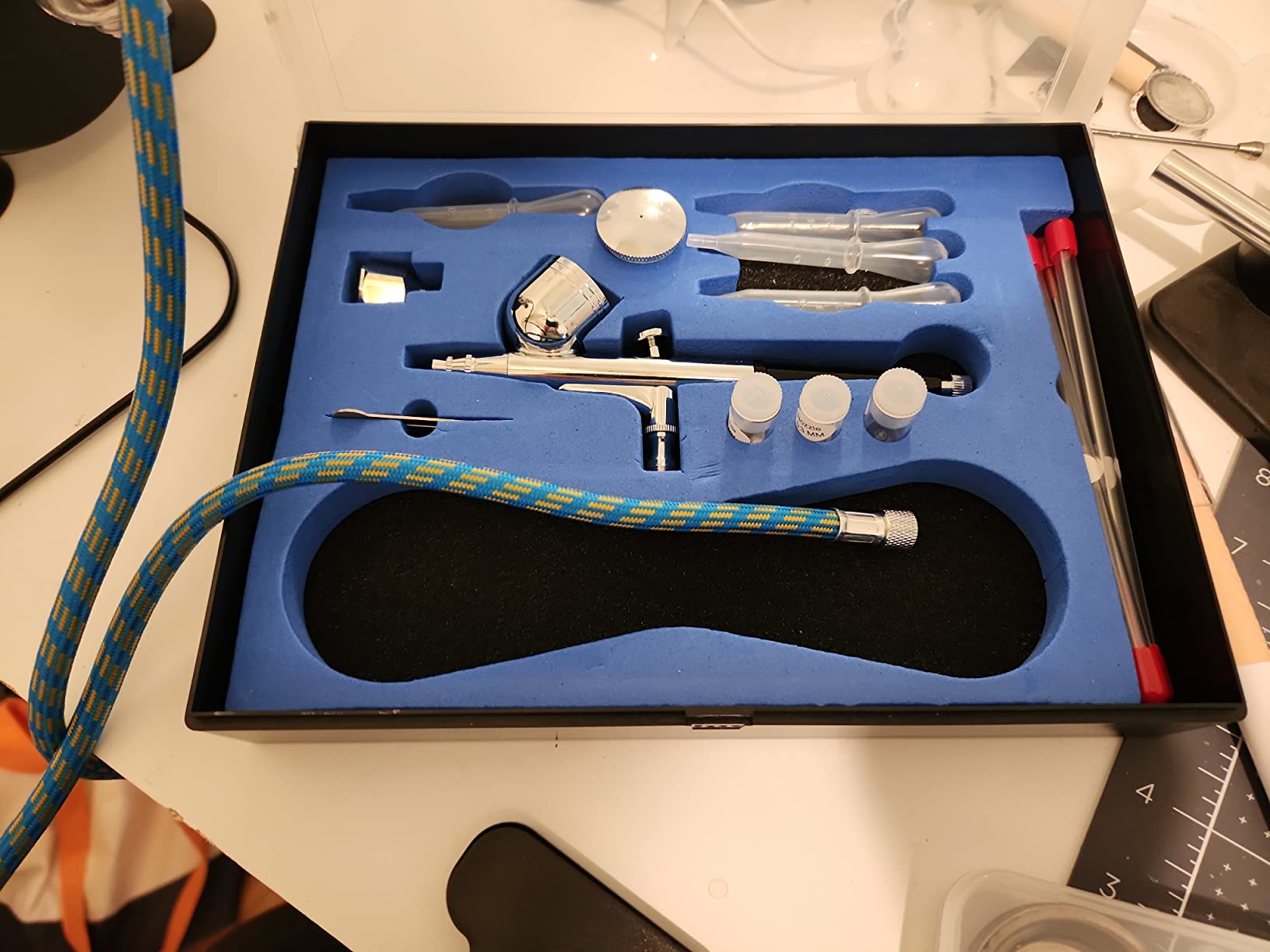
Cleaning is straightforward too, and the metal cup rinses out without fuss. We had no trouble flushing acrylics through the body between colours, and the airbrush broke down with the supplied wrench.
The recurring complaint from owners is the airbrush itself. Reviewers regularly describe it as the weaker half of the set, and a fair number pair it with a better brush later on. Two smaller issues: the compressor feet grip poorly on a smooth table, and the unit warms noticeably after about half an hour of continuous running.
Who this kit suits
Buy this if you have never airbrushed and you are not certain the hobby will stick. It removes the guesswork of matching hoses and fittings, and it takes about ten minutes to get a first spray out of it.
It is also a good stopgap for T-shirt and canvas work at small scale, where the 0.2mm tip handles line work and the 0.5mm covers fills without changing setups.
Who should skip it
Skip it if you already own a compressor. The gun alone will not justify the box, and you would rather start with a brush you can grow with than replace in a year.
Also look elsewhere if you paint for long unbroken sessions. The 7 ml cup refills constantly next to a larger one, and a compressor that heats up is not what you want on a long detail session.
3. Iwata NEO CN – Top Rated for Detail and Consistency
NEO CN Dual Action Airbrush – Effortless Coverage N3 Nozzle, 0.24 oz & 0.10 oz Fluid Cups. Ideal for Beginners & Hobby Painters – Fine Atomization with Low Air Pressure for Makeup, Arts 7 Crafts
Dual-action gravity feed
0.35mm needle
0.24 oz and 0.10 oz cups
10 psi or below
Pros
- Minimal clogging on standard paints
- Very clean polished cup interior
- Easy to reinstall trigger
- Runs evenly at low pressure
- Two cup sizes included
Cons
- Not for heavy paint over large areas
- Struggles with thick metallic paint
- Not a fine freehand detail brush
- Sensitive trigger needs practice
The NEO CN is the step up most people are looking for when a generic kit brush stops cooperating. It holds standard acrylics and enamels with far less thinning than the budget guns, and the polished cup interior rinses clean in a way that cheaper plastic wells never manage.
It is designed to run at low pressure and still produce an even pattern. Iwata rates it for 10 psi or below, and at that setting the atomization stayed consistent across the whole spray arc. The single-piece trigger is easy to refit after disassembly, which saved us time on cleanup.
Two cup sizes come in the box: a detachable 0.24 oz (7 ml) cup with a lid and a 0.10 oz (3 ml) cup. The small cup is genuinely useful for mixing a limited amount of a particular colour rather than committing a full batch.
The limit is paint load. This is not a gun for flooding a large surface, and the 0.35mm tip needs a mid-session clean when you push metallic or heavy pigment through it. It is also a general-purpose brush rather than a freehand detail specialist.
Who this airbrush suits
It suits painters who are past the learning curve on trigger control and want predictable results. Model builders and illustrators working at 0.35mm will find the low-pressure spray and easy cleanup worth the step up.
Anyone moving from a kit airbrush reports the same thing: fewer clogs, less thinning and a much shorter clean at the end of a session.
Who should skip it
Skip it if your work is heavy coverage, basecoating terrain or large panels. The 0.35mm needle and 7 ml cup are built for controlled work, and forcing volume through it costs you time and paint.
Skip it too if you are chasing the sharpest possible freestyle line. For that, look at a thinner needle in the Harder and Steenbeck or NEOECO setups further down.
4. Gaahleri GHAD-39 – Best for Quick Nozzle Swapping
Gaahleri Airbrush Kit, Airbrush Gun Dual-Action Gravity 1/2 & 1/4 oz Fluid Cup, 0.35 & 0.5 mm Needle, Cost-Effective Air Brush Set Makeup Nail Art Painting Model Coloring Cake Decor Silver
Self-centering drop-in nozzle
0.35mm and 0.5mm sets
1/2 oz and 1/4 oz cups
8 micro-air channels
Pros
- No threads to strip on the nozzle
- Two needle sizes and two cup sizes
- Smooth cup interiors resist buildup
- Low cost for a self-centering design
- Good all-around first gun
Cons
- Heavier body than most rivals
- No 0.2mm option for finest lines
- Brand service and spare parts less certain
The defining feature here is the self-centering drop-in nozzle. There are no threads to cross-thread or strip, and the head seats itself in a way that cut our changeover time to a few seconds. On a job where you alternate colours constantly, that is worth more than the raw numbers on the box.
The 8 micro-air-channel nozzle system produced a fine, controlled pattern at low pressure. With the 0.35mm set installed it handled illustration work and miniature shading well, and the 0.5mm covered basecoats without needing a second gun.
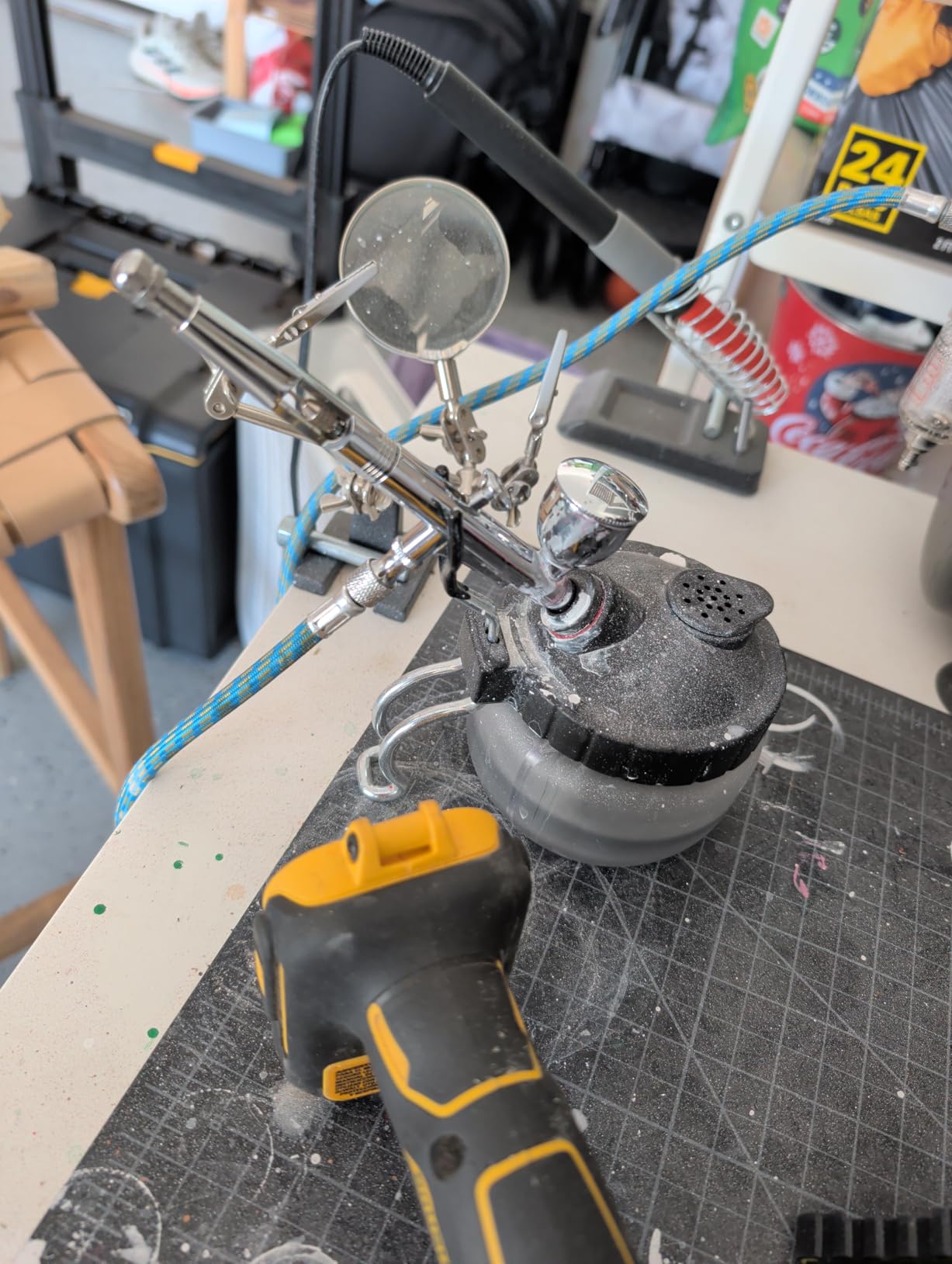
Both cups, 1/2 oz and 1/4 oz, are replaceable and have smooth inner surfaces, so paint does not grip the walls. Extra o-rings are included, and the whole kit ships with a one-year guarantee.
The tradeoff is weight and range. At 0.43 kg it is heavier in the hand than most of the metal guns here, which tells during a long session, and there is no 0.2mm option if your work lives at the very fine end.
Who this airbrush suits
It suits painters who switch media or colours constantly, and beginners who want a forgiving nozzle that is hard to damage. Makeup, nail art and cake decorating all benefit from the clean, compact spray it produces.
Anyone tired of stripped nozzle threads on a cheaper screw-on gun will notice the difference immediately.
Who should skip it
Skip it if hand fatigue matters to you. The heavier body is noticeable over a multi-hour painting block, and lighter precision brushes handle that better.
Skip it if you need a very fine needle for panel lining on scale aircraft or freestyle illustration. There is no needle below 0.35mm in this kit.
5. Fengda BD-183K – Best for Primers and Thick Coatings
Timbertech Multi-Purpose Airbrush Set, AG-183K Dual-Action Gravity Feed Airbrush Kits with 0.3/0.5/0.8mm Needles, 2/5/13CC Fluid Cup for Cake Decorating, Painting, Tattoo, Models Art
Threadless screw-on nozzle
0.3, 0.5 and 0.8mm tips
2, 5 and 13 ml cups
14.5 psi max
Pros
- 0.8mm tip handles primers and basecoats
- Three cup sizes that remove for cleaning
- Very low cost
- Handles high-viscosity coatings
- Adjustable trigger spring tension
Cons
- Inconsistent factory finish on some units
- Needles often need polishing
- 0.3mm tip reported as weak and hard to meter
- Gritty trigger on some examples
- Rough cup plating holds paint
This is the brush for anyone who primes with something thick. The 0.8mm tip pushes heavy primers and basecoats that stall most precision guns, and the 13 ml cup means you are not refilling every thirty seconds. It is also the least expensive way into a three-size setup.
The threadless screw-on nozzle changes without the risk of cross-threading, and the 2 ml, 5 ml and 13 ml cups all remove for cleaning. An adjustable trigger spring is unusual at this level and let us tune the feel to suit lighter hands.
Quality control is the weak point. Some examples arrive with burrs, an overtightened nozzle cap or a loose needle chuck, and the 0.3mm tip is reported as weak and harder to meter than the 0.5mm. Polishing the needle before first use made a visible difference to the spray pattern for us.
Owners who spend ten minutes correcting those factory issues end up with a capable brush. Beginners who want zero setup are better served elsewhere.
Who this airbrush suits
It suits builders priming large numbers of kits, armour panels and terrain bases, or anyone airbrushing thicker enamels and primers on a limited budget.
It also works as a dedicated basecoat gun kept separate from a fine detail brush, which is how a lot of modellers organise their setup.
Who should skip it
Skip it for fine detail work. The 0.3mm set is the weakest part of the kit, and a gritty or notchy trigger is a poor match for controlled line work on a finished model.
Skip it if you want a warranty-backed tool with a service network. Brand support and long-term spare part availability matter more once you are committed to a hobby.
6. Master Airbrush G22 – Best for First-Time Beginners
Master Airbrush G22 Multi-Purpose Dual-Action Gravity Feed Airbrush Gun Set
Dual-action gravity feed
0.3mm needle and nozzle
1/3 oz fluid cup
Nozzle wrench included
Pros
- Progressive paint flow
- Reliable with thinned paint
- Balanced feel in the hand
- Forgiving for new users
- Easy colour changes
Cons
- Paint well is hard to clean fully
- Small parts wear and strip
- Nozzle can break if overtightened
- Some owners replaced the needle
The G22 is the simplest gun on this list and that is exactly why it works as a first airbrush. Paint flow ramps up gradually rather than snapping to full output, so a beginner learns to feather the trigger instead of fighting it from the first pull.
At 0.3mm with a 1/3 oz cup it covers a hairline detail line and a 1-1/2 inch background spray from one setup. It rarely clogged for us with properly thinned paint, and quick colour changes were painless with this cup size.
Balance is a quiet strength. It sits comfortably in the hand and pairs directly with Master Airbrush compressors, which makes it a straightforward pairing for anyone building a first station.
The paint well is the hard part of cleaning. Paint can dry inside the passages where a cloth will not reach, and the needle retaining nut and nozzle are small parts that strip or crack if they are overtightened. Some owners replaced the needle before they were satisfied with the output.
Who this airbrush suits
It suits someone on their first few sessions who wants predictable, forgiving behaviour and does not need three needle sizes. Many buyers keep it as a backup gun, which is a sensible role for a tool this inexpensive.
It also suits anyone who needs short, frequent touch-up jobs rather than long finishing passes.
Who should skip it
Skip it as your only brush if you paint heavily pigmented paint or thick primers. The fixed 0.3mm setup has no headroom for viscous coatings.
Skip it if you dislike cleaning hardware. There are guns at similar money with a cutaway handle or a detachable well, and those save real time at the end of a session.
7. Badger 105 Patriot – Best Build Quality for Serious Detail Work
Badger Air-Brush Co. Model 105 Patriot Fine Gravity Airbrush, Stainless Steel
Dual-action gravity feed
0.5mm needle and nozzle
Self-centering nozzle
Tapered color well
Pros
- Smooth responsive trigger
- Consistent atomization across paints
- Tapered well cleans quickly
- Generous trigger clearance
- Lifetime warranty on needle bearing
Cons
- Single 0.5mm setup with no alternate tips
- Premium tier cost for a first airbrush
- Large 0.5mm tip limits fine line work
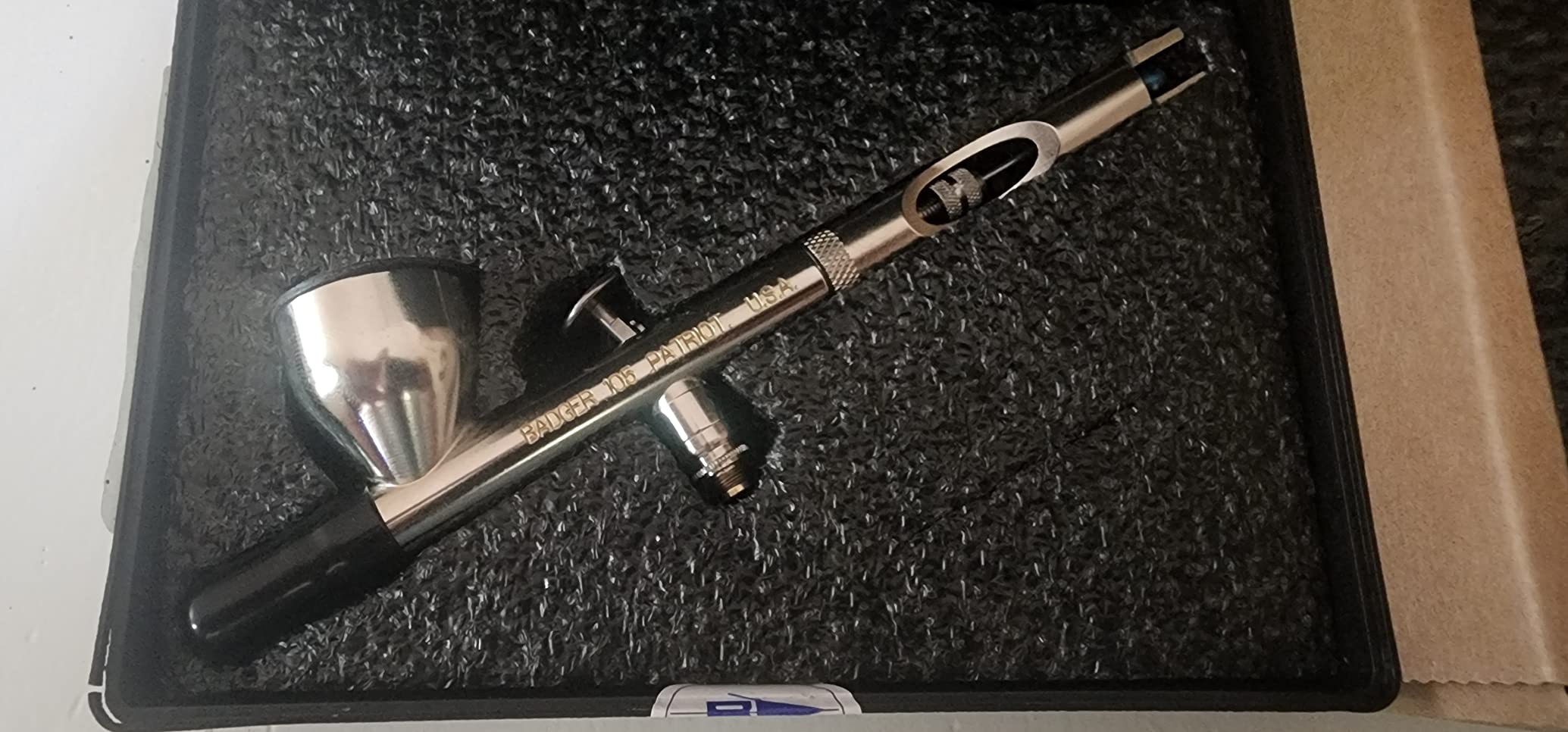
The Badger 105 is the one we reach for when the work is a finished piece rather than a practice piece. The trigger is well adjusted and offers generous clearance and stroke, which gives you room to develop the pull technique that separates smooth shading from a start-stop mess.
Atomization stayed consistent as we moved between thinned acrylic, enamel and heavier mixes, with no change to the setup. The self-centering nozzle means the head returns to position every time, and the acute tapered color well drains and wipes clean faster than a straight-sided well.
There is a patented easy-access needle removal system, so a needle change does not mean stripping a cap with tools in a cramped grip. That single feature saves more time over a year of hobby use than almost anything else on the spec sheet.
The warranty runs one year against manufacturing defects, with lifetime coverage on factory labour and on the PTFE needle bearing. Owners treat this as a one-time purchase rather than a replace-every-few-years tool.
Who this airbrush suits
It suits painters who have outgrown entry guns and want a tool that rewards technique. Detail work, shading and illustration all benefit from the trigger clearance and consistent pattern.
Hobby forums frequently single this model out as one of the easiest airbrushes to clean, and that reputation holds up in practice.
Who should skip it
Skip it if you are still learning trigger control on a tight budget. A 0.5mm single setup is a serious commitment, and a forgiving kit brush is a better place to start.
Skip it if you need very fine line work. The installed 0.5mm tip is the general-purpose choice, and thinner setups would mean a different brush entirely.
8. GotHobby 0.3mm Dual-Action Kit – Best Budget Entry Option
GotHobby 0.3mm Gravity Feed Dual-Action Airbrush Paint Spray Gun Kit Set
Dual-action gravity feed
0.3mm nozzle
7 cc cup with lid
1.5 m hose
Pros
- Very low entry cost
- 0.3mm suits illustration and models
- Case and accessories included
- Easy refills and cleaning
- Stainless steel body
Cons
- Only one needle size supplied
- Small 7 cc cup refills often
- Limited brand service support
If the goal is to find out whether airbrushing suits you without a large commitment, this kit gets you spraying for very little. The 0.3mm nozzle is a sensible general size for illustration, nail art, cosmetics and model work, and the removable back handle cover lets you narrow the spray line when you need it.
It arrives with more than the gun: a 1.5 m hose, a 7 cc cup with a lid, a 2 cc eye dropper for controlled refills, a nozzle spanner and a storage case. Owners consistently mention that the accessories make it feel like a complete package.
Atomization is good enough for hobby work, and the trigger controls air cleanly enough for shading and soft blends. The listed media range covers watercolours, acrylics, inks, dyes, urethane paints, lacquers and enamels, so it is not restricted to one paint type.
The limits are honest ones. There is a single fixed 0.3mm needle with no alternate sizes, the 7 cc cup needs frequent refills, and long-term spare parts and service support are less certain than with an established brand.
Who this airbrush suits
It suits students, beginners and anyone who wants a portable setup for illustration, cake decorating or small models without spending heavily. The storage case makes it easy to keep in a drawer and take out when needed.
The 1/8 inch hose connector with a removable cover is a small detail that makes pairing with a regulator simple.
Who should skip it
Skip it if you paint thick or pigmented paint regularly. One needle size and a modest needle mean frequent cleaning and more thinning than the multi-tip kits in this list.
Skip it as a long-term tool. If the hobby sticks, you will replace it with a gun that gives you more headroom and better parts support.
9. Iwata Eclipse HP-CS – Best for Fine Detail and Illustration
Iwata Eclipse HP-CS Airbrush – Gravity Feed Dual Action, High-Flow Atomization for Fine Detail to Wide Coverage – E3 Nozzle, 0.24 oz Cup – Ideal for Artists, Model Painting, Cosplay & More
Threadless E3 nozzle
0.24 oz fluid cup
High-flow atomization
Cutaway handle
Pros
- Noticeably better spray pattern
- Fast cleaning and needle access
- Handles solvent and water-based paints
- Easy for beginners to use
- Very light and balanced
Cons
- Hose sold separately
- Premium tier cost
- Sold as airbrush only
The Eclipse HP-CS is the clearest step up in this list. The spray pattern and its consistency change noticeably compared with a kit airbrush, and the difference shows up most in shading, where you need a smooth, predictable arc rather than a spray that spatters at the edges.
The compression-fit E3 nozzle has no threads, and the quick-flush cutaway handle gives you fast access to the needle without dismantling the body. At 1.6 ounces the body is light and well balanced, which reduced hand fatigue over a long session.
It handles solvent, water-based and pearlized paints with less thinning than the entry guns, and the spring-steel needle with solvent-resistant packings holds up when you switch paint types. The 0.24 oz cup gives fine control without becoming a refill treadmill on model-scale work.
Two practical notes before you buy. The hose is not included and has to be ordered separately, and the airbrush is sold on its own, so budget for a hose and a compressor alongside it. Owners consistently describe it as a one-time investment worth making once the hobby sticks.
Who this airbrush suits
It suits illustration, portrait work and detailed model finishing where pattern quality matters more than volume. Beginners pick it up quickly despite its premium position, because the trigger is intuitive.
Anyone moving up from a kit airbrush reports the same reaction: cleaner atomization, less paint waste and a shorter clean at the end of the day.
Who should skip it
Skip it if you paint large areas or flood coverage. The 0.24 oz cup and high-flow pattern are tuned for control, not for putting down volume quickly.
Skip it if you want a ready-to-use set. Buying the gun, a hose and a compressor separately costs more attention than the kit options in this roundup.
10. Iwata Revolution CR – Best Rated for Consistent Atomization
Iwata Revolution CR Airbrush
Gravity feed dual action
Iwata Medea build
Model R4500
8.8 oz body
Pros
- Highest average rating in the group
- Consistent atomization from Iwata build quality
- Well-regarded long-term reliability
- Light for a full-size gravity gun
Cons
- Listing gives no needle or cup size
- Airbrush sold without hose or compressor
- Premium tier cost
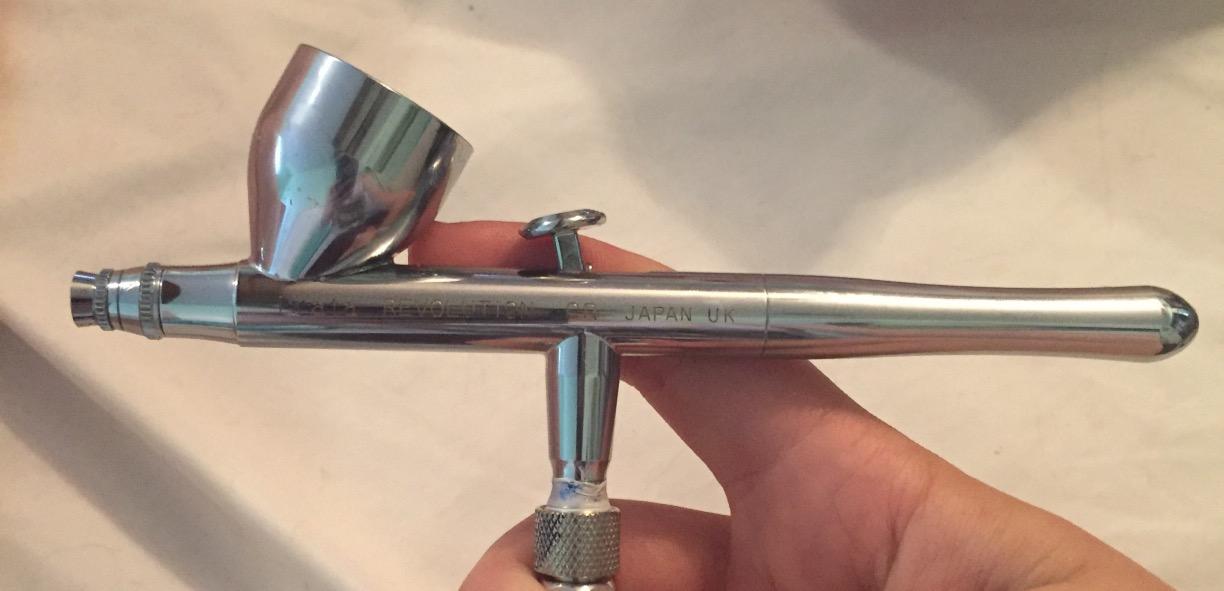
The Revolution CR carries the highest average rating of the twelve, at 4.8 out of 5 across more than a thousand reviews, with 86 percent of those ratings at five stars. That consistency is what painters notice: the same spray, the same atomization, session after session.
Iwata Medea build quality is the reason behind the scores. Parts fit, the trigger action is predictable, and the pattern holds steady across thinned acrylics, enamels and solvent-based paints without repeated adjustment.
It is a gravity feed dual action design in the classic large-cup format, and the 8.8 oz body sits well in the hand for extended work. Owners treat it as a long-term tool rather than something to replace.
The honest drawback is information. The product listing confirms the action type and model number R4500 but does not spell out the needle size or the cup volume, so if fine line work is your priority, confirm the fitted head before you commit. The hose and compressor are not part of the package.
Who this airbrush suits
It suits painters who want repeatable results more than they want novelty. If consistency across a long project matters, the rating profile suggests you will not be disappointed.
It also suits anyone who prefers to buy one serious brush instead of several cheap ones, provided they are comfortable sourcing a hose and compressor separately.
Who should skip it
Skip it if you need a documented specification before buying, or if you want multiple needle sizes in the box. This listing gives you less to work with than most here.
Skip it if you paint very fine detail. Verify the fitted needle first, since the head specification is not published on the listing.
11. NEOECO SJ83 – Best Equipped Multi-Size Setup
NEOECO SJ83 Airbrush, Self-Centring Plug-in Nozzle,0.2, 0.3 & 0.5mm Nozzle Sets and 1/3 oz Cup, Dual-Action Gravity Feed Airbrush with 1/3 oz,2/3 oz,4/3 oz Replacement Cups (Black)
Self-centring plug-in nozzle
0.2, 0.3 and 0.5mm tips
9, 20 and 40 cc cups
35 psi max
Pros
- Three nozzle sets and four cup sizes
- Chrome cup cleans easily
- Very well equipped box
- Good anodized finish
- Handles water and solvent paints
Cons
- Trigger stiff until worn in
- Back-bubbles on the 0.2mm set
- 0.2mm tip has no guard cap
- Confusing paint flow valve
- Occasional assembly faults
On paper this is the most generously equipped gun here. You get 0.2mm, 0.3mm and 0.5mm fluid tips, detachable 9cc, 20cc and 40cc cups with a chrome-plated cup, a cleaning kit, lubricant, replacement o-rings, a quick disconnect coupler and a shoulder strap. Few kits at this level give you that much.
Performance backs up the specification. After a short break-in it sprayed a good range of paints with little clogging, and reviewers regularly place it close to a well-tuned Badger Patriot in practice. The open needle cap and cutaway handle help with line work and flushing.
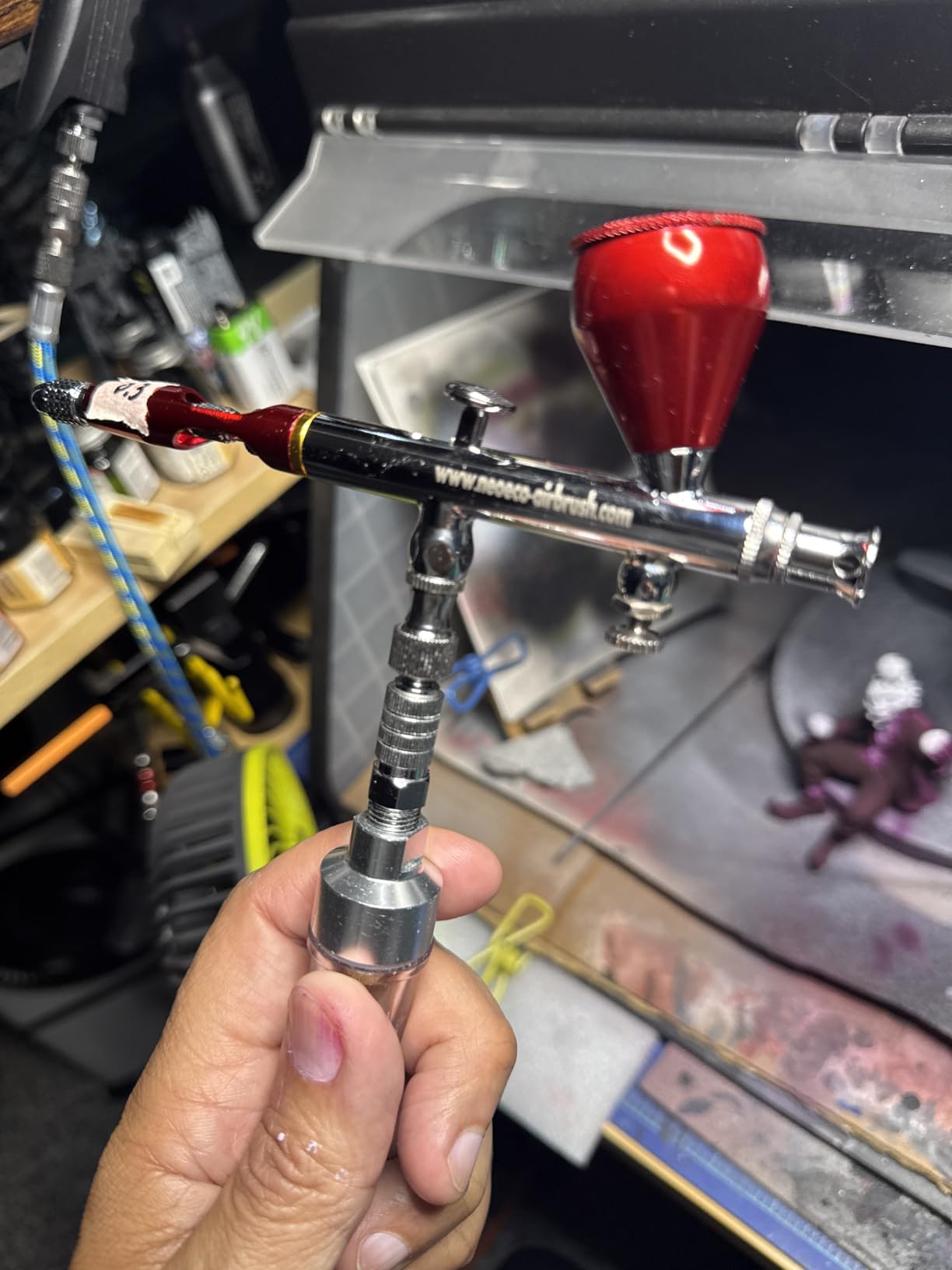
Two things slow it down. The trigger can feel stiff and notchy until it is worn in, and the 0.2mm set can back-bubble, pushing paint into the trigger and making it stick. That same fine set has no guard cap, so it is easy to stab the needle while changing tips.
The paint flow valve under the cup is also a genuine learning curve for newcomers, and a small number of copies arrived mis-assembled or with cups that would not thread on.
Who this airbrush suits
It suits painters whose work spans line work, shading and basecoating and who would rather not buy a second gun. The cup range lets you mix a small batch for detail and fill a large cup for coverage.
The 40cc cup is a genuine advantage for canvas and fabric work where refills slow you down.
Who should skip it
Skip it if you are new to airbrushing and want a brush that behaves predictably out of the box. The trigger break-in and the flow valve both need attention first.
Skip it for fine detail work if you tend to fumble tip changes. The unguarded 0.2mm needle makes an accidental stab likely, and the back-bubbling issue needs a steady hand.
12. Harder and Steenbeck Ultra 2024 – Best for Tool-Free Cleaning
Harder & Steenbeck Ultra 2024 Airbrush, German-Engineered
Dual-action gravity feed
0.45mm self-centering nozzle
5 ml cup plus micro-cup
Tool-free disassembly
Pros
- Excellent atomization and control
- Start Control trigger sequence
- Tool-free disassembly with few parts
- Polished interior resists clogging
- Upgradable to finer heads
Cons
- Bulky nozzle cap for precision work
- Friction-fit cup can drip when pulled
- Trigger stiffens over long sessions
- Less flexible than mixing cups
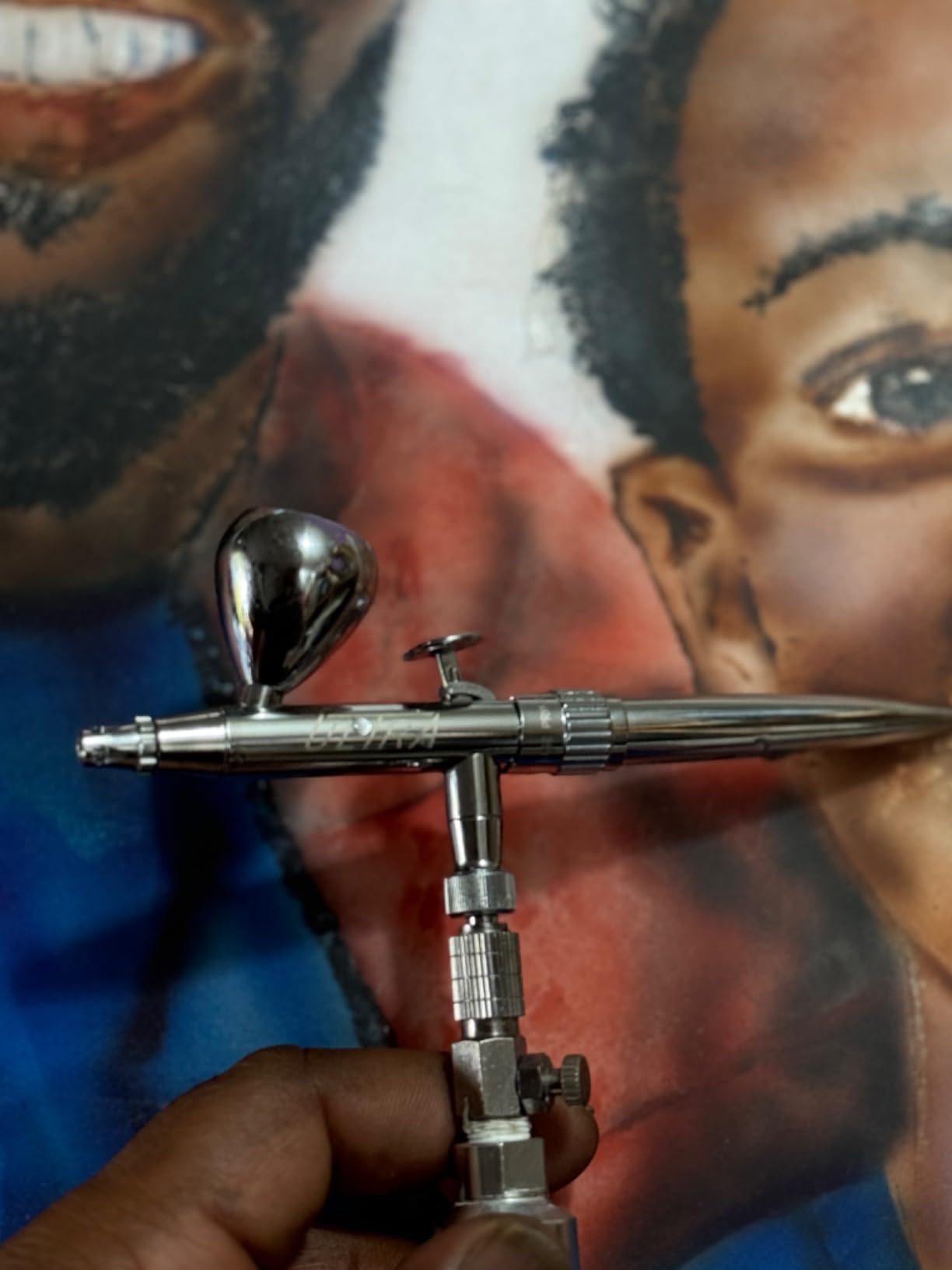
The Ultra 2024 is built around one idea: a first serious airbrush you can take apart and put back together with your hands. No wrenches, no thread tape, no lost needle wrenches at the bottom of a drawer. The polished steel interior cleaned out easily and stayed clog-free across many mediums over our testing.
Start Control handles the trigger sequence properly, releasing air before paint. Beginners waste less paint and make fewer spatter mistakes, which is a real advantage in a gun at this level. The self-centering 0.45mm nozzle gives a versatile atomization across touch-ups and broader coverage.
A 5 ml cup is fitted, and the body includes a micro-cup socket for detail work. It is also backward compatible with existing Harder and Steenbeck parts, including the Infinity FineLine head system, so you can move up to finer detail later without changing guns.
Two ergonomic complaints come up repeatedly. The nozzle cap is bulky and gets in the way of close precision work, and the friction-fit cup can pull out with the wipe during cleaning and drip. The trigger can also stiffen after extended sessions until a full clean.
Who this airbrush suits
It suits beginners who want a serious first airbrush and hate fiddling with tools during cleanup. The disassembly design means you will actually clean it properly, which is why owners report it still working month after month.
It also suits painters planning an upgrade path, since finer heads plug into the same body later.
Who should skip it
Skip it if the smallest possible cap is critical to your technique, or if you paint in very long uninterrupted sessions and will notice a stiffening trigger.
Skip it if you want back-flow cup mixing. Painters used to that technique often find this design limiting, and a traditional paint well suits them better.
Gravity Feed vs Siphon Feed: Which One Should You Buy?
Gravity feed is better for most painters because the cup sits on top of the body, so paint drops into the nozzle instead of being drawn up a tube from a bottle below. You use less paint to prime, flush colours in seconds, run at lower pressure and clog less often. Siphon feed is better when you want to hold a large volume of paint for long, uninterrupted coverage passes on big surfaces.
There is a second decision inside gravity feed: top feed or side feed. A top cup keeps the silhouette narrow and is the most common layout, while a side-feed cup holds more paint and sits lower for balance. Forum users cite cleaning as the deciding factor, with several noting that side feeds are easier to wipe out.
Cup capacity matters as much as the feed type. Small cups around 0.10 oz suit detail work where you mix a limited batch. Larger cups from 0.24 oz upward reduce refills on canvas, fabric and basecoating projects.
If you are still weighing feed types for another kind of purchase, our picks for the best indoor zero gravity recliners and the best zero gravity massage chairs break down their options in a similar at-a-glance format.
How to Choose a Gravity Feed Airbrush in Five Steps
1. Pick the trigger action. Dual action gives separate control of air and paint and is the only sensible choice today. Single action external-mix brushes are still sold as beginner recommendations, and they cannot hold a line or fade a spray the way a dual action gun can.
2. Match the needle to the work. A 0.2mm needle handles freestyle lines and panel lining. 0.3mm is the general-purpose size for shading and illustration. 0.5mm and above cover basecoats, primers and fabric work. If you cannot change needles, a single fixed size limits you later.
3. Check the cleaning design. Look for a self-centering or threadless nozzle, a cutaway handle and a detachable or tapered paint well. These three features decide whether a twenty-minute clean or a one-hour clean happens at the end of a session.
4. Confirm the pressure range. A good gravity feed gun should perform well from roughly 15 to 30 PSI, and fine work often sits at the low end. Brushes rated around 10 PSI or below save air and give a finer mist. A tank compressor with spikes is harder to control than a regulated unit.
5. Think about parts and service. Needle, fluid tip, air cap, cup seal and packing should all be replaceable, from a manufacturer with a real service network. Forum advice consistently favours established brands over unnamed marketplace trigger guns with poor needle seats and leaking seals.
One more practical note: do you need a separate compressor? Yes, unless the package includes one. Airbrushes are sold as airbrush-only guns in most cases, and a premium gun will run on a modest compressor, but the hose and fittings still have to match. The kits in this roundup solve that problem in one box.
Cleaning, Clogs and Paint Chemistry
You should clean your airbrush after every session, even if the next session is the same day. Paint left in the cup, air valve or cup seal hardens there, and the hardened deposit is what causes the persistent clog you spend an evening chasing later. Painting forums give this advice without exception.
Our flush routine, in order:
Empty the cup and wipe the inside with a paint-safe wipe.
Run clean thinner or water through the gun from the cup until the spray runs clear.
Back the trigger out fully so the air passages flush in reverse.
Remove the fluid tip and needle, and wipe the needle seat.
Drop a drop of airbrush oil on the packing, reassemble and trigger a few times.
When a nozzle does block, escalate in this order. First, filter your paint before it enters the cup; hobbyists commonly use fine filters and this alone prevents most blockages. Second, thin the paint further. Third, run a dedicated tip reamer through the nozzle rather than a pin, which can bend the tip. Fourth, flush with cleaner from the cup. Last, if the tip stays blocked, replace it, then the needle seat.
On solvents: match cleaner to paint. Acrylics and water-based work flush with clean water followed by a drop of oil. Enamels and lacquers need their own thinner or an airbrush cleaner, since water will never shift them. Ventilate, and avoid spraying cleaner with a mask that blocks vapours.
Glass cleaners are not something we would put inside an airbrush. Ammonia-based window cleaners are meant for glass, and the residue and vapour are a poor match for a precision tool or a small workspace. Use a proper airbrush cleaner or the thinner that matches your paint.
Frequently Asked Questions
Is gravity fed or siphon feed airbrush better?
Gravity feed is better for most painters because the cup sits on top of the body and paint drops into the nozzle. It primes with less paint, flushes between colours in seconds, runs at lower air pressure and clogs less often. Siphon feed wins only when you want a large paint reservoir for long coverage passes on big surfaces.
What is the best airbrush to start with for a beginner?
For a first all-in-one purchase, a gravity feed kit with a compressor gets you spraying immediately. If you already have a compressor, the Master Airbrush G233 Pro gives you three needle sizes and a progressive trigger that is forgiving while you learn control.
Should I clean my airbrush after every use?
Yes, clean it after every session even if you plan to paint again the same day. Paint left in the cup, air valve or cup seal hardens and turns into the clog you later spend an evening clearing. A two-minute flush with clean thinner or water is enough for most sessions.
Can I use Windex to clean my airbrush?
It is not recommended. Ammonia-based glass cleaners leave residue that can affect the fluid tip and packings, and the vapour is unpleasant in a small workspace. Use clean water for acrylics, a dedicated airbrush cleaner, or the thinner that matches your paint type.
What PSI should I run my airbrush at?
Most gravity feed work happens between 15 and 30 PSI, and fine detail sits at the low end. Some precision brushes are designed to spray cleanly at 10 PSI or below. Raise pressure gradually until the paint atomizes evenly, and lower it again if you see spatter.
The Verdict: Which Gravity Feed Airbrush Should You Buy?
The Master Airbrush G233 Pro Kit takes our top slot for 2026. Three needle sizes, a progressive dual-action trigger and a cutaway handle make it the most capable all-round gravity feed airbrush here, and it is the one we recommend when you want one gun that covers detail and coverage without a second purchase.
Buyers who want everything in one box should take the TIMBERTECH kit with compressor, and painters moving up from a cheap brush should look at the Iwata NEO CN for its low-pressure consistency and easy cleaning. For a serious long-term tool, the Badger 105 Patriot and the Iwata Eclipse HP-CS are the two we would keep.
Whatever you choose, buy it from a brand with real replacement parts, filter your paint, and flush the gun at the end of every session. Those three habits matter more to how long the tool lasts than the badge on the box.