

Choosing the best microscope kits for kids is harder than it looks, because the boxes all shout the same number. One promises 1600x, the next 1200x, the one after that 1000x with a 4K screen. Almost none of those numbers tell you what your child will actually see through the eyepiece on a wet Tuesday afternoon when they have run out of prepared slides.
So we treated this like a purchase decision rather than a gift guide. We lined up twelve microscope kits, compared the glass against the plastic, the focus knobs against small hands, and read what owners say after the novelty wears off. The biggest single factor we found was not magnification at all. It was whether the kit gives a child enough material to keep making their own slides long after the box is empty, and whether the body survives being carried to the kitchen table.
If you are also building out a home science shelf, our picks on the best STEM kits for kids pair well with a microscope for the biology half of the curriculum.
Top 3 Microscope Kits for Kids in 2026
Our top three cover the three genuinely different buying decisions: a narrated starter for a four-year-old, a dual-light optical scope for a school-age child, and a full glass-objective kit for a child who wants to do real slide prep.

GeoSafari Talking Microscope
- Narration by Bindi Irwin
- 60 full-colour images on 20 slides
- Fact Mode and Quiz Mode
- Runs on 3 AAA batteries

National Geographic Dual LED Microscope
- Optical glass lenses at 20x and 50x
- LED lighting above and below the stage
- Over 50 accessories included
- Achromatic objective lens
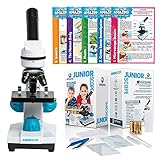
Omano Juniorscope Microscope Kit
- Glass objectives at 40x 100x and 400x
- Works on solid and transparent specimens
- Petri dish and forceps included
- Lifetime limited warranty
All 12 Microscope Kits at a Glance
Every microscope kit in this roundup appears below with its core specs. Scroll it to compare ages, magnification and lighting side by side before you read the individual verdicts.
| Product | Specifications | Action |
|---|---|---|
| GeoSafari Talking Microscope |
|
Check Latest Price |
| National Geographic Dual LED Microscope |
|
Check Latest Price |
 National Geographic 400x Microscope National Geographic 400x Microscope |
|
Check Latest Price |
 Kids Digital Microscope STEM Kit Kids Digital Microscope STEM Kit |
|
Check Latest Price |
| Omano Juniorscope Microscope Kit |
|
Check Latest Price |
 Uarzt 100X-1200X Microscope Kit Uarzt 100X-1200X Microscope Kit |
|
Check Latest Price |
 AmScope 48pc 120X-1200X Kit AmScope 48pc 120X-1200X Kit |
|
Check Latest Price |
 Emarth 40X-1000X Compound Kit Emarth 40X-1000X Compound Kit |
|
Check Latest Price |
 OAEBLLE 4K Digital Microscope OAEBLLE 4K Digital Microscope |
|
Check Latest Price |
 Wow in the World Microscope and Biology Kit Wow in the World Microscope and Biology Kit |
|
Check Latest Price |
 Thames and Kosmos Big and Fun Microscope Thames and Kosmos Big and Fun Microscope |
|
Check Latest Price |
 DOUBLE CC Kids Microscope STEM Kit DOUBLE CC Kids Microscope STEM Kit |
|
Check Latest Price |
1. GeoSafari Talking Microscope – Best Overall for Preschoolers
Educational Insights GeoSafari Talking Microscope
Ages 4-8
60 images on 20 slides
Two eyepieces
Battery powered
Pros
- Holds a 4-year-old's attention for long stretches
- Narration by Bindi Irwin reads as a fun friend rather than a teacher
- Good slide variety across insects and plant material
- Slide compartment keeps the cards together
Cons
- Flat and grooved slide sides look identical so young children struggle to seat them
- Storage compartment does not fully close on some units
- No focus function
This is the kit we kept handing to the youngest testers in the house, and the reason is simple: it does not ask a four-year-old to focus anything. The child seats a slide, leans into one of two eyepieces and listens. Across nearly twelve thousand reviews, parents keep describing the same outcome, a preschooler who will work through slide after slide without an adult taking over.
The content carries that engagement. Sixty full-colour images sit across twenty slides, spanning insects, plant material, salt crystals and blood cells, and the narration runs in two modes. Fact Mode explains what is on the slide; Quiz Mode asks questions about it. That second mode is the underrated part, because it turns a listening toy into something closer to a quiz a child can fail and retry.

It weighs 1.5 pounds and measures 10.1 by 8.1 by 5.6 inches, which is small enough for a four-year-old to reposition with one hand. Power is three AAA batteries, and those are not included, so factor that into day one.
The honest limitation is that there is no focus function at all. That is by design for this age, but it means a child who is ready to move to real slide prep will outgrow it quickly. Owners also flag that the flat and grooved sides of each slide look almost identical, which is invisible to small hands and leaves children pushing a card in the wrong way with no narration triggered. On some units the storage compartment does not latch fully and slides work loose inside the case.

Is this a real microscope or a narrated toy?
A narrated toy that teaches the habit of looking closely at something, which is the actual goal at four. There is no optical focusing and no slide preparation, so if you want a child making their own onion slides in the first week, look at the dual-LED scope instead.
The audio runs in English only. For a family where that is not the household language, the narration becomes decoration rather than instruction, and you may want a kit with printed materials instead.
What ages does this kit actually work for?
The manufacturer lists ages 4 to 8, and that reads honestly. Below four, the seating problem becomes a real frustration. At eight, a child who is ready for glass objectives will find 60 static images a ceiling rather than a floor.
As a stepping stone it is excellent, because it costs one narrated slide at a time and the child who loves it has already learned the vocabulary. That instinct is what makes the next microscope stick.
2. National Geographic Dual LED Microscope – Best for Ages 8-12
National Geographic Dual LED Microscope Science Kit for Kids Ages 8-12
Ages 8-12
Optical glass at 20x and 50x
Two AA batteries not included
2 pounds
Pros
- Top and bottom lighting handles slides and opaque objects
- Clear optical glass lenses with plant cell walls and pollen visible
- Long lens-to-specimen distance protects the glass
- Lightweight with a padded storage container
Cons
- Glass stage is fragile and cannot be replaced easily
- Eyepieces are not locked in and can fall out
- Bottom light can be too bright without a diffuser
This is the kit we recommend for a child who has outgrown narration and wants to see real structure. The specification that matters is optical glass objective lenses at 20x and 50x, and owners consistently report plant cell walls and pollen motes visible through them. Nothing in this roundup gives a school-age child better optics for the money.
The second reason to like it is the dual illumination. A lower LED lights slides from underneath for translucent specimens like cells and bacteria; an upper LED lights opaque objects from above so a rock, a leaf or a coin can be examined directly with no slide prep at all. That single feature keeps a child busy on day one, before they have learned to make a slide.

Over 50 accessories come in the box: 10 prepared slides, blank slides and covers, tweezers, an eye-dropper and a mini geode. At 2 pounds it is light enough to carry to a window or a bench, and the padded container means a sibling cannot find every piece of glass each time. Power is two AA batteries, which are not included.
Two build details deserve a warning label. The stage is glass, and a determined eight-year-old can crack it, with no easy replacement. The eyepieces are not locked into the body and can fall out when the scope is carried from behind. Some reviewers also report that the listing magnification and the fitted lenses do not always agree, so read the lens markings rather than trusting the box.

Why does the glass stage matter more than the magnification?
Because a cracked stage ends the use of an otherwise excellent scope, while lower magnification is a limit a child can work around. The tradeoff is deliberate: real glass resolves detail, and it does not survive being dropped stage-first.
Keep it on a table rather than a shelf, and this becomes a non-issue for most families. It is also the reason we would buy a replacement blank slide pack rather than a second microscope.
Will an 8-year-old use this without help?
Yes. The eyepieces are single-lens style, so there is no binocular alignment or interpupillary adjustment to fiddle with, and the controls are simple enough that owners describe an eight-year-old managing it independently.
Expect the condenser lens to pop out during unboxing. It slides out easily, so check it is seated before the first slide goes on, and keep the small parts tray somewhere safe.
3. National Geographic 400x Microscope – Best First Scope for Ages 5-8
National Geographic Microscope for Kids with Up to 400x Magnification
Up to 400x
LED above and below
1.8 pounds
Plastic body
Pros
- Large focus knobs and a soft-touch eyepiece suit small hands
- LED lighting above and below handles slides and opaque samples
- Plant slides and rocks with blank slides and a lab guide
- Children can work the controls independently
Cons
- Focus mechanism is stiff and jumps rather than sliding smoothly
- Lighting is dim for some rooms
- Build feels light and cheap for a National Geographic product
This is the bridge microscope, and it is the one we would hand to a five-year-old who has already shown interest. Three magnification levels go up to 400x, with LED lighting both above and below the stage so the same scope handles a prepared slide and a chunk of rock.
The controls are the story here. Large focus knobs, a soft-touch eyepiece and an adjustable platform are all designed for hands that are still developing fine motor control. Owners repeatedly describe a five-year-old navigating it without supervision, which is unusual at this stage and is the main reason it earns a place in the roundup.

The kit contents are unusually good for the tier. Six prepared plant slides, six rocks and minerals, six blank slides, a pipette, a specimen dish, tweezers, and a lab guide with viewing activities, a game and merit badge stickers. The rewards matter more than they sound: a badge system gives a child a reason to come back after the first hour.
Where it falls short is mechanical. The focus knob is stiff and moves in jumps rather than a smooth slide, which is exactly the behaviour that frustrates a child trying to bring a specimen into view. Reviewers also report dim lighting in some rooms, and a body that feels light for a National Geographic product. This is a solid first microscope, not a long-term one.
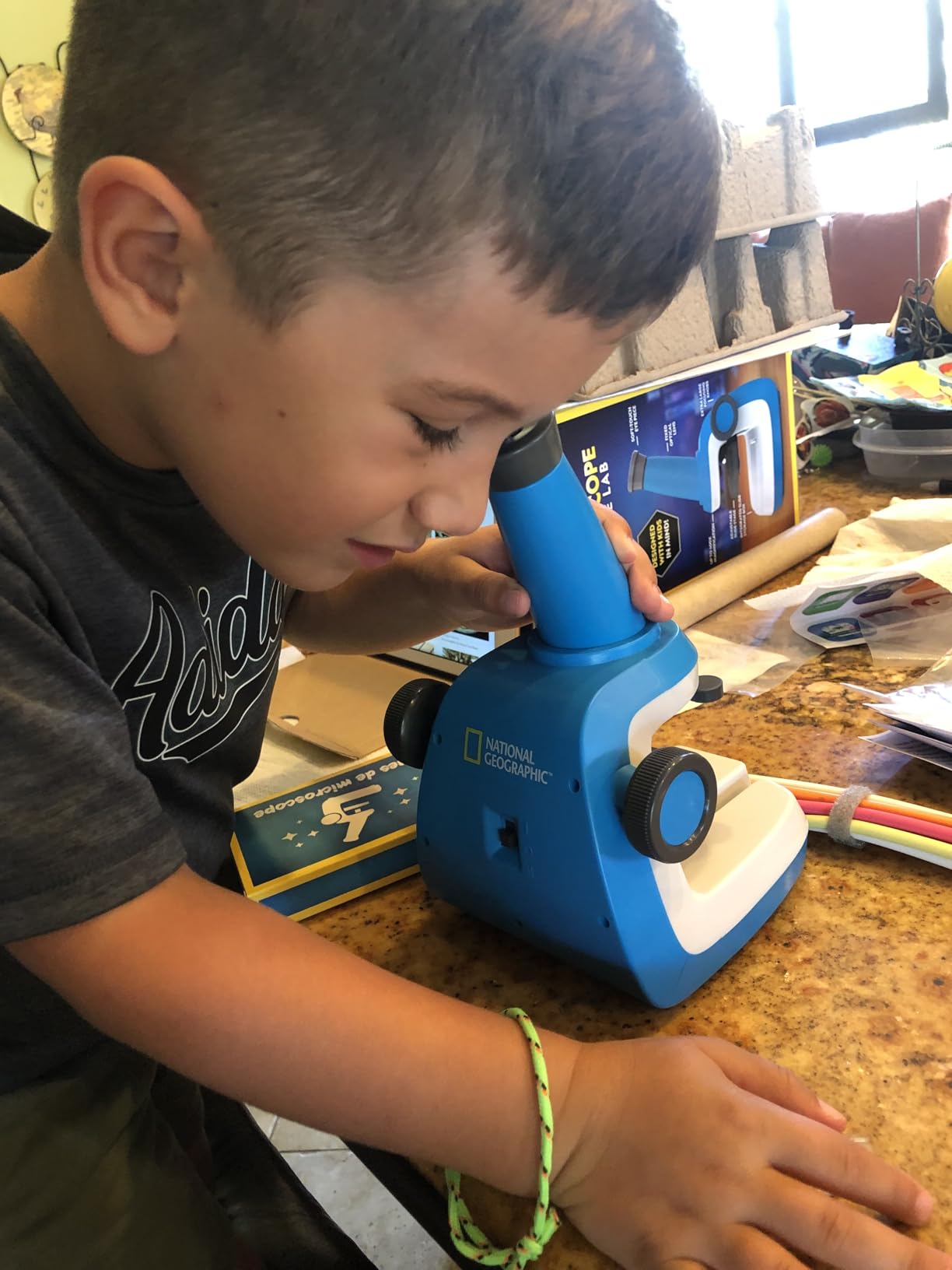
Is this microscope good enough to keep past age eight?
For a while, yes. At 400x with lighting above and below, an eight-year-old can keep working on prepared slides and simple rock thin sections. The optics are entry-level, though, and owners note that prepared slides are hard to make genuinely interesting at any magnification on this model.
Plan on a move up rather than a stretch. Children who finish the rock and mineral set usually need real glass objectives and a proper mechanical stage, not a bigger number on the box.
How does it handle materials other than prepared slides?
Reasonably, which is its strength. The upper LED means a coin, a leaf fragment or a mineral can go straight on the stage with no mounting, and the rocks and minerals in the box are there precisely to encourage that.
For translucent specimens the lower light does the work. If your child wants to prepare their own slide, the six blanks plus the pipette and tweezers are enough to start, though the stiff focus takes practice.
4. Kids Digital Microscope STEM Kit – Best Portable Digital Pick
Kids Digital Microscope STEM Toy: Complete Science Gift Kit for Ages 4-12
Ages 4-12
200x to 1000x
4K screen
Rechargeable
Pros
- Ranks near the top of the Kids' Microscopes category
- Pocket size at 32g with a wide neck strap
- Simple focus wheel and LED adjustment
- Comes with a 32GB card
- glass slides and a fitted hard case
Cons
- Screen-only design means no eyepiece optics to learn
- Battery gives about 2.5 hours of continuous use
If your child wants to photograph findings rather than squint at them, this is the strongest portable digital kit in the roundup. It weighs 32 grams, measures 3 by 1.8 by 4 inches and comes with a wide neck strap, so it goes over a shoulder to the garden rather than living on a desk.
Five adjustable magnification levels run from 200x to 1000x, and the 4K screen shows the result with no eyepiece involved. A child with glasses or with difficulty holding one eye shut can use it comfortably, which is a genuine accessibility advantage over a monocular scope.

The accessories matter here more than the headline number. It ships with five lab-grade real glass prepared slides, a 32GB memory card for photos and video, a custom EVA hard-shell case, a Type-C charging cable and the neck strap. The widened 3mm slide viewing slot means standard glass slides fit, which is an improvement over narrower holders that only take their own thin stock.
Two honest caveats. There is no eyepiece, so a child does not learn the focusing habit that a real optical scope teaches, and the rechargeable battery provides roughly 2.5 hours of continuous use, which means a long afternoon outdoors needs a plug nearby.

Digital or optical microscope for an eight-year-old?
Digital if the child is a sharer. Photographs of pond water or a bee’s wing go straight to a screen that a sibling or parent can look at together, and nothing gets missed because only one person sees through the eyepiece at once.
Optical if the child is a closer. A screen cannot show the subtle detail a good glass objective resolves at 400x, and learning to hold still and bring a specimen into critical focus is the skill that carries forward into school science.
Does it work outside, away from a socket?
Yes, within about 2.5 hours of charge. The 8-inch-plus form factor and the neck strap mean it is genuinely portable, and the fitted case keeps the slides and cable together so a kit does not arrive home half missing.
The memory card is the detail that changes outdoor use most. With 32GB included, a child can record a whole afternoon of findings and sort them later, which is far more interesting than looking and forgetting.
5. Omano Juniorscope Microscope Kit – Best Value Real Compound Scope
Omano Juniorscope Microscope for Kids – Microscope Kit for Kids 8+ for Science Microscope Experiments – Kids Microscope Kit that Encourage STEM Exploration – Beginner Microscope for Kids 8+
Ages 8+
Glass objectives to 400x
3 pounds
Lifetime limited warranty
Pros
- Glass objective lenses give clear views up to 400x
- Handles both solid objects and transparent specimens
- Petri dish and forceps plus slides and a test tube
- Backed by a lifetime limited warranty
Cons
- Single eyepiece means one observer at a time
- No storage case is listed with the kit
Here is a direct route to genuine glass objective lenses, and for a child over eight that is the thing worth paying for. The objectives sit at 40x, 100x and 400x, and owners consistently single out the clarity of the glass as the reason the kit holds up.
It also handles both categories of specimen. Solid objects such as leaves and insects sit on the stage under the LED, while transparent samples such as blood cells and bacteria use transmitted light. That flexibility is what lets the same scope cover a leaf collection and a cheek swab without a second instrument.

The accessory set is complete for real experiments: a petri dish, forceps, dropper, test tube and slides, plus a bonus guide called The Amazing Microscope Adventures that walks through five experiments rather than just listing parts. The scope weighs 3 pounds and measures 9 by 6 by 14 inches, which is a realistic desk footprint for an eight-year-old and above but tall for a younger child to reach over.
It is battery powered with adjustable LED lighting, so it can move to a window or a garden table. The lifetime limited warranty is unusual in this category and is a meaningful signal about how the manufacturer expects the frame to be treated.

Why do glass objectives matter more than the magnification number?
Because magnification tells you how big an image is projected, while the objective lens determines whether that image has any detail in it. A plastic lens at 1200x produces a large, soft, dim picture. A glass lens at 400x produces a smaller picture you can actually read.
That is the single most useful thing to understand in this whole roundup, and it is why we would rather recommend this kit than several cheaper ones with longer numbers on the box.
Will this survive being passed between siblings?
The frame is built for it, and the warranty backs that up. At 3 pounds it is heavy enough to feel solid on a table, which reduces the chance of it being knocked over by a small sibling.
Because the eyepiece is single rather than binocular, only one child uses it at a time. For a family sharing a microscope this is worth knowing in advance, and it pairs well with a digital scope on the same shelf if both children are interested.
6. Uarzt 100X-1200X Microscope Kit – Best for Making Own Slides
Uarzt Kids Beginner Microscope Science Kit with 100X-1200X, 13 Prepared Slides & DIY Blank Slides, 18MM HD Len, LED Light Adjustable and ABS Box, Microscope for Kids 5-7 8-12
100x, 400x and 1200x
13 prepared and 31 blank slides
18mm glass eyepieces
LED
Pros
- Sturdy build that feels like a real beginner science kit
- Magnification delivers visible results for kids
- 31 blank slides plus tools all fit into the case
- Learning guide explains how to prepare your own slides
Cons
- Top 1200x setting produces a blurry image
- Included scalpel and utensils are cheap plastic
- Works best from age seven with adult help below that
The reason this kit earns its place is slide supply. Thirty-one blank slides alongside thirteen prepared ones is the largest consumable count in the roundup, and it is the difference between a microscope that ends in month two and one that is still in use a year later.
Optically it sits in the middle. Adjustable LED illumination and 18mm diameter glass eyepieces give a usable view at 100x and 400x, which is where the actual work happens for a child. The 1200x setting exists mainly to satisfy the box.

The learning guide is unusually good for the tier. It describes what each specimen in the kit actually is and then gives step-by-step instructions for making your own slides, which is the skill that keeps a microscope in rotation. Parents report children still using the kit eight months after purchase, and that is usually down to that manual.
The body is ABS with an achromatic objective lens, and it feels more like a beginner lab kit than a toy. Two things to know before buying: the highest magnification setting produces a blurry image, and the included scalpel and utensils are cheap plastic rather than proper metal tools.

Is the 1200x setting worth paying for?
No, and this is the clearest example in the roundup of a number that describes size rather than clarity. Owners report the top setting gives a blurry image, while the lower settings resolve actual structure. Set the expectations before your child finds it, or they will conclude the microscope is broken.
Judge this kit on the blank slides and the guide instead, which is where the value sits. If you want genuine high-power detail, a scope with glass objectives at 40x, 100x and 400x serves better.
What is the youngest age that can use it?
Seven is the honest floor, with an adult nearby. Below that, the focusing is hard to control and the cheap plastic tools are harder to handle. Owners who bought it for younger children generally came back to buy more slides and tools rather than a different scope.
The protective case is worth noting too, since everything fits inside it. A kit that stores as one object is the one that survives a playroom.
7. AmScope 48pc 120X-1200X Biological Microscope – Best for Classrooms
AmScope – Kids 48pc 120X-1200X Biological Microscope Educational Starter Kit
120x to 1200x
Metal arm and ABS body
48 pieces
2 AA batteries included
Pros
- Metal arm and frame hold up to regular use
- Sturdy storage case makes it feel like real lab equipment
- Slides covers and 2 AA batteries all included
- Cheap glass slides supplied for preparing own specimens
Cons
- Optics are weak so specimens are hard to find at high power
- Body is mostly plastic and feels flimsy
- No light from above so opaque objects are out of reach
AmScope is the brand most adults in the microscopy communities recognise, and this is its entry kit. What separates it from cheaper bundles is construction: a durable metal arm with stage, clips and rack-and-pinion focusing, in a body that combines ABS with metal. It weighs 16 ounces and measures 12.5 by 9 by 6 inches.
The supporting details are unusually complete. A 48-piece accessory starter kit includes an ABS storage case and two AA batteries, which sounds trivial until you have met a kit that ships without them. A built-in LED handles direct illumination, and a reflecting mirror is included for natural light.

Magnification settings run at 120x, 240x, 300x, 480x, 600x and 1200x through rack-and-pinion focusing, which is a mechanism that holds position once set rather than drifting. For a school set, a classroom or a homeschool family buying one per child, that consistency is the deciding factor.
The weakness is optics. Owners report weak lenses that make specimens hard to locate at higher magnifications, and a mostly plastic body that feels flimsy next to the metal arm. There is no light from above, so opaque objects cannot be viewed, and the instructions do not explain how to focus from the lowest setting, which trips up nearly every first-time user.

Is this better than a cheaper kids kit for two or three children?
For a shared, repeated workload, yes. The metal arm, the rack-and-pinion focus that holds position and the storage case mean one unit can cycle between children without drifting or being dropped onto the floor repeatedly.
The mirror for natural light also matters in a room where plugging in is inconvenient, which is the everyday reality of a shared family table.
Why do the corn root slides confuse new users?
Because at high magnification on weak lenses the specimen is genuinely hard to find, and owners often assume the scope is faulty. It is an optics limit, not a broken instrument, and the same reviewers are clear that clear images appear once you learn the focusing technique.
Start every session at the lowest power and work upward slowly. That habit alone fixes the most common complaint about this kit.
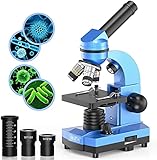
8. Emarth 40X-1000X Compound Microscope – Best for Homeschool and School
Microscope for Kids Beginners Children Student, 40X- 1000X Compound Microscopes with 52 pcs Educational Kits
40x to 1000x
Dual top and bottom light
Two eyepieces
52 pieces
Pros
- Metal objective lens housings rather than plastic
- Two swappable eyepieces at 10x and 25x
- A true compound microscope rather than a toy
- Six built-in colour filters to boost contrast
Cons
- Plastic frame makes the scope feel shakier than metal units
- No storage case is included
- Too complicated for younger children unsupervised
This is the kit that turns into a school instrument rather than a toy, and reviewers who compared it head to head against cheaper kids scopes rated it best for image clarity and construction. Two optical paths, top and bottom illumination, and a real compound layout mean it does not depend on a novelty to be worth using.
Two eyepieces at 10x and 25x come as swappable pieces, which is a detail experienced microscopists in the community single out. One low power for finding your specimen, one high for looking closely at it, is the pairing they recommend to adults, and this kit is one of the few in the roundup that gives a child the same choice.

The 52-piece set includes prepared slides, blank slides and experiment tools. Six built-in colour filters sit in a rotating wheel and adjust the light for contrast, which is the single feature that makes dark, low-contrast specimens such as pond water or unstained cells readable. Focus is smooth rather than stepped, and the head rotates so a child can work seated.
Two practical issues. The frame is plastic, so the scope feels shakier than an all-metal unit when you tap the stage, and no storage case is included even though the instructions reference a dust cover. The included slides are plastic and owners recommend buying extra glass slides separately.

What does a colour filter wheel actually do?
It changes the colour and intensity of the light reaching the specimen. Pale, transparent samples that vanish under white light become visible when you dial in a contrasting colour, which is why the wheel matters far more for real exploration than for looking at prepared slides.
It is also how this kit teaches contrast, a real microscopy concept, rather than just magnification. Show a child the difference between a slide with and without the wheel and the habit of adjusting the light starts forming.
Can a child use this independently?
An eleven-year-old can, according to owners, with the scope set up in advance and the eyepiece swapped to the lower power. Below that, adult supervision is sensible because the controls are more numerous than a first microscope needs.
Quick to set up and straightforward to keep organised, it is the pick we would make for a homeschool family covering a biology unit, and it pairs naturally with the wider STEM kit roundup for the non-microscope half of the syllabus.
9. OAEBLLE 4K 1000X Digital Microscope – Best for Young Outdoor Explorers
OAEBLLE Kids Microscope, 4K 1000X Zoom, 2.4″ Screen, STEM Toy for Ages 4-8
Ages 4-8
2.4 inch IPS screen
150g
Rechargeable
Pros
- Screen is clear enough to show plant cells and insect anatomy
- No setup frustration for young children
- Pocket size with a lanyard for nature walks
- Rechargeable so no spare batteries to keep
Cons
- Effective magnification is well below the advertised 1000x
- Focus is lost if the lens gets too close to the object
- Some children lose interest within minutes
The screen here is 2.4 inches at 1920x1080P, and that display quality is what separates this from the usual pocket magnifier. Owners report plant cells and insect anatomy showing clearly on it, which is more than most screen-based devices in this category deliver.
It weighs 150 grams, measures 4.13 by 3.74 by 2.6 inches and includes a lanyard, so it is genuinely pocketable for a walk. Eight adjustable LEDs handle dark environments, where an integrated screen microscope normally gives up.

Storage is built in. Internal memory holds up to 200 JPG photos, and a TF card up to 64GB is supported for 1080P AVI video at 30fps. The 600mAh battery recharges fully in about two hours over Type-C and then gives roughly two hours of continuous use, and the warranty is one year with replacement rather than repair.
Two honest problems. Effective magnification is well below the advertised 1000x, so treat it as a strong magnifier rather than a true microscope, and focus is lost if the lens gets too close to the object. Some children also lose interest within minutes, which is a common pattern with screen-based toys.

Does it need slides or any consumables?
No, and that is the appeal. There is no glass to break and nothing to restock, so it works on leaves, coins, fabric, soil and live insects straight from the hand.
The trade-off is resolution. Because it is a screen device rather than an optical scope, it is excellent for showing a child that a detail exists and far weaker for reading the structure inside it. Use it for discovery, then move to a glass scope for study.
Is the screen too small for two children to share?
At 2.4 inches it is a personal screen, not a shared one. It suits a single child on a walk, and a parent holding the sample rather than looking through it.
Bring an insect or a leaf back inside rather than trying to share the image outdoors, and the recording function means the finding still gets saved. As with any device-based science toy, some screen-time-weary families prefer the terarium kits for kids route for close-up observation instead.
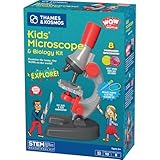
10. Wow in the World Microscope and Biology Kit – Best Audio-Guided Starter
Wow in The World Kids’ Microscope & Biology Kit, Up to 720x Magnification, LED Illumination, Prepared & Blank Slides, Companion Audio Content, Beginner Science Gift for Ages 6+ by Thames & Kosmos
Ages 6+
80x, 360x and 720x
8 prepared slides
Aperture wheel
Pros
- Durable and easy to use for a first microscope
- Real specimens including onion skin and a bee's wing
- Aperture wheel for controlling light level
- Includes the tools for preparing own slides
Cons
- Only one blank slide is included
- No case is listed for storage
The prepared slides here are the best-curated set for the money. Eight slides split four plant and four animal, including onion skin, cotton fibers, a bee’s wing and a bird’s feather. That is a genuine spread of structures a child can compare against each other, rather than six variations of the same leaf.
Magnification runs at 80x, 360x and 720x with a battery-powered LED, and an aperture wheel lets a child bring the light level down to increase contrast. At 11.2 ounces this is the lightest real scope in the roundup, which makes it a good first instrument for a six-year-old.

What makes it different is the audio. Guy Raz and Mindy Thomas guide families through Wow Facts content inside the companion guide, so a child who is not yet a confident reader still gets an explanation for what is on the slide. For an early reader, that narration does the work the printed text cannot.
It also includes a blank slide, a specimen vial, tweezers and a dropper, so there is a path to preparing your own material. Just note that one blank slide is the whole supply, and no case is listed, so buy slides and a box separately.

Is a narrated microscope better than a silent one?
For a six to eight-year-old learning to read a slide, yes. The narration removes the reading barrier, which is the main reason a young child abandons a microscope in week two.
It is a support rather than a substitute. Once a child is reading comfortably, the audio adds less and the slides carry the learning, which is the signal to move to a scope with more magnification and more blanks.
What should you buy alongside it?
Blank slides and cover slips, without question, plus a small box so they do not end up scattered. A dropper and stains such as iodine or methylene blue open up the prepared material further.
Consumable availability is the real test of a first microscope. A kit that is still open on the shelf in month three is almost always one whose supplies you could buy again.
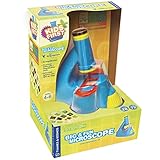
11. Thames and Kosmos Big and Fun Microscope – Best for Ages 3 and 4
Kids First Big & Fun Microscope Science Experiment Kit | Easy-to-Use Kids Microscope | Ages 4-6 | STEM Experiment Guide and Full-Color User Manual | 72 Images | Extra-Wide Eyepiec with Light-up Stage
Ages 4-6
8x magnification
24 printed slides
Light-up stage
Pros
- Extra-wide eyepiece means small children never press their eyes against it
- Internal light-up stage makes specimens easy to see
- Gear mechanism moves the slide tray and children enjoy operating it
- 72 printed images across 24 slides
Cons
- No focusing mechanism at all
- Only 8x magnification with a loose plastic lens
- Printed slides have no storage and get lost easily
Be clear about what this is: a preschool prop, and a good one. At 8x magnification with no focus adjustment, it will not resolve a cell. What it does is make a three or four-year-old feel like a scientist without any risk of frustration, which is a genuinely different job from the rest of this list.
The design is built around small faces. The eyepiece is extra-wide so a child never has to press their eyes against it, and the stage is lit internally so the specimen glows without any lamp to aim. A gear mechanism moves the slide tray, and children enjoy operating it as much as they look through the lens.
There are 24 printed slides across three magnification levels, giving 72 total slide images, and a 32-page full-colour storybook-style experiment manual that supports language development. It weighs 1.4 pounds, measures 8.4 by 7.8 by 11.5 inches and carries a one-year warranty. It is also a Parents’ Choice Recommended award winner.
The limitations are real and worth stating plainly. There is no focus mechanism, so it is a prop rather than a microscope. The single blank slide has no flat surface for placing a specimen, printed slides have no obvious storage and are easily lost, and there is little information about what is actually on each slide.
Will this break the magic of a real microscope later?
We do not think so, provided you set expectations. A child who has spent months delighted by glowing slides usually arrives at a real scope wanting to see more rather than disappointed by a smaller number on the box.
The risk is the reverse. Selling this as a microscope sets up the disappointment, because at eight times there is genuinely nothing to find. Describing it honestly as a first look at tiny things is what makes it work.
Is there enough here to keep it interesting past week two?
For three and four-year-olds, yes. Seventy-two images across 24 slides plus the storybook manual give plenty of variation, and reviewers consistently position it as working well from age three despite the listed range.
For a five-year-old who is already asking questions about why things look different, it will run out quickly. In that case move straight to a scope with a focus knob and blank slides.
12. DOUBLE CC Kids Microscope STEM Kit – Budget Pick
Kids Microscope,40-1600x Microscope Kit for Kids Beginners Children,STEM Kit,Prepared Slides,LED Light and Configured Various Operating Tools- Science Experiment Toy for Kids Ages 6-12
Ages 6-12
Objectives at 4x, 10x and 40x
26 pieces
2 year warranty
Pros
- Three objective lenses give surprising detail for a children's model
- Smooth easy-to-use focus knobs and a brightness knob
- Dual top and bottom illumination with a 7-colour aperture disk
- Phone adapter and well organised packaging included
Cons
- Build feels cheap and the LED is weak
- Included plastic slides are low quality
- Listing magnification claims exceed what the optics deliver
The optics here are the surprise. A WF10X eyepiece with a 4x lens pairs with 4x, 10x and 40x objective lenses, and owners report a level of detail from a children’s scope that they did not expect. A rotatable monocular head gives 40x, 100x, 250x, 400x and 1000x in practice.
It also handles both specimen types. Top incident light covers opaque objects, bottom transmitted light covers translucent slides, and a 7-colour disk aperture adjusts light colour and contrast by touch, which is a genuinely useful feature at this level. It weighs 9.6 ounces and measures 5.12 by 3.35 by 8.66 inches.

The accessory set is 26 pieces with prepared slides, blank slides, droppers and tweezers, plus a cell phone adapter so a child can photograph a specimen with the phone they already own. Packaging is shockproof and keeps spare parts organised, which matters more than it sounds when the smallest parts are the ones that get lost. The warranty runs two years.
The compromises are physical rather than optical. The build feels cheap and flimsy, the lenses can be blurry and hard to focus, and one owner reported the illumination unit failing after about six months with no practical replacement available. The included slides are low quality, so budget for glass replacements.

Is this enough microscope for a curious eight-year-old?
Yes, with caveats. Three objective lenses and a colour aperture give more to explore than many scopes costing more, and owners buying it for ages 6 and up are generally satisfied with the capability.
Where it falls short is durability and lighting. A weak LED in a dim room is frustrating, and a failed illuminator with no spare part ends the microscope for good. Check the unit early.
Why does the listing magnification number not add up?
Because the headline figure is the eyepiece multiplied by the largest objective, while the deliverable result also depends on lens quality and light. On this kit the listing claims exceed what the optics actually produce, which is the exact trap this buying guide is trying to help you avoid.
Read the objective lens markings instead of the listing, and judge the picture rather than the number. A scope that shows a clear image at 400x beats one that blurs at 1600x every time.
How to Choose a Microscope Kit: 7 Things to Check
The single most useful change most families can make is deciding the type of microscope before the brand. Type determines what your child can look at; brand mostly determines how long it survives.
Compound, stereo or digital: which type for which age
Compound microscope. One light path shines up through a thin slide. This is the type that shows cells, bacteria and anything translucent, and it is what you want from about age eight upward once the child can handle a focus knob and prepare a slide.
Stereo microscope. Two optical paths give a three-dimensional view of opaque objects: insects, rocks, coins, fabric, circuit boards. It is far more forgiving for a beginner because there is depth and no thin slide to ruin.
Digital microscope. No eyepiece at all. The image appears on a built-in screen, a phone or a tablet. It is the easiest to share and the easiest to use with glasses, but it trades away real optical resolution for convenience.
Magnification is not resolution: how to read the number on the box
Magnification describes how much bigger the image is projected. Resolution describes how much detail is actually in it. They come from different parts of the instrument, and a cheap scope can hit 1200x and still show you a large, soft, dim picture.
The number to look for instead is the objective lens material. Glass objectives at 40x, 100x and 400x will beat plastic objectives at 1200x in every case a child cares about. The wider rule, and the one the experienced microscopists in the forums repeat, is that the younger the child, the lower the useful magnification should be. A four-year-old does well at 30x to 100x; a ten-year-old can start working toward 400x; beyond that the optics, not the child, are the limit.
Microscope kits to avoid: four red flags and why they matter
Plastic objective lenses. The single most common failure in this category. You pay for a number the lens cannot deliver.
Coarse focus only, with no fine adjustment. At high power a coarse knob overshoots every time. Younger children will cope; an eight-year-old will give up and so will a curious adult.
Fixed-focus digital models marketed at 1000x. A screen device at high advertised magnification is a magnifier. Useful, honest in what it is, misleading in how it is sold.
Pre-printed slide toys. A microscope where the only specimens are printed cards teaches a child that looking closely is about seeing a picture, not finding something. It ends the experiment at the box.
Two softer warnings. Batteries not included is a near-universal one-star trigger across this category, so check before day one. And cheaply made accessories are the part that breaks, not the scope, so buy a glass slide pack rather than relying on the included plastic.
What to look at on day one: ten easy specimens
The biggest driver of whether a microscope gets used past week two is what happens in the first hour. These need no specialist equipment and every one works with a blank slide and cover slip.
Onion skin cells, torn thin and stained. Cheek cells from inside the cheek, stained. Pond water or a drop from a fish tank, where you can move the dropper to hunt. Salt crystals dissolved on a slide and dried out. Sugar crystals the same way. A strand of cotton and a strand of wool, side by side, to compare twist. Newsprint, where the printed dots separate at high power. A hair from a head, a pet or a brush. A fingertip print left on a slide. And a wing scale from a feather or a bee’s wing from the prepared slides.
Onion and cheek cells need transmitted light and a stain. Rocks, coins and fabric need incident light from above. Our picks for those two categories are the dual-LED scopes and the digital devices, which is the reason dual lighting appears so often in this roundup.
Starting versus stepping up: the upgrade path
For a preschooler, the narrated or light-up prop scopes are right, and they are cheap enough that treating them as a first stage is sensible. For ages six to eight, a scope with large knobs, dual lighting and blank slides is the destination.
From nine upward, the move is glass objectives at 40x, 100x and 400x, a mechanical stage and colour filters. That is the tier where a microscope becomes something a child can use for an actual biology unit rather than an afternoon.
One honest alternative that families in the microscopy forums raise regularly: buy a used microscope rather than a cheaper new one. Adults consistently recommend a secondhand model with plan objectives as the cheaper route to real optics, and the same logic applies to a child who has already shown they will use what they are given.
Frequently Asked Questions
What is the best-rated microscope for kids?
The GeoSafari Talking Microscope from Educational Insights is our top-rated pick, holding a 4.6 average across nearly 12,000 reviews. For a school-age child we rate the National Geographic Dual LED Microscope just as highly on optics, giving the same 4.6 across more than 3,300 reviews with real glass lenses and lighting above and below the stage. The first wins on engagement for a four-year-old; the second wins on what a child can actually see.
What are some good real microscopes for kids?
A real microscope passes three tests: glass objective lenses rather than plastic, a focus knob fine enough to bring a specimen into critical focus, and a light path that resolves detail from a slide you made yourself. The Omano Juniorscope and the Emarth 40X-1000X both clear all three, using glass objectives at 40x, 100x and 400x. Anything with printed slides and no focus knob is a prop, however good the packaging looks.
Are kids’ microscopes worth it?
Yes, when the kit includes blank slides, cover slips and a guide for making your own specimens, because that is what keeps a child using it past week two. No, when it is a pre-printed-slide toy, since the novelty ends with the box. Frame the decision as cost per year of use: a kit used monthly for two years is inexpensive, and one abandoned in a cupboard is not.
Which microscope is good for kids?
It depends on age more than brand. A four-year-old wants a narrated or light-up prop with no focus to manage. A six to eight-year-old wants large knobs, lighting above and below the stage, and blank slides to prepare. A ten-year-old wants glass objective lenses at 40x to 400x, a mechanical stage and colour filters. The younger the child, the lower the useful magnification should be.
What is the best microscope for a 10-year-old child?
The Emarth 40X-1000X compound microscope is the strongest fit at this age, with two swappable eyepieces, dual top and bottom illumination and six colour filters that make transparent specimens visible. The Omano Juniorscope is the better value option, offering glass objectives at 40x, 100x and 400x with a petri dish, forceps, dropper and test tube included. Both clear the bar that most kits at this age do not: real glass objectives.
What can you use a microscope for?
Onion skin cells, stained cheek cells, pond water, salt and sugar crystals, cotton and wool fibres, newsprint, a hair, a fingertip print, and insect wing scales. The first five need transmitted light and a stain, while rocks, coins and fabric need light from above. If a kit has both a lower and an upper LED, the child can move between translucent slides and solid objects without a second instrument.
Which Microscope Kit Should You Buy?
If you take one recommendation from this roundup, take the GeoSafari Talking Microscope for a child under eight and the Omano Juniorscope for anything older. The first is the highest-rated kit in the category by a wide margin and holds a four-year-old’s attention on its own. The second gives you glass objective lenses at 40x, 100x and 400x, which is the specification that actually matters.
Whichever you choose, buy a pack of glass blank slides and cover slips alongside it. That consumable is what separates a microscope used for three years from one used for three weeks, and it is the single most useful thing in this entire guide for parents trying to avoid impulse-buy regret. Our other hands-on science roundups cover the modeling clay kits and the water rocket kits if you are building a full shelf of experiments for 2026.