

If your child can name the Galilean moons but has never actually seen them move across the eyepiece field, you have a problem worth solving this 2026. The best telescopes for kids are not the ones with the biggest number printed on the box. They are the ones a seven-year-old can carry out of the door, point at the Moon, and focus in under two minutes.
That is the whole test. Everything else in this guide follows from it. We compared eight telescopes that a parent can actually buy for a child, weighing aperture, mount steadiness, setup friction and the review data owners left behind, and we looked hard at the complaints, because the same three complaints show up again and again: a wobbly tripod, a blurry image, and a child who loses interest because they could not find anything.
Two things shape every recommendation below. First, a child’s first impression of astronomy comes from the first ten minutes with the scope, so pointing ease matters more than any specification. Second, aperture matters more than magnification, which is why a 70mm scope that holds still will always beat a plastic 700x toy that shakes. Saturn reaches opposition on October 4, which makes this a good month to start.
Table of Contents
What to look for when buying a telescope for kids
Three rules decide whether a telescope works for a child. If a scope fails any one of them, it will sit in a cupboard.
Aperture of at least 70mm. Aperture is the diameter of the lens or mirror that gathers light. A 70mm objective shows the Moon’s craters, Jupiter’s four bright moons and the rings of Saturn. A 50mm objective shows a bright Moon and little else. 100mm opens up the craters and begins to reveal deep-sky objects.
A mount that does not shake. The image wobbles at the slightest touch when the tripod legs are thin or the lock knob slips. A tabletop base with no legs at all solves this completely, and a metal tripod on a shorter scope beats a tall plastic one.
Setup that needs no tools and no calibration. If assembly takes more than ten minutes, you will not do it. Skip equatorial mounts and any scope that needs polar alignment before it can point.
There is a fourth filter that is not on any spec sheet: a finder scope or red dot finder already attached. Parents repeatedly report that a child who cannot locate a target loses interest within a single session, and the finder is what turns “where is it?” into “I found it.”
What to skip is just as clear. Avoid plastic scopes with 500x or 700x claims on the box, because magnification that exceeds roughly twice the aperture in millimetres produces a dim, blurry image rather than a sharper one. Avoid third-party marketplace telescopes with no findable brand, and avoid anything where the tripod is the part most likely to break.
Our broader guide to the best telescopes for beginners covers the optics in more depth if you want the physics behind these rules.
Best telescopes for kids: our top three picks in 2026
These are the three we would hand to a parent first, based on aperture, steadiness and how much frustration each one removes from a child’s first session.

Gskyer 70mm AZ Refractor
- 70mm coated objective
- 400mm focal length
- 3x Barlow plus two eyepieces
- 5x24 reflex finder with phone adapter
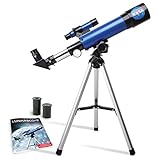
Blue Marble NASA Lunar Scope
- Two eyepieces with straight-through finder
- Lightweight tabletop tripod
- NASA guide included
- Batteries power the unit

ECOOPRO 70mm Refractor
- 70mm multi-coated glass
- Kellner 25mm and 10mm eyepieces
- 5x24 reflex finder
- Works for birding and wildlife by day
All eight telescopes compared side by side
Every pick in this guide, with the features that matter most when you are comparing them on a phone screen.
| Product | Specifications | Action |
|---|---|---|
| Gskyer 70mm AZ Refractor |
|
Check Latest Price |
| Blue Marble NASA Lunar Scope |
|
Check Latest Price |
| ECOOPRO 70mm Refractor |
|
Check Latest Price |
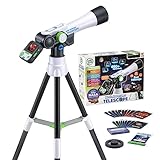 LeapFrog Magic Adventures Telescope LeapFrog Magic Adventures Telescope |
|
Check Latest Price |
 Luzsco 50mm Beginner Telescope Luzsco 50mm Beginner Telescope |
|
Check Latest Price |
 Wow in the World Astronomy Kit Wow in the World Astronomy Kit |
|
Check Latest Price |
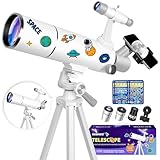 Hawkko 80mm Refractor Hawkko 80mm Refractor |
|
Check Latest Price |
 Educational Insights GeoSafari Starview Educational Insights GeoSafari Starview |
|
Check Latest Price |
Which telescope suits which age?
Age matters more than budget, because it decides what a child can physically do with the controls. Here is the mapping we use when friends ask.
Ages 3 to 5: start with binoculars, not a telescope. A seven-year-old’s problem is usually pointing and focusing, and a full-size optical telescope defeats both at that age. If you want a telescope-shaped gift, the LeapFrog in this list works because it puts the image on a screen.
Ages 6 to 8: a 70mm refractor on an altazimuth tripod is the sweet spot. This is the Gskyer and the ECOOPRO class, and it is also where most telescopes for kids recommendations cluster. Choose the one with a metal tripod and a finder scope.
Ages 9 to 12: move to the largest objective you can reasonably carry, which here means the 80mm Hawkko. At this age they can align a finder, work the focus knobs independently, and start keeping a Moon journal.
Ages 13 and up: a 70mm refractor is no longer a ceiling. Look for scopes where the child can change eyepieces, understand what a Barlow lens does, and start photographing the Moon with a phone adapter. All eight picks here support some of that.
One caveat worth repeating from the expert forums: many regulars argue that the best first telescope is a shared adult-sized scope on a step ladder rather than a small one the child outgrows. The trade-off is real, and it is a reasonable path if you already own something large.
1. Gskyer 70mm refractor: the best telescope for kids overall
Gskyer Telescope, 70mm Aperture 400mm AZ Mount Astronomical Refracting Telescope for Kids Beginners – Travel Telescope with Carry Bag, Phone Adapter and Wireless Remote.
70mm coated objective
400mm focal length
Altazimuth tripod
3x Barlow plus two eyepieces
5x24 reflex finder
Pros
- 70mm aperture resolves craters along the Moon's terminator
- Two eyepieces plus a 3x Barlow cover wide and tight views
- 5x24 reflex finder with cross-hairs makes targets easy to locate
- Phone adapter and wireless remote included
- Carry bag and adjustable tripod for travel
Cons
- Manual altazimuth mount lets targets drift during longer sessions
- Manual focus takes practice for younger children
- Entry-level optics limit faint deep-sky objects
The Gskyer AZ 70400 is the one we keep coming back to. It pairs a fully coated 70mm objective with a 400mm focal length, which gives a wide, forgiving field of view, and it ships with a 5×24 reflex finder that actually has cross-hair lines. Those two details together are the reason it is our top pick: a child can find the Moon and hold it in the field without an adult doing astronomy on their behalf.
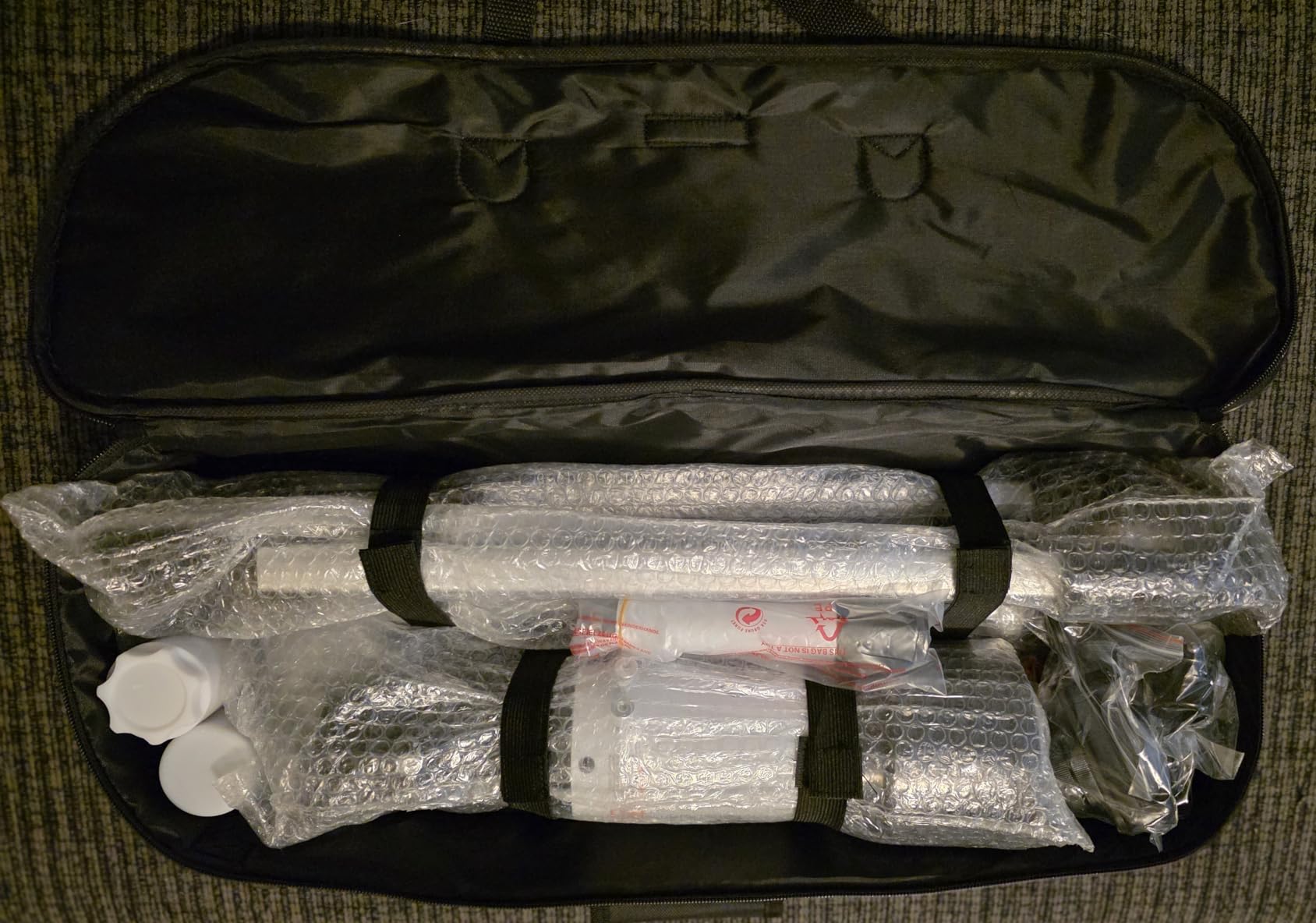
We set it up in under five minutes with no tools, which sounds ordinary until you have tried assembling a first telescope with a six-year-old watching. The tube is about 40cm long and light enough for small hands to reposition, and the accessory tray keeps the eyepieces from rolling off during a session.
Owners consistently describe bright, sharp views of the Moon with this scope, and more than 20,000 ratings give us a reliable picture of what it does well. The three included eyepieces plus the 3x Barlow give a range from wide, naked-eye-like views up to serious magnification on Jupiter. Turn the Barlow off for Jupiter’s moons, because more power there just makes the dots harder to separate.
The phone adapter and wireless camera remote are a genuine bonus at this level. A child can hold a phone to the eyepiece and take a first picture of a crater, and that photo on a phone screen does more for motivation than any sticker or cardboard star chart.
Where this scope holds up best
This is the scope we recommend for a child aged six to eight who is ready to be the operator rather than the passenger. Lunar work is its sweet spot: the 70mm aperture and 400mm focal length give a wide field where the Moon fills about half the view, which makes it easy to sweep along the terminator and find named craters.
Jupiter’s four bright moons and the phases of Venus are comfortably within reach, and because the field is wide, a beginner does not need to fight the finder every time they move the tube. The tripod adjusts to a table for a young child and to full height for an adult standing beside them.
Where it falls short
The manual altazimuth mount is the main limitation. Because nothing tracks, targets drift out of the frame during a long look, and a child who loses Saturn while adjusting focus can lose interest too. It also means no long-exposure phone photography, since the field moves.
The optics are entry-level, so galaxies and nebulae stay out of reach, and the fully manual focus can frustrate a child under six. If you have a child that age, read the LeapFrog section below before buying this one.
2. Blue Marble NASA Lunar Scope: best giftable pick for a young child
NASA Lunar Telescope for Kids Ages 8-12 with Tripod and Finder Scope
25mm objective
Up to 90x magnification
Lightweight tabletop tripod
Straight-through finder
Battery powered
Pros
- Assembly is quick and children can do most of it
- Finder scope plus low and high power eyepieces locate the Moon easily
- NASA branding and learning guide appeal to space fans
- Compact and light enough to move between rooms
- Straightforward gift for a birthday
Cons
- 25mm objective gives very faint images past the Moon
- Very light frame is easy to knock over
- Basic tripod and mount wobble when adjusted
- Better suited to children around 10 and up
This is the most giftable object in the group, and it is also the most limited, and both facts matter. The Blue Marble scope is branded NASA, comes with an educational learning guide, and is listed for ages eight and up. Nearly 7,000 ratings sit at a 4.1 average, which tells you parents are happy with it as a present.
What it actually is, though, is a Moon scope. The objective lens is 25mm, which is a third of the aperture our top pick has, and the maximum magnification is around 90x. That is plenty to show a child that the Moon has craters, and very little beyond that.
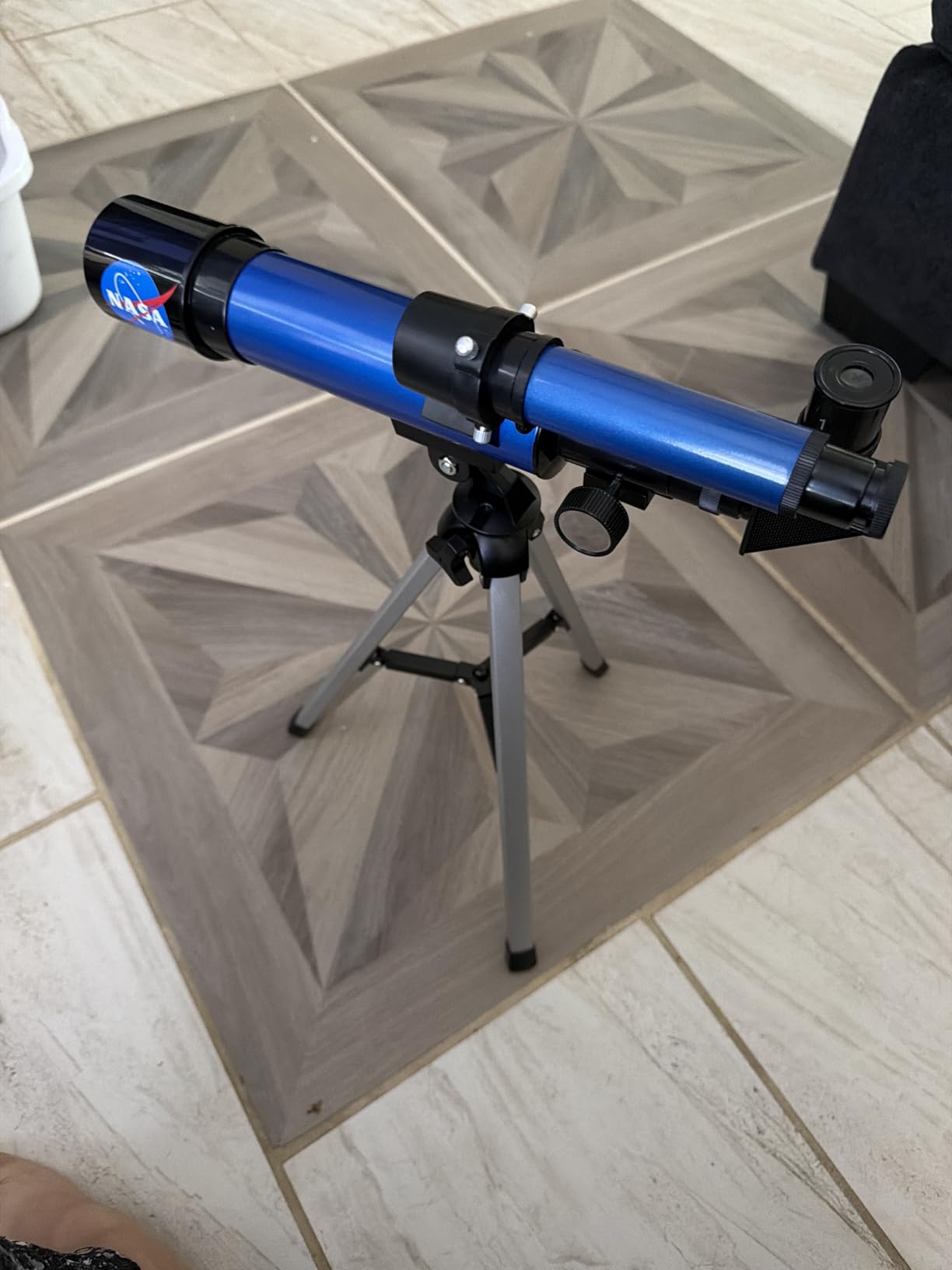
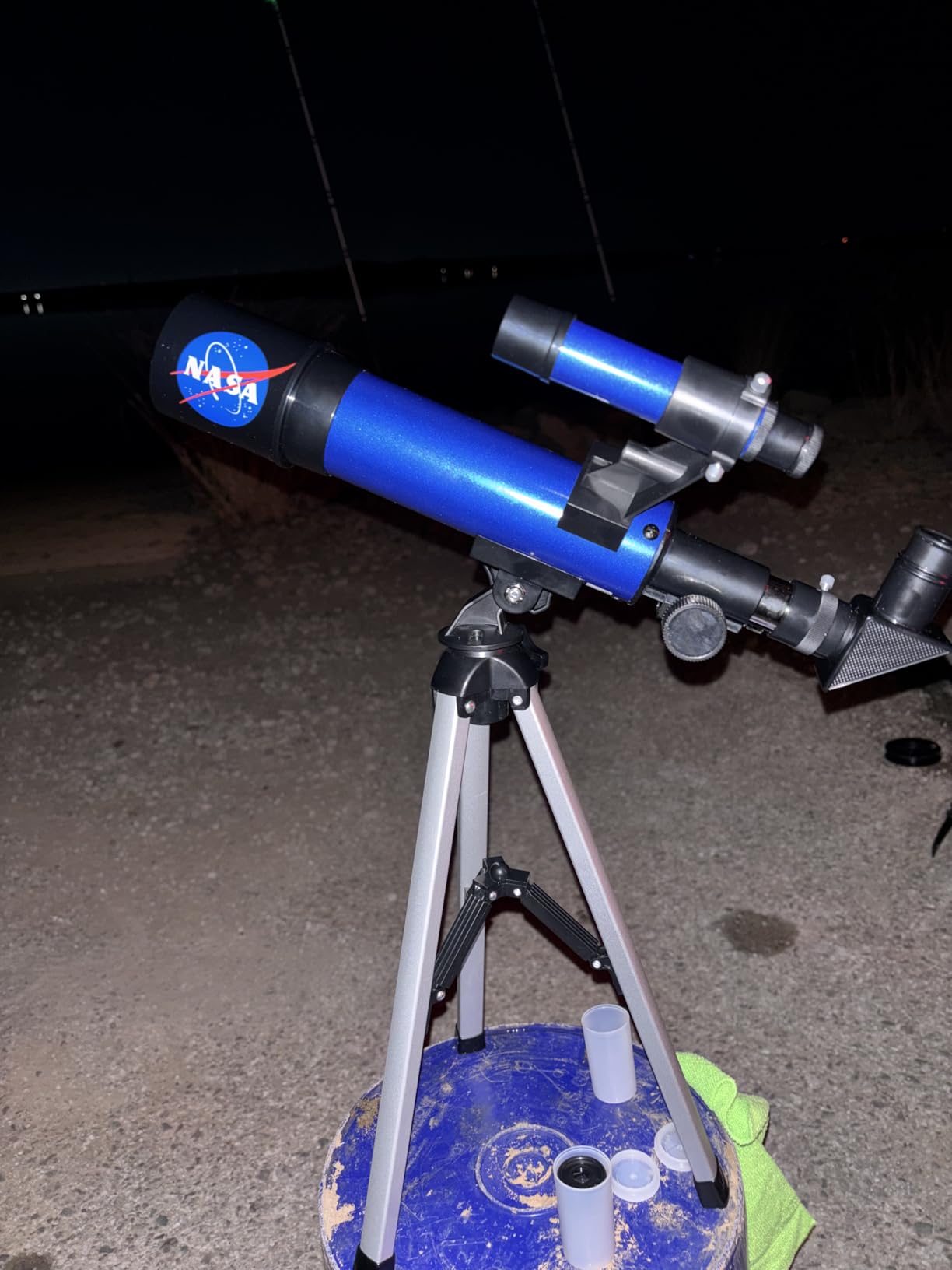
The finder scope is straight-through rather than reflex, which is simpler to align and cheaper to make, and it works well for a single target like the Moon. Two eyepieces, one low power and one high power, plus a lens dust cap and a lightweight tabletop tripod complete the box. It runs on batteries, so there is no cable to trip over in the dark.
Owners praise the quick assembly that a child can manage with minimal help, and several buyers deliberately frame it as a starter rather than a real instrument. That framing is honest and worth keeping. Expectations set this way tend to survive first contact.
Why it earns a place in this list
For a child aged eight or nine, this is a gentle introduction. There is nothing to calibrate, the tripod is a tabletop type with no legs to tangle, and the whole thing can be carried outside by the child themselves. Parents frequently report that it works well as a birthday or holiday gift precisely because it does not demand a lot of setup.
It is also the easiest scope here to pair with an adult activity. The learning guide gives a parent something to point at, and the battery power means it can be used in a bedroom window without dragging a cable across the floor.
Where it stops working
Past the Moon, the 25mm objective simply does not gather enough light, and images go faint and blurry. Planets other than the Moon will mostly be dots. If your child is the sort who has already read about Saturn’s rings, set expectations before the first session or the disappointment will land hard.
The frame is also light and breakable, and the tripod and mount are basic enough to wobble while being adjusted. Several owners place it closer to age ten than age eight. We would use it as a stepping stone rather than as the telescope that lasts.
3. ECOOPRO 70mm refractor: the best value for mixed day and night use
Telescope for Kids & Adults, 70mm Aperture 360mm Refractor (15X-150X)
70mm multi-coated objective
360mm focal length
Altazimuth tripod
Kellner 25mm and 10mm eyepieces
1.4kg
Pros
- 70mm coated glass shows clearly defined lunar craters
- Two Kellner eyepieces give 51x to 128x
- 5x24 reflex finder makes targeting straightforward
- Quick-release tool-free assembly under a minute
- Doubles as a birding and wildlife scope
Cons
- Tripod is very short so a table is needed to reach the eyepiece
- Mount lock knob can slip and let the tube lose focus
- Printed star and moon maps are hard to read
- Lightweight plastic body can crack if knocked over
The ECOOPRO is the value pick, and its value is optical rather than decorative. A 70mm fully multi-coated objective at 360mm focal length is a genuinely respectable amount of glass for a first scope, and the 7.9-degree field of view is the widest in this group, which makes it forgiving for a beginner hand.
Two Kellner eyepieces at 25mm and 10mm give 51x to 128x, and the 5×24 reflex finder is the same design our top pick uses. That combination is why reviewers frequently mention clearly visible lunar craters rather than a vague bright Moon.

The feature no competitor in this list matches is daytime use. Because it is a straightforward refractor on an altazimuth mount, pointing it at birds, a distant ridge line or a neighbour’s garden gnome works exactly as well as pointing it at Jupiter. For many families that doubles the number of times the scope actually gets used, which matters more than any specification.
Owners also like that it packs down small and folds back into the box. The quick-release, no-tools assembly means a child can be observing in under a minute, which is the single most important number in this whole guide.
Why it works in more homes than any other scope here
A telescope used only at night, three months a year, loses interest quickly. This one gives a family something to do on a Saturday afternoon and again after dark, and it does so without any accessory. If your child is outdoors constantly, that versatility is worth more than an extra 10mm of aperture.
The wide field is also a real advantage for a first-time user. Saturn or Jupiter will sit in the frame with room around it, so a shaky hand does not lose the target immediately. That tolerance for error matters enormously with children.
Where it falls short
The tripod is the weak point, and reviewers are consistent about it. It is short, so the eyepiece ends up at table height unless you put something under the legs, and the mount lock knob is repeatedly reported as slipping, which lets the tube flop and lose focus mid-observation.
Several owners recommend buying a better tripod, and that advice is worth taking seriously. The printed star and moon maps included in the box are also too blurry to read, and the phone adapter does not fit phones with cases or multi-lens camera modules. The body is lightweight plastic that can crack if it is knocked over.
4. LeapFrog Magic Adventures Telescope: best for preschoolers
LeapFrog Magic Adventures Telescope
2.4 inch digital screen
Up to 110x zoom
20 cosmic cards included
Ages 5 and up
Battery powered
Pros
- Screen-based viewing removes the eyepiece alignment problem
- Works for children who cannot yet focus on an eyepiece
- 100+ NASA videos and images teach the solar system
- Spacecraft adventure game adds a learning layer
- Rated 4.4 with 538 reviews
Cons
- Screen image is softer than real optics
- Not built for planet or deep-sky observation
- Needs four AA batteries regularly
- Heavier and bulkier than a tabletop scope
Everything else in this guide assumes a child can put their eye to a lens and turn a focus knob. A five-year-old usually cannot, and that is not a flaw, it is a motor skill. The LeapFrog Magic Adventures Telescope solves this by putting a 2.4 inch digital video screen where the eyepiece would be, so the child sees the magnified Moon without learning an unfamiliar physical skill first.
That decision explains the 4.4 average from 538 ratings, with roughly three quarters of reviewers giving five stars. Parents buying this are not looking for an astronomical instrument, they are looking for something that works on the first try, and it does.

The learning content is the real strength. Twenty cosmic cards and more than a hundred NASA videos and images cover the solar system, the phases of the Moon, the life cycle of stars and constellations. There is also a spacecraft piloting adventure game where observations from Mission Control power satellites and reboot robots, which gives a young child a reason to come back to it.
Magnification goes up to 110x, which sounds impressive but is honestly modest, and the intended age is five and up. Four AA batteries are included for demonstration, and the manufacturer’s warranty runs 90 days against defects.

Why this is the right pick for a very young child
Forum consensus among experienced observers is that most four and five-year-olds are not ready for a telescope at all, and that binoculars or a screen-based device is the honest answer. This fits that advice well. A child can sit down with it, see the Moon, and get a story about what they are looking at, without an adult wrestling with a tripod in the dark.
It is also a good birthday present for a child who is not yet ready to share an instrument. Nothing is fragile in the way optics are, and nothing gets knocked over outdoors in the cold.
Where it falls short
It is not really a telescope in the optical sense a parent might hope for. The screen-based image is softer than looking through a real eyepiece, and it is not designed for serious observation of planets or anything in the deep sky. At 110x maximum, most targets beyond the Moon are unresolved.
It is also bulkier and heavier than a simple tabletop scope at 3.8 pounds, and the batteries need replacing regularly. We would treat this as a bridge to the real thing rather than a substitute for it.
5. Luzsco 50mm telescope: the budget pick for a first build
Telescope for Kids, 50mm 100x Beginner Telescope with Tripod
50mm multi-coated objective
Up to 100x magnification
Fixed mount
6mm and 20mm eyepieces
600g
Pros
- One of the most affordable kits that uses real glass
- Includes tripod finder two eyepieces and a Barlow lens
- Assembly doubles as a screen-free STEM activity
- 600g weight is easy for a child to carry
- Two year manufacturer warranty
Cons
- 50mm aperture and Huygens eyepieces give soft low-contrast images
- Fixed mount offers no fine aiming for tracking
- Performance beyond the Moon is limited
- Basic plastic construction
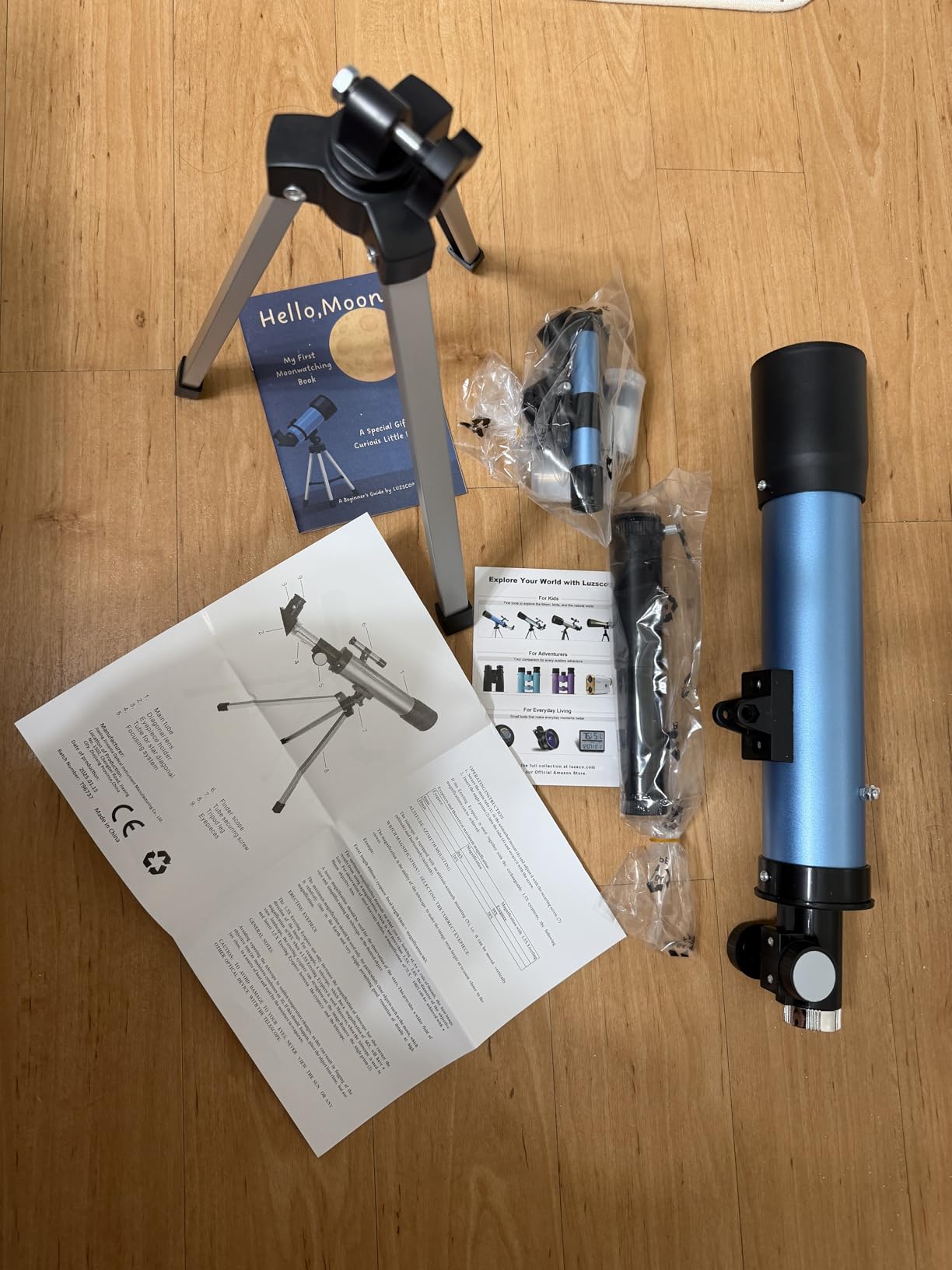
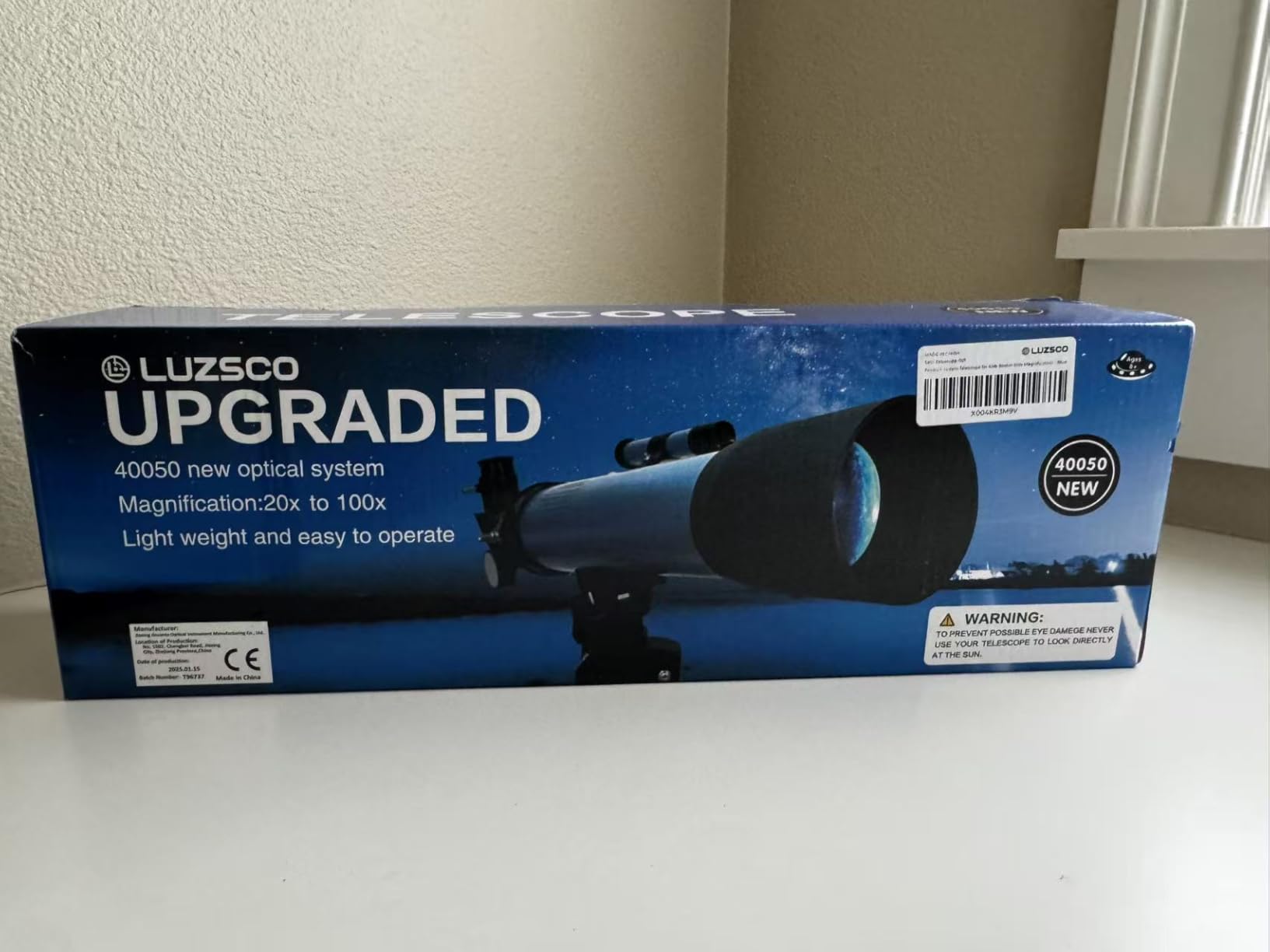
The Luzsco is listed for ages six to twelve, and it is the most complete kit per unit of money in this roundup. You get the telescope, a tripod, a finderscope, two eyepieces at 6mm and 20mm, a Barlow lens and a moon filter in one box, with a two-year manufacturer warranty behind it.
Owners often point out something I agree with: putting it together is itself a good activity. It weighs 600g, it needs no power, and a child can assemble it as a screen-free STEM project before ever seeing the Moon. The 4.3 average from 324 ratings reflects parents who see it that way.
What you are buying is real glass with a modest aperture. The 50mm multi-coated objective is a genuine lens, not a plastic toy lens, and it will show the Moon as a disc with visible maria. Push past that and the image gets soft and low-contrast, because the supplied Huygens eyepieces are basic designs intended for wide, forgiving views.
The fixed mount is the structural limitation. There is no slow-motion control or tracking knob, so pointing a 100x magnification image at a specific crater is a matter of luck. We would consider this a first scope to grow out of rather than one to stay with.
When it makes sense
This one answers a specific question: what is the least I can spend and still give my child a genuine telescope rather than a plastic imitation? The honest answer is this class of kit, and for a six or seven-year-old whose interest might not survive a more demanding instrument, that is a reasonable bet.
It is also a good fit for a classroom, a sleepover bag, or a first shared instrument. Because it is light and inexpensive, losing it to a broken tripod is not a disaster.
When to skip it
If your child has already shown the patience to wait for a clear night and sit through an alignment, spending more on aperture will pay back faster. A 70mm scope such as the Gskyer or ECOOPRO shows the same Moon with far more detail and, critically, holds a planet steady long enough to look at.
The fixed mount and basic Huygens eyepieces are the parts that would bother an older child. Buy this for the building, not for the observing.
6. Wow in the World astronomy kit: best for guided learning
Wow in the World Kids’ Telescope & Astronomy Kit, 25x & 50x Magnification, Adjustable 48” Tripod, Includes Star Wheel & Companion Audio Content, Intro to Astronomy for Ages 6+ by Thames & Kosmos
25x and 50x magnification
10mm and 20mm eyepieces
48 inch aluminum tripod
Star wheel included
Ages 6 and up
Pros
- Aluminum tripod extends to 48 inches for kids and adults
- Altitude handle makes pointing easy for small hands
- Star wheel shows what to look for on a given night
- Illustrated guide and podcast audio add structured learning
- Thick materials survive being knocked about
Cons
- Image stays blurry and astigmatic even at full focus
- 25x to 50x range cannot resolve planets
- Some parts feel cheap
- Polarised reviews from a 4.0 average
This Thames and Cosmos kit comes from the Wow in the World podcast, and that framing shows in the accessories. There is an eight-page illustrated guide explaining how the telescope works and what to look for, exclusive audio content from Guy Raz and Mindy Thomas, and a star wheel that lets a child work out which stars and constellations are visible on a given date and time in the Northern Hemisphere.
The hardware is simple by design. Two Kellner eyepieces at 10mm and 20mm give 25x and 50x, the mount is altazimuth with an altitude adjustment handle sized for small hands, and the aluminum tripod extends to 48 inches so an adult and a child can both use it.

Reviewers consistently praise the tripod as unusually sturdy for a children’s kit. At 2.6 pounds with adjustable aluminum legs, it holds a steady image at the low magnifications this scope provides, and it does not feel like it will fall over when a child bumps the table.
The 4.0 average from 178 ratings is the lowest in this group, and the reason is a genuine split. Families like the tripod, the star wheel and the guided content; a meaningful minority report blurry images even at maximum focus and recommend saving for a better scope.

Why the guided content matters more than the optics
For a six-year-old, a star wheel is arguably the most useful thing in the box. Instead of scanning randomly, the child turns it to tonight’s date and is told which constellations are up. That converts a vague interest in space into an actual plan, and it works without a telescope at all.
The podcast audio is a similar idea. An adult can play a short segment about the Moon, take the child outside, and then let them find what was described. That habit is what keeps astronomy alive past the first month.
Where the optics let you down
At 25x to 50x, this scope shows a wide view of the Moon and bright stars, and that is the limit. Planets will not resolve into anything recognisable, and the 50x maximum does not come close to what you need for Saturn. Several owners describe the image as astigmatic, with one edge noticeably softer than the rest.
Some parts also feel inexpensive next to the sturdy tripod. This is a teaching instrument, and we would pair it with binoculars rather than expect it to carry a night on its own.
7. Hawkko 80mm refractor: the sharpest Moon views in this group
Hawkko 80mm Aperture 500mm Telescope for Kids 8-12 & Adults Beginners
80mm multi-coated objective
500mm focal length
20x to 150x range
10mm and 25mm Kellner eyepieces
3x Barlow
Pros
- 80mm aperture gathers far more light than smaller kits
- Tool-free assembly in minutes with clear instructions
- Adjustable tripod suits kids and adult heights
- Space-themed stickers let kids personalise the tube
- Two year manufacturer warranty
Cons
- Not a strong choice for viewing Jupiter
- Supplied eyepieces are basic Kellner designs
- Some owners find the scope hard to operate and align
The Hawkko has the largest objective in this group at 80mm, and that single number explains why it produces the crispest lunar surface here. A fully multi-coated 80mm lens gathers roughly sixty percent more light than a 70mm, and the 500mm focal length keeps the field wide enough that a child can find targets without constant re-aiming.
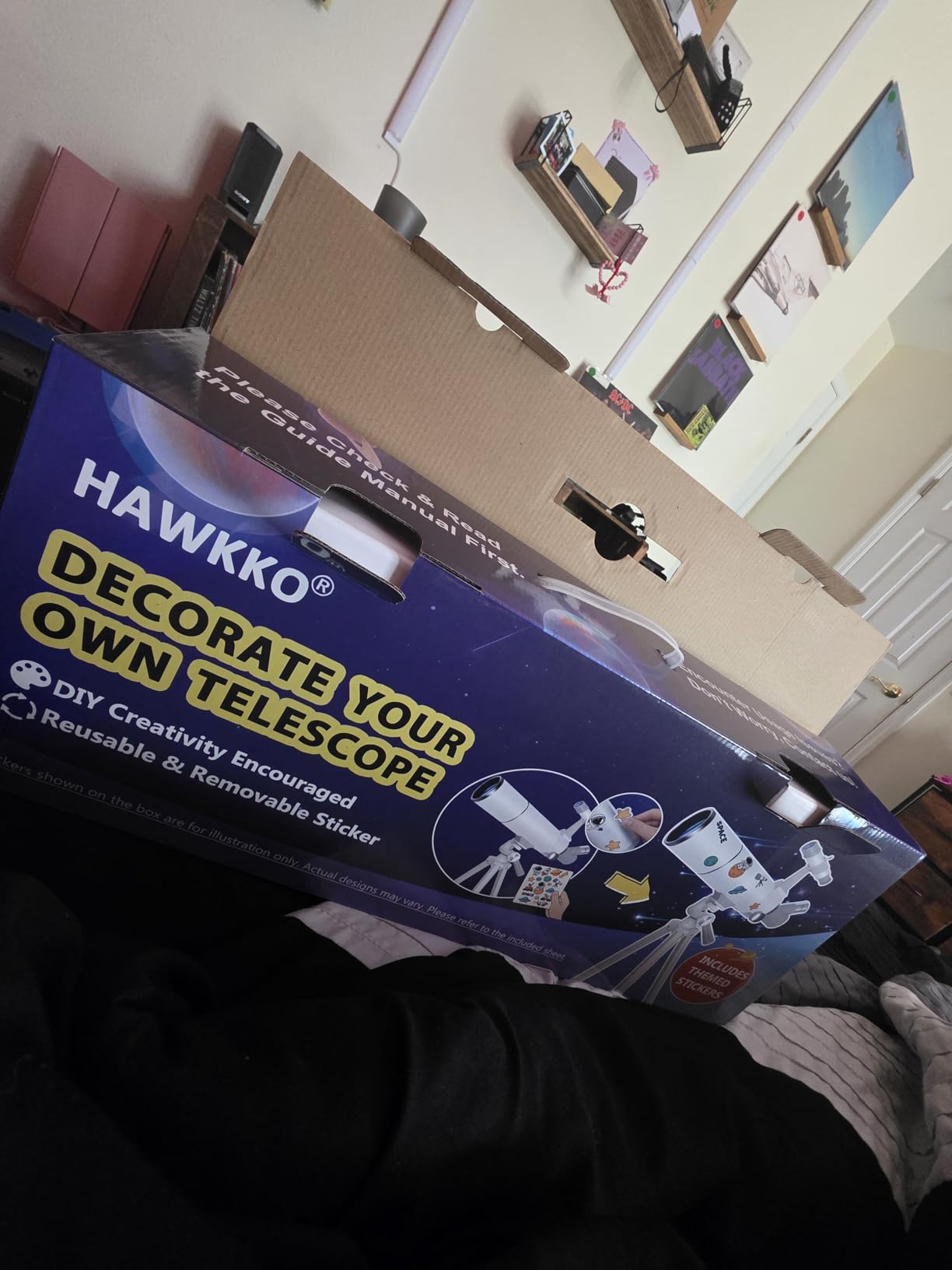
Ratings sit at 4.4 from 169 reviews, with about three quarters at five stars. Owners consistently cite the moon views, the quick tool-free setup, and the portability. The box also includes space-themed stickers and a phone adapter, which children treat as a customization kit rather than an accessory.
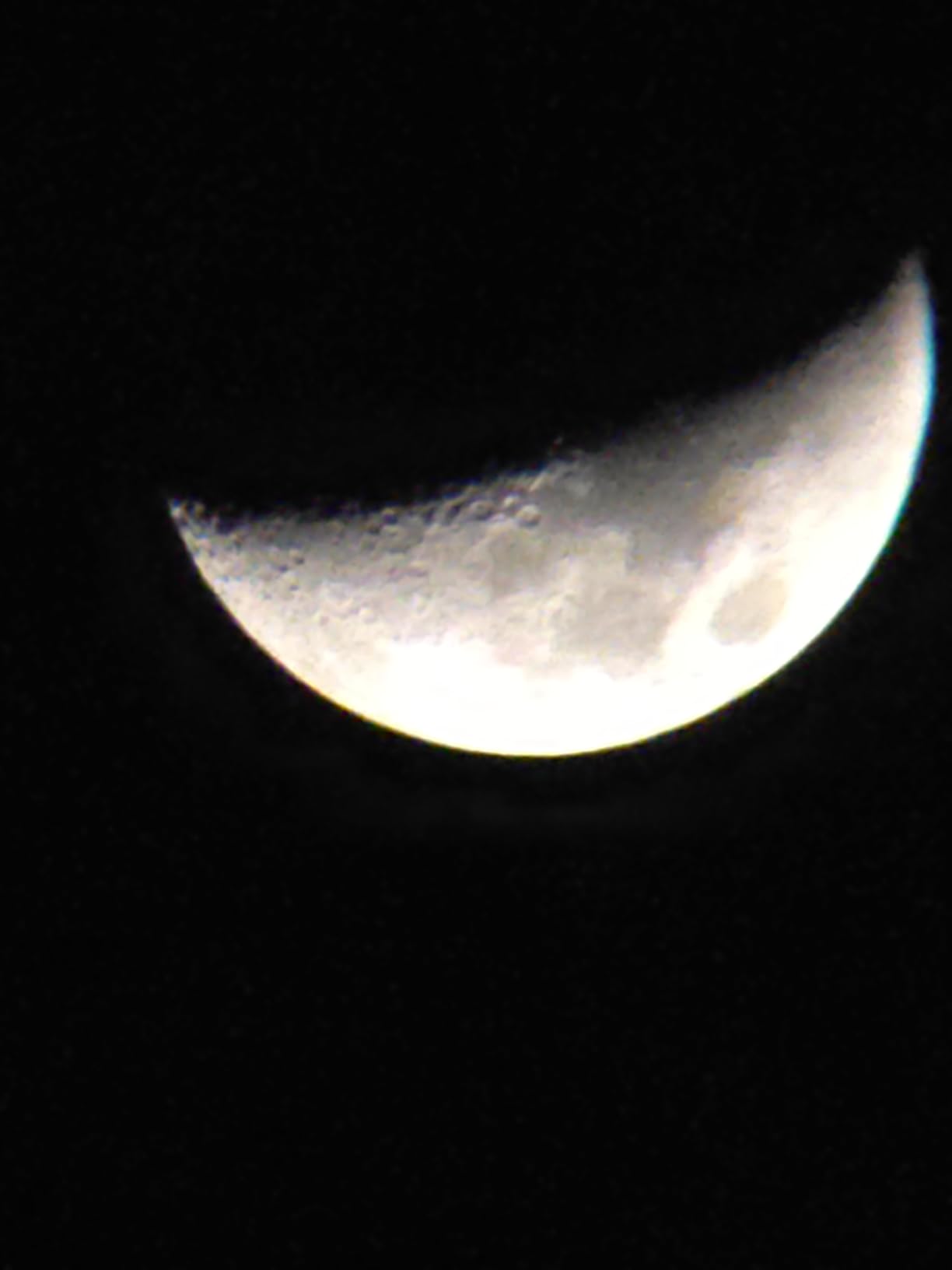
The kit contents are more complete than most at this level: an aluminum alloy tripod, a straight-through finderscope, Kellner eyepieces at 10mm and 25mm, a 3x Barlow lens, a phone adapter, stickers and an instruction manual. Magnification runs from a wide 20x up to 150x using the Barlow, and the tripod doubles as a phone stand for lunar photography.
Its portability is real. The tripod adjusts for both a child’s height and an adult’s, so the same setup works at the breakfast table and at midnight in the garden, which means it actually gets used.
Why the extra 10mm of aperture is worth it here
Light gathering is what determines how much detail survives. At 80mm, the Moon’s craters near the terminator show visible rims and shadowed floors, and the boundary between the bright and dark edges is where a young observer first sees depth in a landscape rather than a flat disc.
For a nine to twelve-year-old, this is also the scope where they can start taking responsibility. Changing eyepieces, re-aligning the finder and working out how much power is too much are all real skills that this aperture makes worth learning.
Where it falls short
Planet viewing is the weak spot, and owners say so directly. Jupiter’s bands and Saturn’s rings need a steadier setup and better eyepieces than a basic Kellner set provides, so at 150x this scope is more likely to show a fuzzy dot than detail.
The straight-through finder also takes more aligning than a reflex finder, and a few owners report difficulty getting a clear image at all. Adding a proper planetary eyepiece later is the most worthwhile upgrade for this scope.
8. Educational Insights GeoSafari Starview: best for classrooms
Educational Insights GeoSafari Starview Telescope
10x and 50x eyepieces
Plossl optics
Altazimuth mount
Portable tabletop tripod
Activity journal included
Pros
- Very easy setup for a group of children
- Switchable eyepieces teach low and high power viewing
- Activity journal keeps learning going after the session
- Compact tabletop tripod works in a backyard or classroom
- Screen-free STEM activity for young children
Cons
- 10x to 50x range resolves very little
- Tabletop tripod is too short for standing use
- Entry-level optics suit the Moon and bright objects only
- Light-duty plastic construction
The GeoSafari Starview is built for a group rather than a single observer, and that is its case. It comes with a tabletop tripod, two lenses at 10x and 50x, and an activity journal that turns a single observing session into a repeatable exercise. Parents and teachers rate it 4.1 across 147 reviews.
What stands out is the switching between 10x and 50x. At 10x, a child can sweep a constellation across the sky and start matching shapes. At 50x, the same child sees the Moon’s surface texture. Teaching the difference between a wide view and a narrow one is a genuine lesson, and this kit makes it concrete.

The journal matters more than it sounds. Owners frequently point out that it extends the learning beyond the telescope itself, giving a child something to record after the session has ended, which is often where a hobby either fades or sticks. It works indoors and outdoors, which suits a classroom demonstration.
Lightweight construction and a compact tabletop base make it easy to move from a desk to a playground, and the whole kit is small enough to store in a cupboard between terms.

Where it makes sense
If you are equipping a small group, a classroom, a scout troop or a family that shares one instrument between two children, low magnification and simplicity win. Nobody is waiting behind someone else for the eyepiece, and the whole session fits inside a single lesson period.
It is also a sensible first purchase for a seven or eight-year-old who is not ready to chase a planet. Nothing about this scope can be broken by a frustrated child, and the journal gives the adult running the session something to hand out.
Where it falls short
The 10x to 50x range is the limit. It resolves little beyond the Moon and a handful of bright stars, so a child who arrives expecting Saturn’s rings will be disappointed no matter how carefully the session is run.
The tabletop tripod is also too short for standing use by an older child or an adult, and the light-duty plastic body and Plossl optics are entry-level in the most literal sense. For a long-term instrument, this is a placeholder.
What your child will actually see at each aperture
Managing expectations is the most useful thing a parent can do in the first week. Most scopes in this roundup are sold with magnification figures that encourage wildly unrealistic targets, and a child who points a 50mm scope at Saturn will conclude the telescope is broken.
25mm objectives: the Moon as a bright disc with visible light and dark patches, and the brightest stars and planets. Nothing more. This is the Blue Marble class.
50mm objectives: a clear Moon with the maria visible, some craters along the terminator if the air is steady, and the brightest planets as small discs. This is the Luzsco class.
70mm objectives: individual craters with shadowed interiors, the four bright moons of Jupiter appearing and shifting during a single evening, the phases of Venus, and the rings of Saturn as an ellipse when conditions are right. This is the Gskyer and ECOOPRO class, and it is the level most parents should aim for.
80mm objectives: everything above, with crater rims resolved and the Moon’s surface holding detail even at higher power. This is the Hawkko.
Two more things a child will not see through any scope in this list. Galaxies and nebulae need a much larger aperture and a genuinely dark site, so if someone promises you the Andromeda Galaxy from a suburban backyard, they are describing a photograph, not an eyepiece view. And the Milky Way’s faint band becomes visible to the naked eye only when light pollution is low enough.
The practical sequence for a first night is short and worth repeating: point at the Moon first because it is huge and unmissable, then Jupiter because its moons move visibly over an hour, then Saturn if it is in the sky. Parents consistently report that a child who sees those two targets on the first night keeps the hobby.
How to buy a kids telescope without wasting your money
Refractor versus reflector versus the rest. A refractor uses a lens, needs no collimation, holds its alignment indefinitely and never clouds on the outside. It is the right default for a child. A reflector uses a mirror, gathers more light per unit of money and occasionally needs its mirrors aligned, which is one job too many for a seven-year-old. A catadioptric uses both and gives a long, compact tube, but the ones priced for children are rare. A smart or app-guided scope points itself at targets, which removes the single biggest frustration, at the cost of the child learning nothing about the sky.
Mount types in plain language. Altazimuth swings side to side and up and down, and is all a child needs for visual observing. Equatorial tilts to one side so a motor can track the sky, and it needs polar alignment before it will work, which is a genuine barrier for young users. A tabletop base has no moving legs at all and simply cannot wobble, which is why it is the safest first format even when the scope on top is modest.
Magnification is a calculation, not a feature. Divide the focal length by the eyepiece focal length and you get the power. The Gskyer at 400mm with a 20mm eyepiece gives 20x; the same scope with the 3x Barlow gives 60x. Useful magnification tops out near twice the aperture in millimetres, so a 70mm scope is finished around 140x. A 700x claim on a plastic box is not a feature, it is a warning.
A Barlow lens is the cheapest upgrade that matters. A 3x Barlow triples the power of every eyepiece you already own, and it costs very little. Most kits here include one. If yours does not, that is the first accessory to add.
A better eyepiece is the second. The supplied eyepieces are usually generic designs that give a narrow, dim field. A single good wide-field eyepiece changes how much a child sees more than any upgrade to the telescope itself, and it is the accessory experienced owners most often recommend adding later. A red dot finder is the third, and it is what makes finding a planet quick enough for a child to stay interested.
Binoculars first, for very young children. A pair of 7×50 binoculars needs no alignment, breaks nothing when dropped, and works in daylight for birds and butterflies as well as at night for the Moon. This is the most repeated piece of advice in expert forums for the three-to-five age group, and it is the advice we would follow. Buy the binoculars now and the telescope at seven.
Our wider picks for telescopes for beginners of every age go deeper on eyepiece selection and the refractor-versus-reflector trade-off if you want to build a kit over several years.
Safe stargazing rules for families
None of this is difficult, but all of it matters with a child who will not read instructions.
Never point any telescope at the Sun without a certified solar filter fitted over the front objective. A finder scope or a phone pointed at the Sun without a filter can cause permanent eye damage in seconds. This applies to every scope in this guide, including the plastic ones.
Keep fingers away from the focuser while the tube is pointed at the Sun. This is the second half of the solar rule and the most common way a filtered scope still causes injury.
Check tripod legs before every session. The legs of the lighter scopes here pinch fingers when collapsed. Carry a folded tripod rather than one carried at arm’s length through a doorway.
Stay with the child until under six. Eyepieces, lens caps and Barlow lenses are all small enough to swallow, and the tripod height means an unsupervised child can easily fall against a pointed tube.
Set up before dark. Almost every accident we read about in family forums involves a child carrying a heavy tube to the garden in the dark. Assemble in the house, carry out, point outside.
Frequently Asked Questions
What is the best telescope for a child?
The best telescope for a child is a tabletop Dobsonian or a small refractor with an aperture of at least 70mm, a stable mount that does not shake, and a setup that needs no tools or calibration. For a child aged six to eight, a 70mm refractor on an altazimuth tripod is the sweet spot, because it shows the Moon’s craters, Jupiter’s moons and Saturn’s rings while staying easy to point.
What aperture do I need for a child’s telescope?
At least 70mm, ideally 100mm. A 70mm objective shows individual craters along the Moon’s terminator, the four bright moons of Jupiter and the rings of Saturn. A 50mm objective shows only a bright Moon, and anything below that is a novelty rather than an instrument.
Can you see planets with a kids telescope?
Yes. A 70mm refractor shows Jupiter as a disc with its four bright moons changing position over an evening, and shows Saturn’s rings as an ellipse under steady conditions. What small scopes cannot do is resolve fine detail such as Jupiter’s cloud bands or Saturn’s ring divisions, which need a larger aperture and a steadier mount.
Is a telescope a good gift for a 5 year old?
Usually not as a traditional telescope. Most five-year-olds cannot yet focus an eyepiece or point a tripod steadily, and the frustration ends the interest before it starts. A screen-based digital telescope, a good pair of 7×50 binoculars, or a star wheel with a moon atlas makes a better gift at that age. Save the real refractor for age seven.
Should I buy my kid a telescope or binoculars?
For children under six, binoculars. They need no alignment, cannot be damaged by being dropped, and work in daylight for birds and butterflies as well as at night for the Moon. Once a child can hold an eyepiece steady and turn a focus knob, at around seven, a 70mm refractor becomes the better instrument.
Final verdict: the best telescopes for kids in 2026
If your child is six to eight, buy a 70mm refractor with a metal tripod, a reflex finder and at least two eyepieces, and do not let a magnification figure sway you. The Gskyer is our first pick for its 70mm aperture and cross-hair finder, and the ECOOPRO is the better option if the family will use the scope in daylight as well. If they are nine to twelve, move up to the 80mm Hawkko and add a 3x Barlow if one is not included.
Under six, start with binoculars and a star wheel rather than a telescope, and consider a screen-based scope only if you want a telescope-shaped gift that works on day one. Whatever you choose, set up indoors, carry out in daylight, and point at the Moon first. If they see craters in the first five minutes, the hobby has already won.