

If your nutrient reservoir has been passing 70F on a July afternoon, you are not short of light or nutrients. You are short of cooling, and no amount of CalMag or hydrogen peroxide fixes a reservoir that sits in the 78F range for three weeks. A reservoir chiller is the only piece of equipment that attacks the problem at the source, by pulling heat out of the water rather than out of the room.
The best reservoir chillers for hydroponic systems hold solution between 65F and 70F no matter how warm the grow room gets, and the good ones drop water 8 to 15F below ambient within a few hours of switching on. Most of the units that growers actually use are aquarium-derived chillers with titanium heat exchangers, because a titanium coil is the only surface that survives years of wet contact with dissolved salts and nutrient runoff, and the models that bundle a pump, tubing and fittings save a week of sourcing before the first test.
Below I compared 10 of them on the things that decide whether a chiller survives a season: real cooling capacity in gallons, flow rate, whether a pump is included, ventilation clearance, noise, and warranty length. I also worked out which reservoir size each one belongs in, because the most common purchase mistake is buying a 1/10 HP unit for a 60 gallon reservoir and then wondering why the water never gets cold.
If you are still choosing the system itself, start with our guides to hydroponic systems for leafy greens and NFT systems for lettuce, then come back once you know your reservoir volume.
Top 3 Reservoir Chillers for Hydroponics in 2026
These three cover the range most growers need. The first is the one I would put in a mid-size system, the second handles larger reservoirs, and the third is the smallest unit worth buying.
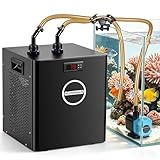
BAOSHISHAN 1/3 HP Chiller
- 1/3 HP compressor
- 8-15F temperature drop
- Titanium evaporator
- 800 L/H flow

Active Aqua 0.25 HP Titanium
- 0.25 HP motor
- 40-92 gallon rating
- Boost pull-down mode
- Titanium evaporator

Active Aqua 0.10 HP Boost
- 1020 BTU capacity
- 10-40 gallon rating
- Digital setpoint control
- Boost function
All 10 Reservoir Chillers Compared
Every unit below has a compressor and a water-contact heat exchanger, and every one of them is rated in gallons of water it can hold rather than in tons of cooling. That matters, because the gallon rating is what you actually match to your reservoir.
| Product | Specifications | Action |
|---|---|---|
| BAOSHISHAN 1/3 HP Chiller up to 79 Gal |
|
Check Latest Price |
| Active Aqua 0.25 HP Titanium 40-92 Gal |
|
Check Latest Price |
| Active Aqua 0.10 HP Boost 10-40 Gal |
|
Check Latest Price |
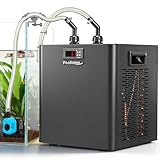 Poafamx 1/3 HP Chiller 40-80 Gal Poafamx 1/3 HP Chiller 40-80 Gal |
|
Check Latest Price |
 Fitnet 1/3 HP Touch Screen Chiller 79 Gal Fitnet 1/3 HP Touch Screen Chiller 79 Gal |
|
Check Latest Price |
 FIIRUS 1/3 HP Wi-Fi Chiller 79 Gal FIIRUS 1/3 HP Wi-Fi Chiller 79 Gal |
|
Check Latest Price |
 VEVOR 1/3 HP Water Chiller 110 Gal VEVOR 1/3 HP Water Chiller 110 Gal |
|
Check Latest Price |
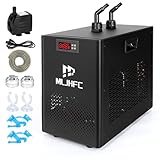 MLJHFC 1/10 HP Quiet Chiller 42 Gal MLJHFC 1/10 HP Quiet Chiller 42 Gal |
|
Check Latest Price |
 Erfolkerz 1/10 HP Chiller 42 Gal Kit Erfolkerz 1/10 HP Chiller 42 Gal Kit |
|
Check Latest Price |
 AKSDSGA 1/10 HP Chiller 160L 270W AKSDSGA 1/10 HP Chiller 160L 270W |
|
Check Latest Price |
What Is a Hydroponic Reservoir Chiller?
A hydroponic reservoir chiller is an in-line refrigeration unit that pumps nutrient solution through a sealed metal coil to hold reservoir water at a steady temperature, typically 65-70F, regardless of how warm the grow room gets. Most are compressor-driven and rated in horsepower, in BTU, and in the gallons of water they can cool rather than in the amount of room air they can condition.
How it works is simpler than it looks. A small compressor circulates refrigerant through a titanium or stainless coil sitting in a water bath inside the unit. Water from your reservoir is pumped through that coil, gives up heat to it, and returns to the reservoir cooler.
Three spec numbers decide whether a chiller keeps up with your system:
- Compressor size is the headline number, from 1/10 HP for a 40 gallon reservoir up to 1/3 HP and beyond for larger volumes.
- Flow rate decides how quickly water moves through the coil. The models here run between 800 and 1200 liters per hour, and higher is better for a recirculating loop.
- Ventilation clearance matters more than most buyers expect. These machines dump heat into the surrounding air, so a chiller crammed into a closet will not hold setpoint.
That last point is the difference between a chiller and an air conditioner. An AC cools the room, which cools the water indirectly and dumps heat outside. A reservoir chiller dumps heat into the room, so it belongs outside the tent or in a ventilated space.
Warm nutrient solution also holds less dissolved oxygen. Water at 78F carries noticeably less oxygen than water at 65F, and roots that cannot take up oxygen stop taking up nutrients, which is why heat and root rot arrive together in July.
Target Nutrient Solution Temperature by Crop
Most hydroponic roots do best between 65F and 70F, but the exact target depends on what you are growing. Warm crops tolerate a slightly higher setting, and leafy greens reward you for pushing to the cool end.
- Lettuce and other leafy greens: 65-68F. Cold water keeps roots white and dense and slows Pythium, which is why growers running leafy green systems in a warm room need a chiller more than almost any other crop.
- Herbs such as basil and mint: 67-70F. Basil is slightly more forgiving, and keeping water in this band avoids the shock that stalls a basil root system mid-grow.
- Strawberries and other fruiting crops: 68-72F. Slightly warmer water supports the higher metabolic demand once plants are flowering, and growers running a dedicated strawberry setup can see the reservoir-side detail in our hydroponic systems for strawberries guide.
- Tomatoes and peppers: 70-72F. Warm crops will tolerate warm water, but going above 72F still invites root pathogens.
Going colder than 65F is not a free improvement. Very cold water holds more oxygen but slows root growth, and growers running fridge-based DIY setups regularly report nutrient solubility problems when solution drops too low. If you are setting up an NFT channel for lettuce, our NFT guide for lettuce covers the return-line and reservoir side of that loop.
1. BAOSHISHAN 1/3 HP Aquarium Chiller for Tanks up to 79 Gallons
BAOSHISHAN 1/3 HP Aquarium Chiller Up to 79 Gal, Drops Down 8-15F 110V
1/3 HP compressor
Titanium evaporator
800 L/H flow
45-50dB at 1 meter
Pros
- Holds reservoirs well below ambient temperature
- Quiet operation comparable to a mini fridge
- Pump tubing and fittings included in the box
- Titanium evaporator resists corrosion
- Responsive customer service
Cons
- Printed manual is largely useless
- Control panel display uses Chinese characters
- Included 3/8-inch fittings restrict flow
This is the unit I keep coming back to for mid-size systems. Long-term hydroponic users report it pulling 20 to 55 gallon reservoirs down 10 to 15F below ambient with steady running and no leaks, which covers the gap between a small 1/10 HP unit and a full 1/3 HP unit without the jump in footprint.
What separates it is that the box includes the water pump, tubing and fittings, so nothing else needs buying before you plumb it into a reservoir loop. The stainless steel shaft pump is the weak point in the package, and a stronger inline pump is the first upgrade most owners make.

The 1/3 HP compressor drops water 8 to 15F and is rated for tanks up to 79 gallons, though the manufacturer suggests 63 gallons in peak summer. That gap between the headline rating and the summer recommendation is a sensible habit of mind, and it is the same logic I use when matching any of these models to a reservoir.
Dual high-speed fans with enlarged side vents handle heat rejection, and the casing keeps noise to 45 to 50dB at one meter, roughly a mini fridge hum. Plan on six inches of clearance on all sides so the fans can pull room air rather than recirculate hot exhaust.

What you should check before buying
Read the specifications rather than the pictures. The on-screen temperature can read a few degrees off an independent thermometer, so drop a cheap probe in the reservoir and trust that reading instead of the built-in display.
Confirm your fittings. The included 3/8-inch barbs choke flow relative to the 800 L/H headline figure, and a 1/2-inch barb kit is a cheap fix that most owners make within a week of setup.
Who it suits and who should pass
This is the right pick for anyone running DWC or RDWC in a 20 to 60 gallon range in a room that regularly sits above 78F. It has the largest review base of any model here, which means there is a lot of long-run data behind it.
Skip it if your reservoir is under 20 gallons, where the cooling capacity is wasted, or if you need a display you can read without a magnifying glass. Several owners also report units cycling noisily or giving out after a full summer of 90F-plus ambient, so buy one with a clear warranty and keep it shaded and ventilated.
2. Active Aqua 0.25 HP Titanium Chiller for 40 to 92 Gallon Reservoirs
Active Aqua Hydroponic Water Chiller, 0.25 HP, Pure Titanium, 40-92 Gallon
0.25 HP motor
396-925 GPH flow
40-92 gallon range
Titanium evaporator
Pros
- Established hydroponic brand name
- Titanium evaporator built for continuous reservoir duty
- Boost function shortens initial pull-down
- Holds set temperature accurately
- Handles reservoirs up to 92 gallons
Cons
- Pump and hoses are not included
- Several long-term owners report failure around 7-12 months
- Highest complaint share in this group
This is the chiller most growers mean when they say hydroponic chiller. Active Aqua built the name in aquaponics, and the titanium evaporator here is specified for continuous nutrient-reservoir duty rather than occasional aquarium use, which is exactly the duty cycle you have.
Owners of the 0.25 HP unit generally confirm accurate temperature holding and strong cooling for 40 to 90 gallon reservoirs. The Boost feature runs the compressor hard for an initial pull-down, then backs off, so you can drop a warm reservoir quickly after a refill.

Flow rate is listed at 396 to 925 gallons per hour depending on where in the range you measure, and it is designed to pair with the AAPW400, AAPW550 and AAPW800 pumps. If you already run one of those, matching is straightforward.
The important catch is that the pump and hoses are not included, so budget for them separately and size them to your actual lift height. A reservoir on the floor with the chiller above it needs more head pressure than the 40 gallon tote next to the chiller.

What you should check before buying
Read the durability pattern, not just the rating. Multiple one-star reports describe units that stopped chilling around the one-year mark, alongside a few reports of units running away cold or failing to start at all.
That complaint share is the highest of any product in this roundup, so treat this as a purchase with a support relationship rather than a set-and-forget appliance. Confirm the warranty terms before you commit, and keep the return window open through at least one full summer of use.
Who it suits and who should pass
Choose this one if your reservoir runs 40 to 90 gallons, if you are building an aquaponic loop, or if you want a brand with a deep parts and service ecosystem behind it. The 92 gallon ceiling is the highest verified reservoir coverage among the models we looked at with a hydroponic track record.
Pass if your setup is a single 20 gallon bucket, where a 0.25 HP unit is oversized, or if the budget stops you from also buying the pump and hoses. Budget-conscious growers with large reservoirs usually get more cooling per unit of spend from a 1/3 HP aquarium-derived unit.
3. Active Aqua 0.10 HP Chiller with Boost for 10 to 40 Gallon Reservoirs
Active Aqua Water Chiller with Boost, 0.10 HP, 10-40 Gal, Cold Plunge
1020 BTU compressor
10-40 gallon range
510 watts listed
About 180W measured
Pros
- Accurate within about a degree of a separate thermometer
- Cycles on a programmable differential
- Quiet enough to sit near a reservoir
- Straightforward digital setpoint programming
- Multi-year continuous operation reported
Cons
- Expensive for the cooling delivered
- Pump and hoses not included
- Barb fittings undersized
- Fans stop immediately with the compressor
This is the smallest chiller I would actually put on a hydroponic reservoir. Hydroponic growers running RDWC and drip systems on 20 to 45 gallon reservoirs report accurate temperature holding, easy setpoint programming and quiet running, with real-world draw measured around 180 watts during cooling.
That measured figure is worth sitting with. The listing shows 510 watts, but growers with a clamp meter report closer to 180W while the compressor is running, and the digital control cycles on a programmable differential rather than running constantly.

The 1/10 HP compressor is rated at 1020 BTU, which is the honest way to size it: it holds a 10 to 40 gallon reservoir and does not chase a 60 gallon one. The boost function gives you a fast initial chill after topping up or draining the system.
The titanium evaporator handles fresh or salt water, and the same unit works for cold plunge tubs, reef tanks and aquariums, which is why it is so widely reviewed. Long-term owners report multi-year continuous operation, which is more than several larger models here can claim.

What you should check before buying
Plan the plumbing. Pump and hoses are not included, and the barb fittings on the unit are undersized, so a 1/2-inch barb kit is usually needed before you connect to anything.
Also note the fan behaviour. Fans cut out immediately when the compressor stops rather than running a cooldown cycle, so expect a more abrupt sound pattern than a bigger model, and keep clear of the intake when it cycles.
Who it suits and who should pass
This is the right unit for a single DWC bucket or a small RDWC system, for anyone who wants setpoint accuracy within a degree, and for a room where noise matters. It is also the sensible first chiller for a grower who is not sure whether a chiller is the answer yet.
Pass if you have more than 40 gallons of reservoir to cool, because you will run the compressor constantly without reaching setpoint, or if you need a unit that arrives with a pump. Several owners also report failures within a few months, so treat the warranty seriously.
4. Poafamx 1/3 HP Aquarium Chiller for 40 to 80 Gallons
Poafamx 1/3 HP Aquarium Chiller, Quiet Fish Tank Water Chiller 40-80 Gal
1/3 HP compressor
65-80F range
Under 45dB
R290 refrigerant
Pros
- Cools hydroponic and aeroponic totes steadily with no leaks
- Quiet enough for living spaces at under 45dB
- Complete kit means no separate pump purchase
- R290 refrigerant with low global warming potential
Cons
- Included pump pushes only about 158 GPH
- Several units reported dead within 8-12 months
- Needs clearance from walls for rear heat discharge
This unit has an unusually honest spec sheet for the category. It states a 65 to 80F range, a maximum drop of 10C below room temperature, a one-year warranty, and a list of 79 gallon and 42 gallon variants, which tells you exactly what you are buying.
Buyers confirm it does the cooling job for hydroponic totes and tanks, holds setpoints and runs quietly. It is also explicitly marketed for hydroponic integration, which is unusual for a brand with an aquarium-first catalogue.

Under 45dB with a ventilated case and dual cooling fans makes it one of the quieter compressors here, and the R290 refrigerant means no global warming penalty in the loop gas. The titanium evaporator handles both fresh and salt water.
Everything you need to start is in the box: chiller, water pump, water hose, hose connectors and clamp. That matters for first-time buyers who otherwise spend a week sourcing fittings before they can run a single test.

What you should check before buying
The included pump is the weak link. It moves about 158 gallons per hour, which is well under what the coil can handle, so most owners upgrade it with a stronger inline pump before they judge the cooling.
Check the reliability pattern too. A meaningful group of owners report the compressor or power switch failing under a year of daily operation, including one documented burnt-wiring report, so treat the one-year warranty as a real constraint rather than a formality.
Who it suits and who should pass
Pick this one for a 40 to 80 gallon reservoir where you want a complete kit, quiet operation, and a lower-gwp refrigerant in a compact footprint. It is a strong middle ground for aeroponic and tote-based systems.
Pass if your system cannot be re-plumbed, because the thermostat readings can run a few degrees off an independent thermometer and you will want a separate probe. It also needs wall clearance for the rear heat discharge, which some small tents cannot give it.
5. Fitnet 1/3 HP Touch Screen Chiller for 79 Gallon Reservoirs
Fitnet 79 Gal Aquarium Chiller, 1/3 HP Fish Tank Water Chiller, Hydroponic Water Chiller with Touch Screen, Hydroponics System Axolotl Jellyfish Coral Reef 300L
1/3 HP compressor
68-79F range
Touch screen control
Power-failure memory
Pros
- Holds target temperature steadily with no leaks
- Works above its 79 gallon rating
- Setpoint memory resumes cooling after a power cut
- Support team responds and sends missing parts
- Quieter than expected for a compressor unit
Cons
- Printed instructions conflict with the product page
- Thermostat can read a few degrees off
- Does not include a filter
- One owner reported a connection fault
The touch screen is the reason this unit stands out, and the power-failure memory is the feature I would actually pay extra for. If your chiller is on the same circuit as lights, pumps and a dehumidifier, an unplanned restart is a matter of when, not if.
Owners running this on 90 to 125 gallon cold plunge tubs and aquariums report strong, stable cooling that holds low temperatures even in 90F weather, with no leak problems. One owner runs it on a 125 gallon tank, comfortably above the 79 gallon rating.

Cooling performance is set between 68 and 79F on a 1/3 HP compressor using R290 refrigerant. Two built-in cooling fans and a perforated housing handle heat dissipation, and a pure titanium pump handles heat exchange.
The water pump, pipe and connectors are all included, which again saves a sourcing trip. A one-year guarantee is standard for the category rather than generous, so treat it accordingly.

What you should check before buying
Read the setup instructions carefully, because the dominant complaint is documentation rather than performance. Owners report the F1 temperature-difference programming is confusing and the printed manual contradicts the product listing.
Budget for a support call or a week of emails if you are not comfortable with programming menus. The thermostat can also read a few degrees off an independent thermometer, so verify setpoint accuracy with a probe once it is running.
Who it suits and who should pass
Choose this for a 60 to 100 gallon reservoir if you want remote-readable control and setpoint recovery after outages, and if you are running alongside other high-draw equipment on the same circuit.
Pass if you need fine control below 68F, since that is the bottom of the range, or if you want a filter, which is not included. It also needs at least six inches of clearance around the unit for the fans to work properly.
6. FIIRUS 1/3 HP Chiller with Wi-Fi App Control for 79 Gallons
FIIRUS 1/3 HP Aquarium Chiller for Up to 79 Gallons
1/3 HP compressor
Wi-Fi app control
Titanium heat exchanger
8 in clearance
Pros
- App gives control over cycle timing and temperature triggers
- Quieter and more compact than the unit it replaced
- Readings track a separate tank probe within a degree
- Complete kit with pump tubing clamps and fittings
- Good insulation keeps noise subdued
Cons
- Requires under 5 GHz Wi-Fi to pair
- Programming happens mainly through the app
- Needs at least 8 inches of side clearance
- Not recommended for a bedroom
This is the only unit in the roundup you can program from a phone, and that changes how you use it. Owners report the app gives full control over cycle timing and temperature triggers, letting the unit run less often instead of chasing setpoint continuously.
That matters for electricity cost. A chiller that cycles tightly on a differential holds temperature with far fewer compressor minutes per day than one running flat out against a warm room, and cycle scheduling is how you control that.

Cooling performance is reported as stable in 60 gallon and coral setups, with quick pull-down from an 80F tank to target. The pure titanium water-contact heat exchanger resists corrosion in both fresh and salt water, and readings track a separate tank probe within about a degree.
A water pump, tubing and connection accessories are supplied. The unit needs at least eight inches of ventilation clearance around the side vents, which is more than most of the other models here ask for.
What you should check before buying
Check your router before you order. The app pairs on 2.4 GHz networks only, so a dual-band mesh system that has moved you to 5 GHz will need the 2.4 GHz band re-enabled first.
Understand that temperature is programmable primarily through the app rather than the panel. If your phone goes missing or the network goes down, the on-unit digital panel still gives you a readout, but the full control path runs through the app.
Who it suits and who should pass
This fits growers who want to cut electricity use by scheduling cycles rather than by buying a bigger unit, and who have a ventilated utility space with eight inches of clearance on each side.
Skip it for a bedroom, because it emits heat, and skip it if you have only 18 ratings of long-run history to lean on. The review base is the smallest of the 1/3 HP models here, so the build is promising rather than proven over many seasons.
7. VEVOR 1/3 HP Water Chiller Rated at 110 Gallons
VEVOR Aquarium Chiller, 110 Gallon, 1/3 HP Water Chiller for Hydroponics
1/3 HP compressor
110 gallon rating
1200 L/H circulation
65-80F range
Pros
- Largest rated reservoir capacity in this roundup
- 1200 L/H circulation rate
- Titanium evaporator for fresh and salt water
- Fluorine-free compressor using R290
- Recognizable widely distributed brand
Cons
- Needs 24 inches of clearance on all sides
- Actual temperature varies with volume and ambient heat
- Emits heat and noise so not suited to a bedroom
- Small review base so far
At 110 gallons of rated capacity and 1200 liters per hour of circulation, this is the largest reservoir rating in the group and the highest flow figure, and both of those numbers matter for large recirculating systems.
High circulation is the difference between cooling a reservoir and churning it. In an RDWC loop where water passes through the coil continuously, flow rate is often the limiting factor before compressor capacity becomes the constraint.
The refrigeration side uses a fluorine-free compressor with R290 refrigerant, and the titanium evaporator handles fresh and salt water. A built-in fan plus ventilation holes cover compressor heat dissipation, and the temperature range is 65 to 80F.
What you should check before buying
Measure your space first. This unit needs at least 24 inches of clearance on all sides, which is the largest footprint requirement of any product here and rules out most tents and small closets.
Manage expectations on setpoint accuracy. Reviewers are reminded that actual water temperature varies from setpoint based on volume, tank size and ambient heat, so a 110 gallon reservoir of warm water will take longer to pull down than a 40 gallon one.
Who it suits and who should pass
This is the pick for a commercial-scale recirculating reservoir, or for a serious multi-bucket RDWC build where flow rate is the bottleneck. If you are running something at the scale covered in our large capacity hydroponic systems guide, this is the size class that matches it.
Pass for a home DWC bucket, for a room where 24 inches of clearance is not available, and for a bedroom. The review base is only 20 ratings, so you are buying on the spec sheet rather than on a long history of field reports.
8. MLJHFC 1/10 HP Quiet Chiller for 42 Gallon Reservoirs
MLJHFC 42Gal Aquarium Chiller 1/10HP 160L Quiet Compressor Cooler
1/10 HP compressor
30-40 dB(A)
800 L/H flow
64-79F range
Pros
- Holds temperature within about a degree of setpoint
- Very quiet compressor cycling on and off
- Solid casing and bright clear front display
- Easy plug-and-play setup with included clamps
- Handles high heat and humidity in a 40-42 gallon tank
Cons
- Included fans are louder than expected
- Manual is machine-translated
- Only 20 ratings to judge it on
- Discharges warm air so needs clearance
This is the quietest unit in the roundup on paper, at 30 to 40 dB(A), and that figure is backed by real-time temperature monitoring and a low-noise compressor with dual silent fans and enhanced ventilation.
With 20 reviews averaging 4.9, owners uniformly report accurate temperature holding within a degree, quiet compressor cycling, easy installation and good build quality, including in high heat and humidity.

Capacity is 42 gallons, about 160 liters, and the range is 64 to 79F at 800 liters per hour. Hose clamps, connectors and a US-standard plug are included, so there is no wiring and no separate fitting run.
The manufacturer recommends keeping water at 80 percent capacity during hot periods, which is sensible advice that applies to every chiller in this roundup rather than just this one. A full reservoir gives the compressor more thermal mass to fight.

What you should check before buying
The one meaningful gripe is the included 120 millimeter fans, which several owners find louder than expected and plan to replace. The headline 30 to 40 dB(A) figure describes the compressor, not necessarily the fans at full speed.
The manual is machine-translated and takes patience to decode. If you are not comfortable with translated technical documentation, the unit itself is straightforward but you will be reading the display panel rather than the booklet.
Who it suits and who should pass
Pick this for a 20 to 42 gallon reservoir in a room where noise is the deciding factor, such as a bedroom-adjacent space or a quiet indoor setup where a compressor hum would be noticeable.
Pass if your reservoir is larger than 42 gallons or if you need a sub-64F setting. It discharges warm air, so it needs clearance in an enclosed space, and 20 ratings is a thin base for judging multi-year durability.
9. Erfolkerz 1/10 HP Chiller with Complete Kit for 42 Gallon Reservoirs
Erfolkerz 1/10 HP Aquarium Chiller– 42gal (160L). for Axolotls, Fish Tanks, hydroponics. Sea & Fresh Water Compatible. Includes Pump, nozzles & Hoops. Ideal for Coral & Shrimp 110V
1/10 HP compressor
45dB operation
Pure titanium evaporator
Over-current shutdown
Pros
- Complete kit with pump nozzles and hoops
- Straightforward button controls without confusing menus
- Runs quietly at about 45dB
- Over-current shutdown and power-failure memory
- Corrosion-resistant titanium for fresh and salt water
Cons
- Only 8 reviews all at 5 stars
- Narrow 68-79F control range
- Very little long-term reliability data
The appeal here is simplicity. Owners describe a complete, easy-to-run kit with quiet operation and clearly labelled buttons, plus safety features most budget units leave out: over-current automatic shutdown and power-failure temperature memory.
That last feature resumes the set temperature after an outage, which is exactly the failure mode that leaves a reservoir sitting at ambient temperature while nobody is watching. The tri-sided cooling design with dual fans handles heat rejection.
What you should check before buying
Check the data, not the stars. With only 8 reviews, all at 5 stars, there is very little long-term reliability data to lean on, and a brand-new listing will always look perfect in early reviews.
The control range is 68 to 79F, which is narrow compared to the models that reach 64F or list a 32F display range. If your room regularly runs above 80F, a unit that cannot push below 68F will struggle to give you a comfortable margin.
Who it suits and who should pass
Choose this for a 20 to 40 gallon reservoir if you want pump, nozzles and hoops included so the whole loop is complete on day one, and if you prefer plain buttons to a menu-driven touch screen.
Pass if you are running a cold plunge or need temperatures below 68F, and pass if durability over several seasons is your main criterion. Buy it understanding you are an early adopter of a young product rather than a late buyer of a proven one.
10. AKSDSGA 1/10 HP Chiller for 160L Reservoirs with 270W Cooling
AKSDSGA 42Gal Aquarium Chiller for Axolotl 1/10HP Water Cooler Fish Tank Chiller Hydroponics Cooling System with Adjustable Temperature, 160L Water Chillers for Aquarium Aquaculture
1/10 HP compressor
270W cooling
47.27 gallon rating
32-122F display range
Pros
- Lowest cost entry point in this group with effective cooling
- Precise stable control verified on a 160L hydroponic setup
- Digital probe tracks real-time water temperature
- Quiet 1/10 HP motor
- Wide 32-122F adjustment range
Cons
- Water pump and pipes are not included
- Slow to pull down a larger 40 gallon tank
- Instructions take time to understand
- One report of a unit arriving defective
This is the cheapest way into the category and reviewers confirm it chills effectively. One hydroponic user reports precise, leak-free temperature control on a 160L system, and a reef keeper held 78F in a 42 gallon tank.
The 1/10 HP compressor has 270W of cooling capacity, rated for 47.27 gallons, with a pure titanium evaporator and a baked-paint metal housing. The digital probe tracks real-time water temperature, and the display is adjustable from 32F to 122F.
The 32F lower bound is a display range rather than a hydroponic target. Set it to the 65F to 70F band that suits your crop and ignore the rest.
What you should check before buying
Confirm what is in the box before you commit. The water pump and pipes are not included, which surprised a few buyers who expected a complete kit, and that changes the real cost of this option considerably.
Size it honestly. Owners report it is slow to pull down a larger 40 gallon tank, and the instructions take some time to understand. With 11 reviews there is also one report of a unit arriving defective, so inspect it on arrival.
Who it suits and who should pass
Choose this if your reservoir is 20 to 40 gallons, your room is moderately warm rather than hot, and you want to test whether a chiller solves your problem before investing in a larger unit or a better pump.
Pass if your reservoir is at the top of its range in a 90F room, because pull-down time is the problem, not peak capacity. It is also a poor fit for anyone who wants a quiet bedroom-adjacent setup without checking noise first.
How to Size a Chiller for Your Reservoir
Size a chiller by matching reservoir volume, ambient room temperature, and the temperature drop you need, in that order. Manufacturer gallon ratings assume a room around 75F, so a room at 85F needs a unit at least one step larger.
The method I use, step by step:
- Measure the reservoir in gallons. Count actual working volume, not the container size. A 55 gallon tote you only fill to 40 gallons is a 40 gallon problem.
- Measure your room temperature at the hottest part of the day. This is the number most buyers skip, and it is the number that determines whether a rating holds.
- Decide your target. 65 to 68F for leafy greens, 68 to 72F for fruiting crops. Lower targets demand more cooling capacity for the same room.
- Add the heat load. Pump heat from the reservoir loop, grow lights, and any camera or dehumidification equipment all end up in the water or in the air around the reservoir.
- Pick one step above the match, not exactly on it. A chiller sized to the last pound runs constantly, wears faster, and costs more to operate than one with headroom that cycles.
Mapped onto the models in this roundup, the ranges look like this:
- 10 to 25 gallons: a 1/10 HP unit, such as the Active Aqua 0.10 HP or the AKSDSGA 160L. Expect 10 to 15F of pull-down below ambient.
- 25 to 45 gallons: a 1/10 HP unit in a hot room, or a 1/3 HP unit in a moderate one. The MLJHFC and Erfolkerz both sit here.
- 45 to 65 gallons: a 1/3 HP unit. The BAOSHISHAN, Poafamx, Fitnet and FIIRUS all cover this band, with the BAOSHISHAN manufacturer suggesting 63 gallons as the summer limit.
- 65 to 92 gallons: the Active Aqua 0.25 HP, or a 1/3 HP unit in a room that rarely exceeds 78F.
- 92 to 110 gallons: the VEVOR 110 gallon unit, with the caveat that the rating assumes a reasonably temperate room.
If your reservoir is part of a larger recirculating build, remember that flow rate often matters before compressor size does. Our guide to large capacity hydroponic systems covers the loop design side of that decision.
What a Reservoir Chiller Actually Costs to Run
Electricity is the single biggest objection to buying a chiller, and the honest answer is that a correctly sized unit is not the expensive thing people fear. Growers who measured draw on the Active Aqua 1/10 HP found roughly 180 watts while the compressor was running, against a 510 watt listing figure.
Work from measured draw, not label wattage. Assume the compressor runs between 8 and 14 hours a day in summer depending on room temperature, target temperature, and reservoir volume:
- 180W running, 12 hours a day: about 2.2 kWh per day, or roughly 65 kWh per month.
- 250W running, 16 hours a day in a hot room: about 4.0 kWh per day, or roughly 120 kWh per month.
- A chiller cycling on a tight differential with app scheduling: the lower end of that range, because idle minutes drop faster than peak draw rises.
Compare that to the alternative. A room air conditioner runs far more continuously and cools the whole volume, not just the water, and ice and frozen bottle methods need daily handling and produce inconsistent temperatures overnight.
Two habits cut the bill further. Keep the reservoir out of direct light, and keep the chiller itself in a ventilated space so it is not fighting its own exhaust. Both cost nothing.
Installation and Heat Rejection
Install a reservoir chiller outside the grow tent, in a ventilated space, with 2 to 3 meters of loop between the chiller and the reservoir. Placing it inside the tent makes the tent hotter, because the unit expels the heat it removes from the water into the same air.
That single placement mistake defeats the purchase, and it is the most common error growers make. The circulation distance also acts as a buffer: water moving through a longer insulated loop gives up heat to the room before it reaches the chiller, which reduces compressor run time.
Match the pump to the lift. A reservoir below the chiller needs a pump rated for that head height, and the 158 GPH pump in one of the kits above is rarely enough for a raised reservoir. Specs here range from 396 to 1200 gallons per hour, and higher flow means better turnover in a recirculating loop.
Give the fans their clearance. Requirements across this roundup run from 6 inches around the unit to 8 inches at the sides and 24 inches on all sides for the largest. A unit starved of fresh air will hold setpoint poorly and run longer than its wattage suggests.
Use insulated, opaque tubing between the chiller and the reservoir, and keep the chiller bath around 8 to 10 liters if the model has a small internal reservoir. Light entering the loop feeds algae, and shaded tubing costs almost nothing.
Chiller vs Ice, Air Conditioner, Swamp Cooler and Mini-Fridge
A chiller is the only option on this list that holds a setpoint overnight without attention. The others work, but each trades away control, labour, or efficiency.
- Ice or frozen bottles: nearly free to start and genuinely effective for short periods, but someone has to swap them daily, and water temperature drifts upward between swaps. Fine as a stopgap, not a system.
- Room air conditioner: cools the room and therefore the water, and works well in a small tent. It costs more to run, dumps heat outside, and leaves the room cold rather than the water targeted.
- Swamp cooler: works by evaporative cooling, so it depends on low humidity. In humid summer air it barely moves the temperature and adds humidity to the room, which is the opposite of what roots need.
- Scored mini-fridge: a common second-hand workaround that works for a single bucket. Growers report the main failure is dropping solution too cold, which causes nutrient solubility problems.
- Reservoir chiller: holds a precise setpoint continuously, has no moving parts in the water, and costs more up front and less attention over a season.
The honest framing is that a chiller is a controlled answer and the alternatives are periodic ones. If your room temperature already stays below 70F, none of this is necessary.
Water Quality, Scaling and Coil Care
Fill the chiller loop with distilled or deionised water where the manufacturer allows it. Mineral-heavy tap water leaves scale on titanium and stainless heat exchangers, and scale is insulating, so cooling output drops over the first season of use.
Where the unit requires tap or mixed water, keep an eye on the display and probe the actual water temperature rather than trusting the built-in sensor. Several models here are documented as reading a few degrees off an independent thermometer, which makes a cheap external probe worth adding to the budget.
Run the bath at the manufacturer fill level, and drop to 80 percent capacity in peak heat. More water gives the compressor more thermal mass and shortens cycling intervals.
Clean the coil once a season. Flush the loop with a mild citric acid solution, run the pump for an hour, then flush again with clean water, following whatever the manual specifies. A chiller that has been running nutrient-contaminated loop water will scale faster than one kept clean.
Pair cooling with hygiene. Growers pair chillers with algaecide and covered or opaque reservoirs rather than relying on cooling alone, because lower temperature slows pathogen growth but does not eliminate it.
What to Look For in a Reservoir Chiller
Look at five things before you buy, in this order: reservoir coverage, flow rate, pump inclusion, ventilation clearance, and warranty length.
- Reservoir coverage in gallons: match it to your actual working volume and your room temperature, then add one step. A 79 gallon rating in an 85F room is a 60 gallon chiller.
- Flow rate in liters per hour: 800 L/H is adequate for a single reservoir, while 1200 L/H and above is what recirculating RDWC loops want. Higher flow shortens the loop time and improves even temperature.
- Pump and hose inclusion: four of the models here include a pump, and three do not. An included pump is often the weakest component, so plan to upgrade it regardless.
- Ventilation clearance: anywhere from 6 to 24 inches. Measure the space before ordering, not after.
- Warranty length and control type: one year is the category norm. App control with cycle scheduling is a genuine advantage for electricity use; touch screens are convenient; plain buttons are fine if the menu depth is low.
Titanium evaporators are standard across this category, so that is no longer a differentiator. Noise figures vary widely, from 30 to 40 dB(A) to 45 to 50 dB, and that range is the difference between a unit you forget is running and one you do not.
When You Should Not Buy a Chiller
Skip the chiller if your reservoir is under about 20 gallons and your room stays below 70F, because a 1/10 HP unit will be oversized for the load and the money is better spent on a pump. Ice and frozen bottles handle a 20 gallon bucket on a mild week.
Also skip it if the real problem is room temperature. A chiller removes heat from water, and that heat goes into your room. If the room is 85F and gaining heat from lights faster than the machine can reject it, the water still ends up warm. In that case the first purchase is light management, airflow, or room cooling.
And do not buy one to solve a root rot problem on its own. Warm water encourages Pythium, but so do poor circulation, low oxygen, and a reservoir that has been sitting uncovered and feeding on light. Fix the hygiene and the oxygenation first.
For herbs grown indoors, where the room is typically a normal living space rather than a 90F grow room, start with airflow. Our indoor hydroponic garden guide for herbs covers setups where a chiller would be dead weight.
Frequently Asked Questions
What is the best water chiller for hydroponics?
For most home growers, the BAOSHISHAN 1/3 HP is the best fit, because it cools 20 to 60 gallon reservoirs 8 to 15F below ambient and comes with a pump, tubing and fittings. Larger recirculating systems from 65 to 110 gallons need a bigger unit, such as the Active Aqua 0.25 HP or the VEVOR 110 gallon model. Match the gallon rating to your working reservoir volume and your hottest room temperature, not to the container size.
What is a water chiller used for in hydroponics?
A water chiller holds nutrient solution at a set temperature, usually 65 to 70F, by pumping reservoir water through a sealed titanium or stainless coil. Cool water holds more dissolved oxygen, so roots keep taking up nutrients, and pathogen growth such as Pythium slows. The heat removed from the water is expelled into the surrounding air, which is why the unit belongs outside the grow tent.
What temperature should hydroponic water be?
Most hydroponic crops perform best between 65F and 70F. Lettuce and other leafy greens do best at 65 to 68F, herbs such as basil at 67 to 70F, strawberries at 68 to 72F, and tomatoes and peppers at 70 to 72F. Going much colder slows root growth and can cause nutrient solubility problems, particularly in fridge-based DIY setups.
How big of a chiller do I need for my reservoir?
Match the gallon rating to your actual working reservoir volume, then add one step if your room regularly runs above 80F. A 1/10 HP unit handles roughly 10 to 40 gallons, a 1/3 HP unit covers about 45 to 80 gallons, and a 0.25 HP to 1/3 HP unit handles 65 to 110 gallon recirculating reservoirs. Manufacturer ratings assume a room near 75F, so a hot room shrinks the usable capacity.
Can I use an aquarium chiller for hydroponics?
Yes, and most hydroponic chillers sold today are aquarium-derived units with titanium heat exchangers, because a titanium coil tolerates years of contact with dissolved salts and nutrient runoff. The key differences from a reef setup are flow rate, which needs to match your recirculating loop, and warranty length, since a nutrient reservoir is a harsher environment than a display tank.
How much electricity does a hydroponic chiller use?
Growers who measured draw on a 1/10 HP unit found roughly 180 watts while the compressor was running, against a 510 watt listing figure. At 180W for 12 hours a day that is about 2.2 kWh per day and roughly 65 kWh per month. A 1/3 HP unit in a hot room can approach 4 kWh per day. Scheduling cycles through an app or digital controller lowers the total by cutting idle compressor minutes.
Should my hydroponic chiller be inside the grow tent?
No. A chiller expels the heat it removes from the water into the surrounding air, so running it inside a tent makes the tent hotter and undoes the cooling. Install it in a ventilated space outside the tent with 2 to 3 meters of loop between the chiller and the reservoir, and give the fans the clearance the manual specifies, which ranges from 6 to 24 inches depending on the model.
How can I keep my DWC water cool without a chiller?
Cover the reservoir to block light, add a surface aerator to raise dissolved oxygen, and run the room as cool as you can. Ice packs or frozen water bottles work as a short-term measure but need daily swapping and drift upward between swaps. A scored mini-fridge works for a single bucket but often drops the solution too cold, which causes nutrient solubility problems. If summer water temperatures stay above 70F, a chiller is the only method that holds a setpoint overnight.
The Bottom Line on Hydroponic Reservoir Chillers
The BAOSHISHAN 1/3 HP is the pick for most people reading this, with a 1/3 HP compressor, a titanium evaporator, 800 L/H of flow, and a pump and fittings in the box, backed by the largest review base in the group. Step up to the Active Aqua 0.25 HP if your reservoir is 65 to 90 gallons, and drop to a 1/10 HP unit such as the MLJHFC or Active Aqua 0.10 HP if you are under 40 gallons and noise or bedroom proximity is the deciding factor.
Whatever you choose, size it to your working volume and your hottest room temperature, install it outside the tent with the clearance it requires, and fill the loop with distilled water. Get those three right and the best reservoir chillers for hydroponic systems will hold your solution in the 65 to 70F band all summer without you touching anything.