
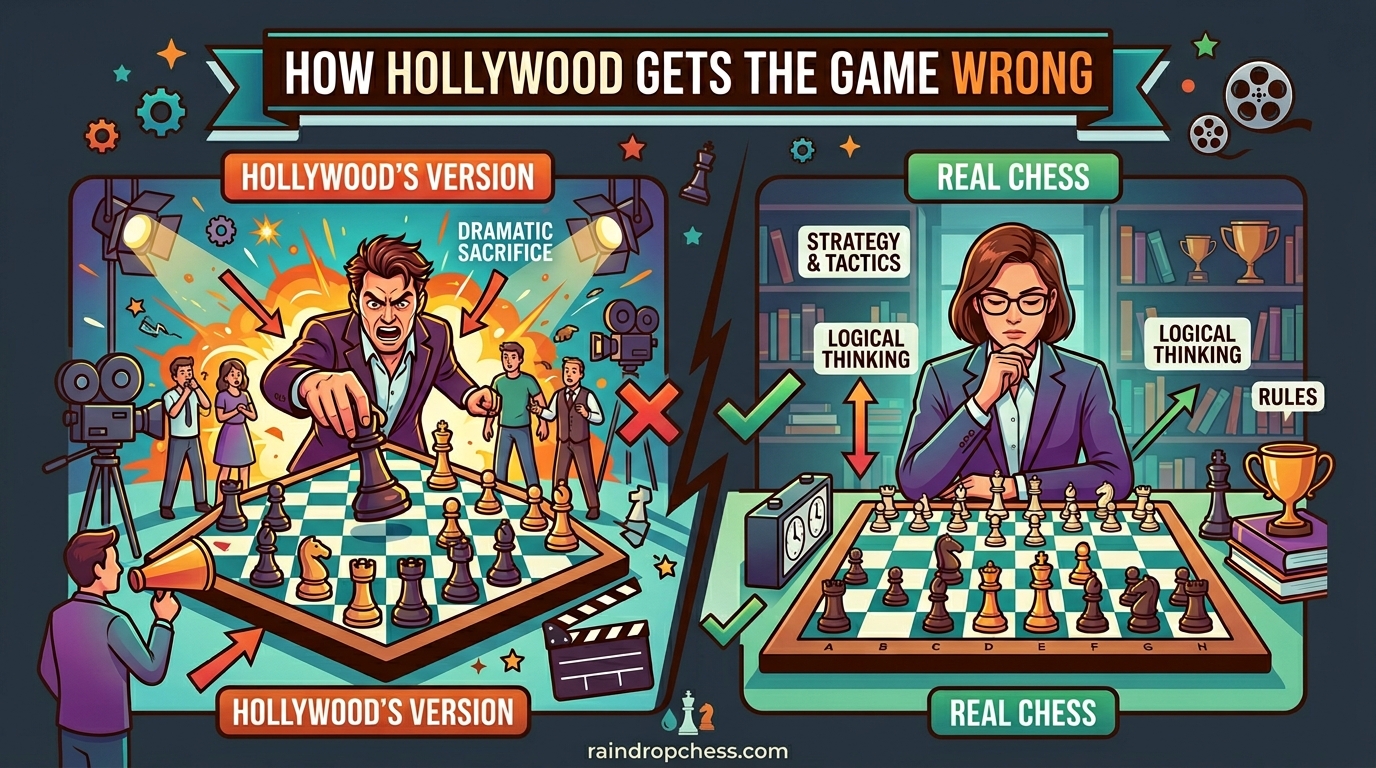
Every chess player knows the feeling. You are settled into the couch, watching a movie, and suddenly there it is: a chessboard on screen. You lean forward. You squint. And within seconds, you spot it. The board is backwards. The queen is on the wrong square. Or there are three bishops on the same color. Chess in TV shows and how Hollywood gets the game wrong is practically its own genre of entertainment for anyone who knows the rules.
I have been playing chess for over fifteen years, and I have paused more movie scenes than I care to admit just to analyze the position on screen. My friends think I am obsessed. They might be right. But the truth is, Hollywood chess errors are so consistent, so predictable, that you can almost set your watch by them.
In this article, I am going to break down the most common chess mistakes in TV shows and movies, explain why they happen, and highlight a few rare examples where filmmakers actually got it right. Whether you are a casual viewer or a rated tournament player, you will never watch a chess scene the same way again.
Table of Contents
Why Hollywood Keeps Getting Chess Wrong
The short answer: because almost nobody notices. Filmmakers make decisions based on what looks good on camera, not what satisfies the roughly two percent of the audience who actually knows how to play chess. A backwards board reads the same to most viewers as a correctly oriented one. A dramatic king tip reads as resignation. An impossible position looks just like a possible one.
But there are real production reasons behind these Hollywood chess errors too. Hiring a chess consultant costs money. On a tight shooting schedule, nobody wants to spend twenty minutes making sure the h1 square is light when the director needs to move on to the next shot. Prop masters set up the board the way it looks best on camera, and if that means rotating it ninety degrees for a better angle, they do it without a second thought.
I spoke with players who have worked as consultants on film sets, and they all tell a similar story. The chess scene is usually a low-priority moment for the director. It might take up thirty seconds of screen time, but it establishes character intelligence or tension. Accuracy is an afterthought. As one Reddit user on r/chess put it: “Getting a position incorrect will not cost them millions of dollars at the box office.”
That said, the landscape is shifting. The Queen’s Gambit proved that audiences care about authentic chess, and more productions are investing in getting it right. But we still have a long way to go.
Bad Setup: The Backwards Board Epidemic
If there is one mistake that appears in almost every chess scene on screen, it is this: the board is set up wrong. Not the pieces, not the positions, but the board itself. It is rotated ninety degrees so that a dark square sits in the bottom-right corner instead of a light one. Chess players have a simple mnemonic for this rule, and it is violated so often in film and television that spotting it has become a running joke in the chess community.
The Right Is Light Rule
The rule is straightforward: “Right is Light.” The square in the bottom-right corner from each player’s perspective must be a light-colored square. Always. No exceptions. If you sit down at a tournament and the board has a dark square at h1, your opponent will correct you before you even touch a piece.
Yet in film after film, that dark square sits proudly in the lower right. Blade Runner does it. Austin Powers does it. Research by chess.com writers found that the majority of Hollywood chess scenes get this basic orientation wrong. It is the equivalent of a guitarist holding the instrument upside down in a concert scene. It would never fly. But with chess, directors barely notice.
The error is so widespread that when a show does get it right, chess forums light up with praise. The community tracks correct and incorrect setups with almost academic precision, maintaining lists of films that pass the “Right is Light” test.
The Queen On Wrong Color Mistake
The second most common setup error involves queen placement. The rule is simple: the queen starts on her own color. The white queen on a light square, the black queen on a dark square. Chess players sometimes phrase it as “the queen’s shoes match her dress.” White queen wears white, black queen wears black.
This mistake goes hand in hand with the backwards board. If you rotate the board incorrectly, the queen and king positions flip too. Suddenly you have queens on the wrong color and kings where the queens should be. It is a cascade of errors that starts with one wrong turn of the board.
Harry Potter and the Sorcerer’s Stone features one of the most famous chess scenes in cinema, and eagle-eyed players have pointed out setup issues in certain shots. The giant chessboard sequence is thrilling and well-directed, but the pieces are not always where they should be. For most viewers, it does not matter. For chess players, it is like hearing a wrong note in a symphony.
Period dramas are especially guilty of this. A show set in 1890 will have characters playing on a board set up incorrectly, despite the rules being standardized decades earlier. It breaks the historical immersion for anyone who knows the game.
Dramatic Checkmate Myths Hollywood Loves
Beyond the physical setup errors, there is a whole category of Hollywood chess errors that involve how the game is played and how players behave. These are not about piece placement but about the culture and psychology of real chess.
The biggest myth is the dramatic checkmate reveal. In movies, checkmate arrives with a gasp. The winning player slowly picks up a piece, holds it dramatically, places it with authority, and says “Checkmate” in a low voice. The opponent’s eyes go wide. Spectators murmur. Sometimes the board gets swept clean in anger.
In real tournament chess, none of this happens. Strong players usually see checkmate coming several moves in advance. When it arrives, the losing player often resigns before it even happens, stopping the clock and offering a handshake. The idea of being “surprised” by checkmate at the tournament level is essentially fiction.
Then there is the king tip. You have seen it in dozens of films: a player who has lost gently pushes their king over, letting it fall on its side. It looks elegant and dramatic. The problem is that this is not a real convention. Players resign by saying “I resign,” offering a handshake, or stopping the clock. The king tip is a purely theatrical invention that exists only in movies and television.
Emotional reactions are similarly exaggerated. In The Queen’s Gambit, Beth Harmon sometimes reacts visibly to her opponent’s moves. In reality, tournament players maintain composure. Grandmasters sit at the board for six hours with barely a change in expression. The drama is internal, invisible, happening in calculations that no camera can capture.
This is the fundamental tension between chess and cinema. Real chess is subtle and internal. Movies need visible, external drama. So directors invent a version of chess that looks like what non-players imagine the game feels like, rather than what it actually looks like.
Deep Cuts: Illegal Positions and Impossible Games
For casual fans, the backwards board is the obvious error. But for serious players, the real fun starts when you analyze the actual positions on screen. This is where things get truly wild. Hollywood regularly presents chess positions that are physically impossible under the rules of the game.
Consider what an illegal position means. A chess game starts with a specific arrangement of pieces, and every move follows strict rules. At any point in a real game, you can trace the position back to the starting setup. But in movies, prop masters often arrange pieces in ways that could never arise from legal play.
You might see a position with two light-squared bishops for the same player, which is impossible since a player starts with only one bishop per square color. You might spot a pawn that has somehow teleported past another pawn without capturing. Or a king in check while the opposing piece that is delivering check could not possibly have gotten there.
Stanley Kubrick’s 2001: A Space Odyssey has a famous scene where the computer HAL plays chess with astronaut Frank Poole. Kubrick was a strong chess player himself, yet the game shown contains errors. The position HAL describes does not match what is on the board, and the moves do not follow from the starting position. It is a fascinating example because Kubrick clearly knew better, but film priorities won out.
The Office has a brief chess moment that similarly falls apart under analysis. In one scene, you can spot bishops on squares that do not match their starting color, suggesting pieces were moved incorrectly or placed randomly for the shot.
Blindfold chess is another area where Hollywood takes liberties. In real life, blindfold chess is an impressive skill where strong players can play entire games without seeing the board. In movies, it is portrayed as almost supernatural, with characters making moves after barely glancing at the position. Real blindfold players rely on systematic calculation, not magic intuition.
TV Shows and Their Chess Blunders
Movies get plenty wrong, but television has its own rich history of chess inaccuracies. Some shows are better than others, and a few have even made genuine efforts at authenticity.
The Queen’s Gambit on Netflix is the gold standard for chess on television. The production hired Grandmaster consultants, and most of the games shown are real positions from actual tournament games. The openings are accurate, the middlegame positions make sense, and the endgame conclusions follow logically. However, chess.com analysts still found a handful of errors. Some tournament situations were unlikely, a few positions did not quite follow from the previous move, and the speed at which Beth resolves certain positions is unrealistic even for a prodigy.
Despite these minor issues, The Queen’s Gambit represents a genuine leap forward. It showed that a production can prioritize chess accuracy without sacrificing drama, and the show’s massive success proved that audiences respond to that authenticity.
The Wire features one of the most discussed chess scenes in television. In Season 1, the character Bodie explains chess rules to his friends using a chessboard on a porch. The scene is not really about chess accuracy; it is about strategy, power, and the game of the streets. Chess players have analyzed the board setup in that scene and found errors, but the cultural significance of the moment transcends technical accuracy. It is one of the rare times chess is used on television not to show someone is smart, but to explore how people think about power and survival.
On the other end of the spectrum, The Simpsons is surprisingly one of the most accurate chess depictions on television. Their episode featuring Magnus Carlsen, where Homer plays the world champion, was praised by the chess community for getting the details right. The board setup was correct, the positions were legal, and the jokes worked for both casual viewers and serious players. If more shows put in this level of effort, this article would be a lot shorter.
Period dramas present a unique challenge. A show set in Victorian England or Renaissance Italy needs chess to look period-appropriate, but the pieces and boards must also be set up correctly for the era. Some productions nail it, while others use modern piece designs in historical settings or ignore period-specific rules that might have applied.
FAQ
What is the most common chess mistake in movies?
The most common chess mistake in movies is setting up the board backwards. The rightmost square from each player’s perspective should be a light square, known as the ‘Right Is Light’ rule. Films like Blade Runner, Austin Powers, and numerous TV shows get this wrong on a regular basis. It is the single most spotted error by chess players watching film and television.
Do real chess players tip their king to resign?
No. Tipping over the king to resign is a purely Hollywood invention. In real tournament chess, players resign by stopping the clock, offering a handshake, or simply saying ‘I resign.’ The dramatic king tip looks great on camera but does not exist in standard chess culture.
Is the chess in The Queen’s Gambit accurate?
Mostly yes. The Queen’s Gambit hired real Grandmaster consultants and used actual tournament games for most positions. However, chess.com analysts found a few minor errors including some unlikely tournament situations and small position inaccuracies. Overall, it remains the most chess-authentic television show produced to date.
What is the Right Is Light rule in chess?
The Right Is Light rule states that the square in the bottom-right corner of the chessboard from each player’s perspective must be a light-colored square. If you see a dark square in the lower right, the board is set up incorrectly. This is the single most violated chess rule in Hollywood productions.
What TV show got chess right?
The Simpsons is widely praised for chess accuracy, especially their episode featuring Magnus Carlsen where the board setup, positions, and gameplay were all correct. The Queen’s Gambit also set a new standard for chess authenticity on television. The Wire’s chess scene, while containing setup errors, is celebrated for its thematic use of the game.
Conclusion
Chess in TV shows and how Hollywood gets the game wrong is a topic that unites chess players in shared frustration and amusement. From the backwards board epidemic to the myth of the dramatic king tip, these errors follow patterns that any trained eye can spot instantly.
The good news is that progress is happening. Shows like The Queen’s Gambit and The Simpsons have proven that chess accuracy does not come at the cost of storytelling. As audiences grow more sophisticated and chess continues its cultural resurgence, directors may finally start getting the details right.
Until then, I will keep my finger on the pause button. Old habits die hard.