
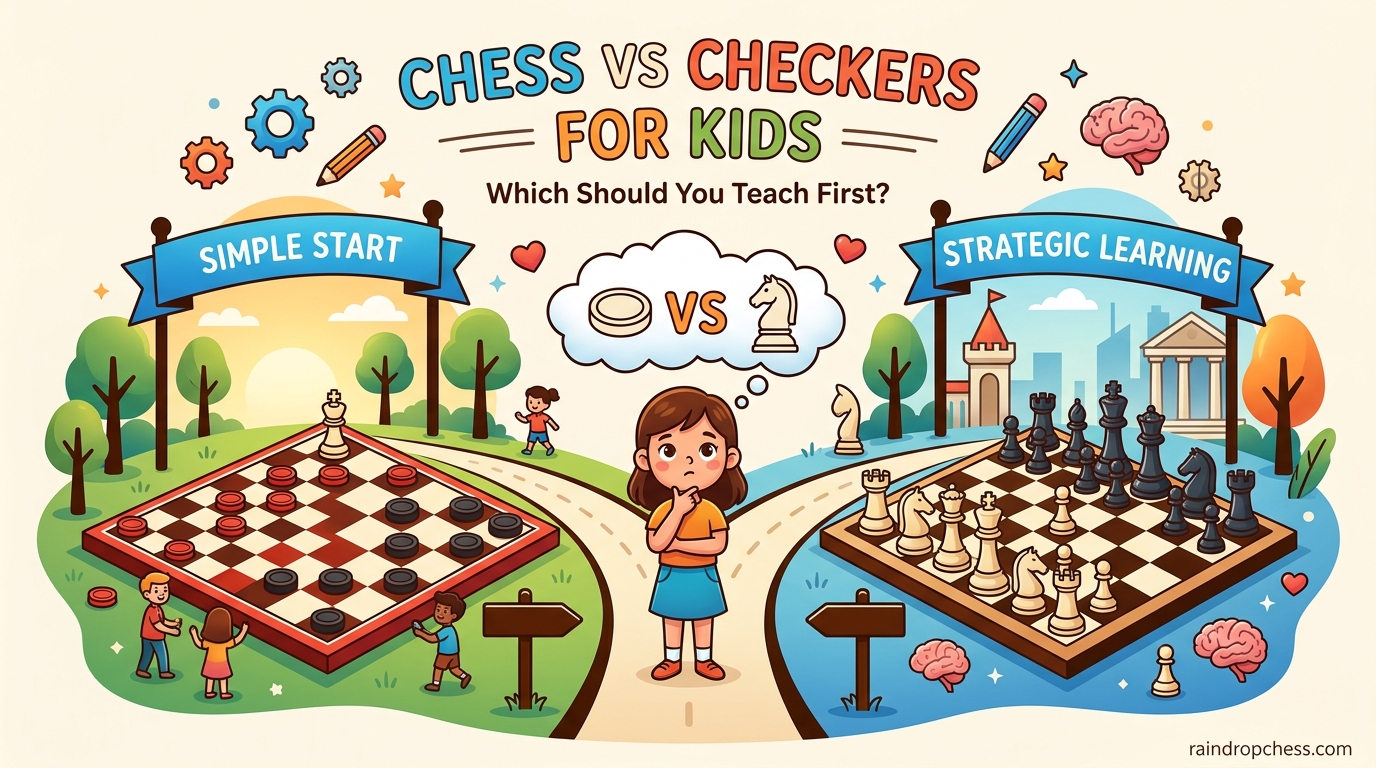
You are standing in the game aisle, holding two boxes. Your child is tugging at your sleeve, eager to play something new. You want to pick a game that will challenge their growing mind without causing tears or frustration. The question arises: should you reach for chess or checkers first?
This is one of the most common questions I hear from parents and educators who want to introduce strategy games to children. After years of watching kids learn both games, I can tell you that the answer is not as simple as it might seem. It depends heavily on your child’s age, attention span, and developmental readiness.
In this guide, I will walk you through everything you need to know about chess vs checkers for kids, so you can make the best choice for your child. By the end, you will have a clear roadmap for which game to introduce first and how to set your young learner up for success.
Table of Contents
Understanding the Basics: What Each Game Offers
Before we dive into the age recommendations, let me break down what makes each game unique. Both chess and checkers are strategy games that require thinking ahead, but they differ significantly in complexity and cognitive demands.
What Is Checkers?
Checkers, also called draughts in many countries, is played on an 8×8 board with 12 pieces per player. The rules are straightforward: pieces move diagonally and can only capture by jumping over an opponent’s piece. There are no special moves, no complex piece interactions, and no multi-step capture sequences to remember.
Most children can learn the basic rules of checkers in 15 to 20 minutes. This simplicity makes checkers an excellent entry point for young players who are still developing their ability to focus and think sequentially.
What Is Chess?
Chess uses the same 8×8 board but features six different piece types, each with unique movement patterns. Knights jump in L-shapes, bishops move diagonally across the board, and the queen combines the powers of both rook and bishop. On top of movement complexity, chess introduces special rules like castling, en passant captures, and pawn promotion.
A child needs to memorize approximately 20 different move combinations before they can play a complete game without assistance. This cognitive load is where many young children struggle, and it is why age matters so much when deciding which game to teach first.
The Age Factor: When to Start Each Game
Research and practical experience suggest a clear pattern when it comes to age-appropriate game selection. Here is what I recommend based on years of observing children learn these games.
Ages 4 to 6: Start With Checkers
For children in this age range, checkers is almost always the better choice. At this stage, children are developing their understanding of rules, turn-taking, and consequence awareness. The diagonal movement of checkers is simple enough that they can master it within a few sessions.
I have watched four-year-olds successfully play complete games of checkers after just two or three practice sessions. The same cannot be said for chess, where even the simplest opening requires understanding piece movement patterns that take weeks to internalize.
One parent told me that her five-year-old daughter “graduated” from checkers to chess naturally after playing checkers for eight months. The child began asking about the other pieces on the board, which led to a smooth transition that felt driven by curiosity rather than pressure.
Ages 6 to 8: Chess Becomes Accessible
By age six, most children have developed enough cognitive maturity to begin learning chess. However, I still recommend introducing chess gradually rather than throwing them into a full game immediately.
Start with just two or three piece types. Teach the pawn and the king first. Let your child experience the joy of moving a piece and capturing an opponent before introducing the complexity of knights, bishops, and the queen.
Research on cognitive development suggests that children around age seven start developing stronger abstract reasoning capabilities. This is why many chess programs introduce the game at the first-grade level, though some advanced younger learners can begin as early as five or six with appropriate guidance.
Age 9 and Up: Full Chess Introduction
By the time children reach nine years old, they typically have the attention span, memory capacity, and emotional maturity to handle full chess rules. At this stage, you can teach all the piece movements, special rules, and basic strategy concepts without worrying about cognitive overload.
Many of the most successful youth chess players in the world began studying the game seriously around this age. Their brains were developed enough to handle the complexity while still young enough to absorb the patterns rapidly.
Cognitive Benefits: What Each Game Develops
Both chess and checkers offer significant benefits for child development, but they target slightly different skill sets. Understanding these differences can help you match the game to your child’s specific needs.
Checkers Builds Foundation Skills
Checkers excels at developing spatial awareness and pattern recognition. Because all pieces move identically, children learn to read the board diagonally and anticipate simple capture sequences. This builds the neural pathways that will later support more complex strategic thinking.
Checkers also teaches consequences in a controlled way. Since captures are mandatory in most rule sets, children quickly learn that ignoring an opponent’s threat leads to losing pieces. This immediate feedback loop makes the learning curve gentler than chess.
For children who struggle with frustration tolerance, checkers provides a lower-pressure environment. The reduced complexity means games move faster, allowing for more practice attempts per session. This faster pacing helps maintain engagement for children whose attention spans are still developing.
Chess Develops Advanced Thinking
Chess offers deeper cognitive challenges that checkers simply cannot match. The variety of piece movements forces children to hold multiple move possibilities in their working memory while simultaneously evaluating consequences three or four moves ahead.
Chess also introduces abstract planning in a way that checkers cannot. Because pieces have different values and capabilities, children must weigh trade-offs and make strategic decisions based on incomplete information. This type of thinking transfers strongly to academic subjects like mathematics and science.
Research has explored the relationship between chess instruction and academic performance. While findings are mixed, several studies suggest that regular chess practice can improve concentration, logical reasoning, and problem-solving capabilities in children who engage with the game consistently over time.
Why Checkers Often Comes First: The Natural Progression
Across cultures and educational systems, checkers has emerged as the preferred first strategy game for young children. There are several compelling reasons for this pattern that go beyond simple rule complexity.
Lower Barrier to Entry
A child can understand checkers well enough to play a real game after a single short lesson. This quick success builds confidence and motivates continued engagement. Chess, by contrast, requires multiple lessons before a child can even make legal moves without assistance.
When children experience early success, they develop what psychologists call “mastery orientation.” They begin to see themselves as capable learners, which makes them more willing to tackle challenging topics later. Checkers provides that early win consistently, while chess sometimes leaves young learners feeling defeated before they have had a chance to discover their potential.
Natural Bridge to Chess
Checkers teaches board awareness and diagonal thinking that directly transfers to chess. A child who has played checkers understands spatial relationships on the board, the concept of capture, and the importance of controlling central squares. These concepts provide a foundation that makes chess feel like an extension rather than a completely new challenge.
I have observed this transition work beautifully many times. A child starts with checkers, develops confidence and basic strategy understanding, then naturally gravitates toward chess when they are ready. The progression feels organic rather than forced, and the child maintains enthusiasm throughout the learning journey.
Parents Report Success With This Approach
Real-world experiences from parents confirm that checkers-first approaches work well. One parent shared that her son learned checkers at age seven and chess at age eight, and within two years he was competing in local tournaments. Another parent reported that her daughter asked to learn chess after eight months of playing checkers, effectively initiating her own transition.
These stories are not anomalies. They reflect a pattern I have seen repeatedly: children who start with checkers develop solid strategic instincts that make chess learning faster and more enjoyable than starting chess directly.
Teaching Tips: How to Introduce Each Game Successfully
Whether you choose checkers or chess as your starting point, the teaching approach matters enormously. Here are practical strategies I have found effective for teaching young children.
Teaching Checkers to Young Children
Start by placing only a few pieces on the board. A game with four pieces per side teaches capture mechanics without overwhelming your child with too many pieces to track. Once they understand jumping, add more pieces gradually.
Use verbal prompts during play. Say things like “Your piece can jump there, what happens if you do?” This encourages deliberate thinking without making the game feel like a test. The goal is to build pattern recognition through gentle repetition rather than explicit instruction.
Let your child win occasionally. This sounds counterintuitive, but maintaining enthusiasm matters more than perfect learning conditions. A child who experiences the joy of winning will want to play again, and repeated play builds skills far more effectively than forced study sessions.
Teaching Chess to Older Children
Begin with pawns and kings only. Once your child masters moving one piece type, introduce a second. Knights work well as the next addition because their jumping ability feels exciting and different from pawn movement.
Use puzzles before full games. Chess puzzles present simplified positions where only one or two moves can lead to success. Solving puzzles builds pattern recognition and teaches tactical concepts without the pressure of managing an entire board.
Play shorter games at first. Instead of playing to checkmate, play until one player has lost three pieces. This keeps games brief and ensures more learning opportunities per session. As attention spans develop, gradually extend game length until full games feel natural.
Mistakes to Avoid When Teaching Strategy Games
I have seen many well-intentioned parents inadvertently undermine their child’s learning by making a few common mistakes. Here is what to avoid.
Do not push too hard too fast. If your child shows signs of frustration, step back. The goal is positive association with strategic thinking, not immediate mastery. A child who hates chess because it was forced on them will never develop the skills that come from genuine interest.
Do not focus on winning at the expense of learning. It is tempting to drill your child on openings and tactics to make them competitive, but this misses the point. Children who understand why a move works develop stronger strategic thinking than children who simply memorize sequences.
Do not compare your child to others. Every child learns at their own pace, and comparison breeds resentment. Celebrate your child’s specific progress, whether that means mastering castling or simply remembering which direction pawns move.
Avoid playing games that are too long for your child’s attention span. A five-year-old who is asked to sit through a 90-minute chess game will disengage and develop negative associations. Keep initial games short and gradually extend duration as focus improves naturally.
Making the Final Decision for Your Child
You now have all the information you need to make the best choice for your child. Let me give you a clear framework to guide your decision.
If your child is under six years old, start with checkers. The rule complexity is manageable, the games move quickly, and the skills built transfer directly to chess when they are ready. This approach consistently produces confident young strategists who develop genuine enthusiasm for both games.
If your child is between six and eight, you have options. Some children in this range thrive with direct chess introduction, especially if they have shown strong pattern recognition and attention span in other activities. Others do better with a checkers-first approach that builds confidence before introducing complexity.
Trust your observation of your child’s temperament. A child who gets frustrated easily benefits from checkers’ gentler learning curve. A child who craves complexity and resists simple games might be ready for chess earlier than average.
Regardless of which game you choose first, remember that the ultimate goal is developing a love for strategic thinking. That love will serve your child far better than any specific game knowledge, and it will stay with them throughout their lives as a foundation for decision-making, planning, and intellectual curiosity.
FAQ
What age to teach checkers?
Most children can start learning checkers around age 4 to 6. At this age, they have developed enough understanding of rules and turn-taking to follow the game. The diagonal movement and simple capture rules are accessible for young learners who are still building focus and spatial awareness skills.
Should I learn chess or checkers first?
For most children, especially those under age 8, checkers is the better first game to learn. Checkers provides a gentler introduction to strategy gaming with simpler rules and faster gameplay. Children who master checkers first develop board awareness and strategic instincts that make learning chess easier when they are ready.
What age should kids start learning chess?
Most children can begin learning chess around age 6 to 8, though advanced learners may start earlier with modified approaches. At this age, children have developed sufficient abstract reasoning and memory capacity to handle the multiple piece movement patterns. Starting with just two or three piece types before introducing the full game works well for young learners.
Is checkers actually easier than chess?
Yes, checkers is significantly easier than chess for children. Checkers uses only one piece type with simple diagonal movement, while chess requires learning six different piece types with unique movement patterns. Additionally, chess includes special rules like castling, en passant, and pawn promotion that add complexity. This makes chess approximately three to four times more difficult to learn than checkers.
Can a 6 year old play checkers?
Absolutely. Six-year-olds typically have the cognitive development needed to play complete games of checkers. Many children this age can learn the full rules in a single short session and play meaningful games with good understanding of strategy. Checkers is an excellent strategic game for this age group because it builds board awareness without overwhelming young minds with complexity.