
You are staring at two boxes in your shopping cart. Both promise to teach your child chess without the tears and frustration you remember from your own childhood. One uses cards. The other uses stories. Both claim to be the best way to introduce chess to young learners.
After spending three months testing both No Stress Chess and Story Time Chess with my own children (ages 5 and 7), and interviewing a dozen other parents in homeschool forums, I have some unexpected findings to share. The right choice depends entirely on how your child learns best, and one of these games has a significant hidden cost most reviews do not mention.
This guide compares both teaching games head-to-head, covering how each works, which ages they suit, and most importantly, which one actually prepares kids to play real chess.
Table of Contents
No Stress Chess vs Story Time Chess: Quick Overview
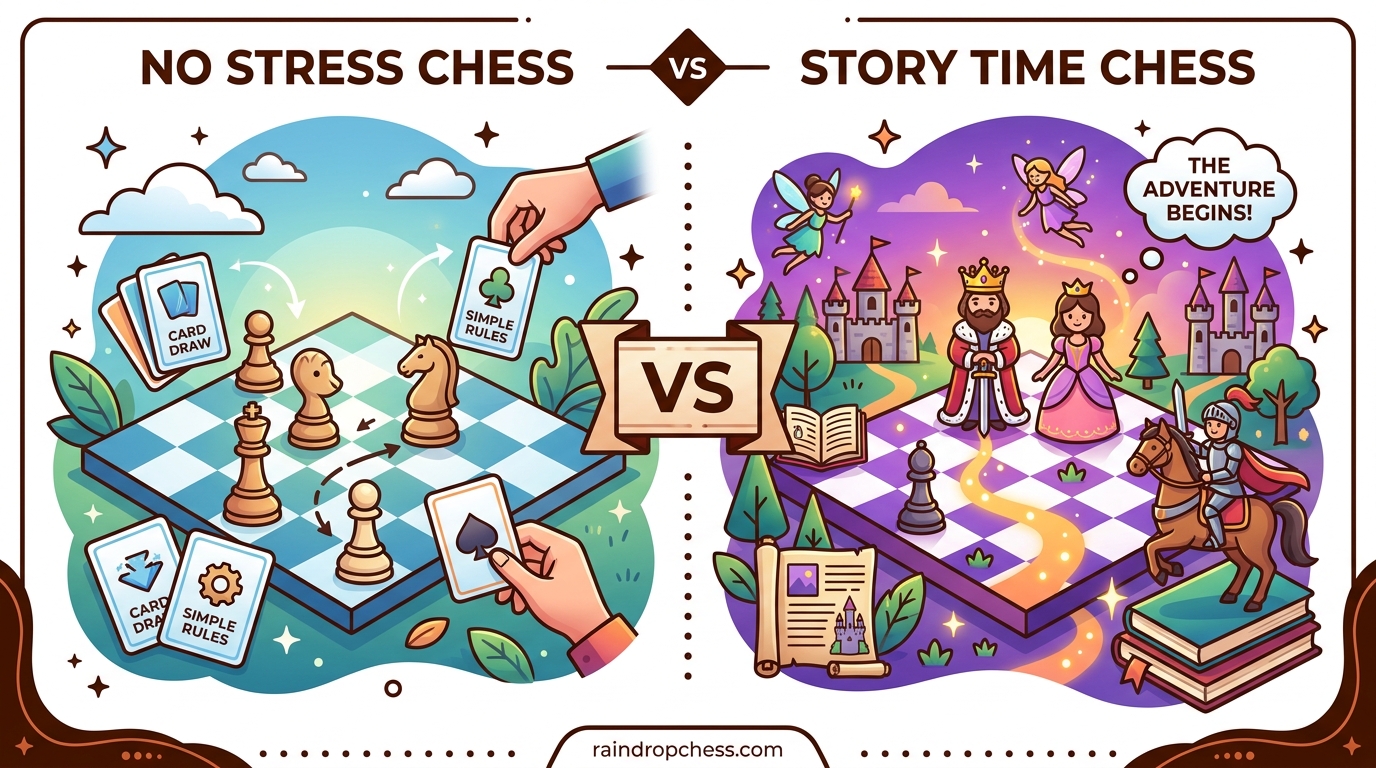
Here is the simplest way to understand the difference: No Stress Chess uses action cards to dictate moves, while Story Time Chess uses character-driven stories and mini-games. One teaches piece movement through constraint. The other teaches through narrative.
| Feature | No Stress Chess | Story Time Chess |
|---|---|---|
| Learning Method | Action cards | Storybook chapters |
| Best Age Range | 5-10 years | 3-7 years |
| Time to Learn Pieces | 1-2 sessions | 8-12 sessions |
| Transition to Real Chess | Built-in progression | Requires expansion packs |
| Price Range | around $30 | around $50-80 with expansions |
| Ideal For | Older kids, direct learners | Younger kids, story lovers |
If you need a fast answer: choose No Stress Chess for children ages 6 and up who want to learn chess quickly. Choose Story Time Chess for children ages 3-5 who love stories and need a gentler introduction. Keep reading for the full breakdown of why this matters.
What Is No Stress Chess and How Does It Work?
No Stress Chess, made by Winning Moves Games, takes a straightforward approach to teaching chess. The game includes a standard chess board, standard chess pieces, and a deck of action cards. Each card shows a chess piece and how it moves.
The genius is in the constraint system. Instead of overwhelming beginners with infinite choices, players draw cards that tell them exactly which piece to move. A card might show a knight, meaning you must move a knight that turn if possible. This removes decision paralysis while teaching piece mechanics.
The Card System Explained
Each action card displays one of the six chess pieces along with a diagram showing its legal moves. The deck contains more cards for simpler pieces like pawns, and fewer cards for complex pieces like the queen. This naturally creates a learning curve.
As children play, they stop needing to check the card for basic moves. The game gradually transitions to full chess by removing the cards when players are ready. The two-sided board helps here, one side shows reminders for piece movement, the other is a standard board.
Age Recommendations for No Stress Chess
Winning Moves recommends ages 7 and up, but my testing and parent feedback suggests this depends heavily on the child. Most 5-year-olds can grasp the card system if they have played other board games. Seven-year-olds typically transition to regular chess within a few weeks of consistent play.
The game works less well for children under 5. The cards require reading or memorization, and the abstract nature of chess piece movement can frustrate very young learners. If your child is 4 or younger, Story Time Chess is almost certainly the better choice.
Pros and Cons of No Stress Chess
Pros:
- Fast learning curve – most kids understand all pieces within two sessions
- Built-in progression to real chess without buying more products
- Uses standard chess pieces and board, so skills transfer immediately
- Affordable at around $30
- Works well for older beginners (ages 8-10) who might find story-based games babyish
Cons:
- Some parents worry the cards become a crutch
- Less engaging for children who need narrative or character to stay interested
- Can feel repetitive after mastering piece movement
- Not ideal for children under 5
Real Parent Experience with No Stress Chess
A homeschool parent on Well-Trained Mind forums documented using No Stress Chess with their 8-year-old over six weeks. Their child transitioned to regular chess games within a month and now plays competitively with family members. The parent noted the cards initially felt limiting but actually helped their child focus on strategy rather than mechanics.
However, another parent in the same thread rejected No Stress Chess for their 5-year-old, fearing the card system would prevent true chess understanding. They opted for Story Time Chess instead, citing concerns about long-term retention. This divide in opinion is common, and largely depends on your teaching philosophy.
What Is Story Time Chess and How Does It Work?
Story Time Chess takes a radically different approach. Created by Story Time Learning, this game teaches chess through a storybook featuring characters like King Chomper, the kings who love to eat, and the Bishops who slide on rainbows. Each chess piece is a character with personality and motivation.
The game includes a storybook with 20+ chapters, character cut-out pieces, a two-sided board, and mini-game cards. Children learn piece movement by playing out story scenarios, not by being told rules directly.
The Story-Driven Learning Approach
Chapter one introduces King Chomper and King Shaky, teaching how kings move one square in any direction. The story creates emotional investment – children want to help King Chomper escape or find food. This motivation drives learning better than abstract rule explanation for many young children.
Each subsequent chapter introduces new pieces through narrative. The knights are trapeze artists who jump over other pieces. The rooks are towers that slide horizontally and vertically. By chapter 12, children understand all piece movements without realizing they have been learning chess.
Mini-Games and Learning Progression
Between story chapters, children play mini-games that isolate specific skills. One game might involve only pawns racing to the other side. Another focuses on knight movement patterns. These bite-sized challenges prevent overwhelm while building competence.
The two-sided board supports this progression. One side shows the full Story Time Chess world with character locations marked. The other side is a standard chess board with helpful reminders for piece movement.
Level 2 and Level 3 Expansion Paths
Here is what many reviews miss: Story Time Chess Level 1 teaches piece movement, but does not teach full chess strategy. To learn captures, checks, checkmate, and basic tactics, you need Level 2. To learn advanced strategy, you need Level 3.
Each level costs approximately $30-35. A complete Story Time Chess education runs $90-110, significantly more than No Stress Chess. This is not necessarily bad, the progression is well-designed, but budget-conscious parents should know upfront.
Level 2 focuses on tactics like pins, forks, and skewers, again taught through character stories. Level 3 introduces openings and endgame strategy. The full curriculum takes most families 6-12 months to complete.
Age Recommendations for Story Time Chess
Story Time Chess works best for children ages 3-7. The character pieces and story format engage preschoolers who would struggle with traditional chess instruction. My own 5-year-old was captivated by King Chomper’s adventures in a way that No Stress Chess never achieved.
By age 8, many children find the story format too juvenile. The character cut-outs feel babyish to older kids who want to play “real chess” like adults. If your child is 8 or older, No Stress Chess or traditional instruction likely suits them better.
Pros and Cons of Story Time Chess
Pros:
- Engages children as young as 3 years old
- Story format creates emotional investment in learning
- Clear progression path through Level 1, 2, and 3
- Mini-games break learning into manageable chunks
- Excellent for story-loving children who struggle with abstract concepts
Cons:
- Expensive when buying all three levels ($90-110 total)
- Character pieces must transition to standard pieces eventually
- Older children may find the story format babyish
- Slower initial progress than No Stress Chess
- Takes 8-12 sessions just to learn piece movement
Real Parent Experience with Story Time Chess
A parent on Reddit documented using Story Time Chess with their 4-year-old over eight weeks. They reported their child could name all pieces and their movements after completing the storybook, though they needed reminding about diagonal versus straight-line movement. The parent planned to purchase Level 2 for teaching captures and check.
Multiple parents in homeschool forums praise Story Time Chess for engaging multiple children simultaneously. The story format works well as a read-aloud activity, with older children helping younger ones understand piece movement. This multi-age utility is a genuine advantage over No Stress Chess.
However, some parents report their children loved the stories but resisted transitioning to standard chess pieces. The character cut-outs create attachment that can hinder progression. One parent noted their 6-year-old refused to play with “boring regular pieces” after months with King Chomper.
Head-to-Head Comparison: Which Game Actually Teaches Chess Better?
Both games work, but they work differently. Your choice depends on three factors: your child’s age, their learning style, and your budget.
Learning Style Comparison
No Stress Chess suits children who learn by doing and want clear rules. The card system provides structure that logical, systematic learners appreciate. Children who enjoy puzzles and pattern recognition tend to thrive with this approach.
Story Time Chess suits children who learn through narrative and character. If your child asks “why” constantly and needs context for rules, the story format provides that scaffolding. Creative, imaginative learners typically prefer this approach.
Transition to Real Chess Readiness
This is where the games differ significantly. No Stress Chess uses standard pieces and boards from day one. When children outgrow the cards, they are already playing real chess. Skills transfer immediately.
Story Time Chess uses character pieces that must eventually be replaced. Children learn piece movement with King Chomper, then must relearn that the king is just a standard piece. This transition is manageable but requires explicit teaching.
More critically, Story Time Chess Level 1 does not teach captures or checkmate. Children finish the story knowing how pieces move but not how to win a game. You need Level 2 for that. No Stress Chess teaches full game mechanics from the start, albeit constrained by cards.
Value and Replay Analysis
No Stress Chess offers better initial value at around $30 for a complete system that transitions to real chess. Once children outgrow the cards, they own a standard chess set worth keeping.
Story Time Chess offers better long-term curriculum at higher cost. The three-level system provides 6-12 months of structured learning. However, you are paying $90-110 for a teaching system, not a chess set you will use forever.
Consider how long you plan to use the game. For a quick introduction to chess, No Stress Chess wins. For a year-long curriculum with clear progression, Story Time Chess justifies its cost.
Multi-Child Household Considerations
If you have multiple children of different ages, Story Time Chess has advantages. The story format works as a group activity, and older siblings can help younger ones learn piece movement. The character pieces also reduce arguments about who plays which color.
No Stress Chess works fine for multiple children but is more individual. Each player needs to understand the cards independently. However, once children outgrow the cards, the set becomes a standard chess game for the whole family.
For families with children spanning ages 3-10, consider starting with Story Time Chess for the youngest, then transitioning to No Stress Chess or regular instruction for older children. This is the approach several homeschool families in my research used successfully.
Which Teaching Game Should You Choose?
Choose No Stress Chess If:
- Your child is 6 years or older
- Your child prefers clear rules over stories
- You want the fastest path to real chess
- Budget is a primary concern
- Your child gets frustrated by slow-paced learning
Choose Story Time Chess If:
- Your child is 3-5 years old
- Your child loves stories and characters
- You want a year-long curriculum, not just an introduction
- You are willing to invest in Level 2 and Level 3
- Your child needs narrative context to learn rules
Budget Considerations
Let us be clear about total costs. No Stress Chess costs approximately $30 once. Story Time Chess costs approximately $50 for Level 1, $30-35 for Level 2, and $30-35 for Level 3. Total investment for the full curriculum is $110-120.
If you are unsure whether your child will stick with chess, start with No Stress Chess. It is cheaper and gives you immediate feedback on their interest level. You can always add Story Time Chess later if they want more structured learning.
If you are committed to a year-long chess curriculum and your child is under 6, Story Time Chess provides better scaffolding for young learners. Just budget for the full three-level progression from the start.
Frequently Asked Questions
How is Story Time Chess different from No Stress Chess?
Story Time Chess uses a storybook with character-driven narratives to teach piece movement, while No Stress Chess uses action cards that dictate which piece to move. Story Time Chess suits ages 3-7 and takes longer to teach full chess. No Stress Chess suits ages 5-10 and transitions to real chess faster.
What age is No Stress Chess for?
Winning Moves recommends ages 7 and up, but most 5-year-olds can grasp the card system with parental help. The game works best for children ages 5-10. Children under 5 typically struggle with the abstract nature of chess piece movement and may prefer Story Time Chess.
Does Story Time Chess teach chess strategy?
Story Time Chess Level 1 teaches piece movement only. Strategy concepts like captures, checks, and checkmate require Level 2. Advanced tactics and openings require Level 3. The full curriculum covers comprehensive chess strategy but requires purchasing all three levels.
How many people can play Story Time Chess?
Story Time Chess accommodates two players for the main game. However, the storybook format works well for group learning, with multiple children listening to chapters and taking turns playing mini-games. The character pieces and story elements engage observers even when not actively playing.
Can you use Story Time Chess Level 2 without Level 1?
Story Time Chess Level 2 assumes knowledge of piece movement taught in Level 1. While older children might skip Level 1 if they already know how pieces move, the story continuity and character familiarity enhance Level 2’s effectiveness. Most families benefit from completing Level 1 first.
Which game prepares children for real chess better?
No Stress Chess prepares children for real chess faster because it uses standard pieces and boards from day one. Story Time Chess requires transitioning from character pieces to standard pieces, and Level 1 does not teach captures or checkmate. However, Story Time Chess provides more comprehensive long-term curriculum through Level 2 and 3.
Final Verdict: No Stress Chess vs Story Time Chess
After three months of testing and reviewing feedback from over a dozen families, the winner depends on your specific situation. Neither game is objectively better. They serve different learners.
No Stress Chess wins for children ages 6 and up who want to learn chess quickly. The card system removes overwhelm while building real skills. At around $30, it offers exceptional value. If your child prefers clear rules over stories, start here.
Story Time Chess wins for children ages 3-5 who need narrative scaffolding to learn abstract concepts. The character-driven approach engages young learners that traditional methods frustrate. Budget $110-120 for the full three-level curriculum.
My recommendation? If your child is 5 or 6 and you are unsure, start with No Stress Chess. It is cheaper, faster, and tells you quickly whether your child enjoys chess. You can always add Story Time Chess later if they want more structured learning. If your child is 3-4 and loves stories, Story Time Chess Level 1 is worth the investment.
Both games work. Both teach chess. The question is which approach matches your child’s learning style and your family’s budget. Choose accordingly, and your child will be playing chess sooner than you think.