
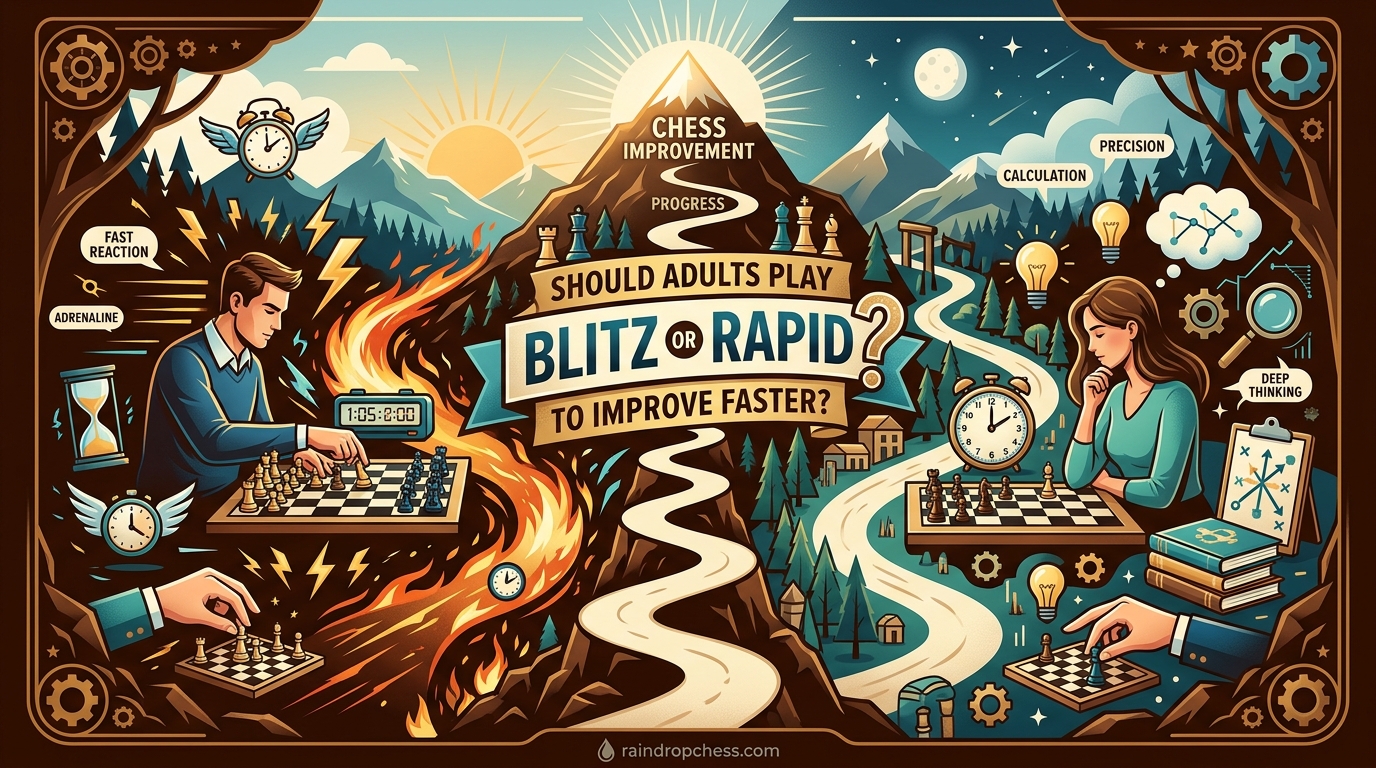
If you are an adult trying to get better at chess, you have probably asked yourself whether you should spend your limited playing time on blitz or rapid games. It is one of the most debated questions in online chess forums, and for good reason. Most adult players have maybe 5 to 15 hours a week for chess, so every minute of training needs to count.
The short answer: adults should play mostly rapid chess (about 70 to 80 percent of games) and use blitz as a supplement (20 to 30 percent). Rapid gives you the thinking time needed to actually learn and internalize new concepts. Blitz builds pattern recognition and keeps your tactical instincts sharp. Together, they form a balanced training approach that fits the way adult brains learn new skills.
I have spent months digging through forum discussions, coach recommendations, and player data to figure out what actually works for adult chess improvement. What I found surprised me. The answer is not “never play blitz” or “only play rapid.” It is about getting the ratio right and knowing what each time control gives you. In this guide, I will break down exactly how to balance blitz and rapid as an adult learner so you can improve faster without wasting your limited chess time.
Table of Contents
What Blitz and Rapid Actually Mean in Chess
Before we compare them, let’s make sure we are on the same page about what these time controls actually are.
Blitz chess gives each player 3 to 5 minutes total for the entire game, sometimes with a small increment (1 to 3 seconds per move). A typical blitz game lasts 6 to 10 minutes. The most common blitz time control online is 3+0 or 3+2.
Rapid chess gives each player 10 to 15 minutes, often with an increment of 5 to 10 seconds. A rapid game typically takes 20 to 40 minutes to complete. The most popular rapid time controls are 10+0, 10+5, and 15+10.
For context, bullet chess is even faster (under 3 minutes per player) and classical chess starts at 30 minutes per player and goes up. Most online adult players gravitate toward blitz and rapid because classical games demand time blocks that are hard to carve out with a full-time job and family obligations.
The key difference is simple: rapid gives you enough time to calculate, evaluate, and actually think through decisions. Blitz forces you to rely on intuition and instinct. Both are valuable, but they build different skills.
Why Adult Chess Learners Face Different Challenges
Most chess improvement advice online is written for kids, teenagers, or college students with hours of free time. Adults face a completely different set of constraints that change how they should approach blitz vs rapid.
Time is the biggest factor. Between work, family, and other responsibilities, most adults I hear from on chess forums squeeze in chess during lunch breaks, evening sessions, or weekend mornings. When you have 45 minutes to play chess, three blitz games feel more productive than one rapid game. But feeling productive and actually improving are two very different things.
Adults learn differently than kids. Research on adult learning shows that adults benefit more from deliberate practice, where they can think deeply about what they are doing and why. Children and teens absorb patterns more naturally through sheer volume. Adults need to be more intentional about their learning. This is why rapid chess, where you have time to work through variations and evaluate positions carefully, tends to produce better improvement results for adults.
Pattern recognition develops more slowly for adults. Many adult players on Reddit report that blitz feels “foggy” or rushed, and they cannot process what is happening on the board fast enough to learn from it. Kids can play hundreds of blitz games and soak up patterns like a sponge. Adults often play the same volume and retain far less because their brains process and store patterns differently.
Concentration stamina is also a factor. Maintaining focus for a 30-minute rapid game takes practice. Some adult learners struggle with this at first, but building that endurance is part of what makes rapid so valuable. The concentration you develop in rapid transfers directly to tournament play and deeper calculation ability.
Why Rapid Chess Helps Adults Improve Faster
If I had to pick one time control for adult improvement, rapid would win easily. Here is why.
Deep calculation builds real understanding. In a rapid game, you actually have time to calculate two or three moves deep on critical positions. You can evaluate candidate moves, consider your opponent’s plans, and make decisions based on reasoning rather than reflex. This kind of deep engagement is what drives lasting improvement.
Post-game analysis is where the magic happens. A 15+10 rapid game generates positions worth analyzing. You can spend 10 to 15 minutes after the game reviewing key moments with the engine, understanding where you went wrong, and filing away lessons for future games. Blitz games, by contrast, often blur together. Most players skip analysis entirely because they cannot remember what they were thinking during the game.
Rapid develops positional understanding, not just tactics. Blitz tends to reward tactical tricks and cheap traps. Rapid rewards understanding pawn structures, piece coordination, and long-term plans. Adult learners who want to break through intermediate plateaus need this kind of strategic foundation.
It builds the habits that transfer to tournament play. If you ever plan to play over-the-board tournaments, rapid is the closest online equivalent. The time management skills, concentration, and decision-making process you develop in rapid carry over directly. Blitz habits like moving in 2 seconds without thinking will actively hurt you in tournament games.
Forum discussions on r/chess consistently show that adult improvers who focus on rapid report better progress with learning fundamentals. Players who spend most of their time in blitz often feel stuck, like they are playing the same mistakes on loop without understanding why.
When Blitz Actually Helps Your Chess Improvement
Now let me be fair to blitz. It is not useless. In fact, blitz has some real benefits when used correctly in a training plan.
Pattern recognition through volume. Chess.com published data showing that the number of blitz games players log correlates more strongly with overall strength than the number of rapid games. Why? Because playing 20 blitz games exposes you to far more tactical patterns than playing 5 rapid games. Volume matters for building a mental library of patterns, especially tactical motifs like pins, forks, and discovered attacks.
Opening repertoire testing. Blitz is the perfect laboratory for trying out new opening lines. You can test whether an opening variation feels comfortable, spot common responses from opponents, and identify tricky moves to prepare for, all without investing 30 minutes per game. Many coaches recommend playing a few blitz games in a new opening before committing to it in rapid.
Time management under pressure. Even in rapid and classical games, you will face time trouble. Blitz trains you to make reasonable decisions quickly when the clock is ticking. Players who never touch blitz sometimes panic in time pressure during longer games because they have no experience making moves under stress.
Keeping chess fun and engaging. This is underrated. Chess improvement is a long journey, and if rapid games start feeling like homework, you will burn out. Blitz is fun, fast, and gives you quick dopamine hits. Playing some blitz keeps your love for the game alive, which keeps you coming back to study and improve.
The key is using a three-step process to actually learn from blitz:
Step 1: Play with focus. Even in blitz, try to make every move intentional. Do not play on autopilot while watching TV. Give each game your full attention for those 5 minutes.
Step 2: Review immediately. After each blitz session, pick one game to review. Just one. Look at the critical moments, see where the engine disagrees with your moves, and note one thing to remember.
Step 3: Extract one lesson per session. Whether it is a tactical pattern you missed or an opening line to study further, pull one actionable takeaway from each blitz session. That turns mindless clicking into actual training.
The Optimal Blitz-to-Rapid Ratio for Adult Improvers
This is where most advice falls short. People say “play more rapid” or “avoid blitz” without giving specific numbers. Let me change that.
ChessGoals ran a survey of thousands of players and found that spending about 25 to 30 percent of your chess time on blitz correlates with the best improvement outcomes. Not zero percent. Not 50 percent. The sweet spot is around a quarter to a third of your total playing time in blitz.
Here is how I would break it down by rating level:
Beginners (under 1100 rating): Play about 80 percent rapid and 20 percent blitz. At this stage, you need to learn fundamental principles: controlling the center, developing pieces, king safety, and basic tactics. Rapid gives you the time to practice these deliberately. Blitz at this level often leads to chaotic play that reinforces bad habits.
Intermediate (1100 to 1699): Play about 70 percent rapid and 30 percent blitz. You have the basics down and need volume to build pattern recognition. Blitz starts becoming more useful because you can actually recognize patterns on the board. You know enough to learn from your blitz mistakes instead of just making random moves.
Advanced (1700 and above): Play about 65 percent rapid and 35 percent blitz. At this level, your pattern recognition is strong enough that blitz games are genuinely educational. You can play quickly while still understanding the positions. Blitz becomes an efficient way to sharpen tactical awareness and test opening preparations.
Notice that rapid is always the majority. No matter your rating, rapid chess should form the backbone of your training. Blitz is the seasoning, not the main course.
A Practical Weekly Schedule for Busy Adults
Knowing the right ratio is one thing. Actually fitting it into your week is another. Here is a sample schedule for an adult with about 7 hours per week for chess.
Monday (1 hour): Study session. Work through a tactics trainer or study an opening line for 45 minutes. Play 2 blitz games in the new opening to test it (15 minutes).
Tuesday (1 hour): Play 2 rapid games (10+5 or 15+10). Spend the remaining time analyzing one of them with the engine.
Wednesday (1 hour): Study session. Review an endgame concept or study a master game for 45 minutes. Play 2 to 3 blitz games for pattern recognition (15 minutes).
Thursday (1 hour): Play 2 rapid games with full post-game analysis. Focus on identifying one recurring mistake pattern in your games.
Friday (1 hour): Light session. Play 4 to 5 blitz games with focused attention. Pick one game to review briefly.
Saturday (1.5 hours): Your main training session. Play 3 rapid games and do thorough analysis on at least 2 of them. This is where the deep learning happens.
Sunday (30 minutes): Rest or light review. Look back at the week’s key lessons and set a focus for the next week.
If you only have 5 hours per week: Cut the Friday blitz session and the Wednesday study session. Prioritize rapid games and analysis. Keep one short blitz session for fun and pattern recognition.
If you have 10 hours per week: Add a second rapid session on Thursday, extend Saturday to 2 hours, and add an endgame study session on Wednesday.
The important thing is not following this exact schedule. The important thing is making rapid the anchor of your training and sprinkling in blitz strategically, not defaulting to blitz because it is quicker.
Common Mistakes Adults Make with Time Controls
After reading through hundreds of forum posts from adult chess learners, I see the same mistakes over and over. Here are the ones that hurt improvement the most.
Mistake 1: Playing only blitz. This is the most common and damaging mistake. Many adults default to blitz because each game is short and they can squeeze in a few during a break. But playing only blitz is like trying to learn a language by only having 30-second conversations. You get exposure but never develop depth. Over months, blitz-only players tend to plateau hard.
Mistake 2: Never analyzing games. Whether you play blitz or rapid, skipping post-game analysis wastes the learning opportunity. Even 5 minutes of review after a game teaches you more than playing another game immediately. The players who improve fastest are the ones who analyze, not the ones who play the most games.
Mistake 3: Expecting blitz and rapid ratings to match. They will not. Most players have a blitz rating that is 100 to 300 points lower than their rapid rating. This is normal. Blitz and rapid require different skills. Do not let a lower blitz rating discourage you or make you think you are not improving.
Mistake 4: Playing blitz when tired or distracted. If you are exhausted after a long workday and cannot focus, blitz becomes pure entertainment with zero training value. At least with rapid, the slower pace forces some engagement. Save blitz for when you are alert enough to play with intention.
Mistake 5: Mixing time controls randomly. Having a plan for when you play blitz versus rapid makes a real difference. Randomly switching between time controls based on mood means you never build a consistent training rhythm. Use the weekly schedule approach above to give your training structure.
FAQ
Should I play blitz or rapid to improve?
For most adult learners, rapid chess is the better primary time control for improvement. Rapid games (10-15 minutes per player) give you time to calculate, evaluate positions, and analyze your games afterward. Blitz (3-5 minutes) builds pattern recognition but does not develop deep understanding. Aim for about 70-80% rapid and 20-30% blitz in your weekly training.
What is the 20-40-40 rule in chess?
The 20-40-40 rule suggests spending roughly 20% of your chess training time on openings, 40% on middlegame skills (tactics and strategy), and 40% on endgames. This framework helps adult learners avoid the common trap of over-investing in opening study while neglecting the phases where most games are actually decided.
Can you improve at chess by playing blitz?
Yes, blitz can help you improve, but only when used as part of a balanced training plan. Blitz builds pattern recognition, tests opening repertoires quickly, and develops time management skills. However, blitz alone is not enough for most adults to improve significantly. You also need rapid or classical games for deep calculation practice and post-game analysis.
Why can I improve at rapid but still struggle at blitz?
Rapid and blitz require different skill sets. Rapid rewards calculation, planning, and positional understanding. Blitz rewards pattern recognition, intuition, and quick decision-making. Many adults improve at rapid because they can apply conscious thinking, but struggle at blitz because their intuitive pattern recognition has not caught up. Playing more blitz with focused attention and reviewing games can close this gap over time.
What is the best time control to play online to improve?
For adult learners focused on improvement, 10+5 or 15+10 rapid chess is the best primary time control to play online. These time controls give you enough time to think through moves carefully and analyze games afterward, which is essential for real improvement. Add 3+2 or 5+0 blitz sessions (about 20-30% of your playing time) to build pattern recognition and keep training fun.
Final Verdict on Whether Adults Should Play Blitz or Rapid to Improve Faster
The debate between blitz and rapid does not have a single winner because they serve different purposes. For adult chess improvement, rapid chess should be your primary training tool. It gives you the time to think deeply, analyze properly, and build the foundational skills that actually move your rating forward. Blitz plays a supporting role at 20 to 30 percent of your playing time, sharpening your tactical instincts and keeping chess enjoyable.
The adults who improve fastest are not the ones playing 50 blitz games a day. They are the ones playing 3 to 4 rapid games a week with honest post-game analysis, supplemented by focused blitz sessions for pattern recognition. The ratio matters more than the total volume.
If you take one thing from this guide: start tracking your time split this week. If you are playing more than 50 percent blitz, shift some of those games to rapid. Even that small adjustment can change the trajectory of your chess improvement in 2026.