

A grow room dehumidifier for a humid basement is a compressor unit rated in pints per day, sized to pull a tent or a whole basement back to 55-65% relative humidity, and plumbed to a continuous drain so it can run unattended overnight. For most basement setups the right capacity lands between 50 and 80 pints per day for a single tent, and 100 to 150 pints per day when the machine also has to fight the whole basement. Those are the numbers behind the ten picks below, and they are the numbers our whole buying guide is built on.
We compared ten compressor dehumidifiers in 2026 on the specifications that actually decide whether a machine survives a basement: rated and real-world pints per day, airflow, drain configuration, the temperature the compressor will tolerate, draw in watts, warranty length and the size of the review pool behind the listing. Every figure we quote comes from the manufacturer specification data, and where the lab-style conditions and real basement conditions disagree we say so.
Basement grow rooms fail in ways upstairs rooms do not. There is no HVAC reach, the slab pushes moisture upward, unconditioned supply and return ducts condense on cold days, and the air is often already near saturation before you add a canopy of plants. Growers on r/basement describe replacing dehumidifiers every two seasons as normal rather than exceptional, and users on r/GrowBuddy report stepping up to a single larger machine after two smaller ones could not hold target humidity. That pattern shaped our shortlist more than any star rating did.
One note before we start. There are no desiccant or semiconductor machines in this roundup, and that is deliberate. Growers repeatedly reject them for real grow rooms, and in a genuinely damp basement a small passive unit is a decoration, not a dehumidifier. Every machine below is a compressor type with a humidistat, a drain outlet and a restart function.
Top 3 Grow Room Dehumidifiers for Humid Basements in 2026

hOmeLabs 50 Pint 7,000 Sq Ft
- 50 pints per day at 80F
- Wi-Fi app control
- Turbo mode 188 to 218 CFM
- Continuous drain outlet
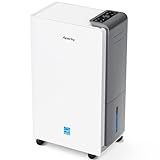
AEOCKY 80 Pint ENERGY STAR
- 80 pints per day
- ENERGY STAR Most Efficient 2025
- 44 dB low fan speed
- Defrost sensors below 65F

Yaufey 150 Pint with Pump
- 150 pints per day
- Built-in upward drain pump
- 16.4 ft pump hose
- 30-80% RH range
All 10 Grow Room Dehumidifiers at a Glance in 2026
Every machine below is listed in the order we recommend them. Capacity figures are the rated lab numbers; real basement output is lower, and we cover that gap in the sizing section.
| Product | Specifications | Action |
|---|---|---|
| hOmeLabs 50 Pint 7,000 Sq Ft |
|
Check Latest Price |
| AEOCKY 80 Pint ENERGY STAR |
|
Check Latest Price |
| Yaufey 150 Pint with Pump |
|
Check Latest Price |
 Kesnos 150 Pint Kesnos 150 Pint |
|
Check Latest Price |
 VEAGASO 34 Pint VEAGASO 34 Pint |
|
Check Latest Price |
 Aiusevo 52 Pint Aiusevo 52 Pint |
|
Check Latest Price |
 KNKA 80 Pint KNKA 80 Pint |
|
Check Latest Price |
 Gasbye 115 Pint Gasbye 115 Pint |
|
Check Latest Price |
 MIONJO V3 45-80 Pint MIONJO V3 45-80 Pint |
|
Check Latest Price |
 AIRPLUS 70 Pint AIRPLUS 70 Pint |
|
Check Latest Price |
What Size Dehumidifier Does a Humid Basement Grow Room Need?
Size a basement grow room dehumidifier at 50 to 80 pints per day for a single 4×8 tent, and at 100 to 150 pints per day when the machine must also control the surrounding basement. Multiply your tent floor area by 20 to get the baseline pint rating, then add roughly 50% if the machine sits in a basement with a bare slab, unfinished walls or no HVAC reach. Round up to the next capacity tier rather than down.
Here is how we get there, in five steps.
1. Start with tent floor area, not room volume. Coverage square-footage claims on retail listings assume ceiling-height, insulated, conditioned rooms. A 4×8 tent is 32 square feet, and a 50-pint machine handles that comfortably with margin. The margin matters because a plant room in bloom transpires water faster than the same room in vegetative growth.
2. Add the plant load, not just the room load. A dense flowering canopy is effectively a humidifier. A useful heuristic is to size the machine to remove roughly 75% of the water added to the space each day, so measure or estimate your daily transpiration and divide by 0.75. Most mixed-canopy 4×8 setups land between 1 and 2 pints per hour, which on its own justifies a 50-pint class machine.
3. Multiply for the basement, not the tent. If one machine handles both the tent and the surrounding basement, treat the full basement footprint as the area. A 1,200 square foot unfinished basement is a different job from a 32 square foot tent, and a 50-pint machine that works beautifully inside a tent will run continuously without ever reaching setpoint in the basement around it.
4. Add a margin for cold surfaces and high ceilings. Basements with bare stone or block walls, or ceilings above eight feet, hold more moisture and have more surface area for condensation. Sizing up by roughly one capacity tier is cheaper than running a machine flat out for a year.
5. Check the rating standard before you compare numbers. Modern units are rated under updated DOE and AHAM standards, so a current 30-pint machine performs about like an older 40-pint machine. If you are comparing a new listing against a used unit, the gap is real and the new machine is not the downgrade it appears to be.
A worked example: a 4×8 tent in a 1,200 square foot unfinished basement with no HVAC reach. Baseline for the tent is 32 square feet times 20, so 64 pints. Add plant load margin, add the unfinished-basement multiplier, and land in the 100 to 115 pint class. A 115-pint machine on a humidistat set to 60% RH in continuous mode, plumbed to a floor drain, is the right answer for that room.
One more sizing detail that catches people. The pints-per-day figure on a box is measured at 95F and 90% RH, which is a hot and near-saturated test chamber. A basement sitting at 68F and 65% RH gets a fraction of that. Gasbye is the only machine in this group that publishes output at three separate temperature and humidity points, which is why we lean on its numbers when we talk about real output.
Why Basement Humidity Is a Different Problem
Yes, 70% relative humidity is too high for a basement, and it is too high for a grow room. Above roughly 60% RH, spores settle on leaf surfaces, and powdery mildew and bud rot both move from possible to likely. The problem is that a basement rarely lets you fix that with airflow alone.
Four things make basements different from upstairs rooms, and none of them are solved by a bigger fan.
Moisture arrives from below, not from the air. Soil moisture moves up through a bare slab and through foundation walls by vapor drive, and it does not stop because the indoor RH is lower. In an unfinished basement with no subfloor, that load is continuous and it is the reason small machines never reach setpoint.
Your ducts are not helping. Unconditioned supply and return runs in a basement pick up condensation whenever the duct surface drops below the room dew point. Growers on r/japanlife describe basements their HVAC simply cannot serve because of duct layout, which is why a portable dehumidifier is the primary control rather than a supplement.
Cool surfaces condense first. Stone walls, block, cold ductwork and uninsulated rim joists go wet before the air does. Even at a perfect 55% room reading you can find surface mold on those surfaces, which is the failure that a dehumidifier alone will not fix. Insulating and sealing rim joists and cold ductwork does more for a mold problem than any single machine.
Exhausting outdoor air can backfire. A grow room in a basement is already at or above the outdoor dew point for long stretches of the year. Running an intake fan to bring in drier air can add moisture faster than the dehumidifier removes it. One r/GrowBuddy user describes running an overpowered exhaust fan and a cross-canopy breeze purely to move air across the canopy, not to bring any of it in from outside.
The practical takeaway is that basement grow rooms need two things most rooms do not: a machine plumbed to a drain so nobody is emptying a tank at 2am, and enough capacity to actually reach the setpoint rather than merely run.
1. hOmeLabs 50 Pint 7,000 Sq Ft Dehumidifier – Best Overall for a Basement Grow Room
hOmeLabs Dehumidifier 7,000 Sq Ft 50 Pint (MAX 120 Pint at 95°F, 90% RH)
50 PPD at 80F/60% RH
165 CFM
322 watts
40 pounds
Wi-Fi and Turbo mode
Pros
- Largest review pool in the group at more than 25000 reviews
- Wi-Fi control lets you change setpoint from a phone
- Turbo mode lifts the fan from 188 to 218 CFM
- Auto defrost and auto restart for basement power loss
Cons
- Drain hose not included
- 1.6 gallon tank is small for sustained runs
- Plastic chassis styling
This is the machine we keep coming back to for a mid-size basement grow room because it is the one here with a review base deep enough to lean on. More than 25,000 reviews at a 4.4 average is not the highest rating in the group, but it is by a wide margin the deepest evidence that the machine does what the box claims in real rooms.
Rated at 50 pints per day at 80F and 60% RH, with the manufacturer claiming up to 120 pints at 95F and 90% RH. Airflow is 165 CFM in normal operation, and Turbo mode pushes the fan from 188 to 218 CFM when you need to pull the room down fast after lights-on or a weather front.

Wi-Fi is the feature that separates it from the rest of the field. In a basement you do not want to walk down two flights of stairs to read a humidistat, and the app lets you watch the RH trend from upstairs. For a grower running lights on a timer, watching relative humidity fall during the lights-on window is genuinely useful diagnostic information.
The technical list covers the basement checklist: automatic defrost, automatic restart, automatic shutoff at tank full, continuous draining, a removable tank, a timer, a touch control panel and a washable filter. Auto restart matters more in a basement than in a bedroom, because storms take power out and a machine that forgets its setpoint after a power event will coast for hours.

Who the hOmeLabs 50 Pint suits
It suits a grower with one 4×8 tent and a mid-size basement who wants remote monitoring and the reassurance of a heavily reviewed machine. It also suits anyone who is nervous about desiccant machines and wants a proven compressor design with a familiar tank and hose arrangement.
At 50 pints per day it sits in the middle of the range, which means it handles a tent comfortably and a small to mid-size basement adequately. If your basement is large or your slab is bare, step up a tier rather than stretching this one.
Who should skip the hOmeLabs 50 Pint
Skip it if you intend to run it tank-only. The 1.6 gallon reservoir is small for a machine that will run near-continuously in a damp space, and the drain hose is not included in the box, so budget for a hose and a fitting before you need it.
Skip it if you need upward drainage. There is no built-in pump here, so the drain line has to run downhill to a floor drain or a sump. If the only drainage point is above the unit, you need one of the pump-equipped machines further down this list.
2. AEOCKY 80 Pint ENERGY STAR Dehumidifier – Best Value for Large Basements
AEOCKY 5500 Sq.Ft Energy Star Most Efficient 2025 Dehumidifier Max 80Pint/D
80 PPD at 95F/95% RH
56 PPD in basement conditions
280 watts
ENERGY STAR Most Efficient 2025
Pros
- ENERGY STAR Most Efficient 2025 certification
- Rotary compressor with 7mm pure copper tubing
- Defrost sensors for operation below 65F
- Includes drain hose and garden hose adapter
Cons
- 1.45 gallon tank is small for the stated coverage
- Needs doors and windows closed to hit rated output
- Listing leans on self-comparison marketing
This is the efficiency pick. Rated at 80 pints per day at 95F and 95% RH, and importantly it also publishes 56 pints per day at 86F and 80% RH, which is a much more honest number for a real basement than a single headline figure. Draw is 280 watts for a machine in that class, and it carries ENERGY STAR Most Efficient 2025 certification.
The build details are what separate it from the generic listings in this category. It uses a rotary compressor with a 3+2 evaporator and condenser structure, 7mm pure copper tubing rather than aluminum, and a hydrophilic aluminum foil coil coating. Copper tubing matters in a basement because it resists the corrosion that eats cheaper fittings and lines.

Quiet operation is a genuine selling point here. The lowest fan speed is published at 44 dB, which means it can run in a grow room without being the loudest thing in the space. It also has a child lock, a 24-hour-style timer, a power-off memory function and a set of modes including auto, constant humidity, continuous, smart drying and sleep.
Defrost sensors are specified for operation below 65F, which covers most basements through the heating season. That is the number to watch if your basement gets cold, and we cover the freeze-up problem in detail in the buying guide.

Who the AEOCKY 80 Pint suits
It suits a grower with a mid-to-large basement who cares about electricity as much as capacity. At 280 watts with ENERGY STAR Most Efficient 2025 certification, it is the pick if the dehumidifier is going to run twenty-four hours a day through a wet season.
It also suits anyone who wants honest numbers. The listing states 56 pints per day in basement conditions, and the included drain hose and garden hose adapter mean you can plumb it properly on day one without a separate shopping trip.
Who should skip the AEOCKY 80 Pint
Skip it if the drain point is above the unit. There is no built-in upward pump, so gravity drainage only, and the 1.45 gallon tank is small enough that tank-only operation becomes a daily chore.
Skip it if your basement is large. Eighty rated pints is a strong mid-size number, not a whole-basement number. In a 2,000 square foot space with a bare slab, you will want the 115 or 150 pint class instead.
3. Yaufey 150 Pint Dehumidifier with Pump – Best for Whole Basements
Yaufey 150 Pint Dehumidifier with Pump for Basement 8500 Sq. Ft.
150 PPD at 95F/90% RH
8,500 sq ft coverage
Built-in upward pump
16.4 ft pump hose
500 watts
Pros
- Tied for the highest rated capacity in this group at 150 pints per day
- Built-in pump with a 16.4 ft hose for upward drainage
- 30-80% RH range is wider than the common 40-80%
- 1.85 gallon tank is the second largest here
Cons
- 500 watt draw is high
- Upper temperature rating capped at 89.6F
- Only one year of standard coverage
If the machine has to control the whole basement and not just a tent, this is the class you need. At 150 rated pints per day and a claimed 8,500 square foot maximum coverage, it is tied for the top capacity figure in this roundup, and the 159 CFM airflow and rotary compressor support that rating.
The feature that actually decides basement installs is the drainage system. It offers three options: an upward pump, tank operation, and gravity drainage, and it includes a 16.4 foot pump hose plus a 3.28 foot gravity hose. In a basement where the only realistic drain is a sump pit below floor level, a built-in pump removes an entire class of installation problems.

Control range is 30-80% RH adjustable in 5% steps, which is wider than the 40-80% band most machines in this group offer. The lower end is useful in a dry winter basement where an overly aggressive humidistat can pull the room too far down and stress plants. There is a swing louver with a 40-80 degree sweep, three fan speeds, temperature and humidity sensors, and auto defrost, memory restart and overload protection.
Warranty is the weak point. Coverage is one year, extendable by an additional year with registration, plus lifetime technical support. Two years is thin for a machine expected to run continuously for years in a damp space, and it is worth factoring into the decision.

Who the Yaufey 150 Pint suits
It suits growers dehumidifying a full basement with a tent inside it, especially where the drainage point sits below the machine. The upward pump and long hose make it the easiest of the large machines to install correctly without raising the floor or running a line.
It also suits anyone who wants a wide humidity band. The 30-80% range gives real control across a wet spring and a dry winter, which a 40-80% machine cannot do.
Who should skip the Yaufey 150 Pint
Skip it if power cost is the leading concern. A 500 watt draw running continuously is the highest consumption profile here, and the 89.6F upper temperature rating is lower than some competitors, so it is a poor choice for a basement that gets genuinely hot in summer.
Skip it for a single tent. A 150 pint machine in a 4×8 tent will short-cycle constantly because the humidistat reaches setpoint faster than the compressor can shut down cleanly, and repeated cycling is one of the harder duty patterns on a compressor. If your moisture load is tent-sized, this is far more machine than the job needs.
4. Kesnos 150 Pint Dehumidifier – Best Tank Capacity and Warranty Flexibility
Kesnos 150 Pint Dehumidifier for Basement with Drain Hose, 7,500 Sq. Ft.
150 PPD at 95F/90% RH
7,500 sq ft
2.12 gallon tank
500 watts
Rotary compressor
Pros
- Largest tank in the group at 2.12 gallons
- Front humidity display with a MIRAGE sleep mode that blanks it
- 24-hour timer for scheduling around off-peak rates
- Coverage extends to two years on registration
Cons
- Short 3.3 ft drain hose
- Only two fan speeds
- One year of standard coverage before registration
The Kesnos shares the 150 pint class with the previous pick but makes a different trade. It carries the largest water tank in this group at 2.12 gallons, rated capacity of 150 pints per day at 95F and 90% RH, and a claimed 7,500 square feet of coverage.
Tank size is not a glamorous spec, but in a basement it is a practical one. A 2.12 gallon reservoir is 8 liters, which gives you far more buffer before the auto shutoff trips. If your drain is not plumbed yet, that buffer is the difference between checking the machine twice a week and twice a day.

The control panel is unusually good for this category. There is a front humidity display, and the MIRAGE sleep mode blanks the display entirely so a bright panel does not glow through a dark basement. A 24-hour timer lets you schedule the machine around off-peak electricity rates, which on a 500 watt continuous load is real money over a year.
Drainage is gravity only. A 3.3 foot continuous drain hose is included and fits a 3/4 inch garden hose, and the 2.12 gallon tank has auto shutoff. There is also auto defrost, memory restart, a safety lock and overload protection, 360 degree casters, hidden handles and built-in cord storage.

Who the Kesnos 150 Pint suits
It suits a grower who wants maximum capacity and a large buffer before the drain has to be plumbed. It also suits anyone who plans to run the machine on a timer to dodge peak electricity rates, because the 24-hour timer is right there on the panel.
The display that blanks in sleep mode is a small detail that matters more in a basement than it does anywhere else, since you do not want a lit panel glowing all night next to a grow room.
Who should skip the Kesnos 150 Pint
Skip it if the drain is above the machine. There is no pump, and the included 3.3 foot hose is a short run for most basements, so any real installation means buying a longer line or a garden hose.
Skip it if you need fine fan control. Two fan speeds is the minimum useful configuration, and it is noticeably coarser than the four-speed machine further down this list. Wrist-aching is not a spec, but a basement machine that runs at full blast all night is a thing you will notice.
5. VEAGASO 34 Pint Dehumidifier – Best Budget Pick for Small Tents and Closets
VEAGASO 34-36 Pint/D, 2500 Sq.Ft Dehumidifier for Basement with Drain Hose
34 PPD, up to 36 pints
2,500 sq ft
40 dB low speed
Defrost to 41F
230 watts
Pros
- Lowest operating temperature published in this group at 41F
- Very compact at 19 by 10 by 12.5 inches
- Three modes covering dehumidify
- laundry dry and continuous
- Two-year warranty with quick online registration
Cons
- 0.53 gallon tank needs emptying twice a day or more
- 2500 sq ft coverage claim is optimistic for many rooms
- Casters do not lock
This is the small-tent pick, and it is genuinely useful inside a 2×4 or 3×3 tent rather than as a basement-wide solution. Rated at 34 pints per day, up to 36, across a claimed 2,500 square feet, at 230 watts.
Two things stand out. First, the auto defrost is specified for operation down to 41F, the lowest operating temperature published by any machine in this group. If your basement is unheated and genuinely cold, most compressor machines will struggle and this one is specified to keep going.
Second, the form factor. At 19 by 10 by 12.5 inches it is one of the shallowest machines here, which matters when the unit lives inside a tent and every inch of floor is canopy space. It has an LED touchscreen with a live humidity readout, a 1 to 24 hour timer, power failure memory, a recessed handle, 360 degree swivel casters and a removable washable filter.

Three operating modes cover dehumidify, dry and continuous. The dry mode doubles as a laundry drying setting, which is a secondary benefit in a basement that doubles as a laundry or utility space.
A drain hose is included for continuous drainage, which removes the main objection to a machine this size. At 40 dB or below on low speed, it is quiet enough to sit inside a tent without being the dominant noise source.

Who the VEAGASO 34 Pint suits
It suits a grower running a 2×4 or 3×3 tent who wants a quiet machine inside the tent footprint and does not need to control the basement around it. The included drain hose and the compact body make it the easiest small machine to integrate into a tent setup.
It also suits anyone with a genuinely cold space, since the 41F defrost specification is the most permissive in the group and the two-year warranty is the longest among the smaller machines.
Who should skip the VEAGASO 34 Pint
Skip it for a basement. Thirty-four pints is a tent-scale number, and pairing it with a 1,200 square foot unfinished basement is the exact mistake described in a r/basement thread about units that never reach setpoint and just run the electricity bill up.
Skip it if you want to run tank-only. A 0.53 gallon reservoir means emptying it two or more times a day, which in a basement nobody is watching at 3am. Plumb the drain hose.
6. Aiusevo 52 Pint Dehumidifier – Lowest Power Draw in the Group
52 Pint Dehumidifier, 5000 Sq. ft Dehumidifier for Basement Large Room
52 PPD at 95F/90% RH
140.4 watts
42 dB minimum
26 pounds
5,000 sq ft
Pros
- Lowest wattage in the group at 140.4 watts
- Compact 26 pound body is easy to move between rooms
- 42 dB minimum noise suits a bedroom or closet
- Owners report it matched much larger machines
Cons
- Only a one-year warranty
- 0.66 gallon tank needs frequent emptying
- Low sales rank at number 206 in the category
Power consumption is the metric most buyers never look at and every long-running basement should. The Aiusevo draws 140.4 watts while rated at 52 pints per day, the lowest figure in this roundup by a wide margin. Over a year of continuous running, that gap matters more than any small difference between two competing machines.
Physically it is a compact machine: 11.81 by 8.46 by 19.13 inches and 26 pounds, with an ABS body, a 42 dB minimum noise level, a digital humidity display, a 24-hour timer, 360 degree casters and an ergonomic handle. Moving it between a tent and a closet is a one-person job.

It has dehumidify, dry and continuous modes, automatic defrost, a child lock, a washable filter and a 6.65 foot drain hose for continuous drainage. The tank is a 0.66 gallon visible type with water-full auto shutoff.
Reviewers frequently report that it performs as well as larger machines they replaced, and the efficiency per watt is genuinely the best in this group. That is a real strength, and it is also the reason we would not put it at the top of the list.

Who the Aiusevo 52 Pint suits
It suits a grower on an electricity budget who wants a mid-size machine that will not add meaningfully to the monthly bill. At 140.4 watts, it is the most efficient large-basement-capable option we reviewed.
It also suits anyone running a mixed setup where the same machine moves between a vegetative tent and a storage closet, because at 26 pounds it is the easiest to relocate.
Who should skip the Aiusevo 52 Pint
Skip it if warranty length matters to you. One year is the shortest coverage here, and durability is the top complaint in the r/BuyItForLife dehumidifier discussion, where owners describe going through multiple machines across Midea, Honeywell and Hisense brands in a few years.
Skip it if you cannot run a drain line. The 0.66 gallon tank is small, and combined with a one-year warranty this is a machine to use with a hose permanently plumbed rather than carried around.
7. KNKA 80 Pint ENERGY STAR Dehumidifier – Quietest at High Capacity
KNKA Energy Star 5500 Sq.Ft Dehumidifier for Basement, Max 80 Pint/Day
80 PPD at 95F/95% RH
56 PPD in basement conditions
40-45 dB
ENERGY STAR certified
360 watts
Pros
- Very quiet at 40-45 dB with measured readings from reviewers
- 80 pints per day plus 56 in basement conditions
- ENERGY STAR certified
- Optional 2.64 gallon external tank extends run time
Cons
- 4.1 stars with a 14% one-star band
- Reports of tank-full auto shutoff malfunction
- Short 6.56 ft drain hose
The KNKA is rated at 80 pints per day at 95F and 95% RH, with 56 pints per day in basement conditions, and it is ENERGY STAR certified. What sets it apart acoustically is the 40-45 dB operating range, with reviewer measurements of 42 dB at one foot and 31 dB at six feet.
That measurement matters more than the headline figure. A machine that reads 31 dB across the room is a machine you can run next to a sleeping area or a quiet room, which is not something you can say about a 500 watt machine running at full compressor.
Control features are solid for the class: AUTO, DRY and SETTING modes across a 30-80% RH range, a 12-hour timer, a child lock, 360 degree casters, cord storage and a washable reusable filter. The real-time humidity display includes a color-changing indicator light that shows the humidity level at a glance.

Drainage is a 1.45 gallon built-in tank plus a 6.56 foot hose, with an optional 2.64 gallon external tank sold separately. That external tank option is unusual in this category and useful if the drain line is not ready on day one.
Two data warnings. The listed weight of 2.5 kg does not match an 80 pint compressor build, and the listing shows 220 volts while a standard North American residential outlet is 120 volts. Both suggest the specification sheet needs confirming with the manufacturer before you rely on it.

Who the KNKA 80 Pint suits
It suits a grower who needs real capacity and near-silence at the same time, such as a basement grow room next to a bedroom or a workspace. The measured 31 dB at six feet is the quietest real-world figure in this group.
It also suits anyone who wants the option to extend tank capacity later without buying a second machine.
Who should skip the KNKA 80 Pint
Skip it if reliability is your top priority. At 4.1 stars with a 14% one-star band, this is one of the two weakest-rated machines here, behind the AIRPLUS, and reviewers specifically report tank-full auto shutoff malfunctions on some units. An auto shutoff that fails in a basement means an overflow, and a wet floor around a grow room is a mold problem you were trying to avoid.
Skip it if the wraparound tank design bothers you. Reviewers note that the tank geometry splashes when you empty it, which sounds trivial until you are carrying it up basement stairs at midnight.
8. Gasbye 6000 Sq Ft 115 Pint Dehumidifier – Best Published Performance Data
Gasbye 6000 Sq.Ft 2026 Energy Star Dehumidifier for Basement Max 115Pints/D
115 PPD at 86F/80% RH
73 PPD at 80F/60% RH
50 PPD at 65F/60% RH
ENERGY STAR 2026
500 watts
Pros
- Publishes tested output at three separate temperature and humidity points
- Highest average rating in the group at 4.6 stars
- Heaviest build here at 43 pounds with reinforced copper tubing
- Two-year coverage with replacement units
Cons
- 500 watt draw is among the highest listed
- Black finish suits a utility space more than a finished room
Most listings in this category give you one headline number measured at 95F and 90% RH, which is close to useless for a basement. Gasbye publishes three: 115 pints per day at 86F and 80% RH, 73 pints per day at 80F and 60% RH, and 50 pints per day at 65F and 60% RH. That last figure is the one to plan around, because a basement sitting at 65F with doors closed is the hardest realistic case.
It is also the highest-rated machine in this group at 4.6 stars across roughly 920 reviews, with 80% five-star and only 4% one-star ratings. It carries ENERGY STAR 2026 certification and claims up to 30% better efficiency than non-certified models.

The build is the heaviest here at 43 pounds, using reinforced thickened copper tubing and a five-tier copper coil. Compressor noise is published at 45 dB, and the humidity control uses a 3% hysteresis, shutting off 3% below target and restarting 3% above, plus a post-shutdown fan run to cool the residual coil.
That last detail is a real engineering choice rather than a feature-list item. Coils kept warm and wet in a basement are the start of mold inside the machine, so a cooldown fan run is worth paying for.

Who the Gasbye 115 Pint suits
It suits a grower who wants to size a machine with real numbers rather than marketing numbers, and who has a basement that runs cool. The 50 pints per day figure at 65F tells you exactly what this machine will do on the coldest night of the year.
It also suits anyone who cares about the machine surviving. A 43 pound copper build with a two-year replacement policy is the most durability-focused design in this group, which matters given that replacement cycles are the number one complaint in basement forums.
Who should skip the Gasbye 115 Pint
Skip it if power cost dominates your decision. At 500 watts, this is one of the highest consumption profiles here, and the 45 dB compressor is not the quietest option even though it is well controlled.
Skip it for a finished room you look at. The black finish is built for a utility space, not a room you have to look at, and a black chassis in a dusty basement shows every mark.
9. MIONJO V3 45-80 Pint Dehumidifier – Best Adjustable Airflow
4500 Sq. Ft Dehumidifier for Basement with Drain Hose, Energy star
45-80 pints
4,500 sq ft claimed
90 degree adjustable outlet
40 dB
ENERGY STAR certified
Pros
- 90 degree adjustable louver directs dry air at corners and laundry
- 40 dB operation with a one-tap sleep mode
- 1.72 gallon tank plus included drain hose
- ENERGY STAR certified
Cons
- Smallest review base in the group at 428 reviews
- Specification data is incomplete with no wattage or voltage
- Listed weight of 10 pounds looks low for the class
The MIONJO V3 is the quiet mid-size option, rated at 45 to 80 pints per day across a claimed 4,500 square feet, running at a published 40 dB with a one-tap sleep mode and ENERGY STAR certification. That noise figure puts it among the quietest machines in this group, level with the VEAGASO and below the KNKA.
Its distinguishing feature is the 90 degree adjustable air outlet. In a basement that is a genuinely useful control, because the wet spots are specific: the base of a stone wall, the seam where a cold duct meets the joist, the corner behind a storage shelf. A fixed louver leaves you moving the machine; an adjustable one lets you keep it running in the best draw position.
The rest is competent rather than remarkable. A 1.72 gallon self-shutoff tank with an included drain hose, 30-80% RH adjustable humidity with an indicator light, sleep mode, child lock, a 24-hour timer, four 360 degree swivel wheels and a hidden cord wrap.

One thing to be aware of before you commit: the specification data on this listing is thin. The floor area field reads as 1, there is no wattage or voltage listed, and the stated weight of 10 pounds does not match an 80 pint compressor unit. The review pool of 428 is also the smallest in this group by a wide margin.
That is not disqualifying, but it does mean you are buying on a thinner evidence base than with the machines above it. Ask for the wattage and the verified test points before you commit to a large install.

Who the MIONJO V3 suits
It suits a grower with a targeted damp spot rather than a uniformly humid room. If your problem is one cold corner or one section of wall, the adjustable louver lets you aim the machine at it and keep the rest of the room undisturbed.
It also suits anyone running a quiet grow room where a 40 dB compressor and a sleep mode matter more than peak capacity.
Who should skip the MIONJO V3
Skip it if you are installing it as your only line of defence for a large damp basement. With 428 reviews and incomplete specifications, the risk is not a bad machine so much as a machine you cannot verify before committing to a full install.
Skip it if you need certainty on a specification, such as the real power draw for budgeting. That number is simply not published on the listing.
10. AIRPLUS 70 Pint Dehumidifier with Drain Hose – Best Starter Unit for a Basement
AIRPLUS 70 Pint Dehumidifier with Drain Hose, 4500 Sq.Ft for Basement
70 PPD
4,500 sq ft
300 watts
Four fan speeds
3.9 ft drain hose
0.7 gallon tank
Pros
- 70 pints per day at 300 watts
- Four fan speeds give finer control than two-speed machines
- Owners report a fast visible drop in basement humidity
- Digital panel shows humidity and timer
Cons
- 4.0 stars with a 14% one-star band
- Reports of evaporator coil icing and failure after about two seasons
- 0.7 gallon tank and a short 3.9 ft drain hose
The AIRPLUS is a 70 pint per day machine rated for 4,500 square feet, drawing 300 watts. Multiple owners report a fast, visible drop in basement humidity, and four fan speeds give more granular control than the two-speed machines common in this size class.
It has a full feature list: four smart modes including laundry dry, noise reduction and sleep, a digital panel showing temperature, humidity, timer and mode, a 24-hour timer, automatic defrost, auto shutoff and restart, a negative ion function, a detachable washable filter, a child lock and overheat protection.

Drainage is a 0.7 gallon tank with water-full auto shutoff and a 3.9 foot drain hose for continuous drainage. The manufacturer also offers a 30-day exchange or refund policy alongside a one-year warranty.
Where it falls down is the review profile. It is the lowest-rated machine here at 4.0 stars, with 60% five-star and 14% one-star ratings. The specific complaints are consistent and worth taking seriously: some machines do not shut down when they reach target humidity, and some suffer evaporator coil icing and failure after about two seasons.

Who the AIRPLUS 70 Pint suits
It suits a first-time basement grower who needs a real amount of capacity, around 70 rated pints, without stepping up to a 115 or 150 pint machine and the electrical draw that comes with it. At 300 watts it sits comfortably in the middle of this group.
It also suits anyone who wants finer fan control, since four speeds gives noticeably better low-output humidity control than a two-speed machine and helps in a room with plants at mixed stages.
Who should skip the AIRPLUS 70 Pint
Skip it if reliability is the priority. A 4.0 average with a 14% one-star band and reports of coil icing and two-season failure is a poor bet for a machine you cannot easily check on while you are asleep or away.
Skip it if you plan to run it tank-only. A 0.7 gallon tank with a 3.9 foot hose means a short plumbed run or frequent manual checks, and if the machine also has a reported tendency to keep running past setpoint, the overflow risk is higher rather than lower.
How to Choose a Basement Grow Room Dehumidifier
Capacity is the first decision and the easiest to get wrong, but it is not the one that decides whether the machine lasts. These are the criteria we used, in the order that mattered.
1. Compressor, desiccant, or split system. Compressor machines like every product on this list use a refrigeration cycle and are the right default for basements between roughly 55F and 95F. Desiccant and semiconductor machines are cheaper and quieter but their capacity falls off badly as temperature drops, and growers repeatedly describe them as ineffective for real grow rooms. Split-system and LGR units, which put the compressor in an outdoor or remote unit and duct cold air in, are the commercial answer and a step up in installation complexity. We cover that class separately in our commercial LGR dehumidifier guide.
2. Drainage configuration. In a basement this is not a minor feature. A continuous drain hose removes the single most common failure mode in unattended operation, which is a full tank at 2am. If your drain point is below the unit, gravity drainage with a standard hose works. If the drain is above the unit or far away, you need a built-in pump, and the Yaufey in this group is the clearest example of what that buys you. Plumb to a sump pump discharge as a backup if you have one.
3. Operating temperature and auto defrost. Compressor dehumidifiers lose capacity below about 65F and will eventually freeze the evaporator coil. Every machine here has automatic defrost, but the published floors differ sharply: the AEOCKY specifies defrost sensors for operation below 65F, while the VEAGASO is specified down to 41F. If your basement is unheated and hits the low 50s in winter, either keep the room above 65F or pick a machine with a low published operating floor. A small space heater set to maintain 65F in the room is the common workaround and is often cheaper than a larger machine.
4. Dual-unit versus single-unit placement. The most common question in grow forums is whether one machine for the whole basement is enough or whether the tent needs its own. In a genuinely damp basement, dehumidifying the whole space and the tent at the same time is much harder than running a dedicated unit inside the tent and a second larger unit for the basement around it. Placement beats brand every time: the tent unit should sit inside the tent with its return air drawing from the canopy, and the basement unit should sit away from walls with clear airflow and a plumbed drain. If you are running a crawl space rather than a full-height basement, our crawl space dehumidifier guide covers the tighter clearances.
5. Noise. Anything above 45 dB at a low fan speed is going to be audible in a grow room next to a sleeping area. The measured readings matter more than the headline: one 80 pint machine here is reported at 31 dB from six feet, while a 500 watt machine running at full compressor sits far higher. A sleep mode that blanks the display as well as dropping fan speed is worth paying for in a dark basement.
6. Watts and running cost. Running cost is watts times hours, and the differences in this group are large. At 140.4 watts, one machine here costs roughly a third of what a 500 watt machine costs for the same hours. Two machines on smart plugs, cycling on five to ten minute intervals as growers on r/microgrowery describe, save real money by avoiding the steady compressor load of a machine running far below its capacity.
7. Warranty and what actually breaks. Five of the ten machines here carry a one-year standard warranty, while the AEOCKY carries three years. Buyers on r/BuyItForLife describe going through three dehumidifiers in three years across several major brands, and the failures are consistent: compressors from short cycling, float switches from tank water, drain pumps from scale and biofilm, and coils from never being cleaned. Parts availability matters more than the warranty card. A three-year warranty from a brand that does not sell the part is worth less than a one-year warranty from one that does.
8. Maintenance you can actually keep up with. In a grow environment, biofilm and scale build up in drain lines faster than in a bedroom. Flush the drain line monthly, clean or wash the filter every few weeks, and wipe the coil when you can see it. A machine that is never cleaned is a machine that fails early, and in a basement that failure means water on the floor.
For whole-basement dehumidification that is not tied to a grow room, we also have a broader basement dehumidifier roundup that covers the same sizing questions without the plant context.
Frequently Asked Questions
What size dehumidifier do I need for a 4×8 grow tent?
A 4×8 tent is 32 square feet, and a compressor dehumidifier rated at 50 pints per day handles it with comfortable margin once you account for plant transpiration. If the machine also has to control the surrounding basement, size up to the 70 to 115 pint class instead, because a bare slab and unfinished walls add a continuous moisture load that a 50 pint machine will chase without ever reaching setpoint.
Is 70% humidity too high for a basement?
Yes. Above roughly 60% relative humidity, mold spores settle on surfaces and leaf tissue, and powdery mildew and bud rot both become likely rather than possible. In a basement the challenge is that cool surfaces such as stone walls, block and unconditioned ductwork condense first, so even a lower room reading does not mean those surfaces are dry.
Should I use the tank or connect a continuous drain hose?
Use a continuous drain hose in any basement. Tanks in this category range from 0.53 gallons to 2.12 gallons, and a small tank in a damp room can fill more than once a day. If the only drain point is above the unit, choose a machine with a built-in pump and enough hose length to reach it.
Why does my dehumidifier keep freezing up in a cold basement?
Compressor dehumidifiers depend on the evaporator coil staying above freezing, and they lose capacity below about 65F. If your basement drops into the 50s, look for a machine with a low published operating floor and confirm it has automatic defrost, and consider keeping the room above 65F with a small space heater. Running the unit constantly in a cold room is also the fastest route to coil icing.
Do I need one dehumidifier for the tent and one for the basement?
Often yes. A dedicated unit inside the tent controls the canopy environment directly, while a separate larger unit for the surrounding basement reduces the load that the tent has to fight. Place the tent unit inside the tent drawing air from the canopy, and the basement unit in open floor area with clear airflow and a plumbed drain.
How much does it cost to run a dehumidifier 24/7?
Running cost is simply watts times hours, so the spread across this group is wide. A 140 watt machine costs roughly a third of a 500 watt machine over the same period. Cycling the machine on a smart plug in five to ten minute intervals, rather than letting it run flat out, reduces the compressor load and the bill at the same time.
Bottom Line
For a single 4×8 tent with a mid-size basement around it, the hOmeLabs 50 Pint is our pick for grow room dehumidifiers for humid basements, because it is the one machine here with Wi-Fi control and a review base deep enough to lean on. If the basement is the real problem, the AEOCKY 80 Pint gives you the most capacity per watt and the most honest published numbers. If the machine has to hold an entire unfinished basement, go to the 115 or 150 pint class and plumb the drain properly. Nothing in this list is a dedicated grow-tent machine, so if your tent is the entire problem, the VEAGASO 34 Pint is the one to put inside it.
Whatever you pick, buy the continuous drain, keep the room above 65F, and set the humidistat instead of letting the machine run flat. Those three habits matter more to how long it lasts than the model name does.