
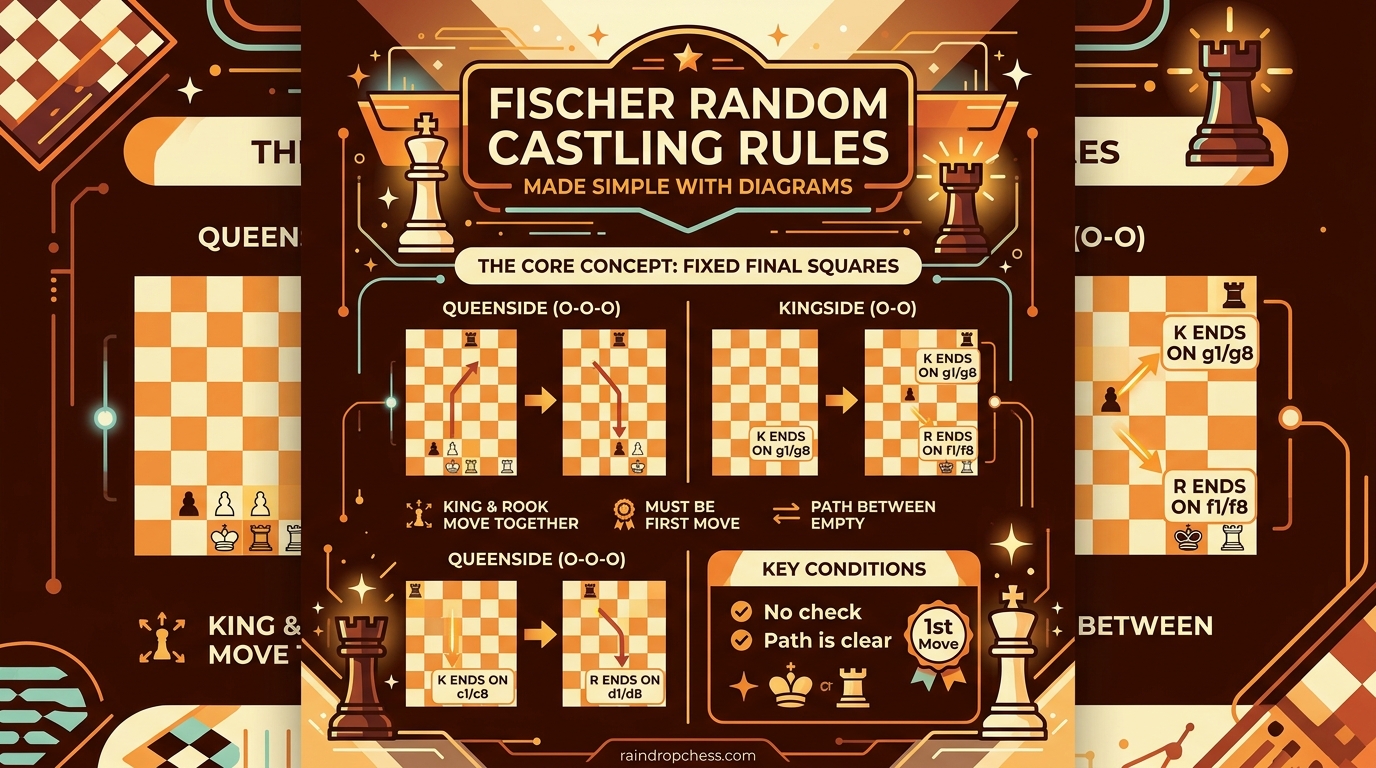
If you have ever played standard chess, you know castling is one of the most important moves for protecting your king. But when you first encounter Fischer Random Chess (also called Chess960), the castling rules can feel completely foreign. Pieces start in different positions, the king might begin on the c-file or g-file, and suddenly the familiar O-O and O-O-O do not look the same at all. I remember my first Fischer Random game. I was completely confused about whether I could even castle, let alone how to do it correctly. After studying the rules carefully and playing dozens of games, I realized the system is actually quite logical once you understand the core principle: the end positions are always the same as in standard chess.
This guide will walk you through Fischer Random castling rules using clear diagrams for every castling type. By the time you finish reading, you will understand exactly how to castle in any of the 960 starting positions, why the rules work the way they do, and how to perform the move correctly on a physical board or online platform.
Table of Contents
What is Fischer Random Chess (Chess960)?
Fischer Random Chess is a chess variant created by legendary grandmaster Bobby Fischer in 1996. He proposed it as a way to eliminate opening theory and force players to rely on creativity and understanding rather than memorization. FIDE, the World Chess Federation, adopted it in 2009 under the name Chess960.
History of Fischer Random
Fischer first publicly discussed his idea for randomized starting positions in a 1996 interview with Time Magazine. He was frustrated that top-level chess had become too dependent on memorizing opening variations. His solution was elegantly simple: randomize the back rank while keeping certain rules in place. The bishops must still be on opposite colors, and the king must still be somewhere between the two rooks. This ensures the position is always legal and the game is always winnable for both sides. The first official Fischer Random World Championship took place in 2019, with Magnus Carlsen winning the inaugural title.
Why Chess960 Exists
The randomized starting positions mean no opening theory exists. Every game is a new problem to solve from move one. This makes chess more about true understanding and less about preparation. The trade-off is that some standard chess concepts, like castling, need special handling. In standard chess, the king always starts on e1 and rooks on a1 and h1, so castling always involves the same squares. In Chess960, the king could start on any square from c1 to f1 (depending on the setup rules), which fundamentally changes how castling must work.
The Four Castling Conditions in Fischer Random
Before we get into the specific types of castling moves, let us establish the four universal conditions that must all be met before you can castle in Fischer Random. These are the exact same conditions as standard chess, and they apply regardless of which of the 960 positions you are playing from.
Condition 1: The King and Rook Must Be Unmoved
Neither the king nor the rook involved in the castling may have moved earlier in the game. This is identical to standard chess. If you have already moved your king or the relevant rook, you cannot castle with that piece. This condition prevents players from gaining positional advantages by castling multiple times or after the king has already traveled across the board.
Condition 2: The Squares Between Must Be Vacant
All squares between the king and the rook must be empty at the time of castling. In standard chess, this means squares d1, e1, f1, and g1 for kingside castling, or b1, c1, d1, and e1 for queenside castling. In Fischer Random, the exact squares vary depending on where your king and rook start, but the principle remains the same: nothing can be blocking the path.
Condition 3: The King Cannot Castle Through or Into Check
The king cannot pass through squares that are under attack by enemy pieces. Additionally, the king cannot land on a square that is under attack. This is the same rule as standard chess, but it takes on added importance in Fischer Random because the path the king travels may be different from what you expect based on your standard chess experience.
Condition 4: Castling Is Allowed Only Once Per Game
Each player may castle only once during a game, on either kingside or queenside. This has not changed from standard chess. Once you castle, you cannot castle again regardless of what happens to your king and rook later in the game.
Understanding c-castling vs g-castling
If you are new to Fischer Random, you might be wondering why people say “c-castling” and “g-castling” instead of the familiar “queenside” and “kingside” castling. This is one of the first confusing aspects of Chess960 that trips up many players transitioning from standard chess.
What is g-castling (Kingside)
In Fischer Random, castling is named after the square where the king lands, not the side of the board. So g-castling always means the king ends up on g1 (or g8 for Black). The rook will end up on f1 (or f8). This is called “kingside” castling in standard chess, and the notation O-O is still used. However, the path the pieces take to get there can vary dramatically depending on where they start.
What is c-castling (Queenside)
C-castling means the king ends on c1 (or c8 for Black), with the rook landing on d1 (or d8). This corresponds to “queenside” castling in standard chess, and the notation O-O-O still applies. The key difference from standard chess is that in some starting positions, the king might already be on c1, in which case only the rook moves during c-castling.
Understanding the destination-based naming is crucial because it eliminates ambiguity. No matter where your pieces start in Fischer Random, g-castling always means the same final position, and c-castling always means the same final position. This consistency is what makes the system work.
The Four Types of Castling in Chess960
Here is where Fischer Random gets interesting. In standard chess, there are only two types of castling: kingside (O-O) and queenside (O-O-O). In Chess960, there are four distinct types of castling moves depending on where your king and rook start on the back rank. This is the heart of what makes castling in Fischer Random different and, once you see the patterns, surprisingly intuitive.
Two-Move Castling (Transposition Castling)
Two-move castling is the most common type in Fischer Random. Both the king and rook move, but they do so by essentially swapping positions. The king moves two squares toward the rook, and the rook jumps over the king to land on the square the king crossed. This is conceptually similar to standard chess castling, where the king moves two squares and the rook moves to the other side.
For example, if your king starts on e1 and your rook starts on h1 (the standard position), moving the king from e1 to g1 and the rook from h1 to f1 is two-move castling. The king travels two squares, and the rook lands where the king was when it crossed the f1 square. This is exactly what happens in standard chess, which is why transposition castling feels most familiar to traditional chess players.
Space-Swap Castling
Space-swap castling occurs when the king and rook start with exactly one square between them. When this happens, the king moves only one square toward the rook, and the rook moves to the square the king crossed. This creates a different-looking pattern than standard castling but achieves the same end position.
Imagine your king on f1 and rook on h1 with the g1 square empty. The king moves one square from f1 to g1, and the rook from h1 jumps to f1. The king ends on g1 and rook on f1, exactly where they would be after a standard kingside castle. The only difference is the king moved only one square instead of two.
King-Only Castling
King-only castling happens when the king starts on g1 (or g8 for Black). Since the king is already on the destination square for g-castling, only the rook needs to move. You pick up the rook and place it on f1 (or f8), and the king stays where it is. This is one of the more counterintuitive scenarios for players new to Fischer Random.
At first glance, it does not look like castling at all. The king is not moving. But because all four castling conditions are met and the correct end positions are achieved, this counts as a legal castling move. It consumes your one castling right just like any other castling. Online platforms typically handle this by having you drag the rook onto the king or use a special castling interface, while on a physical board you simply pick up the rook and place it on f1.
Rook-Only Castling
Rook-only castling is the mirror image of king-only castling. It occurs when the rook starts on f1 (or f8 for Black). The king moves normally from its starting square to g1, but the rook is already on the landing square, so only the king actually travels. This also counts as a full castling move and uses your one castling right.
Some players find rook-only castling even stranger than king-only because the king is moving but only a short distance. However, the logic is perfectly consistent: both pieces end up in their correct final positions (king on g1, rook on f1), so the castling is legal and complete.
How to Castle on a Physical Board
Playing Fischer Random over the board requires a few adjustments if you are used to standard chess. The good news is that the physical execution is straightforward once you understand what the end positions should be.
Step-by-Step Instructions
First, confirm all four castling conditions are met. Check that your king and the relevant rook have not moved, all squares between them are empty, your king is not in check, and you have not already castled in this game. If all four conditions are satisfied, you can proceed.
Next, determine which type of castling applies. Are both pieces moving (two-move or space-swap), only the king (rook-only), or only the rook (king-only)? This tells you how many pieces you need to move.
For king-only castling, simply pick up the rook and place it on f1 (or f8 for Black). Leave the king where it stands. Announce “castle” to your opponent to make your intention clear.
For rook-only castling, move the king from its starting square to g1 (or g8). Again, announce “castle” and leave the rook where it is.
For two-move or space-swap castling, move the king first. Place it on the destination square (g1 for g-castling or c1 for c-castling). Then pick up the rook and place it on the correct square (f1 or d1). Always move the king before the rook when both are moving.
Common Mistakes to Avoid
One of the most common mistakes is trying to mimic the exact hand movements from standard chess. In Fischer Random, there is no standard hand movement pattern because the pieces might start in unexpected positions. Focus on the end result, not the path the pieces took in standard chess.
Another frequent error is forgetting that king-only and rook-only castling are still full castling moves. They consume your single castling right, and you cannot castle again later in the game. Some players accidentally try to castle twice, thinking the first “half-castling” did not count.
Finally, be careful about announcing your castling. In casual play, it is good etiquette to say “castle” so your opponent understands what you are doing. In tournament play, the rules require you to make your intention clear, and simply moving the pieces without announcement can lead to disputes.
Fischer Random Castling vs Standard Chess Castling
Understanding the differences between castling in standard chess and Fischer Random helps reinforce why the rules were designed this way and makes it easier to remember the key principles.
Key Differences at a Glance
In standard chess, the king always starts on e1 and rooks on a1 and h1. Castling kingside means king from e1 to g1 and rook from h1 to f1. Castling queenside means king from e1 to c1 and rook from a1 to d1. The path is always the same because the starting positions are always the same.
In Fischer Random, the king can start on any square from c1 to f1 (and the equivalent c8 to f8 for Black). The rooks can be on any squares as long as the bishops are on opposite colors and the king is between them. This means the king might start on g1, c1, or anywhere in between. As a result, castling might involve both pieces moving two squares, one square, or not at all.
The brilliant insight of Chess960 is that while the journey varies, the destination is fixed. Regardless of where your king and rook start, g-castling always puts them on g1 and f1, and c-castling always puts them on c1 and d1. This preserves the strategic value of castling in every position while accommodating the randomized setup.
How to Notate Fischer Random Games
Recording your Fischer Random games uses the same algebraic notation as standard chess, with a few specific conventions for castling. The notation O-O still means g-castling (kingside), and O-O-O still means c-castling (queenside). These symbols represent the final destination squares regardless of how many pieces moved or how they got there.
In PGN (Portable Game Notation), Fischer Random games typically include a tag identifying the starting position. Chess960 games often use FEN notation with the “x” in the castling field replaced by specific letters indicating which squares are available for castling. For example, KQ denotes castling rights for both kingside and queenside when the king starts on e1 and rooks on their home squares.
When analyzing games or communicating about specific positions, it helps to specify the starting position number (SP) if using a numbered setup. Chess960 has 960 possible starting positions, each identified by a number from 1 to 960. This makes it easy to recreate any position for study or review.
Frequently Asked Questions
How does castling work in Fischer Random?
In Fischer Random (Chess960), castling works by moving the king and rook to specific squares: for g-castling (kingside), the king ends on g1 and the rook ends on f1; for c-castling (queenside), the king ends on c1 and the rook ends on d1. The pieces can move in different ways depending on their starting positions, but the end positions are always the same as in standard chess.
What are the four rules of castling?
The four castling conditions are: (1) The king and rook must not have moved previously in the game; (2) All squares between the king and rook must be vacant; (3) The king cannot castle through, out of, or into check; (4) Each player may only castle once per game. These rules apply to both standard chess and Fischer Random.
Why were the castling rules chosen to be what they are in Chess960?
The castling rules in Chess960 were designed to preserve the strategic essence of castling, which is protecting the king and often activating the rook, while accommodating randomized piece starting positions. By keeping the final destination squares fixed (g1/f1 for kingside, c1/d1 for queenside), players in any of the 960 starting positions can still employ this crucial king-safety maneuver.
How does Fischer random work?
Fischer Random Chess (also called Chess960) is a chess variant where pieces on the back rank are randomized within certain rules. The bishops must be on opposite colors, and the king must be between the rooks. This eliminates opening theory and forces players to think creatively from move one. Castling rules are modified so the king still ends up in familiar safe squares.
Can pieces already be on the castling destination squares in Fischer Random?
Yes, this is one of the unique aspects of Chess960. If your king starts on g1, g-castling results in a king-only castling where only the rook moves. If your rook starts on f1, g-castling results in a rook-only castling where only the king moves. The rules accommodate any starting configuration while ensuring the same final positions as standard chess.
Conclusion
Fischer Random castling rules may seem intimidating at first, but they follow a simple, elegant logic. The destination squares never change: g-castling always ends with the king on g1 and rook on f1, while c-castling always ends with the king on c1 and rook on d1. What varies is how the pieces get there, which can involve both pieces moving, one piece moving, or in some cases no piece moving at all.
The four universal conditions (unmoved pieces, vacant squares, no check paths, once per game) ensure castling remains a meaningful strategic decision rather than an automatic move. Understanding these conditions and practicing with different starting positions will build your confidence quickly.
The best way to learn Fischer Random castling is to play games and work through positions yourself. Start with positions where your king is near the standard e1 square, then gradually try positions with more unusual king placements. Before long, the different castling types will feel natural, and you will be able to castle confidently in any of the 960 starting positions Chess960 has to offer.