
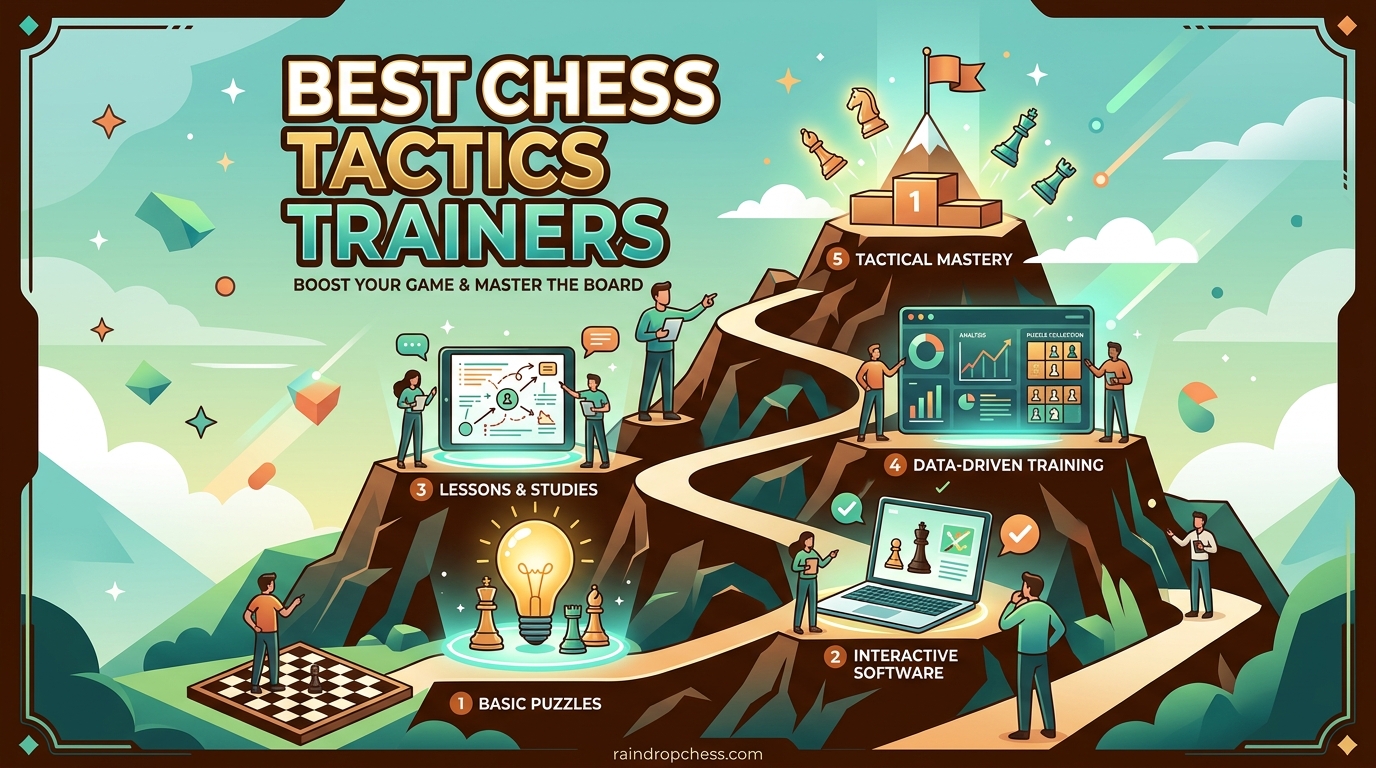
If you have spent any time playing competitive chess, you have probably heard the famous quote attributed to Richard Teichmann: “Chess is 99% tactics.” Whether the exact percentage is debatable or not, the underlying truth is not. Tactical skill — the ability to spot combinations, calculate variations, and recognize patterns — is what separates winning players from everyone else. That is exactly why so many players turn to online tactics trainers, and why finding the best tactics trainer sites compared to ChessTempo and other major platforms has become one of the most common questions in chess forums and communities.
In this guide, our team breaks down the top chess tactics training platforms available in 2026. We look at ChessTempo, Lichess Puzzles, and Chess.com Tactics side by side. You will see how each one works, what they do well, where they fall short, and which one is the right fit for your skill level and training style. No fluff, no vague recommendations — just a direct, honest comparison based on real experience and community feedback.
Whether you are a beginner who just learned what a fork is, or an advanced player trying to stay sharp for your next tournament, this article gives you everything you need to pick the right trainer and start improving today.
Table of Contents
Why Tactics Training Is the Fastest Way to Improve at Chess
Before we compare platforms, it is worth understanding why tactics training deserves your time in the first place. The short answer: it works faster than anything else.
Studies in cognitive science and motor learning show that pattern recognition improves through repeated exposure to specific scenarios. In chess, this means solving hundreds and thousands of tactical puzzles builds mental “chunks” — patterns your brain recognizes instantly without conscious calculation. Grandmasters do not calculate every move from scratch. They recognize familiar patterns and then verify with calculation. Tactics training builds that recognition library.
For club-level players rated between 800 and 1800 Elo, tactical blunders account for the majority of lost games. One hanging piece, one missed mate in two, one overlooked skewer — these mistakes decide most games at that level. Fixing those errors through targeted tactics practice yields the fastest rating improvement of any training method, faster than studying openings, endgames, or positional concepts.
The key is consistency. Solving 15 to 30 minutes of puzzles per day, every day, outperforms sporadic three-hour sessions. That daily repetition is what cements patterns into long-term memory. And that is where choosing the right tactics trainer matters — you need a platform that keeps you engaged, serves the right difficulty level, and fits your schedule.
ChessTempo: The Gold Standard for Chess Tactics Training
ChessTempo has been around since the late 2000s and has built a reputation as the go-to free chess tactics trainer recommended by coaches, forums, and club players worldwide. It is not the flashiest platform, but it does one thing exceptionally well: serving high-quality puzzles matched to your ability.
How ChessTempo Works
ChessTempo uses an adaptive rating system similar to the Glicko system used in competitive chess. When you solve a puzzle correctly, your tactics rating goes up, and the next puzzle gets harder. When you fail, your rating drops, and the puzzles get easier. Over time, the system converges on your actual tactical ability, giving you puzzles in your zone of proximal development — hard enough to challenge you, but not so hard that you feel lost.
The database contains over 2 million puzzles sourced from real games. Each puzzle is tagged with tactical motifs like pins, forks, discovered attacks, deflections, and back-rank mates. You can filter by motif, difficulty range, or even by the phase of the game (opening, middlegame, endgame).
Key Features
The standout feature of ChessTempo is the option to solve puzzles without a timer. Unlike Chess.com, where a ticking clock pressures you into rushed decisions, ChessTempo lets you take as long as you need. This is invaluable for training pure calculation ability rather than speed-guessing. You can enable a timer if you want to practice under time pressure, but it is entirely optional.
ChessTempo also provides detailed post-puzzle analysis. After solving (or failing) a puzzle, you can review the full line, see alternative moves, and understand why the correct solution works. This review process is where a lot of actual learning happens — understanding why a wrong move fails is just as important as finding the right one.
The statistics and progress tracking on ChessTempo are genuinely useful. You can see your rating graph over time, your accuracy percentage by motif type, your average solve time, and how your performance compares to your peak. These metrics help you identify weaknesses. If your pin accuracy is 90% but your deflection accuracy is 60%, you know exactly what to drill.
Free vs Premium
Here is where ChessTempo really shines. The free tier gives you unlimited access to the standard tactics database. No daily limit. No cap on puzzles. You can solve as many as you want, for free, forever. That alone makes ChessTempo one of the best free chess tactics trainers available.
The premium subscription unlocks additional features like endgame puzzles, opening training, a larger set of curated puzzle sets, and more detailed analytics. Premium also removes ads, which is a quality-of-life improvement. But the core tactics training experience — the thing most players actually need — is completely free.
What Could Be Better
The interface looks dated. There is no way around it. ChessTempo has a functional but unpolished design that feels like it belongs in 2012 rather than 2026. It works fine on mobile browsers, but there is no dedicated mobile app, which is a drawback if you like to train on your phone during commutes.
The onboarding experience for new users is also minimal. You are dropped straight into puzzles with little guidance on how to use the platform effectively. A short tutorial or orientation would help beginners get started faster.
Who ChessTempo Is Best For
ChessTempo is ideal for serious improvers who want high-quality puzzles without paying a cent. It is the platform I recommend most often to players in the 800 to 2000 Elo range who are willing to look past an older interface in exchange for superior puzzle quality and unlimited free access. Coaches also frequently recommend ChessTempo to students because the lack of a timer encourages proper calculation habits.
Lichess Puzzles: Free, Unlimited, and Community-Driven
Lichess needs no introduction. The free, open-source chess platform has millions of users worldwide, and its built-in puzzle trainer is one of the most popular tactics tools on the internet. Since Lichess is entirely free and ad-free (funded by donations), its puzzle section is accessible to everyone with zero barriers.
How Lichess Puzzles Work
Lichess sources its puzzles from real games played on its platform. When a game contains a notable tactical sequence, it gets extracted and added to the puzzle database. This community-driven approach means the puzzle pool is always growing — currently sitting at over 400,000 puzzles and counting.
The rating system uses Glicko-2, the same system Lichess uses for its competitive play ratings. Your puzzle rating adjusts after each solve, and puzzles are served at your current level. The system is responsive and generally accurate, though some players report rating swings that feel larger than expected.
Key Features
One of the best things about Lichess puzzles is the interface itself. It is clean, modern, and works beautifully on both desktop and mobile. The board is easy on the eyes, piece movement is smooth, and the overall experience feels polished in a way that ChessTempo does not match.
Lichess also offers puzzle themes and puzzle streak modes. You can filter puzzles by tactical motif — forks, pins, mate in 1, mate in 2, and so on. The puzzle streak mode is particularly fun: you get progressively harder puzzles and try to solve as many in a row as possible without failing. It is a gamified way to practice that keeps you engaged.
Another underrated feature is the puzzle dashboard. Lichess tracks your performance over time and shows your rating curve, accuracy by theme, and other statistics. It is not as detailed as ChessTempo’s analytics, but it gives you enough information to spot trends in your training.
The Counting Problem Debate
One criticism that comes up frequently in chess forums and Reddit threads is that Lichess puzzles at certain rating ranges have too many “counting” problems. These are puzzles where the solution involves counting attackers and defenders on a square, rather than spotting a tactical motif. Some players find these puzzles abstract and less applicable to real games.
This complaint is legitimate at certain rating bands, particularly in the 1500 to 1900 puzzle rating range. The mix of motifs does feel less varied than ChessTempo at times. However, Lichess has been improving its puzzle curation over the years, and the issue is less pronounced than it used to be.
What Could Be Better
The puzzle quality on Lichess can be inconsistent. Because puzzles are sourced algorithmically from user games, some puzzles have ambiguous solutions or feel less “clean” than hand-curated puzzles. ChessTempo puzzles, by contrast, tend to have clearer, more instructive solutions.
Lichess also lacks a structured training plan or curriculum. You get puzzles served to you based on rating, but there is no guided path that says “here is what to practice this week.” Players who want more structure may find this limiting.
Who Lichess Puzzles Are Best For
Lichess puzzles are perfect for casual and intermediate players who want a clean, modern interface with unlimited free puzzles. If you already play on Lichess and want to add tactics training to your routine without creating a separate account or learning a new platform, the built-in puzzle trainer is convenient and effective. It is also the best option for mobile-first players who want to train on their phone.
Chess.com Tactics: The Mainstream Option
Chess.com is the largest chess platform in the world, and its tactics trainer is one of the most-used features on the site. With over 150 million members, Chess.com has massive reach, and many players default to its puzzles simply because they already have an account.
How Chess.com Tactics Work
Chess.com uses an adaptive rating system similar to its competitors. Puzzles are served based on your current puzzle rating, and the system adjusts difficulty after each solve. The puzzles are sourced from real games and tagged with tactical themes.
The platform offers several training modes beyond standard puzzles. Puzzle Rush is a timed mode where you race against the clock to solve as many puzzles as possible. Puzzle Battle lets you compete head-to-head against another player. And Puzzle Streak challenges you to solve progressively harder puzzles without making a mistake.
The Free Tier Limitation
Here is the biggest drawback: Chess.com limits free users to 5 puzzles per day. Five. For a platform that positions itself as a training tool, that daily cap is extremely restrictive if you are not paying for a membership. If you want to do more than 5 puzzles, you need to upgrade to a premium plan.
This is a hard pill to swallow when ChessTempo and Lichess both offer unlimited free puzzles. For budget-conscious players or those who just want to try tactics training without committing to a subscription, the 5-puzzle daily limit is a significant barrier.
The Timer Penalty Controversy
One of the most criticized aspects of Chess.com’s tactics trainer is the mandatory timer. Every puzzle has a countdown, and taking too long results in a rating penalty — even if you eventually solve the puzzle correctly. This design choice has been debated extensively in chess forums.
The argument against the timer penalty is straightforward: it encourages guessing over calculation. Players learn to make quick, instinctive moves rather than working through variations carefully. That habit can hurt your real-game performance because real chess rewards thorough calculation, not speed-guessing.
Chess.com’s perspective is that the timer trains you to calculate faster, which is valuable in blitz and bullet games. Both arguments have merit, but for players focused on improving their tactical accuracy rather than speed, the mandatory timer is a genuine drawback.
What Chess.com Does Well
Despite its limitations, Chess.com’s tactics trainer has genuine strengths. The puzzle quality is generally good, the variety of training modes (Puzzle Rush, Puzzle Battle, Puzzle Streak) keeps things interesting, and the integration with the rest of the Chess.com ecosystem is seamless. You can jump from a puzzle session straight into a game, review your mistakes, and access lessons — all on one platform.
The mobile app is also excellent. If you train primarily on your phone, Chess.com provides one of the smoothest mobile chess experiences available.
Who Chess.com Tactics Are Best For
Chess.com tactics make the most sense for players who already have a premium membership and use Chess.com as their primary platform. If you are paying for the full Chess.com experience, the tactics trainer is a solid component of that package. Puzzle Rush is also uniquely fun and competitive in a way that neither ChessTempo nor Lichess replicates. If you want gamified training with leaderboards and social competition, Chess.com delivers that experience better than the others.
ChessTempo vs Lichess vs Chess.com: Feature-by-Feature Comparison
Now let us put all three platforms head to head across the dimensions that matter most. This is where the best tactics trainer sites compared to ChessTempo, Lichess, and Chess.com really start to differentiate themselves.
Puzzle Quality and Variety
ChessTempo wins on puzzle quality and variety. With over 2 million puzzles and detailed motif tagging, the variety of tactical themes you encounter is unmatched. Each puzzle has been curated and vetted, so ambiguous or poorly constructed puzzles are rare. Lichess comes second — its puzzles are good but occasionally suffer from unclear solutions or excessive counting problems. Chess.com’s puzzles are solid but limited in free mode.
Free Access and Value
Both ChessTempo and Lichess offer unlimited free puzzles with no daily caps. Chess.com limits free users to 5 puzzles per day. If free access is your top priority, Chess.com is clearly the weakest option here. Between ChessTempo and Lichess, both are genuinely free, though ChessTempo has ads on the free tier while Lichess is ad-free.
Rating System Accuracy
All three platforms use adaptive rating systems that generally work well. ChessTempo’s rating feels the most stable and consistent, with smaller swings after individual puzzles. Lichess’s Glicko-2 system is solid but can feel volatile at times. Chess.com’s puzzle rating system works adequately but feels more influenced by the timer than pure tactical ability.
User Experience and Interface
Lichess has the cleanest, most modern interface of the three. Chess.com is polished and professional, especially on mobile. ChessTempo’s interface is functional but dated, which is its biggest weakness from a usability standpoint.
Training Modes and Gamification
Chess.com leads here with Puzzle Rush, Puzzle Battle, and Puzzle Streak offering multiple ways to train. Lichess has puzzle streak and theme filtering. ChessTempo focuses on straightforward puzzle solving with deep analytical review. If you want variety in your training modes, Chess.com wins. If you want focused, distraction-free training, ChessTempo wins.
Analysis and Mistake Review
ChessTempo provides the most detailed post-puzzle analysis, showing full lines, alternative moves, and explanations. Lichess shows the correct line but provides less depth. Chess.com shows the correct move and continuation but the analysis depth is limited compared to ChessTempo.
Mobile Experience
Chess.com has the best dedicated mobile app. Lichess also has an excellent mobile app with full puzzle access. ChessTempo relies on its mobile-responsive website, which works but is not as smooth as a native app experience.
Training Methodology: Repetition vs Variety in Chess Tactics
Beyond choosing a platform, there is a deeper question about how you should actually train. Two dominant methodologies have emerged in chess tactics training, and they map to different platforms and training approaches.
The Woodpecker Method: Depth Through Repetition
The Woodpecker Method, popularized by GM Hans Tikkanen, involves solving the same set of puzzles multiple times over weeks and months. You work through a curated puzzle set, then revisit it repeatedly, trying to solve each puzzle faster and more accurately each time.
The science behind this approach draws on spaced repetition research. By repeatedly exposing yourself to the same patterns with increasing intervals between sessions, you strengthen the neural pathways associated with each tactical motif. The goal is automatic recognition — seeing a position and instantly knowing the tactical idea without conscious calculation.
This method works best with a curated puzzle set rather than an infinite stream of new puzzles. ChessTempo supports this approach well because you can filter by motif and difficulty, creating custom sets to cycle through. Physical puzzle books also work well for the Woodpecker Method.
The Variety Approach: Breadth Through Exposure
The alternative approach emphasizes solving new puzzles constantly, never repeating, and exposing yourself to as many different tactical scenarios as possible. The idea is that breadth of experience builds a wider pattern library, making you more adaptable in games.
Lichess and Chess.com naturally support this approach because their systems keep feeding you new puzzles based on your rating. You never run out of fresh material, and the variety keeps training engaging.
Which Approach Works Better
The honest answer is both, and the best players use a combination. Repetition builds speed and automatic recognition. Variety builds adaptability and exposes you to unfamiliar patterns. If I had to pick one for a player rated under 1500, I would recommend repetition first — nail down the core motifs until they are automatic. Then add variety to broaden your tactical vision. Players rated above 1500 benefit from a balance of both approaches.
Which Tactics Trainer Should You Choose Based on Your Level
Different skill levels have different needs. Here are my recommendations based on where you are in your chess journey.
For Beginners (Under 1000 Elo)
Start with Lichess puzzles. The clean interface, unlimited free access, and lower barrier to entry make it the most beginner-friendly option. Focus on puzzles rated at your level and pay attention to the tactical motif tags. Do not worry about speed — take your time and calculate carefully. Fifteen to twenty minutes per day is enough to see noticeable improvement within a few weeks.
For Intermediate Players (1000 to 1600 Elo)
Switch to ChessTempo for your primary training. The puzzle quality, motif variety, and detailed analysis will push your calculation skills further than Lichess alone. Use the motif filters to identify and drill your weak areas. If your pin recognition is strong but you keep missing deflections, spend a week focusing on deflection puzzles. Supplement with Lichess for variety and mobile practice.
For Advanced Players (1600+ Elo)
Use ChessTempo as your core trainer for its deep analysis and challenging puzzle pool. Consider adding the Woodpecker Method with a curated puzzle set to build automatic pattern recognition. Chess.com can supplement your training with Puzzle Rush for speed drills and time-pressure preparation. At this level, combining platforms gives you the best of all worlds.
For Budget-Conscious Players
ChessTempo and Lichess together give you everything you need without spending anything. ChessTempo handles your quality training and deep analysis. Lichess handles your mobile practice and casual puzzle solving. Between these two free platforms, you have access to millions of puzzles, adaptive rating systems, progress tracking, and detailed mistake review. There is no need to pay for a tactics trainer unless you specifically want Chess.com’s gamified modes or ecosystem integration.
What is the difference between Chessable and ChessTempo?
What is the best site to learn chess?
Who said chess is 99% tactics?
What is the best chess tactics book?
Is ChessTempo better than Lichess for puzzles?
How many chess puzzles should I solve per day?
Final Thoughts on the Best Chess Tactics Trainer Sites
After comparing the best tactics trainer sites alongside ChessTempo, Lichess, and Chess.com, the picture is clear. ChessTempo remains the gold standard for free, high-quality tactics training with unmatched puzzle variety and detailed analysis. Lichess offers the best all-around free experience with a modern interface and seamless mobile support. Chess.com provides the most gamified and socially integrated training, but its free tier is too limited for serious training.
My recommendation: start with ChessTempo for focused daily training, supplement with Lichess for mobile practice and variety, and consider Chess.com only if you already have or plan to get a premium membership. The most important thing is not which platform you choose — it is that you train consistently. Pick one, set a daily goal, and stick with it. Your tactical vision will improve, and your rating will follow.