
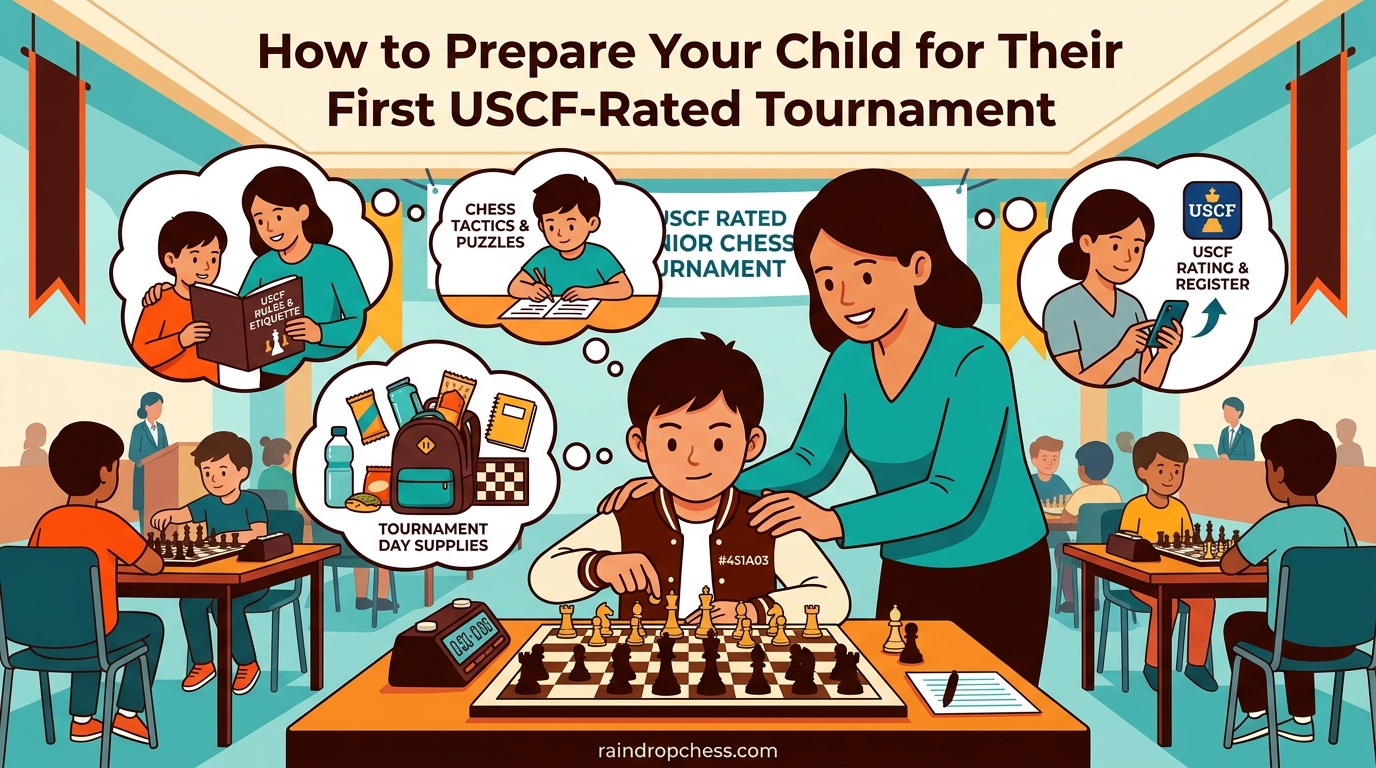
Watching your child discover the strategic depth of chess is rewarding. Seeing them want to test their skills against new opponents is exciting. A USCF-rated tournament represents their first step into organized competitive chess, and proper preparation makes all the difference between a positive learning experience and overwhelming frustration.
This guide walks you through everything needed to prepare for that first USCF-rated tournament. We’ll cover assessing readiness, registration, equipment, rules, and how to support your child through wins and losses alike. Drawing from hundreds of parent experiences on chess forums and insights from tournament directors, you’ll learn exactly what to expect and how to make tournament day a success.
Table of Contents
Is Your Child Ready for Their First USCF-Rated Tournament?
Children develop chess skills and emotional maturity at different rates. Knowing when your child is ready for their first USCF-rated tournament matters more than their age or current skill level. Let’s look at the key indicators that suggest they’re prepared.
Technical Readiness
Your child should know all basic chess rules confidently. This includes how pieces move, special moves like castling and en passant, checkmate versus stalemate, and basic checkmate patterns. They don’t need to be a strong player, but they should understand the game’s fundamentals completely. Nothing feels worse than losing because you didn’t know a rule.
Practice games at home or chess club should demonstrate reasonable focus. A typical USCF-rated tournament game for younger children lasts 30-60 minutes per side. Your child needs the attention span to sit and concentrate for that duration. If they’re finishing games in 5 minutes at home, they’ll need practice slowing down and thinking through each move.
Basic sportsmanship is essential. Your child should understand that winning isn’t everything and that losing is part of learning. They should be able to shake hands before and after games, accept defeats gracefully, and congratulate opponents. These emotional skills often matter more than chess ability for first-tournament success.
Emotional Maturity
Can your child handle losing without melting down? Tournament play means losses, often multiple in a row. Emotional readiness means understanding that defeats happen and don’t reflect their worth as a person or player. Parents on chess forums consistently report that crying after losses is normal for young children, but they should be able to recover and play the next round.
Your child should want to play in a tournament. This might seem obvious, but many parents push children into competition before they’re interested. If your child is excited about testing their skills against new opponents, that’s a great sign. If they’re anxious or indifferent, waiting a few months makes sense.
Independence is another key factor. You won’t be able to help during games, so your child needs to be comfortable making decisions alone. They should be able to use a chess clock, record moves (if required), and seek help from the tournament director if needed without you at their side.
Age-Specific Considerations
Children ages 5-7 often need constant reminders about rules and play very fast. They may cry after losses, which is completely normal. Shorter attention spans mean they benefit from tournaments with faster time controls. Many parents start children this age in unrated sections before trying rated play.
Children ages 8-10 typically understand rules better and can handle longer games. They’re beginning to understand strategy and can take notation more easily. This age group balances competitiveness with learning sportsmanship. They can manage emotions better but may still need support after tough losses.
Children ages 11+ are usually more independent and understand the rating system. They’re more serious about competition and can handle longer time controls. They’re better at post-game analysis and more focused on improvement. This age group often transitions quickly from beginner to intermediate play.
If you’re unsure whether your child is ready, try a local chess club’s casual tournament day first. These low-pressure events let children experience tournament-like conditions without the formality (and anxiety) of rated play. Many parents report that one positive club experience made all the difference for their child’s confidence.
USCF Registration and Membership Guide
Before your child can play in a USCF-rated tournament, they need USCF membership. The United States Chess Federation is the official governing body for chess in America, and only USCF members can participate in rated events. The registration process is straightforward, but completing it in advance prevents tournament-day stress.
Step 1: Register Online
Visit the USCF website and create an account. You’ll need your child’s personal information including full name, date of birth, and contact details. The membership fee varies by age and membership type, with discounts available for multiple years. Consider a multi-year membership if your child plans to play regularly.
After registration, your child receives a unique USCF ID number. This number stays with them for life and tracks all their rated games. Save this number somewhere accessible—you’ll need it for every tournament registration. Most parents store it in their phone alongside emergency contacts.
Understanding the Rating System
Your child starts as an unrated player. After playing four rated games, they receive a provisional rating. This rating is an initial estimate of their skill level based on those first games. After playing 26 rated games, their rating becomes established. The rating system uses mathematical formulas to adjust ratings based on game results and opponent strength.
Rating divisions at tournaments help ensure fair competition. A typical scholastic tournament might have sections for U800 (unrated to 800 rating), 800-1200, and 1200+. Your child will be paired against players with similar ratings, which means competitive but manageable games. The Swiss system used in most tournaments means players with similar scores face each other in each round.
Finding Tournaments in Your Area
The USCF website maintains a comprehensive tournament calendar searchable by location and date. Local chess clubs also host regular events, and many schools have chess programs that participate in team competitions. When choosing that first tournament, look for events specifically labeled as scholastic or beginner-friendly.
Consider tournament size carefully. Large events with hundreds of players can feel overwhelming to a first-timer. Smaller local tournaments with 20-50 children provide a gentler introduction to competitive play. Many parents report that their child’s first tournament experience shaped their attitude toward chess competition, so choosing the right environment matters.
Register for tournaments before the deadline. Most events require advance registration, and walk-in registration may not be available. Some popular tournaments fill weeks in advance. When you register, you’ll need your child’s USCF ID number and payment information. You’ll typically receive a confirmation email with tournament details and check-in instructions.
Essential Equipment Checklist for Tournament Day
Being properly equipped prevents unnecessary stress on tournament day. While many tournaments provide some equipment, having your own ensures everything is familiar and comfortable. This checklist covers everything your child needs for a successful tournament experience.
Chess Equipment
A tournament-standard chess set is essential. USCF rules specify piece size and board dimensions, and most chess sets sold as “tournament sets” meet these requirements. The board should have 2.25-inch squares, and pieces should be the standard Staunton pattern. Your child will be more comfortable playing with equipment they’ve used at home.
A chess clock is mandatory for rated games. Digital clocks with delay features are standard in modern tournaments. The delay feature gives players a grace period before their time starts counting, which prevents time-pressure blunders. If you’re purchasing a clock, choose one with large, easy-to-read buttons. Practice using it at home so your child is comfortable with its operation.
A scorebook or notebook is necessary if your child will be recording moves. While notation isn’t always required for beginners, learning to record games develops important chess skills. Choose a scorebook with clear notation sheets or a notebook with graph paper. Some tournaments provide scoresheets, but having your own ensures you’re never without.
Comfort Items
Tournament venues vary in temperature, so dress in layers. Bring a light sweater or jacket even in summer. Indoor arenas can be surprisingly cold, and shivering doesn’t help concentration. Comfortable clothes that allow your child to focus on chess rather than discomfort make a real difference in performance.
Water and snacks are crucial. Tournaments can last several hours, and brain work requires fuel. Pack water bottles and healthy snacks like nuts, fruit, or granola bars. Avoid sugary treats that cause energy crashes. Many experienced parents recommend protein-rich snacks that provide sustained energy throughout multiple rounds.
Something to do between rounds helps children stay relaxed. Books, quiet games, or drawing materials occupy downtime between games. Many children bring homework or reading material. Avoid electronics with loud games or videos—tournament areas should remain quiet for players still competing.
Parent Items
Bring cash for registration fees, food, and emergency needs. While many tournaments accept credit cards, cash is always useful. Pack a phone charger and contact information for the tournament director. Having the tournament schedule printed out prevents confusion about round times and locations.
A folding chair can be valuable if seating is limited. Some tournaments have ample seating for parents, but others don’t. Being prepared for any situation means you can focus on supporting your child rather than searching for a place to sit.
Complete Checklist
Chess set and board, chess clock, scorebook or notebook, pencils and erasers, water bottle, healthy snacks, light jacket or sweater, comfortable clothing, something to do between rounds, cash, phone charger, tournament schedule and location details, emergency contact information. Review this checklist the night before the tournament to ensure nothing is forgotten.
Pre-Tournament Preparation Routine
The two weeks before a tournament are crucial for preparation. This preparation isn’t about cramming new chess knowledge—it’s about reinforcing what your child already knows and establishing routines that reduce anxiety. A well-prepared child approaches tournament day with confidence instead of nervousness.
Two Weeks Before
Start practicing with a chess clock if your child hasn’t used one regularly. Set the clock to the tournament’s time control and play practice games. Most scholastic tournaments use G/30 (30 minutes per player) or G/25 with a 5-second delay. Getting used to the clock’s presence and the sound of its buttons prevents surprises on tournament day.
Review special rules that often trip up beginners. The touch-move rule, castling through check, en passant, and pawn promotion should all be crystal clear. Many children learn these rules but forget them under pressure. Quick review games where you deliberately create situations requiring these rules reinforce understanding.
Play practice games at a chess club or with stronger opponents. Facing new playing styles and strategies builds adaptability. If your child always plays the same opponents at home, the variety of tournament play will be eye-opening. Many chess clubs host casual tournament days that simulate real competition without the pressure.
One Week Before
Establish a consistent sleep schedule. Chess requires concentration, and tired brains don’t function well. Ensure your child is getting adequate sleep each night, not just the night before the tournament. Fatigue affects decision-making and emotional regulation, both crucial for tournament success.
Review basic checkmate patterns. Many tournament games are lost because a player doesn’t know how to deliver checkmate with a king and queen against a lone king, or with two rooks. These fundamental patterns should be automatic. Practice them until your child can checkmate quickly and confidently.
Talk about tournament expectations. Emphasize that the goal is learning and having fun, not winning every game. Discuss what to do if they lose, and frame losses as learning opportunities. Children who understand that mistakes help them improve handle tournament pressure better than those focused solely on results.
Day Before
Prepare everything you’ll need for tournament day. Lay out clothes, pack the chess bag, and double-check the checklist. Knowing everything is ready reduces morning stress and prevents forgotten items. Charge devices, print directions, and plan your departure time.
Plan healthy meals for tournament day. Breakfast should provide sustained energy without being heavy—oatmeal with nuts, eggs with whole grain toast, or yogurt with fruit are excellent choices. Pack lunch and snacks if the tournament venue’s food options are limited or expensive.
Do something relaxing and fun. Last-minute cramming doesn’t help and increases anxiety. Watch a chess movie, play a casual game, or do something completely unrelated to chess. A well-rested, relaxed mind performs better than one stressed by over-preparation.
Mental Preparation
Help your child visualize tournament success. Not winning necessarily, but handling situations well. Visualize finding the right board, shaking hands before the game, focusing on each move, and being a good sport regardless of the result. Mental rehearsal builds confidence and reduces anxiety.
Discuss strategies for common situations. What if your opponent plays a strange opening you’ve never seen? What if you make a mistake and want to take a move back? What if you forget to press the clock? Having plans for these scenarios prevents panic if they occur.
Establish a pre-game routine. Some children like to arrive early and walk around, others prefer to come just in time. Some like to review openings, others prefer to relax. Finding what works for your child and sticking to it creates consistency and comfort.
Understanding Tournament Formats
Chess tournaments use specific formats that determine how players are matched and how winners are determined. Understanding these formats helps you and your child know what to expect. The Swiss System is the most common format for scholastic tournaments, but knowing the alternatives helps you choose the right events.
The Swiss System
Most USCF-rated scholastic tournaments use the Swiss System. In this format, players are paired with opponents who have similar scores. After each round, players with the same number of wins face each other. This means everyone plays all rounds regardless of whether they win or lose.
Here’s how it works in practice: Round 1 pairs players randomly. Winners in round 1 face other winners in round 2, while losers face other losers. This continues throughout the tournament, ensuring competitive games where players face opponents of similar strength. By the final rounds, players with similar records compete against each other.
The Swiss System has advantages for scholastic players. Everyone plays the same number of games, so no one is eliminated. Players face opponents of similar ability, making games competitive but not overwhelmingly one-sided. The system also allows large numbers of players to compete in a single tournament without requiring endless rounds.
Tournament Sections
Most tournaments divide players into sections based on age and rating. A typical scholastic tournament might have sections like K-3 Unrated, K-5 U800, K-5 Championship, and K-12 Open. Your child’s section determines who they play against and what trophies are available.
Age-based sections group children by grade level. This ensures a first grader doesn’t face a middle schooler. Rating-based sections group players by skill level, creating fair competition. Some tournaments have both age and rating restrictions, while others use only one criteria. Check the tournament announcement to understand how sections are organized.
Open sections include players of any rating or age. These are typically for stronger players who want to face the toughest competition. Scholastic sections are restricted to school-age players and often have rating limits. Unrated sections are for players without established ratings and provide a gentler introduction to tournament play.
Number of Rounds
Most scholastic tournaments have 4-6 rounds, though some have more. Each round is a complete game against a different opponent. More rounds provide more games and a more accurate final ranking, but they also extend the tournament’s duration. For first-timers, 4-round tournaments are often less exhausting than 6-round events.
Time controls vary by tournament. Common scholastic time controls include G/30 (30 minutes per player), G/45, or G/60. Some tournaments use time controls with delay, written as G/30;d5, meaning 30 minutes per player with a 5-second delay before time starts counting. Longer time controls mean deeper thinking but longer games and tournaments.
Other Tournament Formats
Round-robin tournaments have each player play every other player. These work well for small groups but aren’t practical for large tournaments. Quad tournaments divide players into groups of four, where everyone in each group plays everyone else. Quads guarantee competitive games against players of similar strength.
Knockout tournaments eliminate players after they lose a certain number of games. These are rare in scholastic chess because they’re frustrating for beginners who want to play all day. Team events have players compete as part of school or club teams, with individual scores contributing to team results.
Understanding formats helps you choose appropriate tournaments. For a first experience, look for Swiss System events with scholastic sections and 4-5 rounds. These provide the right balance of competition, learning opportunities, and manageability for beginners.
Tournament Day: Check-In and Logistics
Tournament morning can feel chaotic if you don’t know what to expect. Understanding the check-in process and typical tournament schedule reduces stress for both you and your child. Let’s walk through a typical tournament day from arrival to awards.
Arrival Time
Plan to arrive 30-45 minutes before the first round. This gives you time to find parking, locate the tournament hall, and complete check-in without rushing. Late arrivals can result in forfeits, so being early is always better. Many experienced parents recommend arriving even earlier for your first tournament to account for unexpected delays.
When you arrive, look for directional signs or check-in tables. Most tournaments have a registration area where you confirm your child’s presence and receive important information. You’ll typically need to show your USCF membership card or provide your child’s USCF ID number.
The Check-In Process
At check-in, you’ll confirm your child’s section and receive their pairing number. This number identifies your child for the tournament’s pairings system. Make sure your child knows their number—it’s how they’ll find their board for each round. Some tournaments provide name tags or pairing cards with this information.
You’ll also receive the tournament schedule, showing round times and any breaks. Most tournaments post pairings on a wall chart or website. The wall chart shows each player’s number, rating, and board assignment for each round. Teach your child how to read this chart or be prepared to help them find their board each round.
After check-in, find the skittles area or team room. This is where players and parents gather between rounds. It’s also where you’ll wait while your child plays their games. The playing area itself is typically off-limits to parents during games, so the skittles area becomes your home base for the day.
Before Round 1
About 15 minutes before the first round, pairings are posted. Find your child’s name and board number. The board number tells you which table they’ll play at. Boards are usually numbered consecutively, making them easy to locate. Walk with your child to their board so they know where to go.
Help your child set up their chess set if they brought one. If the tournament provides sets, those will already be in place. Ensure they have their scorebook, pencil, and clock (if required). Remind them of basic rules like shaking hands before the game and pressing the clock after each move.
Take a moment to settle any nerves. Remind your child that the goal is to do their best and have fun. A quick hug or encouraging word sends them to their board with confidence. Then step back—parents aren’t allowed at the playing area during games.
During Games
Parents cannot enter the playing area during games. This rule is strictly enforced. You’ll watch from a distance or wait in the skittles area. Many parents use this time to meet other chess families, read, or work. Bring something to occupy yourself—you’ll be waiting 30-60 minutes per round.
If there’s an issue during the game, your child should raise their hand and wait for the tournament director. The TD resolves problems like illegal moves, clock malfunctions, or disputes. Teach your child before the tournament that the TD is the person to ask for help, not you.
Games finish at different times depending on how quickly players move. Some children finish in 15 minutes, others use the full time control. When you see your child finish their game and shake hands, they’re done for that round. Meet them at the edge of the playing area, not at their board.
Between Rounds
The time between rounds ranges from 10-30 minutes. This is when players eat snacks, use the bathroom, and relax. Some children like to analyze their games with coaches or parents, while others prefer to decompress completely. Follow your child’s lead—some want to talk about every move, others want to forget the game entirely.
Encourage your child to use the bathroom and get fresh air between rounds. Running around or physical activity helps some children burn off energy and refocus for the next game. Others prefer quiet activities like reading. Find what works for your child and make it part of your between-round routine.
About 10 minutes before the next round, new pairings are posted. Check the wall chart or website to find your child’s board number for the next round. Walk them to their board, offer a quick word of encouragement, and step away again. This routine repeats for each round of the tournament.
Food and Breaks
Most tournaments have a lunch break after the second or third round. This break typically lasts 45-60 minutes. Some tournaments provide food, but many don’t. Plan ahead by bringing lunch or knowing nearby food options. This break is also a good time for fresh air and a change of scenery.
Hydration matters during long tournaments. Remind your child to drink water between rounds, but avoid excessive liquid right before a game. Brain function declines with dehydration, so regular water intake throughout the day helps maintain concentration.
Final Rounds and Awards
The final round often feels the most intense. By this point, children are tired, and the day’s results are taking shape. Extra encouragement and patience help. After the final round ends, there’s typically a break before the awards ceremony.
Awards ceremonies vary by tournament. Some have trophies for top scorers in each section, others give medals to all participants. Large tournaments might have multiple award categories based on age, rating, or school grade. Stay for awards if possible—they’re celebratory and recognize all participants’ efforts.
Before leaving, check that you have all your belongings. Chess sets, clocks, and personal items are easily forgotten after a long day. Thank the tournament directors and volunteers who made the event possible. Their hard work creates these opportunities for your child.
Critical Tournament Rules Every Child Must Know
Tournament chess follows specific rules that aren’t always used in casual home games. Understanding these rules before tournament day prevents costly mistakes and disputes. Let’s review the most important rules that every first-time tournament player needs to know.
The Touch-Move Rule
The touch-move rule is the most important tournament rule and the one that causes the most confusion. The rule is simple: if you intentionally touch a piece, you must move it. If you touch one of your opponent’s pieces, you must capture it if possible. This rule prevents players from “testing” pieces to see how they feel before deciding on a move.
Here’s how it works in practice: If your child touches their knight to move it, they must move that knight. They can’t change their mind and move a different piece instead. If they touch an opponent’s pawn that can be captured, they must capture that pawn. The only exception is if the touched piece has no legal moves—in that case, they can move a different piece.
The rule applies to intentional touches. If a hand accidentally brushes a piece while reaching for something else, that doesn’t count as a touch. Players should say “I adjust” before straightening a piece on its square, which signals they’re not making a move. This prevents accidental touches from being misinterpreted.
This rule catches many beginners off guard. Practice it at home before the tournament. Make it a rule in practice games that touching a piece means moving it. Your child will learn to think before reaching, which is good chess habit anyway.
No Talking During Games
Tournament games require silence. Players cannot talk to their opponents during the game except for specific phrases like “I adjust” or offering a draw. They certainly can’t ask for advice or discuss the game with anyone, including parents. Talking can result in penalties or even forfeiture of the game.
Teach your child that if they have a question or problem, they should raise their hand and wait for the tournament director. The TD will handle any disputes or clarify rules. This includes issues like illegal moves, clock problems, or questions about the game’s conclusion.
Silence extends to the playing area in general. Spectators and parents must remain quiet while games are in progress. If you’re watching games, do so from a respectful distance and avoid making comments that players might hear. The playing area is a space for concentration, not conversation.
Illegal Moves
An illegal move is a move that violates the rules of chess. Common illegal moves for beginners include moving a piece through other pieces, forgetting that kings can’t move into check, or castling through check. In tournament play, illegal moves have specific consequences.
If a player makes an illegal move, the tournament director should be called. The player must take back the illegal move and make a legal move instead. In tournaments with digital clocks, the opponent typically gets two extra minutes on their clock as compensation for the illegal move. Repeat illegal moves can result in forfeiting the game.
The best approach is preventing illegal moves entirely. Before the tournament, review basic rules thoroughly. Make sure your child understands check, checkmate, stalemate, castling rules, and how each piece moves. A solid foundation in chess rules prevents most illegal moves.
Chess Clocks and Time Forfeits
Chess clocks track how much time each player has to make their moves. In most scholastic tournaments, each player has 25-60 minutes for all their moves. When a player’s time runs out, they lose the game, regardless of the board position. This is called a time forfeit.
Clocks have two displays, one for each player. After making a move, a player presses the button on their side of the clock, which stops their time and starts their opponent’s time. This continues until the game ends. Many modern clocks have a delay feature, which gives players a few seconds of grace before their time starts counting down.
Forgetting to press the clock is a common beginner mistake. Your child might make a move and then wait, thinking their opponent is taking a long time. Meanwhile, their own clock is running. Remind them before the tournament: make a move, press the clock immediately, then think about their opponent’s move.
Time management is a crucial chess skill. Teach your child to check their clock regularly and not spend too long on any single move. Playing practice games with a clock at home builds this skill. Many children improve quickly after experiencing their first time forfeit in a tournament.
Draws and Resignations
Games can end before checkmate through draws or resignations. A draw is a tied game. Players can agree to a draw if neither believes they can win. Common draw situations include stalemate (when a player has no legal moves but isn’t in check), three-fold repetition (the same position occurs three times), or insufficient material to checkmate (such as king versus king).
To offer a draw, a player makes their move and says “I offer a draw.” The opponent can accept or decline. If declined, play continues. Your child shouldn’t offer draws in positions where they have a clear advantage, and they shouldn’t feel pressured to accept draw offers if they think they can win.
Resignation means admitting defeat before checkmate occurs. A player typically resigns when the position is hopeless and checkmate is inevitable. Resignation is polite—it acknowledges that the opponent has won and saves time. However, beginners should be encouraged to play on until checkmate in most positions, as learning to finish games is an important skill.
Calling the Tournament Director
The tournament director (TD) is the authority on rules and resolves disputes. If your child has any problem during a game—a question about rules, a disagreement with their opponent, an equipment malfunction—they should raise their hand and wait for the TD. They should never try to resolve disputes themselves or ask their parents for help.
TDs are experienced chess players trained in tournament rules. They want tournaments to run smoothly and fairly for all participants. They’re especially understanding with beginners and will explain rules patiently. If your child is unsure about anything, calling the TD is always the right choice.
Teach your child how to politely ask for the TD. Raising a hand quietly and waiting is the standard approach. If the TD doesn’t notice, they can say “Tournament director, please” in a normal voice. The TD will come to their board and address the situation.
Understanding these rules before tournament day prevents confusion and helps your child play with confidence. Review them in the week before the tournament, and consider creating a small rules reference card your child can keep in their pocket or scorebook.
Chess Notation Basics
Chess notation is the system used to record games move by move. While not always required for beginners, learning to notate games develops important chess skills and becomes necessary as players advance. Understanding notation basics helps your child feel prepared whether or not they’re required to record their games.
Why Notation Matters
Recording games lets players review their games later to find mistakes and missed opportunities. This analysis is one of the best ways to improve at chess. Notation also provides an official record if there’s a dispute during a game. In many tournaments, notation becomes required once players reach certain rating levels or age divisions.
Notation connects written symbols to physical moves on the board. This connection reinforces chess literacy and helps players communicate about games. Being able to read and write notation opens up chess books, magazines, and online resources that use this universal language.
Understanding Algebraic Notation
Algebraic notation uses letter-number coordinates to identify each square on the chess board. Files (columns) are labeled a-h from left to right (white’s perspective). Ranks (rows) are numbered 1-8 from bottom to top (white’s perspective). Each square has a unique coordinate like e4, d5, or a1.
Pieces are designated by letters: K for king, Q for queen, R for rook, B for bishop, and N for knight. (K is used for king, so knight uses N instead). Pawns aren’t designated by a letter—if you see a move like “e4,” it means a pawn moved to e4.
Captures are indicated by an “x.” For example, “Nxe5” means a knight captured the piece on e5. Check is indicated by “+”, and checkmate is indicated by “#” or “++.” Castling kingside is written as O-O, and castling queenside is O-O-O.
Recording a Complete Move
A complete notation entry includes the piece, the destination square, and any special symbols. For example, “Nf3” means a knight moved to f3. “Bxe5+” means a bishop captured on e5 with check. “Qxg7#” means a queen captured on g7 with checkmate.
Ambiguous moves require clarification. If you have two knights that could both move to f3, you’d write “Ngf3” (the knight on the g-file moves to f3) or “Nbf3” (the knight on the b-file moves to f3). If two pieces of the same type can capture on the same square, you specify which one by including its starting square.
Pawn captures include the starting file. “exd5” means a pawn from the e-file captured on d5. Pawn promotions include the promoted piece: “e8=Q” means a pawn reached e8 and promoted to a queen.
When Is Notation Required?
Tournament rules specify when notation is required. Many scholastic tournaments don’t require notation for beginners or in lower sections. As players advance, notation becomes mandatory. The USCF recommends that players learn to notate by the time they reach a rating of 1200 or play in sections with time controls longer than G/30.
Even when not required, notation is a good habit to develop. Encourage your child to practice notation in casual games at home or at chess club. The skill develops quickly with practice, and being comfortable with notation before it’s required removes one source of tournament stress.
Simple Notation Practice Tips
Start by teaching your child the board coordinates. Point to squares and have them name the coordinates. Then practice identifying pieces: “Which knight is that? The one on b1.” Connect the coordinates and pieces: “The knight on b1 moves to c3, so we write Nc3.”
Practice notation in casual games. Have your child notate a few moves at a time, then gradually increase to recording full games. Check their notation afterward and help them correct mistakes. Learning notation is like learning any language—immersion and practice lead to fluency.
Use notation when reviewing games together. Even if you didn’t record the game, you can reconstruct key moments using notation. This reinforces the connection between notation, positions, and moves. Before long, your child will think in notation naturally.
Sportsmanship and Tournament Etiquette
Chess tournaments are about more than just playing good moves—they’re about being a good sport and respecting the game, your opponent, and the tournament environment. Teaching your child proper etiquette before their first tournament helps them make a positive impression and enjoy the experience more fully.
Before the Game
Arrive at your board a few minutes early to set up. If you’re using your own equipment, set it up neatly and make sure the clock is working. If using tournament equipment, verify everything is in place. A well-organized board shows respect for the game and your opponent.
Introduce yourself to your opponent before the game. A simple “Hi, I’m [name]” followed by a handshake is polite and friendly. This small gesture establishes a positive tone for the game. Even if your opponent doesn’t respond warmly, maintain your own courtesy.
Determine who plays white before the tournament director starts the round. In most tournaments, this is shown on the pairing sheet or wall chart. If it’s not clear, you can ask your opponent or check with the TD. White typically sits on the side of the board with the white pieces in the lower right corner (a white square on h1).
During the Game
Sit still and quiet while your opponent is thinking. Fidgeting, tapping, or making noise is distracting and disrespectful. If you need to stand or stretch, do so quietly and without disturbing your opponent. The playing area should remain as quiet as possible for everyone’s concentration.
Keep your hands away from the board when it’s not your turn. Touching pieces or hovering over the board can be distracting or intimidating. Think about your move while your opponent is thinking, but don’t reach for a piece until you’re certain what you want to play.
Press the clock firmly but gently. Don’t slam it, and don’t press it with excessive force that might disturb the board or your opponent. Develop a smooth, controlled motion for making your move and pressing the clock. This rhythm becomes part of your game flow.
If you need to use the bathroom or leave the playing area, tell your opponent and the tournament director. In most tournaments, you’re allowed to leave temporarily, but your clock keeps running. Make these trips quickly and don’t abuse this privilege.
Ending the Game
Offer a handshake when the game ends, whether you win, lose, or draw. Shake hands regardless of the result or how you feel about it. This gesture acknowledges the game you’ve just played together and shows respect for your opponent. Even tough losses deserve a graceful handshake.
Stop the clock when the game ends. Both players should stop the clock after the final move or when one player resigns. This prevents unnecessary time from running and signals to the tournament director that the game is complete. If you’re not sure how to stop the clock, ask the TD for help.
Set up the pieces properly before leaving. Most tournaments expect players to reset the board for the next round. Place all pieces on their starting squares and make sure the board is neatly arranged. Leaving the board tidy shows respect for the next players who will use it.
Treating Opponents with Respect
Your opponents come from different backgrounds, ages, and skill levels. Treat everyone with the same respect regardless of these differences. Younger players deserve the same courtesy as adults, and beginners deserve the same respect as experienced players.
Don’t comment on your opponent’s play during or after the game. Saying “You should have done this” or “That was a mistake” is unsportsmanlike. If your opponent asks for advice after the game, suggest they talk to a coach or more experienced player. Let others provide analysis—it’s not your place during a tournament.
Accept results gracefully. If you win, be humble—don’t boast or celebrate excessively at your opponent’s expense. If you lose, be gracious—congratulate your opponent and don’t make excuses. Good sportsmanship means handling both victory and defeat with class.
Respecting the Tournament Environment
The playing area is for players, not spectators. If you’re watching games, stand back from the boards and remain quiet. Don’t stand close enough that players can hear your breathing, movements, or comments. Respect the concentration of everyone playing.
Keep the playing area clean. Don’t leave trash, food crumbs, or personal items in the tournament hall. Clean up after yourself between rounds. A clean environment shows respect for the venue and the other participants.
Thank the tournament directors and volunteers. These people work hard to create opportunities for players to compete. A simple “thank you” before you leave acknowledges their effort and helps build a positive chess community. Gratitude goes a long way in making tournaments welcoming for everyone.
Parental Role: What to Do and Not Do
Your role as a chess parent significantly impacts your child’s tournament experience. Knowing how to support them appropriately—without overstepping—helps them develop independence and confidence. Let’s explore the do’s and don’ts of chess parenting based on experienced tournament families’ insights.
Where Parents Can and Cannot Be
Parents cannot enter the designated playing area during games. This rule is strictly enforced at all USCF-rated tournaments. The playing area is for players only, and parents must remain in designated spectator areas or skittles rooms. This rule ensures quiet, distraction-free environments for players.
Before games begin, parents can help children find their boards and get settled. Once the round starts, parents must leave the playing area immediately. Lingering even for a moment can delay the round or distract players. Trust that your child can handle themselves on the playing floor—that’s part of the tournament experience.
Between rounds, parents and children reconnect in the skittles area or team room. This is your time to offer snacks, encouragement, and support. It’s also when you can help them find their next board assignment or use the bathroom. But once the next round begins, the separation happens again.
What to Say Between Rounds
The best thing to say between rounds is often simply “How are you?” and “What do you need?” Let your child lead the conversation about their game. Some want to analyze every move, others prefer to forget the game entirely. Follow their lead rather than forcing a post-mortem they don’t want.
Focus on effort, not results. Instead of “Did you win?”, try “Did you play your best?” or “What was your favorite move?” This reinforces that effort and improvement matter more than winning. Children who focus on learning and enjoying chess handle tournament pressure better than those focused solely on results.
Avoid criticism immediately after games. Even if you see obvious mistakes, right after the game isn’t the time to point them out. Your child knows if they made mistakes, and hearing about it from a parent in that moment doesn’t help. Save analysis for later, ideally with a coach or at home in a supportive context.
Handling Emotional Moments
Losses often bring tears, especially for younger children. This is completely normal and doesn’t indicate that your child isn’t ready for tournaments. What matters is how you respond. Offer comfort without judgment, acknowledge their feelings, and help them recover for the next round.
Sometimes children want to quit mid-tournament after a tough loss. Unless there’s a genuine reason to stop (illness, extreme distress), encourage them to finish. The resilience developed by playing through disappointment is valuable. Frame it as “You’re upset now, but you’ll feel better if you finish the tournament.”
Managing your own emotions is part of being a chess parent. You might feel frustrated by mistakes or disappointed by losses, but your child absorbs these feelings. Project calm and positivity, even if you’re feeling something different. Your emotional stability helps your child regulate their own emotions.
Managing Parental Anxiety
Many parents find tournament days more stressful than their children do. Not being able to help during games feels unnatural, and watching from a distance can be nerve-wracking. Recognize that this anxiety is normal and find ways to manage it.
Connect with other chess parents. The chess community is welcoming, and experienced parents understand what you’re feeling. Sharing concerns and tips with other parents builds support networks and makes tournament days more enjoyable. Many lifelong friendships start at chess tournaments.
Find something to occupy yourself during games. Bring a book, work, or a hobby. Distracting yourself from the stress of watching your child compete helps you stay calm. When your child finishes their game, you’ll be refreshed and ready to support them.
Building Independence
The ultimate goal of chess parenting is raising independent players who can navigate tournaments without constant parental guidance. Encourage this independence gradually. Let them carry their own bag, find their own boards (after the first time), and keep track of their own scores.
Teach problem-solving before the tournament. Discuss scenarios like “What if you forget your scorebook?” or “What if you’re paired against someone much older?” Having plans for these situations builds confidence. When problems arise, encourage them to seek help from the tournament director rather than you.
As your child gains experience, gradually step back. After their first tournament, let them take more responsibility for check-in, finding boards, and managing their equipment. Your role shifts from direct manager to supportive presence. This transition builds the independence they’ll need as they advance in chess.
Red Flags: What NOT to Do
Never interfere with games. Don’t signal from the sidelines, don’t try to communicate with your child during games, and don’t enter the playing area. These behaviors can result in your child’s forfeiture and create embarrassing situations. Trust that they can handle themselves on the playing floor.
Avoid living vicariously through your child’s chess achievements. Their chess journey is theirs, not yours. Pressure to perform for your sake creates anxiety and can turn them away from chess. Celebrate their efforts and progress, but remember that chess is ultimately their activity, not yours.
Don’t compare your child to others. Every child develops at their own pace, and comparisons only create insecurity. Focus on your child’s individual progress and enjoyment. Chess is an individual pursuit where personal growth matters more than relative rankings.
Common First-Tournament Mistakes to Avoid
Learning from others’ mistakes helps your child avoid common pitfalls. Based on hundreds of parent experiences shared on chess forums, these are the most frequent mistakes first-timers make. Being aware of these issues beforehand helps you and your child navigate tournament day more smoothly.
Playing Too Fast
Every parent reports the same phenomenon: children play dramatically faster in tournaments than at home. The excitement, nervousness, and unfamiliar environment all contribute to rushed moves. Children who think for 5 minutes per move at home might make moves in seconds during their first tournament.
Before the tournament, practice playing with a clock and encourage your child to use their time. Remind them that tournament time controls are generous—30 minutes per side means plenty of time to think. Between rounds, reinforce that slower, careful play leads to better results than rushing.
Forgetting to Press the Clock
This happens to almost every first-timer. Your child makes a move, then sits and waits for their opponent, all while their own clock is running. By the time they realize their mistake, they may have lost crucial time or even the game on time.
The rhythm is: make a move, press the clock immediately, then think about your opponent’s move. Drill this sequence in practice games at home. Make it a physical routine—move, press, hands away from the clock. Muscle memory helps prevent this mistake on tournament day.
Not Knowing Basic Checkmates
Many children can win pieces and gain advantages but don’t know how to deliver checkmate. They get a king and queen against a lone king and can’t finish the game. This leads to frustrating draws or even losses when time runs out.
Practice basic checkmates in the weeks before the tournament. Your child should be able to checkmate efficiently with king and queen versus king, and with two rooks versus king. These patterns should be automatic. Practice them repeatedly until your child can execute them quickly and confidently.
Poor Nutrition and Hydration
Brain function depends on proper fuel. Children who skip breakfast, eat sugary snacks, or don’t drink water struggle with concentration and emotional regulation. By the later rounds, they’re tired, cranky, and playing worse than they’re capable of.
Pack healthy snacks and water. Emphasize protein and complex carbohydrates that provide sustained energy. Avoid sugary treats that cause energy crashes. Remind your child to drink water between rounds. Proper nutrition and hydration make a noticeable difference in performance and mood throughout the tournament day.
Arriving Late
Arriving late creates immediate stress and can result in forfeits. Even if your child isn’t forfeited, rushing to find the board and settle in creates anxiety that affects the entire tournament experience. Starting the day frantic sets a negative tone.
Plan to arrive 30-45 minutes early. This buffer accounts for traffic, parking issues, and unexpected delays. Your child can check in calmly, find their board, and mentally prepare for the first round. The extra time also allows you to connect with other parents and build the chess community relationships that make tournaments enjoyable.
Parent Interference
Well-meaning parents often try to help in ways that violate tournament rules. Standing near the playing area, making hand signals, or attempting to communicate during games are all serious violations. These behaviors can result in your child’s forfeiture and create embarrassing situations.
Understand the rules before tournament day. Parents cannot be in the playing area during games, period. Accept that your child is on their own during games and that this independence is part of the tournament experience. Your role is support before and after games, not involvement during games.
Emotional Meltdowns After Losses
Every child reacts differently to losses. Some shrug them off, others cry inconsolably. Both reactions are normal, but extreme emotional distress can affect subsequent rounds and the overall tournament experience.
Discuss emotional management before the tournament. Talk about what to do if they lose, and frame losses as learning opportunities. Develop coping strategies: taking deep breaths, getting fresh air, or taking a break between rounds. The goal isn’t to eliminate disappointment—it’s to manage it constructively.
Not Knowing When to Call the TD
Children sometimes hesitate to call the tournament director when problems arise. They might not want to cause trouble or might not realize a situation requires TD intervention. This can lead to playing illegal moves, clock disputes, or other issues that could have been easily resolved.
Teach your child that calling the TD is always appropriate when they’re unsure about something. The TD is there to help, and there’s no penalty for asking questions. Common situations requiring TD intervention include illegal moves, clock problems, disputes about the game state, or confusion about rules.
Exhaustion by Final Rounds
Tournament days are long, especially for children. By the final rounds, mental fatigue sets in, leading to careless mistakes and emotional volatility. Children who started the day excited often end it tired and cranky.
Prepare for the marathon nature of tournaments. Emphasize rest and nutrition throughout the day. Encourage fresh air and movement between rounds. Some children benefit from quiet activities like reading between rounds, while others need physical activity. Find what helps your child maintain energy and focus through all rounds.
Post-Tournament: Celebration and Learning
The tournament’s conclusion marks the beginning of an important post-tournament phase. How you handle the hours and days after the event significantly impacts your child’s attitude toward future tournaments and chess in general. Let’s explore how to make the post-tournament period positive and productive.
The Awards Ceremony
Most tournaments conclude with an awards ceremony. Trophies or medals are awarded to top scorers in each section, with many tournaments giving participation awards to all players. The ceremony typically occurs 30-60 minutes after the final round ends.
Stay for awards if possible. Even if your child didn’t win a trophy, watching others receive recognition teaches sportsmanship and builds community. Participation awards, when available, acknowledge every child’s effort. If you must leave early, explain to your child beforehand so they understand why you’re missing the ceremony.
Celebrate others’ successes enthusiastically. When friends win trophies, congratulate them genuinely. This teaches your child to celebrate others’ achievements, not just their own. The chess community thrives on mutual support and shared joy in the game.
Understanding Results
Tournament results show each player’s score, rating change, and final standing. Your child’s rating will increase, decrease, or stay the same based on their performance. For first-timers with provisional ratings, changes can be dramatic as the system calculates their strength.
Explain the rating system simply. Wins against stronger players increase ratings more than wins against weaker players. Losses to weaker players decrease ratings more than losses to stronger players. The system is designed to accurately reflect your child’s skill level over time.
Tiebreak systems determine final standings when players have equal scores. Common tiebreak methods include Solkoff (sum of opponents’ scores), Modified Median (sum of opponents’ scores excluding highest and lowest), and Cumulative (sum of your round-by-round scores). These systems can be confusing, but they ensure fair rankings when players tie.
Celebrating Participation Over Winning
Regardless of results, completing a tournament is an achievement. Your child played multiple games against new opponents, navigated complex rules, and managed tournament-day stress. That deserves celebration regardless of the score.
Frame the experience positively. Instead of “You won 2 games,” try “You played 4 complete games and learned so much.” Focus on effort, improvement, and positive experiences rather than just results. Children who feel good about their tournament experience are more likely to want to play again.
Do something fun after the tournament. Go out for dinner, visit a park, or do an activity your child enjoys. This reinforces that tournaments are celebrations of chess, not just competitions. The day should end on a positive, memorable note regardless of the tournament results.
Post-Tournament Analysis
In the days after the tournament, review games when your child is receptive. Look at what went well and what could be improved. This analysis is most productive when it’s collaborative and positive, not critical and judgmental. Focus on learning, not finding fault.
Identify areas for improvement. Did your child struggle with time management? Opening principles? Tactical patterns? These insights guide future practice and instruction. Many children show remarkable improvement after their first tournament simply because they now understand what to work on.
Consider lessons with a chess coach if your child shows serious interest. A coach can analyze tournament games systematically and provide targeted instruction. Group lessons at chess clubs offer another option for structured improvement. Post-tournament is an ideal time to start formal instruction if your child is motivated.
Planning Next Steps
Ask your child about their tournament experience. Did they enjoy it? Do they want to play again? What was their favorite part? Their answers guide your next steps. Some children are immediately hooked and want to play in every tournament, others need more time before trying again.
Research local chess clubs and regular tournaments. Many areas have monthly scholastic tournaments that provide consistent playing opportunities. Chess clubs offer casual play, instruction, and community between tournaments. Regular play leads to steady improvement and deeper engagement with chess.
Set realistic expectations for improvement. Chess skill develops gradually through practice and play. Your child might not see dramatic rating changes immediately, and that’s normal. Focus on the joy of playing and the satisfaction of improvement, not just rating numbers. A love for chess sustains interest longer than any rating goal.
Building a Chess Community
One of tournament play’s greatest benefits is the community it builds. Your child will meet other players who share their interest, and you’ll meet other chess parents. These relationships enrich the chess experience and provide support for future tournaments.
Exchange contact information with families your child connects with. Play dates, practice games, and carpooling to tournaments all become possible through these connections. The chess community is welcoming, and experienced families often mentor newer ones.
Stay connected with your local chess scene. Follow clubs and organizers on social media, join email lists, and attend chess events. The more engaged you are, the more opportunities your child will have to play and improve. Chess is more fun when it’s a shared activity with a community of friends.
Frequently Asked Questions
How old should a child be for their first USCF-rated tournament?
Most children start between ages 6-10, but readiness matters more than age. Your child should know all chess rules, be able to focus for 30-60 minutes, and handle winning and losing reasonably well. Many clubs offer unrated sections for 5-6 year olds to gain experience before rated play.
What rating should my child have before playing in a USCF-rated tournament?
Rating doesn’t matter for your first tournament—everyone starts as unrated. After playing four rated games, your child receives a provisional rating. Tournaments have sections for different rating levels, ensuring fair competition. Unrated sections are available specifically for first-time players.
How long does a chess tournament last?
Most scholastic tournaments last 4-8 hours depending on the number of rounds and time controls. A typical 4-round tournament with G/30 time controls runs about 5-6 hours including breaks. Larger tournaments with more rounds can last all day. Check the tournament announcement for specific schedule details.
What if my child cries or gets upset after a loss?
This is completely normal, especially for younger children. Offer comfort without judgment and acknowledge their feelings. Most children recover quickly and are ready for the next round. Emotional resilience develops with tournament experience. Focus on effort and learning rather than results to build healthy perspectives on winning and losing.
Can I watch my child’s games during a tournament?
Parents cannot enter the designated playing area during games. You can watch from a distance in spectator areas if available, but you must remain quiet and not interfere. Most parents wait in the skittles area or team room during games. This rule ensures quiet, distraction-free environments for all players.
What happens if my child needs to use the bathroom during a game?
Your child should tell their opponent and the tournament director before leaving. In most tournaments, bathroom breaks are allowed but the clock keeps running. Your child should make these trips quickly and not abuse this privilege. Remind them to use the bathroom between rounds to minimize interruptions during games.
How do I find USCF tournaments near me?
The USCF website maintains a comprehensive tournament calendar searchable by location and date. Local chess clubs also host regular events, and many schools have chess programs that participate in competitions. Chess club directors and coaches are excellent resources for finding age-appropriate tournaments in your area.
Does my child need to know chess notation for their first tournament?
Notation requirements vary by tournament. Many scholastic tournaments don’t require notation for beginners or in lower sections. However, learning notation is valuable for improvement and becomes required as players advance. The USCF recommends learning notation by the time a player reaches a 1200 rating or plays in longer time controls.
Conclusion
Preparing your child for their first USCF-rated tournament is about more than chess skills—it’s about building confidence, resilience, and independence. The lessons learned through tournament competition extend far beyond the chess board, teaching children how to handle pressure, manage emotions, and navigate new situations with grace.
Remember that every chess champion started exactly where your child is now. Their first tournament marked the beginning of a journey that would teach them lessons about perseverance, sportsmanship, and personal growth. Your child’s tournament experience, whatever the results, represents a milestone in their development as a player and person.
The chess community welcomes young players with open arms. Tournament directors, experienced parents, and fellow players all remember their own first tournaments and genuinely want to help newcomers have positive experiences. You’re not alone in this process—support and guidance are always available from those who have walked this path before.
Focus on making your child’s first USCF-rated tournament a celebration of their chess journey rather than a test of their ability. When children feel supported, prepared, and encouraged, they naturally perform better and enjoy the experience more. The wins and losses will fade, but the memories of sharing this adventure together will last forever.
Your child’s first tournament is just the beginning. With each event, they’ll grow stronger, more confident, and more skilled at chess and life. The preparation you’ve done together lays the foundation for countless positive experiences ahead. Welcome to the wonderful world of competitive chess—you and your child are going to do great.