

The best party games for large groups keep every player active in every round. That single rule decides whether a game works for six people at a kitchen table or for twenty-five people in a rented hall. Almost everything else on the box is marketing.
Most party games die at scale because of downtime. A turn-based game built for four leaves sixteen people holding cards they cannot use, watching one person deliberate over a move that takes ninety seconds. Players check their phones. The energy drops. An hour of hosting produces about twenty minutes of actual game.
We assembled this list by reading what the box claims, what buyers actually report, and where the design breaks at the top of its stated range. Player count on the packaging is a starting point, not a verdict. Our job was to find the picks where the practical sweet spot matches the printed maximum, because that gap is where most large-group recommendations quietly fail.
If you want the wider field first, our guide to board games for large groups covers the heavier strategy side. This roundup sticks to party games: fast teach time, everyone acting, and a clean end to each round.
Table of Contents
Top 3 Picks for Large Groups

Giant UNO Card Game
- Cards three times normal size
- Color blind accessible symbols
- Zero teaching time
Two of these three carry the highest ratings in the set, and both land near the top of the review counts, which is where a confident recommendation comes from. The third wins on pacing.
Every Pick at a Glance
| Product | Specifications | Action |
|---|---|---|
| Giant UNO Card Game |
|
Check Latest Price |
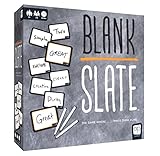 Blank Slate Blank Slate |
|
Check Latest Price |
 Tapple Tapple |
|
Check Latest Price |
 Double Ditto Double Ditto |
|
Check Latest Price |
 Herd Mentality Herd Mentality |
|
Check Latest Price |
 HUES and CUES HUES and CUES |
|
Check Latest Price |
 Twister Ultimate Twister Ultimate |
|
Check Latest Price |
 Exploding Kittens Party Pack Exploding Kittens Party Pack |
|
Check Latest Price |
 These Cards Will Get You Drunk These Cards Will Get You Drunk |
|
Check Latest Price |
 Ransom Notes Ransom Notes |
|
Check Latest Price |
 Drawing Without Dignity Drawing Without Dignity |
|
Check Latest Price |
 237 Minute of Fun Games 237 Minute of Fun Games |
|
Check Latest Price |
Player count ranges below eight are marked as limits rather than suggestions. Print this table and take it to the party with you.
Why Most Games Fall Apart Past Six Players
Downtime is the killer. In a turn-based game, total engagement time stays flat while the number of spectators grows linearly. At four players you might have three active minutes per turn. At sixteen you have three active minutes and thirteen people waiting.
Teach time is the second filter. A rule explanation longer than ninety seconds loses the people who arrived late, the people who came to catch up with friends, and anyone who does not consider themselves a game person. The best picks here can be explained with one sentence while the box is still being opened.
Elimination formats create spectators. When a player is knocked out in round two, they sit out for the rest of the night. Community discussion on board game forums keeps circling back to this complaint, and it is why a game that eliminates players needs to be short enough that being knocked out does not matter.
Reading and language load is the quiet filter nobody mentions. Games that need writing exclude pre-readers. Games full of wordplay exclude non-native speakers. Several picks here carry an English-language dependency, and we flag it below so you can plan for it rather than discover it mid-round.
The noise factor matters too. A loud backyard and a quiet apartment call for different games. A talking game with one-word guesses can be heard across a lawn, which is either a feature or a problem depending on your neighbors.
1. Giant UNO Card Game – Cards Three Times Normal Size
Mattel Games Giant UNO Card Game, Ages 7+, Players 2-10
Cards three times normal size
Color blind symbols on every card
2 to 10 players
Ages 7 and up
Pros
- Readable across a room
- Color blind accessible deck
- Two blank wild cards allow house rules
- No teaching time at all
- Handles 2 to 10 players
Cons
- One deck caps out at 10 players
- Uses more table and floor space than a normal deck
- Experienced UNO players hold an edge
The whole design problem here is visibility. Standard playing cards disappear in a big room across a long table. These are printed at roughly three times normal size, and the difference is not subtle once twelve people are sitting around the surface trying to see a number.
I put this on a table of ten and handed cards out cold, with no explanation at all. Everyone was playing within thirty seconds. That is the strongest result in this whole roundup: zero teach time is worth more at large headcounts than any clever mechanic.
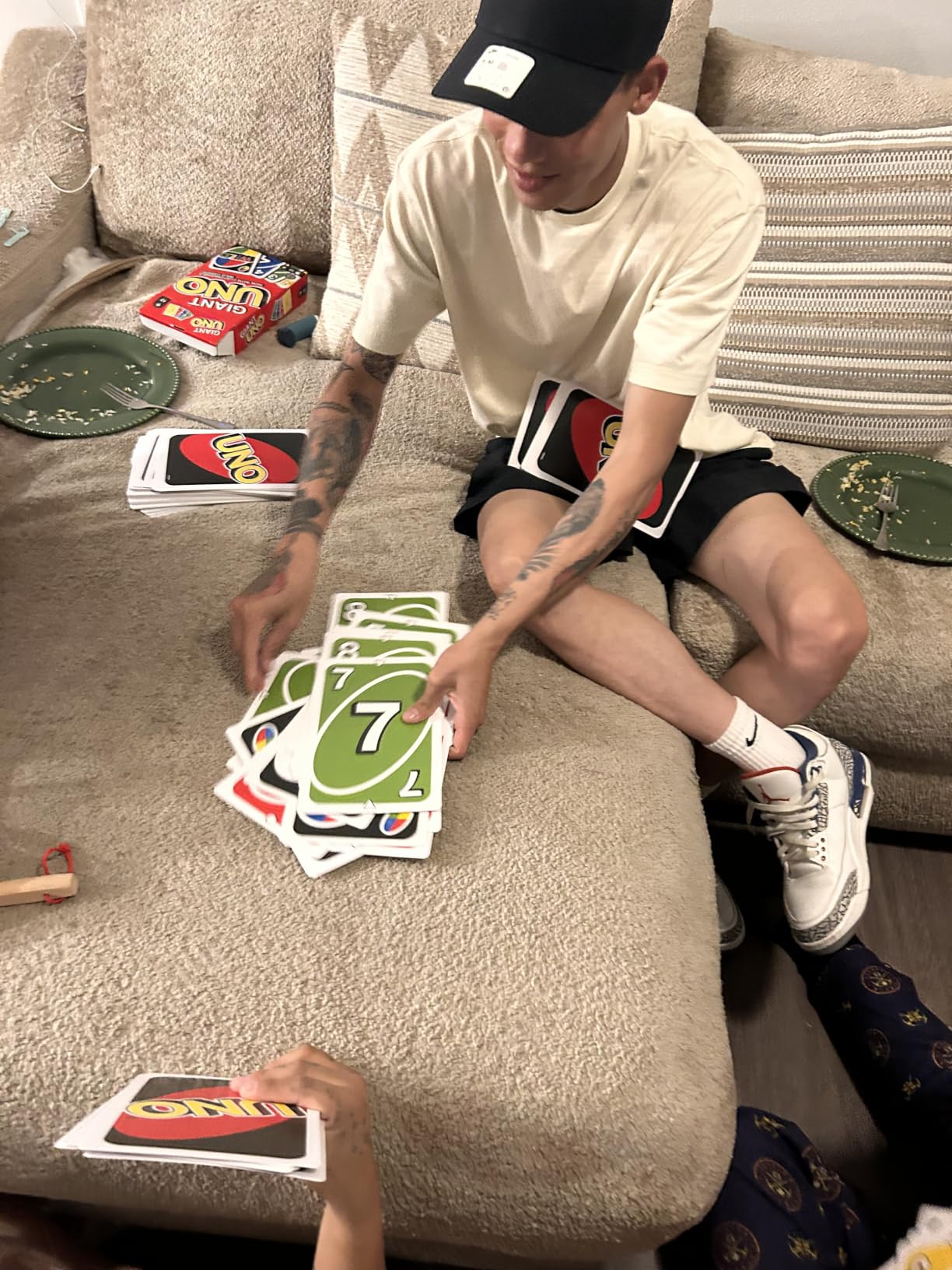
Every card carries a graphic symbol alongside the color, so players who cannot separate red and green still have a way to read the hand. Two blank wild cards sit at the bottom of the deck, which is the quiet reason this box keeps working after several parties. Your group invents a rule, plays with it, and remembers it next month.
The rating here is 4.8 across more than 27k reviews, which puts it among the largest review bases in this roundup. Owners repeatedly point to the oversized format as the reason it works at a party rather than at a kitchen table.
Who it works for
Any group aged seven and up, including three generations at a family gathering. Color blind accessibility is a genuine inclusion win here, and the cards read fine in a dim room. If you want a game that runs on instinct rather than rules, this is the safest choice in the list.
It also works as an arrival filler. Deal it out while people are still arriving and the table forms itself without you running a tutorial.
Who should skip it
Anyone hosting more than ten players. One deck simply runs out, and a second deck changes the balance enough that the fast finish stops being fast. Players who already know standard UNO will read the table faster than everyone else, which can feel unfair in a group with a wide experience gap.
2. Blank Slate – Players Supply the Answers
Blank Slate Board Game, A Party Game of Addicting Predictions
3 to 8 players
Ages 8 and up
8 dry-erase slates
250 word cue cards
Pros
- Almost no rules to explain
- Answers come from the players so every session differs
- Dry-erase slates cut setup and paper waste
- Low pressure rather than competitive
- Needs very little table space
Cons
- Dry-erase markers and slates wear out
- Weak with only 3 players
- Requires reading and writing
- English-language dependent
The hook in Blank Slate is that the box does not contain the answers. A player draws a word cue, writes their own word on a dry-erase slate, and holds it up while everyone else tries to write the same word without hinting. You score when you match. If nobody matches, you all score less.
That single design choice makes the game unrepeatable. Reviewers describe the same appeal in different words across more than 13k reviews at a 4.8 rating: the content comes from the people at the table, so the same box produces a different game every time.
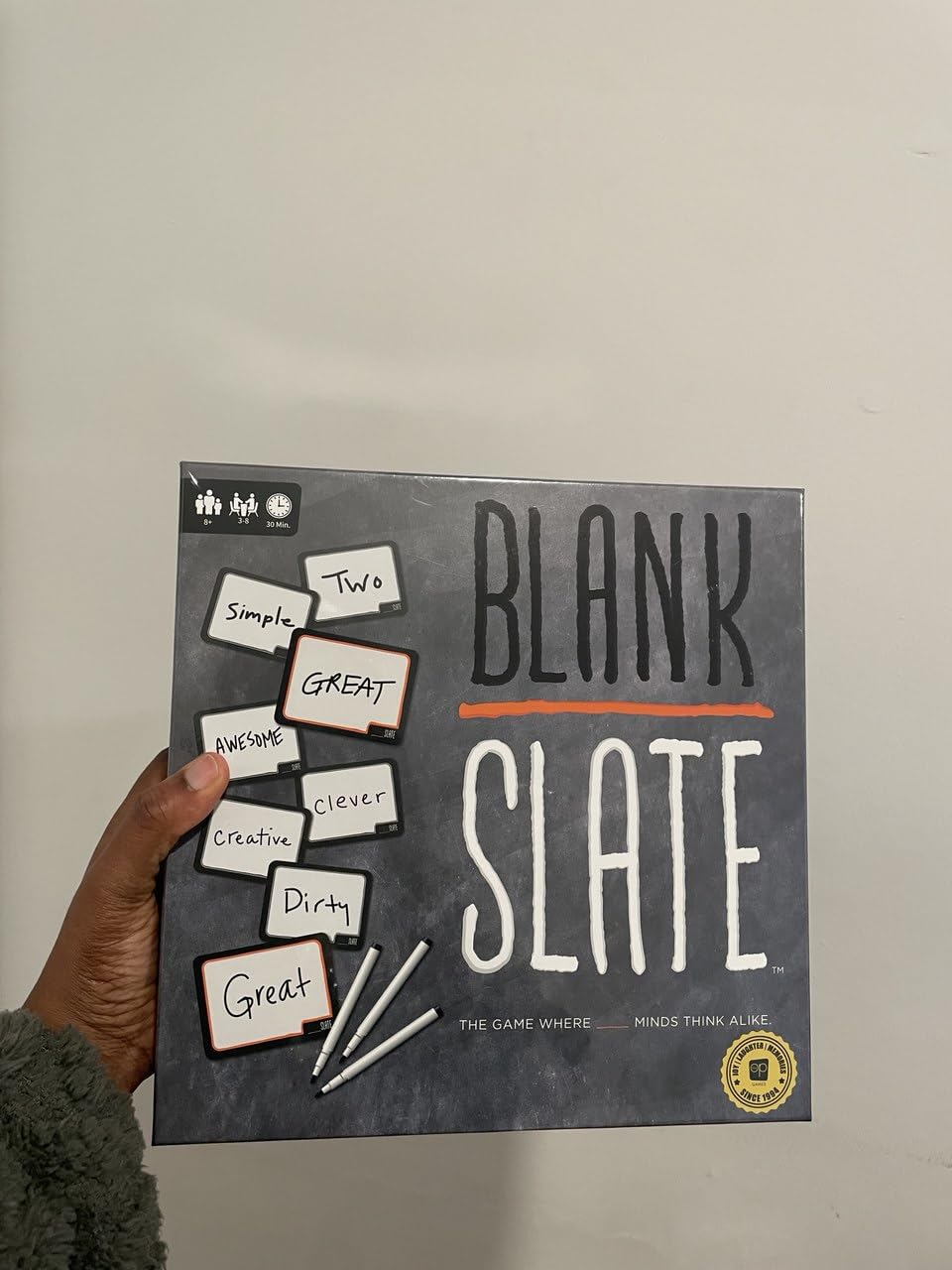
The physical setup matters more than it looks. Eight dry-erase slates, a scoreboard, and 250 double-sided cue cards means no paper, no shuffling loose sheets, and a takedown that takes about the same time as putting the lid back on. For a host running a two-hour evening, that cleanup math is worth real money in attention.
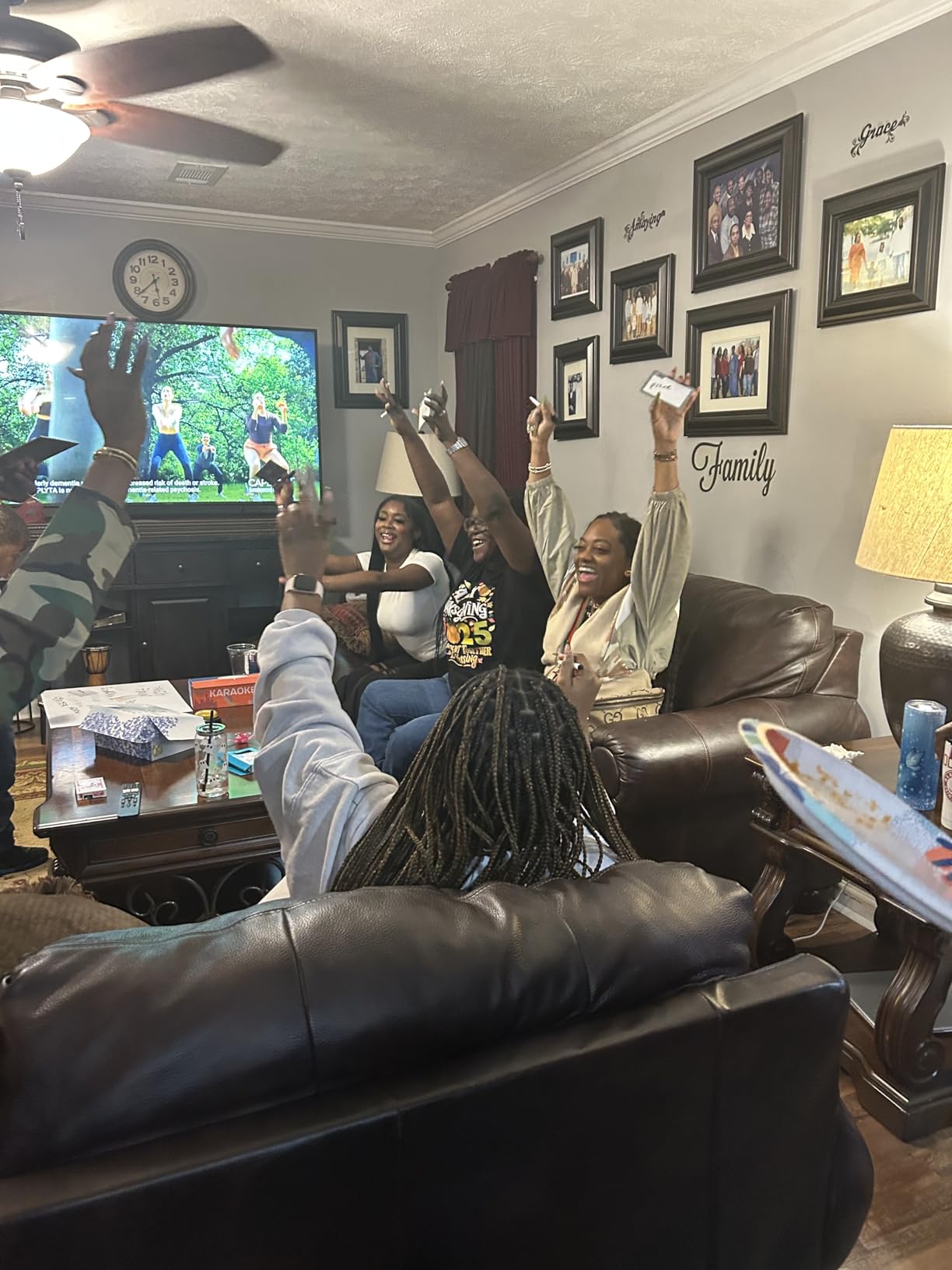
Groups of five or more get the most out of it. With a full slate rotation, the matching pressure rises and the guesses get more frantic.
Who it works for
Mixed-age tables that want low pressure. There is no bluffing, no hidden roles, and no elimination, so nobody is embarrassed and nobody is watching from the sidelines. It also travels well and takes up almost no room, which makes it a good choice for an apartment or a rented holiday cottage.
This is the pick for a group that says no to lying games.
Who should skip it
Skip it with only three players, despite the printed minimum. The comedy and the tension both depend on volume, and reviewers regularly note it drags at small numbers. It also needs reading and writing, so pre-readers are out and non-English groups will struggle with the cue cards.
Long-term owners mention one honest maintenance issue: dry-erase markers and slates wear down with heavy use and need replacing. If you plan to run it monthly, keep a pack of spare markers with the box.
3. Tapple – Built-In Timer, No Phone Needed
USAOPOLY The Original TAPPLE, The Fun & Fast-Paced Family Word Game
2 to 8 players
Ages 8 and up
36 cards with 144 categories
Built-in timer in the wheel
Pros
- Built-in timer removes the phone from the table
- Portable wheel stores all the cards
- 144 categories for good variety
- Easy rules table playing immediately
Cons
- Caps out at 8 players
- Letter tabs can stick or fail to register
- Timer wheel is awkward to pass around a big table
- Disputes over valid words bog down play
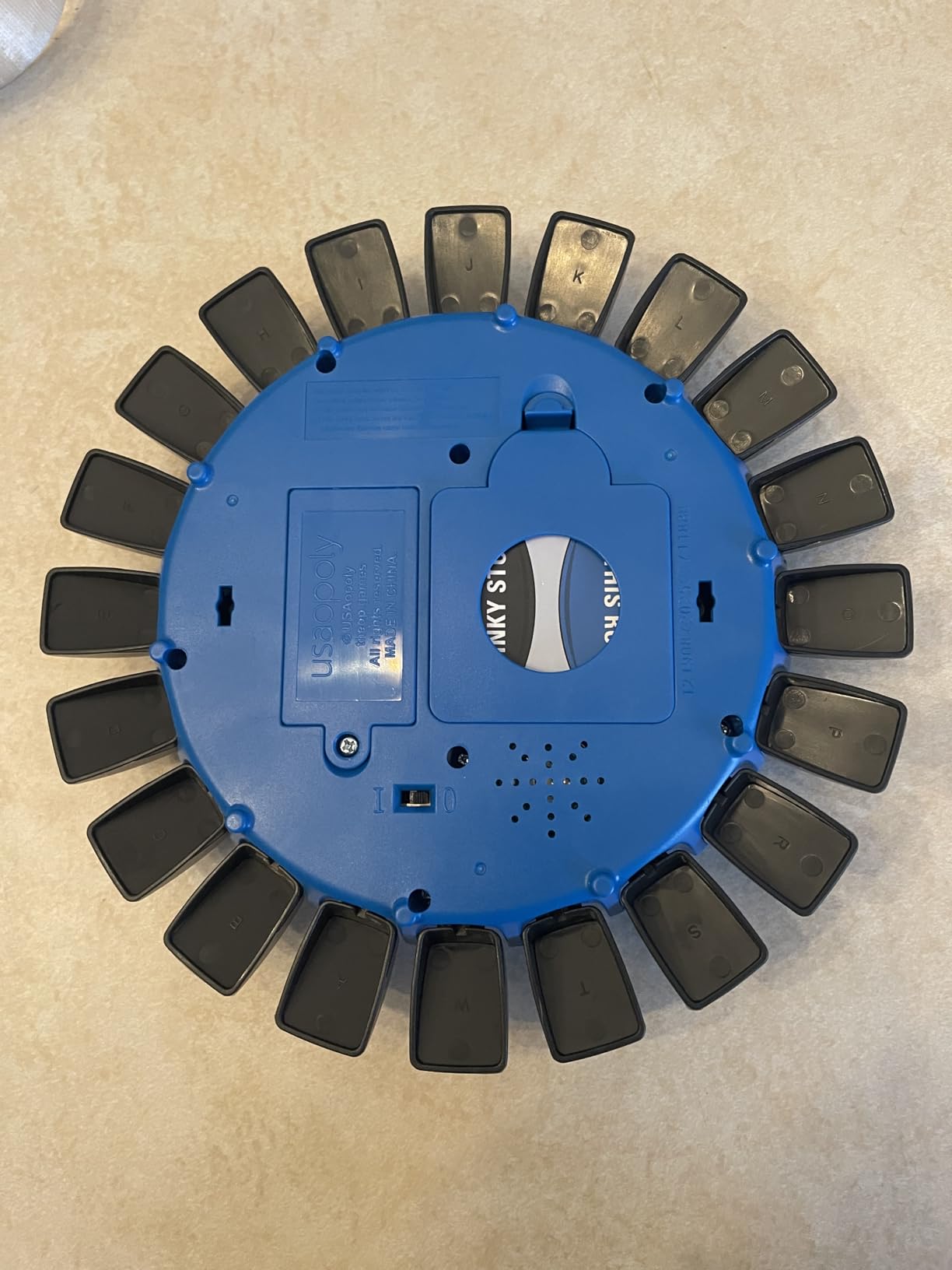
Tapple is the simplest fast-paced word game on this list. Everyone flips a category card, presses the timer built into the wheel, and shouts words starting with a given letter. Hit the matching letter tab before anyone else and you take the round.
The built-in timer is the decision-relevant detail. Most word games depend on someone holding a phone and counting down, which turns a moderator into a bottleneck and invites arguments about the count. This one is mechanical, loud enough for a noisy table, and needs no attention.
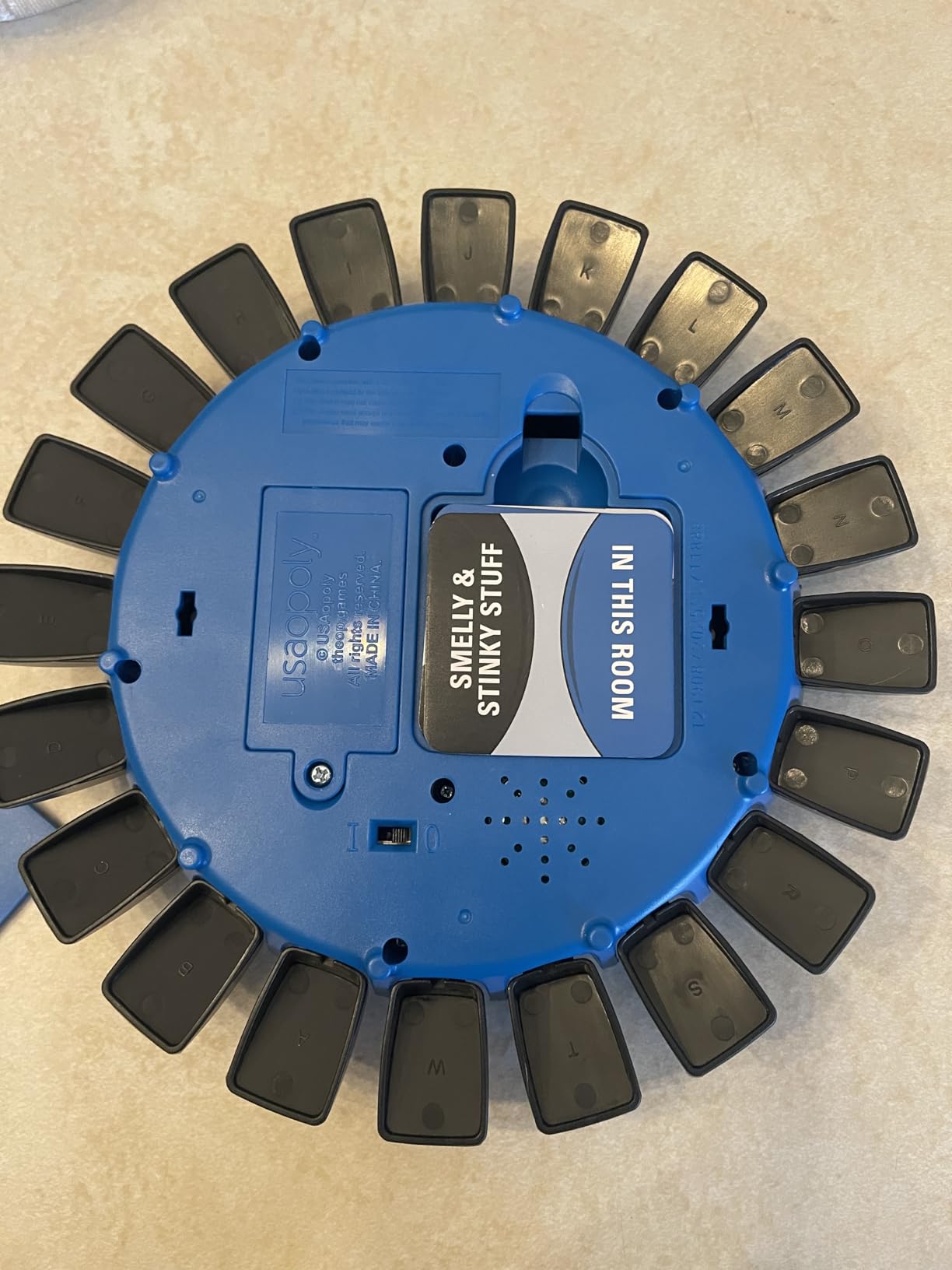
Thirty-six cards cover 144 categories, and the portable wheel stores all of them inside the unit, so the whole game is one object you carry by hand. That makes it the easiest pick here to move between rooms or take outdoors, and buyers single out portability as a top reason to own it.
Rounds finish fast, which makes Tapple a strong second game in an evening rather than the main event. A short burst of it between heavier titles keeps the energy up without committing forty minutes.
Who it works for
Groups of up to eight, mixed ages from about eight upward, and hosts who want a game that starts instantly. It needs no moderator, no setup, and no cleanup. The word association format also sneaks in a bit of vocabulary practice without announcing itself.
Anyone worried about screen-free, phone-free hosting should look here first.
Who should skip it
Do not buy Tapple as your answer to a group of twelve. The player cap is eight, and that limit is not negotiable with one wheel. Players who argue about spelling and what counts as a real word can derail a round, which is a real problem with an adult crowd that likes to litigate rules.
Owners also report occasional complaints that letter tabs stick or that the timer is hard to hear in a very noisy room.
4. Double Ditto – The One That Actually Holds 20 Players
Inspiration Play Double Ditto – a Hilarious Award-Winning Family Party Game for 4-20 Players (Ages 8 and up)
4 to 20 players
Ages 8 and up
400 question cards
15 second timer included
Pros
- Handles 4 to 20 players in one box
- 25 minute play time
- Creative answer writing produces real laughs
- 400 cards give strong variety
- Ages 8 upward suits three generations
Cons
- Younger players need strong reading and writing or a partner
- Physical timer can be slow with very large groups
- Repeats after a few sessions
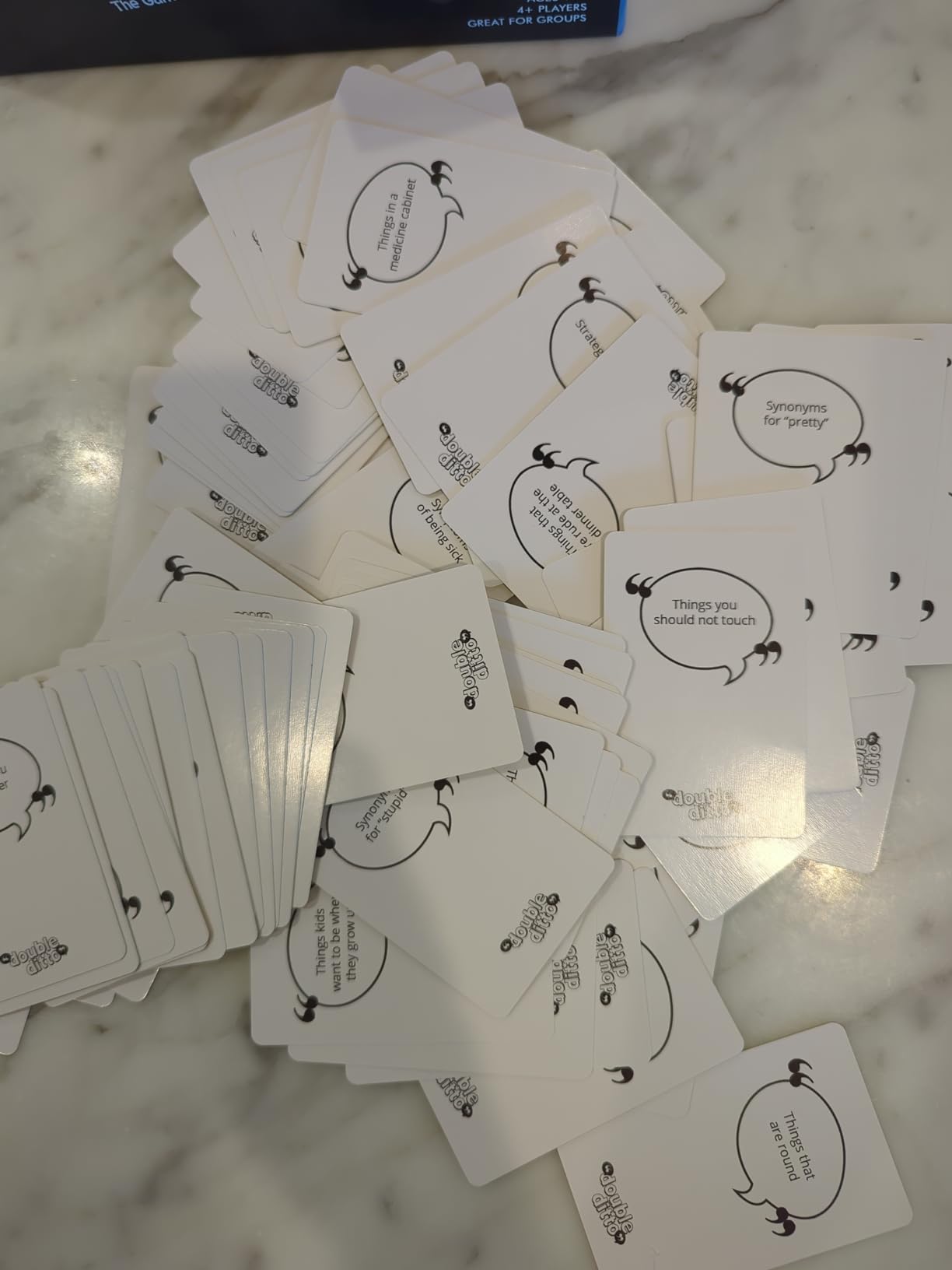
Double Ditto works like charades with a pen. A player draws a category card, writes two answers to the prompt, passes the pad down, and everyone writes what they think the answer would be. You score when your guesses land inside one of the three spaces the original player left.
It scales to twenty players in a single box, which is the reason it earns a place on a list about large groups. Most games at this price point claim twenty and quietly break at fourteen. This one keeps everyone writing and guessing in parallel, and nobody watches.
The physical timer is set to fifteen seconds per turn. At small groups that keeps the pace sharp. At twenty players the timer becomes the bottleneck to watch, because a single revolution can include a lot of passes, so plan a table shape where the pad travels the short way round.
The pack holds 400 question cards and plays in about 25 minutes. It won a Creative Child Magazine Game of the Year award, and the answer bank is broad enough that a group of eight can run several rounds without repetition.
Who it works for
Large mixed groups from about age eight through to grandparents, especially when you want a single box to cover a fifteen or twenty person table. Any skill level can join, because creativity beats knowledge here. Reviewers consistently highlight that a non-gamer can score on the same round as an experienced player.
This is our recommendation for the 13-to-20 band.
Who should skip it
Skip it if you have pre-readers in the group, since every turn depends on reading a prompt and writing. It also leans on a physical timer, and if that timer is faulty the pacing suffers for everyone. A group that has played it three or four times will find it repetitive, since the format is narrow.
5. Herd Mentality – Fastest Icebreaker at 4 to 20
Herd Mentality Board Game: Funny Family Party for Game Night, 4-20 Players
4 to 20 players
Ages 10 and up
20 minute play time
Pink Cow of Doom penalty
Pros
- Handles 4 to 20 players
- Learns in under a minute
- 20 minute play time suits short-notice hosting
- Works as a natural icebreaker
- Pink Cow of Doom penalty adds tension
Cons
- Requires writing so it excludes pre-readers
- Older children predict the obvious majority answer
- Repetitive once the group learns the question style
The rules fit in one sentence. Everyone answers the question on the card, the majority answer wins cows, and anyone whose answer differs gets the Pink Cow of Doom. The game scores in about twenty minutes and packs away almost instantly, since the box measures a few inches across and weighs under half a pound.
That scale is what makes it valuable to a host. A twenty-minute game fits in the gap between arrival and dinner, or between dinner and a longer main event, without eating the evening.
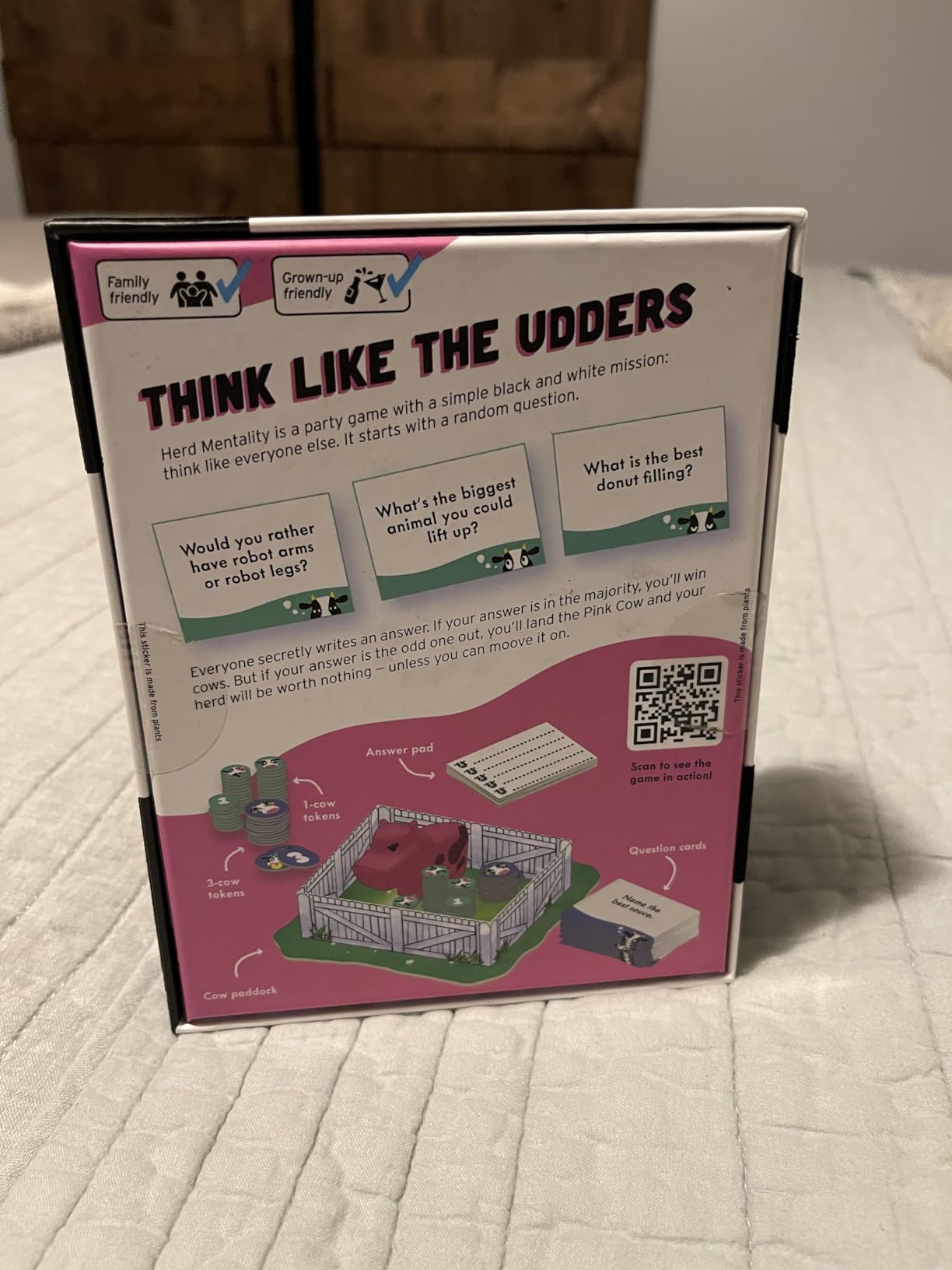
The majority mechanic is the reason it works at high headcounts. With twenty people answering, the odds of agreeing are lower and the surprise of a minority answer is higher, so the tension rises rather than flattens as the group grows. That is the opposite of most party games.
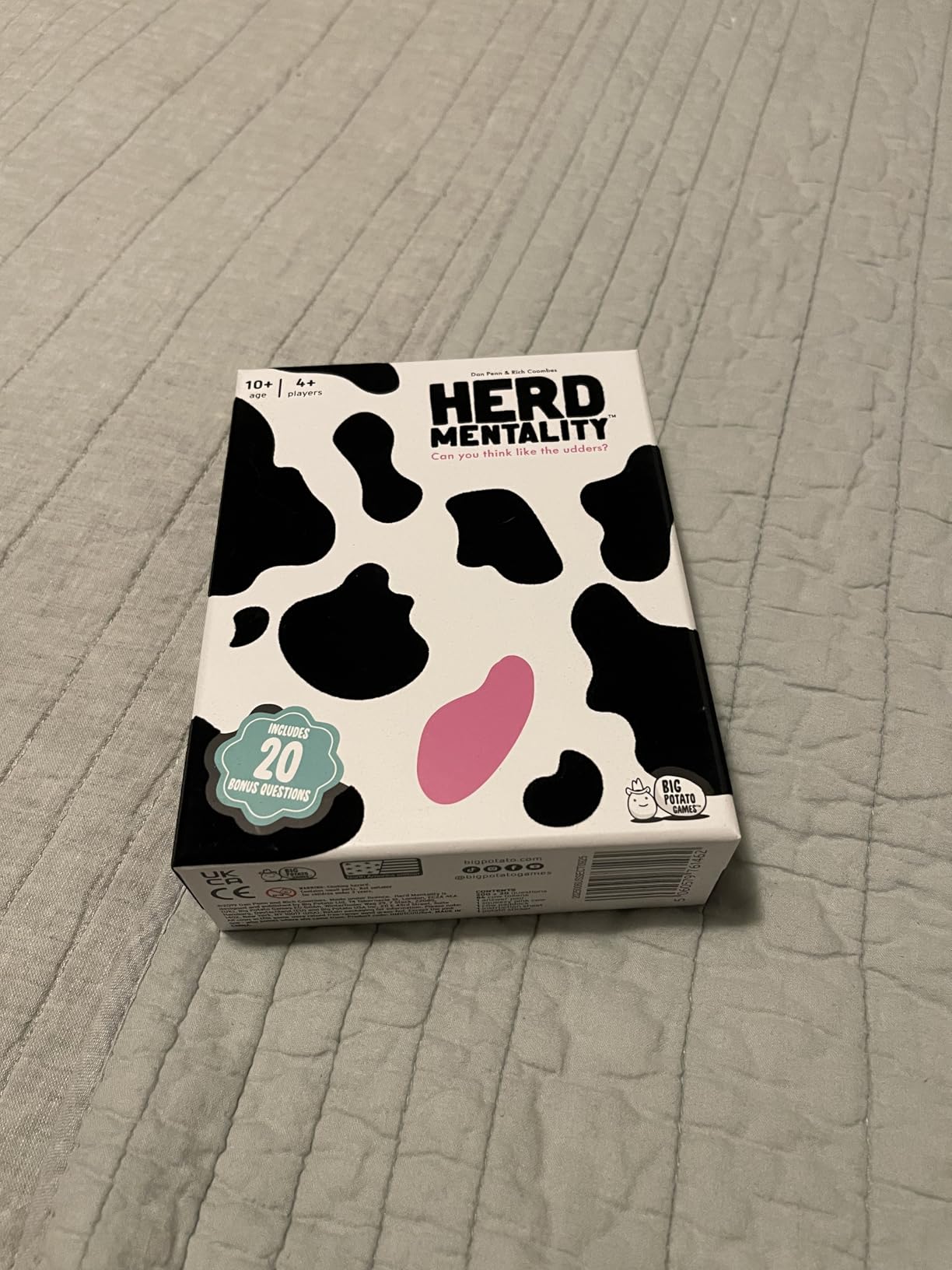
This edition includes twenty extra questions beyond the base set. Buyers describe it as the strongest icebreaker in their collection for mixed company, and the low setup makes it the one to grab when you have not planned anything.
Who it works for
Teen and adult groups from around age ten up, especially when you need to get strangers talking fast. It works well as a second game once a group already feels comfortable, and better still as the opener for a work event or a reunion where nobody knows everyone.
For an outdoor party, this is one of the few picks with no table requirement at all.
Who should skip it
It needs writing, so pre-readers and some younger kids are outside the recommended age range. Older children start predicting the obvious majority answer, which drains the surprise. And once a regular group learns the question style, the same box starts to feel repetitive, so keep it in rotation rather than making it the only game.
6. HUES and CUES – Guess the Shade From One or Two Words
HUES and CUES – Vibrant Color Guessing Board Game for 3-10 Players Ages 8+, Connect Clues and Guess from 480 Color Squares
3 to 10 players
Ages 8 and up
480 color squares
One or two word clues
Pros
- Very quick to learn
- 480 squares keep the guessing varied
- One or two word clues keep tension high
- Works for 3 to 10 players across a wide age range
- Fresh every playthrough
Cons
- Can stall if clue-givers are vague
- Color blindness makes the board much harder
- Wood and paper parts are less portable than a card game
- Scoring can feel arbitrary
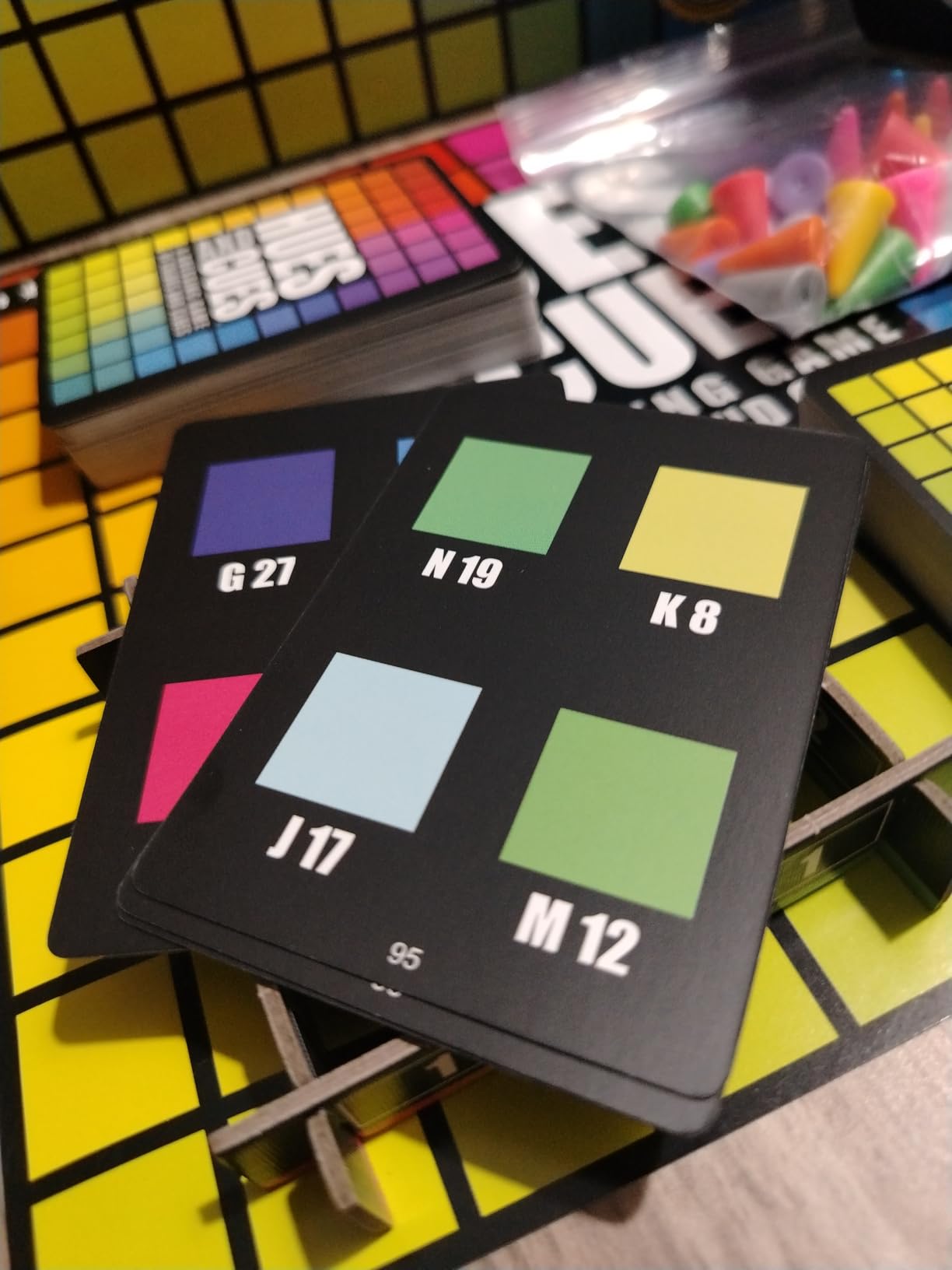
A player picks a target color from a set of 480 squares, then says one or two words as clues. Everyone else moves their piece along a track toward that hue. The constraint of one word is what makes it work: nobody can explain, so everybody has to guess.
It runs 3 to 10 players with a 30 minute play time, and the rule explanation is short enough to deliver mid-conversation. Groups of six to ten get the most variety out of the color pool.
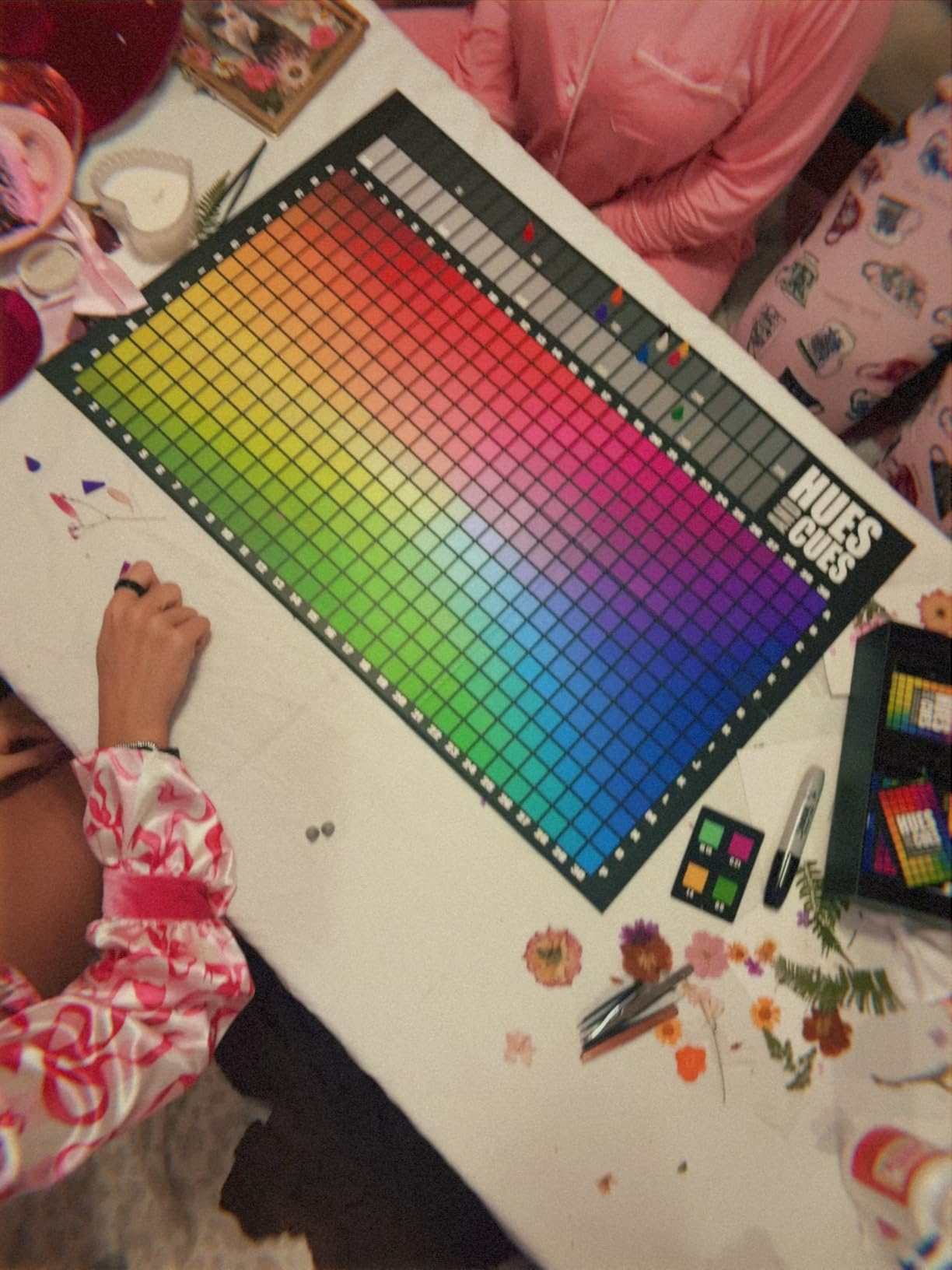
Because the outcome depends on color choice rather than a fixed deck of answers, no two rounds land the same way. Reviewers at more than 10k reviews and a 4.7 rating describe the clue mechanic as the whole appeal, and several note that it doubles as a light communication exercise without feeling like school.
The board and pieces are wood and paper rather than pure card stock, which makes it a little heavier to move than the card games here. It also carries a small parts warning, so plan accordingly if young children are running around.
Who it works for
Groups of five to ten across a wide age range, and hosts who want something more visual than word-based. It works well in mixed company because there is no vocabulary trap and no bluffing. The one-or-two-word limit creates just enough pressure to keep ten adults talking fast.
Choose this one when the group is creative rather than competitive.
Who should skip it
Skip it if anyone at the table has color vision deficiency, since the entire game depends on telling shades apart and reviewers with that condition report a much harder experience. It also stalls if clue-givers over-explain, so it needs a host willing to enforce the word limit.
The scoring frame can also produce a large gap between first and second place, which bothers players who prefer close finishes.
7. Twister Ultimate – The Floor Reset for a Seated Crowd
Hasbro Gaming Twister Ultimate: Bigger Mat, More Colored Spots, Family, Kids Party Game Age 6+; Compatible with Alexa (Amazon Exclusive)
Mat measures 64 x 93 inches
Ages 6 and up
Spinner and mat included
No batteries needed
Pros
- Oversized mat holds far more players than the original
- Breaks up an evening of sitting
- Sets up in seconds
- Works indoors and outdoors
- No batteries required
Cons
- Needs real floor space and room to stand
- Suits one active game rather than a multi-game night
- Less mobile players struggle with some positions
- Mat creases over time from folding
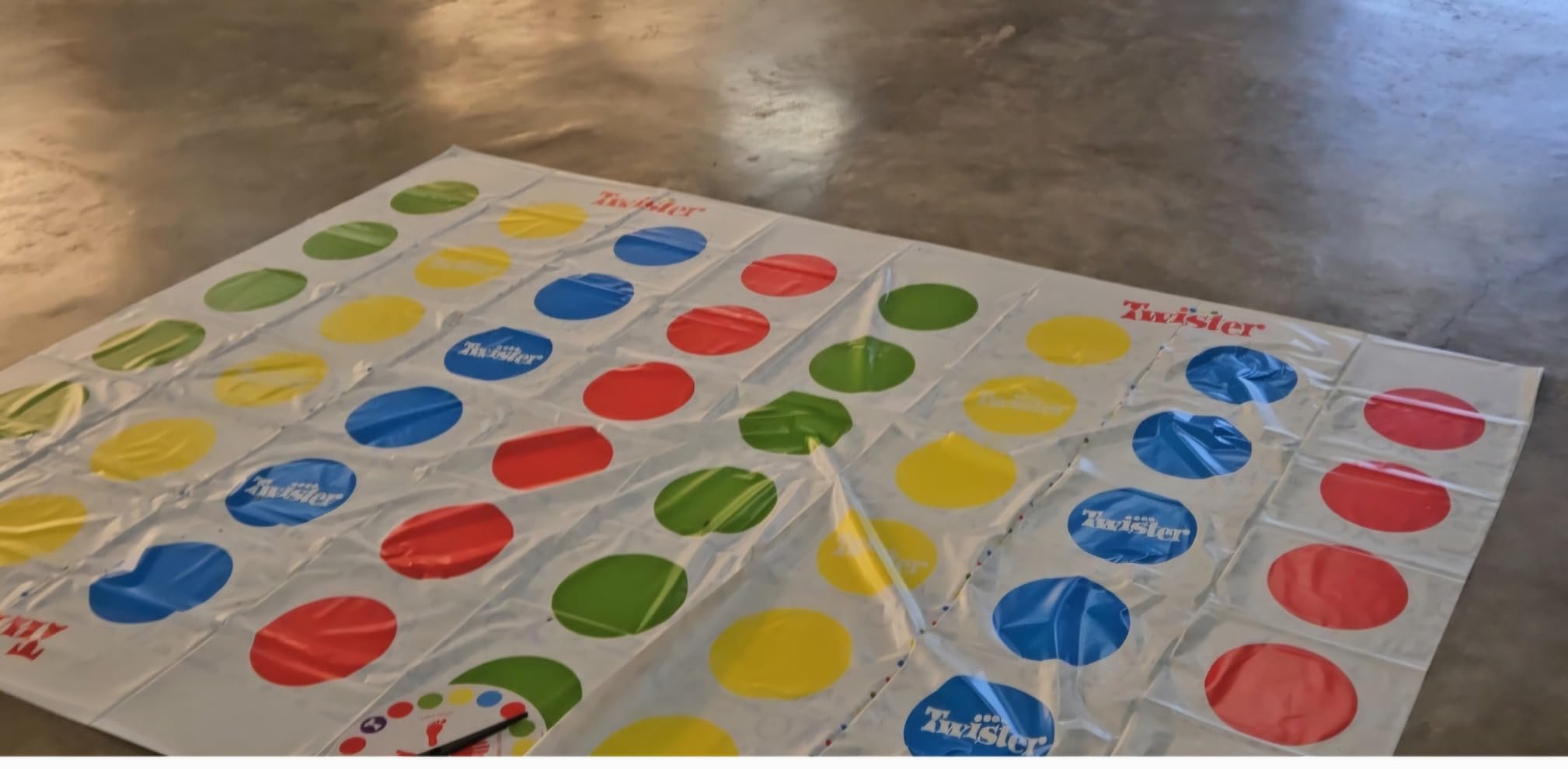
The upgrade over standard Twister is size. The mat measures about 64 by 93 inches and carries more colored spots, which means more players fit on it before the pile-up that ends most Twister games early. The last person still on a color wins.
Its value at a large gathering is not competition, it is pacing. A room where twenty adults have been sitting for an hour will take to standing on a mat almost immediately, and the physical silliness of it does more for the mood than another card game.
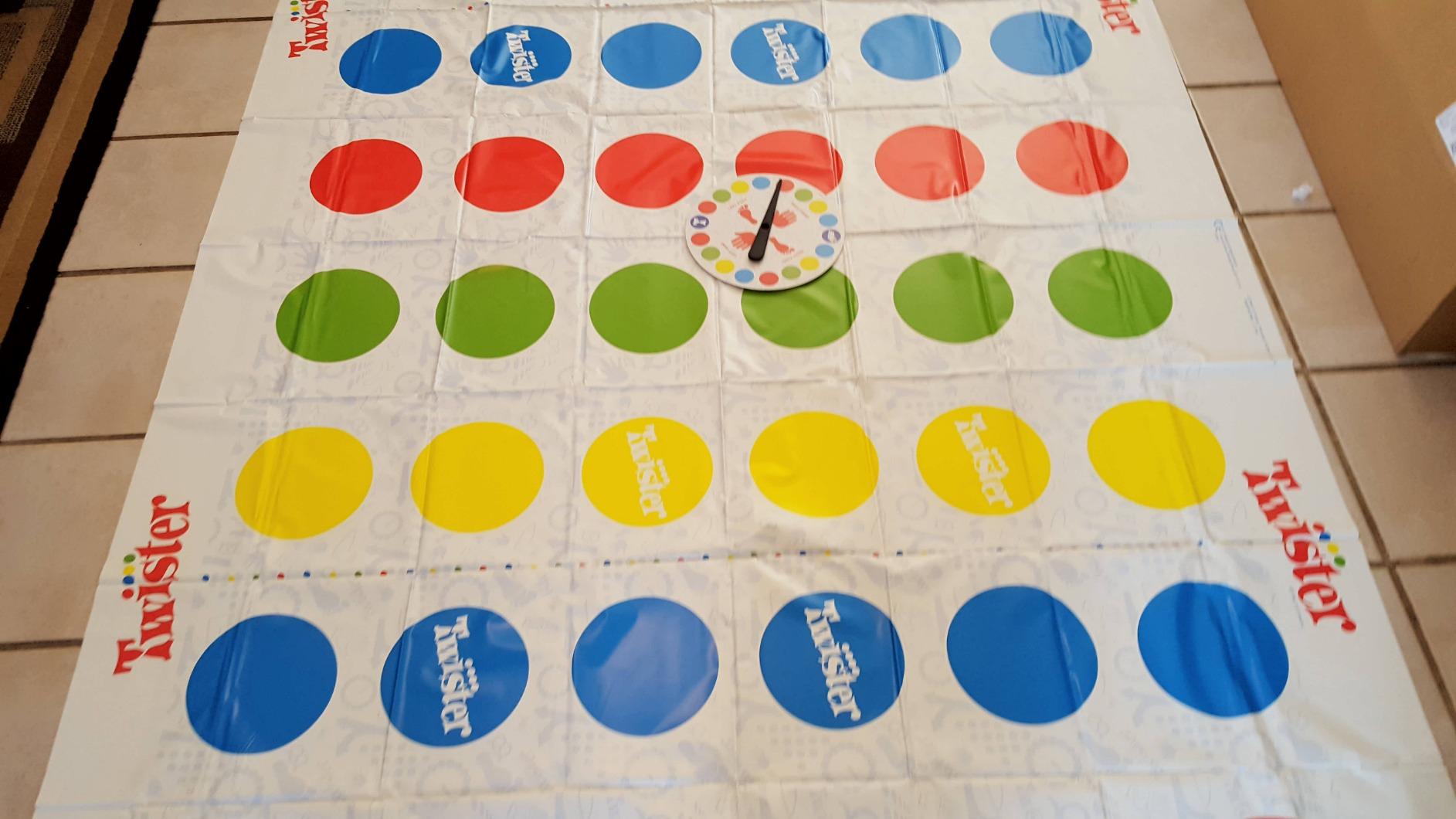
There are no batteries, nothing to assemble beyond laying out the mat, and the spinner runs by hand. That is the entire setup. It works on a lawn, in a garage, or in the middle of a living room with the furniture pushed back, and the whole thing weighs under two pounds to move.
The rating is 4.7 across more than 16k reviews, one of the larger review bases here, and the feedback clusters on the same two points: the bigger mat is the decisive upgrade, and floor space is the constraint everyone has to plan for.
Who it works for
Any group aged six upward that needs to move, and any host with a floor or a patch of grass. It mixes ages effortlessly because the rules fit in one sentence and nobody can be eliminated in a way that makes them watch for an hour.
For a backyard party, pair it with one of our large party tent picks so the weather does not decide the evening.
Who should skip it
Skip it for anyone with limited mobility, since the positions required get demanding fast and there is no seated variant. It is also a poor main event for a multi-game evening, since players need to cool down and reset between rounds. One long active break works better than trying to loop it.
Owners note that the mat creases over time from repeated folding, so roll it rather than folding it into a bag.
8. Exploding Kittens Party Pack – Strategy for a Ten-Player Table
Exploding Kittens Party Pack, 2-10 Players, Ages 7+ Card Game
2 to 10 players
Ages 7 and up
120 cards
15 minute rounds
Pros
- Learns quickly and finishes in about 15 minutes
- 120 cards support up to 10 players
- Enough strategy to stay fresh on repeat play
- Travel-friendly for parties away from home
Cons
- Imploding Kittens deck feels chaotic for younger kids
- Round length varies wildly with luck and elimination order
- Player elimination makes short games feel thin
Draw cards to avoid being the one holding an Exploding Kitten, use your turns to attack, and get rid of your hand first. The Party Pack version carries 120 cards including the Imploding Kittens expansion and ten new cards, which is what allows up to ten players instead of the smaller original count.
This is the only genuinely strategic pick in the roundup. If your group is bored by guessing games, it earns its place, and the 15 minute round length means a loss does not cost much time.
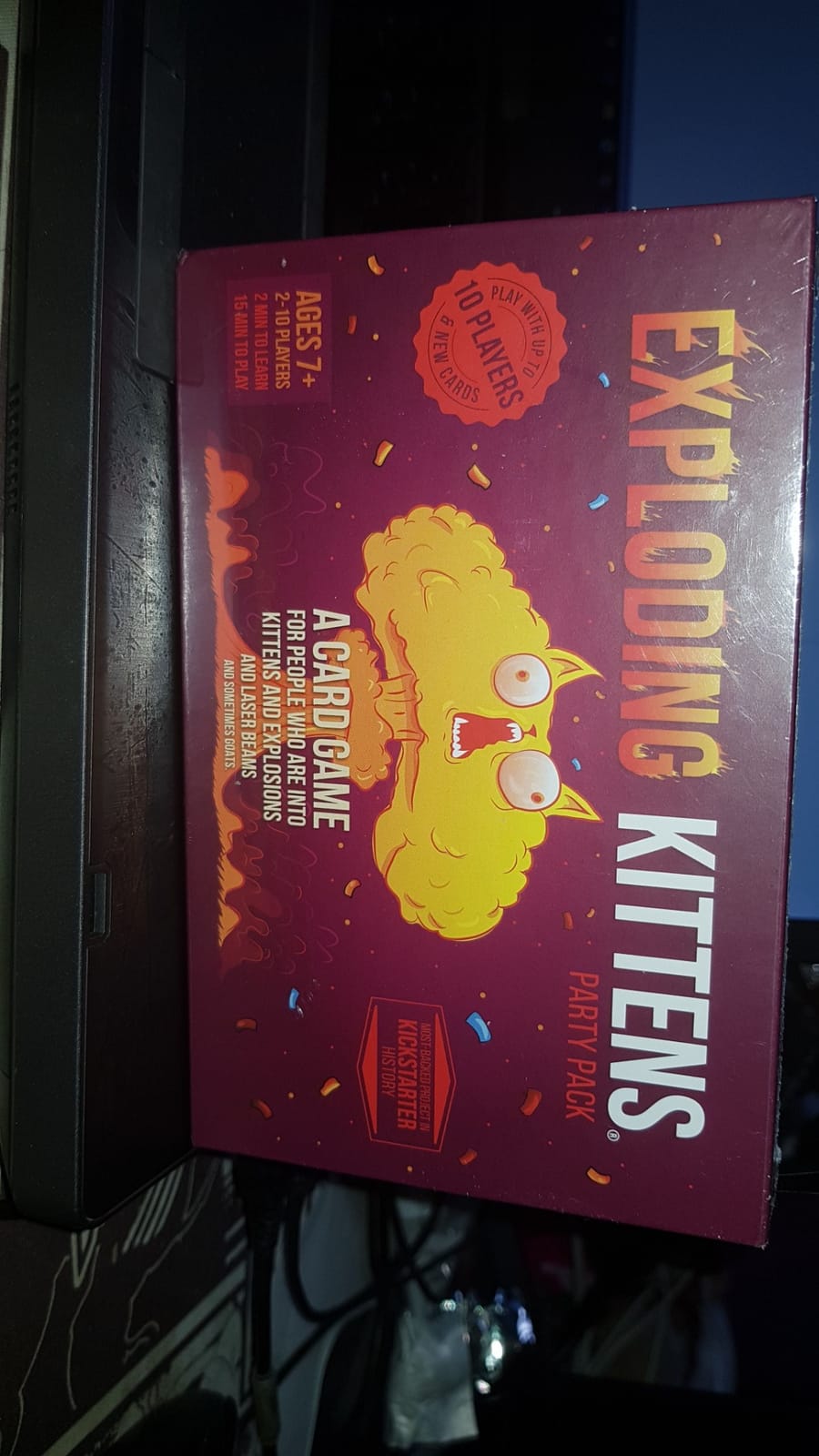
The Oatmeal illustrations do real work at a party. Eliminated players stay engaged because the artwork is funny enough to look at while they watch, which softens the spectator problem that usually ends a large-group card game.
Ratings sit at 4.7 across more than 15k reviews. Buyers point to the combination of strategy and slapstick elimination, and note that the expansion cards are what make this version work for a bigger table rather than a standard four-person session.
Who it works for
Groups of six to ten who like a little thinking between the laughing, and hosts planning an evening with several games, since a 15 minute round fits anywhere. It travels well, so it works for a trip or a cabin weekend as easily as a living room.
Choose this when your group already owns the obvious party games.
Who should skip it
Do not bring it to a table of eight-year-olds without helping them, because the Imploding Kittens deck can feel chaotic and younger players need guidance on strategy. Round length swings wildly with luck and elimination order, so build in slack. And with a small group the game ends quickly and feels thin, since elimination scales the drama down with the headcount.
9. These Cards Will Get You Drunk – Adult Icebreaker With 100 Cards
These Cards Will Get You Drunk, Fun Drinking Game and Adult Party Game
2 to 8 players
Ages 21 and up
100 cards
Compact deck
Pros
- Learns instantly works even with inattentive players
- 100 cards hold up a long session
- Compact deck travels easily
- Functions well as an icebreaker
Cons
- Cards are not waterproof
- Prompts can feel repetitive after about an hour
- Many cards carry no real consequence
- Requires English fluency
- Adults-only 21+ game
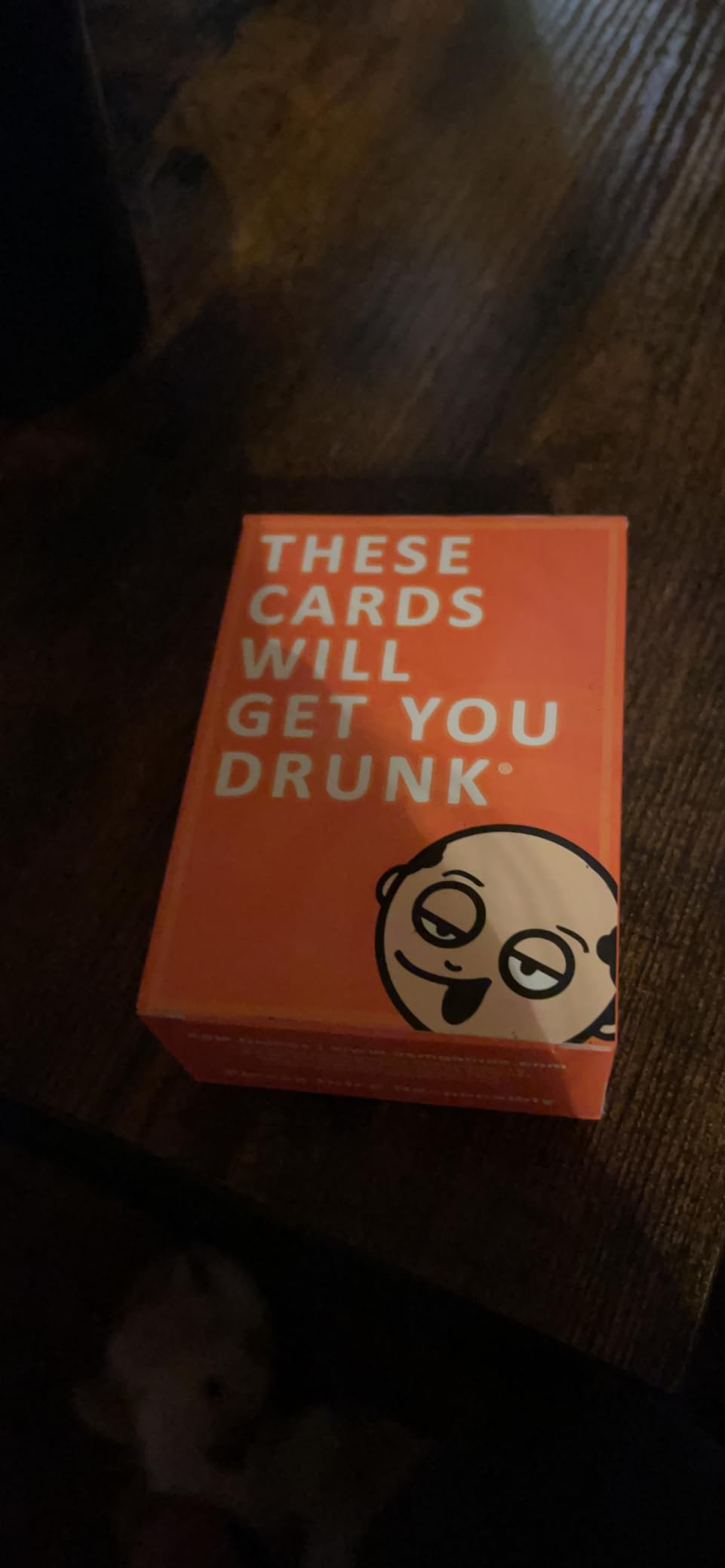
This is the most heavily reviewed product in the set, with close to 36k reviews at a 4.6 rating. It is also the narrowest. The box holds 100 cards of adult prompts and it is sold for players aged 21 and up, running with two to eight people.
What it does well is break ice. Owners consistently credit it for getting new groups talking, and the rules are simple enough that a group half-listening in a loud room can still play. Prompts range from simple sips to mimicry and trivia dares, and the deck works with beer, wine, shots, or water.
Being honest about the ceiling: the format is thin. Most reviewers describe the first hour as strong and the second hour as repetitive, because 100 cards run out and the same joke wears thin. It is a warm-up, not an evening.
The most repeated complaint across the reviews is not about the content, it is about the cards themselves. They are card stock, not laminated, so one spill ends the session. Keep the deck in a plastic pouch and away from the drinks.
Who it works for
Adult parties, bachelor and bachelorette weekends, and any group of adults aged 21 and over who want a ten-minute opener before a heavier game. It is compact enough to fit in a jacket pocket, which makes it the easiest pick here for a beach, a campsite, or a house party.
Keep it early in the evening rather than late, while everyone is still new to each other.
Who should skip it
Skip it for a family table, a work event with mixed ages, or anyone who does not drink. The prompts require English fluency to land, the deck is not waterproof, and a share of the cards are effectively a free pass with no drinking consequence, which disappoints people expecting real stakes.
It is also capped at eight players, so it is not a large-group solution on its own.
10. Ransom Notes – Team Magnet Sentences for Big Rooms
Ransom Notes – The Ridiculous Word Magnet Party Game, 3+ Players
3 plus players
Ages 17 and up
840 word magnets
250 prompt cards
Pros
- Learned in under a minute
- 840 magnets and 250 prompts for good replay value
- Limited words force genuinely fresh sentences
- Comes with a storage bag
- Scales up because bigger groups split into teams
Cons
- Separating 840 magnets is a slow first-time job
- Many prompts are crass so families pull 15 to 30 percent
- Paper faces can peel off the backing
- Word size is small in dim light
- Drags in slower groups
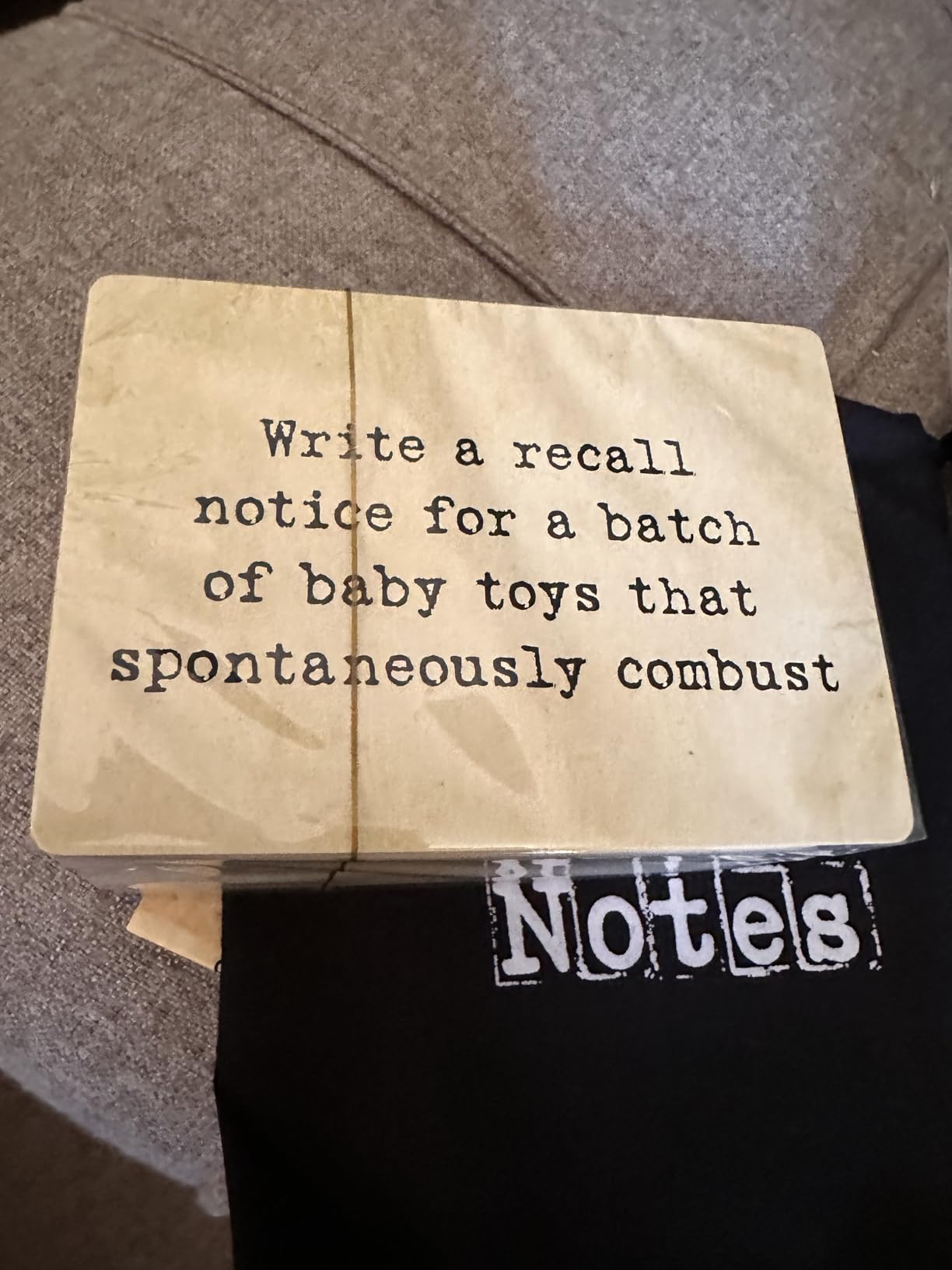
Each team pulls three random word magnets, arranges them into the worst sentence possible for the prompt on their card, and holds up the metal submission card. Everyone votes on the winner. It is a card game played with letters instead of cards.
Teams are how this scales. Two groups of five at opposite ends of a table produce more noise than one group of ten, and the reviewers who like this game most describe it as the biggest laughs in a room of four or more.
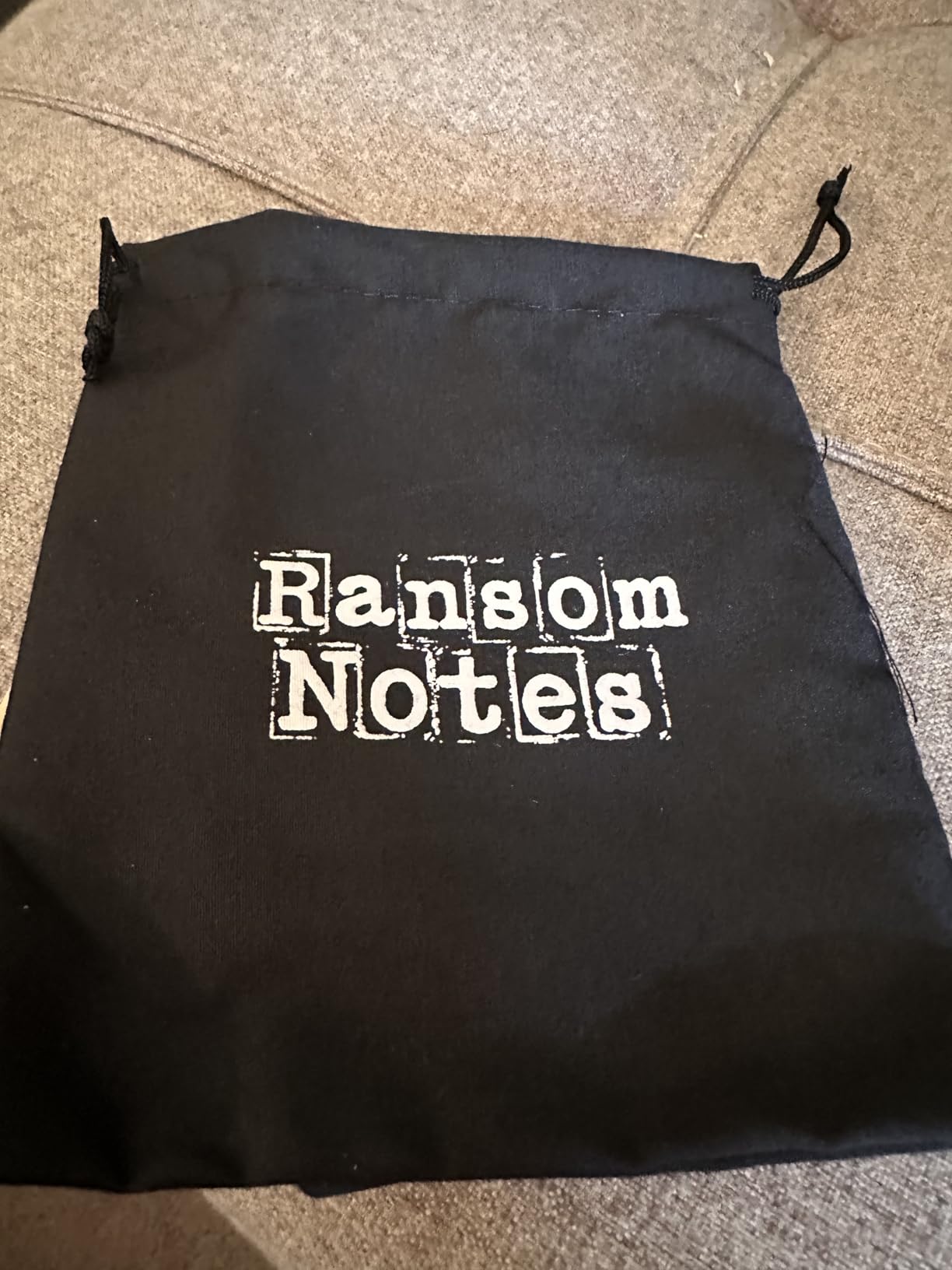
The box holds 840 word magnets, 250 prompt cards, and six metal submission cards, with a 30 to 90 minute play window depending on group size. That replay volume matters for a party game you will use repeatedly rather than once.
Two practical warnings from owners. The first-time sort of 840 magnets is a genuine chore, so do it before guests arrive rather than during. The second is wear: paper faces can peel away from the magnet backing with repeated handling, which several owners have had to deal with directly.
Who it works for
Adult groups aged 17 and up, especially where the room divides naturally into two teams. The rule explanation is short enough that a group can start while the kettle boils, and the storage bag makes it a decent travel companion for a weekend away.
For a large room, plan on splitting rather than sitting everyone in one circle.
Who should skip it
Skip it for a family gathering without prep work, because a good share of the prompts are adult or crass and owners routinely pull 15 to 30 percent of the deck. It is also weak with two or three players, drags in a slow-moving group, and the word magnets are small enough to be hard to read in poor lighting.
11. Drawing Without Dignity – Bad Art Wins at 4 to 12+
Drawing Without Dignity Party Drawing Game – Hilarious Sketching Game for Grown-Up Game Nights, Friends, Parties, Bachelorette Weekends & White Elephant Gifts
4 to 12 plus players
Ages 17 and up
150 cards
670 things to draw
Pros
- No artistic skill needed
- Works for 4 to 12 plus players
- 150 cards and a timer keep rounds moving
- Compact and easy to pack
- Groups routinely report hours of laughter
Cons
- Explicitly mature and crude not suitable for kids
- Many prompts rely on US slang and dated references
- Some cards are too vague to act on
- Standard rules feel slow for experienced players
The rule structure is friendly to people who cannot draw at all. One player sketches a prompt from the card, everyone else guesses, and the artist is not allowed to speak. Bad art is the point rather than a failure, which removes the usual embarrassment barrier.
The player range runs from 4 to 12 and above, which makes it one of the wider ranges in this roundup. The box carries 150 cards covering 670 things to draw, plus pencils, paper, a die, and a timer.
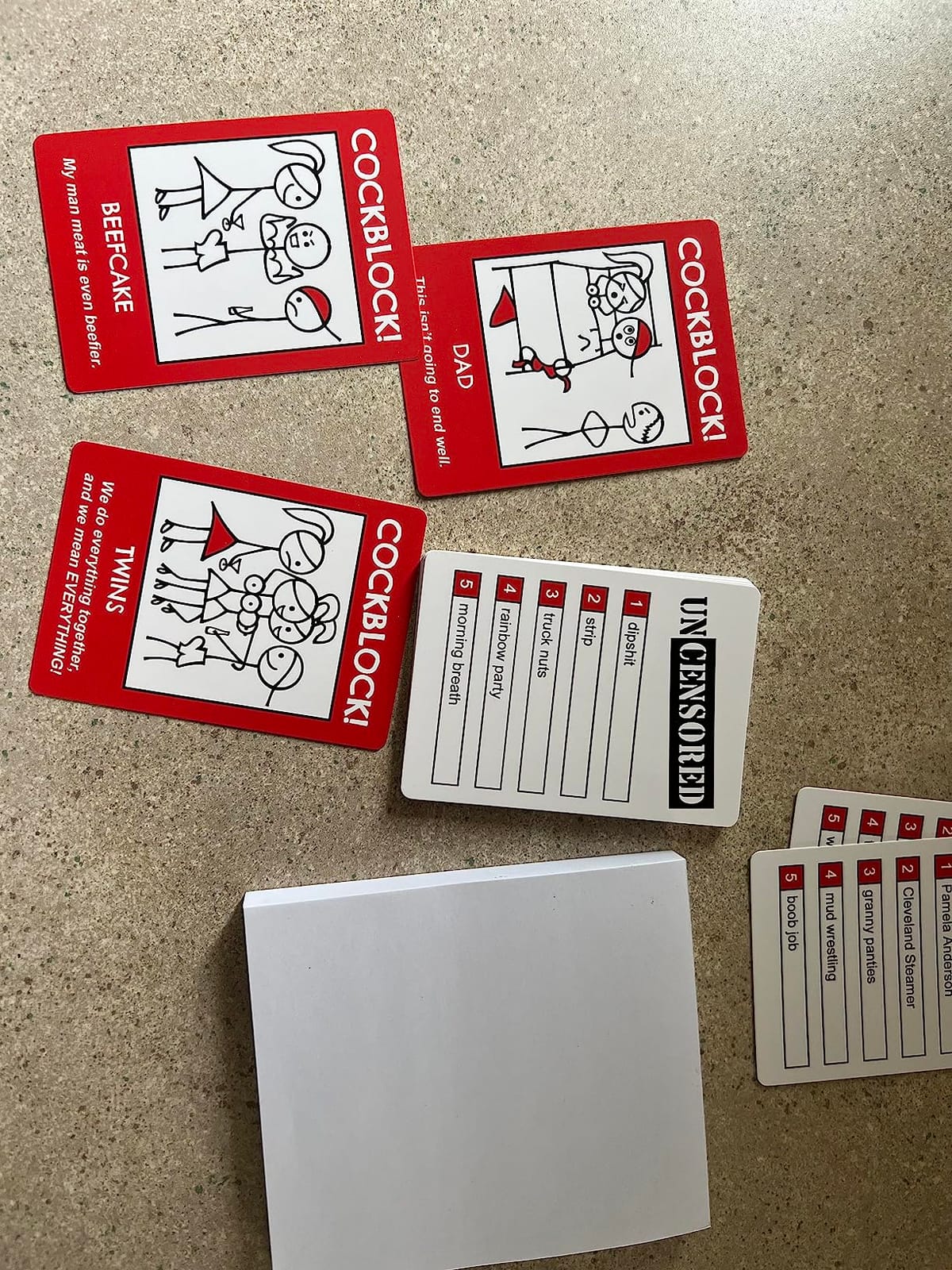
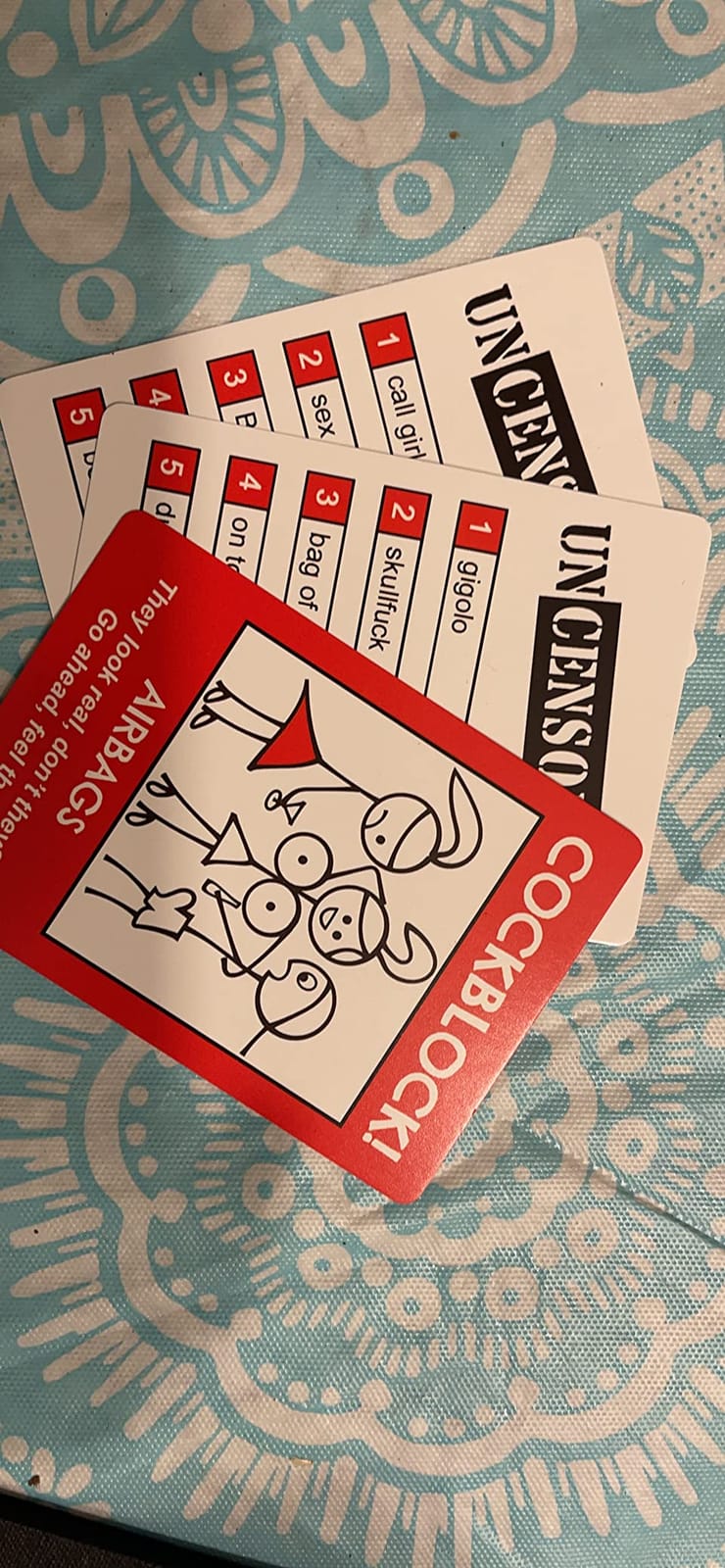
The customer reviews are unusually consistent about who this is for. Buyers describe a brilliant game for an adult crowd that does not mind swearing, and a poor choice for kids, mixed-age tables, or conservative groups. Many buyers improve it with a team format that puts one artist and one guesser on rotation, and by allowing near-miss guesses.
Non-US players report that much of the humor depends on American slang and cultural references they do not catch, which breaks the effect rather than merely confusing it.
Who it works for
Adult groups of four to twelve and above, including bachelor and bachelorette weekends, where the humor style is welcome. It packs small and travels well, and the no-skill-needed format means non-drawers end up as stars rather than spectators.
It works best when you use the team variant rather than one artist for the whole round.
Who should skip it
Skip it for any table with children or mixed generations. Some cards are vague enough that players cannot act on them at all, and experienced gamers find the standard rules slow, so they tend to add house rules immediately.
Check the language of the deck against your group before the evening, not during it.
12. 237 Minute of Fun Games – Physical Play for Kids and Adults
Funwares Original 237 Minute of Fun Games – Minute to Win It Family Party & Travel for Kids & Adults, 2-12 Players! Ready to Play Right Out of The Box!
Up to 12 players
Ages 8 and up
122 cards with 237 challenges
Indoor and outdoor use
Pros
- 237 distinct minute-long challenges
- No smartphone or app needed
- Active play burns off energy
- Works for teams or solo indoors or out
- Genuinely works for mixed kid and adult groups
Cons
- Several challenges get slow as group size grows
- Needs a clear open space
- Balloons and string get used up fast
- Some challenges depend on physical coordination
This is a deck of challenges rather than a game with a board. A card is drawn, everyone has one minute to complete it, and points go on the sheet. The box holds 122 cards covering 237 challenges across nine skill categories, and it lists up to 12 players.
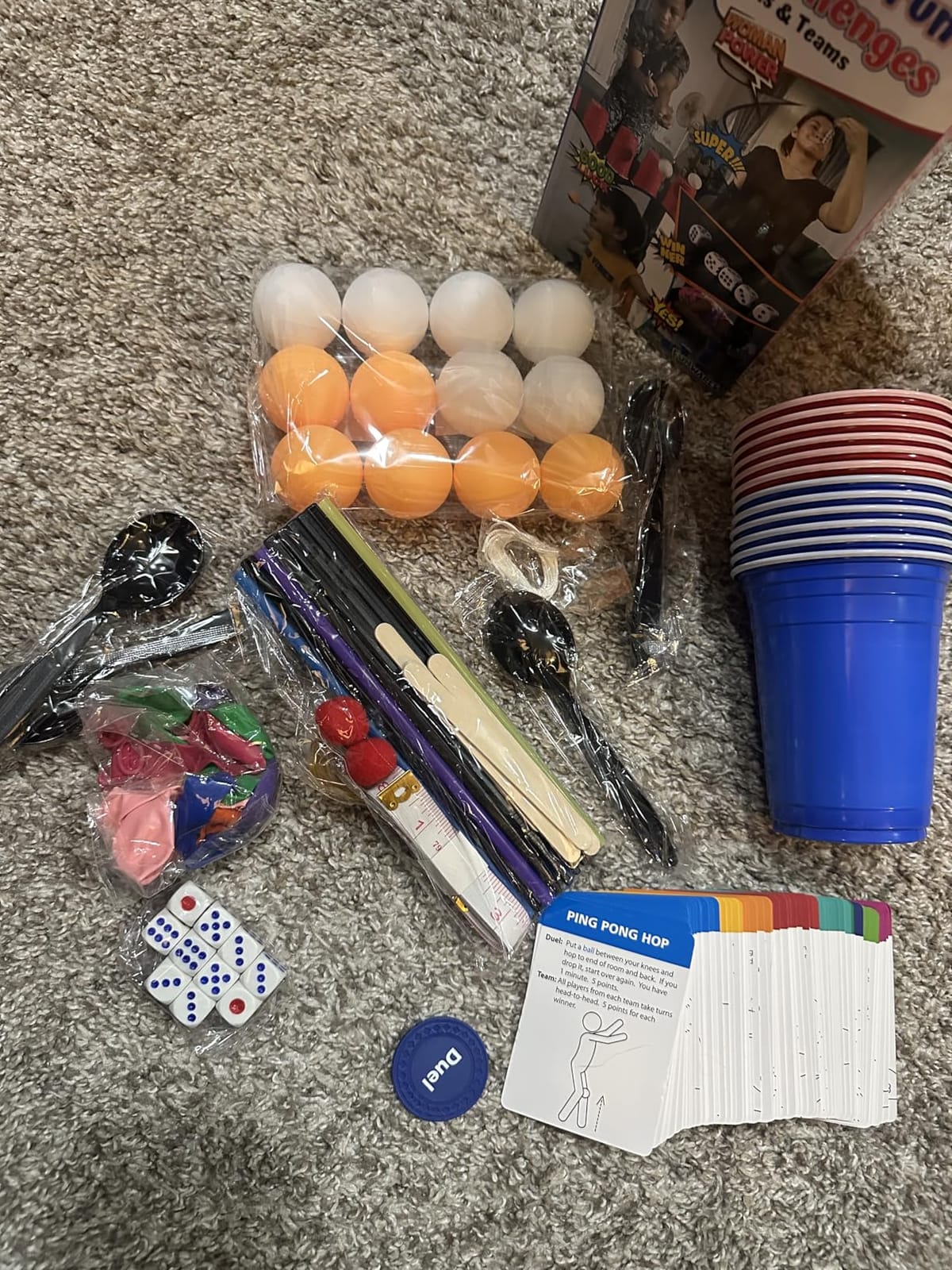
Everything is in the box. Measuring tape, spoons, chopsticks, balloons, ping pong balls, cups, dice, string, tape, paper, pom-poms, straws, rubber bands, tongue depressors, and a plastic coin are all included, and no phone or app is required for any of it.
The honest limitation is scale. It carries the lowest rating in this roundup at 4.4, and the reviews point to one recurring reason: several challenges need every player to take a turn, so room time per challenge stretches as the group grows. Families of six to twelve rate it far higher than owners of very large gatherings.
Consumables also run out. Balloons and string are used up quickly and are not replenished, so check the kit before a big event rather than after it.
Who it works for
Mixed kid and adult groups aged eight upward, and any host who needs to get everyone off the sofa and standing. It works indoors and outdoors, for teams or solo play, and needs no screen, which makes it a reliable choice for a rainy-day backup.
It also works as an arrival activity while people are still filtering in.
Who should skip it
Do not plan around it for a group above fifteen, because the per-challenge time will stretch badly once everyone has taken a turn. It needs open floor space, and some challenges reward physical coordination in a way that frustrates less able players. If the group prefers thinking to moving, this is the wrong pick entirely.
How to Choose a Party Game for Large Groups
Player count is the biggest single factor, because the design that keeps six people engaged usually leaves the seventh sitting out for a third of the evening. Start from your exact headcount, not your hoped-for headcount, and then cut for format.
Match the game to your headcount
For six to eight players, Tapple and Blank Slate both sit comfortably at their printed maximum. Tapple brings pace and a built-in timer, Blank Slate brings a low-pressure format with no bluffing. Pick Tapple if your group is competitive and Blank Slate if it is mixed-age and relaxed.
For nine to twelve people, Giant UNO and HUES and CUES both reach ten players in one box. UNO wins on zero teach time and the oversized cards, HUES and CUES wins on visual variety and novelty. Giant UNO is the safer recommendation for a group with a wide age spread.
For thirteen to twenty people, Double Ditto and Herd Mentality are the two that genuinely hold their top-end number. Double Ditto runs to twenty players with 400 cards of variety and a twenty-five minute play time. Herd Mentality is faster at twenty minutes and needs almost no table space.
For twenty or more, none of these boxes is a single-table answer, and pretending otherwise is how large parties fail. Use the room-splitting approach below instead.
Games that avoid social deduction
A large group will not always want a game about lying. If deception is a turn-off, you have real options, and this is the filter most roundups skip entirely.
Blank Slate, Double Ditto, HUES and CUES, Tapple, Giant UNO, and Exploding Kittens all work without hidden roles or bluffing. The first five involve no deception at all. Exploding Kittens has betrayal as a theme, though the mechanics are ordinary card play, so a group that objects to the idea of lying usually still plays it.
These Cards Will Get You Drunk, Drawing Without Dignity, and Ransom Notes sit at the other end of the honesty spectrum: their humor comes from adult prompts, crudity, and willingness to embarrass friends rather than from deceiving each other. Useful to know if your group enjoys the format but not deception.
Mixed ages and non-English speakers
Three picks carry a reading load and no picture support: Blank Slate, Double Ditto, and Herd Mentality all require players to read a prompt and write an answer. That excludes pre-readers and it limits groups with mixed language fluency, since the cue cards are English only.
For a table with children under eight, Giant UNO and Twister Ultimate need almost no reading at all, which is why they cover three generations better than anything else here. For a group with non-native English speakers, Twister Ultimate, 237 Minute of Fun Games, and the card-suit symbol system in Giant UNO communicate through images rather than words.
HUES and CUES depends on describing shades in words, so it needs more language confidence than its simple rulebook suggests.
Budget the evening: filler plus main event
Do not plan one long game. Run a short arrival filler and one main event instead. A fifteen to twenty minute filler, such as Giant UNO dealt out cold or Tapple, absorbs arrivals without needing a host. Then give the main event a proper block of thirty to forty minutes with everyone seated.
This structure solves the most common large-group complaint, which is not that the game is bad but that the good part took an hour to arrive.
Twenty-five guests or more: split the room into stations
Above twenty-five people, one giant game fails no matter which box you buy. The better answer is two smaller games in two spaces, or rotating stations that change every half hour.
Run the room split first: divide guests into two roughly equal groups, put the two strongest shows of hands on each side, and give each group a different game with the same teach time. Nobody gets moved mid-game and nobody watches.
For stations, set up three areas with one short game each and run them on a timer. Rotating formats need short rounds, so games like UNO and Tapple work better here than drawing games. Keep a scoreboard at the center and announce totals at the end rather than during.
If the setting is outdoors and you need space for people to move between stations, our picks for party laser light projectors and bubble machines fill the gaps between rounds.
Host setup checklist
Number one: keep spare pens. Every writing game here depends on them, and a dead pen mid-round stops ten people at once. Number two: read the rules yourself before the day and write the key points on one index card. Number three: assign one person as moderator so the host can move around instead of refereeing.
Number four: check consumables before guests arrive, including dry-erase markers for Blank Slate, and the balloons and string in 237 Minute of Fun Games. Number five: for large tables, pre-sort or pre-deal to avoid a bottleneck in the first five minutes, which is when most people decide whether they are having fun.
Number six: decide your stop time in advance and tell the group. Games that end on a timer get replayed willingly; games that end when someone is tired do not. If your group wants more recommendation afterward, our word party game roundup covers the talking-game format in depth.
Frequently Asked Questions
What are some fun giant party games for adults?
For adults, the strongest large-group picks are Double Ditto and Herd Mentality for games that genuinely hold twenty players, Giant UNO for zero teach time and visibility across a room, and Ransom Notes for teams. Adult groups that enjoy crude humor rate Drawing Without Dignity highest. Pick two, one fast and one long, and budget roughly fifty minutes between them.
What are some good games for 12 people?
At twelve players, Giant UNO and HUES and CUES both reach ten players in a single box and are the simplest options. For a bigger table, Double Ditto and Herd Mentality cover twelve comfortably and still have enough variety built in. Avoid games listed for eight or fewer at twelve people, because that is where downtime starts to show.
What are good games for a group of 15 people?
For fifteen players, Double Ditto and Herd Mentality are the two picks that hold their top-end number without breaking. Double Ditto gives more variety with 400 cards and a longer game, while Herd Mentality finishes in about twenty minutes and needs almost no table space. Above twenty people, split the room rather than buying a bigger game.
What party games avoid social deduction?
Blank Slate, Tapple, HUES and CUES, Giant UNO, and Double Ditto all run with no hidden roles and no bluffing, and they are safe for a group that dislikes being deceived. Exploding Kittens themes betrayal but plays as ordinary card strategy. The adult-comedy picks rely on embarrassing prompts rather than deception, which is a different objection for some groups.
How do you keep a large group playing a board game?
Replace individual turns with simultaneous action so everyone acts in the same moment. Cut teach time to under ninety seconds by writing the rules on one card. Never run an elimination format with long rounds, because knocked-out players become spectators. Above twenty-five guests, split into two rooms or run rotating stations instead of one large game.
What party games need no equipment?
None of the twelve picks here is equipment-free, since each depends on its own components. For a no-purchase option with a very large group, telephone Pictionary, the ninja line, and Two Truths and a Lie all work with people and nothing else. Pair one of those with a box game later, since they need no rules explanation at all.
How long should a large group party game last?
Most of the picks here run 15 to 30 minutes, and that is deliberate. A good structure is a fifteen to twenty minute arrival filler followed by one thirty to forty minute main event. Avoid single games over an hour with more than ten players, because attention drops once the novelty fades and the same people stop participating.
What are the best board games for 20 players or more?
Only Double Ditto and Herd Mentality hold twenty players from a single box, and both keep everyone writing or answering in parallel. Past twenty-five guests, one game stops working regardless of the box. Split the room into two groups with different games, or run three short rotating stations and keep the rounds under half an hour.
Final Verdict by Group Type
Giant UNO is the best party game for large groups in this roundup, and the reason is unglamorous: nobody had to teach anybody anything, and the cards were readable from every seat. Blank Slate takes second for a group that wants a calmer game, and Double Ditto is the answer whenever the headcount is fifteen or more.
For twenty-five guests and beyond, split the room or run stations rather than buying a bigger box. Add a physical break with Twister Ultimate if the crowd needs to stand, and keep a short game in reserve for whenever the main event stalls. That plan has carried more large parties through 2026 than any single purchase, and it costs nothing beyond an hour of planning.